
The AI Visibility Check: Why Your Practice Is Invisible to ChatGPT & Gemini
Most chiropractic practices are invisible to AI. Not struggling. Not underperforming. Invisible.
And it's not because their SEO is weak — it's because AI can't confirm they exist. This invisibility stems from three core infrastructure failures that prevent AI engines from recognizing, validating, and recommending the practice when patients ask who to trust.
The first failure is weak or nonexistent entity trust signals. AI engines do not read websites the way humans do. They evaluate structured data points that confirm a business exists as a legitimate entity with verifiable expertise. Without consistent NAP (Name, Address, Phone) data across directories, verified business profiles, and authoritative citations, the AI has no foundation to build confidence that the practice is real or credible. If your business information conflicts across platforms — different phone formats, old addresses, unclaimed listings — AI engines cannot validate your legitimacy and will not recommend you.
The second failure is an absence of structured data markup, specifically schema implementation that defines the practice's services, specializations, and credentials in machine-readable format. Schema acts as a translation layer between human-facing content and AI comprehension. It tells AI engines exactly what you offer, who you serve, what credentials you hold, and why you're qualified. A website without proper LocalBusiness, MedicalBusiness, Physician, and Service schema markup is functionally invisible to AI, regardless of how well it ranks in traditional search results or how visually appealing it appears to human visitors. AI cannot extract meaning from unstructured content — it moves to the next practice that implemented schema correctly.
The third failure is generic content that lacks semantic density and verifiable depth. AI engines validate expertise by analyzing content for specificity, citation quality, and interconnected topical authority. Surface-level service descriptions like "We treat back pain" and keyword-optimized blog posts do not meet the validation threshold. The practice must demonstrate comprehensive knowledge through detailed, evidence-backed content that addresses patient questions with the depth an AI can verify and trust enough to recommend as the definitive local authority. Without this layer, even practices with strong entity signals and proper schema implementation remain invisible because AI cannot confirm they actually know what they claim to know.
Last Updated: May 11, 2026
- • The Paradigm Shift: From Lists to Verdicts
- • Why Traditional SEO No Longer Protects Your Visibility
- • The Three Infrastructure Failures Making You Invisible
- • Why AI Recommends Your Competitor Instead
- • The "Everything to Everyone" Problem
- • What an AI Visibility Check Actually Measures
- • How to Run Your Own Preliminary Check
- • Why This Problem Accelerates Over Time
- • Frequently Asked Questions
- • How is being 'AI visible' different from my Google Business Profile ranking?
- • What is "entity trust" and why does it matter for a chiropractor?
- • Can I just add keywords to my website to become visible to AI?
- • Why would ChatGPT recommend my competitor and not me?
- • How can I perform an AI Visibility Check on my own practice?
- • If I rank well on Google Maps, doesn't that mean I'm visible to AI?
- • How long does it take to fix AI invisibility once it's identified?
- • Conclusion: The Binary Choice
The Paradigm Shift: From Lists to Verdicts
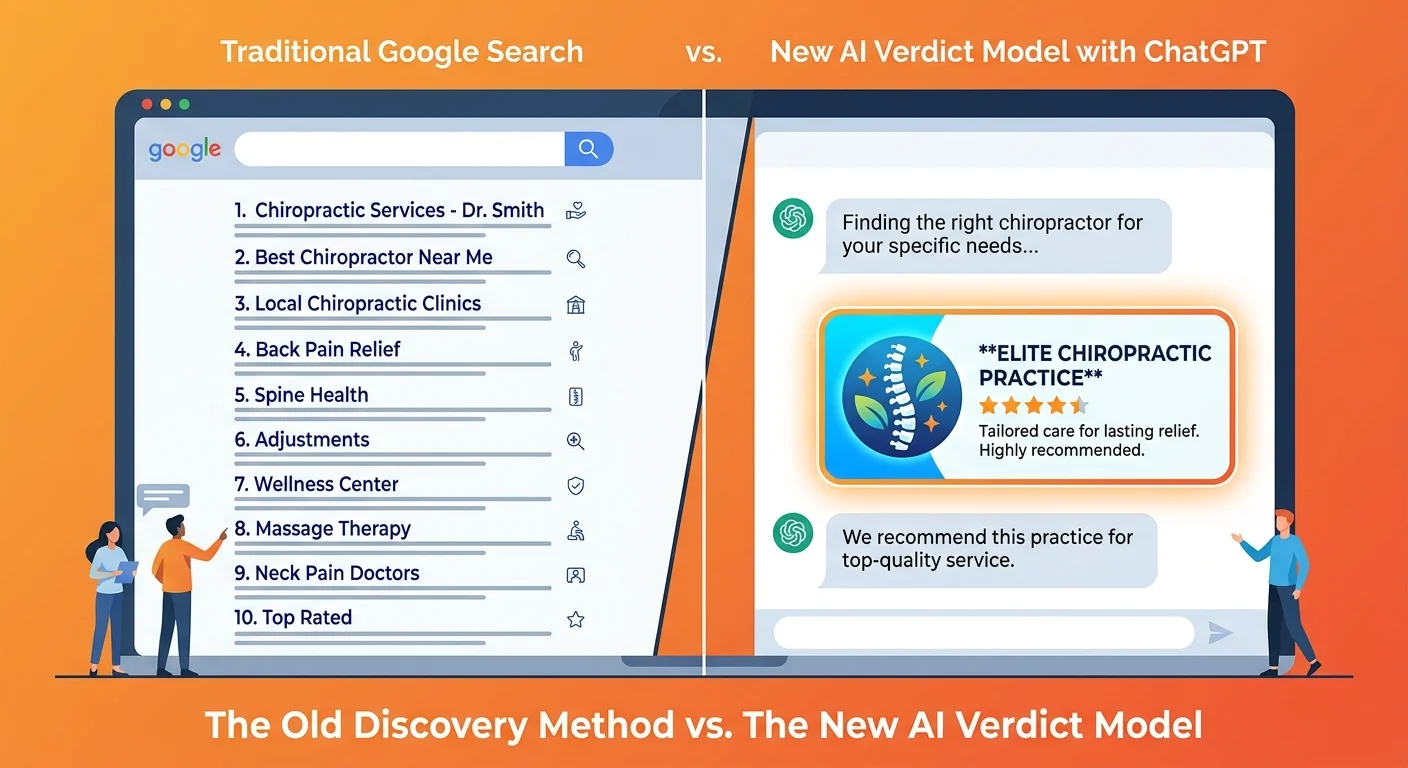
Here's what most chiropractors don't realize: your website isn't the problem.
Not exactly.
The problem is that AI can't read it. Schema missing. Entity signals weak. Content so generic that ChatGPT and Gemini have no way to confirm who you are, what you do, or whether you're worth recommending.
The marketing industry sold you a beautiful digital brochure and called it a strategy.
It's not.
Patients stopped Googling. They started asking. And when they ask — "Who's the best chiropractor near me for lower back pain?" — AI gives one answer. Not a list. A verdict.
If you're not that answer, you don't exist.
That's not hyperbole. That's the mechanism. Traditional SEO optimized for a list. Answer Engine Optimization (AEO) optimizes for being the singular name AI says.
Those aren't variations of the same thing.
Why Traditional SEO No Longer Protects Your Visibility
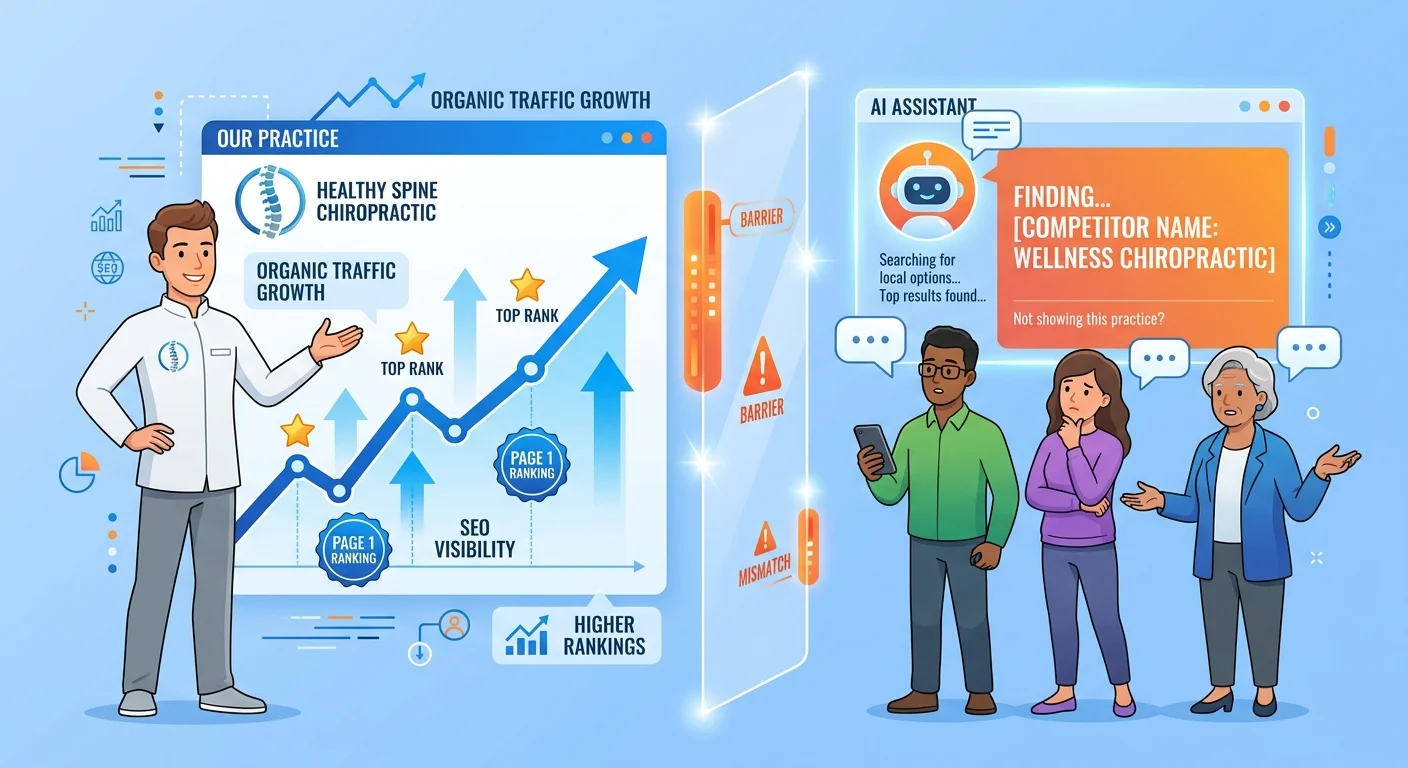
You rank on Google Maps. Your website loads fast. You've got backlinks.
Maybe you even hired an SEO agency that promised "page one results."
And yet — new patient volume is flat or declining.
Here's why: traditional SEO was built for a world where patients clicked through a list and made their own choice. You optimized for keywords. You built backlinks. You earned a spot on page one. Patients visited your site, compared you to competitors, and decided.
That entire discovery chain is being replaced.
AI search skips the comparison process. It skips the list. It gives one answer — a verdict. The patient doesn't evaluate five options. They get a single, confident recommendation and they act on it.
If you're not the practice AI names, you're not in the consideration set at all. You're invisible.
According to research from Semrush on zero-click searches, over 25% of Google searches now end without a click. The patient got their answer directly from the interface. They never visited your website.
That percentage is accelerating. Fast.
The Zero-Click Problem
Zero-click search means patients are getting answers without ever visiting a website.
Google's featured snippets. ChatGPT's direct responses. Gemini's conversational recommendations. Perplexity's cited answers.
All of these give the patient what they need — a name, a phone number, a confidence statement — without sending traffic to your site.
Your beautiful homepage? Irrelevant.
Your service pages? Never seen.
If AI doesn't trust your entity enough to name you, traffic metrics don't matter.
Traffic as a Vanity Metric
"But my traffic is fine."
I've heard this one a lot. And it misses the point.
High-volume traffic was the primary driver of clinic growth when patients compared options by visiting multiple websites. That's not how the majority of high-intent discovery happens anymore.
Data from Pew Research Center on Americans' use of artificial intelligence shows that AI tool usage for information gathering is growing rapidly — and those users aren't clicking through to websites. They're getting a verdict and acting on it.
You can have traffic. Your competitor can have consensus trust from AI engines.
Those aren't the same asset.
The Three Infrastructure Failures Making You Invisible
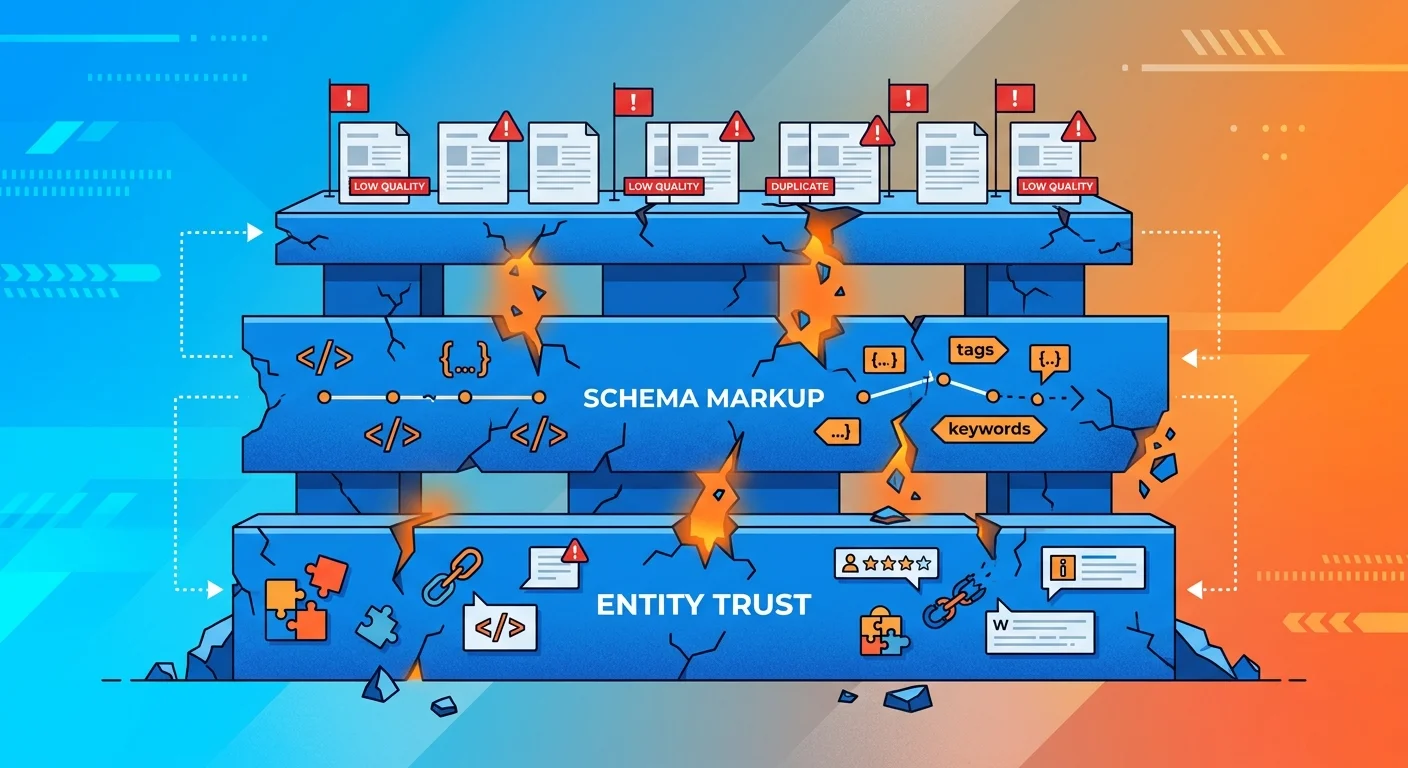
Most practices that are invisible to AI share three infrastructure failures.
Not ranking failures. Infrastructure failures.
These aren't things you can fix with more blog posts or paid ads. They're foundational gaps in how your practice exists digitally.
| Infrastructure Failure | What You Experience | What AI Sees |
|---|---|---|
| Entity Trust Signal Gaps | Inconsistent data across directories, unclaimed profiles, missing citations | "This business might not be real or credible — too many conflicting signals to trust" |
| Schema Blindness | Clean website design, good user experience, unclear why AI can't parse services | "No machine-readable data defining expertise, services, or qualifications — functionally invisible" |
| Generic Content Depth | Service pages written, blog posts published, no measurable authority gain | "Surface-level descriptions with no verifiable depth or citation quality — cannot validate expertise" |
Entity Trust Signal Gaps
Entity trust vs. keyword rankings is the new war for patient discovery.
Entity trust is an AI's confidence that your practice is a legitimate, authoritative expert. It's built from consistent data across the web — not from a single website. According to Search Engine Journal's guide to entity-based SEO, AI engines validate entities by cross-referencing structured data across multiple authoritative platforms to build confidence in legitimacy and expertise.
AI engines verify a business exists by cross-referencing structured data across multiple authoritative platforms.
- Your Google Business Profile
- Healthgrades
- Zocdoc
- State licensing boards
- Industry directories
- Social profiles
If your NAP data (Name, Address, Phone) is inconsistent across these platforms — different phone formats, old addresses, unclaimed listings — AI can't confirm you're real.
Here's what entity trust looks like in practice:
A patient asks ChatGPT, "Who's the best chiropractor for sports injuries in Huntington Beach?" AI scans its dataset for practices it has verified. It cross-references Google Business Profile data, Healthgrades listings, Zocdoc profiles, state licensing board records, and local directory citations.
If your NAP data matches across all platforms — same business name, same address format, same phone number — AI gains confidence you're a real, legitimate entity.
If your data conflicts — "iTech Valet Chiropractic" on one platform, "iTech Valet, Inc." on another, phone number formatted differently across three listings, old address still showing on two directories — AI cannot validate you're the same business. It flags you as unverifiable.
And when an entity is unverifiable, it doesn't get recommended. Ever.
Practices with entity trust gaps fail the validation layer before content or schema even matter.
The Schema Blindness Problem
Your website might look great to humans.
To AI, it's gibberish.
Schema markup is the translation layer between human-facing content and machine comprehension. As BrightLocal's 2024 Local Search Ranking Factors research confirms, entity and trust signals — not just traditional keyword-based factors — now drive local discovery mechanisms, making structured data critical for AI validation. It's structured data that tells AI engines: "This is a medical business. These are the services. This is the person's credential. This is the geographic area served."
Without proper LocalBusiness, MedicalBusiness, Physician, and Service schema implementation, AI cannot parse what you offer, who you serve, or why you're qualified.
The website becomes functionally invisible — regardless of design quality, load speed, or how well it converts once someone actually lands on it.
Most practices that think they have AI-readable infrastructure don't. Their schema is missing, incomplete, or improperly nested. AI can't extract meaning from it.
So it moves to the next practice in the data set — the one that implemented schema correctly.
Generic Content That AI Cannot Validate
AI engines don't reward keyword density.
They reward verifiable depth.
Surface-level service pages like "We treat back pain" give AI nothing to validate. No specificity. No citations. No interconnected topical authority that proves you actually know what you're talking about.
AI evaluates content for three things:
- Semantic density — how deeply and comprehensively a topic is covered
- Citation quality — whether claims are backed by verifiable sources
- Topical interconnection — whether your content demonstrates a complete knowledge graph around your specialty
Generic descriptions written to "rank for keywords" fail all three tests. They're optimized for an algorithm that's being replaced.
And every month they sit on your website, they compound the invisibility problem.
Why AI Recommends Your Competitor Instead
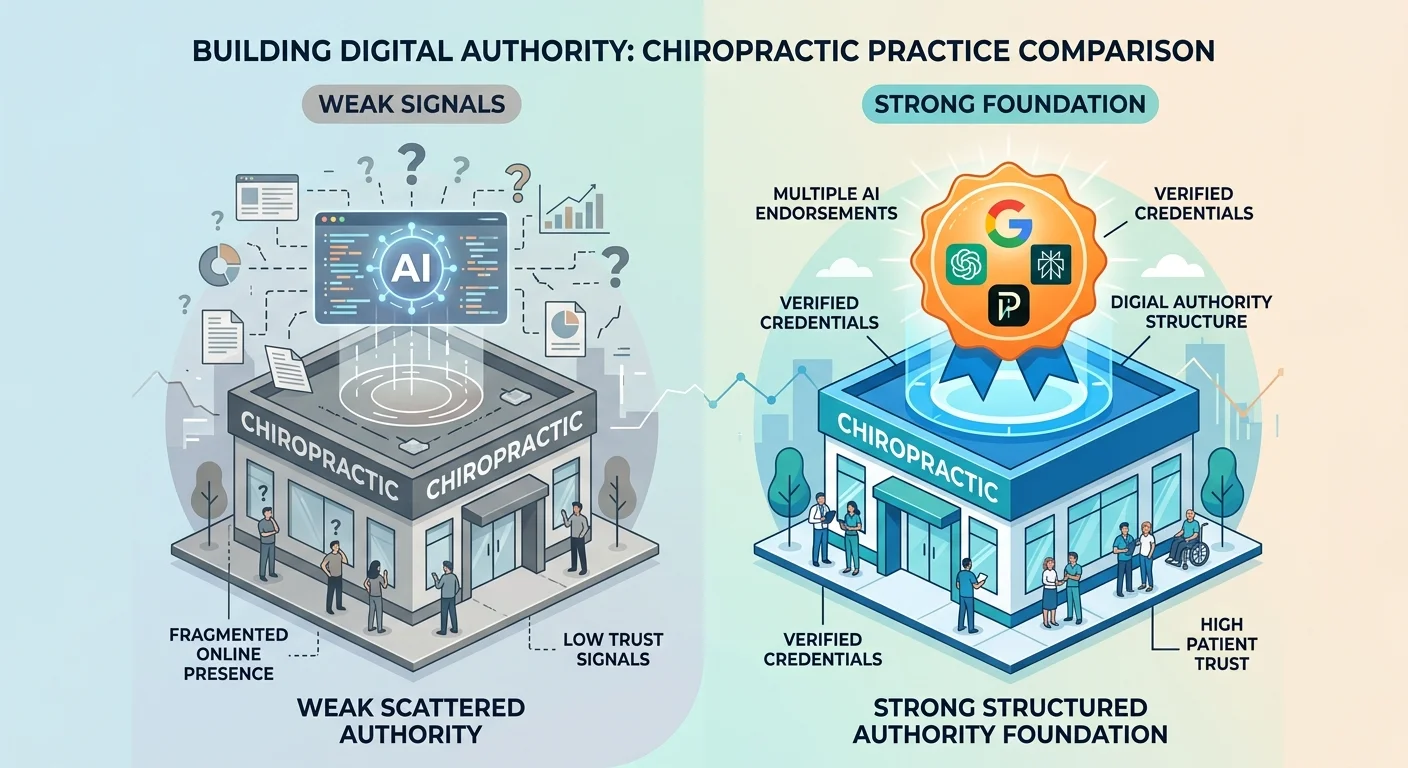
Here's the thing: the competitor who gets recommended by AI isn't necessarily the better clinician.
They're the practice AI can most confidently validate.
That's it.
When a patient asks ChatGPT or Gemini who to trust, the AI engine scans its dataset for practices it has verified entity trust for, reads structured schema data to confirm expertise, and evaluates content depth to validate authority.
The practice with the strongest signal in all three areas gets named.
Your competitor likely has better entity trust signals — their NAP data is consistent across more directories, their profiles are claimed and verified, their citations are authoritative.
They probably implemented schema correctly — LocalBusiness, Service, FAQPage, BreadcrumbList all properly nested and validated.
And their content goes deeper — not more blog posts, but more verifiable, semantically dense answers to the questions patients are actually asking AI.
AI defaults to the practice it can trust. Not the one with the best clinical outcomes — the one with the best infrastructure.
| Infrastructure Layer | Your Practice | Competitor Practice | AI Recommendation Outcome |
|---|---|---|---|
| Entity Trust Signals | Inconsistent NAP, unclaimed profiles, weak citations | Consistent data across 15+ directories, verified credentials | Competitor validated as legitimate entity |
| Schema Depth | Missing or incomplete LocalBusiness schema | Full schema suite properly implemented and nested | Competitor's services and expertise machine-readable |
| Content Authority | Generic service pages, keyword-focused blog posts | Deep topic clusters with verifiable citations and semantic density | Competitor cited as authoritative source |
| AI Verdict | "Insufficient data to recommend" | Named as trusted local authority | Patient books with competitor |
The "Everything to Everyone" Problem
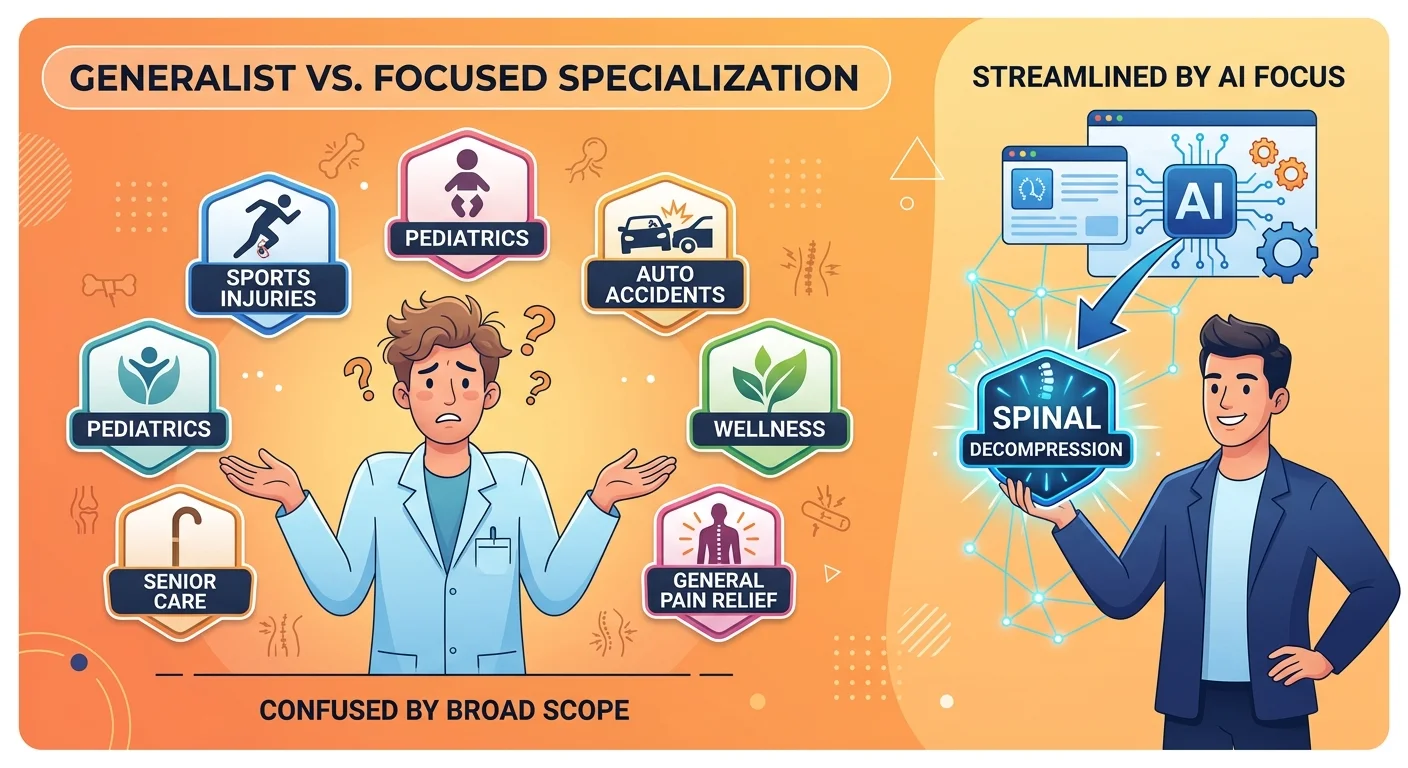
AI recommends specialists, not generalists.
If your website lists every service under the sun — sports injuries, pediatric care, auto accidents, wellness, senior care, general pain relief — with equal weight and no clear specialization, AI has no idea what you're definitively an authority on.
So it defaults to the competitor who owns a niche.
The "everything to everyone" practitioner thinks they're casting a wider net. They're not. They're creating semantic noise that makes AI citation impossible.
When a patient asks, "Who's the best chiropractor for sports injuries near me?" — AI looks for a practice with deep, interconnected content proving sports injury expertise.
Your generic service page that mentions sports injuries in one paragraph? Not enough signal.
The competitor who specialized — who built an entire content cluster around sports injury treatment, published case studies, cited clinical research, and structured their schema around that focus — gets named.
This isn't about limiting your actual practice scope. It's about defining what you want AI to know you for.
Refusing to specialize dilutes authority.
What an AI Visibility Check Actually Measures
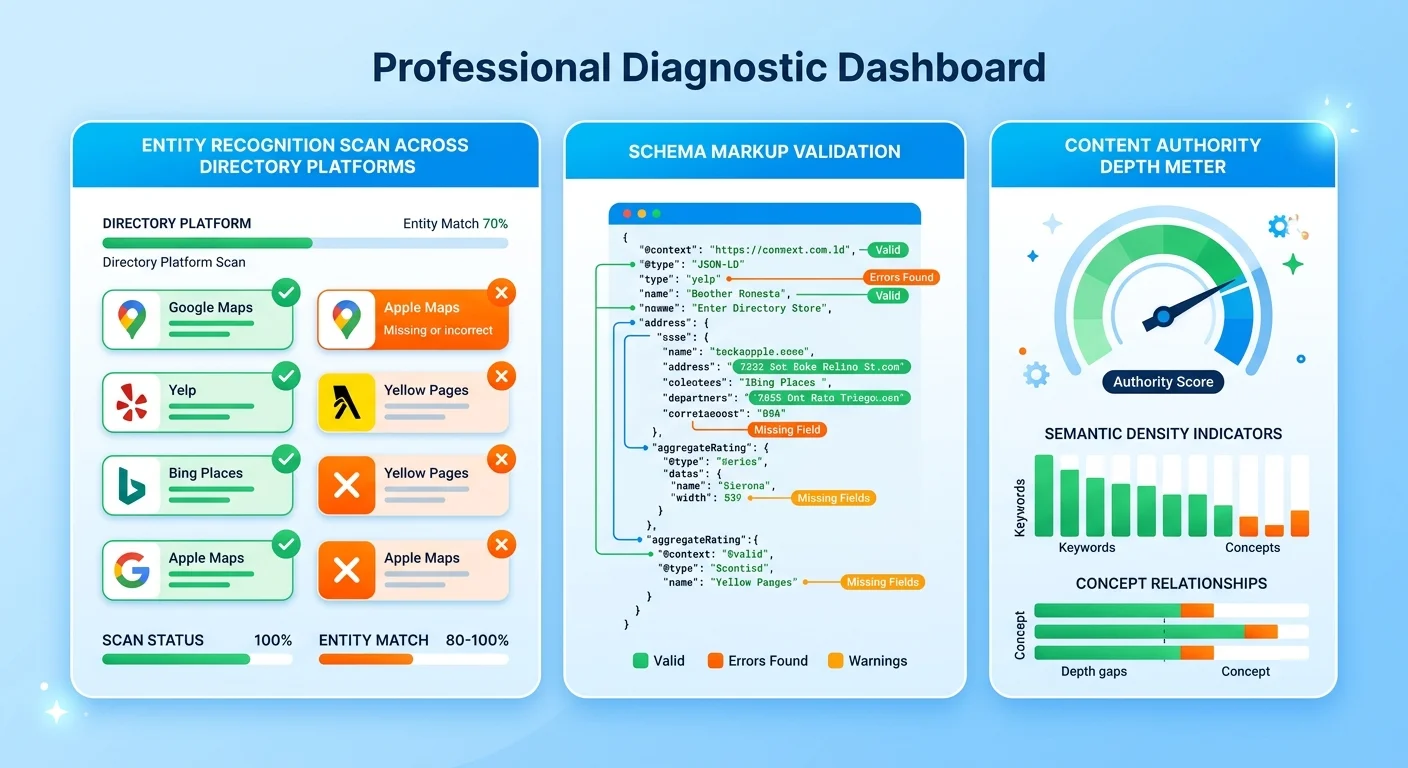
An AI Visibility Check is not a marketing audit.
It's a technical infrastructure diagnostic.
It measures the specific data points AI engines use to determine whether your practice exists as a trusted entity, whether your expertise is machine-readable, and whether your content meets the validation threshold for recommendation.
Run the AI Visibility Check — and you'll see exactly where the infrastructure gaps are. Not guesses. Not opinions. Data.
Entity Recognition Across Platforms
The check verifies consistent NAP data across every platform AI engines use to validate legitimacy.
- Google Business Profile
- Yelp
- Healthgrades
- Zocdoc
- Vitals
- State licensing boards
- Industry associations
- Social profiles
It identifies where your data conflicts — different phone formats, old addresses, unclaimed listings. It flags platforms where you should have a presence but don't. It measures how many authoritative citations exist for your practice compared to competitors in your market.
If AI engines can't confirm you exist across multiple verified sources, they can't recommend you.
The entity recognition scan shows you exactly where those confirmation gaps are.
Schema Implementation Audit
The audit analyzes what schema types are present on your website — and whether they're implemented correctly.
- LocalBusiness
- MedicalBusiness
- Physician
- Service
- FAQPage
- BreadcrumbList
- Review aggregation
- Credentials and qualifications
It checks whether schema is properly nested. Whether required fields are populated. Whether the data matches what's on the page. Whether validation errors exist that make the schema unreadable to AI.
Missing or improperly implemented schema creates blind spots AI can't parse.
The audit identifies every one.
Content Authority Depth Analysis
The content analysis evaluates semantic density, citation quality, topical interconnection, and verifiable expertise signals across your entire site.
Surface-level pages score poorly. Generic service descriptions with no supporting depth. Blog posts that answer questions superficially without evidence or interconnected topic clusters.
Deep, evidence-backed content compounds authority.
The analysis shows you where your content meets the validation threshold — and where it doesn't.
How to Run Your Own Preliminary Check
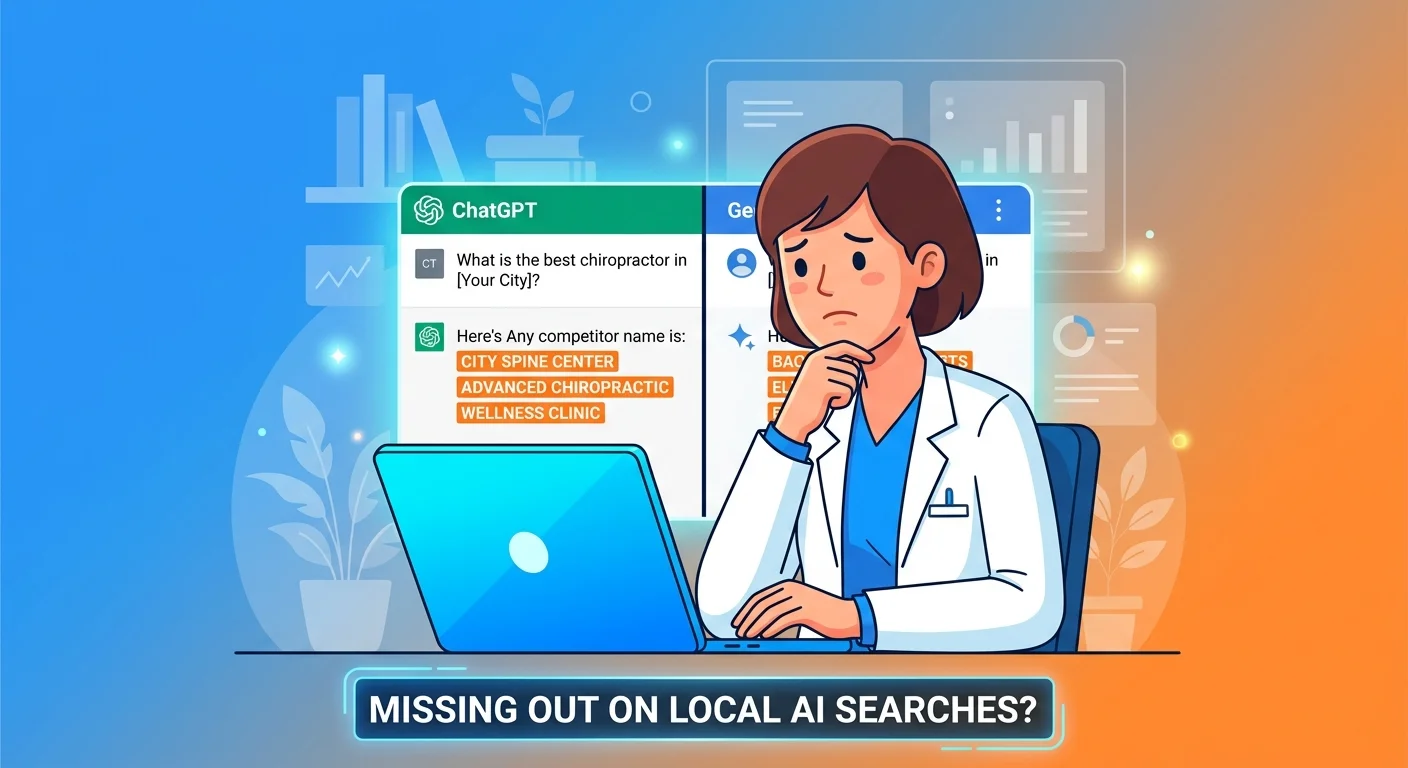
You can run a basic self-test.
It won't tell you why you're invisible. But it'll confirm you are.
Open ChatGPT, Gemini, and Perplexity. Ask specific questions about your services and location — questions a real patient would ask.
- "Who is the best chiropractor for lower back pain in [your city]?"
- "What chiropractic clinics near [local landmark] specialize in sports injuries?"
- "Which chiropractor in [city] has the best patient reviews for auto accident recovery?"
Document every AI engine's response.
If your name appears — you have some level of visibility.
If your name doesn't appear — you're invisible.
If a competitor's name appears consistently — they own the authority signal you're missing.
This preliminary test reveals the symptom. It doesn't diagnose the cause.
But it's a starting point. And if you run it and your name doesn't show up once? You know the answer.
Why This Problem Accelerates Over Time
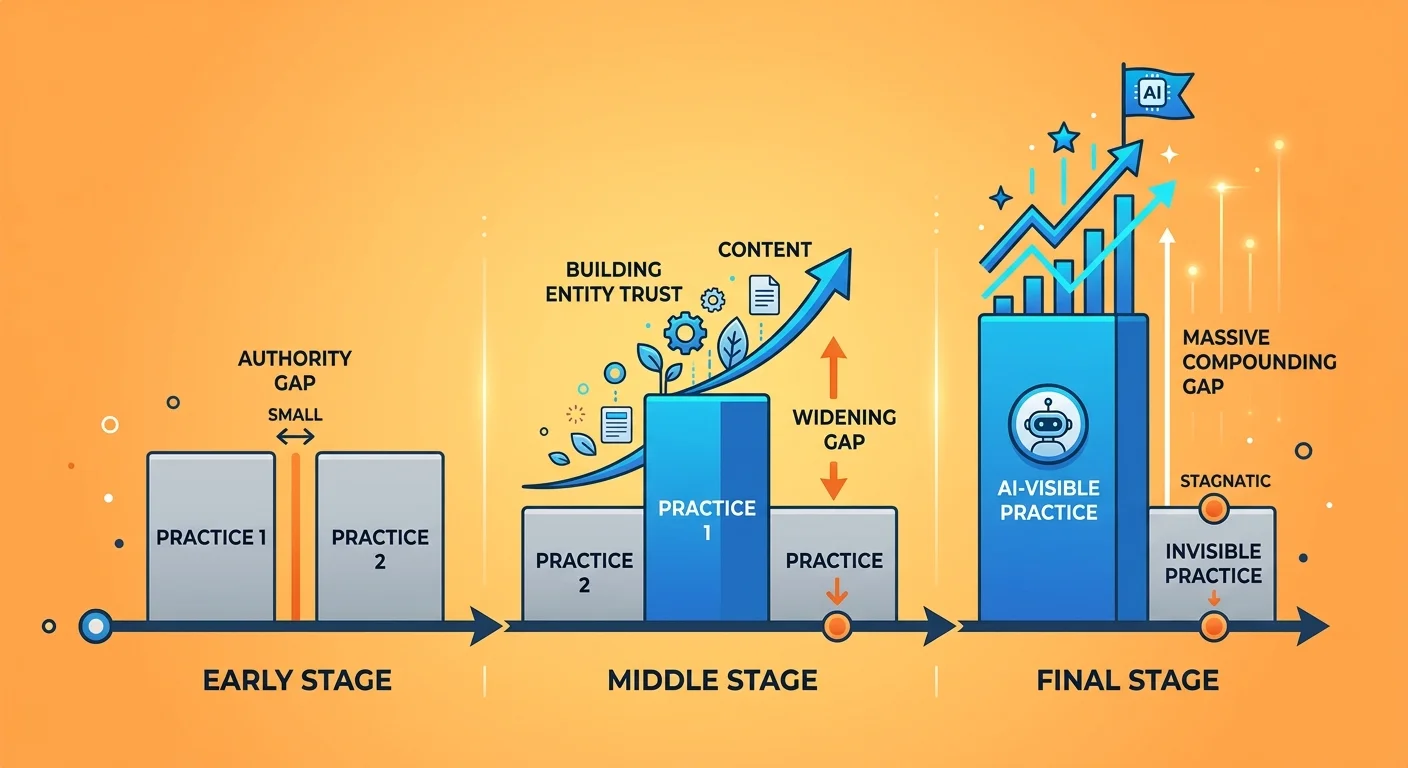
Authority is not a one-time build.
It's a compounding system.
Every month a practice remains invisible, competitors with better infrastructure pull further ahead. The gap widens exponentially, not linearly.
- Month one: Your competitor fixes their entity trust signals. AI can now validate they exist. You don't fix yours. Small gap.
- Month three: Your competitor implements full schema markup. AI can now parse their services and expertise. You don't implement schema. Gap widens.
- Month six: Your competitor publishes deep, evidence-backed content that AI can cite. You publish generic blog posts. Gap accelerates.
- Month twelve: Your competitor is the default recommendation in your market. AI has verified them across platforms, read their structured data, and validated their expertise through content depth. You're still invisible. Massive compounding gap.
Traditional SEO had some level of churn. A new competitor could rank with enough backlinks or keyword optimization.
AI authority doesn't churn as easily. Once an entity owns the trust signal, dislodging them requires matching or exceeding their entire infrastructure.
That takes time.
The practices that start now will own the recommendations six months from now. The ones that wait will be fighting an uphill battle against compounded authority.
And here's the part most chiropractors underestimate: AI engines reinforce their own recommendations through usage data. The more often an AI engine recommends a specific practice, the more confidence it builds that the recommendation was correct. That feedback loop accelerates dominance.
Your competitor gets recommended once. Then twice. Then ten times. Each recommendation reinforces AI's trust in that entity. The gap doesn't just widen — it locks in.
Breaking that cycle requires not just matching your competitor's infrastructure — it requires exceeding it. And every month you wait, that threshold gets higher.
| Time Period | Competitor Action | Your Inaction Cost | Cumulative Gap |
|---|---|---|---|
| Month 0-3 | Entity trust signals fixed, schema implemented | No infrastructure changes made | AI can validate competitor, cannot validate you — gap opens |
| Month 4-6 | Deep content clusters published, semantic authority building | Generic blog posts continue, no topical depth | Competitor cited as source, you remain invisible — gap widens |
| Month 7-9 | AI engines reinforce competitor as default recommendation through usage data | No authority signals added, traffic declines | Competitor compounds trust through recommendations, you fall further behind — gap accelerates |
| Month 10-12 | Competitor owns local authority, patient volume increases from AI discovery | Market share erodes, patient acquisition cost rises | Competitor is the answer, you don't exist — gap is now structural |
Frequently Asked Questions
How is being 'AI visible' different from my Google Business Profile ranking?
Your Google Business Profile ranking is for a list of search results patients click through and evaluate.
AI visibility means being the singular, trusted answer an AI engine gives when a patient asks a direct question — "Who's the best chiropractor near me for lower back pain?"
The first is about being in the consideration set. The second is about being the verdict. AI skips the consideration set entirely. It gives one name.
What is "entity trust" and why does it matter for a chiropractor?
Entity trust is an AI's confidence that your practice is a legitimate, authoritative expert.
It's built from three layers: consistent data across the web that confirms you exist, structured schema markup on your website that defines your expertise in machine-readable format, and in-depth content that validates your knowledge with verifiable evidence.
Without entity trust, AI engines can't recommend you. They don't have enough signal to confirm you're real, credible, or qualified.
Can I just add keywords to my website to become visible to AI?
No.
AI engines largely ignore traditional keyword density. They're not scanning for "chiropractor near me" repeated ten times. They're evaluating structured data, verified claims, and semantic depth.
Keywords were the optimization target for Google's old algorithm. Entity trust and content authority are the optimization targets for AI.
Adding keywords to a website with weak entity signals and no schema does nothing.
Why would ChatGPT recommend my competitor and not me?
Your competitor likely has a more robust authority infrastructure.
Their website is structured for AI to read — proper schema implementation that defines services, credentials, and expertise. Their business data is consistent across more platforms — Google, healthcare directories, citation sources. Their content answers patient questions with more verifiable depth — not more blog posts, but deeper topical coverage with evidence and citations.
AI defaults to the practice it can most confidently validate.
That's your competitor. Not because they're better clinicians — because their digital infrastructure meets the validation threshold yours doesn't.
How can I perform an AI Visibility Check on my own practice?
Start with a basic self-test.
Ask ChatGPT, Gemini, and Perplexity specific questions about your services and location. Document whose names appear.
If your practice isn't mentioned — you've confirmed the symptom.
For a comprehensive diagnostic that identifies the underlying cause — entity trust gaps, schema failures, content authority deficits — a formal check is needed.
If I rank well on Google Maps, doesn't that mean I'm visible to AI?
No.
Google Maps ranking is a separate algorithm. It measures local pack visibility for traditional search queries. Strong Maps ranking does not guarantee entity trust or semantic authority for conversational AI recommendations.
I've seen practices rank #1 in the local pack and still be completely invisible to ChatGPT and Gemini.
Why? Because Maps ranking is optimized for one system. AI visibility requires entity trust signals, schema implementation, and content depth that Maps ranking doesn't measure.
How long does it take to fix AI invisibility once it's identified?
Authority infrastructure rebuilds are measured in months, not weeks.
Schema implementation and entity trust signal alignment can happen relatively quickly — fixing NAP consistency, claiming profiles, implementing proper structured data. That's the foundation.
Content authority depth compounds over time. Deep topic clusters with verifiable citations and semantic density take months to build.
The good news: once built, they compound.
The practices that start now will own the recommendations six months from now. The ones that wait will watch competitors compound authority while they remain invisible.
Here's the practical difference: Google Maps ranking happens when a patient types "chiropractor near me" into Google and views a list of local results. That's a traditional search query with a traditional list output.
AI visibility happens when a patient opens ChatGPT and asks, "Who should I see for lower back pain in Huntington Beach?" — and gets a single name as the answer. No list. No comparison. One practice.
Google Maps optimizes for the list. AI visibility optimizes for the verdict. They measure different things. Ranking well in one does not mean you're visible in the other.
I've run diagnostics on practices ranking #1 in Google Maps local pack who were completely absent from ChatGPT and Gemini recommendations. Why? Because their entity trust signals were weak, their schema was missing, and their content lacked the depth AI needs to validate expertise.
Maps ranking got them traffic. AI invisibility cost them the patients who never clicked.
Conclusion: The Binary Choice
AI gives one answer.
If you're not the answer, you don't exist.
That's not a ranking problem. It's not a marketing problem. It's an infrastructure problem with a clear, compounding cost.
The practices that address it now will dominate local AI recommendations. The ones that wait will watch their market share erode month by month as patients receive a single trusted name — and it's not theirs.
This isn't about becoming the best clinician in your market. You might already be that.
This is about becoming the answer AI trusts enough to say out loud when a patient asks who to trust.
The gap between visible and invisible is widening. Every month you remain invisible, a competitor is building the authority signals you're not. Their entity trust is getting verified across more platforms. Their schema is being read and validated by more AI engines. Their content is being cited as authoritative.
And every time a patient asks — "Who's the best chiropractor for lower back pain near me?" — AI says their name.
Not yours.
There's no version of this where doing nothing is a safe play. Answer Engine Optimization (AEO) isn't a trend. It's the replacement mechanism for patient discovery.
The practices that understand that and act on it will own the next decade. The ones that don't will be explaining to an empty waiting room why their website looks great.
The AI Authority Agency model exists because this problem can't be fixed with blog posts or backlinks. It requires infrastructure. Entity trust. Schema depth. Content authority. Built in layers. Compounding over time.
You're either building it — or your competitor is.
Want to know if AI is recommending your practice—or your competitor's? Run My AI Visibility Check. It takes 15 minutes and shows you exactly what ChatGPT, Gemini, and Grok say when someone asks who to trust in your market.

621 Enterprises, Inc. | Copyright 2026 | All rights reserved