
Why AI Can't Read Your Website: The Schema Problem That Makes You Invisible
Missing schema markup is the reason AI answer engines like ChatGPT, Gemini, and Grok cannot understand or recommend your chiropractic practice. Schema is structured data that tells AI engines what services you offer, where you're located, what conditions you treat, and what credentials you hold. Without it, your website is just unstructured text — a digital brochure that machines can read but cannot interpret.
When a patient asks ChatGPT "Who's the best chiropractor near me for sports injuries?" the AI engine doesn't evaluate websites based on design quality or keyword density. It evaluates them based on structured entity signals. It looks for machine-readable data that confirms you are a verified medical business, that you specialize in sports injury treatment, that you operate in the patient's geographic area, and that other trusted sources validate your expertise. If those signals are missing, the AI cannot verify your authority. It will not recommend you. It will recommend the competitor whose website provides those signals clearly.
This is not an aesthetic problem. This is not a content problem. This is a structural problem. Your website may be visually impressive, optimized for traditional SEO, and filled with patient testimonials. But if the underlying code does not communicate your expertise in a format AI engines can parse, you are invisible. The gap between what humans read and what machines trust is where most chiropractic practices lose the AI recommendation war. Schema markup closes that gap by translating clinical expertise into machine-verifiable facts. Without it, you're not even in the conversation.
Last Updated: May 11, 2026
- • The Digital Brochure Problem
- • What Schema Markup Actually Is
- • Why Your Web Designer Didn't Build It
- • The AI Entity Trust Model
- • Essential Schema Types for Chiropractors
- • The Templated Website Trap
- • How to Diagnose Missing Schema
- • FAQ
- • Does schema guarantee AI will recommend me?
- • Why didn't my web designer implement schema correctly?
- • How can I test my website for schema errors for free?
- • What are the most important schema types for a chiropractor?
- • What happens if I ignore schema markup?
- • Can I just add schema to my existing website?
- • What's the difference between schema and traditional SEO?
- • Conclusion
The Digital Brochure Problem
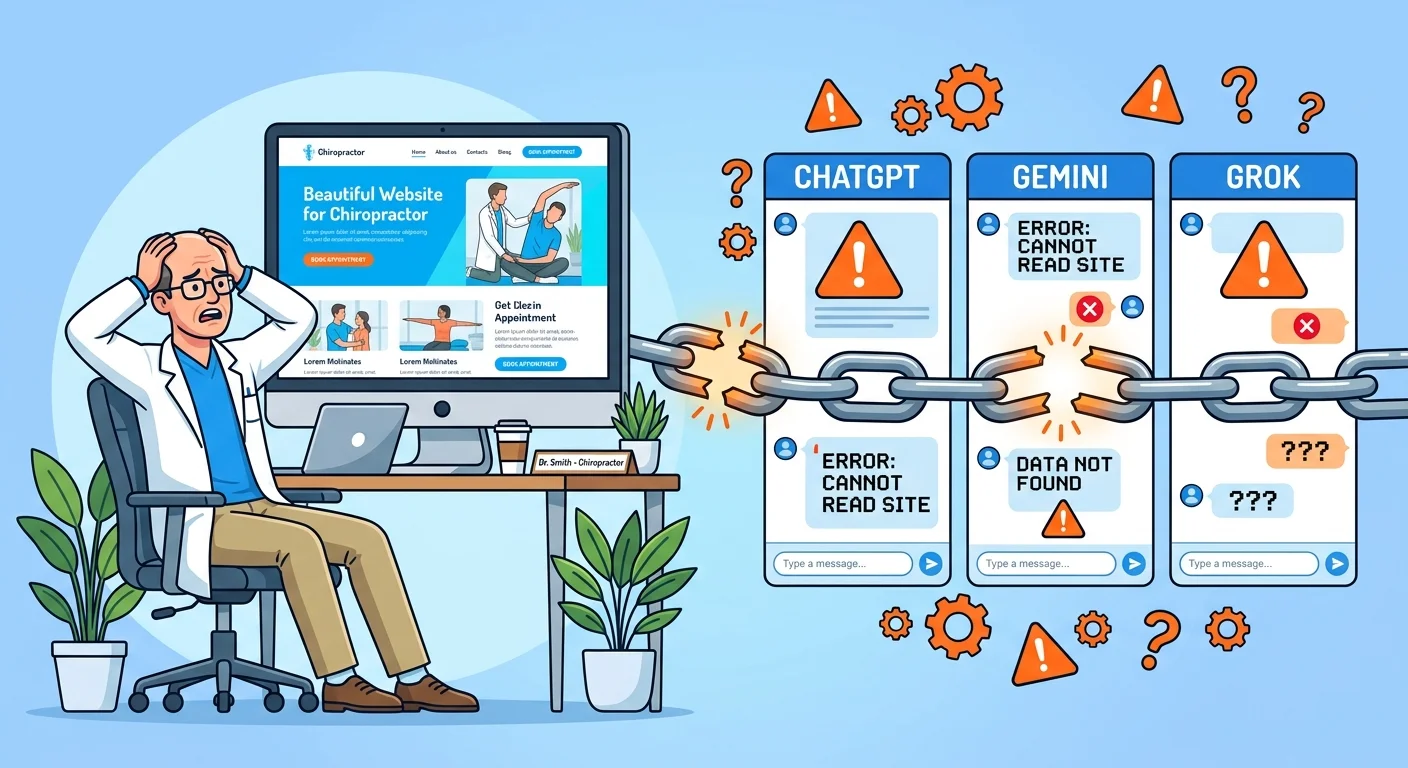
Here's what most chiropractors don't realize: your website isn't the problem.
The problem is that AI can't read it.
You paid for a beautiful site. Clean design. Professional photos. Patient testimonials. Service pages that look great on mobile. The agency told you this was what patients wanted. They were half right. Patients see all of that. AI sees unstructured text it can't parse into authority signals.
The marketing industry sold you a beautiful digital brochure and called it a strategy.
It's not.
Why Pretty Websites Fail in the AI Era
Traditional web design optimizes for human visitors. Visual hierarchy. Clear navigation. Compelling copy. High-quality images. All of that matters to the person scrolling your homepage.
None of it matters to ChatGPT.
AI doesn't evaluate sites the way humans do. It doesn't care if your hero image is stunning. It doesn't parse testimonials for emotional resonance. It looks for structured entity signals — machine-readable data confirming who you are, what you specialize in, where you operate, and whether trusted sources validate your expertise.
If those signals are missing, AI moves on.
It doesn't rank you lower. It doesn't put you on page two. It skips you. Your competitor — the one whose site might actually look worse — gets recommended because their infrastructure speaks the language AI understands.
That language is schema. And if your web designer didn't build it in from the ground up, you're invisible.
The Betrayal by Template Builders
Here's how you got here.
Most chiropractors didn't build their sites from scratch. They used Wix. Squarespace. A WordPress theme from ThemeForest. Maybe a "done-for-you" agency using one of those tools under the hood. These platforms sold themselves as professional solutions. Drag-and-drop simplicity. No coding required. Hundreds of beautiful templates.
Here's what they didn't tell you: those templates were built for visual appeal, not machine trust.
Template builders include basic schema at best — just enough to technically "have" structured data without creating authority signals. They'll mark up your business name and address. Maybe your phone number. But they won't customize for medical specialties. They won't structure service offerings by condition. They won't build the granular entity signals that tell AI you're a verified expert in sports injury treatment or pediatric care.
Why?
Because templates are built for everyone. A chiropractor. A dentist. A lawyer. A plumber. One-size-fits-all tools create one-size-fits-all results. And in the AI recommendation war, generic is invisible.
Google's documentation calls schema "a way to help search engines understand your content." That's the sanitized version. The real version: schema is the difference between being a website and being an entity AI trusts enough to recommend.
You were sold a commodity tool. The result is a commodity outcome.
AI doesn't recommend commodity. It recommends specificity.
What Schema Markup Actually Is
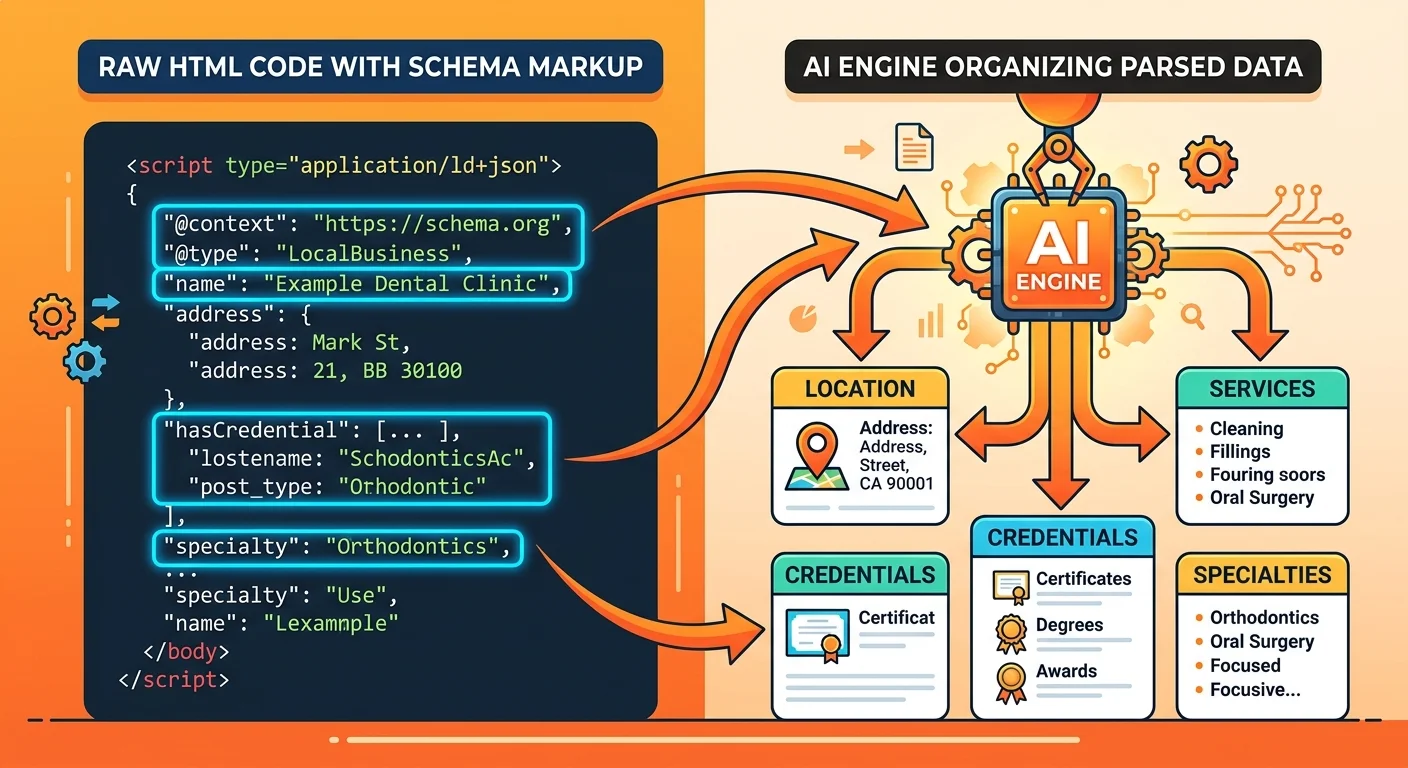
Schema is a vocabulary — a standardized language that tells machines what your content means, not just what it says.
It's structured data embedded in your site's code, invisible to human visitors but critical for AI. The format is JSON-LD (JavaScript Object Notation for Linked Data). It wraps your content in machine-readable tags that define relationships, categories, and attributes.
Here's the difference:
- What humans see: "We specialize in sports injury treatment, chronic pain management, and pediatric chiropractic care."
- What AI sees without schema: A sentence. Text. No verifiable structure. No way to confirm this is a medical service claim from a licensed provider.
- What AI sees with schema: Three distinct
Serviceentries, each tagged withMedicalSpecialtyproperties, linked to aMedicalBusinessentity withChiropracticcredentials, validated by consistentPostalAddressandareaServedsignals.
That's the gap. Schema translates expertise into facts AI can verify.
| What Humans See | What AI Sees Without Schema | What AI Sees With Schema |
|---|---|---|
| "Sports injury specialist" | Generic keyword phrase | Verified MedicalSpecialty property linked to licensed Physician entity |
| Office address in footer | Unstructured text | PostalAddress schema with geo-coordinates, validated against external citations |
| List of services on page | Bullet points | Structured Service types with offers, provider, and areaServed properties |
| Patient testimonials | Quotes with names | Review schema with reviewRating and author validation |
| FAQ section | Q&A text blocks | FAQPage schema with machine-readable question-answer pairs |
The Schema.org documentation defines this as "a collaborative, community activity with a mission to create, maintain, and promote schemas for structured data on the Internet." It's the universal vocabulary AI uses to understand entities.
And if you're not speaking it, you're not in the conversation.
The Entity Signal Framework
Schema doesn't exist in isolation. It builds layers.
At the foundation, MedicalBusiness schema establishes baseline trust. It tells AI you're a healthcare provider, not a blog or directory listing. That's the root entity.
Next layer: Chiropractic as a specialty. This narrows your authority from "healthcare provider" to "verified chiropractic practice." It's the first filter AI uses when someone asks a condition-specific question.
Third layer: Service schema. Each service gets its own structured entry. Sports injury treatment. Chronic pain management. Pediatric care. Prenatal chiropractic. Every condition becomes a machine-readable expertise signal. AI doesn't have to infer what you treat from paragraph text — it reads it directly from structured data.
Fourth layer: Social proof. Review schema for patient feedback. FAQPage schema for educational content. Each layer compounds. The more specific and interconnected your schema, the more confidence AI has in recommending you.
This is what Entity Trust is built on. Not keywords. Not backlinks. Structured entity signals AI can verify, cross-reference, and trust.
Why Your Web Designer Didn't Build It
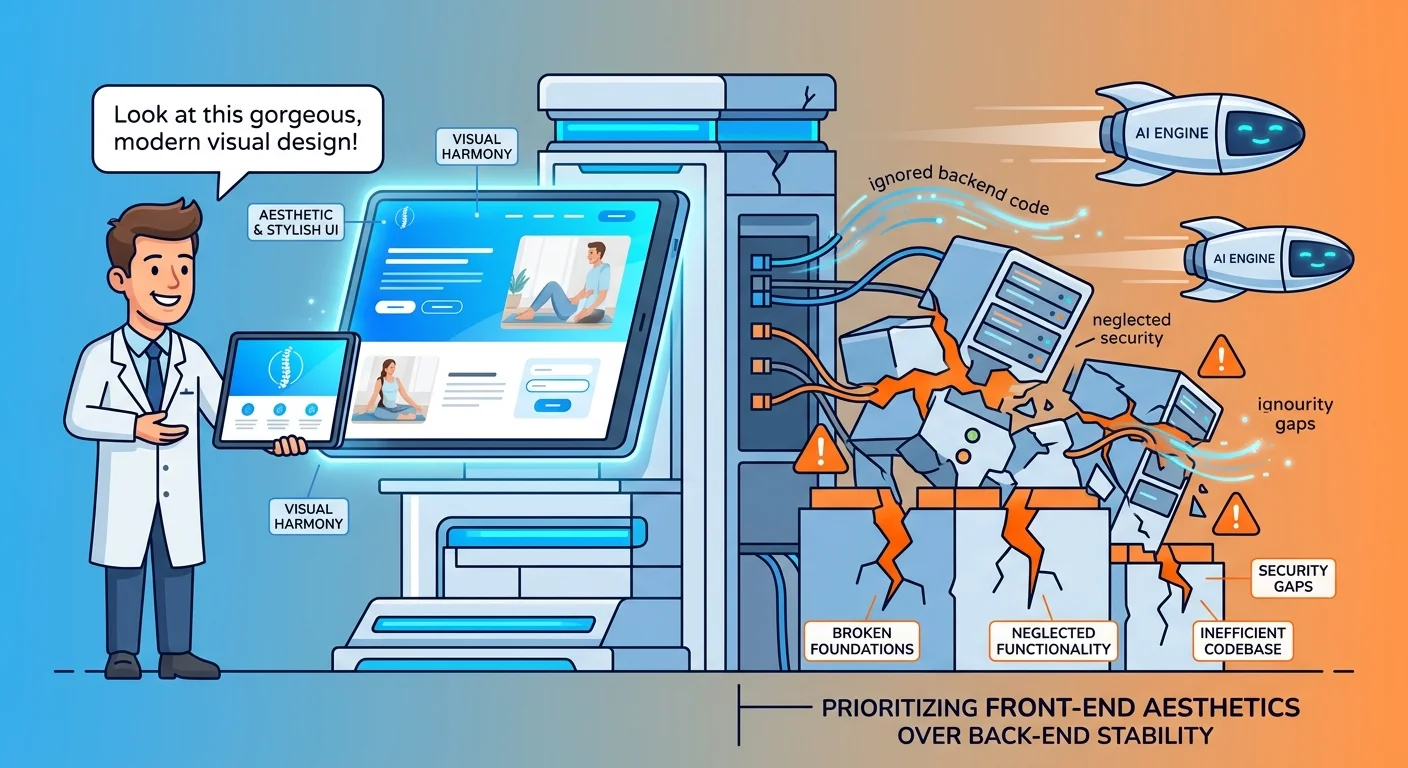
Your web designer didn't skip schema because they were lazy or incompetent.
They skipped it because they were trained to optimize for a world that no longer exists.
Traditional web design education prioritizes visual hierarchy, user experience, and conversion optimization. Designers learn color theory. Typography. How to guide a visitor's eye down the page. How to place a CTA button for maximum clicks. These are real skills. They matter to human visitors.
But they have nothing to do with whether AI trusts your practice enough to recommend it.
Schema is treated as an afterthought SEO task — something a plugin handles or a developer adds at the end if there's budget left. Most designers don't understand entity trust models. They weren't trained for AI answer engines. They were trained for Google's old algorithm, back when ranking on page one was the goal.
Answer Engine Optimization (AEO) is a different discipline. It's not about making your site look good to humans. It's about making your authority verifiable to machines. That requires rethinking the entire build process — starting with infrastructure, not design.
The SEO Agency Gap
Even agencies that claim to be "SEO experts" miss this.
Here's what they do: install Yoast or RankMath. Enable the schema toggle. The plugin auto-generates basic LocalBusiness markup from your business name and address. Check the box. Call it done.
Here's what they don't do: customize that schema for medical specialties. Structure individual service offerings. Add MedicalSpecialty properties. Link practitioner credentials to each service. Build FAQ schema that turns your content into citation-ready Q&A pairs. Validate consistency between your schema and external directory listings.
That's the gap. Between having schema and having authority schema.
Most SEO agencies are still optimizing for traditional search rankings — keyword density, title tags, backlinks, page speed. Those tactics were built for Google's old algorithm, where the goal was to rank in a list of ten blue links. Search Engine Journal's guide to schema markup explains the technical implementation well. What it doesn't address is the strategic difference between checkbox schema and entity-verifying schema.
AI doesn't rank you in a list. It names you as the answer — or it doesn't.
And the practices that get named are the ones whose infrastructure speaks the language AI trusts.
The AI Entity Trust Model
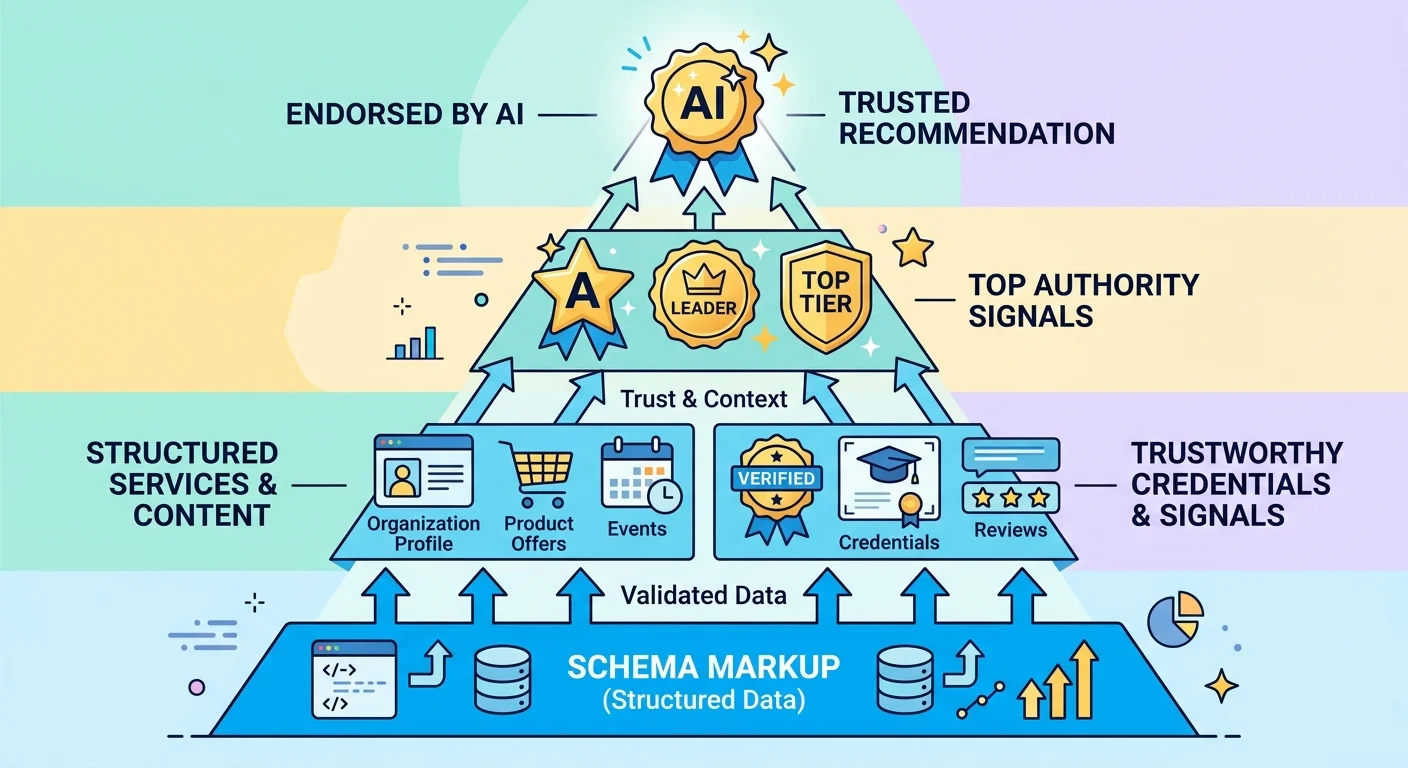
Here's the part most practices miss: AI doesn't evaluate your site the way Google did. It verifies you the way a medical board does. Schema is the evidence file. No file, no recommendation.
When ChatGPT or Gemini evaluates whether to recommend your practice, it's running a trust algorithm. First signal: your site's schema. Does it clearly state what entity you are? What services you offer? Where you operate? What credentials you hold?
Second signal: external validation. Do trusted directories — Zocdoc, Healthgrades, Google Business Profile — list the same business name, address, and services? Is the data consistent?
Third signal: social proof. Do you have structured reviews? Educational content in FAQ format? Patient testimonials AI can parse as validation?
The engine cross-references all of this. If your schema says you specialize in sports injury treatment, but no directory mentions that specialty, the trust score drops. If your address on your site doesn't match your address on Google, the trust score drops. If you claim expertise but have no structured content proving depth, the trust score drops.
This is why citation management alone isn't enough.
You can have perfect NAP consistency across fifty directories, but if your site doesn't provide the schema framework that tells AI what to verify, those citations don't compound into authority. They're just noise.
| Schema Type | What It Validates | Why AI Uses It |
|---|---|---|
MedicalBusiness |
Entity classification | Confirms you're a healthcare provider, not a blog or aggregator |
Chiropractic |
Medical specialty | Narrows authority from general healthcare to verified chiropractic expertise |
Service (per condition) |
Specific expertise areas | Validates condition-specific claims (e.g., "sports injury treatment") |
PostalAddress + geo-coordinates |
Geographic service area | Determines local relevance for "near me" queries |
Review |
Patient feedback validation | Social proof that other patients trust this provider |
FAQPage |
Content depth and expertise | Proves knowledge by structuring educational Q&A content |
According to BrightEdge's explanation of entity SEO, "entities are how search engines understand the relationships between people, places, and things." That understanding is built on schema. The more granular and interconnected your structured data, the higher your entity trust score.
And when AI recommendations are determined by that trust score, the practices with the strongest schema win.
Location Verification
Geographic targeting isn't just about listing your city name in a paragraph. It's about structured location signals.
PostalAddress schema confirms your geographic service area at the entity level. Geo-coordinates validate your physical location. openingHours schema confirms operational status. All of this tells AI: this is a real, active business that serves this specific area.
When someone asks "Who's the best chiropractor near me?" AI doesn't search for the phrase "near me" on your site. It evaluates whether your structured location data matches the searcher's location.
If your schema doesn't include geo-coordinates or doesn't specify areaServed, you're not in the filter. You're not even being considered.
This is the difference between being visible in a general search and being recommended as a local authority. The latter requires location schema AI can parse, verify, and trust.
Essential Schema Types for Chiropractors
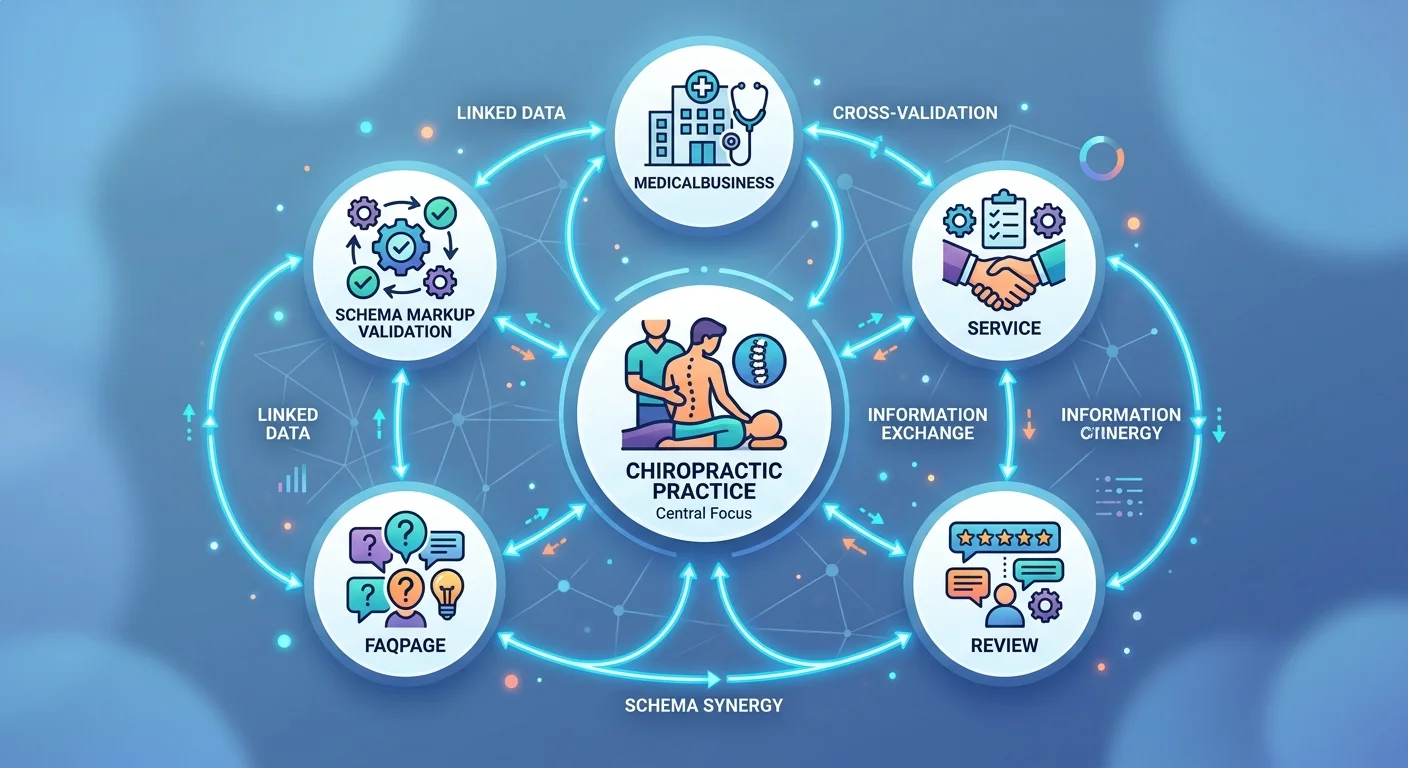
Not all schema is created equal. Some types validate your existence. Others validate your authority.
For a chiropractic practice, the minimum schema stack looks like this:
- MedicalBusiness — Root entity type. Tells AI you're a healthcare provider.
- Chiropractic — Specialty designation. Narrows your authority from general medical to verified chiropractic expertise.
- Physician — Practitioner credentials. Links your name, license, and qualifications to the business entity.
- Service — Individual service offerings. One entry per condition or treatment type. Each with its own
ServiceType,provider, andareaServedproperties. - Review — Patient feedback. Structured testimonials with ratings and author validation.
- FAQPage — Educational content. Q&A pairs that prove expertise depth and become citation opportunities.
Miss any of these, and you're building on an incomplete foundation. AI won't reject you outright — it just won't have enough signals to trust you over a competitor whose infrastructure is complete.
| Schema Type | Required Properties | Impact on AI Visibility |
|---|---|---|
MedicalBusiness |
@type, name, url, address, telephone |
Baseline entity classification — without this, AI doesn't recognize you as a healthcare provider |
Chiropractic |
medicalSpecialty property within MedicalBusiness |
Specialty verification — distinguishes you from general practitioners |
Physician |
name, medicalSpecialty, alumniOf, worksFor |
Practitioner-level authority — links credentials to the business entity |
Service |
serviceType, provider, areaServed, offers |
Condition-specific expertise — each service is a separate authority signal |
Review |
reviewRating, reviewBody, author, datePublished |
Social proof validation — proves patients trust this provider |
FAQPage |
mainEntity array with Question and Answer pairs |
Content depth signal — structured educational content AI can cite directly |
The Yoast guide to local business schema covers the technical implementation of these types. What it doesn't address is the strategic layering — how each schema type validates the next, creating a compound authority signal AI uses to determine trust.
Service Schema Architecture
Here's where most practices go wrong: they list all their services in one paragraph and call it a service page.
AI can't parse that. It sees text. It doesn't see structured expertise.
Service schema requires granularity. One Service entry per condition you treat. Each entry includes:
serviceType— The specific condition or treatment (e.g., "Sports Injury Chiropractic Care")provider— A reference to yourPhysicianschema, linking the service to your credentialsareaServed— Geographic targeting for that specific serviceoffers— Pricing or availability details (optional but adds validation)
This is how AI understands you don't just "do chiropractic." You specialize in sports injuries. You treat chronic pain. You work with pediatric patients. Each service becomes its own authority signal.
The practices that structure this properly get cited when someone asks a condition-specific question. The ones that lump everything into a paragraph get passed over.
FAQ Schema for Authority
FAQPage schema is one of the most underutilized authority tools in chiropractic marketing.
Here's why it matters: when you structure your educational content as Q&A pairs, AI can extract those pairs and present them as direct answers. Your FAQ content becomes citation-ready without additional formatting.
Each Question and Answer pair in your schema is a verification point. It proves you've addressed patient concerns in depth. It demonstrates expertise on specific topics. It gives AI machine-readable content it can trust and recommend.
Most practices bury FAQ content in long paragraphs with no structure. AI reads it as text. FAQPage schema turns that text into a database AI can query.
That's the difference between being a source and being the answer.
The Templated Website Trap

Here's the structural limitation of one-size-fits-all tools.
Templates are designed for broad applicability. A Wix chiropractic theme needs to work for a sports injury specialist in Denver and a pediatric chiropractor in Miami. So the schema it includes is generic. LocalBusiness markup. Maybe HealthAndBeautyBusiness if you're lucky. Nothing specific to medical specialties. Nothing granular enough to validate condition-specific expertise.
This is the "Everything to Everyone" problem at the infrastructure level.
A practice that refuses to specialize in messaging — that tries to attract every patient type with every condition — creates the same authority problem as a template that tries to serve every business type. Dilution. AI can't determine what you're actually an expert in, so it doesn't recommend you for anything.
The solution isn't to add a plugin or inject some code. It's to rebuild the Authority Infrastructure from the ground up — starting with schema that reflects your actual specialization, not a generic business category.
The Plugin Problem
SEO plugins like Yoast and RankMath provide basic schema functionality. They'll generate LocalBusiness markup automatically. They'll pull your business name and address from your settings. They'll create a simple FAQ schema if you format your content with their blocks.
What they won't do: customize for MedicalBusiness. Add Chiropractic as a specialty. Structure individual Service entries for each condition you treat. Link Physician credentials to those services. Validate consistency with external citations.
Plugins are checkbox implementations. They give you the technical existence of schema without the strategic authority schema creates.
And in the AI recommendation war, technical existence doesn't win. Verified, interconnected entity signals win.
This is why practices relying on plugins are losing to practices that build schema as part of their core infrastructure strategy. The difference isn't a few lines of code. It's the difference between being recognized as a business and being verified as an authority.
How to Diagnose Missing Schema
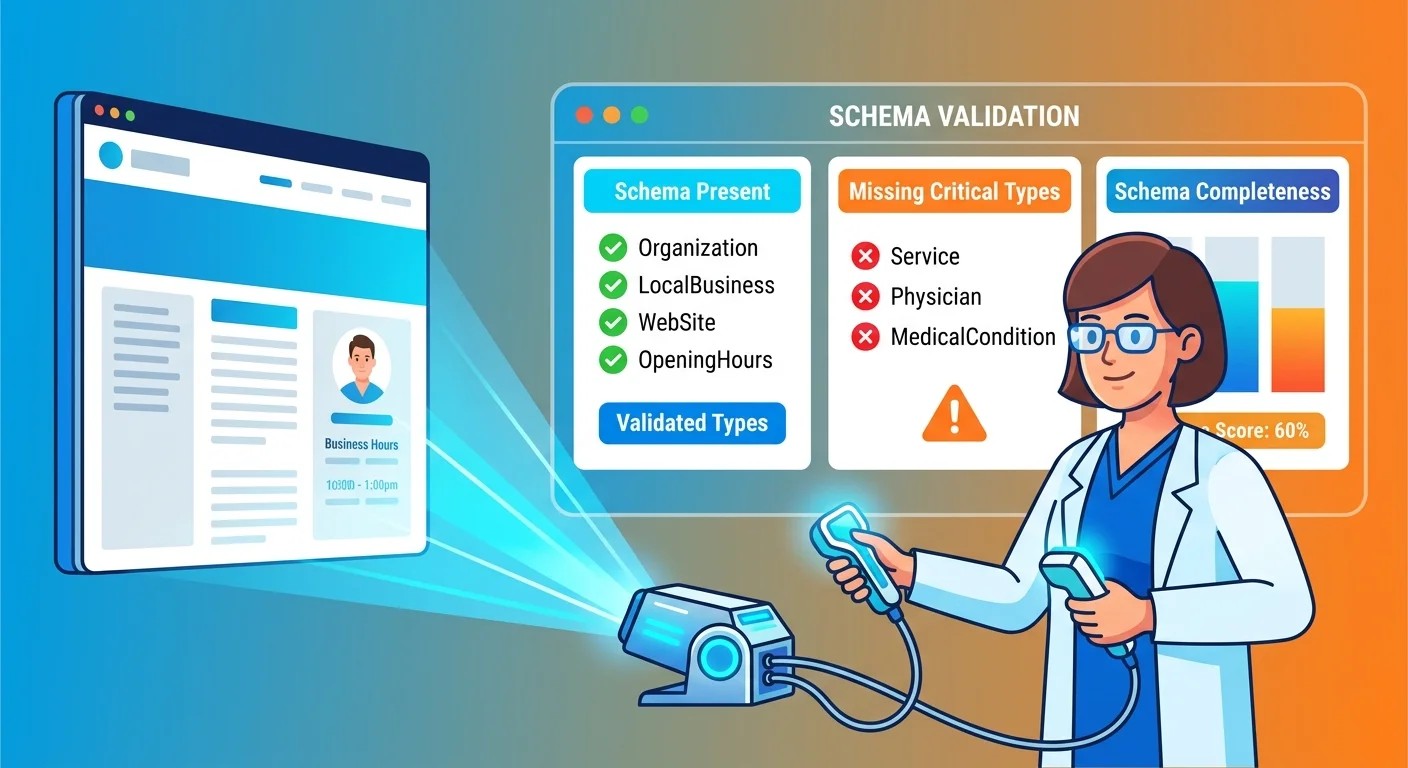
You can check if schema exists on your site. Google's Rich Results Test will tell you that. So will the Schema Markup Validator.
But here's what those tools won't tell you: whether the schema you have is the right schema for AI authority.
You can have technically valid schema and still be invisible to AI. If your markup only includes basic LocalBusiness properties and skips medical specialties, service structures, and practitioner credentials, you're passing a technical test while failing the strategic one.
The real diagnostic question isn't "Do I have schema?" It's "Does AI recommend me?"
That's a different test. And it requires a different tool.
The AI Visibility Check
Here's how the check works: we query ChatGPT, Gemini, and Grok with the same patient-intent questions your ideal patients are asking. "Who's the best chiropractor near me for sports injuries?" "Which chiropractic practice in [city] specializes in pediatric care?" "Who should I see for chronic lower back pain?"
Then we see what AI says.
If your name comes up — you're visible. If a competitor's name comes up instead — you're not. It's that simple.
This isn't a ranking diagnostic. There's no list. There's no "you're number three, just below Dr. Smith." AI gives one answer. You're either it, or you're not.
The AI Visibility Check reveals what your schema should have been built to do. It shows you the gap between technical implementation and strategic authority. And it does it in 15 minutes — no guessing, no theory, no hoping your web designer got it right.
Want to know where you stand right now? Run My AI Visibility Check.
I've run this check with practices that were convinced they were in good shape. Most weren't.
They paid for a professional website. They've been told their SEO is "optimized." They rank on page one for a few local keywords. They assume that means AI knows who they are.
Then they see the results. ChatGPT names a competitor. Gemini names a different competitor. Grok doesn't mention them at all.
And the realization hits: everything they thought was working... wasn't.
This isn't "just more tech jargon." This is the mechanism that determines whether patients find you or skip you. And if you're not willing to see the data — if you'd rather assume your current setup is fine — you're choosing to let someone else take the spot.
Sound fair? Either you're the answer AI gives, or you're funding someone else's patient acquisition while wondering why your marketing doesn't work.
| Tool | What It Tests | What It Misses |
|---|---|---|
| Google Rich Results Test | Whether schema exists and is technically valid | Whether the schema validates authority or just technical presence |
| Schema Markup Validator | Syntax correctness and property completeness | Whether the schema types align with AI entity trust models |
| Manual Code Inspection | Specific properties and structure | How AI engines interpret and prioritize your schema vs. competitors' |
| AI Visibility Check | Whether AI recommends you by name across multiple engines | N/A — this is the only test that answers the strategic question |
The validation tools are useful for technical debugging. They'll tell you if your JSON-LD has a syntax error. They won't tell you if your schema strategy is winning or losing the AI recommendation war.
That's what the check is for.
FAQ
What's the difference between schema and traditional SEO?
Traditional SEO optimizes for a ranked list. You target keywords, build backlinks, improve page speed, and hope Google puts you on page one. Then patients click through, evaluate ten options, and choose one.
Schema optimizes for being the single answer AI gives when a patient asks a question. It doesn't help you rank higher in a list. It helps AI verify your entity as trustworthy enough to recommend directly — bypassing the list entirely.
Those aren't variations of the same thing. They're different games with different rules. And most chiropractors are still playing the old game while patients moved to the new one.
Can I just add schema to my existing website?
You can. But it's a patch.
If your site was built as a digital brochure — optimized for visual design, not machine trust — adding schema on top doesn't fix the underlying problem. It's like putting a new roof on a house with a cracked foundation. Technically better. Structurally still broken.
True AI authority comes from building the entire site's infrastructure around entity signals from the ground up. That's the difference between having schema and having Authority Infrastructure. One is a band-aid. The other is a rebuild.
What happens if I ignore schema markup?
You remain invisible to AI answer engines.
Not ranked lower. Not harder to find. Invisible. AI doesn't evaluate you. It doesn't consider you. It doesn't mention you. It recommends competitors whose sites provide the structured data it needs to verify authority.
Every month you wait, those competitors compound their advantage. The longer their schema infrastructure is in place, the more AI trusts them. The more they're cited, the more authority they build. The gap widens.
And once a competitor owns the AI recommendation in your market, catching up isn't about doing a little better — it's about rebuilding from scratch while they keep compounding.
This isn't a "nice-to-have" technical improvement. This is the foundation that determines whether you exist in the AI-driven patient discovery model.
What are the most important schema types for a chiropractor?
Six types matter most:
- MedicalBusiness — Root entity classification. Without this, AI doesn't recognize you as a healthcare provider.
- Chiropractic — Specialty designation. Narrows your authority from general medical to verified chiropractic expertise.
- Physician — Practitioner credentials. Links your qualifications to the business entity.
- Service — Condition-specific offerings. One entry per treatment area. Each is a separate authority signal.
- Review — Patient feedback validation. Social proof that others trust this provider.
- FAQPage — Educational content structure. Proves expertise depth and creates citation opportunities.
Miss any of these, and AI has gaps in your entity profile. The more complete your schema, the more confidence it has in recommending you.
How can I test my website for schema errors for free?
Google's Rich Results Test and the Schema Markup Validator will show you if schema exists and whether it's technically valid.
But those tools only answer half the question. They tell you if the code works. They don't tell you if the strategy works.
The strategic question is: does AI recommend me? That's what the AI Visibility Check answers. It queries ChatGPT, Gemini, and Grok with patient-intent questions and shows you whose name comes up. If it's not yours, the problem isn't a syntax error. It's a structural gap.
Why didn't my web designer implement schema correctly?
Because they were trained to build websites for humans, not machines.
Most web designers prioritize visual appeal, user experience, and conversion optimization. Those are real skills. They matter for human visitors. But they have nothing to do with whether AI trusts your practice enough to recommend it.
Schema is treated as an SEO afterthought — something a plugin handles or a developer adds if there's budget left. The result: checkbox implementations that technically exist but don't create authority signals.
This isn't incompetence. It's a training gap. Web design education doesn't teach entity trust models or AI answer engine optimization. Designers build for the world they were taught existed.
That world doesn't exist anymore.
Does schema guarantee AI will recommend me?
Schema doesn't guarantee anything. What it does: makes you eligible for the conversation. Without it, you're not even being considered. With it, AI can verify what you claim. Then execution determines whether you win.
Think of it this way: schema is the foundation. AEO content execution is the structure built on top. Citation consistency is the reinforcement. All of it compounds. Remove the foundation, and nothing else matters. But the foundation alone isn't enough.
What I will say: every practice that owns AI recommendations in their market has schema. None of the practices being skipped by AI have proper schema.
That's not a coincidence.
Conclusion
Schema is not an upgrade. It's not a feature. It's not a technical nicety you add after the fact if you have budget left over.
It's the foundation that determines whether AI can verify your authority.
The beautiful website you paid for is a liability if AI can't read it. And right now, if your site was built by a template tool or a traditional web designer who prioritized aesthetics over entity signals, AI can't read it. Not in a way that creates trust. Not in a way that leads to recommendations.
Every month without proper schema, your competitors compound their advantage. The practices that built authority infrastructure early are the ones AI trusts now. The ones that waited — the ones still hoping their current setup is "good enough" — are funding someone else's patient acquisition while wondering why their marketing stopped working.
There's no version of this where doing nothing is a safe play. AI is already making recommendations in your market. Either your name is in the answer, or a competitor's is.
That gap widens every month it goes unaddressed.
Want to know if AI can actually read your website — or if you're invisible right now? The AI Visibility Check takes 15 minutes. It queries ChatGPT, Gemini, and Grok with the same questions your patients are asking. Then it shows you whose name comes up.
If the results don't make the problem self-evident, walk away. No pressure. But if they do — if you see a competitor's name where yours should be — you'll know exactly what needs to happen next.
And you'll understand why waiting isn't neutral. It's a choice to let someone else own the answer.

621 Enterprises, Inc. | Copyright 2026 | All rights reserved