
Your AI Visibility Check: A 15-Minute What-To-Expect Guide
An AI Visibility Check is a 15-minute live diagnostic call that demonstrates what AI answer engines like ChatGPT, Gemini, and Grok say about a specific business. The process involves real-time, unscripted queries to these engines to reveal which businesses are recommended for key services in a local market. It identifies visibility gaps and the underlying authority infrastructure issues causing them.
During the call, you watch as we ask AI engines variations of the questions your potential patients are actually asking. We test your business name directly. We test service-specific queries. We test competitor comparisons. Every query is live and unscripted. You see the raw results in real time—no slideshow, no canned demo, no prepared report. If AI recommends you, you'll see it. If AI recommends your competitor instead, you'll see that too.
The diagnostic reveals whether your business exists in the new paradigm of patient discovery. It's not a sales presentation. It's a data-driven look at your current standing in the age of AI-powered search. The value is in seeing the problem with your own eyes, not in being told about it through vanity metrics or theoretical frameworks. This is the moment of truth that proves whether you are the answer AI gives—or if you're invisible.
Last Updated: May 11, 2026
- • What Happens on the Call
- • The Three-Engine Test
- • Why This Isn't Another Sales Call
- • What the Check Reveals About Your Infrastructure
- • After the Check: Your AI Authority Snapshot
- • FAQ
- • What if the results show I'm already visible?
- • Why can't I just ask ChatGPT myself?
- • Will I get a report or a recording afterward?
- • What AI engines do you check during the diagnostic?
- • How is this different from a traditional SEO audit?
- • Do I need to prepare anything for the call?
- • Is the AI Visibility Check really free?
- • Next Steps
What Happens on the Call
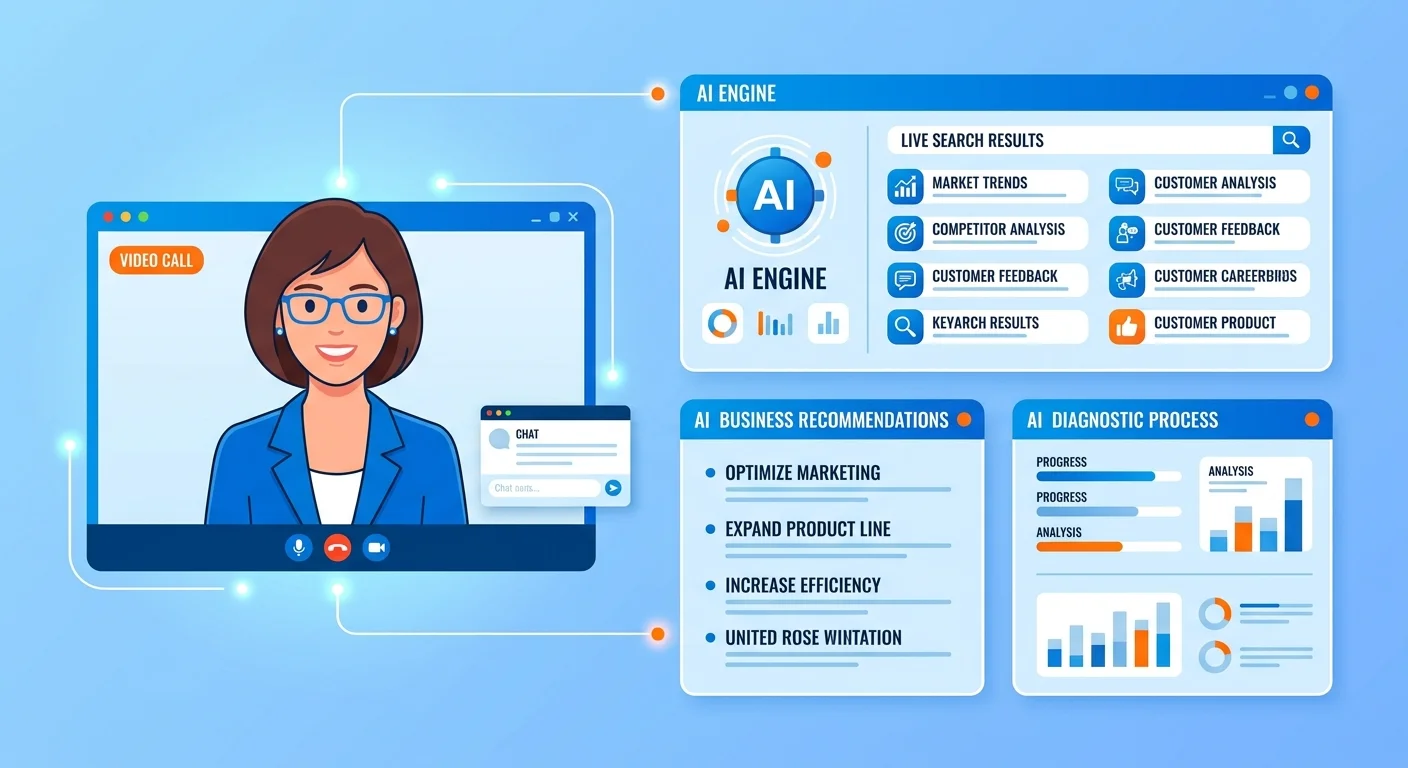
We get on Zoom. You see my screen. Fifteen minutes start to finish.
You don't prep anything. No files. No website audit. We're testing your AI visibility exactly as it exists right now — today, unfiltered, unpolished.
The First 60 Seconds
I introduce myself. We confirm your practice name and your main service focus. That's it.
Then I explain what we're about to do. We're gonna ask three major AI engines the same questions your patients ask. You'll see every result as it happens — live, unscripted, raw.
If you're nervous, that's normal. Most docs are.
The Live Query Process
Here's what most agencies won't tell you.
The reports they send? Designed to look impressive whether the data matters or not.
Clicks. Impressions. "Increased visibility by 47%."
None of that answers the question that determines whether you get new patients: does AI say your name when someone asks?
The AI Authority Agency model rejects vanity metrics entirely. We don't care how many people saw your listing if AI recommended your competitor when it mattered.
The AI Visibility Check is live proof. No spin. No PDF report designed to justify last month's retainer. Just raw data.
I'll type variations of what patients actually ask:
- "Best chiropractor near [your city]"
- "Who should I see for lower back pain in [your area]"
- "Top-rated chiropractor [your city]"
- Direct competitor comparison queries
You watch the answers appear in real time.
I don't touch the results. I don't refresh until we get a better answer. What you see is what your patients see.
What You'll See on the Screen
ChatGPT gives a conversational recommendation. Sometimes one name. Sometimes a short list.
Gemini shows citations next to every claim. You'll see which sources it's pulling from — and whether your practice is one of them.
Grok integrates real-time search. Its answers shift based on what's happening on the web right now.
Each engine has a different format. But they're all testing the same thing: does your authority infrastructure register as trustworthy enough to cite?
| Engine | Response Format | What We're Looking For |
|---|---|---|
| ChatGPT | Conversational recommendation, often names 1-3 businesses directly | Does it name you? Does it name competitors? How specific is the recommendation? |
| Gemini | Citation-forward format with linked sources for every claim | Are you cited as a source? What directories or platforms does it reference? |
| Grok | Real-time search integration with links to recent mentions | Does it pull your site or social profiles? Are you mentioned in current discussions? |
The Three-Engine Test
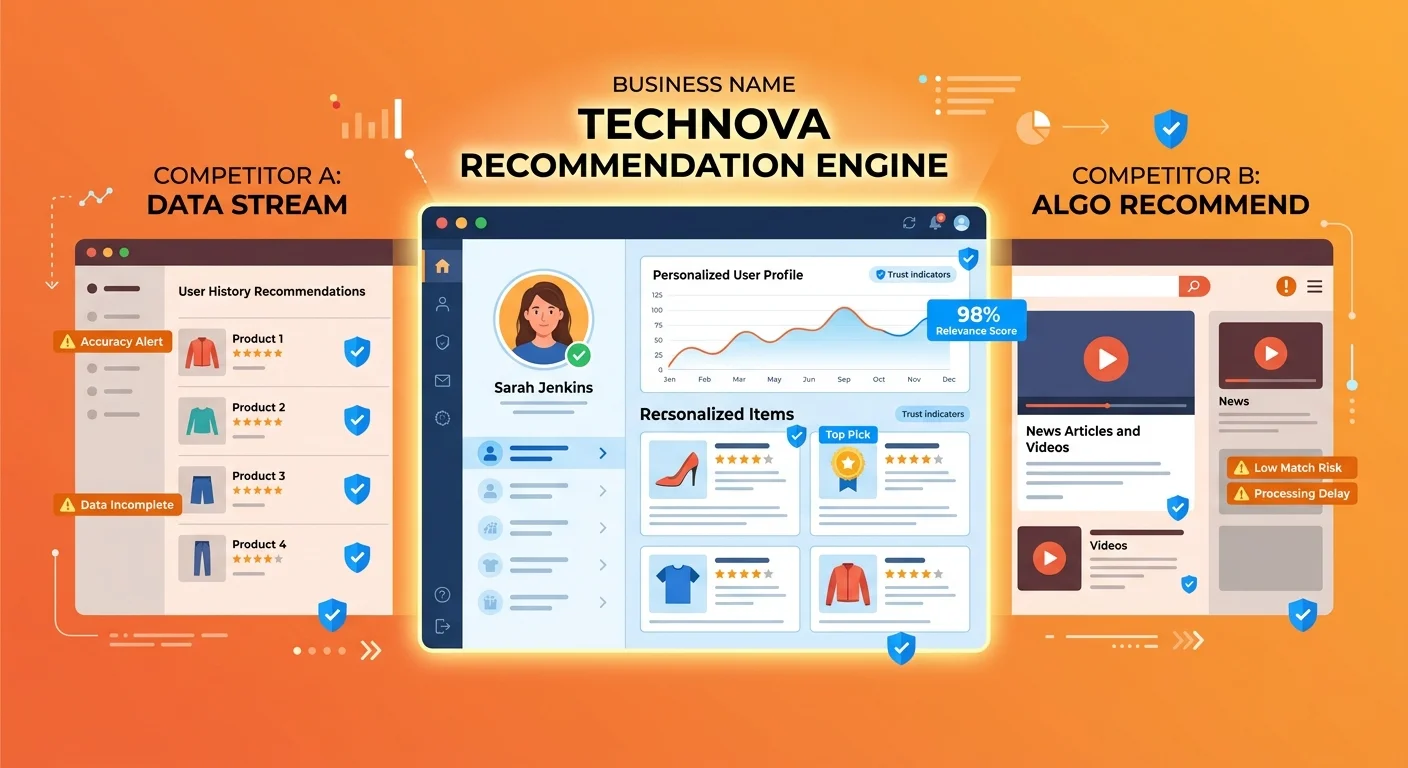
We test three engines because they pull from different data sources and weight authority signals differently.
One engine might recommend you. Another might not.
That spread tells us where your infrastructure is strong and where it's invisible.
You need all three engines. Not for completeness — because one engine lying to you is worse than knowing the truth across all of them. Testing just ChatGPT gives you a narrow view. Testing all three gives you the full picture of how AI sees your practice across the platforms patients actually use.
ChatGPT: The Conversational Benchmark
ChatGPT synthesizes recommendations from the broadest dataset.
According to McKinsey's explainer on large language models, LLMs like ChatGPT are trained to predict the most contextually accurate answer based on patterns in massive datasets.
That means ChatGPT defaults to businesses with the strongest, most consistent authority signals across multiple sources.
A strong result: ChatGPT names your practice specifically and explains why you're the recommendation.
A weak result: ChatGPT gives a generic list of "top chiropractors in [city]" without naming you. Or worse — names your competitors and not you.
Gemini: The Citation-Forward Engine
Gemini shows its work.
Every claim it makes is backed by a citation. Patients can see exactly where the recommendation came from.
That changes the math.
If Gemini cites Healthgrades, Zocdoc, or a local directory that lists you accurately — you get visibility. If those platforms don't recognize your entity or your information is incomplete, you don't.
Consensus Trust Engineering explains how AI engines cross-reference your reputation across multiple platforms to verify you're real, trustworthy, and contextually relevant. Gemini is the clearest example of this process in action.
Grok: The Real-Time Wild Card
Grok pulls from live web data.
That includes social mentions, recent articles, updated directory listings, real-time reviews.
If your practice has been mentioned recently — in a news article, on social media, in a community forum — Grok is more likely to surface you.
If you haven't been mentioned anywhere recently? Grok defaults to whoever has.
That's the new reality of zero-click searches according to Gartner. AI doesn't send patients to a list of options. It gives them the answer it trusts most.
All three engines matter because patients don't just use one.
A patient might ask ChatGPT on their phone, Gemini on their laptop, and see a Grok-powered result on X. If you're invisible on two out of three, you're losing patients.
Why This Isn't Another Sales Call
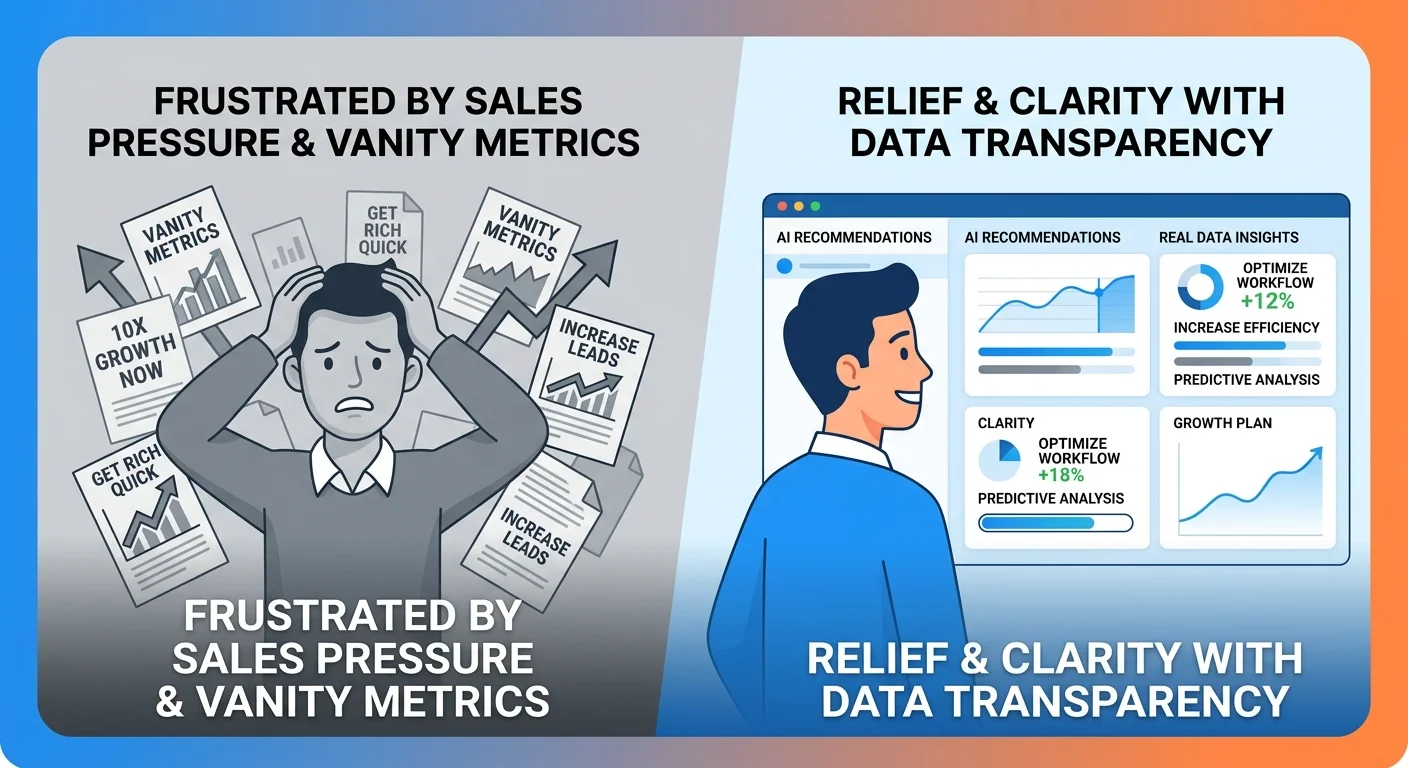
I know the skepticism. You've been burned before.
Some agency promised you leads. Charged you $2,000 a month. Sent you reports full of graphs that looked impressive but didn't move the needle.
Six months later you cancelled and the results disappeared.
I've heard that story more times than I can count. The frustration isn't just the wasted budget — it's that you never got a straight answer about what was actually broken.
Why Most Audits Are Theater
Most audits are designed to look thorough while avoiding the hard truth.
They'll tell you your keyword rankings improved. They'll show you increased impressions. They'll point to traffic spikes that didn't result in a single new patient.
None of that matters if AI doesn't recommend you.
The problem with traditional SEO audits? They're testing for an algorithm that's being replaced.
Google's ranked list of ten blue links isn't how patients find chiropractors anymore.
According to Search Engine Journal's breakdown of E-E-A-T, Experience, Expertise, Authoritativeness, and Trust are the signals search engines — and now AI engines — use to evaluate sources.
But traditional audits measure proxies. Backlinks. Keyword density. They don't test whether AI engines actually trust your entity enough to cite it.
The AI Visibility Check is different. It's not a prepared slideshow. It's not a PDF report you skim and file away.
It's a live test of the only metric that determines whether you win or lose: does AI say your name?
No Preparation, No Pressure
You don't need to prepare anything for the call. That's intentional.
We're not testing how well you explain your business. We're testing how well AI engines recognize your authority without any intervention.
If the results are good — great. You'll see proof that your infrastructure is working.
If the results are bad — you'll see exactly why. And we'll talk about whether fixing it makes sense for your practice.
There's no hard sell.
If your market isn't competitive and your patient flow is steady, the check will prove you don't need this. I'll tell you that on the call.
But if the check reveals you're invisible while your competitors are getting recommended? You'll know. And that clarity is worth 15 minutes.
| Element | AI Visibility Check | Traditional SEO Audit | Why It Matters |
|---|---|---|---|
| What's Tested | Live AI recommendations across ChatGPT, Gemini, Grok | Keyword rankings, backlinks, on-page SEO | One tests the outcome patients see. The other tests proxies. |
| Format | Live, unscripted screen share | Pre-generated PDF report | You see the problem in real time, not through a marketing filter. |
| Metrics | Does AI name you or your competitor? | Clicks, impressions, "visibility score" | One predicts patient bookings. The other predicts nothing. |
| Sales Pressure | Diagnostic only — no obligation | Often tied to upsell packages | The check exists to show you reality, not to close a deal. |
What the Check Reveals About Your Infrastructure
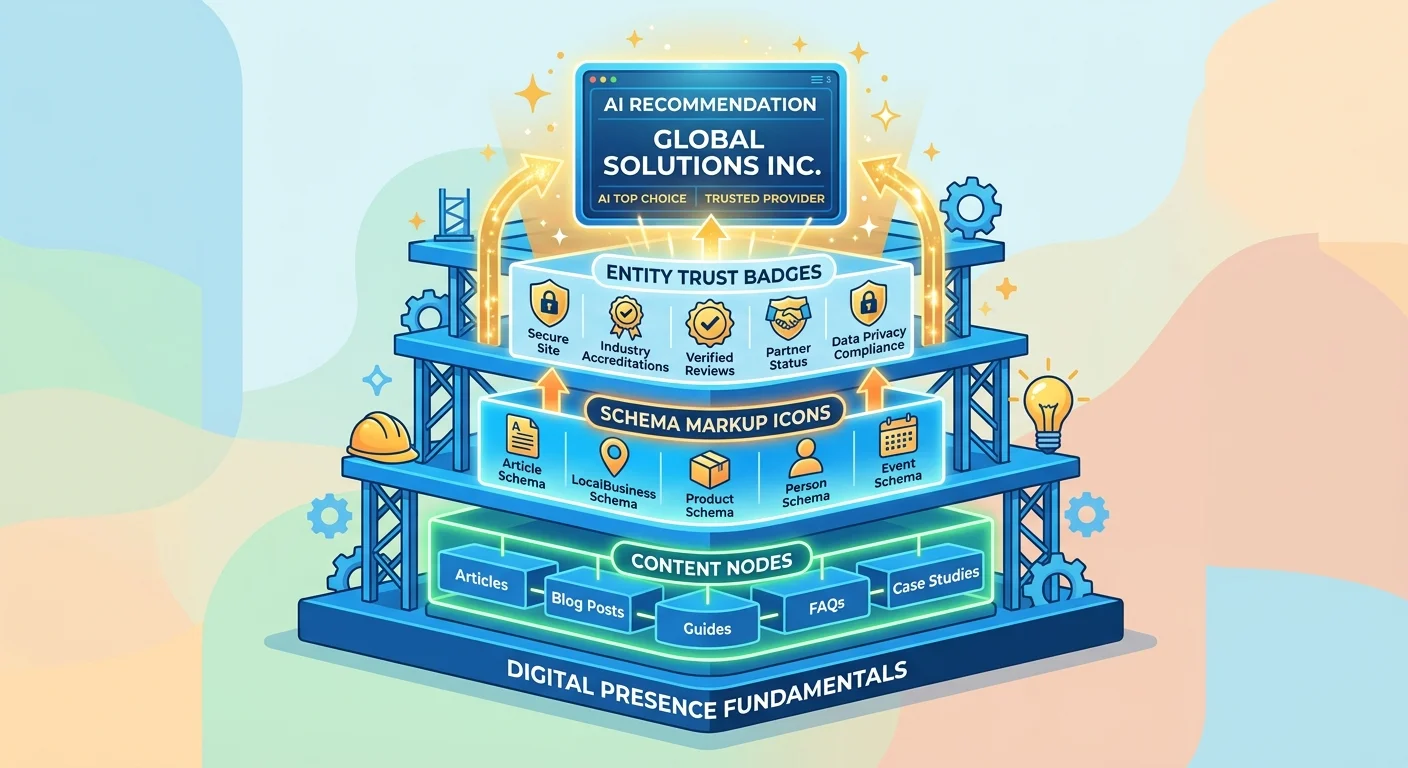
The check doesn't just show you the problem. It reveals the cause.
When AI doesn't recommend your practice, it's not random. It's structural.
Your website, your directory listings, your content — none of it is registering as authoritative to the engines making recommendations.
That's what we mean by authority infrastructure. It's the foundation AI engines use to decide whether you're trustworthy enough to cite.
When AI Can't Read Your Website
Here's what I see on most checks. Beautiful websites that AI engines completely ignore.
The design is clean. The photos are professional. The copy sounds good.
But the underlying structure — the schema markup, the entity signals, the machine-readable data — is either missing or so weak that AI has no way to verify who you are.
A pretty website that AI doesn't recognize is an expensive digital business card. It looks good when someone lands on it. But AI never sends anyone there in the first place.
The check often reveals this in real time.
I'll ask ChatGPT for a recommendation. It'll name a competitor whose website looks worse than yours.
Why? Because their infrastructure is readable. Yours isn't.
Building Entity Trust is the process of making your business recognizable and verifiable to AI engines. It's not about aesthetics. It's about structure.
The Specialist vs. Generalist Gap
The check often reveals something uncomfortable. AI rewards specialists.
If your website says you treat "back pain, neck pain, headaches, sports injuries, auto accidents, wellness care, and pediatric adjustments" — you're telling AI you treat everything.
AI doesn't cite businesses that treat everything. It cites businesses that own a specific niche.
I've run this check with generalist practices that were convinced they were in good shape.
The result? AI recommended a competitor who specialized in sports injuries. Not because that competitor had more reviews or a bigger ad budget. Because their authority signals were clear and focused.
If you refuse to specialize — if you insist on being everything to everyone — the diagnostic will prove why that dilutes your authority and makes AI citation impossible.
This isn't theory. You'll watch it happen live.
The Competitor Advantage
Why does AI recommend some competitors and not others?
It's not luck. It's not ad spend. It's infrastructure.
Competitors who show up in AI recommendations have done three things right:
- Their entity is recognizable across multiple authoritative sources
- Their content and directory listings reinforce a clear specialty
- Their schema markup tells AI engines exactly what they do and where they do it
Competitors who don't show up are missing one or more of those layers.
The check reveals which layer you're missing — and what it's costing you.
If your infrastructure doesn't pass those tests, you're invisible.
| Infrastructure Element | What AI Sees | What You're Missing |
|---|---|---|
| Schema Markup | Machine-readable data about your business type, services, location | AI can't verify what you do or where you do it |
| Entity Signals | Consistent NAP (Name, Address, Phone) across directories | AI sees conflicting data and assumes you're not trustworthy |
| Specialty Focus | Clear, repeated signal that you own a specific niche | AI defaults to recommending a competitor with sharper positioning |
After the Check: Your AI Authority Snapshot
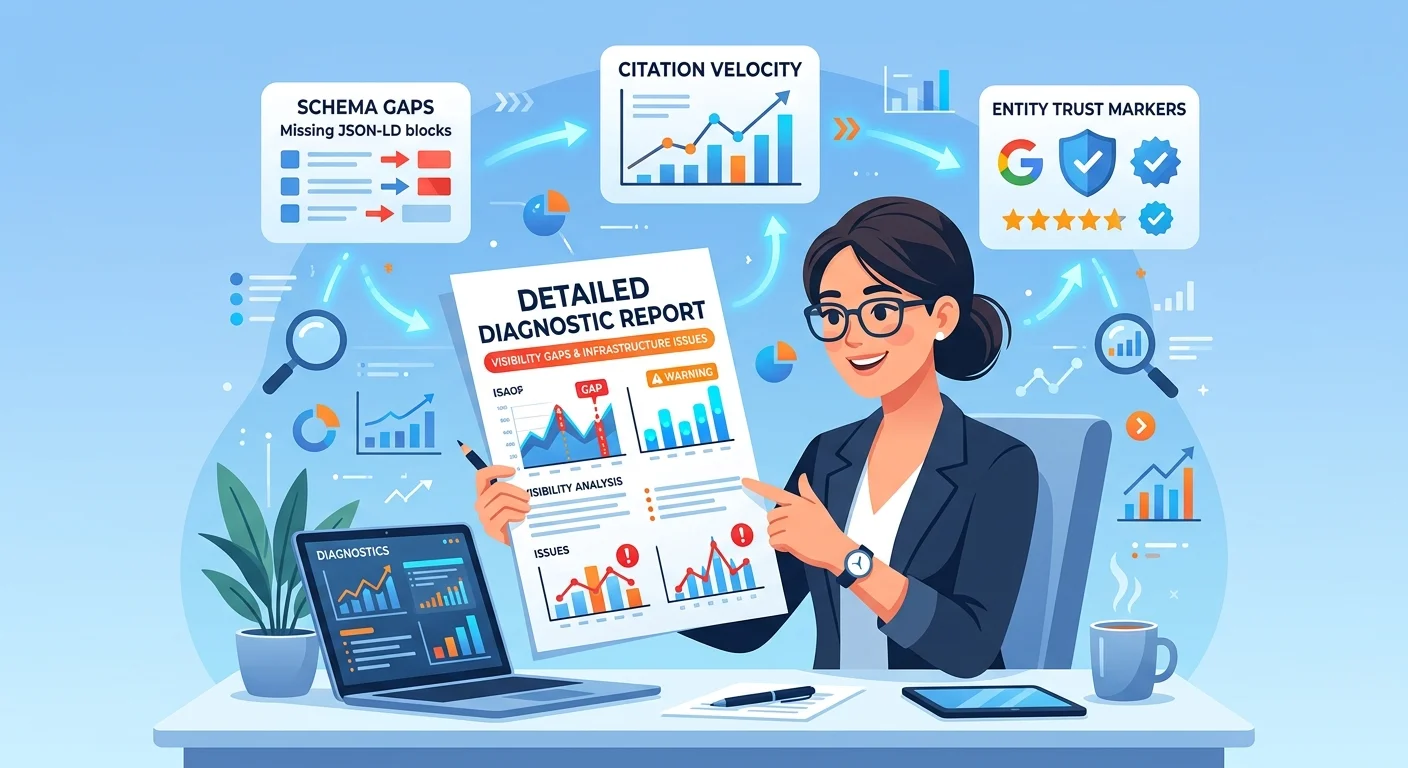
The value of the check is seeing the problem live.
But after the call, we send you the AI Authority Snapshot — a written summary of what we found.
It's not a 40-page PDF designed to justify a retainer. It's a concise breakdown of your visibility gaps and the infrastructure issues causing them.
What's in the Snapshot
The Snapshot includes:
- Visibility Summary — Which engines recommended you, which didn't, and what they said instead
- Infrastructure Gaps — The specific missing or weak authority signals (schema, entity consistency, content depth)
- Competitive Positioning — How your competitors are showing up and what they're doing differently
It's written in plain language. No jargon. No fluff. Just the data.
The First Step Forward
After you review the Snapshot, we'll schedule a follow-up call if you want one. No obligation.
That call isn't a sales pitch. It's a conversation about whether the Local AI Authority Engine is the right fit for your practice.
If your market isn't competitive, if fixing the gaps doesn't make financial sense, if you're not ready to commit to 12 months of execution — I'll tell you.
This only works if you're the right fit.
But if the check revealed you're losing patients to competitors who are less qualified but more visible — and if that gap is widening every month — then we'll talk about what it takes to fix it.
FAQ
Is the AI Visibility Check really free?
Yes. Completely free. No catch.
The 15-minute diagnostic is designed to show you the reality of your current AI visibility. There's no obligation to move forward.
If the results don't make the problem self-evident, that's fine. Walk away.
Do I need to prepare anything for the call?
No. You don't need to prepare anything.
The check is most effective when it's a live, unscripted look at how AI engines see your business right now.
Preparation isn't necessary — and in some ways, it would defeat the purpose.
How is this different from a traditional SEO audit?
A traditional SEO audit looks at keyword rankings, backlinks, and on-page optimization for Google's old algorithm.
The AI Visibility Check looks at what AI engines say when asked for a direct recommendation.
Those are fundamentally different tests. One measures proxies. The other measures the outcome.
When you compare AEO vs. SEO, the difference is clear: SEO optimizes for a ranked list. AEO optimizes for being the answer.
What AI engines do you check during the diagnostic?
We primarily check the major conversational AI engines that patients are using now: ChatGPT, Gemini, and Grok.
This gives a comprehensive view of your visibility across the platforms that matter.
If there's a fourth engine you want us to test, we can add it during the call.
Will I get a report or a recording afterward?
The value is in seeing the results live. But yes, we provide an AI Authority Snapshot after the call — a summary of the findings that outlines the specific visibility gaps we uncovered.
We don't provide a recording of the call, but the Snapshot captures everything you need to know.
Why can't I just ask ChatGPT myself?
You absolutely can. And you should.
But the check evaluates visibility across multiple engines and interprets the results.
We show you not just what AI says, but why it's saying it by connecting the answer to your underlying authority infrastructure.
Running the test yourself gives you a data point. Running it with us gives you the full diagnostic picture.
What if the results show I'm already visible?
Then you'll know you're in good shape and can focus elsewhere.
The check is diagnostic, not a predetermined sales pitch.
If AI is already recommending you, that's a win. We'll tell you that on the call. No reason to fix what isn't broken.
Next Steps
AI is already making recommendations in your market. Right now. Today.
Either your name is in the answer or a competitor's is.
That gap widens every month it goes unaddressed.
The AI Visibility Check takes 15 minutes. It shows you exactly where you stand.
If the results don't make the problem self-evident — walk away. No pressure.
But if they do? You'll know exactly what to do next.
Want to know if AI is recommending your practice — or your competitor's? The check is free, it takes 15 minutes, and it shows you exactly what ChatGPT, Gemini, and Grok say when someone asks who to trust in your market. No preparation needed. No sales pitch. Just real data.
621 Enterprises, Inc. | Copyright 2026 | All rights reserved