
Market Authority Displacement: How to Become THE Answer in Your City
Market Authority Displacement is the strategic process of restructuring a business's digital infrastructure and content hierarchy to become the singular, trusted recommendation by AI answer engines like ChatGPT and Gemini. It shifts the goal from competing for a position on a search results list to establishing such deep entity trust and semantic relevance that AI engines bypass competitors entirely, rendering them invisible for high-intent local queries.
This displacement is achieved through three core components working in concert. First, an AI-readable foundation that allows AI engines to verify who you are, what you do, and where you practice through structured data and schema markup. Second, high-velocity Answer Engine Optimization content that demonstrates depth of knowledge and builds semantic authority across every service, condition, and patient question relevant to your practice. Third, verifiable authority signals including consistent citations, patient reviews, and professional credentials that AI engines use to confirm trustworthiness.
The distinction from traditional search engine optimization is fundamental. Traditional SEO optimizes for placement in a ranked list of ten results that users evaluate and click through. Market Authority Displacement optimizes for being named as the definitive answer inside a conversational AI response, where being second means being invisible. When someone asks ChatGPT or Gemini who the best chiropractor in their city is, the AI engine either names your practice or it names a competitor. There is no middle ground. The infrastructure, content depth, and trust signals that determine that outcome are what Market Authority Displacement systematically builds.
Last Updated: May 18, 2026
- • The New Reality: AI Gives One Answer
- • What Market Authority Displacement Actually Means
- • Why Traditional SEO No Longer Determines Who Wins
- • How Competitors Are Already Displacing You
- • The Market Authority Displacement Process
- • What This Is Not
-
• Frequently Asked Questions
- • What's the difference between Market Authority Displacement and traditional SEO?
- • How long does it take to displace competitors and become the AI's top recommendation?
- • Can my competitors just copy this strategy once they see what I'm doing?
- • Is this strategy only for chiropractors?
- • How can I check my business's current AI visibility?
- • The Choice: Build Authority or Watch Competitors Take It
The New Reality: AI Gives One Answer
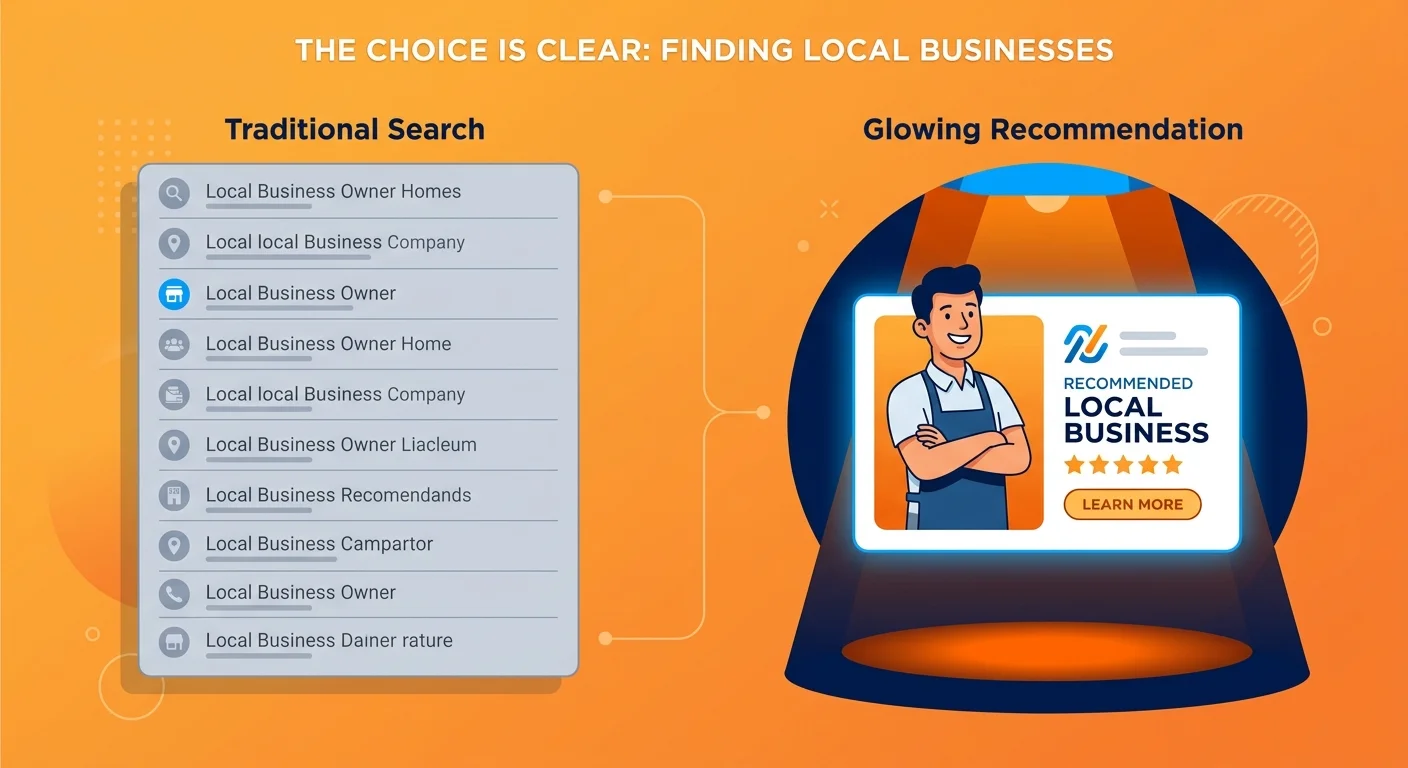
Your competitor just got named. You didn't.
That's the new reality.
AI doesn't produce a list of ten options patients can compare. It gives one verdict. And if you're not that verdict, you don't exist — no matter how much you spent getting to the top of Google's old rankings.
Here's what most chiropractors don't realize: the game changed. Not gradually. All at once.
The practices still optimizing for page-one rankings are fighting for visibility on a list patients never see. Because when someone asks ChatGPT or Gemini who the best chiropractor in their city is, AI doesn't show them ten websites to evaluate. It names one practice. Period.
That's the binary outcome. You're either the answer or you're invisible.
The Binary Outcome of AI Recommendations
There's no second place in an AI recommendation.
When ChatGPT or Gemini produces an answer, it names one practice. Not three to compare. Not a list of ten ranked by relevance. One name.
This is fundamentally different from traditional search. Google gave users ten blue links. They clicked through, visited multiple sites, compared options, and made a decision.
AI collapses that entire funnel into a single step. It makes the decision for them.
According to Pew Research Center, AI adoption among American adults is accelerating. And once users start trusting AI for answers, they don't go back to traditional search for the same types of questions.
The data's clear: patients asking AI who to see aren't comparison shopping. They're looking for a trusted answer. And whichever practice AI names wins that patient.
If your name isn't in the answer, you don't exist to that patient. Full stop.
Why Zero-Click Search Changes Everything
Zero-click search means the patient gets their answer without ever leaving the AI interface.
No clicking through to your website. No comparing five different practice pages. No visiting your competitor's site to see how you stack up.
The AI delivers the verdict directly. The patient reads it, trusts it, and acts on it. Done.
Gartner research on how generative AI is changing buyer behavior confirms this. When AI delivers a recommendation upfront, buyers skip the comparison phase entirely. The traditional sales funnel — awareness, consideration, decision — collapses into one step.
Think about what that means for your practice.
Your beautifully designed website? Doesn't matter if AI never sends the patient there. Your keyword-optimized service pages? Irrelevant if the patient never sees them. Your backlink profile? Meaningless if AI doesn't cite you in the first place.
The new competition isn't about getting patients to click. It's about being the answer AI trusts enough to name.
That's a different game. And Answer Engine Optimization (AEO) is what wins it.
What Market Authority Displacement Actually Means
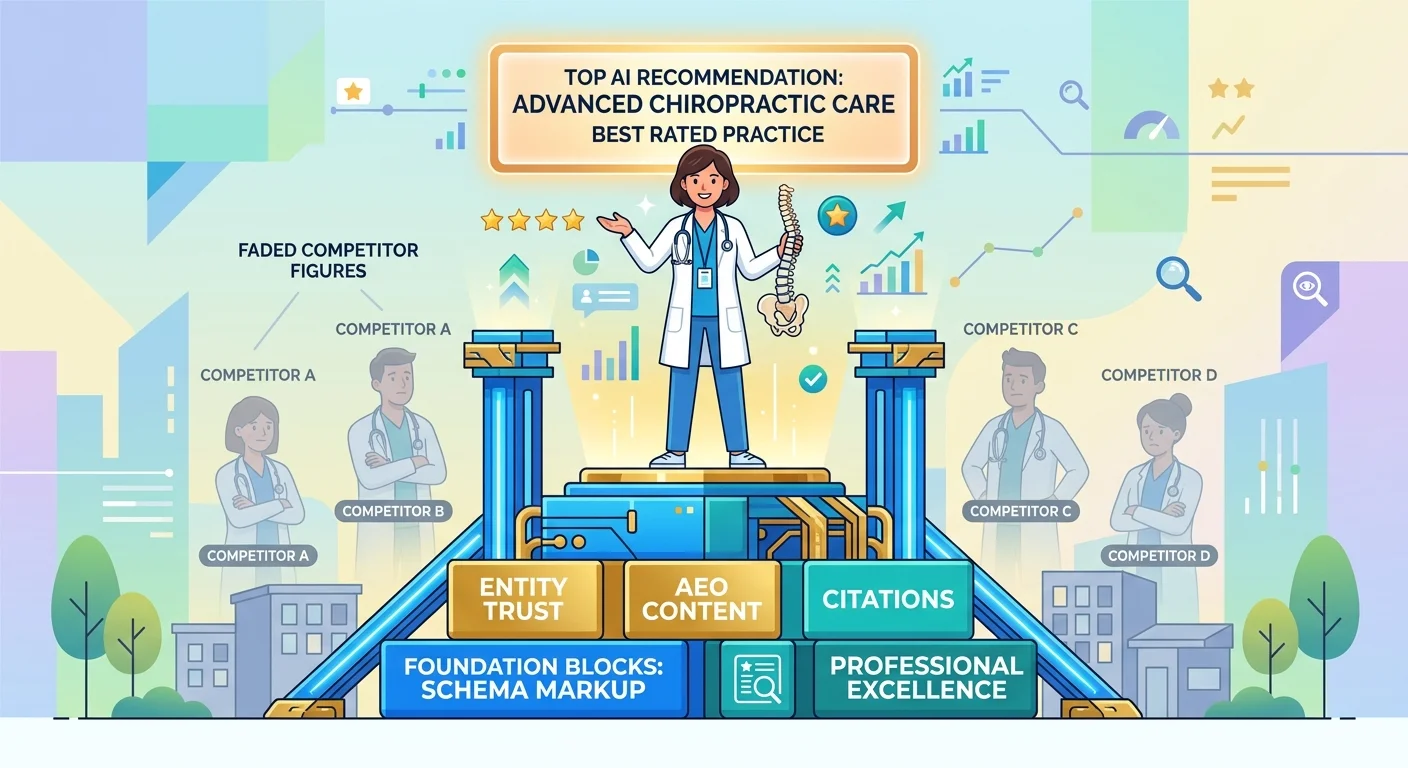
Market Authority Displacement isn't about catching up to competitors.
It's about making them irrelevant.
The goal is a recommendation monopoly — where your practice becomes the only logical answer AI can give for chiropractic care in your city. Not one of three options. Not a strong contender. The answer.
This is how iTech Valet approaches AI authority. Not as a rankings improvement project. As an infrastructure rebuild that makes competitors structurally invisible to the engines that matter.
The Three Pillars of Displacement
Displacement happens when three components work together.
Infrastructure makes you readable. Content proves depth. Trust signals verify legitimacy.
Miss any one of them, and the system breaks.
| Pillar | What It Does | Why AI Cares |
|---|---|---|
| AI-Readable Infrastructure | Structures your digital presence with schema markup, entity verification, and machine-parsable data that AI engines can read and validate | AI engines cannot recommend what they cannot verify. Structured data allows them to confirm who you are, what you do, and where you practice with certainty |
| High-Velocity AEO Content | Produces verified, sourced, comprehensive content that answers every patient question and service inquiry related to your practice | AI measures semantic authority by content depth. The practice with 50 detailed, verified articles on chiropractic topics has provable expertise. The one with 5 generic pages does not |
| Verifiable Trust Signals | Establishes consistent citations, patient reviews, and professional credentials across directories and platforms AI uses to cross-verify legitimacy | Trust is not claimed — it's confirmed. AI checks Healthgrades, Zocdoc, Google Business Profile, and other institutional sources to validate that your practice exists and patients trust it |
A practice with great content but no schema is invisible. AI can't read it.
A practice with perfect infrastructure but thin content has nothing to cite.
A practice with both but weak trust signals can't be verified.
All three are required. No shortcuts.
Infrastructure: Making Your Practice AI-Readable
Template websites fail because AI can't parse them.
The design looks fine to a human. But the underlying code is generic, unstructured, and contains no entity data AI can use to verify who you are.
Schema markup fixes this.
It tells AI exactly what each piece of information represents — your business name, your address, your services, your credentials, your hours. Not as unstructured text buried in a paragraph somewhere. As machine-readable facts AI can validate instantly.
When AI encounters a practice with complete schema, it can verify identity immediately. When it hits a template site with no structure, it moves on to the next result.
Building Entity Trust is the foundation. Without it, everything else is invisible.
Content Velocity: Proving Semantic Authority
AEO articles aren't blog posts. They're proof of depth.
Each one answers a specific patient question comprehensively. Verified sources. Structured data. Semantic richness that demonstrates you actually know what you're talking about.
When AI evaluates who knows the most about treating sciatica, it doesn't check keyword density. It measures how thoroughly the question is answered, how many related questions are addressed, and whether the content is sourced and verifiable.
A practice publishing 12 AEO articles per month builds semantic authority at a velocity competitors can't match.
After six months, that's 72 comprehensive articles. After a year, 144.
That volume of verified content creates a semantic moat. AI sees breadth and depth. Competitors with 10 generic service pages don't register.
Trust Signals: Verification at Scale
Citations across directories let AI cross-verify your identity and reputation.
If your practice is listed consistently on Healthgrades, Zocdoc, Google Business Profile, and other institutional platforms with matching data — AI confirms legitimacy.
If your data is inconsistent, incomplete, or absent — AI can't verify you exist.
Whitespark research on local search ranking factors shows that entity-based signals like business profile completeness, citation consistency, and review volume are now weighted more heavily than traditional keyword signals.
Patient reviews work the same way. A practice with 200+ verified reviews across multiple platforms has social proof AI can measure. A practice with 12 reviews on one platform doesn't.
Trust isn't what you claim. It's what AI can independently confirm.
Why Traditional SEO No Longer Determines Who Wins
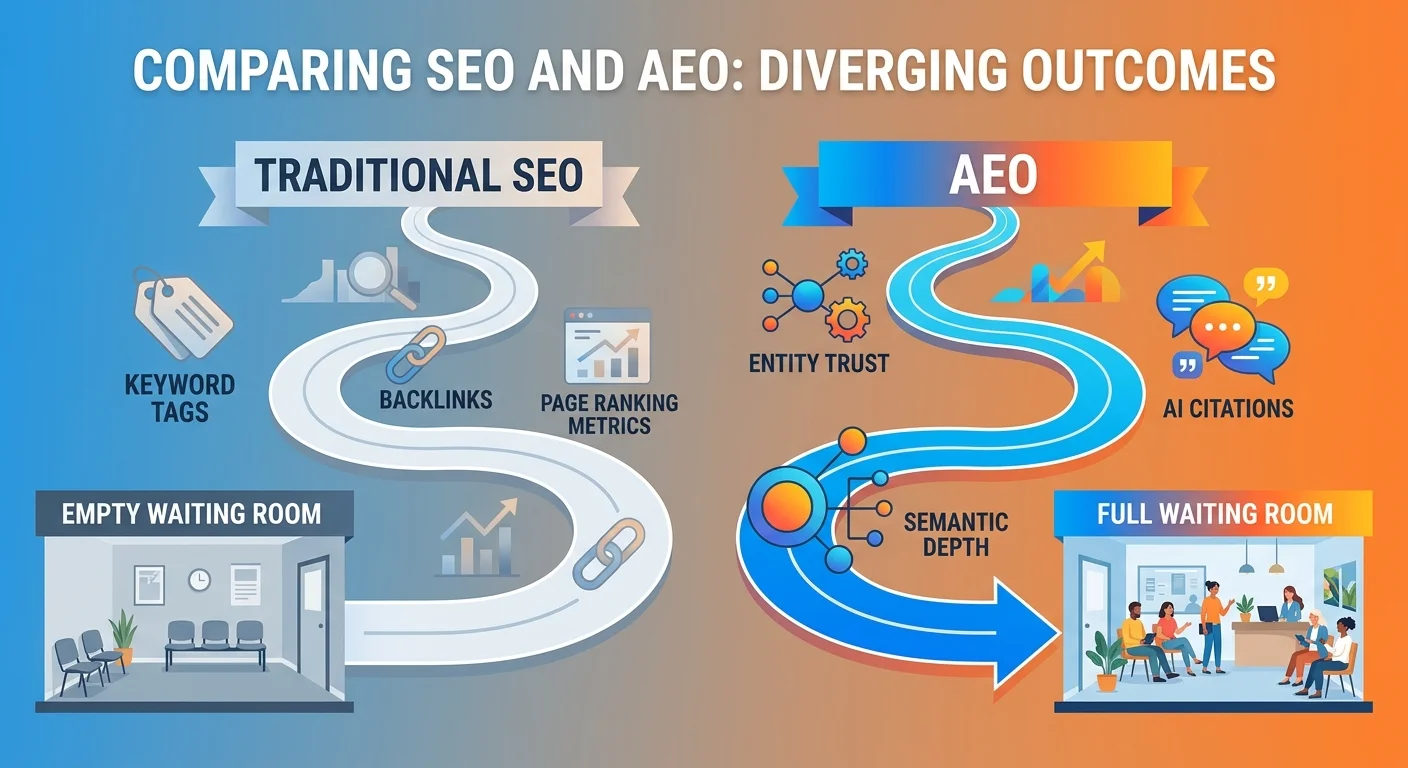
Traditional SEO was built for Google's old algorithm.
Optimize a keyword, build some backlinks, get on page one. Patients clicked through, found you, booked an appointment.
That chain's broken.
Why Being "First on Google" No Longer Means You're Winning
Being first on a list nobody sees is irrelevant.
McKinsey research on how generative AI is changing buyer behavior shows that AI-assisted buyers skip comparison entirely when AI provides a definitive recommendation. The traditional sales funnel — awareness, consideration, decision — collapses into a single step when AI delivers trust upfront.
AI doesn't show the list. It gives the verdict.
And the verdict isn't "here are ten chiropractors in your city" — it's "here's the one you should call."
The practices still chasing page-one rankings are competing for a placement that no longer converts. Even if they get there, patients never see it. Because AI answered the question before the patient ever saw Google's results page.
The new competition is for inclusion in the AI's answer. Different game. Different rules.
Why Being "First on Google" No Longer Means You're Winning breaks this down fully. The shift isn't subtle. It's a complete displacement of the old model.
The Shift from Keywords to Semantics
Keyword density was the old game. Semantic relevance is the new one.
AI understands meaning and context, not just keyword matches. According to Search Engine Journal, search engines have moved decisively toward semantic search, which prioritizes understanding the intent and context behind queries rather than simply matching keywords.
A page optimized for "chiropractor near me" might rank. But if it doesn't comprehensively answer why someone would choose chiropractic care, what conditions it treats, and how your practice differs from competitors — AI won't cite it.
Semantic authority means demonstrating depth across every relevant topic, question, and concern a patient might have.
It's not about repeating a keyword. It's about proving you understand the subject completely.
That's why AEO content execution is measured in topics covered, questions answered, and sources cited — not keyword density or backlink count.
How Competitors Are Already Displacing You
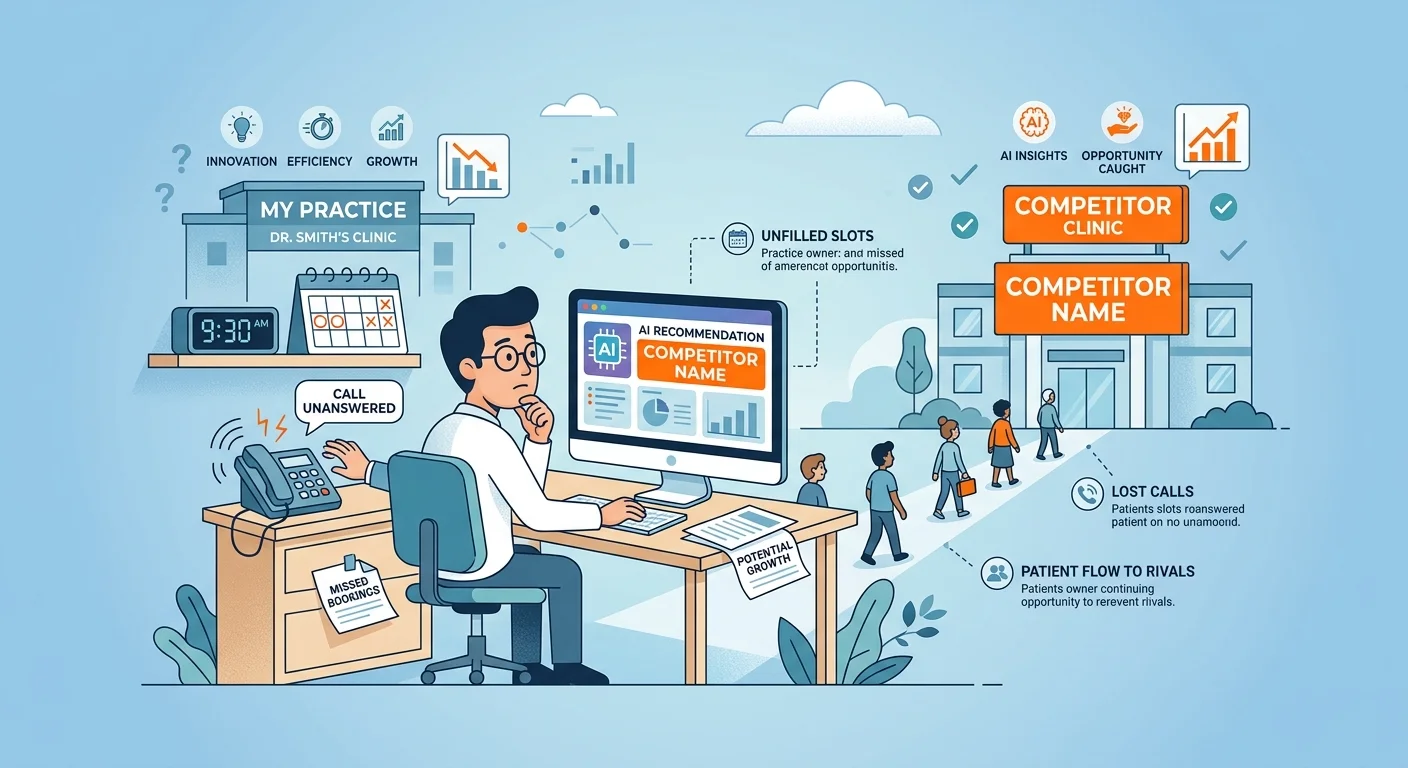
Competitors who moved first are building compounding advantages right now.
Every month you wait, the gap widens.
This isn't a static race where everyone starts from the same position. Authority compounds. The practice that started building six months ago has infrastructure, content depth, and trust signals that take time to replicate.
You can't snap your fingers and catch up. The math doesn't work that way.
The Citation Monopoly is real. Once a competitor owns the AI recommendation in your market, displacing them requires overcoming an established moat.
The First-Mover Advantage in AI Visibility
Let me show you what the gap looks like.
| Timeline | Early Mover (Started 12 Months Ago) | Late Mover (Starting Today) |
|---|---|---|
| Month 1 | Infrastructure complete, schema deployed, 12 AEO articles published | Infrastructure build begins, no content live yet |
| Month 6 | 72 AEO articles published, entity trust verified across 15+ directories, AI citing practice in 60% of queries | 60 AEO articles published, entity trust building, AI citing practice in 15% of queries |
| Month 12 | 144 AEO articles published, semantic authority across all service areas, AI citing practice in 85%+ of queries, competitor displacement complete | 132 AEO articles published, entity trust established, AI citing practice in 45% of queries, still competing for visibility |
Authority compounds because each piece of verified content, each citation, each trust signal builds on the previous ones.
The practice that started early has a structural advantage. Their semantic depth is greater. Their entity trust is stronger. Their citation velocity is established.
A competitor starting today has to catch up while the leader continues building. That gap doesn't close quickly.
Why "Catching Up" Gets Exponentially Harder
AI engines reward established authority.
A practice with 50 comprehensive AEO articles, complete schema markup, and verified citations across a dozen directories has a moat a new competitor can't cross with 10 articles and a rebuilt website.
The math doesn't work. If both practices publish at the same velocity going forward, the gap never closes. The leader maintains their advantage indefinitely.
The only way to displace an established authority is to outpace them — publishing more content, building deeper trust signals, executing faster than they do.
That requires commitment and sustained investment most practices aren't willing to make.
Which is exactly why AI Invisibility is so dangerous. Once a competitor locks in authority, reversing it becomes exponentially harder every month.
The Market Authority Displacement Process
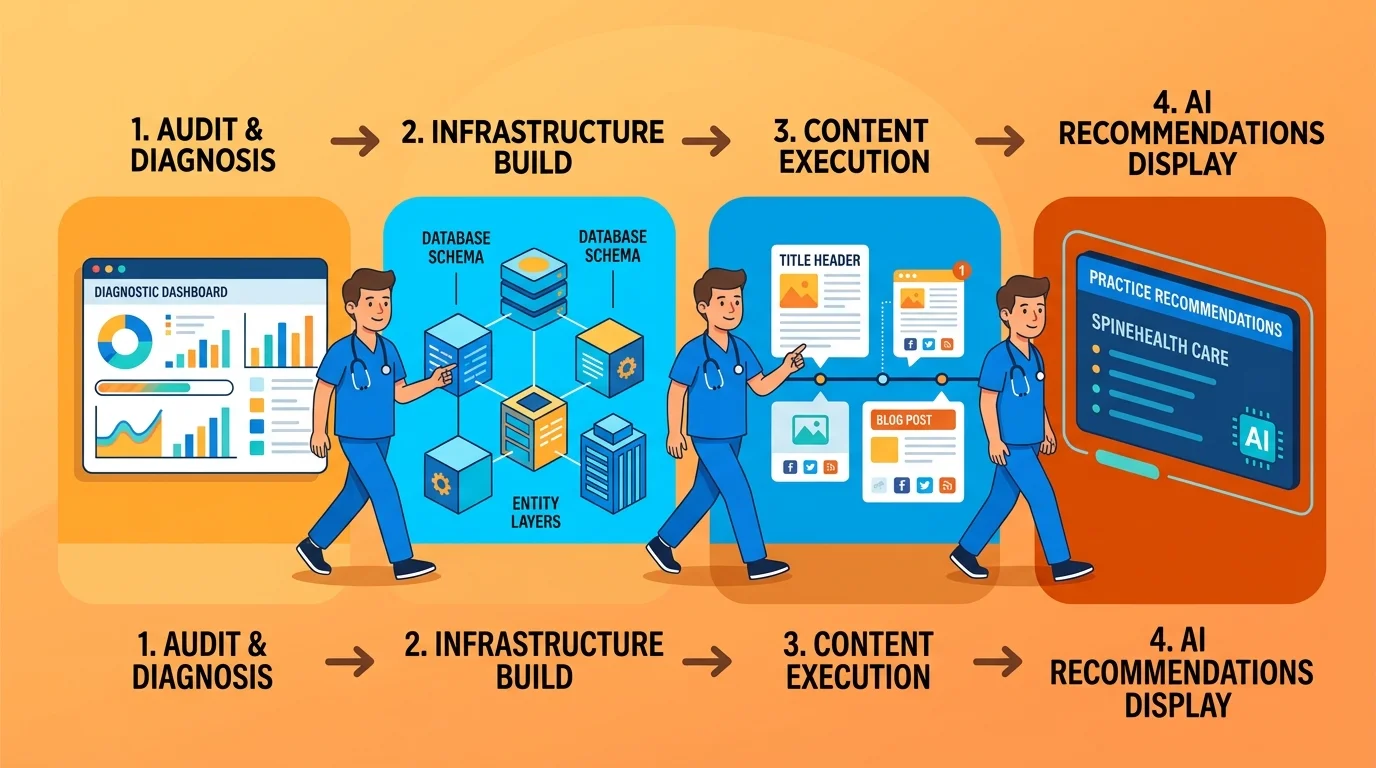
Market Authority Displacement is a repeatable process with four distinct phases.
This isn't a DIY guide. This is proof that there's a system — a methodology that produces predictable outcomes when executed correctly.
The process is white-glove. The client does nothing. The work gets done, the steak gets on the plate, and the AI recommendation shifts over time.
Phase 1: Diagnostic — Know Where You Stand
Running an AI Visibility Check across ChatGPT, Gemini, and Grok reveals current state.
Most practices discover they're invisible. When asked "Who's the best chiropractor in [city]?" — AI names a competitor. Or multiple competitors. Never them.
The diagnostic is binary. Either your name appears in the answer or it doesn't. There's no grey area.
This phase takes 15 minutes. The results make the problem self-evident. If AI isn't recommending you, the infrastructure and authority signals it needs don't exist.
Phase 2: Foundation — Build AI-Readable Infrastructure
The website gets restructured with schema markup, entity verification, and content hierarchies AI can parse.
This isn't a redesign. It's a technical rebuild.
The visual design might not change at all. But the underlying code shifts from generic template to structured, machine-readable data.
Schema tells AI who you are, what you do, where you practice, and how to verify every claim. Business hours, services offered, conditions treated, credentials held — all structured as facts AI can read and confirm.
Without this foundation, the rest of the process fails. AI can't cite what it can't read.
Phase 3: Execution — High-Velocity AEO Content
Monthly AEO content builds semantic depth systematically.
Each article is researched by one AI engine, written by another, validated by the first, and refined until every claim is sourced and every statistic verified.
No vibes. Just receipts.
| Month | AEO Articles Published | Cumulative Total | Semantic Topics Covered | AI Citation Rate (Estimated) |
|---|---|---|---|---|
| Month 1-3 | 12 per month | 36 | Foundational services, common conditions | 10-20% |
| Month 4-6 | 12 per month | 72 | Advanced topics, procedure details, patient concerns | 30-45% |
| Month 7-9 | 12 per month | 108 | Deep-dive FAQs, competitive differentiators, trust-building | 50-65% |
| Month 10-12 | 12 per month | 144 | Complete semantic coverage, authority maintenance | 70-85%+ |
Over 12 months, that's 144 comprehensive articles covering every service, condition, patient question, and objection relevant to your practice.
The semantic breadth and depth that creates is what AI measures when determining authority.
This phase never stops. Authority decays without maintenance. The practices that sustain execution compound their advantage. The ones that stop lose ground.
Phase 4: Validation — Measure Displacement Over Time
Displacement is tracked by running the same AI Visibility Check monthly.
Month one: AI names three competitors, never you.
Month six: AI names you 40% of the time, competitors 60%.
Month twelve: AI names you 85% of the time, competitors rarely appear.
That shift is the outcome. It's measurable, verifiable, and binary.
Either your name is in the answer or it's not.
The timeline varies by market competitiveness and how aggressively competitors are executing. But the pattern holds: sustained execution displaces competitors over time.
What This Is Not
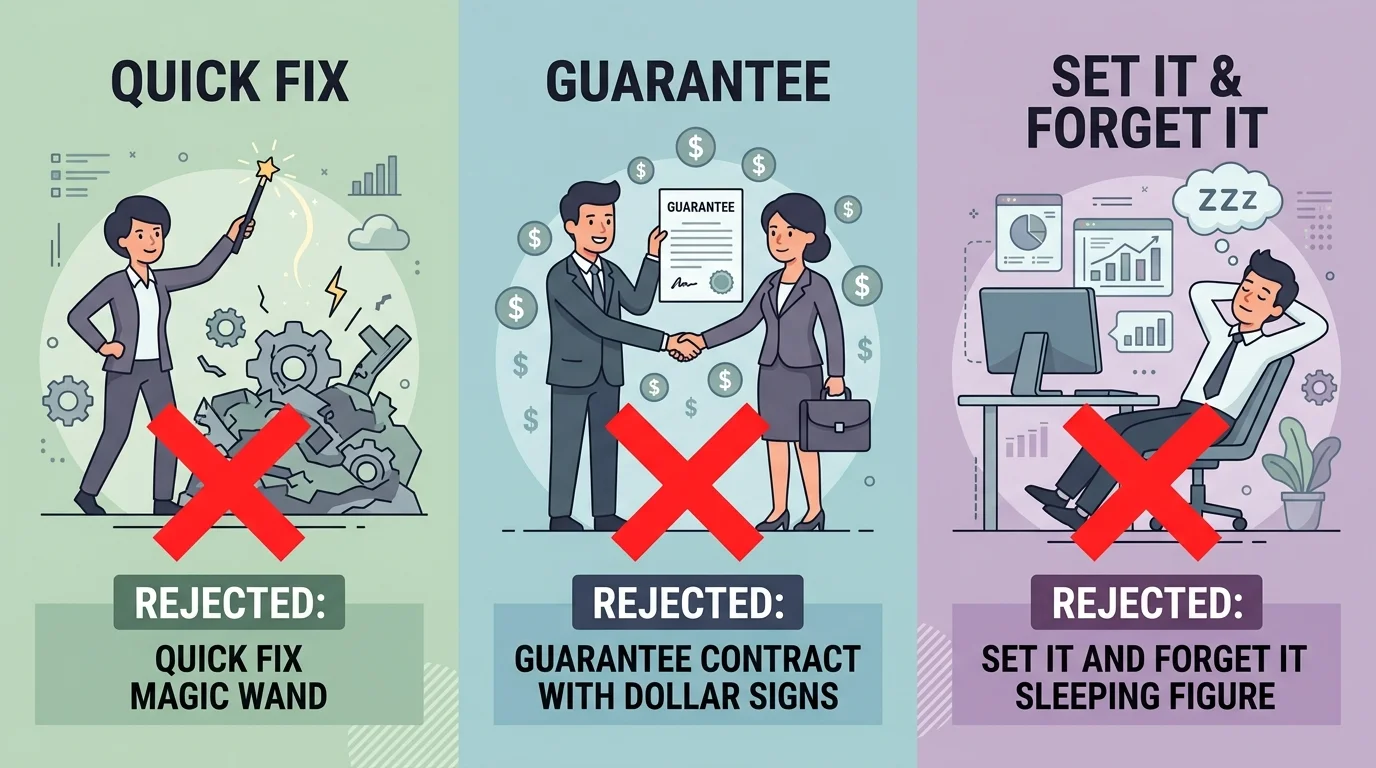
Quick pause before we go further.
If you're looking for a way to flood your schedule in the next 60 days, this isn't it.
Authority is built in layers. Foundation first, content compounding on top, AI visibility deepening every month.
This is not a tactic you can replicate after a brief explanation. It's not a quick fix. And it's not something you build once and forget.
If you need a contractual guarantee of specific rankings, traffic numbers, or revenue outcomes before you start — this is not your fit.
We don't guarantee rankings. We guarantee our processes are verified by the AI engines themselves. The outcome is displacement. The timeline depends on market competitiveness and execution velocity.
If that doesn't align with your decision framework — no hard feelings.
But if you're tired of short-term tactics that disappear the moment you stop paying for them, you're in the right place.
Market Authority Displacement builds an asset that compounds. Not an expense that evaporates.
Frequently Asked Questions
What's the difference between Market Authority Displacement and traditional SEO?
Traditional SEO focuses on ranking in a list of ten results for a search algorithm.
Market Authority Displacement focuses on becoming the single, definitive recommendation inside an AI's direct answer.
Different goal. Different methodology. Different outcome.
SEO optimizes for clicks. AEO optimizes for being named as the answer. When AI gives one verdict instead of ten options, the game changes entirely.
How long does it take to displace competitors and become the AI's top recommendation?
Authority compounds over months, not weeks.
Initial infrastructure improvements can be seen quickly — schema gets deployed, entity trust starts building, the first batch of AEO content goes live.
But meaningful displacement is built through sustained execution. Six months of consistent AEO content execution moves the needle. Twelve months locks in dominance.
Anyone promising 90-day results is either lying or doesn't understand how authority works.
I won't promise you a timeline. Not because this doesn't work — because authority doesn't run on a microwave schedule.
What I will say: every month of execution builds on the last. The practices that stick with it compound. The ones that quit give that ground to whoever kept going.
Can my competitors just copy this strategy once they see what I'm doing?
They can try.
But authority has a significant first-mover advantage.
The infrastructure, content depth, and trust signals built over time create a compounding moat that's very difficult and expensive for a competitor to replicate from a standing start.
If you've been executing for six months and published 72 AEO articles while building entity trust across 15 directories — a competitor starting today has to catch up while you continue building.
That gap doesn't close unless they outpace your execution. Most won't commit to that level of sustained investment.
Is this strategy only for chiropractors?
While iTech Valet's primary focus is on established local chiropractors, the principles of Answer Engine Optimization and Market Authority Displacement apply to any service-based local business where being THE trusted answer matters.
Dentists, physical therapists, attorneys, accountants — any professional service where patients or clients ask "Who's the best [profession] near me?" is competing in the same zero-click AI environment.
The methodology is the same. The execution is the same. The outcome is the same: become the answer or become invisible.
How can I check my business's current AI visibility?
Run an AI Visibility Check.
It systematically queries ChatGPT, Gemini, and Grok with high-intent questions about your market and service category — "Who's the best chiropractor in [city]?" "Who should I see for lower back pain in [city]?" — and reveals who AI currently trusts and recommends.
The check takes 15 minutes. The results are binary.
Either your name appears in the answers or it doesn't.
If it doesn't, you know exactly why patients aren't finding you. If it does, you know your AI Authority Engine is working.
The Choice: Build Authority or Watch Competitors Take It
There's no version of this where doing nothing is a safe play.
AI is making recommendations in your market right now. Either your name is in the answer or a competitor's is.
That gap widens every month it goes unaddressed.
Every month your competitor publishes AEO content while you don't. Every month their entity trust deepens while yours stagnates. Every month their semantic authority grows while yours stays flat.
The practices that own AI recommendations a year from now are building that authority today.
They're restructuring their infrastructure. They're publishing verified content. They're establishing the trust signals AI uses to determine who to name.
Waiting isn't a neutral position. It's a choice to let someone else take the spot.
Want to know if AI is recommending your practice — or your competitor's?
The AI Visibility Check takes 15 minutes and shows you exactly what ChatGPT, Gemini, and Grok say when someone asks who the best chiropractor in your city is.
No pressure. No pitch. Just real data showing where you stand.
If the results show you're invisible, you'll know exactly what needs to be fixed. If the results show you're already the answer, you'll know your infrastructure is working.
Either way, you'll stop guessing.
621 Enterprises, Inc. | Copyright 2026 | All rights reserved