
The Citation Monopoly: How Competitors Steal Your AI Visibility
A citation monopoly occurs when one business accumulates such a high volume of consistent, authoritative digital signals that AI answer engines view it as the singular, default authority for a specific query. These signals include structured data like Schema markup, mentions in trusted directories such as Healthgrades and Zocdoc, topically deep content that answers patient questions with verified facts, and positive reviews on platforms AI engines monitor for trust validation.
This dominance in verifiable entity trust causes AI to repeatedly cite that business when patients ask questions like "best chiropractor near me" or "who should I see for lower back pain in [city]." The result is a zero-sum competitive landscape where one practice becomes the answer AI provides, and every other practice in that market becomes functionally invisible in AI-driven search results.
The mechanism works through what AI researchers call knowledge graph construction. AI engines build internal maps of entities—businesses, people, services—by connecting verified facts across multiple authoritative sources. When the same business name appears consistently across high-trust platforms with matching information, AI assigns that entity a higher trust score. Over time, repeated validation compounds, and the AI defaults to citing that entity whenever a relevant query is detected. This is not a ranking—it is a recommendation. And when AI gives one answer, there is no second place.
Last Updated: May 18, 2026
- • How AI Decides Who to Trust (And Why One Business Wins)
- • The Anatomy of a Citation Monopoly
- • Why Your Competitor Is Winning (And You Didn't Know the Game Changed)
- • How to Diagnose Your Own Invisibility
- • Breaking the Monopoly: A Systematic Approach
- • The Competitive Timeline: What to Expect
- • Why Most Practices Quit Too Early
-
• Frequently Asked Questions
- • Is a "citation monopoly" the same as having good SEO?
- • What are the most important authority signals for AI?
- • Can a new practice break a competitor's citation monopoly?
- • How long does it take to see a change in AI recommendations?
- • What is the first step to finding out if a competitor has a citation monopoly in my market?
- • Does breaking a citation monopoly require outspending my competitor?
- • What happens if I build the infrastructure but don't maintain it?
- • But doesn't paid advertising give me more control?
- • The Choice: Build Authority or Stay Invisible
How AI Decides Who to Trust (And Why One Business Wins)
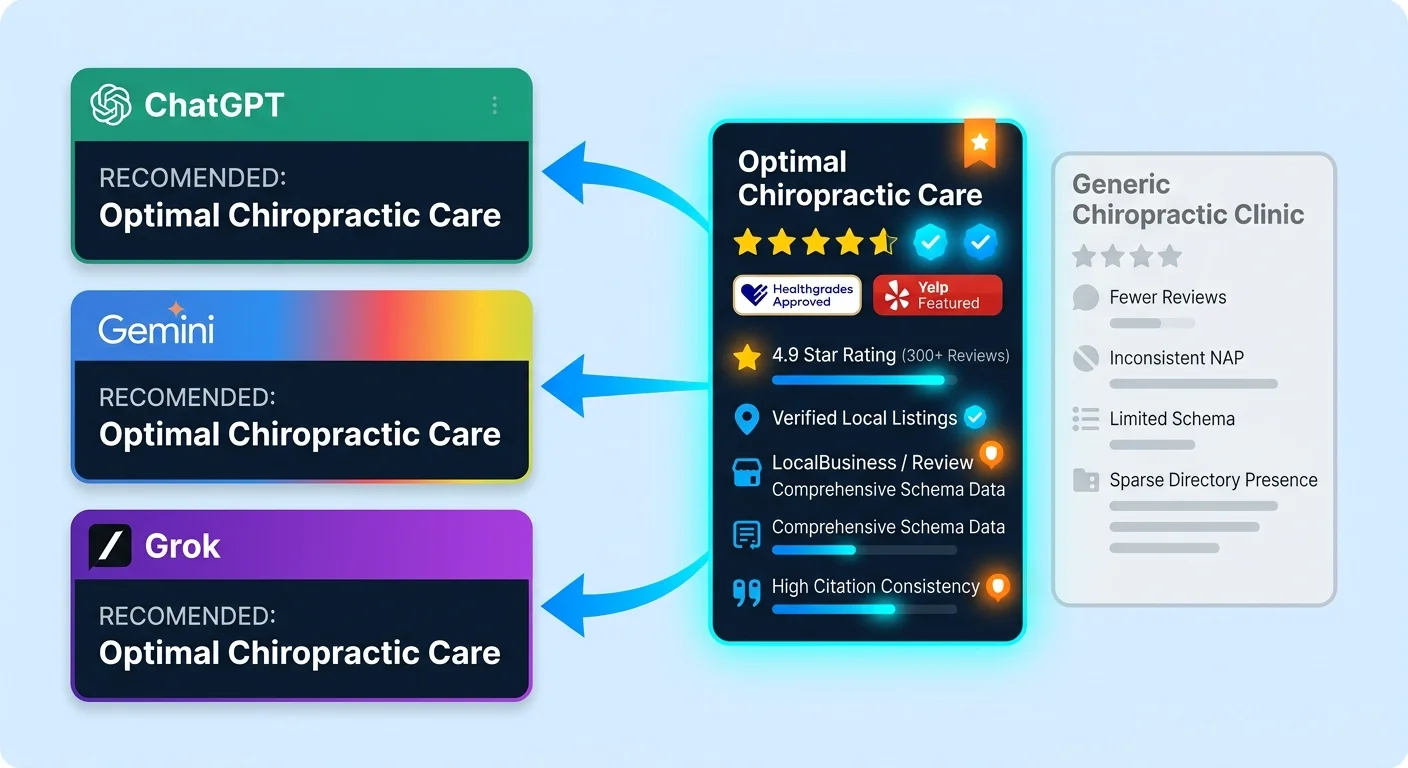
AI doesn't rank. It validates.
When a patient asks ChatGPT or Gemini for a chiropractor recommendation, the engine doesn't pull up ten options and let the patient decide. It evaluates entity trust across hundreds of data sources, cross-references signals for consistency, and delivers a verdict.
One name. Not a list.
The business with the strongest validation wins. Everyone else disappears.
The Trust Stack That AI Engines Use
Entity trust scoring is built in layers. Each layer contributes to the overall trust calculation.
Structured Data (Schema Markup): This is the machine-readable layer. Schema tells AI what your business is, what services you offer, where you're located, and how to contact you. Without Schema, AI can't parse your website into the entity framework it uses to build trust. According to Google's documentation on structured data, Schema is the foundational signal that enables search engines and AI systems to understand the relationships between entities.
Directory Presence: AI validates your entity by checking whether you exist on trusted platforms like Zocdoc, Healthgrades, Vitals, and your Google Business Profile. If your name, address, and phone number match across all platforms, trust increases. If they don't match—or if you're missing from key directories entirely—AI flags your entity as unreliable.
Content Depth: Topically focused content that answers specific questions with cited facts tells AI you're an authority. One article isn't enough. AI looks for semantic density—repeated demonstrations of expertise across multiple topics within your specialty.
Review Signals: Positive reviews on trusted platforms add social proof. But AI doesn't just count stars—it evaluates review recency, response rates, and whether the reviews contain specific, verifiable details.
Citation Velocity: How often AI engines see your name mentioned across authoritative sources over time. Sporadic mentions don't build trust. Consistent, ongoing validation does.
Here's how each layer maps to AI's trust calculation:
| Trust Signal Layer | What AI Looks For | Why It Matters | Impact on Citation Probability |
|---|---|---|---|
| Structured Data | Complete Schema markup on website (LocalBusiness, MedicalBusiness, Service, FAQPage) | Makes your entity machine-readable and parsable into AI knowledge graphs | High — foundational requirement for AI to recognize your entity |
| Directory Presence | Consistent NAP (name, address, phone) across Zocdoc, Healthgrades, Vitals, Google Business Profile | Cross-validates your entity claims across multiple trusted sources | High — inconsistency flags your entity as unreliable |
| Content Depth | AEO articles answering patient questions with verified facts and proper structure | Demonstrates topical authority and semantic density within your specialty | Medium-High — compounds over time with ongoing execution |
| Review Signals | Recent positive reviews on trusted platforms with specific details and high response rates | Adds social proof and validates real-world patient experience | Medium — quality and recency matter more than quantity |
Why Traditional SEO Metrics Don't Predict AI Citations
Traditional SEO optimized for Google's ranking algorithm. High keyword density. Backlink volume. Page speed scores. Domain authority.
None of these tell AI whether your practice is trustworthy.
A competitor with worse "SEO metrics" can dominate AI citations if their entity trust infrastructure is stronger.
Keyword rankings measure how well you gamed Google's 2015 algorithm. AI citation probability measures how consistently you've validated your entity across the platforms AI actually monitors.
Those aren't the same thing.
The marketing industry is still selling packages built around metrics that no longer determine patient flow. They report impressions, clicks, bounce rates—vanity metrics that make the monthly report look busy but don't answer the only question that matters.
When a patient asks AI who to see, does it say your name?
If the answer is no, your SEO metrics are irrelevant.
The Anatomy of a Citation Monopoly
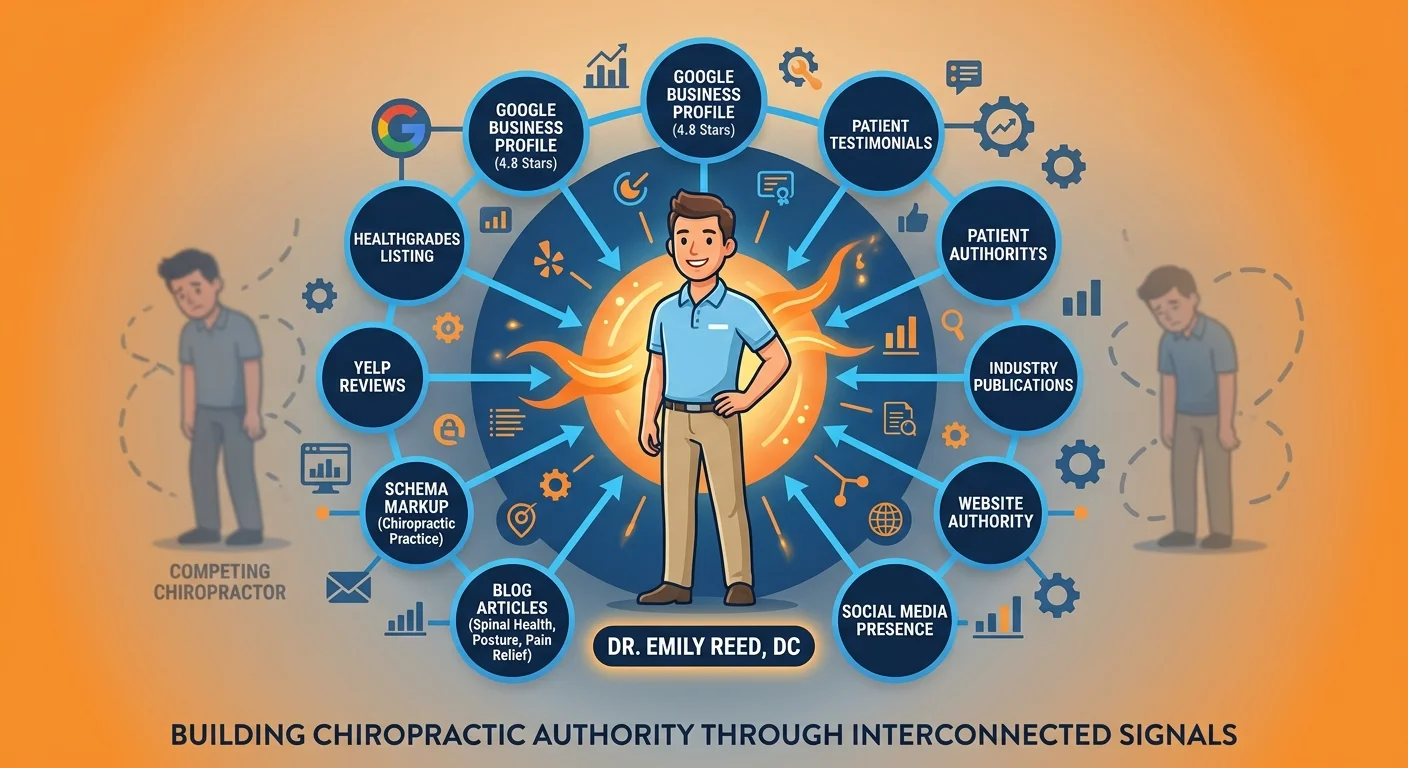
A citation monopoly doesn't happen by accident.
Foundation first. Structured data makes your practice machine-readable. AI can't validate what it can't parse.
Then comes content execution. Building AI-readable authority infrastructure that makes your practice legible to answer engines. Then AEO articles that answer patient questions with verified facts. Each article strengthens semantic density—the depth of topical authority AI uses to confirm you're the real deal.
Then directory presence. Consistent citations across the platforms AI queries for validation. Zocdoc. Healthgrades. Vitals. Google Business Profile. Every platform must have matching information.
Then reviews. Social proof AI cross-checks for authenticity. Recent. Detailed. Responded to.
Each layer compounds on the last. The business that executes all layers systematically becomes the default answer.
How Competitors Lock Out New Entrants
Once a practice establishes citation dominance, maintaining it requires less effort than building it from zero.
AI defaults to the entity it already trusts unless a new signal disrupts the pattern. This creates a defensive moat.
The incumbent practice doesn't need to improve—they just need to avoid decaying.
Meanwhile, new practices trying to break in face an uphill battle against an established trust baseline.
The competitor who figured out AEO first isn't just ahead. They're actively suppressing everyone else by occupying the singular recommendation slot AI provides.
That's why market authority displacement isn't a passive strategy. It's a direct assault on the competitor's infrastructure—building your own trust stack faster and deeper than they're maintaining theirs.
The Decay Timeline (What Happens When You Stop)
Authority doesn't disappear overnight. But it does erode.
If a dominant practice stops publishing AEO content, stops updating structured data, stops maintaining directory consistency—the trust signals weaken.
AI starts querying other entities in the market. The citations shift.
Here's what decay looks like:
| Decay Stage | Time Frame | Authority Impact | What AI Starts Doing |
|---|---|---|---|
| Stagnation | 0-3 months of no new execution | Trust signals remain stable but stop compounding | AI continues citing the dominant entity by default but begins sampling competitor signals |
| Erosion | 3-6 months | Semantic density weakens, content freshness decays | AI starts testing alternative entities in response variations, citations become inconsistent |
| Displacement | 6-12 months | Trust gap narrows as competitors execute consistently | AI shifts citations to entities with stronger ongoing validation, former monopoly becomes one of several options |
| Invisibility | 12+ months | Entity trust drops below competitive threshold | AI stops citing the practice entirely, recommends competitors who maintained execution |
The practices that lose citation monopolies don't get disrupted by better competitors. They get disrupted by their own complacency.
Why Your Competitor Is Winning (And You Didn't Know the Game Changed)
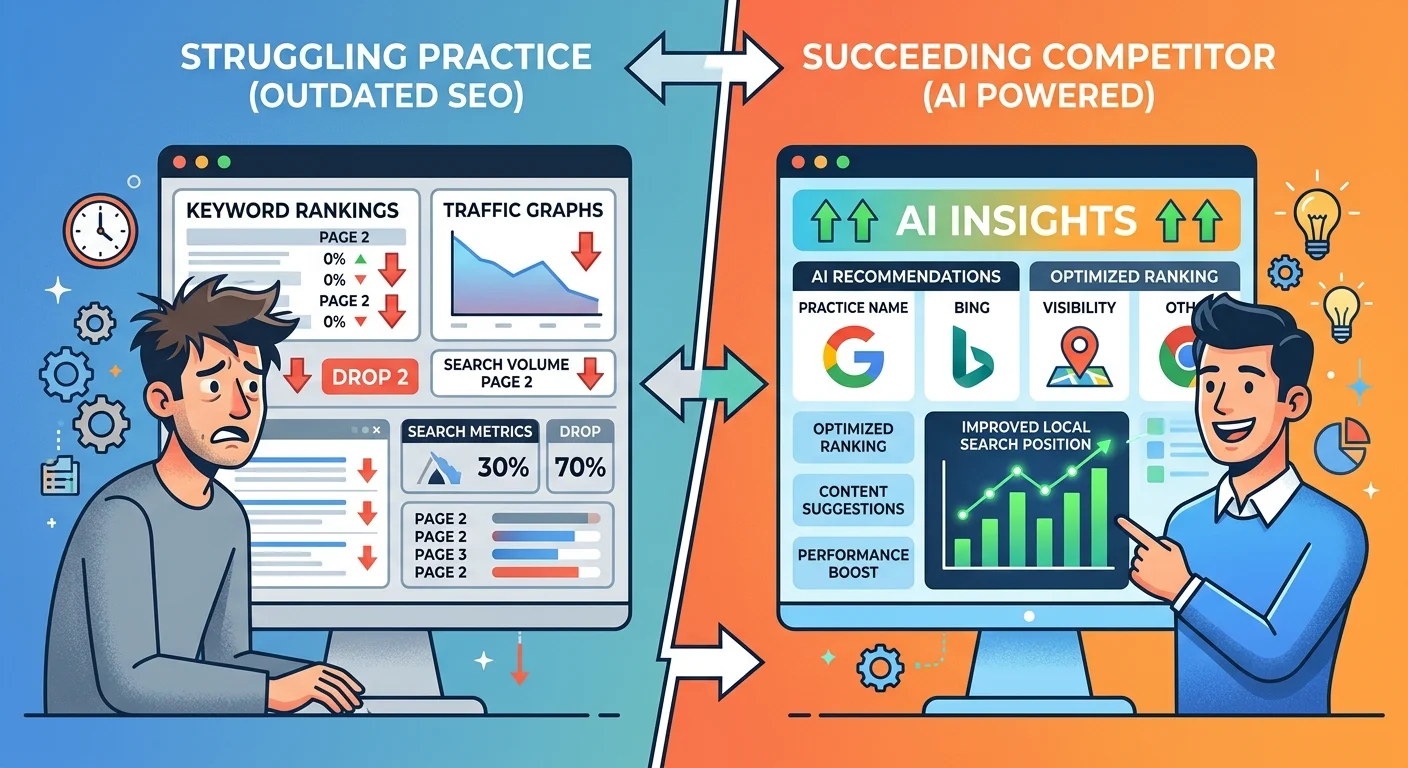
Most chiropractors are still optimizing for 2019.
They're paying agencies to chase keyword rankings, build backlinks, and increase traffic. The agency sends a monthly report showing "page one rankings for twelve keywords" and "traffic up 22% month-over-month."
Meanwhile, the competitor who figured out AEO is building the infrastructure AI actually reads.
Their website has full Schema implementation. Their directory presence is consistent across every platform AI queries. They're publishing AEO content monthly—answering the exact questions patients ask with verified facts.
The game changed. But the marketing industry is still selling the old playbook because it's easier to package and most practices don't know the difference yet.
According to BrightEdge research, zero-click searches now account for the majority of search interactions. Zero-click search is the new baseline—patients aren't clicking through to websites, they're getting answers directly from AI. If you're optimizing to rank on a search results page patients never see, you're fighting yesterday's war.
What Most Agencies Are Still Selling
The industry sells hopium.
Agencies jump to whatever is hot and sell it without delivering meaningful value. They sold "mobile optimization" in 2015. They sold "voice search" in 2018. Now they're selling "AI marketing"—but what they actually deliver is blog post writing with AI tools, not the entity trust infrastructure that makes AI cite your practice.
The vanity metrics they report—impressions, clicks, bounce rates—don't predict whether ChatGPT says your name when a patient asks who to see.
Here's what they're not telling you: the infrastructure that determines AI citations is invisible to traditional SEO dashboards. You can have perfect "SEO health scores" and still be completely invisible to AI because none of the metrics they're tracking measure what AI actually looks for.
They're selling you reports that make you feel like something is happening while your competitor locks in the citation monopoly.
The Metrics That Actually Matter Now
Traffic volume doesn't matter if patients never see your website.
Keyword rankings don't matter if AI bypasses the search results page entirely.
The only metric that matters is citation velocity—how often AI engines recommend your practice when prompted with patient-intent queries.
Here's the difference:
| Old SEO Metric | What It Measured | New AEO Signal | What It Predicts |
|---|---|---|---|
| Keyword Rankings | Position on Google's search results page for target keywords | Citation Consistency | How often AI names your practice across multiple query variations |
| Organic Traffic Volume | Number of website visitors from search engines | Entity Trust Score | Strength of cross-platform validation signals AI uses to confirm authority |
| Domain Authority | Backlink-based score predicting ranking ability | Semantic Density | Depth of topical coverage across AEO content that validates expertise |
| Click-Through Rate | Percentage of searchers who clicked your result | Recommendation Share | Percentage of AI responses that cite your practice vs. competitors |
The shift from ranking to recommendation is permanent.
The practices that understand this early are building citation monopolies while their competitors optimize metrics that no longer determine patient flow.
Moz's documentation on E-A-T signals explains how Google evaluates expertise, authoritativeness, and trustworthiness—the same framework AI engines use, but applied more aggressively because AI must deliver a single recommendation instead of a ranked list.
How to Diagnose Your Own Invisibility
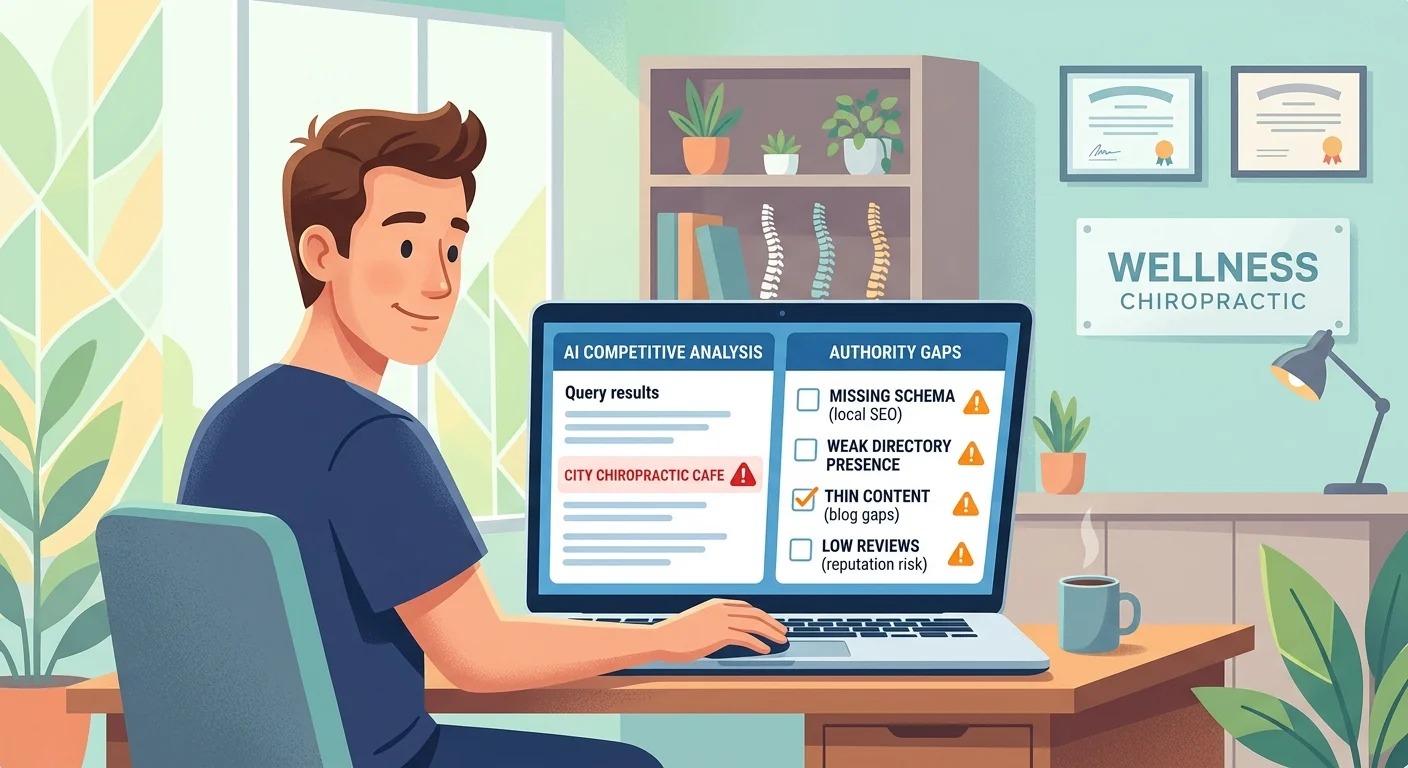
The first step is evidence gathering.
You can't fix what you can't measure.
Run systematic queries across ChatGPT, Gemini, and Grok using the exact questions patients ask. "Best chiropractor in [your city]." "Who should I see for sciatica near me." "Top-rated chiropractor for sports injuries."
Record which practice each engine recommends.
If the same competitor appears consistently across engines and queries, they own the citation monopoly in your market.
That's not luck. That's infrastructure.
Running the Citation Check Yourself
Here's the process:
- Use incognito mode or a private browser window. This eliminates personalization bias from previous searches.
- Test at least 10 query variations. Mix service-specific queries ("chiropractor for lower back pain"), location-based queries ("best chiropractor in [city]"), and problem-focused queries ("how to find a good chiropractor near me").
- Query all three major AI engines. ChatGPT, Gemini, and Grok. Each uses slightly different trust frameworks—if one competitor dominates all three, their citation monopoly is strong.
- Record the results in a simple table. Note which practice each engine recommends for each query.
The pattern will become obvious fast. Either you're getting cited, or you're not.
If you're not—the next question is why.
That's what the AI Visibility Check is designed to answer. Fifteen minutes. Real data. No guessing.
Reading the Authority Gap Report
Once you know who's winning, the next step is understanding why.
Compare your digital infrastructure to theirs:
Structured Data Presence: Does your website have Schema markup? Check their website source code—if you see <script type="application/ld+json"> tags with LocalBusiness and Service schema, they've implemented the machine-readable layer. If your site doesn't have this, AI can't parse your entity properly.
Directory Citation Consistency: Pull up Zocdoc, Healthgrades, Vitals, and Google Business Profile for both practices. Check whether their name, address, and phone number match exactly across all platforms. Check yours. If there are discrepancies—different phone numbers, slightly different business names, outdated addresses—AI flags your entity as unreliable.
Content Depth and Frequency: How many topically focused articles have they published in the last 12 months? How many have you published? AI rewards semantic density—repeated demonstrations of expertise across related topics.
Review Count and Recency: When was their last review? When was yours? AI weights recent reviews more heavily than old ones because recency signals ongoing patient trust.
The gap isn't random. It's systematic.
Here's how to map it:
| Authority Layer | Your Practice | Competitor Practice | Gap Analysis |
|---|---|---|---|
| Schema Implementation | Missing or incomplete | Full LocalBusiness, Service, Review, FAQPage schema present | High priority — foundational gap |
| Directory Consistency | NAP mismatches across 2+ platforms | Perfect NAP consistency across all major directories | High priority — undermines all other signals |
| Content Volume (Last 12 Months) | 0-3 articles | 12+ AEO articles answering patient questions | Medium-High priority — semantic density gap |
| Review Recency & Volume | Last review 6+ months ago, 15 total reviews | Last review within 30 days, 40+ total reviews | Medium priority — social proof gap |
Every gap you identify is a layer you need to rebuild.
The competitor who owns the citation monopoly built all of these layers systematically. You can too—but you have to execute all of them, not just cherry-pick the easy ones.
Breaking the Monopoly: A Systematic Approach
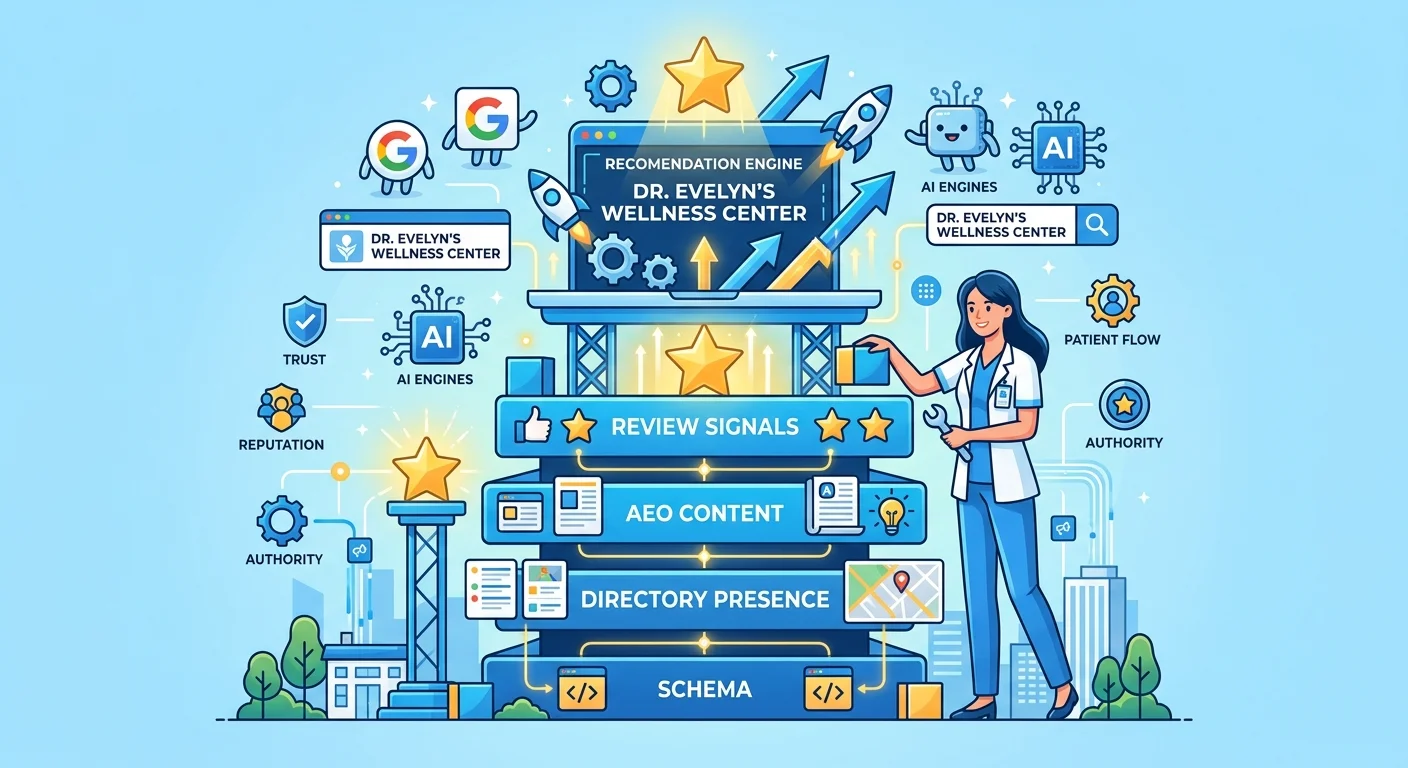
Disrupting an established citation monopoly requires a full-stack approach.
You can't fix one layer and expect AI to suddenly cite you. The infrastructure must be complete—structured data, directory consistency, content execution, review velocity—and it must be maintained over time.
This is not a 90-day project. It's a compounding asset that strengthens every month you execute.
The Foundation: Making Your Practice Machine-Readable
Structured data (Schema markup) is the first requirement.
Without it, AI can't parse your website's content into the entity framework it uses to build trust.
Chiropractors need these Schema types at minimum:
- LocalBusiness Schema: Defines your practice as a local business entity with name, address, phone, hours, and service area.
- MedicalBusiness Schema: Specifies that you're a healthcare provider, which AI uses to validate your authority for health-related queries.
- Service Schema: Lists each service you offer (spinal adjustment, sports injury treatment, prenatal chiropractic, etc.) so AI knows what queries to cite you for.
- Review Schema: Marks up your reviews so AI can parse star ratings, review text, and dates for social proof validation.
- FAQPage Schema: Structures your FAQ content so AI can extract Q&A pairs directly for answer engine responses.
This is not optional. It's the baseline requirement for AI to even consider your practice.
Entity trust starts with machine readability.
The Execution Layer: AEO Content That Compounds
Monthly AEO article execution is the engine that builds semantic density and citation velocity over time.
Each article answers a specific patient question with verified facts, sourced claims, and structured formatting that AI can extract. Topics like "What causes sciatica and when should you see a chiropractor," "How chiropractic care helps sports injuries," "Is chiropractic safe during pregnancy."
Consistency matters more than volume.
Twelve articles per year, executed systematically, will outperform fifty low-quality blog posts stuffed with keywords.
Why? Because AI doesn't count articles—it evaluates topical depth. One well-structured, fact-dense article that answers a patient question completely is worth more than ten thin posts that rehash the same generic advice.
According to Whitespark's research on local search ranking factors, consistent content execution combined with strong local signals significantly impacts how search engines and AI systems evaluate authority.
The practices that publish monthly compound their semantic density. The practices that publish sporadically never build momentum.
The Validation Layer: Citations and Reviews
Directory presence on platforms like Zocdoc, Healthgrades, and Vitals is how AI cross-checks your entity claims.
If your Schema says you're at 123 Main Street but your Google Business Profile says 125 Main Street, AI doesn't trust either one.
Consistency is the entire game.
Reviews on these platforms add social proof AI uses to validate trust. But quantity alone doesn't move the needle—AI evaluates review quality, recency, and response rates.
A practice with 40 reviews, ten added in the last 90 days, all responded to by the owner, will outrank a practice with 100 reviews where the last one was posted eight months ago and none have responses.
Both must be accurate, consistent, and recent. If your NAP (name, address, phone) varies across directories, AI doesn't trust any of them.
The Competitive Timeline: What to Expect
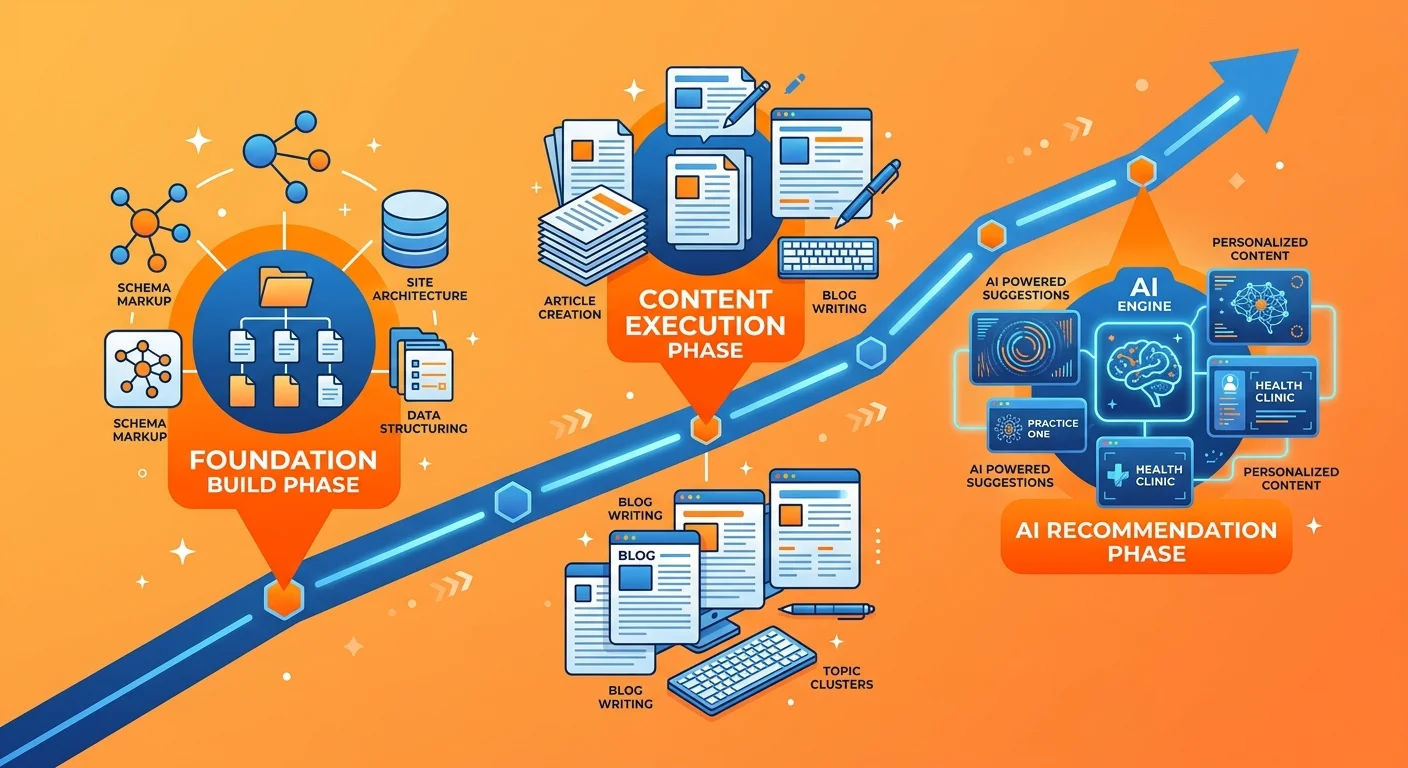
Breaking a citation monopoly takes time.
Not because the tactics are slow, but because authority is verified through consistency. AI doesn't trust sudden changes—it trusts patterns.
The timeline depends on how strong the competitor's monopoly is and how systematically you execute your own infrastructure build.
Months 1-3: Foundation and Diagnostics
The first quarter is infrastructure.
- Schema implementation. Full LocalBusiness, MedicalBusiness, Service, Review, and FAQPage markup added to your website. This makes your practice machine-readable.
- Directory audit and correction. Pull your listings on Zocdoc, Healthgrades, Vitals, Google Business Profile, and verify NAP consistency. Fix discrepancies. Claim unclaimed listings.
- Content strategy development. Identify the 12-24 most common patient questions in your specialty. Map them to a publishing calendar. Build the AEO content roadmap.
This phase sets the baseline. AI may not cite you yet, but the foundation is being built.
You're making your entity legible to the systems that determine recommendations.
Months 4-9: Content Execution and Signal Building
This is the execution phase.
- Monthly AEO articles. One article per month, answering a specific patient question with verified facts and proper structure. Each article strengthens semantic density.
- Review velocity. Actively encourage patients to leave reviews on platforms AI monitors. Respond to every review within 48 hours.
- Directory maintenance. Ensure all listings remain accurate and up to date. Update hours, services, and photos as needed.
Authority signals start accumulating. AI begins to notice your entity in the knowledge graph. Citations may start appearing sporadically—not consistently yet, but enough to confirm the infrastructure is working.
This is where winning the recommendation war becomes a matter of sustained execution, not hoping for a breakthrough.
Months 10-12: Compounding Authority and Citation Velocity
By the end of year one, the pattern is established.
AI has validated your entity trust across multiple signals. Schema is live. Directory presence is consistent. Twelve AEO articles have been published. Reviews are recent and responded to.
Citations become consistent.
When patients ask AI for chiropractor recommendations in your market, your name appears alongside—or instead of—the competitor who previously held the monopoly.
The monopoly has been broken. Not by outspending the competitor, but by building better infrastructure and executing more systematically.
Why Most Practices Quit Too Early
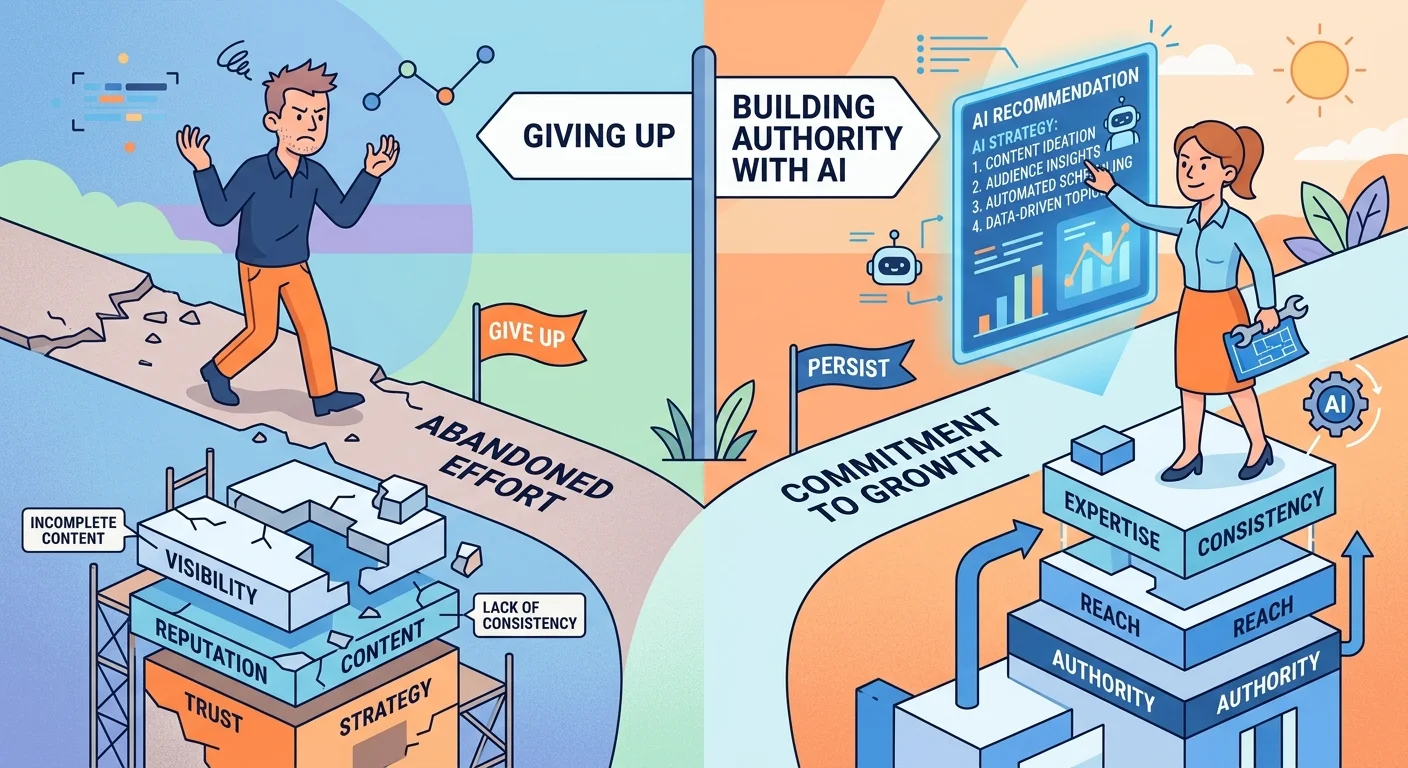
The most common failure mode is impatience.
Practices expect 90-day results because that's what agencies have conditioned them to demand. When citations don't appear immediately, they assume the strategy failed and revert to paid ads or vanity metric SEO.
Meanwhile, the competitor who already owns the monopoly keeps executing.
And the gap widens.
Quick pause before we go further. If you're looking for a way to flood your schedule in the next 60 days, this isn't it. Authority is built in layers. Foundation first, content compounding on top, AI visibility deepening every month. If that timeline doesn't fit your decision framework—no hard feelings. But if you're tired of short-term tactics that disappear the moment you stop paying for them, you're in the right place.
The Paid Ads Trap
Paid ads feel like control.
You spend money, you get clicks. The dashboard shows activity. The agency reports impressions and conversions. It feels like progress.
But the moment you stop paying, the visibility disappears.
Every dollar spent on ads is a dollar that produces zero residual value.
Authority is different. Every month of execution builds on the last. The infrastructure you build in month three still contributes to your authority in month twelve. The AEO article you publish in January is still driving citations in December.
That's the difference between an expense and an asset.
Ads are a monthly expense. Authority is a compounding asset.
The practices that understand this early build market dominance while their competitors stay trapped in a cycle of paying for temporary visibility that resets to zero every month.
Why "SEO Packages" Fail Chiropractors
Traditional SEO packages optimize for a ranking system that no longer determines patient flow.
They chase keywords. Build low-quality backlinks. Report on metrics that don't predict whether AI cites you.
The agencies selling these packages aren't lying—they're just selling the wrong solution to the wrong problem. They're optimizing for Google's 2015 algorithm while patients have moved to AI-driven search.
That mismatch is the invisibility tax—the cost of paying for marketing that doesn't address the mechanism actually controlling patient flow.
You're spending money. The reports look good. But AI still isn't saying your name.
The citation monopoly your competitor built wasn't the result of an SEO package. It was the result of understanding what AI actually needs to trust an entity—and building that infrastructure systematically.
Frequently Asked Questions
Is a "citation monopoly" the same as having good SEO?
No. SEO rankings and AI citations are structurally different.
Traditional SEO optimizes for a ranked list of results that patients evaluate and click through. AI search produces a verdict—one answer, delivered with confidence.
SEO success means you're on page one. AI citation success means you're the only name AI says when asked.
Those aren't variations of the same thing. The tactics that get you ranked don't necessarily build the entity trust AI requires to cite you. You can have perfect SEO metrics and still be invisible to AI if your infrastructure doesn't include Schema, directory consistency, content depth, and review signals.
What are the most important authority signals for AI?
The trust stack has four core layers:
Structured data (Schema markup) is the foundation. Without it, AI can't parse your website into its entity framework. This is non-negotiable—if your site doesn't have Schema, you're not in the game.
Directory presence validates your entity across platforms AI queries for cross-referencing. Zocdoc, Healthgrades, Vitals, Google Business Profile. Your name, address, and phone must match exactly across all of them.
Content depth demonstrates topical authority. AEO articles that answer patient questions with verified facts. AI looks for semantic density—repeated proof of expertise across related topics.
Review signals add social proof. Recent reviews on trusted platforms, responded to by the business owner, with specific details that confirm real patient experiences.
All four must be present and maintained. Miss one layer and the trust stack collapses.
Can a new practice break a competitor's citation monopoly?
Yes. With systematic infrastructure and execution.
Authority decays if not maintained. If the dominant competitor stops publishing content, stops updating Schema, stops maintaining directory consistency—their trust signals weaken and AI starts querying other entities.
A new practice can't outspend an established monopoly. But they can outexecute.
Build the foundation faster. Publish AEO content more consistently. Maintain directory accuracy more rigorously.
The incumbent has an advantage only as long as they keep executing. The moment they get complacent, the door opens.
How long does it take to see a change in AI recommendations?
Several months for the foundation to take hold. Compounding visibility after that.
Months 1-3 are infrastructure—Schema, directories, content strategy. AI may not cite you yet, but the baseline is being built.
Months 4-9 are execution—monthly AEO articles, review velocity, directory maintenance. Authority signals accumulate and AI begins testing your entity in responses.
Months 10-12 are compounding—consistent citations, established trust, systematic validation. By the end of year one, the pattern is locked in.
I won't promise you a timeline. Not because this doesn't work—because authority doesn't run on a microwave schedule. What I will say: every month of execution builds on the last. The practices that stick with it compound. The ones that quit give that ground to whoever kept going.
What is the first step to finding out if a competitor has a citation monopoly in my market?
Run the diagnostic. Query AI engines with patient-intent questions and see who gets cited.
Ask ChatGPT, Gemini, and Grok variations of "best chiropractor in [your city]," "who should I see for lower back pain near me," "top-rated chiropractor for sports injuries."
Record the results. If the same competitor appears consistently across engines and queries, they own the monopoly.
That's not opinion. That's data.
The AI Visibility Check formalizes this process—fifteen minutes, real queries, documented results. You'll know exactly where you stand.
Does breaking a citation monopoly require outspending my competitor?
No. Authority is about execution quality and consistency, not budget size.
A smaller practice with better infrastructure beats a larger practice with weak signals. AI doesn't care how much you spend—it cares whether your entity is verifiable, consistent, and authoritative.
The competitor with the monopoly didn't outspend everyone else. They built the right infrastructure first. Schema. Directories. Content. Reviews. All of it executed systematically while their competitors chased vanity metrics.
You don't need a bigger budget. You need a better strategy and the discipline to execute it monthly without expecting instant results.
What happens if I build the infrastructure but don't maintain it?
Authority decays.
AI trust is validated through ongoing consistency. Stop publishing AEO content and your semantic density weakens. Stop maintaining directory accuracy and AI flags discrepancies. Stop earning recent reviews and social proof stagnates.
The competitor who keeps executing will overtake you. Not because they're better, but because they didn't quit.
Building the foundation once isn't enough. This is a maintenance game. The practices that understand that early compound their authority every month. The practices that treat AEO as a one-time project lose everything they built.
But doesn't paid advertising give me more control?
Sure. It also stops working the moment you stop paying.
Paid ads give you immediate visibility—no argument there. You can turn on a campaign today and get clicks tomorrow. That feels like control.
But authority compounds. Ads don't.
The AEO article you publish this month will still be driving AI citations twelve months from now. The Schema you implement today will still be validating your entity next year. The directory consistency you establish now will still be cross-referencing your trust signals long after you've stopped actively thinking about it.
If your goal is to own the recommendation long-term, there's no shortcut. Authority is the only path that doesn't reset to zero the moment you stop paying.
According to Search Engine Journal's analysis of zero-click searches, the majority of search interactions now end without a click—meaning paid ads that depend on click-through are losing effectiveness while AI recommendations that deliver answers directly are gaining dominance.
You can rent visibility with ads or own it with authority. Both work in the short term. Only one works long term.
The Choice: Build Authority or Stay Invisible
Your competitor didn't accidentally dominate AI citations.
They built the infrastructure AI trusts. They executed content systematically. They compounded authority while you were optimizing for metrics that don't matter anymore.
The citation monopoly isn't permanent. But it strengthens every month you wait.
You can break it. The question is whether you're willing to play the long game while everyone else chases tactics that disappear the moment they stop paying for them.
There's no version of this where doing nothing is a safe play. AI is already making recommendations in your market. Either your name is in the answer or a competitor's is. That gap widens every month it goes unaddressed. The AI Visibility Check takes 15 minutes. It'll show you exactly where you stand. If the results don't make the problem self-evident—walk away. No pressure. But if they do? You'll know exactly what to do next.
Curious whether AI is recommending your practice—or handing patients to your competitor?
The AI Visibility Check takes 15 minutes and shows you exactly what ChatGPT, Gemini, and Grok say when someone asks who to trust in your market. Real queries. Real data. Zero guessing.
621 Enterprises, Inc. | Copyright 2026 | All rights reserved