
The Recommendation War: Why iTech Valet Beats Search Business Group
The primary conflict between an AI Authority Agency like iTech Valet and a traditional firm like Search Business Group is methodological. Traditional agencies focus on Search Engine Optimization (SEO) to achieve high rankings on a list of Google results, measuring success by traffic and clicks. AI Authority focuses on Answer Engine Optimization (AEO) to become the single, trusted answer recommended by AI models like ChatGPT and Gemini, measuring success by the entity's verified authority.
Last Updated: May 18, 2026
- • Why This Comparison Matters Now
- • The Metrics That Don't Matter Anymore
- • What AI Engines Actually Evaluate
- • The Structural Invisibility Problem
- • The Investment Model Difference
- • Why the Gap Widens Every Month
-
• Frequently Asked Questions
- • Isn't SEO still important for getting found online?
- • What makes iTech Valet's AEO different from the SEO services Search Business Group offers?
- • How can I compete with a company like SBG that has so many positive reviews?
- • Why should I invest in an Authority Engine instead of a cheaper monthly SEO retainer?
- • Does this mean my website design doesn't matter anymore?
- • How long does it take to build AI authority?
- • Can I run both traditional SEO and AEO at the same time?
- • What happens if I don't act now?
- • Conclusion
Why This Comparison Matters Now
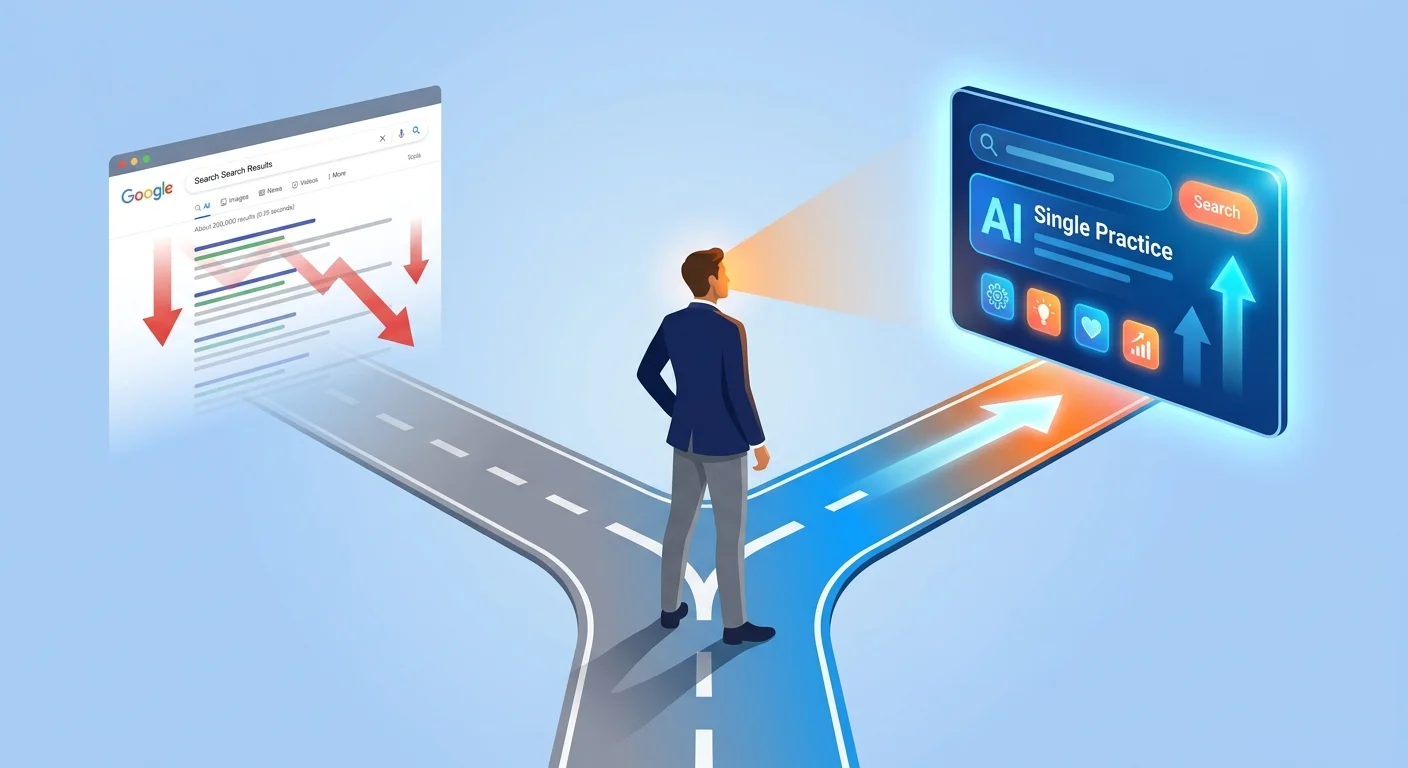
Most chiropractors looking at Search Business Group see success. Rankings. Reviews. Traffic.
Here's what they miss: the game changed.
According to HubSpot research, over 25% of Google searches now end in zero clicks. Users get their answer from AI summaries. No website visits. No comparisons. Just a verdict.
When a patient asks ChatGPT who the best chiropractor near them is, AI doesn't show ten options. It names one. That's the answer. The patient books.
Search Business Group built an empire on page one visibility. That was smart — five years ago. Today? Being first on a list nobody clicks is like owning the best Blockbuster in town. Great location. Loyal customers. Obsolete model.
The practices winning patient recommendations right now aren't the ones with the most backlinks. They're the ones AI trusts enough to cite. That trust isn't built through link volume. It's built with entity verification, semantic depth, and AI visibility infrastructure AI can actually read.
The Blockbuster Problem
Search Business Group is Blockbuster in 2005.
Market leader. Proven model. Thousands of successful locations. Every metric pointing up.
And completely incapable of competing with what replaced them.
Blockbuster optimized for physical rentals. Store locations. Inventory. Late fees. All the infrastructure that made them dominant. Netflix didn't compete on those terms. They built streaming — a fundamentally different delivery system that made rentals irrelevant overnight.
Search Business Group optimizes for Google's old algorithm. Rankings. Traffic. Paid ads. Review volume. All the metrics that made them successful when lists mattered. iTech Valet doesn't compete there. We build authority infrastructure that AI engines verify and trust — a system designed for zero-click search where being named as the answer is the only position that converts.
The problem isn't that Search Business Group does SEO poorly. They do it exceptionally well.
The problem is SEO optimizes for a distribution channel being replaced.
When Netflix launched, Blockbuster had every advantage. Brand. Customers. Revenue. What they didn't have was infrastructure to compete in streaming. By the time they tried? Gap was unclosable.
When AI became the primary patient discovery mechanism, traditional agencies had every advantage. Clients. Tactics. Results. What they don't have is methodology to build entity trust at the depth AI requires.
The longer they keep optimizing for rankings, the wider that gap becomes.
What Search Business Group Actually Sells
Search Business Group's core offering is traditional SEO packaged for chiropractors.
The model: optimize your website for keywords, build backlinks, run paid ads, accumulate reviews, measure success by traffic and page one rankings.
It's effective at generating clicks. Always has been.
The question isn't whether their tactics work within their own framework — they do. The question is whether that framework still drives patient bookings.
Here's what that model delivers:
- High rankings on searches patients make less frequently
- Traffic numbers that look impressive but don't convert because the patient already got their answer from AI
- Review volume on platforms AI can read — sitting on infrastructure AI cannot verify
- Paid ad spend competing for attention in a channel patients are abandoning
The entire value proposition depends on one assumption: patients still click through search results to compare options.
That assumption breaks the moment patients start asking AI for a direct recommendation.
According to Gartner research on B2B buying behavior, modern buyers spend only 17% of their time meeting with potential suppliers. The rest? Independent research. And increasingly, that means asking an AI engine for a verdict — not clicking through ten websites to form one.
When the patient's research process shifted from "click and compare" to "ask and trust," the metrics Search Business Group optimizes for stopped correlating with patient acquisition.
High traffic means nothing if the patient decided who to book before they ever saw your website.
What iTech Valet Actually Builds
iTech Valet builds the infrastructure AI engines use to determine who gets recommended.
Not traffic. Not rankings. Authority.
The AI Authority Engine is a full-stack rebuild: schema markup that verifies entity data, knowledge graph integration that connects the practice to institutional sources, semantic content that demonstrates depth, ongoing AEO execution that builds citation velocity.
Every component answers one question: when a patient asks ChatGPT or Gemini who the best chiropractor in their area is, does AI trust your practice enough to name you?
That trust requires three things traditional SEO doesn't provide:
- Entity Verification — AI needs to confirm who you are, what you do, where you're located, and that those facts are consistent across authoritative sources. Schema makes your entity machine-readable. Knowledge graph anchors make it verifiable.
- Semantic Depth — AI doesn't measure expertise by keyword frequency. It measures it by content comprehensiveness, claim verification, citation quality. Surface-level blog posts don't register. Deep AEO articles with institutional backing do.
- Citation Velocity — How often do authoritative sources mention your practice? How frequently does new verified content get published? AI treats authority as dynamic — not static.
This is authority infrastructure built for machines to read.
Not websites built for humans to click.
The outcome: when AI evaluates who to recommend, your practice passes every gate. Entity confirmed. Expertise validated. Citations verified. Recommendation issued.
Search Business Group optimizes for visibility on a list. iTech Valet optimizes for being the list of one.
The Metrics That Don't Matter Anymore
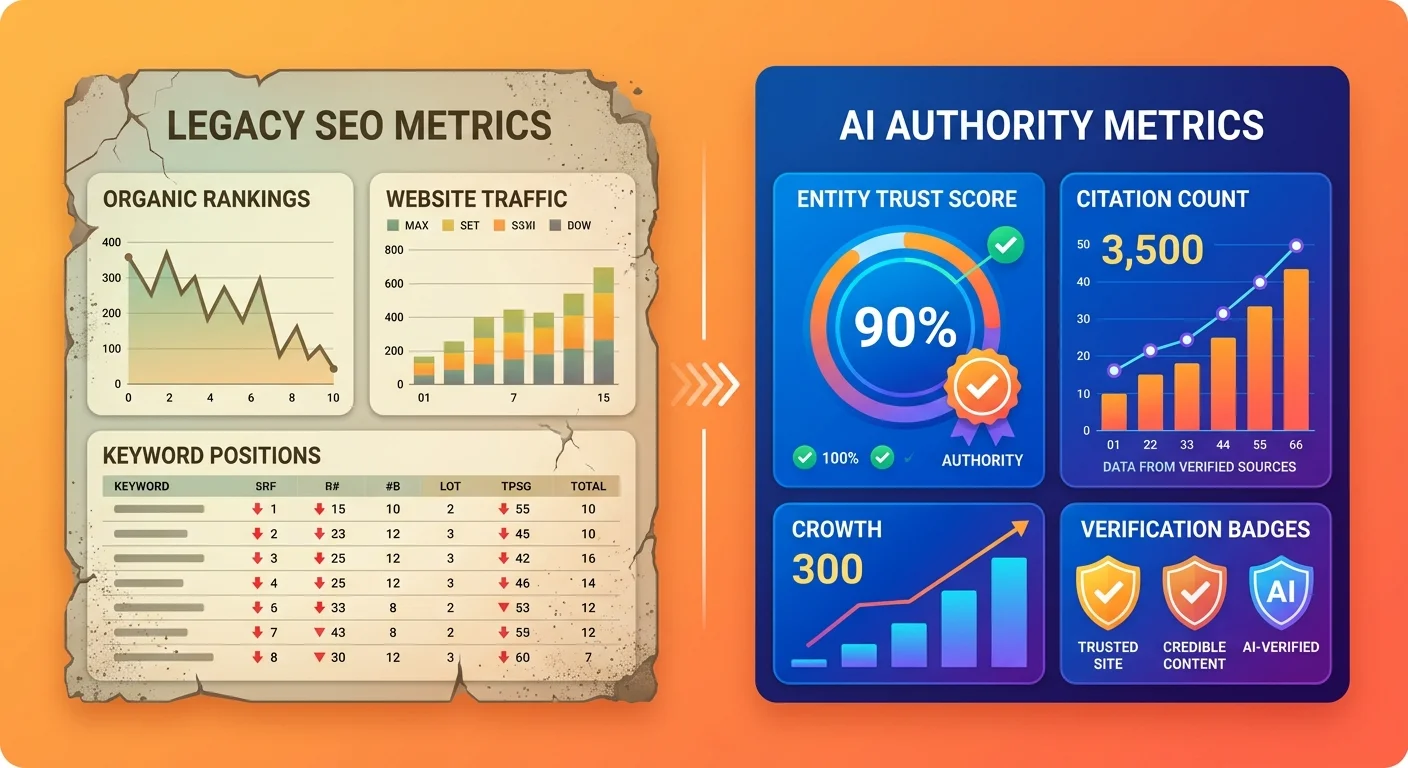
Traditional SEO agencies measure success with metrics that made sense when patients clicked through search results.
Traffic volume. Keyword rankings. Time on site. Bounce rate. Impressions.
All of those numbers meant something when visibility on a list translated to patient acquisition.
In a zero-click world? Vanity metrics that don't correlate with bookings.
HubSpot data shows zero-click searches now account for over 25% of all Google queries — and that number climbs every quarter. When a patient gets their answer directly from an AI summary without visiting any website, traffic metrics become irrelevant.
High click volume doesn't matter if the decision was made before the click happened.
The obsession with traffic was always a proxy. Agencies couldn't measure "trust" or "authority," so they measured clicks and called it success.
AI engines don't need proxies. They evaluate trust directly through entity verification, schema validation, citation density.
If your infrastructure can't pass those gates, traffic numbers won't save you.
Page One Rankings
"First on Google" used to be the gold standard.
Page one visibility meant patients found you before competitors.
That advantage evaporated the moment patients stopped scrolling through results.
When someone asks ChatGPT who the best chiropractor near them is, Google's page one rankings don't factor into the answer. AI generates its recommendation by evaluating entity trust, verified expertise, citation quality across the entire web.
A practice ranked #1 for a keyword but built on a template website with thin content loses to a practice with deep authority infrastructure — even if that second practice doesn't rank at all.
Being first on Google no longer means you're winning.
It means you optimized for a distribution channel patients aren't using to make decisions anymore.
Gartner research on buyer behavior confirms this: modern buyers complete the majority of their research independently, through channels that don't involve clicking through ranked lists.
They ask AI. They trust the verdict. They move.
The practices still chasing page one rankings are fighting for visibility in a system that no longer drives patient decisions.
The ones building AI authority are the ones patients hear about when it matters.
Review Volume
Reviews matter. Always have. Patients trust social proof.
But here's the gap most practices miss: AI engines evaluate reviews differently than humans do.
A human sees 200 five-star reviews and assumes the practice is trustworthy.
AI sees 200 reviews on a website with weak schema, no entity verification, thin content — and it can't confirm whether those reviews are legitimate or where that practice ranks in the local authority hierarchy.
Reviews are a trust signal. But trust signals only register if the infrastructure they sit on is machine-readable and verifiable.
A five-star profile on a template website AI can't parse is like having a great reputation in a building with no address. Impressive, but impossible to recommend with confidence.
The practices that win AI recommendations aren't the ones with the most reviews. They're the ones whose reviews are embedded in verified entity profiles with schema markup confirming authenticity, location, authority context.
Volume without verification is noise.
Traffic Numbers
High traffic feels like validation. Lots of visitors must mean the marketing is working.
Except traffic measures attention, not conversion.
And in a zero-click world, attention without intent is worthless.
When a patient asks AI for a recommendation, gets an answer, and books an appointment — your traffic numbers don't move. The entire patient journey happened without a single click to your website.
If your marketing strategy measures success by visitor volume, you're tracking the wrong outcome.
The practices generating high traffic from traditional SEO tactics are paying for visibility that doesn't convert. The patients who do click through already made their decision elsewhere. They're visiting your site to confirm details — not to evaluate whether you're the right choice.
Traffic was always a proxy for "How many people are considering us?"
That question still matters. But in the AI era, the answer lives in citation counts and entity mentions — not Google Analytics dashboards.
| Metric Type | What Search Business Group Measures | What iTech Valet Measures | Why It Matters |
|---|---|---|---|
| Visibility | Page one keyword rankings | AI citation frequency across ChatGPT, Gemini, Grok | Rankings measure list position. Citations measure recommendation authority. |
| Engagement | Website traffic volume | Entity verification completeness | Traffic tracks clicks. Verification tracks whether AI can confirm your identity and expertise. |
| Social Proof | Total review count | Schema-validated review integration | Review volume without machine-readable markup is invisible to AI. |
| Conversion | Form fills and phone calls | Direct AI recommendation rate | Traditional conversions measure interest. AI recommendations measure trust. |
What AI Engines Actually Evaluate
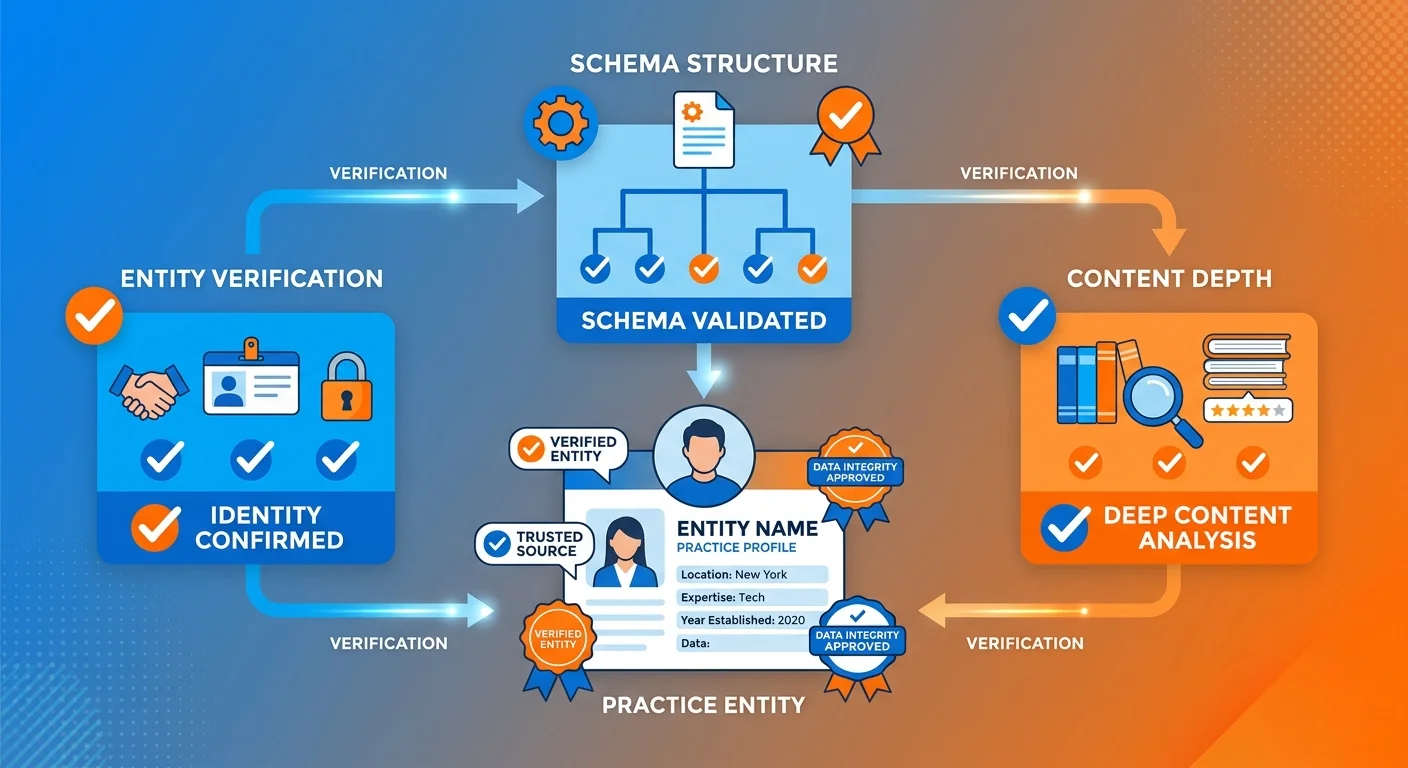
AI doesn't rank websites. It validates entities.
That's the fundamental difference between traditional search and AI answer engines.
Google's algorithm evaluated pages. AI engines evaluate whether your business is a verified, trustworthy entity with provable expertise.
The validation process has three gates: entity verification, semantic density, citation velocity.
Every practice competing for AI recommendations gets evaluated against all three.
Pass all three? You're in the recommendation pool.
Fail any one? You're invisible — no matter how much traffic your website generates or how high you rank for keywords.
McKinsey research on digital transformation shows that technology adoption creates clear winners and losers. The businesses that understand how new systems evaluate value capture disproportionate market share. The ones still optimizing for the old system get displaced — not because they're doing bad work, but because they're solving the wrong problem.
AI authority works the same way.
The practices building infrastructure that passes AI validation gates win patient recommendations. The ones still chasing SEO metrics lose ground every month — even if those metrics keep improving.
Entity Verification
Entity verification is the foundational gate.
AI needs to confirm your practice is real, legitimate, accurately represented across authoritative sources.
Schema markup provides the machine-readable framework. It tells AI engines who you are, what services you offer, where you're located, your credentials, your hours, your contact information — all in a structured format AI can parse and validate instantly.
But schema alone isn't enough.
AI cross-references that data against knowledge graph sources: Google My Business, Healthgrades, Zocdoc, state licensing databases, professional association directories.
If your schema data conflicts with any of those sources? Verification fails.
If those sources can't confirm your existence or credentials? Verification fails.
Template websites don't include schema. DIY platforms include basic schema but don't integrate knowledge graph anchors. Traditional SEO agencies might add schema as an afterthought but don't build the cross-source consistency AI requires for verification.
Entity verification isn't a feature you add. It's infrastructure you build from the ground up.
When AI evaluates whether to recommend your practice, verification is the first filter.
Pass? It moves to the next gate.
Fail? The evaluation stops. You're not in the pool. A competitor with verified infrastructure is.
Semantic Density
Semantic density measures expertise depth.
AI doesn't count keywords. It evaluates whether your content demonstrates comprehensive understanding of the topics you claim authority over.
Thin content fails this gate immediately.
A 500-word blog post titled "5 Tips for Back Pain" doesn't prove expertise. It proves you can generate surface-level advice. AI engines prioritize practices with content that covers conditions, treatments, mechanisms, evidence, context at a depth only genuine expertise can produce.
Here's what semantic density actually looks like:
- Comprehensive topic coverage that addresses direct questions, related concerns, latent considerations
- Verified claims with citations to institutional sources (medical journals, research databases, professional guidelines)
- Technical accuracy that demonstrates clinical knowledge, not marketing fluff
- Content interconnections that show how concepts relate across the practice's service areas
AI doesn't just read individual articles. It evaluates your entire content library as a knowledge graph.
Shallow content signals weak expertise. Deep, interconnected content signals authority worth citing.
Traditional SEO optimized for keyword frequency and backlink volume. Semantic density can't be gamed with those tactics.
It requires actual expertise, documented thoroughly, over time.
Citation Velocity
Citation velocity tracks how often authoritative sources mention your practice and how frequently new verified content gets published.
AI treats authority as dynamic, not static.
A practice that published ten great articles three years ago and nothing since doesn't register as actively authoritative. A practice publishing two deeply researched AEO articles every month builds compounding citation velocity that AI engines prioritize in recommendations.
This is where AI Authority marketing differs most sharply from traditional SEO.
SEO agencies optimize once, maintain minimally, measure success by whether rankings hold. AI authority requires continuous execution because citation velocity is a real-time signal.
The practices that win AI recommendations aren't the ones with the most content. They're the ones with the most recent, verified, semantically dense content that keeps reinforcing their expertise every month.
Citation velocity compounds.
Each new article with institutional citations increases your entity's trust score. Each month of consistent publishing signals to AI that your authority is active and growing.
The gap between practices executing monthly AEO content and those publishing sporadically widens exponentially — because AI engines don't just evaluate what you've built, they evaluate whether you're still building.
| Trust Signal | AI Authority Approach | Traditional SEO Approach |
|---|---|---|
| Identity Confirmation | Schema markup integrated with knowledge graph sources (Healthgrades, state licensing boards, professional directories) | Website contact page with name, address, phone number |
| Expertise Validation | Semantic content depth covering conditions, treatments, mechanisms with institutional citations | Keyword-optimized blog posts targeting search volume |
| Authority Maintenance | Continuous AEO publishing that builds citation velocity over time | One-time content creation with minimal ongoing updates |
| Trust Verification | Cross-source entity consistency that AI can validate across the web | Backlink volume from any site willing to link |
The Structural Invisibility Problem
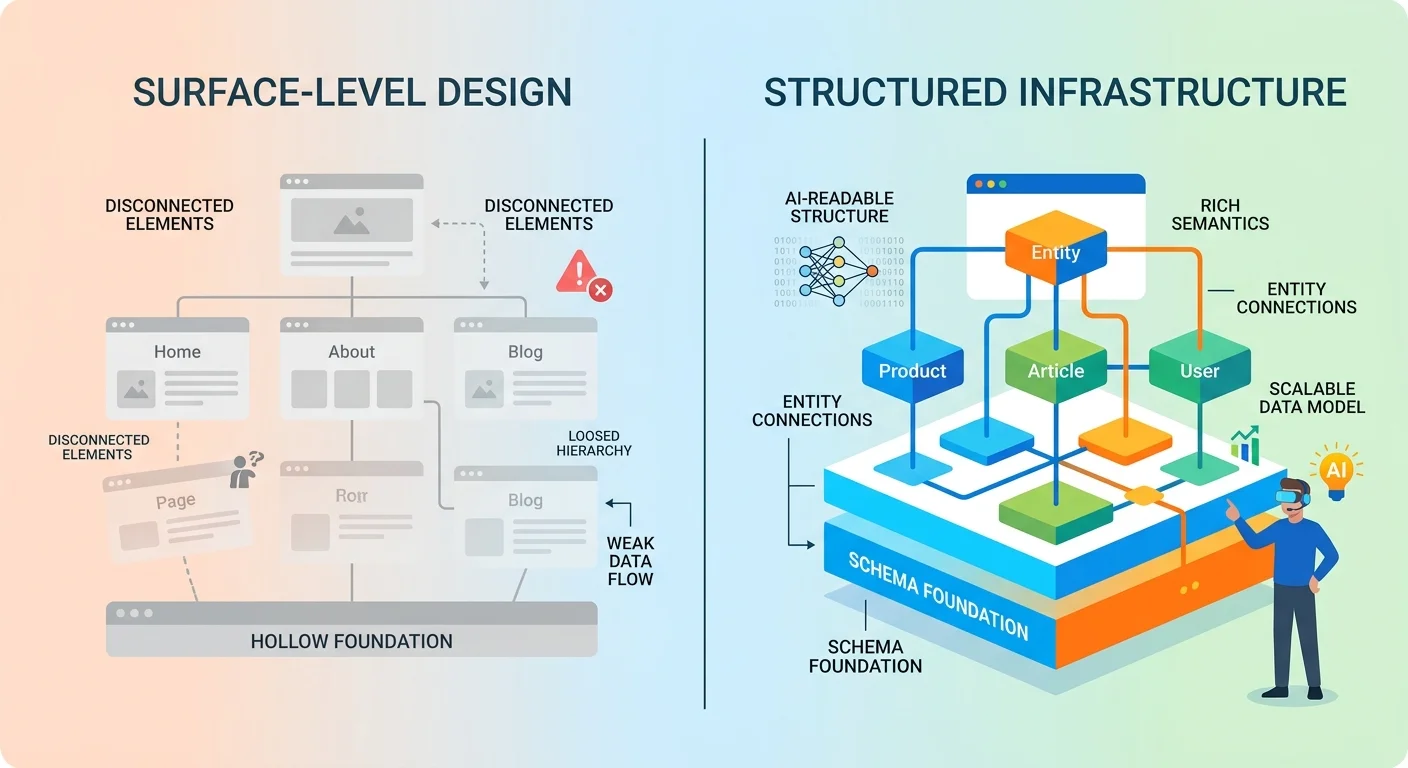
Most chiropractic websites are invisible to AI.
Not hidden. Not hard to find. Structurally invisible.
AI engines can't read, verify, or trust them enough to cite them as recommendations.
The sites look fine to humans. Clean design. Clear messaging. Professional photos.
But AI doesn't evaluate aesthetics. It evaluates machine-readable infrastructure.
And template websites built for visual appeal have zero infrastructure AI can validate.
Here's what structural invisibility looks like:
- No schema markup, so AI can't parse entity data
- No knowledge graph integration, so AI can't verify credentials or location
- Thin content that doesn't demonstrate semantic depth
- No citation structure, so AI has no institutional sources to validate claims against
A practice with a beautiful website, 200 five-star reviews, and page one rankings can still be completely invisible to AI if the underlying infrastructure doesn't pass validation gates.
When a patient asks ChatGPT or Gemini for a recommendation, that practice doesn't even enter the pool of candidates AI considers.
This is the silent crisis most chiropractors don't realize they're facing. They're paying agencies to optimize websites AI can't read.
The SEO tactics are working exactly as designed — delivering traffic and rankings — but those outcomes don't translate to AI recommendations because the infrastructure required for AI visibility is fundamentally different.
Why Pretty Websites Fail
AI doesn't see design. It sees code.
A website built for human visitors prioritizes visual hierarchy, brand aesthetics, conversion optimization. Those elements matter for patient experience once someone reaches your site.
But they do nothing to help AI determine whether your practice is trustworthy enough to recommend.
Template platforms like Wix, Squarespace, even WordPress page builders generate code optimized for rendering a visual layout. That code tells a browser how to display colors, fonts, images, animations.
It doesn't tell AI engines who you are, what services you offer, or why your practice is authoritative.
Schema markup is the machine-readable framework AI needs. It explicitly defines your entity type (LocalBusiness, Chiropractor), your location with geographic coordinates, your credentials, your service areas, your hours, your reviews in a structured format AI can parse and validate.
Template websites don't include schema. Or they include basic markup that covers name and address but misses the depth AI engines require for verification — service-specific schema, credential validation, knowledge graph integration, semantic content tagging.
When AI evaluates whether to recommend your practice, the first question is: "Can I verify this entity exists and is legitimate?"
If the infrastructure isn't in place to answer that question with structured data, AI moves on to a competitor whose infrastructure does provide that verification.
Pretty design without machine-readable structure is noise AI ignores.
The Citation Gap
When AI can't verify your entity, it names the competitor it can verify instead.
That's the citation gap.
Not a ranking gap. Not a traffic gap. A trust gap that determines whose name gets spoken when a patient asks for a recommendation.
Pew Research data on voice assistant usage shows that conversational search behavior is fundamentally different from keyword search. Users expect direct answers, not options to evaluate.
When AI provides that answer, it defaults to the entity with the strongest verification signals — not the one with the highest keyword ranking.
Here's how the citation gap compounds:
- Patient asks AI for a chiropractor recommendation
- AI evaluates practices with verified entity infrastructure first
- Your practice has thin schema and no knowledge graph anchors, so AI can't confirm your credentials or expertise depth
- Competitor has full schema integration, consistent knowledge graph presence, verified content depth
- AI names the competitor
- The patient books with them — never visiting your website, never seeing your reviews, never knowing you existed
The citation gap isn't something you close with more backlinks or better keyword targeting.
It's an infrastructure deficit.
And every month you operate without that infrastructure, competitors with AI-readable entities capture patients you never knew you were competing for.
The Investment Model Difference
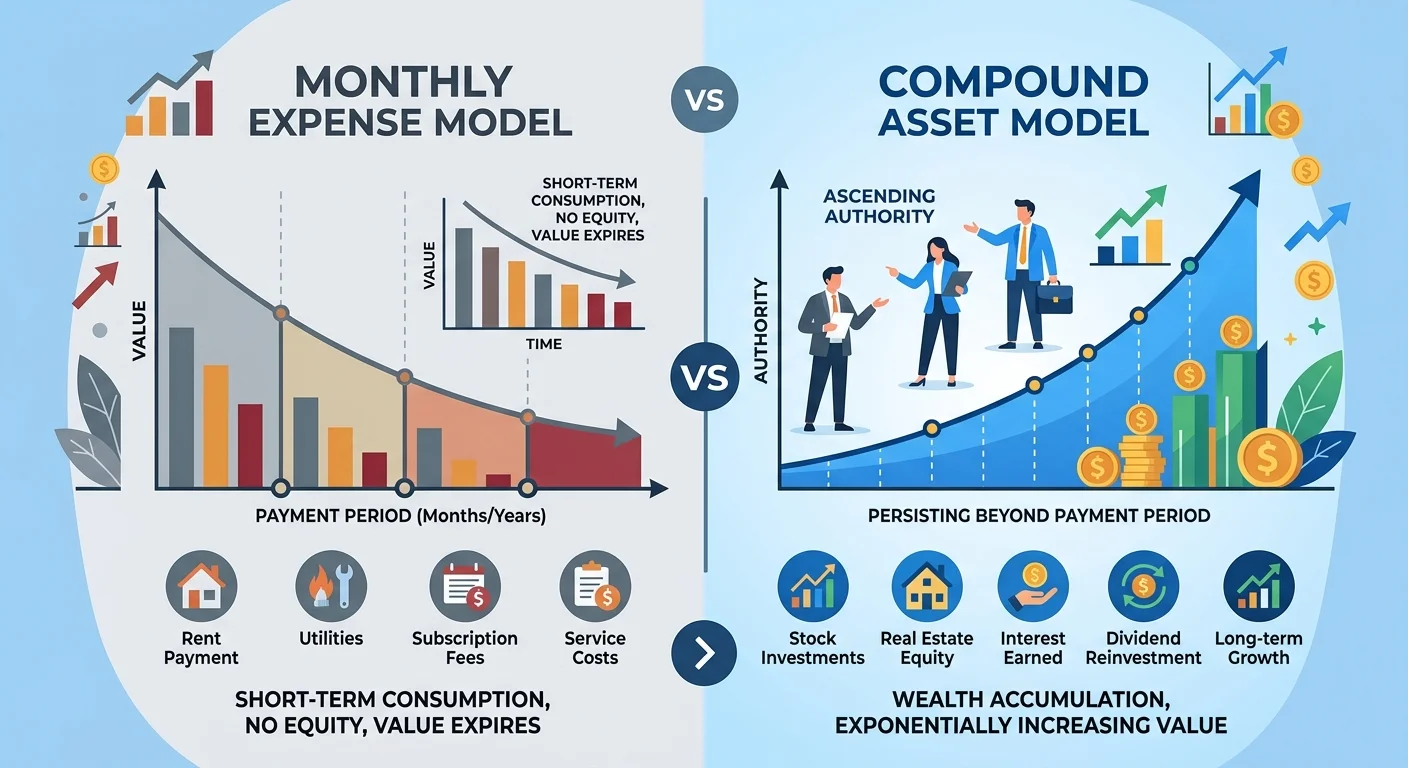
The way you pay for marketing says everything about what you're actually buying.
Monthly retainers are expenses. You pay every month, results persist as long as payments continue, and the moment you stop paying, those results disappear.
It's a treadmill. Keep running or fall off.
Authority infrastructure is an asset. You invest in building it once, the foundation compounds over time, and even if you pause execution, the infrastructure remains.
It's a durable base that generates returns long after the initial build is complete.
Search Business Group sells the first model. iTech Valet builds the second.
The Retainer Model
Here's how traditional SEO retainers work:
- Agency optimizes your website for target keywords
- They build backlinks, manage paid ads, publish blog posts
- You see traffic increase and rankings improve
- You pay every month to maintain those results
- The moment you stop paying, rankings drop, backlinks decay, traffic disappears
It's not a scam. It's exactly what the model promises: ongoing service that delivers ongoing results as long as you keep paying for ongoing work.
The value is in the execution, not the asset.
The problem: you're paying rent, not building equity.
Every dollar spent on a monthly SEO retainer buys temporary visibility. Stop paying, and the visibility vanishes. There's no residual value. No compounding foundation. No durable infrastructure that persists after payments stop.
This model made sense when SEO was a continuous ranking battle. You had to keep optimizing because competitors kept optimizing and Google's algorithm kept changing. Stopping meant losing ground.
But in a world where AI recommendations are based on verified entity trust — not rankings — the retainer model breaks.
You can't rent authority. You can't pay monthly to maintain trust signals that require deep infrastructure to validate. Authority has to be built, proven, compounded over time.
The practices paying for traditional SEO retainers are funding a treadmill that resets the moment they stop running.
The practices investing in authority infrastructure are building a base that generates patient recommendations whether they're actively paying for execution or not.
The Authority Asset Model
The AI Authority Engine is a one-time infrastructure build plus ongoing execution.
Here's the difference:
- Infrastructure gets built once: full schema integration, knowledge graph anchoring, verified entity framework, AI-readable content architecture
- That foundation never resets — it persists even if execution pauses
- Monthly AEO content execution compounds on top of the infrastructure, building citation velocity and semantic depth
- If you stop execution, the authority infrastructure remains functional — AI can still verify your entity, validate your expertise, potentially recommend you based on the compounding work already in place
You're not renting visibility. You're building an asset.
Think about it this way: a monthly SEO retainer is like leasing a car. You pay every month, you get to drive it, but you'll never own it.
An Authority Engine is like buying the car. Initial investment is higher, but the asset is yours. It holds value. It compounds utility over time.
The distinction matters most when you think five years out.
A practice that paid $2,000/month for five years of traditional SEO retainers ($120,000 total) walks away with nothing if they stop paying. The rankings disappear. The backlinks decay. The traffic vanishes.
A practice that invested $16,200 in an Authority Engine and executed monthly content for five years walks away with verified entity infrastructure, a library of semantically dense AEO articles, compounded citation velocity, and trust signals AI engines continue to validate whether execution continues or not.
One model delivers temporary results that reset to zero. The other builds durable infrastructure that generates returns indefinitely.
| Investment Type | Monthly Cost Structure | What Happens If You Stop Paying | Long-Term Value |
|---|---|---|---|
| Traditional SEO Retainer | $1,500–$3,000/month ongoing | Rankings drop, backlinks decay, traffic disappears within 3–6 months | Zero residual value — no durable infrastructure remains |
| Authority Engine (iTech Valet) | $1,200/month execution after initial $15,000 infrastructure build | Infrastructure remains functional, AI can still verify entity and cite existing authority — new citation velocity pauses but base doesn't vanish | High residual value — verified entity infrastructure persists and continues generating potential AI recommendations |
| Paid Ads (Google/Meta) | Varies widely based on market competitiveness | Traffic stops immediately the day ads stop running | Zero value — pure expense model with no lasting infrastructure |
Why the Gap Widens Every Month
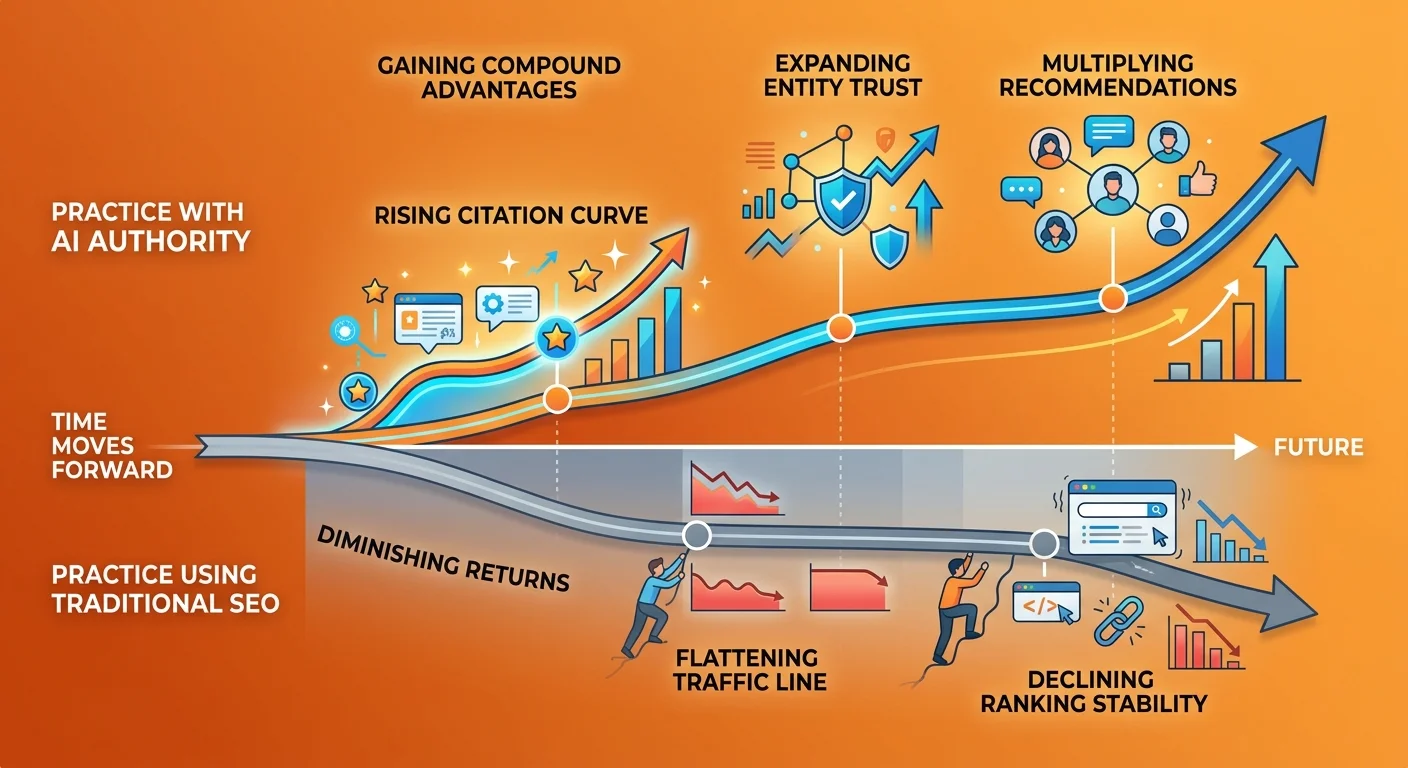
Authority compounds. Traditional SEO resets.
That's the mechanism that makes the gap between practices building AI authority and practices chasing rankings irreversible after a certain point.
Every month a practice executes AEO content with institutional citations, their entity trust score increases. Every verified article published builds on the last one. AI engines see continuous expertise demonstration, active citation velocity, deepening semantic coverage.
Each new piece of content makes the entire library more authoritative — not just the individual article.
Every month a practice relies on traditional SEO, they're optimizing for a ranking position that can reset with the next algorithm update. The work generates temporary visibility, but it doesn't compound.
A blog post published this month doesn't make last year's blog posts more valuable. Backlinks decay. Keyword strategies require constant adjustment. Traffic gains are fragile.
Search Engine Journal's analysis of the future of SEO confirms this shift: as AI-generated search results become the default user experience, traditional SEO tactics deliver diminishing returns.
The practices that keep investing in ranking optimization are running harder to stay in the same place.
The ones building AI authority are pulling further ahead every month — because their work accumulates instead of resets.
The widening gap isn't about who works harder. It's about which infrastructure compounds and which one doesn't.
First-Mover Authority Advantage
AI engines assign trust based on verified depth and longevity.
A practice with two years of consistent AEO execution, 50+ semantically dense articles, deep schema integration, and active citation velocity has an authority foundation a competitor can't replicate in six months.
Not because the tactics are secret. Because trust signals compound over time and can't be manufactured retroactively.
When a new competitor tries to build AI authority, they start from zero. They have to prove entity verification, establish semantic depth, build citation velocity — while the established practice keeps publishing and compounding.
The gap doesn't shrink. It widens.
This is the first-mover advantage in AI authority.
The practices that started building early locked in trust signals competitors will never catch. Not because those competitors can't do the same work. Because by the time they start, the established practices have already moved further ahead.
Every month you wait, the practices already executing AEO content add another layer of verified authority you'll have to overcome.
Every month you invest in traditional SEO instead, you're funding a model that doesn't build the infrastructure required to compete in the recommendation war.
The gap accelerates. It doesn't close.
The Algorithm Reset Risk
Google updates its ranking algorithm constantly. Major core updates happen multiple times per year. Each one shifts which sites rank where.
Traditional SEO agencies spend massive resources adapting to those updates. What worked last quarter stops working. Rankings drop. Traffic declines. The agency scrambles to diagnose the change, adjust tactics, recover position.
Even if they succeed, the next update resets the battle.
Entity trust doesn't reset.
AI engines evaluate whether your practice is verified, authoritative, trustworthy. Those signals are structural, not algorithmic.
Your schema markup doesn't stop working because Google released an update. Your knowledge graph anchors don't decay because AI changed its ranking formula. Your semantic content depth doesn't lose value when the algorithm shifts.
The practices relying on traditional SEO rankings are vulnerable to every algorithm change Google ships.
The ones building AI authority infrastructure are insulated from that volatility because entity trust is foundational, not tactical.
When the next major algorithm update drops, SEO agencies will flood inboxes explaining why rankings dropped and what needs to change.
Practices with verified authority infrastructure won't notice — because the foundation AI uses to determine recommendations didn't change at all.
If you're building for authority, algorithm updates are irrelevant. If you're building for rankings, they're existential.
This is not for guarantee demanders.
If you need a contractual promise that your phone will ring more next month, this isn't your model.
Authority can't be guaranteed — because real trust can't be manufactured on a timeline or delivered with a service-level agreement.
AI engines validate expertise depth, entity verification, citation velocity over time. That process has no shortcuts. You can't force AI to trust your practice faster by spending more money or demanding better results.
You build the infrastructure. You execute the content. You wait for the signals to compound. You prove authority through consistency, not contracts.
Traditional SEO agencies can promise page one rankings because they're optimizing for a measurable position on a list. That promise is often hollow — rankings shift constantly, and "page one" for a low-competition keyword means nothing — but it's technically deliverable.
AI authority can't be promised that way.
No one can guarantee ChatGPT will name your practice as the answer six months from now — because AI evaluation criteria are dynamic, competitive, based on trust signals that only compound through verified execution over time.
What iTech Valet does guarantee: our processes are verified by the AI engines themselves. The infrastructure we build is machine-readable. The content we publish meets semantic density standards AI requires. The schema integration passes entity verification gates.
Does that mean AI will recommend you tomorrow? No.
Does it mean you're building the only foundation AI can evaluate and trust over time? Yes.
If you're looking for guaranteed outcomes on a specific timeline — hire a paid ads agency. You'll get measurable leads as long as you keep paying, and the moment you stop, the leads vanish.
If you're looking to build durable authority that compounds and wins patient recommendations when it matters most — that's what the Authority Engine does.
But it requires patience, trust in the process, acceptance that real authority doesn't come with a timeline or a money-back guarantee.
Anyone requiring more doesn't understand how authority works — and probably shouldn't invest in building it.
Frequently Asked Questions
Isn't SEO still important for getting found online?
SEO is important for visibility on a list of Google results. That visibility still matters for some users who manually scroll through search results and click through to websites to compare options.
But as zero-click searches grow — HubSpot data shows over 25% of Google queries now end without any click — being on that list matters less than being the answer AI provides directly.
Traditional SEO optimizes for a ranked list. AEO optimizes for being the verdict.
Those aren't variations of the same thing. They're fundamentally different goals built on incompatible infrastructure.
If your patient acquisition strategy still depends on people Googling, clicking, comparing, deciding — SEO has value.
If you want to be the practice AI names when patients ask who to trust — you need authority infrastructure SEO doesn't build.
The practices hedging by doing both often end up doing neither well. Split focus means you're not fully committed to either model, and authority requires full commitment to compound.
What makes iTech Valet's AEO different from the SEO services Search Business Group offers?
Search Business Group optimizes surface-level signals: keywords, backlinks, traffic volume. Those tactics work for traditional search rankings. They don't build the deep entity trust AI engines require to issue recommendations.
iTech Valet builds AI-readable infrastructure from the ground up: schema markup integrated with knowledge graph sources, semantic content that demonstrates expertise depth with institutional citations, ongoing AEO execution that builds citation velocity over time.
The difference isn't in execution quality. Search Business Group is good at what they do.
The difference is in what they're optimizing for. They're optimizing for an algorithm being replaced. We're building the infrastructure AI engines use to validate authority and issue recommendations.
One model chases rankings. The other builds trust.
In a world where AI provides direct answers instead of ranked lists, trust is the only position that converts.
How can I compete with a company like SBG that has so many positive reviews?
Reviews are one trust signal. AI also evaluates entity verification, schema structure, semantic content depth, citation velocity, knowledge graph integration.
A practice with 200 five-star reviews on a template website with thin content and no schema markup is structurally invisible to AI. The reviews exist, but AI can't verify the entity they're attached to or confirm the expertise they claim to validate.
A practice with 50 reviews, verified schema integration, deep semantic content, and active citation velocity registers as more authoritative to AI — because the infrastructure allows AI to validate the entire entity, not just the review count.
Review volume without verification infrastructure is noise. Reviews embedded in a verified entity profile with semantic depth backing them up are trust signals AI prioritizes.
You compete with SBG by building the infrastructure they don't have — not by accumulating more reviews than they do.
Why should I invest in an Authority Engine instead of a cheaper monthly SEO retainer?
A monthly SEO retainer is an expense that disappears when you stop paying. Rankings drop. Traffic vanishes. You walk away with nothing.
An Authority Engine is an asset that compounds over time. The infrastructure persists. The verified entity remains functional. The semantic content library continues demonstrating expertise even if execution pauses.
You're not choosing between two versions of the same service. You're choosing between renting visibility that resets to zero and building a foundation that generates durable returns.
Think five years out. If you stopped paying today, what would remain?
With a retainer model: nothing.
With authority infrastructure: a verified entity AI can still evaluate and potentially recommend based on the compounding work already in place.
One model optimizes for temporary outcomes. The other builds lasting value.
The initial investment is higher because you're buying an asset, not renting results.
Does this mean my website design doesn't matter anymore?
Design matters for patient experience. Once a patient reaches your site, aesthetics, usability, conversion optimization are critical.
But a beautiful website that AI can't read is invisible when it matters most — the moment a patient asks AI for a recommendation and never visits your site at all.
The priority is infrastructure first, design second. Build an AI-readable foundation with schema integration, knowledge graph anchors, semantic content depth. Layer aesthetics on top of that functional foundation.
Most practices do it backwards. They invest in beautiful design first, then try to bolt on SEO or AEO as an afterthought. AI can't validate an entity built that way because the infrastructure required for verification was never integrated from the ground up.
Design without machine-readable structure is noise AI ignores. Structure without design works for AI recommendations but delivers poor patient experience if they do visit your site.
The correct model: build structure first, design second, integrate both.
How long does it take to build AI authority?
Authority compounds over months, not weeks.
The infrastructure build takes 30–45 days. Entity verification signals stabilize over 60–90 days. Citation velocity becomes measurable after 3–6 months of consistent AEO execution.
No one can promise you'll see results in 90 days — even though many practices do — because AI evaluation criteria are dynamic and competitive. The practices in your market with existing authority didn't build it overnight. You won't displace them overnight.
What we can say with certainty: every month of execution compounds.
The practices that commit to 12+ months of consistent AEO publishing build authority foundations competitors can't replicate. The ones looking for immediate outcomes lose to the ones willing to play the long game.
Real trust takes time to verify. If that timeline doesn't fit your decision framework, this isn't your model.
Can I run both traditional SEO and AEO at the same time?
Technically, yes. Realistically, most practices don't have the budget or strategic focus to execute both well.
Traditional SEO and AEO aren't incompatible, but they require different infrastructure, different content strategies, different success metrics. Splitting resources often means neither gets the full commitment it needs to deliver results.
If you're going to choose one, prioritize the model that matches where patient discovery is heading — not where it's been.
SEO optimizes for a distribution channel patients are using less every quarter. AEO builds infrastructure for the channel taking over.
The practices trying to do both often end up doing neither effectively. Focus wins. Hedge strategies lose.
What happens if I don't act now?
Every month you wait, competitors build authority you can't reverse.
Authority compounds. The practices publishing AEO content right now are building citation velocity, deepening semantic coverage, reinforcing entity trust signals that AI engines prioritize in recommendations.
The longer you wait, the wider that gap becomes.
This isn't a scare tactic. It's math.
First-mover advantage in AI authority is real because trust signals accumulate over time and can't be manufactured retroactively. A practice with two years of verified execution has a foundation you can't replicate in six months — no matter how much you spend.
The gap doesn't shrink. It accelerates.
If you're waiting to see proof that AI recommendations matter before you invest in building authority, you're guaranteeing you'll never catch the practices that didn't wait.
By the time the shift is obvious to everyone, the competitive positions will be locked.
Conclusion
There's no version of this where Search Business Group pivots and wins the recommendation war.
Not because they lack execution capability — they're exceptionally good at traditional SEO.
Because the infrastructure required to win AI recommendations is fundamentally incompatible with the infrastructure they built their business on.
Blockbuster couldn't become Netflix. Not because they lacked resources or ambition. Because their entire business model, operational structure, competitive advantage were built for a distribution system being replaced.
By the time they tried to pivot, the gap was unclosable.
Search Business Group is the undisputed champion of an obsolete game. High rankings. Massive review volume. Proven traffic generation. All built for a world where patients clicked through search results to compare options.
That world is disappearing. AI answer engines replaced the list with a verdict.
The practices winning AI recommendations right now aren't the ones with the most traffic. They're the ones AI trusts enough to name when a patient asks who to book with.
That trust requires verified entity infrastructure, semantic content depth, citation velocity — none of which traditional SEO builds.
The gap between practices that moved early and those still chasing rankings widens every month.
Authority compounds. Rankings reset.
Every quarter you invest in traditional SEO tactics, competitors building AI authority pull further ahead — because their work accumulates while yours evaporates the moment you stop paying.
Waiting isn't a neutral position. It's a choice to let someone else take the spot.
And once they lock in the authority signals AI uses to determine who to recommend, you're not competing for first place. You're competing to be visible at all.
The recommendation war is already happening in your market. Either your name is in the answer or a competitor's is.
That gap accelerates every month it goes unaddressed.
Want to know if AI is recommending your practice — or your competitor's?
The AI Visibility Check takes 15 minutes and shows you exactly what ChatGPT, Gemini, and Grok say when someone asks who to trust in your market.
Before you decide anything about your marketing strategy, you need to see where you actually stand in the recommendation war.
621 Enterprises, Inc. | Copyright 2026 | All rights reserved