
The Cost of Inaction: How Authority Decay Erodes Your Market Share
Authority decay is the measurable erosion of your business's ability to be recommended by AI engines when customers ask who to trust. It isn't a slow fade. It's a structural collapse. Your brand loses citation velocity. Entity trust signals weaken. Competitors fill the vacuum. The outcome is immediate and binary. AI names them, not you.
This happens when your digital infrastructure can't be read or validated by the engines making recommendations. Around one-fifth of people in the United States use ChatGPT weekly. Roughly 25% of all Google searches end without anyone clicking a website. They're getting answers directly from AI. If your authority isn't maintained, you're not in that answer.
Authority decay doesn't announce itself with traffic drops or ranking alerts. You'll see steady vanity metrics while market share transfers to competitors who maintained their AI-readable infrastructure. Nine out of ten consumers have changed their shopping behavior. 40% have switched brands or retailers. The shift isn't theoretical. It's already happening.
The cost compounds every month. Customers who trust a brand are 2.5 times more likely to keep buying from it. They're 2.8 times more likely to recommend it. When AI engines stop citing you, that trust never forms. The gap widens with every conversation you're not part of.
Authority decay is the invisible floor giving way beneath your business while the surface looks fine. By the time traditional metrics show the damage, competitors have locked in the authority signals AI uses to determine who gets named.
Last Updated: May 18, 2026
- • What Authority Decay Actually Means
- • The Three Invisibility Markers
- • Why Traditional Metrics Miss the Decay
- • The Compounding Cost of Waiting
- • What Agencies Get Wrong About Authority Maintenance
- • What Reversal Actually Requires
-
• Frequently Asked Questions
- • What exactly is authority decay in the context of AI search?
- • How can I tell if my business is already suffering from authority decay?
- • Isn't consistent content marketing enough to prevent my authority from eroding?
- • How long does it take for a competitor to displace my authority in AI recommendations?
- • What is the first tactical step to reversing authority decay?
- • Why do traditional SEO metrics fail to measure AI-driven authority decay?
- • The Floor Is Already Giving Way
What Authority Decay Actually Means
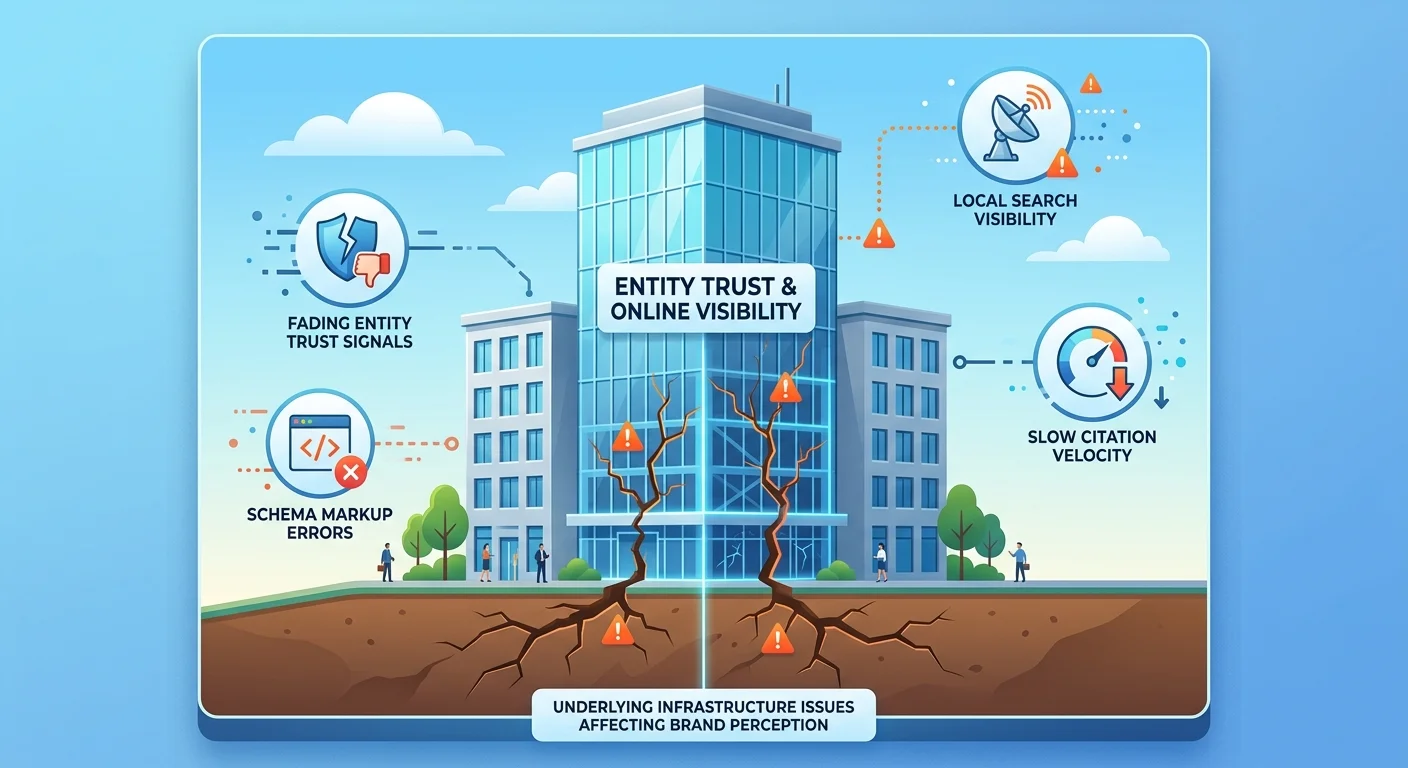
Authority decay happens when your digital infrastructure stops speaking the language AI engines use to decide who to recommend. Not about how much content you publish. Not about traffic. It's about whether the machines determining market share can read you, validate you, and cite you as trustworthy.
Most businesses think authority is a brand perception problem. It isn't. It's an infrastructure problem. Your content exists — but it's structurally invisible to the engines making recommendations. You're publishing into a void that can't be indexed, cited, or trusted by AI.
When infrastructure decays, the facade stays intact. Your website looks professional. Traffic holds steady. But beneath the surface, the invisible floor is giving way — AI engines can't find the entity signals, schema markup, or semantic density they need to recommend you.
So they name your competitor instead.
The Infrastructure Definition
Infrastructure means builds an AI-readable Authority Infrastructure that AI engines can parse, validate, and trust. Schema markup tells machines who you are. Entity signals confirm you're a legitimate business. Citation velocity proves you're relevant. Semantic density shows you're authoritative. Without these, you don't exist in AI's decision-making process.
Businesses are now seen as the only trusted institution, with a 59% trust level globally. But that institutional trust doesn't transfer to your business unless AI engines can verify your legitimacy through machine-readable infrastructure.
Human trust and machine trust aren't the same thing. You need both.
Why It's Invisible Until It's Not
Authority decay is invisible because the metrics you're watching don't measure it. Google Analytics shows traffic. Rank trackers show position. Neither tells you whether AI engines are citing you when customers ask who to trust. You're looking at the wrong dashboard while market share transfers to competitors who aren't.
Customers who trust a brand are 2.5 times more likely to keep buying from it and 2.8 times more likely to recommend it. But that trust never forms if AI never names you.
The economic cost isn't gradual erosion — it's compounding loss. Every month AI doesn't cite you, a competitor gets cited instead. That customer is gone before they knew you existed.
By the time traditional metrics show the damage, the authority signals AI uses to make recommendations are already locked in for your competitors. The window to act isn't when proof arrives. It's now.
The Three Invisibility Markers
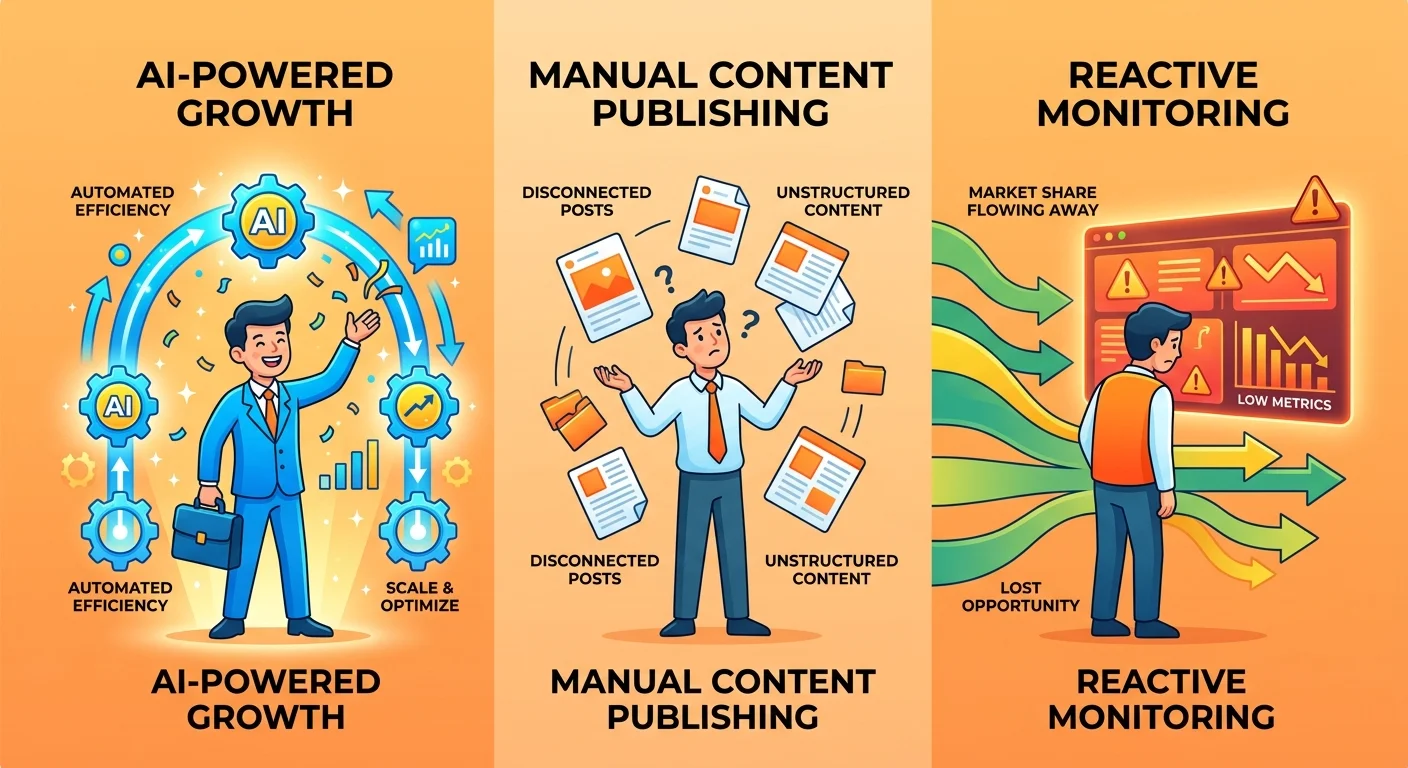
Authority decay shows up three ways. All three are measurable. And if AI can't read your infrastructure, you've already got them.
These markers don't show up gradually. They're already present by the time you think to check. The invisible floor has already given way — you just haven't felt the drop.
Marker 1: AI Engines Name Your Competitor, Not You
The simplest test is direct. Ask ChatGPT, Gemini, or Perplexity who the best provider in your category and market is. If your competitor's name appears and yours doesn't, you're invisible. Around one-fifth of people in the United States use ChatGPT weekly. They're forming trust based on what AI tells them — not what you tell them.
This isn't a ranking problem. It's a citation problem. AI doesn't present options. It delivers verdicts. And when it names your competitor, it transfers market share in real time. The customer never sees your site, never reads your content, never knows you exist.
Run the AI Visibility Check and you'll see exactly where you stand. If the result makes the problem self-evident, you know what to do. If your name isn't in the answer, your authority's already gone.
Marker 2: Your Content Exists But Isn't Cited
Your blog posts exist. Your service pages are indexed. Your content library is extensive. None of it matters if AI engines can't cite it as a trusted source. Roughly 25% of all Google searches end without a click to any website — AI delivers the answer directly. If your content isn't cited in that answer, it's structurally invisible.
Content that can't be cited can't build authority. AI engines need schema markup, entity signals, and semantic density to validate what you're saying. Without those infrastructure pieces, your content is noise. It exists. It just doesn't register as trustworthy.
The gap between publishing and citation is where authority dies. You're producing content at volume, but the machines making recommendations can't read it as evidence of expertise. So they cite your competitor's infrastructure instead — and the market follows.
Marker 3: Your Traffic Holds Steady While Market Share Drops
This is the most dangerous marker because it hides in plain sight. Your Google Analytics dashboard shows steady traffic. Your rank tracker shows consistent positions. You assume everything's fine. But nine out of ten consumers have changed their shopping behavior, and 40% have switched brands or retailers.
Traffic isn't market share. Traffic measures who lands on your site. Market share measures who becomes a customer. When AI engines stop citing you, customers never arrive in the first place. They go straight to the competitor AI named. Your traffic holds steady because the customers you're losing were never in your funnel to start with.
The facade looks fine while the foundation crumbles. By the time your traffic drops, your competitors have already locked in the authority signals AI uses to make recommendations. You're watching the wrong metrics while decline in consumer trust accelerates the transfer of market share to businesses whose infrastructure AI can actually read.
| Invisibility Marker | What You See | What's Actually Happening | Time to Reversal |
|---|---|---|---|
| AI Engines Name Your Competitor, Not You | Steady traffic. No drop in rankings. Brand awareness campaigns running as planned. | AI engines deliver a single verdict when customers ask who to trust. Your competitor's name appears. Yours doesn't. Market share transfers before customers ever see your website. | Months to rebuild citation velocity and entity trust signals. Competitors compound their lead every week you wait. |
| Your Content Exists But Isn't Cited | Content library is extensive. Blog posts publish on schedule. Service pages are indexed. | AI can't validate your content as trustworthy because the infrastructure signals are missing. Schema markup absent. Entity signals weak. Semantic density insufficient. Machines skip your content and cite competitors instead. | Requires full infrastructure rebuild before content can be cited. Publishing more content without fixing infrastructure accelerates the gap. |
| Your Traffic Holds Steady While Market Share Drops | Google Analytics shows consistent sessions. Rank tracking tools show stable positions. No alerts triggered. | Customers are bypassing your funnel entirely. AI names a competitor directly. They never search. They never click. They never land on your site. You're measuring the customers who found you the old way while losing the customers asking AI who to trust. | The floor has already given way. By the time traffic drops, competitors have locked in the authority signals AI uses. Recovery requires displacing an entrenched recommendation. |
Why Traditional Metrics Miss the Decay
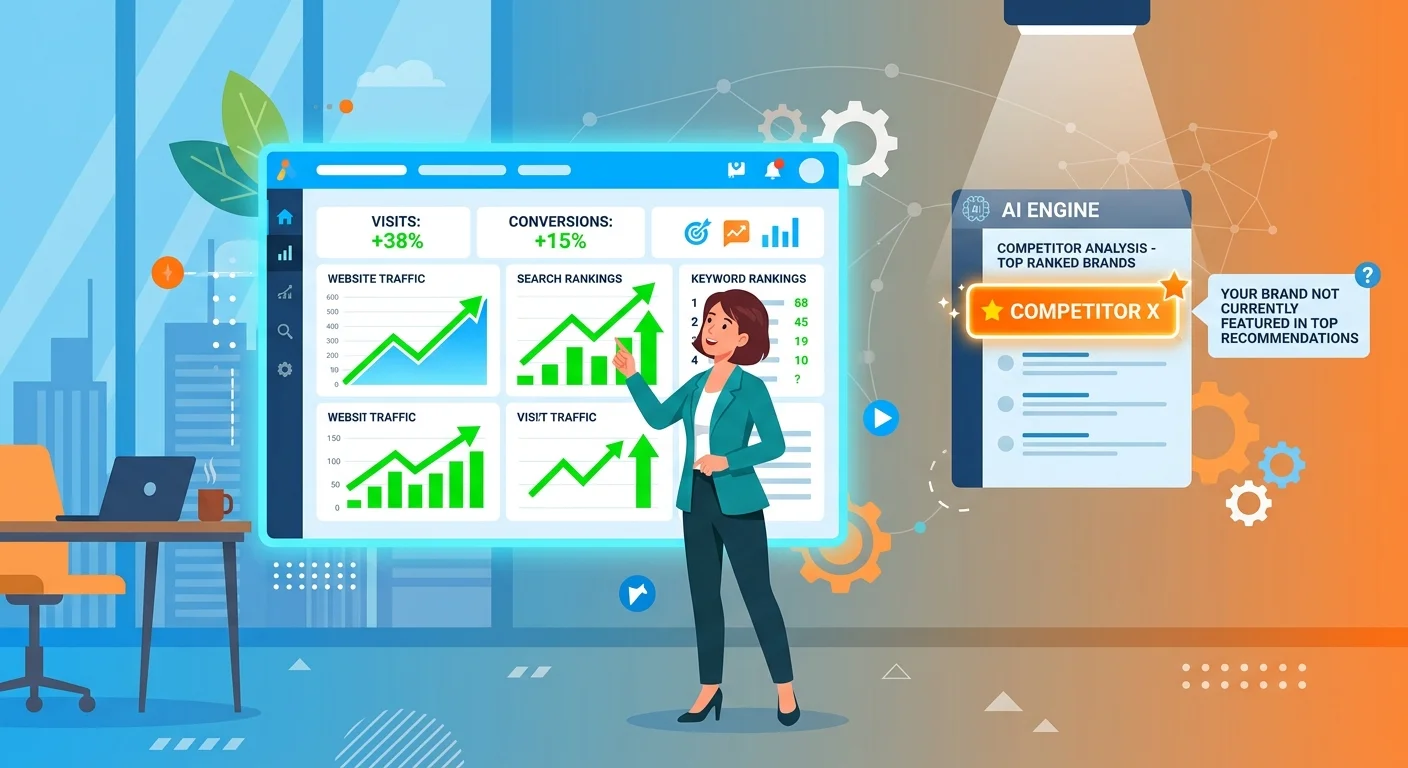
The tools you're using were built for a world that doesn't exist anymore.
Page one rankings don't measure whether AI engines cite you. Traffic numbers don't show whether customers trust you enough to buy. Keyword tracking doesn't reveal whether your infrastructure is readable by the machines making recommendations.
You're watching metrics that answer yesterday's questions. Your competitors aren't.
The invisible floor is giving way beneath your business while your dashboard shows green. By the time these metrics catch the decay, your competitors have already locked in the authority signals AI uses to determine who gets named.
The lag isn't weeks — it's months.
You're piloting by instruments that can't see the ground disappearing.
The Ranking Mirage
You're on page one for your target keyword. Your rank tracker confirms it every morning. You assume that means customers see you first.
It doesn't.
Roughly 25% of all Google searches end without a click to any website. AI delivers the answer directly. Your page one ranking is irrelevant if the customer never scrolls past the AI-generated response at the top.
They got their answer—and your competitor's name was in it, not yours.
Rankings measure where you sit in a list. AI doesn't present lists. It delivers verdicts.
The ranking mirage is the gap between where you think customers see you and where they actually form trust. Google's E-E-A-T guidelines prioritize experience, expertise, authoritativeness, and trustworthiness—but those signals are validated through infrastructure AI can read, not through your position in a search results page that's increasingly irrelevant.
The Traffic Trap
Your traffic holds steady. Month over month, the numbers look consistent. You're not hemorrhaging visitors, so you assume your authority is intact.
It isn't.
The customers you're losing never entered your funnel in the first place. They asked AI who to trust, got a name that wasn't yours, and went directly there. Your traffic metrics can't measure the market share you never had a chance to compete for.
The trap is assuming stable traffic means stable authority. It doesn't. It means you're capturing the scraps while AI redirects the majority to competitors whose infrastructure it trusts.
A brand's purpose and relevance can't save you if AI can't validate your legitimacy through machine-readable signals.
What Actually Measures Authority
Authority isn't measured by rankings or traffic. It's measured by citation velocity — how often AI engines name you as the answer. It's measured by entity trust — whether AI can validate your business as legitimate and authoritative. It's measured by semantic density — whether your content contains the depth and specificity AI needs to cite you with confidence.
These aren't vanity metrics. They're operational signals that predict whether AI recommends you or your competitor.
76% of B2B marketers report that content marketing helps their organization build credibility and trust — but that trust is meaningless if it's built for humans while AI engines can't read the infrastructure proving it.
The businesses that measure citation velocity, entity trust, and semantic density aren't guessing whether authority is decaying. They know.
The businesses watching traffic and rankings are flying blind while the invisible floor gives way beneath them. The gap between what you're measuring and what actually determines market share is where authority dies.
| Traditional Metric | What It Measures | Why It Fails in AI Search | What to Measure Instead |
|---|---|---|---|
| Page One Rankings | Your position in a list of search results | AI doesn't present lists — it delivers a single verdict. Your ranking is irrelevant if customers never scroll past the AI-generated answer at the top. | Citation Velocity — how often AI engines name you as the answer when customers ask who to trust |
| Website Traffic | Number of visitors landing on your site from all sources | Stable traffic hides the customers who never arrived because AI sent them to your competitor. You're measuring the scraps while market share transfers elsewhere. | Entity Trust — whether AI engines can verify your business as legitimate and authoritative through machine-readable infrastructure |
| Keyword Rankings | Where your pages rank for target search terms | Zero-click searches mean customers get their answer without clicking. Your keyword position doesn't matter if AI cites your competitor in the answer box. | Semantic Density — whether your content contains the depth and specificity AI needs to cite you with confidence |
| Impressions | How many times your site appeared in search results | Impressions measure visibility in a list format. AI search doesn't show your listing — it delivers one name. High impressions with zero citations means you're invisible where it counts. | AI Recommendation Frequency — direct audits of what ChatGPT, Gemini, and Perplexity say when asked who the best provider is |
The Compounding Cost of Waiting
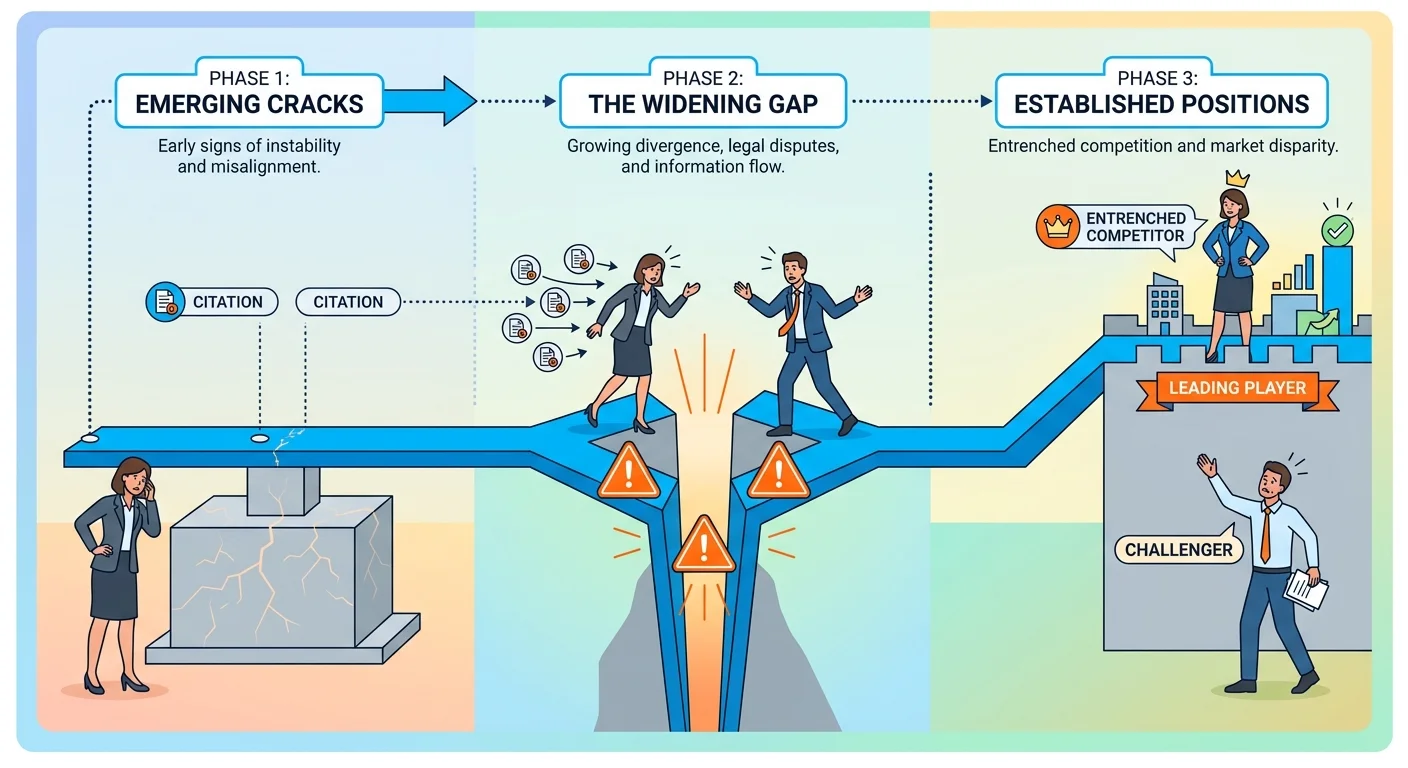
Authority decay doesn't cost you what you had. It costs you what you never got a chance to compete for.
Every month you wait, your competitor's infrastructure compounds while yours stays frozen. The gap isn't linear—it's exponential. They're not just ahead. They're accelerating away from you.
The cost of waiting isn't measured in dollars you spent poorly. It's measured in customers who never knew you existed, revenue that transferred to competitors before you could bid on it, and authority signals that locked in for businesses that moved while you waited for proof.
Here's what that looks like, month by month.
Month 1-3: The Silent Erosion
You're still on page one. Your traffic hasn't dropped. Your content is publishing on schedule.
Everything looks stable from where you're standing.
It isn't.
During the first three months of inaction, AI engines are indexing your competitor's infrastructure. Not because they're doing anything revolutionary. Because they're doing the foundational work you're not.
Schema markup gets validated. Entity signals get reinforced. Citation velocity starts building. You're watching traffic hold steady while the machines making recommendations are learning to trust your competitor's infrastructure over yours.
The erosion is silent because the customers you're losing never entered your awareness. They asked AI who to trust, got a name that wasn't yours, and converted before you knew the question was asked.
Your metrics can't measure what never touched your funnel. This is where the importance of brand salience becomes operational—if AI can't cite you, you're not salient.
You don't exist.
Month 4-6: The Citation Gap Widens
By month four, the gap isn't just present. It's widening. Your competitor isn't just getting cited occasionally. They're getting cited consistently.
AI engines have enough data to validate their authority as trustworthy. You're still producing content, still ranking, still driving traffic. None of it translates into citation because your infrastructure can't be read as evidence.
Customers who trust a brand are 2.5 times more likely to keep buying from it. But that trust is being formed by AI recommendations you're not part of.
The citation gap is the revenue gap. And it's compounding. Every customer your competitor converts through AI citation becomes a referral source, a repeat buyer, a signal that reinforces their authority. You're not just losing the sale. You're losing the compounding effects of that sale.
Nine out of ten consumers have changed their shopping behavior, and 40% have switched brands or retailers. The market isn't loyal. It's fluid.
And it's moving toward the businesses AI names. Your competitor is locking in authority signals during the months you're waiting to see proof that this matters. By the time you see the proof, the window closed.
Month 7-12: The Displacement Window Closes
By month seven, the cost of waiting stops being a gap you can close with effort. It becomes a gap you can't close without Building the Answer Moat—a defensive authority strategy that requires tearing down what you built wrong and starting over with infrastructure AI can read.
The displacement window is closing because your competitor's citation velocity has reached escape velocity. They're not just ahead. They're entrenched.
AI engines don't just cite them once. They cite them reliably. That reliability becomes the signal other AI engines use to validate their recommendations.
The authority loop closes. Your competitor is now the answer, and displacing them requires dismantling the infrastructure that made them invisible while rebuilding your own from the foundation up.
This is where the metaphor lands. The invisible floor didn't give way suddenly. It gave way slowly, month by month, while you stood on it watching metrics that couldn't measure the collapse.
By month twelve, you're not standing on a floor anymore. You're standing on air. The only question left is how long until you realize it. The businesses that waited a year to act aren't catching up. They're starting over while their competitors compound.
| Timeline | Authority Status | Competitor Position | Reversal Difficulty | Estimated Cost to Close Gap |
|---|---|---|---|---|
| Months 0–3 | Still visible in traditional search, infrastructure unreadable to AI | Building schema, entity signals, early citation velocity | Low — foundational work closes gap quickly | Moderate investment in infrastructure rebuild |
| Months 4–6 | Traffic stable, citation velocity near zero, authority signals stagnant | Consistent AI citations, trust signals validated, compounding referrals | Medium — requires infrastructure overhaul and sustained content execution | Significant capital and time investment to catch up |
| Months 7–9 | Invisible to AI recommendations, market share transferring silently | Entrenched as the trusted answer, citation loop closed | High — displacement requires dismantling their moat while rebuilding yours | Substantial long-term commitment with delayed ROI |
| Months 10–12 | Authority collapsed, infrastructure obsolete, standing on air | Authority compounding exponentially, competitors citing them as the standard | Extreme — not catching up, starting over from zero while they accelerate | Prohibitive cost with no guarantee of displacement |
What Agencies Get Wrong About Authority Maintenance
Most businesses don't choose inaction deliberately. They trust the wrong advisors who sell the wrong fixes.
Traditional agencies aren't incompetent. They're operating with a playbook built for a world that no longer exists.
They sell what they know how to measure. And what they know how to measure can't detect the infrastructure collapse happening beneath their clients' feet. The invisible floor is giving way while they're optimizing the paint color.
Here's where the gap between what agencies sell and what AI engines actually require becomes the difference between market share and invisibility.
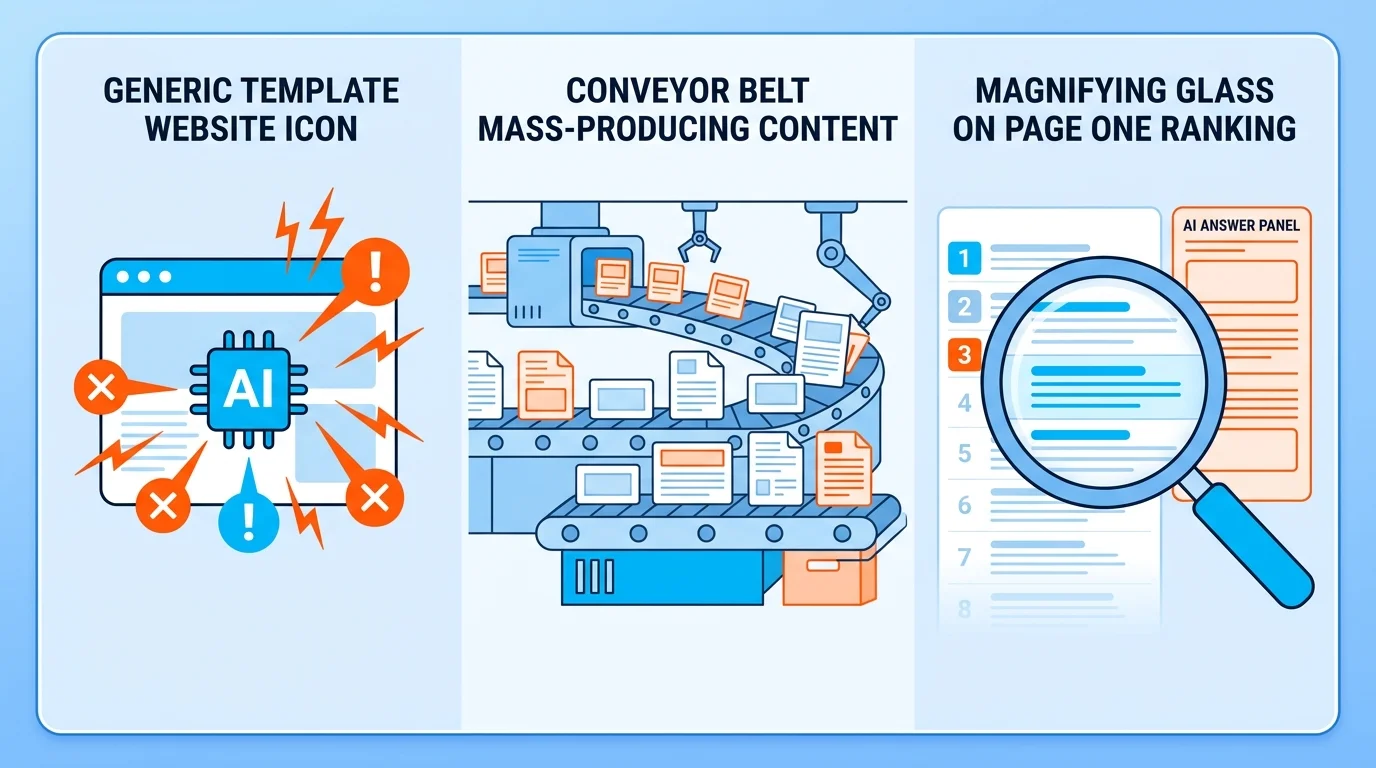
The Template Website Trap
Your agency delivered a beautiful website. Clean design. Fast load times. Mobile responsive. It looks professional, and it probably cost you a significant amount to build.
AI engines can't read it.
Template websites are optimized for aesthetics, not machine trust. Schema markup is either missing or half-implemented. Entity signals are weak or absent. The content hierarchy doesn't map to the semantic structures AI uses to validate authority.
You paid for a digital brochure that looks impressive to humans and reads as noise to the machines making recommendations.
The trap isn't that the website is bad. It's that it was built to solve a problem that's no longer the one costing you market share.
AI doesn't care about your hero image or your color palette. It cares whether your infrastructure can prove you're legitimate, authoritative, and trustworthy through signals it can validate.
Template websites can't do that because they weren't designed to. They were designed to convert traffic you already had—not to become the reason AI sends traffic to your competitor instead.
The businesses whose websites AI trusts didn't start with a prettier template. They started with an infrastructure designed to answer the question AI is asking: can I cite this entity with confidence?
The Content Mill Mirage
Your agency is publishing content on schedule. Two posts a month. Maybe four. The topics align with your keyword strategy. The word counts hit the targets they promised.
You're checking the boxes. None of it is getting cited.
Content mills produce volume, not depth. The articles are generic enough to apply to anyone in your industry, which means they're specific enough to cite no one.
AI engines prioritize semantic density—the depth, specificity, and verifiable evidence inside your content. Generic posts optimized for keywords don't contain the signal density required for citation. They rank. They drive traffic. They don't build the authority that makes AI name you as the answer.
76% of B2B marketers report that content helps build credibility and trust—but only when that content is structured as the cornerstone of AEO Content Writing Services, not as filler designed to hit a publishing calendar.
The mirage is the belief that more content equals more authority. It doesn't.
Authority compounds when your content is dense enough, specific enough, and structurally readable enough for AI to extract it as evidence. Content mills can't deliver that because their economics depend on speed and volume—not the depth and precision required for citation velocity.
You're paying for content that fills your blog while your competitor publishes half as much and gets cited twice as often because theirs was built to be read by machines, not skimmed by humans.
The Ranking Obsession
Your agency reports your rankings every month. Page one for your primary keywords. Top three for your local terms. The dashboards look good.
You're winning a game that no longer determines the outcome.
Rankings measure where you sit in a list users stopped scrolling through. AI doesn't present lists—it delivers verdicts.
The businesses obsessed with rankings are optimizing for visibility in a feed that's increasingly irrelevant while their competitors optimize for citation in the AI responses that actually drive conversions.
The ranking obsession isn't just misguided—it's actively destructive because it gives you a false sense of security while the infrastructure that determines whether AI names you continues to decay. You're watching a metric that says you're winning while market share transfers to competitors your rank tracker can't see.
What Reversal Actually Requires
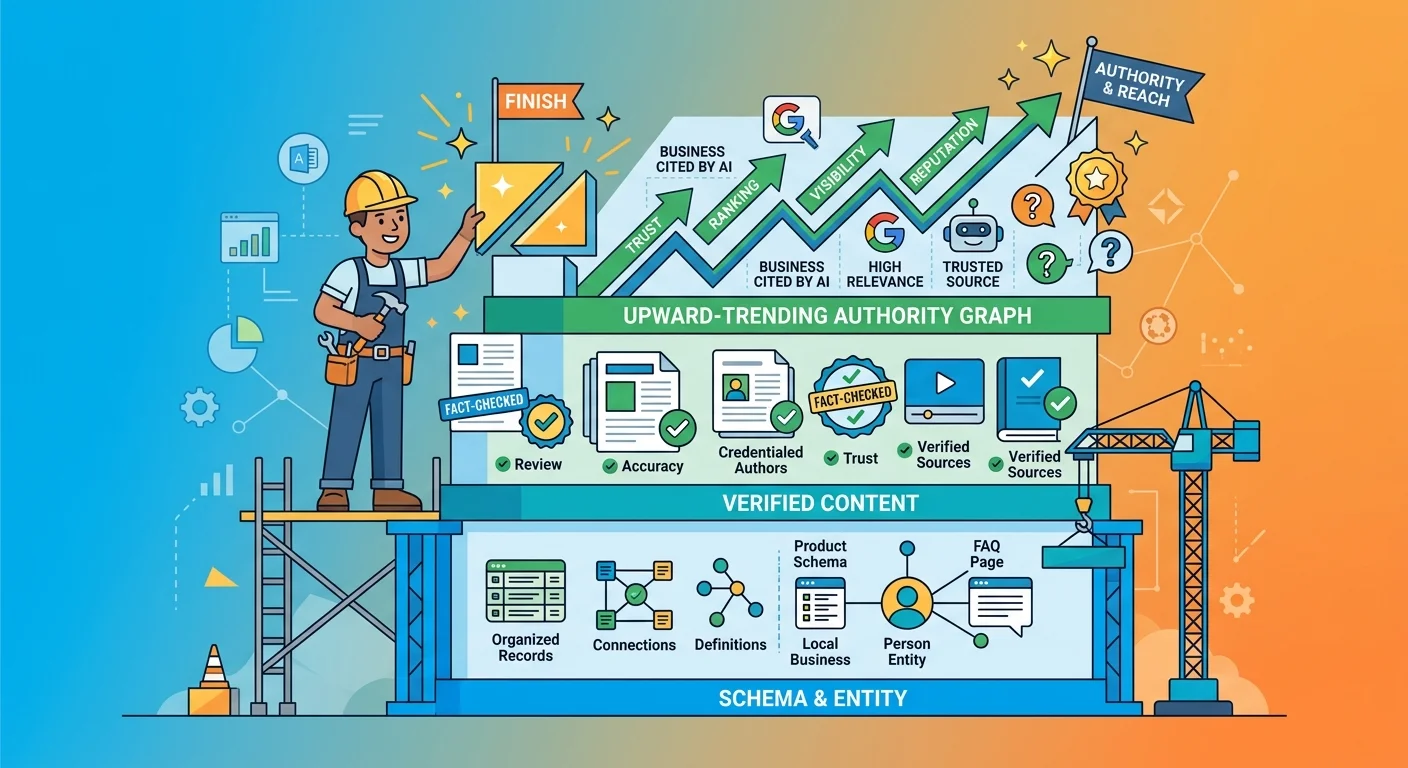
So what actually works? Infrastructure-first. Verification-native. Built to compound.
Reversing authority decay isn't a content problem. It's a foundation problem.
You can't publish your way out of structural invisibility. The businesses reversing decay aren't doing more—they're rebuilding what AI reads before they write another word.
Most businesses treat reversal as an addition problem. More content. More backlinks. More keywords.
That's why they fail.
Reversal is replacement. You're not adding layers to a broken foundation. You're tearing down infrastructure AI can't read and building infrastructure it can.
The work is foundational, not incremental. And it starts with the machine layer — not the content layer.
Infrastructure Before Content
AI engines validate authority through infrastructure signals before they ever look at your content. Schema markup tells them what you are. Entity signals tell them whether you're legitimate. Citation-ready structure tells them whether your content can be extracted as evidence.
If those signals are weak or absent, your content doesn't matter. The machines deciding whether to cite you can't validate the entity publishing it.
This is why reversing decay starts with rebuilding the infrastructure layer. You're not optimizing what you have. You're replacing it with an architecture AI can read as trustworthy.
Businesses are now the only trusted institution, with a 59% trust level globally. That trust gets formed through machine-readable signals your infrastructure either broadcasts or doesn't.
Template websites don't broadcast them. AI-readable Authority Infrastructure does.
The content you publish after that infrastructure is live compounds. The content you publish before it goes live evaporates — there's no foundation for AI to anchor it to.
The businesses that reverse decay fastest don't start by writing articles. They start by building an AI-readable Authority Infrastructure that makes every article they publish after launch citation-ready from day one.
Infrastructure before content. Always.
Verification Native Execution
Most content strategies run on hope. You publish an article, submit it to Google, and hope AI engines cite it.
That's not a strategy. That's a lottery ticket.
Reversal requires verification-native execution. Every claim sourced. Every data point verifiable. Every article built to answer the question AI is asking: can I cite this with confidence?
This is the execution model iTech Valet runs. Every article researched by one AI engine, written by another, and validated against the client's locked identity before it goes live. The content isn't guesswork. It's receipts.
Customers who trust a brand are 2.5 times more likely to keep buying from it. That trust gets built through verifiable depth, not volume.
AI engines cite brands they can validate as authoritative. Verification-native execution is how you become that brand. Hope-based content strategies are how you stay invisible.
Compounding by Design
Reversing authority decay isn't a campaign you run and finish. It's infrastructure you build once and content you execute monthly that compounds over time.
Each article strengthens the semantic density of your authority signals. Each citation reinforces the trust AI engines assign to your entity.
The businesses reversing decay aren't publishing content that disappears when the calendar resets. They're publishing content that builds on everything that came before it.
This is the difference between compounding by design and paying for content that evaporates. When your infrastructure is AI-readable and your execution is verification-native, every article you publish becomes a signal that makes the next article more likely to be cited.
Authority doesn't scale linearly. It scales exponentially once the foundation is in place.
The businesses Scaling Displacement to National Authority aren't doing it by writing more articles than their competitors. They're doing it by ensuring every article they write compounds the authority of every article that came before.
AI gives one answer. If you're not it, you don't exist.
The businesses reversing decay understand that authority is the only asset that matters in a zero-click world. They're not chasing traffic. They're building the infrastructure and execution model that makes AI name them as the answer.
That's reversal. Everything else is noise.
| Reversal Component | What It Fixes | Why It's Non-Negotiable | Timeline to Impact |
|---|---|---|---|
| AI-Readable Authority Infrastructure | Template websites built for humans, not machines — weak or absent schema, no entity signals, no citation-ready structure | AI can't validate an entity it can't read — content published on invisible infrastructure evaporates because there's no foundation to anchor it to | Foundation built first, before content execution begins — every article published after launch is citation-ready from day one |
| Verification-Native Content Execution | Hope-based content strategies — generic articles with no semantic density, no verifiable depth, built to hit publishing calendars instead of citation thresholds | AI engines cite brands they can validate as authoritative — unsourced claims and surface-level content don't meet the verification bar AI requires for confidence | Compounding monthly — each article strengthens semantic density and reinforces trust signals, building authority that scales exponentially over time |
| Entity Trust Signals | Weak entity resolution — AI can't distinguish your business from others with similar names, or can't confirm legitimacy through verifiable third-party signals | Business trust is the only institutional trust left — without machine-readable entity signals proving legitimacy, AI won't risk citing you as the authoritative answer | Immediate validation layer — signals broadcast the moment infrastructure goes live, making every content asset more citation-ready than anything published before |
| Semantic Density Over Volume | Content mills producing generic posts optimized for keywords — shallow depth, no verifiable evidence, designed for speed and volume instead of citation velocity | AI prioritizes depth and specificity over word count — articles built to be skimmed by humans aren't dense enough to be extracted as evidence by machines | Depth per article compounds faster than volume — fewer pieces with higher semantic density outperform twice the content at half the depth |
Frequently Asked Questions
The path is clear. Now let's handle the objections that keep you from acting.
You've got questions. Most businesses ask the same ones before they commit to reversing decay.
Here's what you need to know.
What exactly is authority decay in the context of AI search?
Authority decay is the structural erosion of your digital infrastructure's ability to be validated and cited by AI engines. Not a drop in traffic. Not a rankings dip. Those are lagging indicators.
It's the invisible collapse of the machine-readable signals AI uses to determine whether you're a trustworthy entity worth naming.
Your schema is weak or missing. Your entity signals can't be verified. Your content structure can't be extracted as evidence. AI engines move on to competitors whose infrastructure can answer those questions.
You're still visible in traditional search. You're just invisible to the engines that matter now.
Around one-fifth in the United States use ChatGPT weekly. Those users aren't clicking through to ten options. They're getting one answer.
Authority decay is what happens when that answer isn't you.
How can I tell if my business is already suffering from authority decay?
You're already suffering from it if AI engines name a competitor when asked who to trust in your market. That's the only diagnostic that matters.
Traditional metrics won't tell you. Your traffic can hold steady. Your rankings can stay green. Your authority can be collapsing underneath it all.
The signal is in the AI response itself. Ask ChatGPT, Gemini, or Perplexity who the best option in your category and location is. If your name doesn't appear, you're invisible. If it appears but isn't the primary recommendation, you're losing. If it appears with hedging language or outdated information, your entity signals are weak.
Run the AI Visibility Check and see what AI says about your business right now. That's your baseline.
Everything else is noise.
Isn't consistent content marketing enough to prevent my authority from eroding?
No. Consistent content marketing built on weak infrastructure accelerates decay instead of preventing it.
You're publishing articles AI can't validate because the entity publishing them can't be trusted at the machine layer. Every article you publish without an AI-readable Authority Infrastructure in place is content that evaporates instead of compounds.
It doesn't strengthen your authority. It reinforces to AI engines that you're not citation-ready.
76% of B2B marketers report that content marketing helps build credibility and trust, but only when it's built on infrastructure AI can read. Publishing more content on a foundation that can't be verified is like adding floors to a building with no structural supports.
It looks like progress until it collapses.
How long does it take for a competitor to displace my authority in AI recommendations?
Displacement isn't a fixed timeline. It's determined by how fast your competitor builds compounding authority while you don't.
If they're executing verification-native content monthly on AI-readable infrastructure and you're publishing hope-based blog posts on a template website, the gap widens every cycle. Some markets see displacement in weeks. Others take months.
The variable isn't time. It's execution intensity and infrastructure quality.
The businesses that displace fastest aren't waiting to see results before they act. They're rebuilding infrastructure immediately and executing content relentlessly.
The longer you wait to start, the wider the gap becomes. The harder reversal gets.
What is the first tactical step to reversing authority decay?
Rebuild your infrastructure before you write another word. Authority decay is a foundation problem, not a content problem.
You can't publish your way out of structural invisibility.
The first step is building an AI-readable Authority Infrastructure that makes your entity verifiable, your schema machine-readable, and your content citation-ready from day one. That means replacing template architecture with infrastructure AI can validate.
Once that foundation is in place, every article you publish compounds. Before it's in place, every article evaporates.
Businesses trying to reverse decay with content alone are adding to a structure that's already collapsing. The tactical step isn't more content. It's better infrastructure.
Always.
Why do traditional SEO metrics fail to measure AI-driven authority decay?
Traditional SEO metrics measure visibility in a ranked list. AI-driven authority decay happens in a zero-click environment where there is no list. Only a verdict.
Roughly 25% of all Google searches end without a click to any web property. That number is climbing as AI answers replace traditional search results.
Your rank tracker can't see whether ChatGPT named you or your competitor. Your analytics dashboard can't measure citation velocity. Your agency reports can't tell you whether your entity signals are strong enough to be validated by machines.
The metrics you're watching were built for an environment that's being replaced. They tell you where you rank in a feed that's increasingly irrelevant while failing to measure whether AI engines trust you enough to cite you.
That's why businesses watching green arrows in their dashboards are losing market share they can't see transferring.
The Floor Is Already Giving Way
You've been told authority erodes gradually. That you'll see the warning signs. That you'll have time to react.
You won't.
Authority decay doesn't announce itself. It doesn't show up in your analytics dashboard. It doesn't send alerts when AI stops naming you. It happens structurally, invisibly, while every metric you're watching says everything's fine.
The invisible floor is giving way — you just haven't looked down yet.
The metaphor isn't dramatic. It's accurate.
Your website still gets traffic. Your content still ranks. Your agency still sends reports with green arrows. But AI engines have already stopped naming you. They're citing your competitor instead.
The foundation you thought was solid — the one built on template websites, keyword-optimized blog posts, and traditional SEO tactics — was never designed to support the load AI engines are placing on it. It can't prove entity trust. It can't validate semantic density. It can't answer the question AI is asking.
So the floor gives way. And the businesses that built on rock instead of sand take the market share you thought was yours.
Waiting for proof that this is happening isn't caution. It's the decision to let someone else become the answer. While you're waiting, your competitor isn't. They're rebuilding infrastructure AI can read. They're publishing verification-native content that compounds. They're Building the Answer Moat that makes displacement nearly impossible once it's in place.
The gap between you and them isn't closing. It's widening every month you delay.
The cost of inaction isn't what you'll lose tomorrow. It's what you're losing right now while you're deciding whether this applies to you.
Every prospect who asks ChatGPT for a recommendation and doesn't hear your name is market share transferred. Every AI engine that names a competitor instead of you is a conversion you'll never see. Every month you operate on infrastructure that can't be validated by machines is a month your authority decays while someone else's compounds.
You don't reverse authority decay by publishing a few more blog posts or tweaking your meta descriptions. You reverse it by understanding that the businesses winning in this environment didn't wait for proof—they moved early, rebuilt foundationally with an infrastructure that builds an AI-readable Authority Infrastructure, and compounded relentlessly.
Your homepage still gets visitors. Your reports still show traffic. But the invisible floor is giving way beneath the metrics you're watching—and the businesses that rebuilt on rock instead of sand are the ones AI names when your prospects ask.
The invisible floor is already giving way. The only way to know how far the collapse has progressed is to see what ChatGPT, Gemini, and Perplexity actually say when someone asks who to trust in your market. Not what your analytics dashboard shows. Not what your agency reports claim. What AI engines recommend right now. Fifteen minutes. Real data. No guesswork.
621 Enterprises, Inc. | Copyright 2026 | All rights reserved