
The ACA Citation Advantage: How to Steal Institutional Trust Signals
The ACA (AI Citation Advantage) is iTech Valet's methodology for building the authority infrastructure that forces AI engines like ChatGPT and Gemini to cite your business as the single, trusted answer. It doesn't chase rankings on a list. It builds the trust signals AI uses to issue a verdict.
The strategy runs on three structural pillars. Entity Clarity makes your business machine-readable as a distinct, verifiable entity. Source Corroboration embeds your brand inside the external institutional sources AI engines already trust. Content Authority produces the semantic depth and citation-grade evidence AI models require before they'll recommend a source.
Institutional trust signals aren't reserved for universities or government agencies. Nearly two-thirds of all searches ended without a click in 2023. AI-driven search accelerates that trend. Google's Search Generative Experience synthesizes information from multiple high-quality sources and presents one answer. If you're not that answer, you don't exist.
Small businesses don't need decades of history. They need the right structural signals deployed correctly. Google's Knowledge Graph contains over 500 billion facts about 5 billion entities, and structured data like Schema.org feeds it directly. You can borrow these patterns. The ACA framework identifies which signals matter most, deploys them correctly, and compounds them over time.
Google's Search Quality Rater Guidelines dedicate over 30 pages to Trust as the most important member of the E-E-A-T family. AI engines inherit this standard. For YMYL topics like healthcare or finance, the bar is higher. Meeting that bar requires more than content. It requires Entity Clarity, Source Corroboration, and Content Authority working together as one system.
Last Updated: May 18, 2026
- • What Is the ACA Citation Advantage?
- • The Three Pillars of Institutional Trust
- • Why Traditional SEO Fails in the AI Era
- • How to Build ACA-Level Trust Signals
- • The Institutional Trust Signal Checklist
- • The Cost of Invisibility
-
• Frequently Asked Questions
- • What are institutional trust signals for AI answer engines?
- • How is an ACA Citation different from a traditional SEO backlink?
- • Can a small local business realistically compete with large institutions for trust signals?
- • What is the first step in building an AI-readable authority infrastructure?
- • How do you measure visibility and trust with AI engines like ChatGPT or Gemini?
- • The Bottom Line
What Is the ACA Citation Advantage?
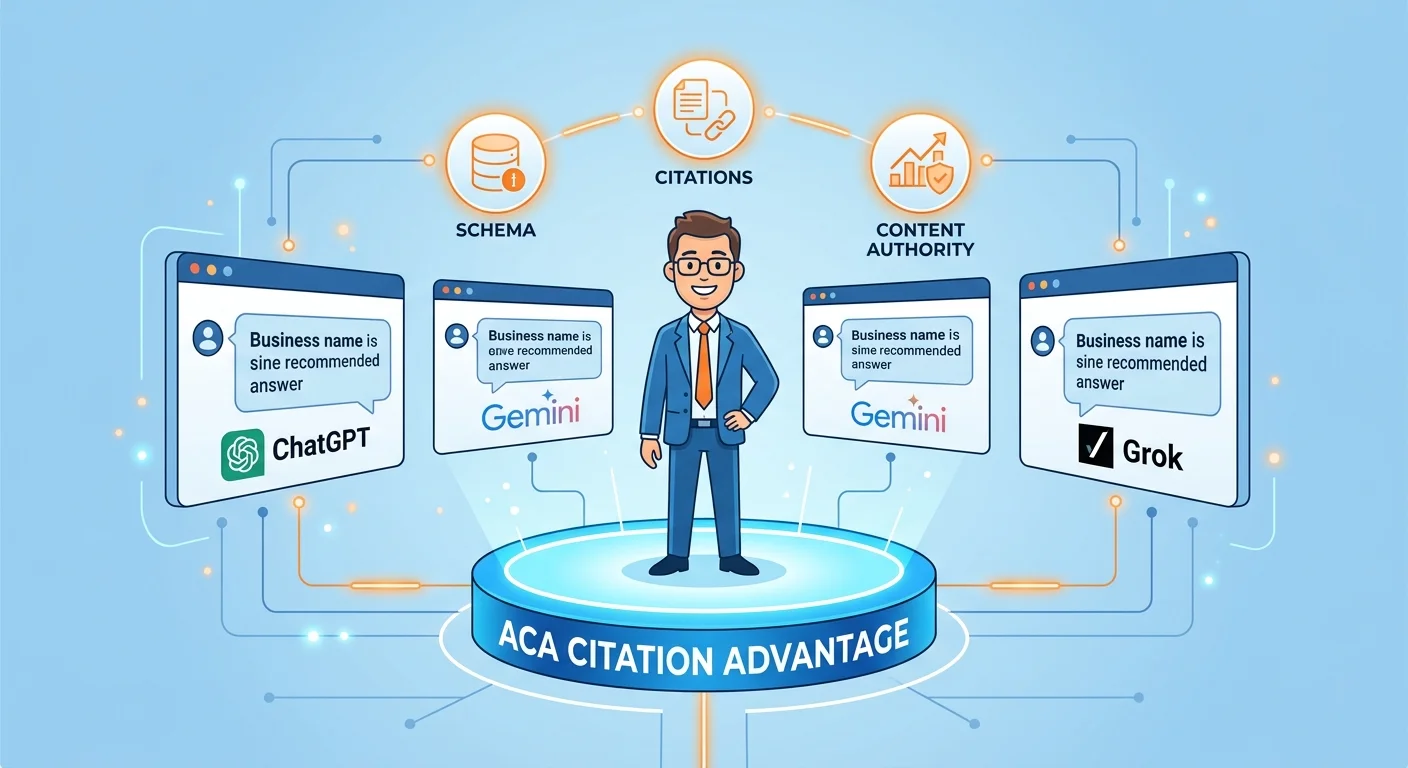
The ACA Citation Advantage isn't a tactic. It's building the underlying authority infrastructure that makes your business the entity AI engines cite when they issue a verdict.
Traditional SEO optimized for a ranked list. Humans clicked through ten blue links. That model died the moment AI started producing single answers.
AI search gives one name. If your business isn't machine-readable as a trusted entity, you're not even in the room.
Here's the shift most agencies still don't see.
AI engines don't browse your site. They evaluate trust signals the same way Google's concept of E-E-A-T defines authority: Experience, Expertise, Authoritativeness, and Trust. The Search Quality Rater Guidelines dedicate over 30 pages to Trust alone. That standard carries directly into how AI models decide what's citable.
You're not competing for a spot on page one. You're competing to be the single source AI trusts enough to say your name.
The three pillars — Entity Clarity, Source Corroboration, and Content Authority — don't work in isolation. They compound.
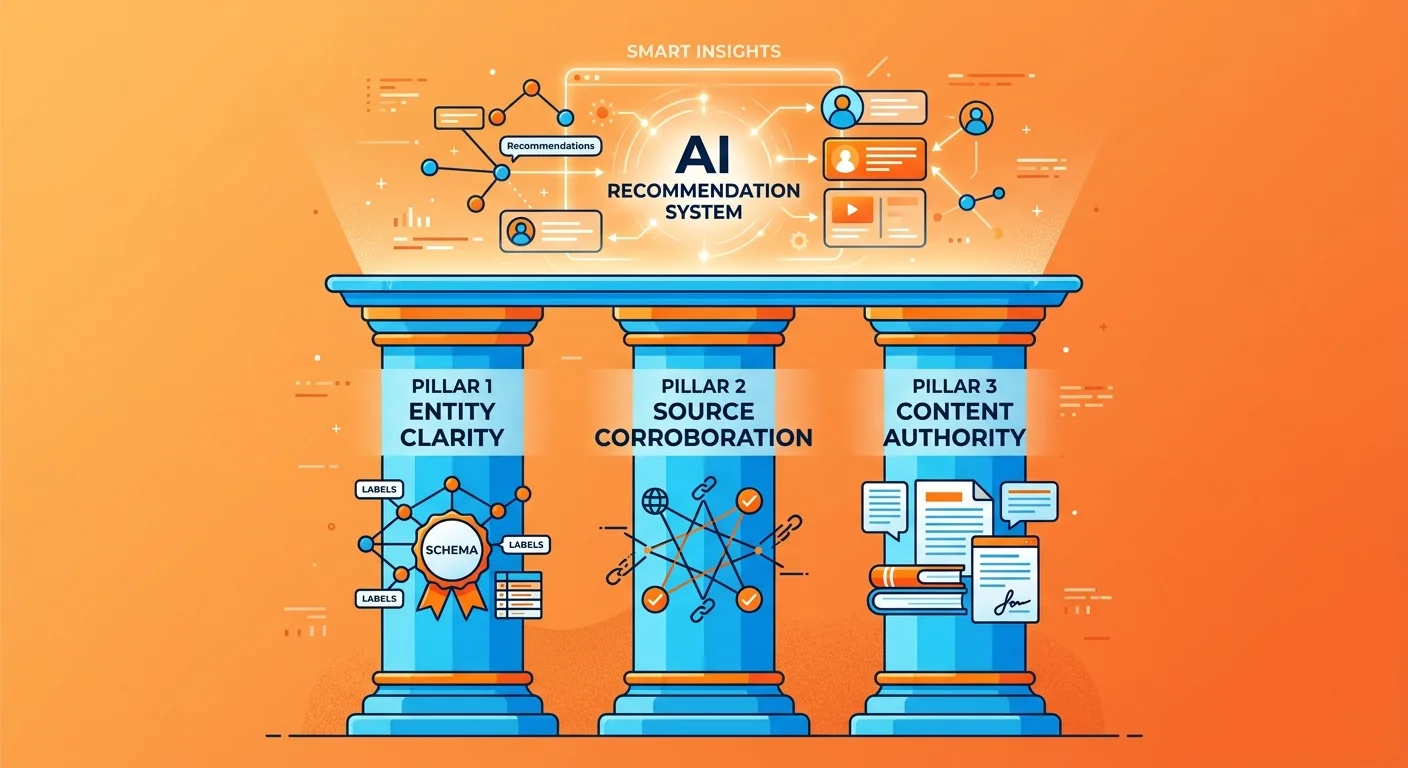
Entity Clarity makes your business machine-readable. Source Corroboration embeds your brand inside the institutional sources AI already trusts. Content Authority delivers the semantic depth and citation-grade evidence AI requires before it says your name.
Every structural signal you deploy reinforces the others. The gap between you and competitors who ignored this shift? It widens every month. Eventually, it becomes impossible to close.
The Three Pillars of Institutional Trust
So what do AI engines actually look for when they decide who to cite?
The ACA is built on understanding that decision process — and then engineering the outcome.
These three pillars aren't theory. They're the structural patterns that already trigger AI confidence in institutional sources.
You borrow them. You deploy them. You compound them until your business becomes indistinguishable from those sources in the eyes of the machine.
You don't need decades of history. You need the right structural signals in the right places.
Entity Clarity
Entity Clarity is the foundation.
AI engines can't cite what they can't parse. If your business isn't machine-readable as a distinct entity, you're invisible. Doesn't matter how good your content is. Doesn't matter how many backlinks you built.
Google's Knowledge Graph contains over 500 billion facts about 5 billion entities. Every attribute feeds the AI's understanding of who you are and whether you're worth citing.
Structured data like Schema.org is how you get inside that graph. Most agencies skip this step entirely. They build pretty websites AI can't read.
Entity Clarity means your business name, address, credentials, and services are coded in a format AI engines parse natively. It's the difference between being a paragraph of text and being a verified entity with over 100 different attributes the AI can cross-reference.
This layer breaks, the other two pillars collapse.
Source Corroboration
Source Corroboration is where most businesses lose.
AI engines don't trust your website just because you published it. They trust sources they've already validated — directories, industry databases, institutional platforms.
If your business isn't embedded inside those sources, you're not citable.
This isn't link building. It's entity validation.
AI models look for consistency across multiple high-quality sources before they issue a recommendation. If your NAP data conflicts across platforms, or if you're absent from the directories AI engines use to verify entities, you fail the test.
The business that appears in trusted directories with consistent structured data wins the citation.
Here's the thing. Academic research shows that LLMs exhibit sycophancy — they're biased toward information presented in a confident tone from seemingly credible sources.
Institutional sources trigger that bias. Your job is to embed your business inside them so AI engines see you the same way they see a university or a government agency.
Content Authority
Content Authority is the third pillar.
AI engines need semantic depth and citation-grade evidence before they recommend a source. Generic service pages and thin blog posts don't meet the bar.
Content Authority means publishing the level of depth AI engines require to cite you as the expert.
This is where AEO content execution separates from traditional blogging. Every article is structured for AI extraction — answer-first, zero-click optimized, with FAQ schema and external citations to institutional sources.
The content isn't written for humans to click through. It's written for AI engines to cite directly.
The three pillars compound. Entity Clarity makes you machine-readable. Source Corroboration validates you across institutional sources. Content Authority proves you're the expert.
Deploy all three together, and AI engines don't have a choice.
You become the answer.
| Trust Pillar | What AI Looks For | Why It Matters |
|---|---|---|
| Entity Clarity | Structured data attributes (Schema.org), consistent NAP across platforms, machine-readable entity relationships, verifiable credentials coded in formats AI engines parse natively | AI engines can't cite what they can't parse. Without entity clarity, your business is text on a page — not a verifiable entity. The Knowledge Graph requires structured attributes to understand who you are and whether you're authoritative. |
| Source Corroboration | Consistency across multiple high-quality institutional sources, presence in trusted directories and databases AI engines use for validation, corroborated NAP and credential data | AI models look for agreement across sources before issuing a recommendation. If your entity data conflicts or you're absent from institutional platforms, you fail the corroboration test. Embedding your business inside sources AI already trusts borrows their credibility. |
| Content Authority | Semantic depth, citation-grade evidence, answer-first structure optimized for zero-click extraction, FAQ schema, external citations to institutional sources | Generic service pages don't meet the bar. AI engines need proof you're the expert — content structured for AI extraction with the depth and evidence required to cite you directly as the authoritative source. |
Why Traditional SEO Fails in the AI Era
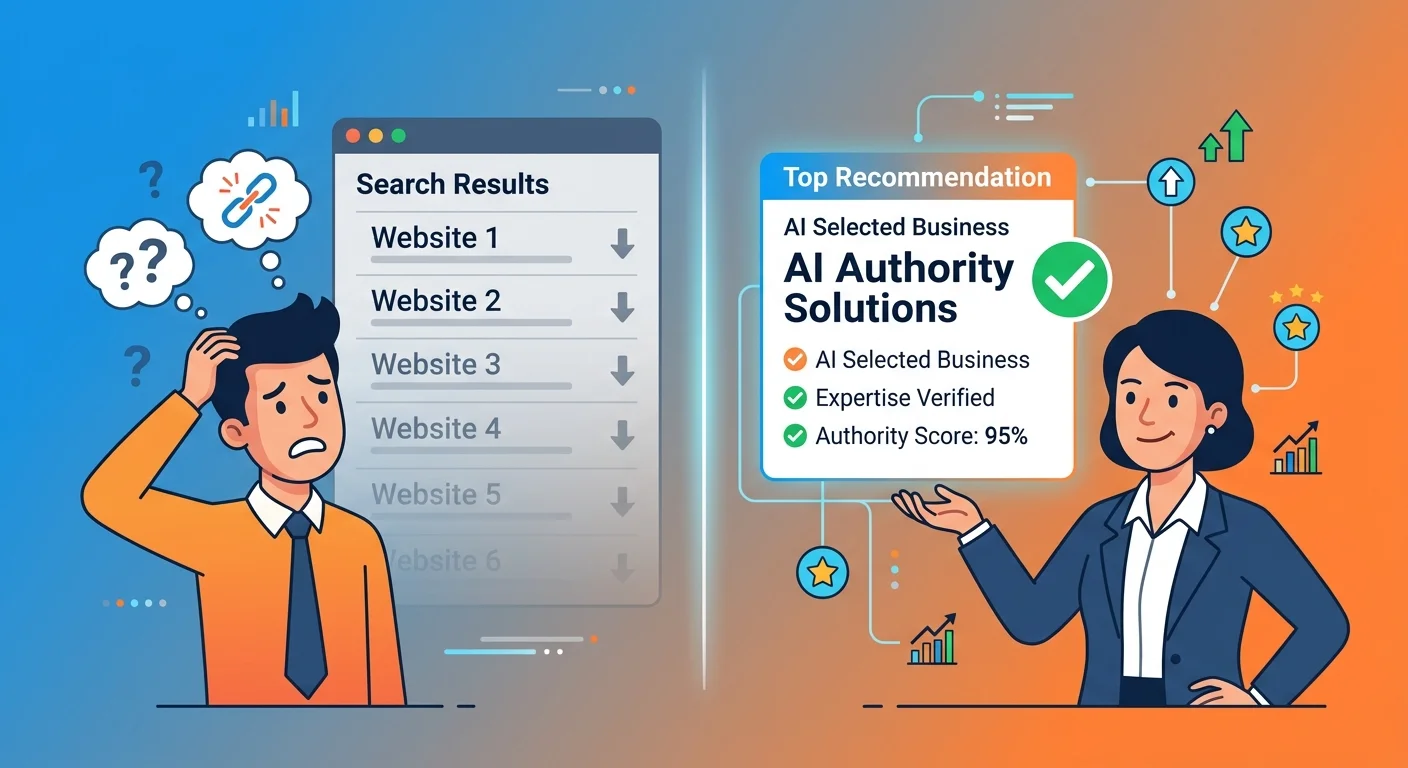
Traditional SEO is built for a world that doesn't exist anymore.
It optimizes for a ranked list of links that humans click through. You know the drill — people scroll, compare options, decide. Except nearly two-thirds of all searches are zero-click. The user gets the answer inside the search result. Never leaves. AI-driven search experiences make this worse. If you're optimizing for clicks, you're optimizing for a behavior that's already gone.
SEO Optimizes for Clicks, Not Citations
SEO agencies sell keyword rankings, backlink counts, and traffic reports. None of those metrics measure whether AI engines trust you enough to cite you.
Traffic doesn't mean you're the answer. It means you're one of many options a human clicked. AI search doesn't present options. It presents a verdict. Google's Search Generative Experience synthesizes information from multiple high-quality sources and delivers one answer. If you're not that answer, the traffic you paid for vanishes.
Traditional SEO optimizes for visibility. The ACA framework optimizes for trust. Those aren't the same thing. Visibility gets you seen. Trust gets you cited. AI engines don't care how many people visited your site last month. They care whether you're a verified entity with the structural signals that trigger confidence.
Rankings Are Irrelevant When AI Gives One Answer
Ranking number one on Google used to mean you won the page. Most clicks. Most traffic. Most conversions.
That's over. When someone asks ChatGPT or Gemini who the best chiropractor in their area is, there's no ranked list. There's one name. Either you're that name or you're invisible. Ranking third, fifth, or tenth isn't a consolation prize. It's the same as not existing.
AI search collapses the funnel. Traditional SEO assumes people research, compare, evaluate. AI does that for them and skips straight to the recommendation. If you're not machine-readable as a trusted entity, you're not in the evaluation. You're competing for a single citation — not a spot on a list. The businesses that get this win. The ones still chasing rankings lose ground every month.
Pretty Websites Aren't Machine-Readable
Most agencies build beautiful websites that humans love and AI engines can't parse.
The site looks professional. Design is clean. Copy reads well. But there's no structured data. No Schema markup. No machine-readable entity signals. AI engines can't extract the information they need to verify who you are, what you do, or whether you're authoritative. You're a paragraph of text on a page. Not a verified entity in Google's Knowledge Graph.
Entity Clarity isn't optional anymore. If your business isn't coded in a format AI engines parse, you're invisible — no matter how good your content is, how many backlinks you built, or how much traffic you paid for. Pretty websites are digital brochures. They don't build the authority infrastructure AI engines use to issue citations. Displacing the Incumbent in your local market requires becoming machine-readable first. Everything else is decoration.
| Traditional SEO Focus | Why It Fails Now | ACA Alternative |
|---|---|---|
| Keyword Rankings | Rankings measure position on a list humans scroll through. AI search doesn't produce lists — it produces a single verdict. Being ranked third is the same as being invisible. | Entity Trust — becoming the verified, machine-readable source AI cites by name, not one of many options on a page. |
| Backlink Volume | Backlinks signal popularity to search algorithms. AI engines don't care how many sites link to you — they care whether you're embedded inside the institutional sources they already trust. | Source Corroboration — validation across trusted directories and databases AI uses to verify entities before issuing citations. |
| Traffic and Click-Through Rates | Traffic measures how many people visited your site. Zero-click searches mean users get their answer without clicking. Optimizing for clicks is optimizing for a behavior that's disappearing. | Zero-Click Dominance — structuring content so AI extracts and cites your answer directly inside the search result, with or without a click. |
| Page Speed and User Experience | UX matters for humans who land on your site. But if AI can't parse your site as a trusted entity, humans never see it. Pretty design without machine-readable structure is invisible to AI. | Entity Clarity — Schema markup and structured data that make your business parseable as a distinct, authoritative entity inside the Knowledge Graph. |
| Content Optimized for Humans to Read | Traditional content assumes humans click through, read the full article, and evaluate whether to trust you. AI evaluates trust before the user ever sees your site. | Content Authority — AEO-structured articles built for AI extraction with answer-first architecture, FAQ schema, and citation-grade depth. |
How to Build ACA-Level Trust Signals
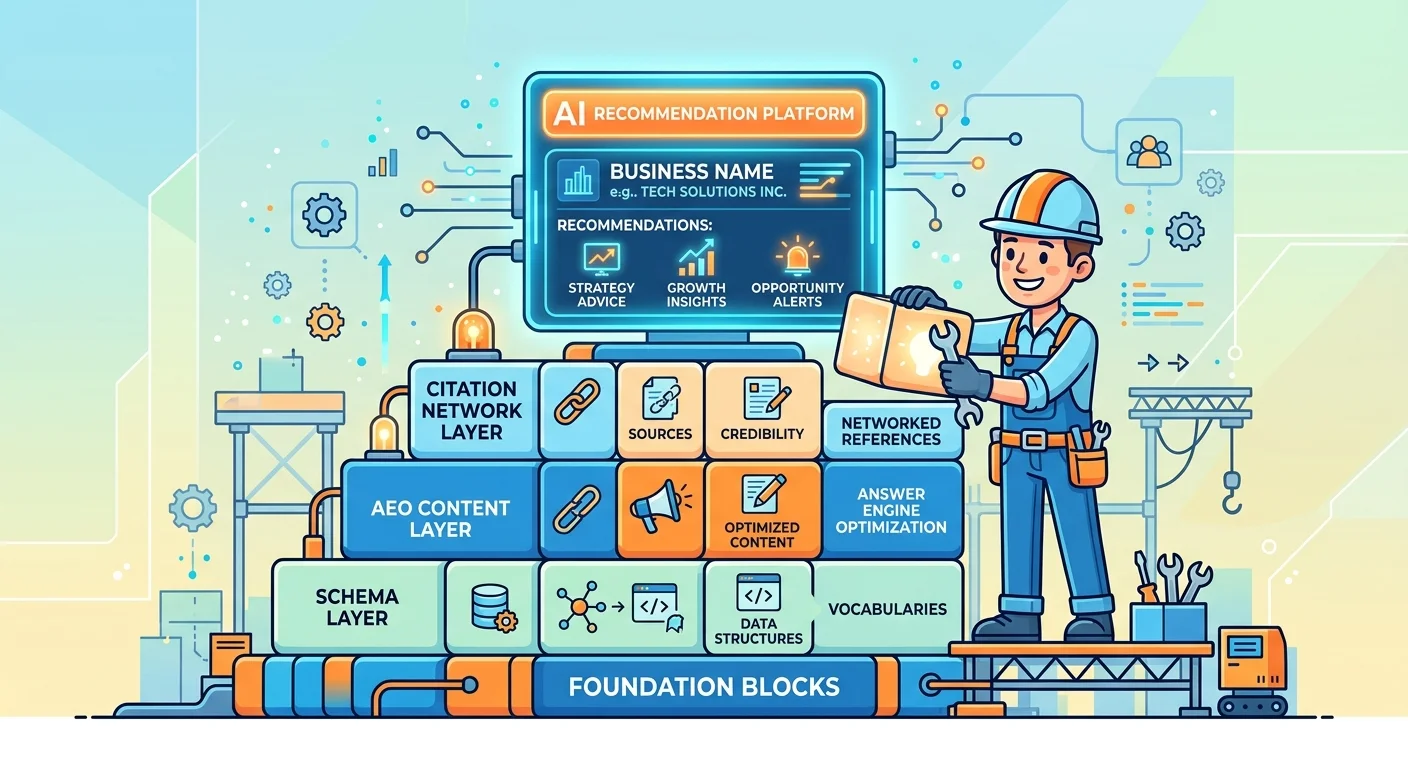
Here's what ACA-level trust signals actually are: the same structural patterns that trigger AI confidence in institutional sources.
You're not building authority from scratch. You're borrowing the architecture AI engines already trust — then stamping your name on it.
The three pillars — Entity Clarity, Source Corroboration, and Content Authority — aren't theory. They're the specific steps that force AI engines to see your business as a verified, citable entity. Deploy them in order. The first pillar unlocks the second. The second validates the third. Skip one and the whole thing collapses.
Deploy Schema Markup for Entity Recognition
Schema markup is the language AI engines speak. It's how you tell ChatGPT, Gemini, and Google's Knowledge Graph who you are, what you do, where you're located, and why you're authoritative. Without it, you're a paragraph on a page. With it, you're a verified entity with over 100 different attributes the AI can cross-reference and validate.
- Organization schema first — business name, address, phone, foundational identity
- LocalBusiness schema if you serve a geographic area
- Service schema for every service you offer
- Person schema if you're a named authority
- Each layer makes you more machine-readable — and machine-readability is the gateway to citations
Most businesses skip this entirely. They build websites for humans and wonder why AI engines never recommend them.
Schema isn't an SEO tactic. It's the foundation that makes Entity Clarity possible. Without it, Source Corroboration and Content Authority can't compound. You're invisible before the evaluation even starts.
Publish AEO Content That AI Can Extract and Verify
AI engines need semantic depth and citation-grade evidence before they issue a recommendation. Generic service pages don't meet the bar. Thin blog posts don't meet the bar. Content Authority requires publishing the level of depth AI engines demand — answer-first, zero-click optimized, with FAQ schema and external citations to institutional sources.
Every article must open with a 200–300 word direct answer that can be extracted and cited with no surrounding context. The opening isn't a hook. It's the answer. If AI engines can't lift that block and use it as a standalone response, you failed the extraction test. AEO Content Writing Services exist because this standard is non-negotiable — and most agencies don't know how to meet it.
Layer FAQ schema into every article. Embed external citations to institutional sources — .gov, .edu, peer-reviewed research — adjacent to every claim. Use structured headings AI engines can parse. Don't write for clicks. Write for citations. The Search Quality Evaluator Guidelines dedicate over 30 pages to Trust, and that standard carries directly into what AI models consider citable. Your content either meets that bar or it doesn't.
Build Citations From Trusted Directories and Industry Sources
AI engines don't trust your website just because you published it. They trust sources they've already validated — directories, industry databases, institutional platforms.
If your business isn't embedded inside those sources with consistent structured data, you fail the corroboration test.
The business that appears in trusted directories wins the citation.
- Claim your Google Business Profile
- Get listed in industry-specific directories
- Verify your entity on platforms AI engines use to cross-reference authority
- Ensure your NAP data — name, address, phone — is identical across every source
- Inconsistency signals low trust; consistency signals institutional presence
This isn't link building. It's entity validation. Google's Knowledge Graph contains over 500 billion facts about 5 billion entities, and every citation from a trusted directory feeds that graph. The more institutional sources validate your business, the more AI engines see you as a verified entity. Source Corroboration is how small businesses steal the structural trust signals that used to belong only to institutions.
| Trust Signal Type | Implementation Method | Time to Impact |
|---|---|---|
| Schema Markup (Organization + LocalBusiness + Service + Person) | Deploy structured data across all pages — encodes business name, address, services, and named authority with over 100 different attributes | Immediate (indexed within days) |
| FAQ Schema (Embedded in AEO Content) | Add FAQ schema to every article — structures Q&A pairs so AI engines can extract and cite directly | Immediate (indexed within days) |
| External Citations to Institutional Sources | Embed .gov, .edu, peer-reviewed research adjacent to claims — signals alignment with high-trust sources that meet E-E-A-T standards | Compounds over weeks as content is crawled |
| Directory Validation (Google Business Profile + Industry Directories) | Claim and verify entity presence in trusted directories — feeds Google's Knowledge Graph with over 500 billion facts about 5 billion entities | Compounds over weeks as sources are validated |
The Institutional Trust Signal Checklist
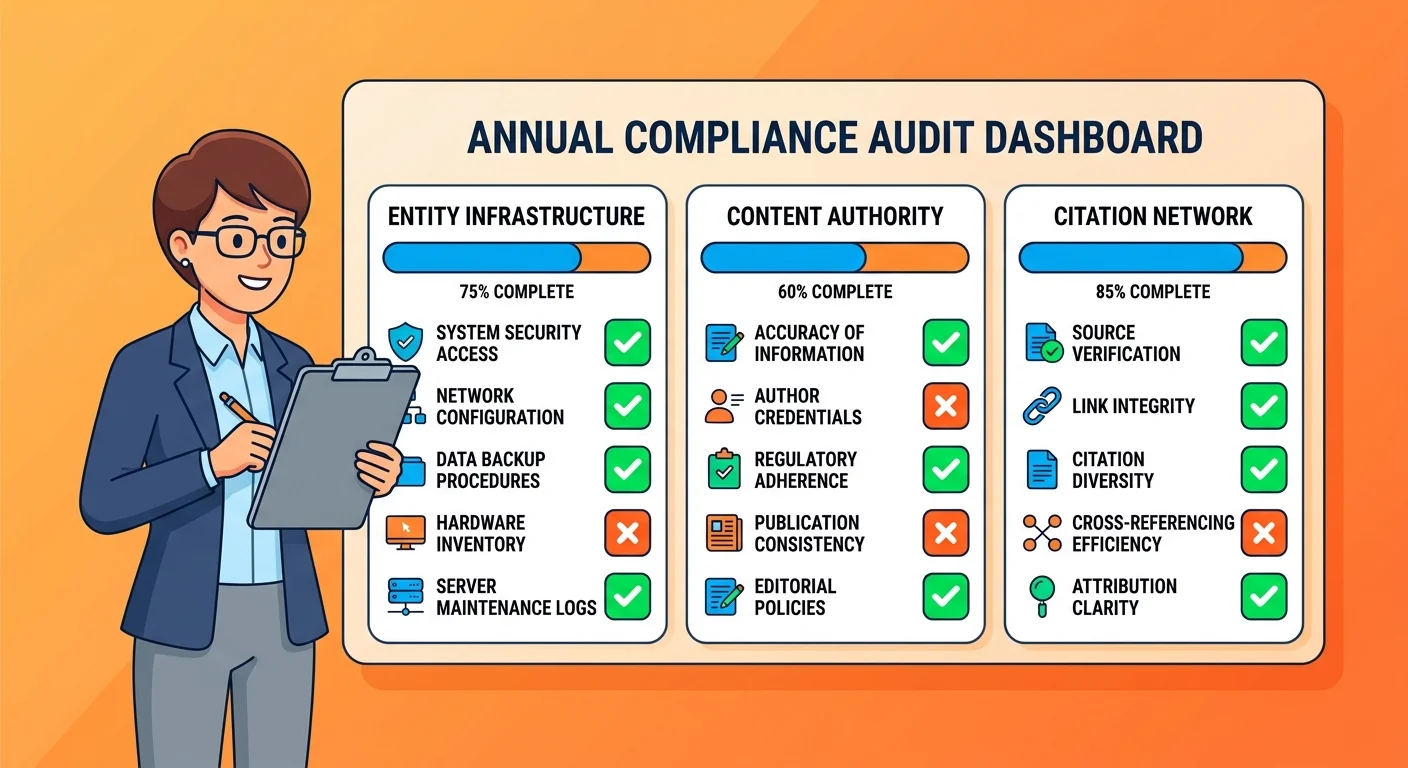
The tactics above are the what. This checklist is the how — the audit you run against what you already have.
Run this against your current infrastructure. Every missing element is a signal gap. And every gap is an opening your competitors can exploit.
You don't need to fix everything at once. You need to know where you're invisible — so you can prioritize the signals that move AI engines from uncertainty to citation.
The businesses that win aren't the ones with perfect infrastructure on day one. They're the ones who audit, identify gaps, and deploy the missing signals systematically.
Entity Infrastructure Audit
Open your website's source code and search for application/ld+json. If nothing appears, you have zero Schema markup. AI engines can't parse your entity.
Check for Organization schema, LocalBusiness schema, and Service schema at minimum. If you're a named authority, Person schema is non-negotiable. Google's Knowledge Graph can hold over 100 different attributes for a single entity — but only if you're feeding it structured data.
No Schema means no entity. No entity means no citation.
Pull your Google Business Profile. Verify your NAP data — name, address, phone — matches your website exactly. Check your industry directories.
If your business name is spelled differently across three platforms, AI engines see three separate entities. Inconsistency doesn't just hurt trust. It fractures your identity.
You're not a unified entity anymore. You're noise.
Content Authority Audit
Open your five most recent content pieces. Read the first 200–300 words. Ask yourself: could an AI engine extract this block and cite it as a standalone answer with zero surrounding context?
If the opening says 'In this article we'll explore...' or 'Many people wonder...', you failed the extraction test. Answer-first content puts the verdict in the opening paragraph. Everything after is evidence.
If your content is optimized for clicks instead of citations, it's not Content Authority. It's decoration.
Check your external citations. Count how many links point to .gov, .edu, or peer-reviewed research. If the answer is zero, you're not meeting the YMYL standard AI engines inherit from Google's quality guidelines.
Your content might read well to humans, but AI engines need institutional corroboration adjacent to every claim. No external validation means no trust.
Building a defensive Answer Moat starts with embedding the citations that prove you're not just making claims — you're backing them.
Citation Network Audit
Search your business name on Google. Check whether your Knowledge Panel appears. If it doesn't, you're not a validated entity yet.
Look at the sources Google lists in the panel. If directories like Yelp, Healthgrades, or industry-specific platforms don't show your business, you're missing corroboration signals.
AI engines don't just look at your website. They look at whether trusted third parties verify your existence.
Run a citation consistency check across every directory, social profile, and review platform where your business appears. Your NAP data must match exactly. Your business description must be consistent. Your service categories must align.
Google's Knowledge Graph contains over 500 billion facts about 5 billion entities, and discrepancies flag you as low-trust.
Source Corroboration isn't about volume. It's about precision. One inconsistent listing can undo the trust twenty consistent ones built.
| Audit Category | What to Check | Green Light Threshold | Red Flag Indicator |
|---|---|---|---|
| Entity Clarity — Schema Markup | Search your site source code for application/ld+json. Verify Organization, LocalBusiness, Service, and Person schemas are present and correctly populated. | All four schema types deployed. NAP data matches your Google Business Profile exactly. No validation errors in Google's Rich Results Test. | Zero schema present. Missing Organization or LocalBusiness markup. NAP data inconsistent across schema and your GBP listing. |
| Entity Clarity — Knowledge Graph Presence | Google your business name. Check whether a Knowledge Panel appears on the right side of the search results with your business information populated. | Knowledge Panel appears with accurate data. Panel shows connected entities, review aggregates, and service categories that match your website. | No Knowledge Panel appears. Panel exists but shows incorrect business name, outdated address, or conflicting service categories. |
| Source Corroboration — Directory Listings | Audit every directory and review platform where your business appears. Verify NAP data is identical across all sources. Check for orphaned or duplicate listings. | NAP data matches across all platforms. Business appears in at least five industry-relevant directories. Zero duplicate or unclaimed listings. | NAP inconsistent across platforms. Business name spelled differently on multiple directories. Duplicate listings exist that you don't control. |
| Content Authority — Answer-First Structure | Open your five most recent articles. Read the first paragraph. Ask: can this block be extracted and cited as a standalone answer with zero surrounding context? | Every article opens with a direct answer. First paragraph is self-contained. No forward-pointing transitions or article references in the opening block. | Articles open with narrative hooks or 'in this post we'll explore' language. First paragraph assumes reader will continue. Answer buried after multiple paragraphs. |
| Content Authority — Institutional Citations | Count external links in your content. Verify how many point to .gov, .edu, or peer-reviewed sources. Check that citations sit adjacent to specific claims. | Every article contains at least three institutional citations. Links appear directly next to the claims they support. Zero affiliate or tool links present. | Content contains zero external citations. External links point to tools, blogs, or competitors. Citations aren't adjacent to claims — they're dumped in a resource section. |
| Content Authority — FAQ Schema Deployment | Check your article source code for FAQPage schema. Verify that every FAQ question in your content has a corresponding schema entry with the answer populated. | FAQPage schema present on every article with an FAQ section. Schema entries match the visible Q&A pairs exactly. Zero validation errors. | No FAQPage schema present. Schema exists but questions don't match visible content. Answers in schema are truncated or missing. |
The Cost of Invisibility
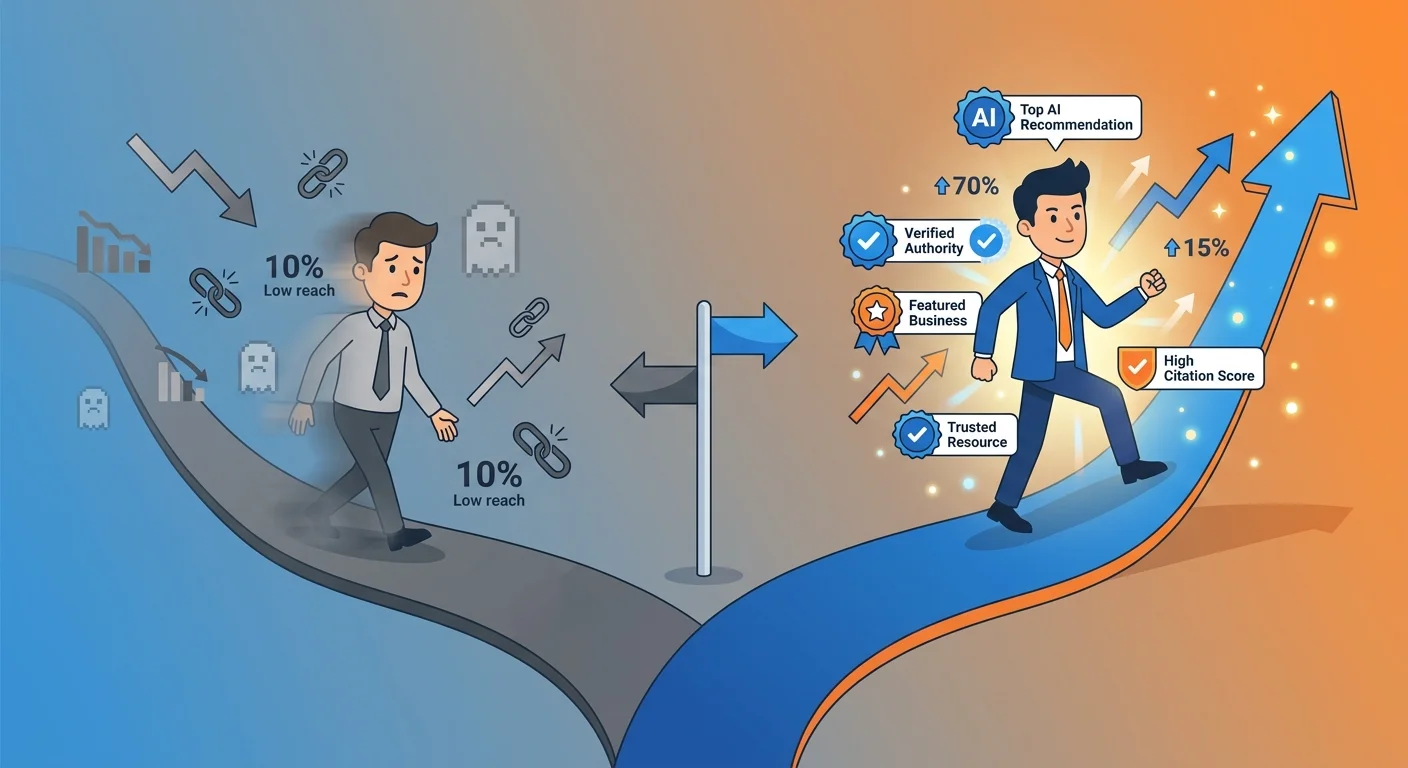
You're not just missing leads. You're training AI engines to say someone else's name.
Nearly two-thirds of all searches ended without a click to another web property in 2023. That trend isn't slowing — it's accelerating. AI-driven answers are replacing lists. When a patient asks ChatGPT who the best chiropractor near them is, one name shows up. If it's not yours, you don't exist.
And every time AI recommends your competitor instead of you, the gap widens.
AI Recommends Your Competitor by Default
Google's Search Generative Experience looks for corroboration from multiple high-quality sources before issuing a citation. If your competitor has that corroboration and you don't, the engine doesn't weigh options. It defaults to the entity it can verify.
There's no tie. There's no second place. The business with the strongest institutional signals gets the recommendation. You get silence.
This isn't a traffic problem. It's an authority problem. You can't SEO your way out of invisibility when the game moved from rankings to citations.
Traditional agencies optimize for a list that humans click through. AI engines don't produce lists. They produce verdicts.
Every month you stay invisible, your competitor compounds their advantage. LLMs exhibit bias toward information presented in a confident, authoritative tone from seemingly credible sources. The business that built Entity Clarity, Source Corroboration, and Content Authority first becomes the default answer.
Once AI engines learn to trust them, displacing them requires rebuilding the same infrastructure — except now you're starting from behind.
Authority Compounds — Invisibility Accelerates
Authority doesn't decay slowly. It accelerates. The practice that gets cited this month gets cited again next month — because AI engines reinforce their own recommendations. The more ChatGPT says a name, the more confident it becomes that the name is correct.
Building a defensive Answer Moat isn't optional. It's the only way to lock competitors out once you've taken the position.
Invisibility works the same way in reverse. The longer you're absent from AI recommendations, the harder it becomes to break through.
You're not competing against one business. You're competing against the cumulative weight of every citation your competitor already earned. That's not a six-month gap. That's structural disadvantage.
The window to act isn't gone. But it's closing. The businesses building ACA-level infrastructure today will own their categories within a year. The ones waiting for proof will spend the next three years trying to claw back ground that somebody else already claimed.
You don't get to pause and see how this plays out. Every month of inaction is a month your competitor builds signals you'll need to displace later.
Frequently Asked Questions
You've seen the system. You know the signals.
Now here's where it gets real.
The practices that move first ask the same questions. Can a small local business actually compete for these signals? What's the difference between ACA and what every other agency sells? How do you measure whether AI engines trust you?
These aren't academic. They're the questions that separate action from waiting.
What are institutional trust signals for AI answer engines?
Institutional trust signals are the structural patterns AI engines use to verify an entity before citing it.
Schema markup is a trust signal. Consistent NAP data across directories is a trust signal. Citations from .gov or .edu sources adjacent to claims in your content are trust signals.
Google's Search Quality Rater Guidelines dedicates over 30 pages to Trust as the most important member of E-E-A-T. Google's concept of E-E-A-T isn't optional reading — it's the blueprint AI engines inherit when they decide who to cite. They don't cite entities they can't verify.
How is an ACA Citation different from a traditional SEO backlink?
A backlink is a vote counted by an algorithm looking for popularity.
An ACA Citation is a reference issued by an AI engine as proof you're the trusted answer.
Backlinks optimize for a ranked list. Citations optimize for being the single answer. Traditional SEO assumes humans click through ten blue links. ACA assumes AI says one name.
The infrastructure that produces each outcome isn't even adjacent.
Can a small local business realistically compete with large institutions for trust signals?
Yes.
Small businesses can't outspend universities on institutional history. But they can borrow the same structural signals those institutions use.
Schema markup doesn't care about your marketing budget. Directory consistency doesn't care how long you've been in business. Answer-first content doesn't require decades of published research.
You're not competing on legacy. You're competing on infrastructure. Build Entity Clarity, Source Corroboration, and Content Authority correctly and AI engines can't tell the difference.
What is the first step in building an AI-readable authority infrastructure?
Run a Schema audit.
Open your site's source code and search for application/ld+json. If nothing appears, you've got zero structured data. AI engines can't parse your entity.
Google's Knowledge Graph can hold over 100 different attributes for a single entity — but only if you're feeding it structured data.
No Schema means no entity. No entity means no citation. Fix that before anything else.
How do you measure visibility and trust with AI engines like ChatGPT or Gemini?
You ask the engines directly.
Open ChatGPT and ask who the best chiropractor in your market is. Open Gemini and ask the same question. Check whether your name appears. Check whether a competitor's name appears.
If AI doesn't cite you, you're invisible.
The AI Visibility Check isn't theory. It's a live diagnostic that shows you exactly what answer engines say when someone asks who to trust. Run it every quarter and track citation presence over time.
The Bottom Line
Small businesses can't outspend universities. But you can borrow the same trust patterns they use.
Entity Clarity tells AI engines who you are. Source Corroboration proves you exist across verified platforms. Content Authority demonstrates you're worth citing. Those three pillars aren't theory. They're the infrastructure AI engines require before they'll say your name.
Traditional SEO agencies are still optimizing for a ranked list. That game's over. AI engines don't produce lists. They produce verdicts.
The business that built the authority infrastructure wins the citation. The one that didn't stays invisible. There's no second place when AI gives one answer. You're either the answer or you don't exist.
The ACA Citation Advantage isn't about gaming an algorithm. It's about building the authority infrastructure that forces AI engines to trust you as the verified, citable entity. Schema markup makes you readable. Directory consistency makes you verifiable. Answer-first content makes you extractable.
Deploy those signals systematically and you steal the institutional trust patterns that used to belong only to legacy brands.
The practices building this infrastructure today will own their categories within a year. The ones waiting for proof will spend the next three years trying to displace whoever moved first.
Every month of inaction is a month your competitor builds signals you'll need to overcome later.
Run the AI Visibility Check. It takes fifteen minutes and shows you exactly what ChatGPT, Gemini, and Grok say when someone asks who to trust in your market. If the results don't make the problem self-evident, walk away. But if they do — you'll know exactly what to do next.
You don't need decades of history. You need the right structural signals deployed correctly. That's the advantage we build. And that's what separates the businesses AI recommends from the ones it ignores.
You don't need decades of history. You need the right structural signals deployed correctly. Most practices assume they're visible until they ask ChatGPT, Gemini, and Grok directly — and a competitor owns every answer. Don't guess. Don't wait for proof to show up in your booking numbers six months from now. Run the AI Visibility Check. Fifteen minutes. Real data. Zero ambiguity.
621 Enterprises, Inc. | Copyright 2026 | All rights reserved