
Why Consensus Trumps Traffic in the AI Recommendation Cycle
AI recommendation engines don't count the crowd. They count the votes. When ChatGPT or Gemini decides which chiropractor to name, they're not pulling traffic reports. They're pulling consensus—the verifiable agreement among trusted sources about who has authority. Traffic tells you how many people visited your site. Consensus tells you how many trusted sources agree you're the right answer. Those aren't the same thing.
Consensus is built through structured signals AI engines can read and verify. Schema markup that tells machines exactly what you do. Citations from directories like Healthgrades or industry associations. Consistent entity mentions across verified platforms. Content that demonstrates expertise and trustworthiness in a way AI can trace back to its source. AI models are trained on datasets where the frequency and context of information establishes entities and relationships—they identify patterns of agreement, not popularity metrics.
This matters because most searches now end without a click. In 2020, nearly 65% of Google searches ended without a click to another web property. When someone asks an AI engine who the best option is and gets their answer on the screen, the traffic your site generates is invisible to that cycle. What AI engines evaluate instead are the authority signals embedded in your digital infrastructure—the machine-readable markers that validate your expertise before a human ever lands on your page. Google's ranking systems reward content demonstrating expertise, authoritativeness, and trustworthiness, prioritizing factors like author reputation and citations from authoritative sources.
The shift from traffic-focused SEO to consensus-focused authority building isn't optional. It's structural. Traditional agencies optimize for a list of results users click through and evaluate. AI engines produce a single recommended answer backed by verifiable trust signals. If your digital presence doesn't carry consensus markers—entity verification, trusted citations, structured data—you're not in the conversation. You're just counting visitors AI never sees.
Last Updated: May 18, 2026
- • The Traffic Illusion: Why Visitor Numbers Stopped Mattering
- • What Traditional SEO Gets Wrong
- • How AI Engines Actually Build Consensus
- • The Practical Reality: Shifting from Traffic Obsession to Consensus Building
-
• Frequently Asked Questions
- • How do AI engines like ChatGPT or Gemini determine consensus?
- • If traffic doesn't matter, what specific metrics should I be tracking for AI visibility?
- • Can a new business with low traffic build enough consensus to be recommended by AI?
- • What is the first step in auditing my business's current consensus signals?
- • How long does it typically take to shift AI recommendations by focusing on consensus over traffic?
- • The Bottom Line
The Traffic Illusion: Why Visitor Numbers Stopped Mattering
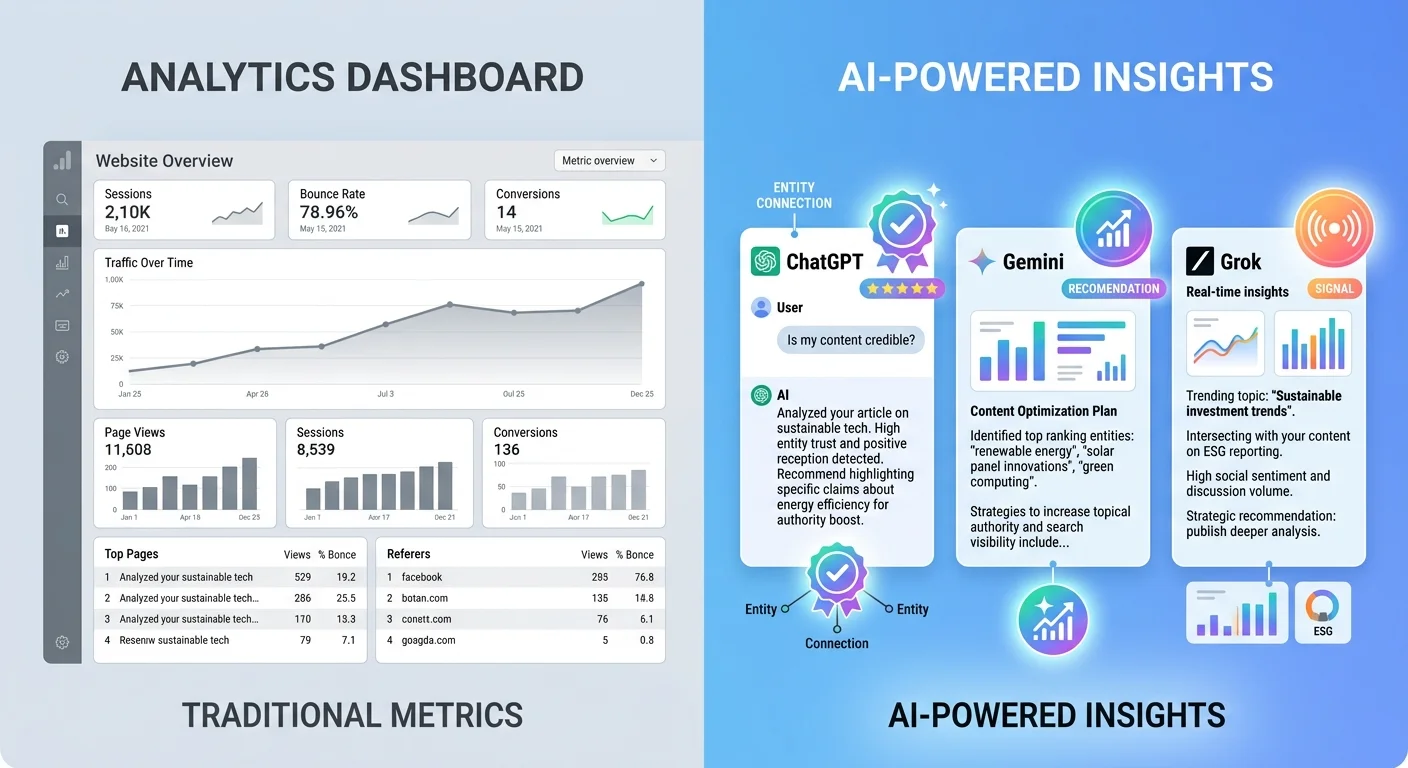
For the last decade, the marketing industry worshipped traffic. Page views. Unique visitors. Session duration. The whole SEO apparatus was built around driving more people to click through from a search results page to your website. Agencies sold traffic growth as the north star—more visitors meant more authority, which meant better rankings, which meant even more visitors.
That flywheel powered the entire industry.
It doesn't anymore.
The traffic-equals-authority equation depended on one assumption: users would click through to evaluate options themselves. But when zero-click searches dominate and AI engines deliver the answer directly, the click never happens. The visitor never arrives. Your traffic counter sits at zero while the AI engine recommends your competitor—not because they had more visitors, but because they had more verifiable consensus.
The Zero-Click Reality
In 2020, nearly 65% of Google searches ended without a click to another web property. Mobile searches show an even higher percentage of zero-click results. This isn't a temporary blip. It's the new baseline. Users ask a question, the AI interface surfaces an answer with citations, and the transaction ends right there. No click. No page view. No traffic signal for your analytics dashboard to capture.
This is the traffic illusion in its starkest form. You're optimizing for a metric the AI never sees. Even worse—Google's Helpful Content System generates a site-wide signal that penalizes sites with high amounts of unhelpful content, meaning traffic acquired through content that doesn't satisfy users actively works against you. The crowd you counted wasn't casting votes. They were bouncing.
When AI Engines Became Endpoints, Not Referrers
The fundamental shift isn't just zero-click search. It's the role of the AI engine itself. Traditional search engines were referrers—they pointed users toward ten blue links and let people decide. AI engines are endpoints. They evaluate the options, synthesize the answer, and deliver a verdict. The user doesn't click through to compare. They trust the engine's recommendation and move on.
When the engine becomes the endpoint, the only thing that matters is whether the engine trusts you enough to recommend you. That trust isn't built by traffic volume. It's built by the verifiable agreement of authoritative sources—schema markup that machines can parse, citations from directories AI engines validate against, structured entity data that anchors your business in a knowledge graph. Traffic measures the crowd. Consensus measures the votes. And AI engines don't count the crowd. They count the votes.
| Search Type | User Gets Answer From | Site Visibility | Traffic Impact |
|---|---|---|---|
| Traditional search (2010-2020) | List of ten blue links—user clicks through and evaluates options | High—user visits site to compare and decide | Every click generates a page view; traffic becomes the primary signal |
| Zero-click search (2020-present) | Featured snippet or direct answer on the search results page | Medium—site content is displayed but user may not click | Traffic drops even when the site's content is featured; visibility without visits |
| AI conversational search (2023-present) | Synthesized answer with inline citations—user reads and moves on | Low—user never leaves the AI interface | Zero traffic generated; the recommendation happens without a click |
| AI recommendation (current) | Single named entity delivered as the answer—'Try Dr. Smith on Main Street' | Irrelevant—AI evaluated consensus before user saw anything | Traffic is a lagging indicator; consensus was the determining factor |
What Traditional SEO Gets Wrong
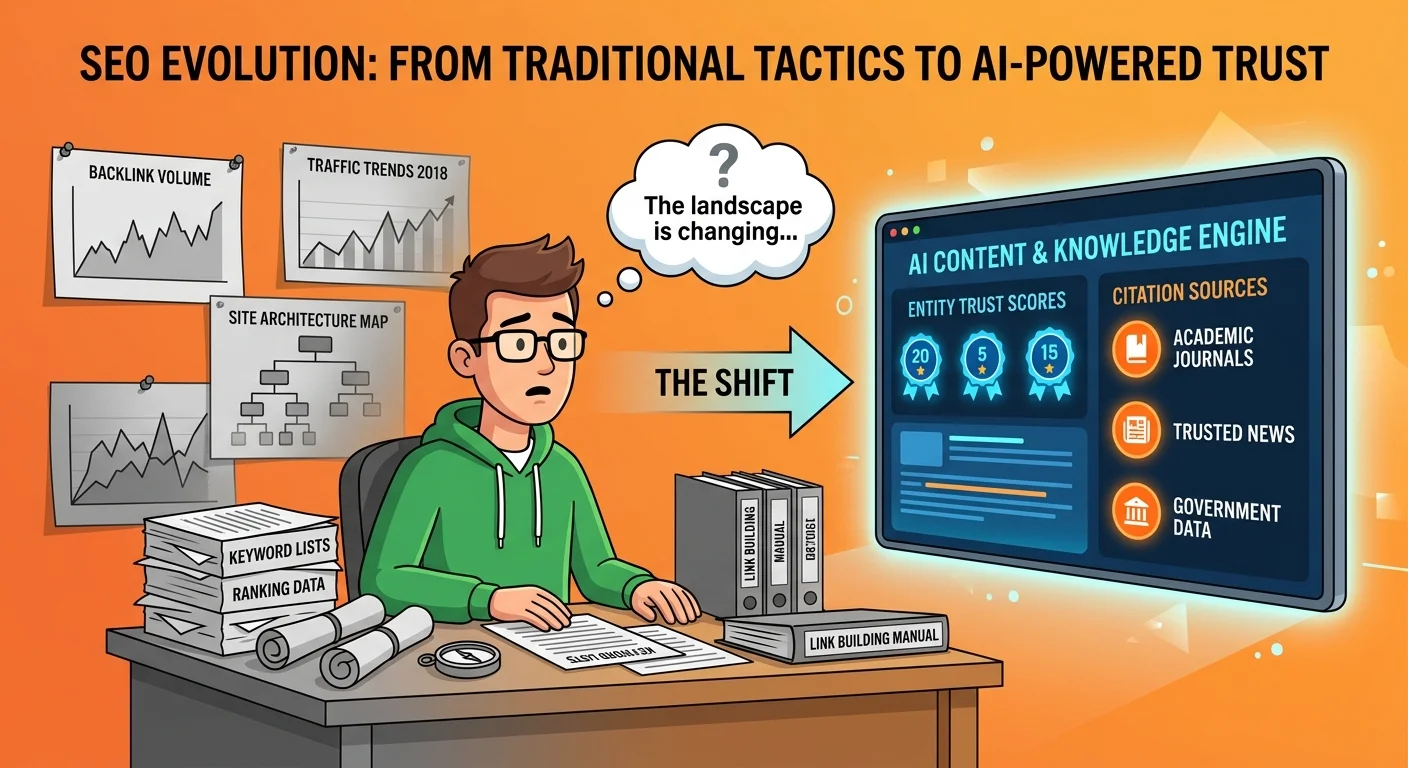
Traditional SEO was built for a world that doesn't exist anymore. The playbook — keyword density, backlink volume, domain authority scores — existed to game Google's old algorithm. You know, the one that handed you a list and let you pick.
That world's gone.
AI engines don't hand you a list. They hand you a verdict. And that verdict isn't built on traffic or keywords. It's built on verifiable entity consensus — the degree to which trusted sources agree you're the answer. Most agencies are still chasing metrics that have nothing to do with that calculation.
The Keyword-Stuffing Hangover
Keyword stuffing left a scar the industry still hasn't healed. Agencies figured out they could manipulate rankings by cramming content full of exact-match phrases. And for a while, Google's algorithm couldn't tell the difference between real authority and content written for a machine.
Then Google started rewarding content that actually demonstrates expertise, authoritativeness, and trustworthiness — things like the author's reputation and citations from other authoritative sources. AI engines took that framework and turned it into law. They don't care if your page says "chiropractor near me" fifteen times. They care if other entities verify you're a chiropractor worth recommending. The keyword's a signal. Consensus is the decision.
Why Backlink Quantity Fails the Consensus Test
The backlink arms race was the next hustle. Agencies realized they could juice rankings by piling up hundreds or thousands of inbound links. Volume became the scoreboard. The logic was dead simple — more links equals more authority.
But AI doesn't count links. It evaluates sources. Ten links from trusted healthcare directories carry infinitely more consensus weight than a thousand links from blog networks and low-quality directories. Google's systems already penalize sites with high amounts of unhelpful content — and AI engines crank that filter to eleven. If your backlink profile is built on volume instead of entity trust, you're invisible to the recommendation engine.
The 'Traffic = Authority' Fallacy
Here's where the whole thing collapses. Most agencies still sell SEO on the promise of traffic. More visitors, higher rankings, better visibility. Sounds logical until you understand how search algorithms work.
Traffic measures who showed up. Consensus measures who agrees you're the answer. AI engines don't count the crowd. They count the votes.
A practice can pull ten thousand visitors a month and still be invisible to ChatGPT. Because none of those visits built entity trust. None of those clicks told the AI engine this business is the authoritative answer. The traffic was real. The authority signal wasn't.
| Traditional SEO Tactic | What It Optimizes For | What AI Engines Actually Evaluate | Why It Fails Consensus |
|---|---|---|---|
| Keyword Density Optimization | Search engine crawler keyword matching and relevance scoring | Entity expertise signals, author reputation, and citation validation from authoritative sources | Keyword frequency doesn't establish trust—it signals to AI that content was written for bots, not humans, triggering quality penalties instead of authority recognition |
| High-Volume Backlink Campaigns | PageRank-style link counting where more links equal more authority | Trust signals from verified directories, institutional citations, and authoritative validators | AI engines filter for source credibility, not link volume—a hundred low-authority backlinks carry zero consensus weight compared to one citation from a trusted entity |
| Traffic Growth as North Star Metric | Click-through rates and page view volume as authority proof | Machine-readable entity data, schema markup, and structured consensus markers AI can parse before a user ever clicks | Traffic measures human behavior AI never observes—in zero-click search environments, visitor counts are invisible to recommendation engines evaluating trust |
| Content Volume Publishing | Indexing more pages to capture more keyword combinations and long-tail traffic | Site-wide quality signals that reward satisfying user experiences and penalize shallow, unhelpful content | Publishing high volumes of thin content to chase traffic triggers automated quality penalties that damage entity trust across the entire domain |
How AI Engines Actually Build Consensus
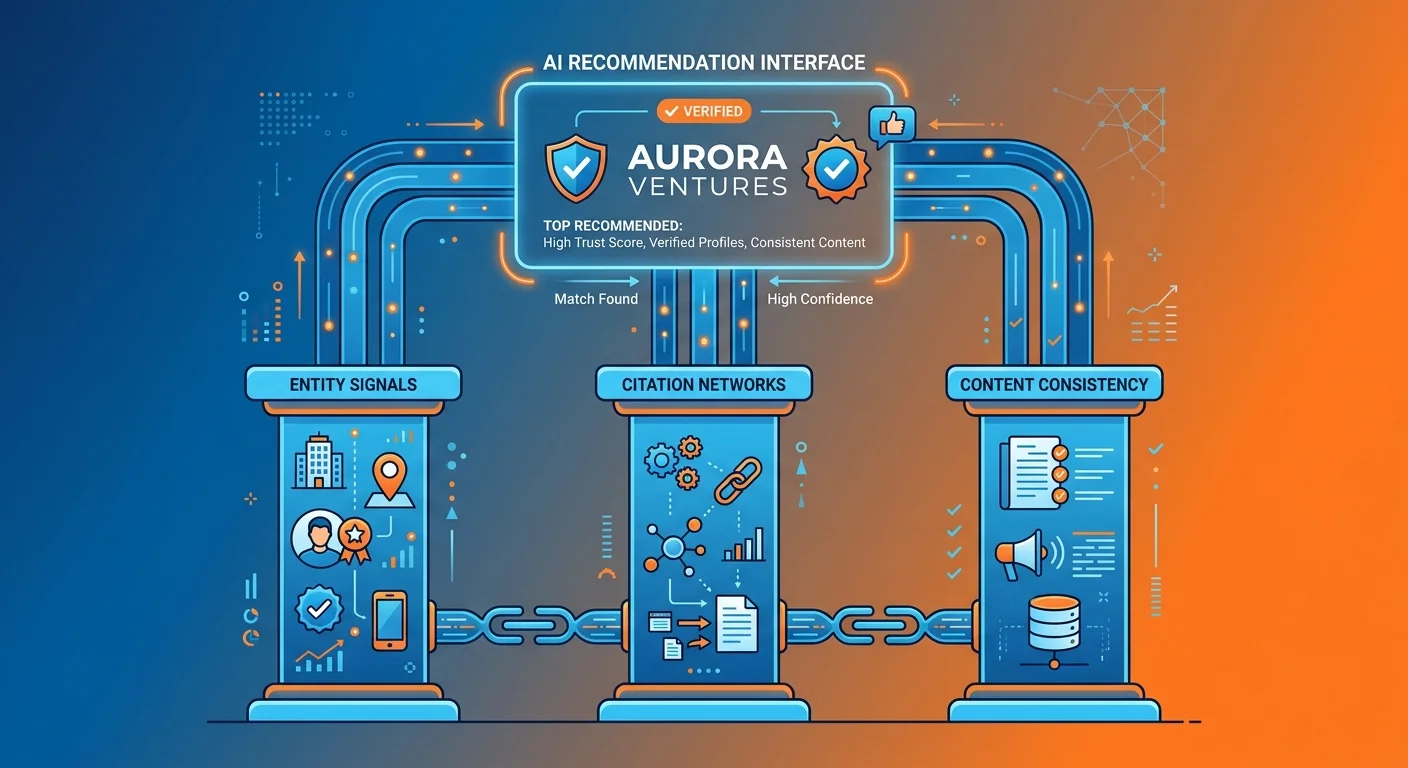
Traffic measures who showed up. Consensus measures who agrees you're the answer.
AI recommendation engines don't count visitors. They count validations. Every time a trusted source mentions your business, every time your entity appears in structured data across authoritative directories, every time your content gets cited by institutional sources—the engine logs it. Those validations form the basis of consensus. Recommendation algorithms often use collaborative filtering, which identifies patterns from user agreements. It's the AI equivalent of multiple trusted validators independently arriving at the same conclusion.
Here's what that looks like when you're the one asking the question. Perplexity shows its work—every citation is right there in the response. Users see exactly which sources the engine used to validate the recommendation. If your entity appears in healthcare directories like Zocdoc and Healthgrades, those platforms are treated as trusted validators. The engine isn't asking how many people visited your website last month. It's asking how many authoritative sources confirm you exist, do what you say you do, and have the credentials to back it.
Entity Signals
AI models are trained on vast datasets where the frequency and context of information help establish entities and relationships. That's not marketing copy. That's how the training works. The engine builds a knowledge graph. Your business is a node. Every mention, every citation, every structured data point is an edge connecting you to other validated entities.
If your entity signals are weak—missing schema, inconsistent NAP data, no presence on institutional directories—the engine can't confirm you're real. It won't recommend what it can't verify.
Most practices have a website. Fewer have an entity the AI can trust. That gap is the difference between being buried in a directory and being the answer ChatGPT gives when someone asks who to see.
Citation Depth
The next layer is citation depth. It's not enough for one source to mention you. AI engines look for repeated, consistent citations across multiple authoritative sources. The more institutional validators that independently cite your business, the stronger the consensus signal.
That's why we build entity trust as infrastructure, not as an afterthought. One directory listing won't move the needle. A citation network across healthcare directories, local business platforms, and institutional content does. The engine sees patterns. The more validated touchpoints, the higher the confidence score.
Content Consistency
Content consistency matters because AI engines cross-reference what you say about yourself. If your website says you specialize in sports injuries but your directory profiles say general chiropractic care, the engine flags the mismatch. Inconsistent messaging tanks trust.
The fix isn't complicated. It's just ignored by most agencies. Every touchpoint must reinforce the same entity identity. Same services. Same credentials. Same geographic scope. That consistency signals to the AI that you're a stable, verified entity—not a business trying to be everything to everyone depending on which page the user lands on.
The Practical Reality: Shifting from Traffic Obsession to Consensus Building
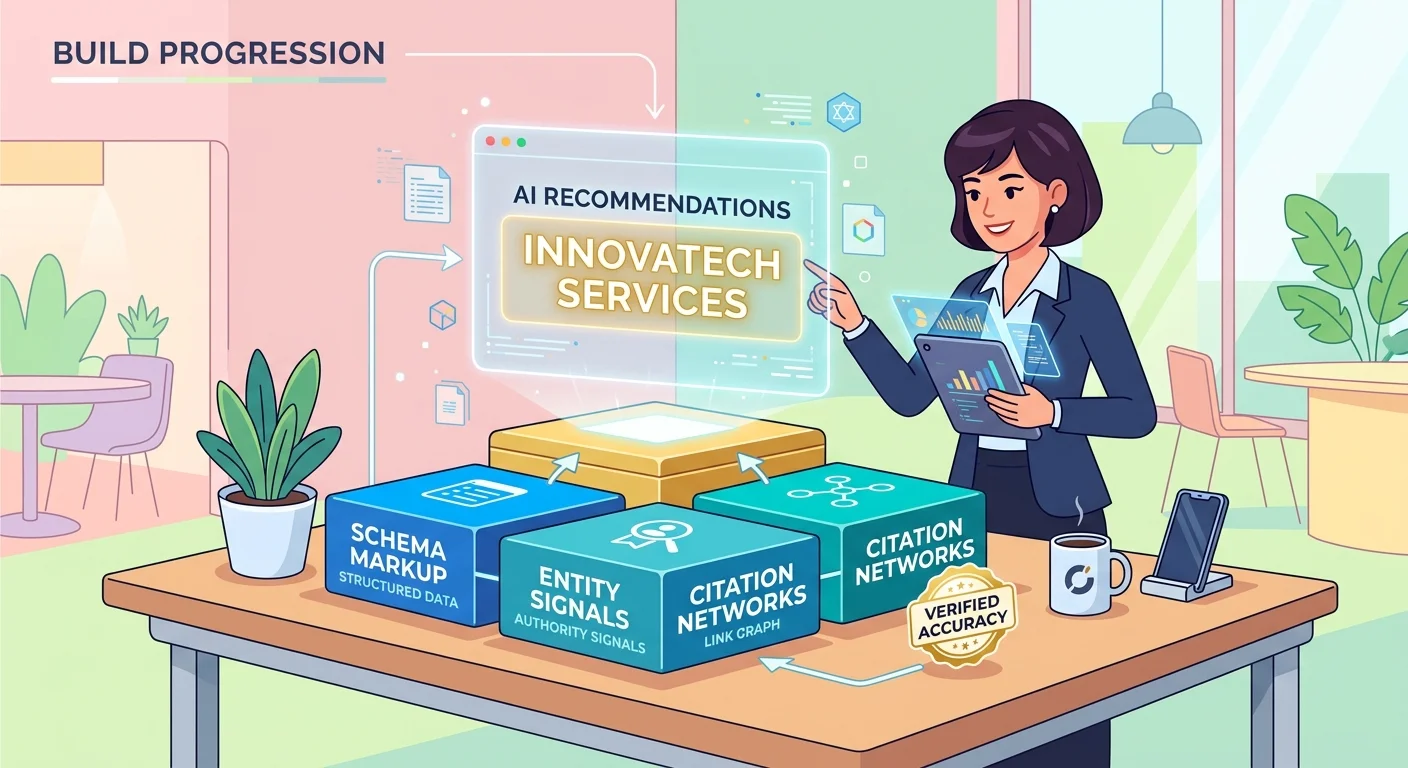
Here's the reality most businesses don't want to hear: you can't chase traffic and build consensus at the same time. The tactics are mutually exclusive.
Traffic optimization rewards volume and short-term engagement. Headlines that bait clicks. Content designed to game impressions. Strategies built around attracting as many visitors as possible.
Consensus building rewards depth and long-term validation. Infrastructure that machines can verify. Citations from sources AI engines already trust. Content that proves expertise over time.
You're either optimizing for the crowd or optimizing for the votes. You can't do both.
The shift isn't philosophical. It's operational.
Businesses that continue dumping budget into traffic-first tactics aren't just wasting money — they're actively delaying the moment AI engines will trust them enough to say their name. Because nearly 65% of searches ended without a click. The traffic you're chasing never converts into AI recommendation.
The user got their answer from the AI interface itself. Your traffic spike didn't register. Your entity did — or it didn't.
Infrastructure Over Impressions
Building for consensus starts with infrastructure, not content volume.
Most businesses skip straight to blogging because it feels productive — publish more, rank more, get more traffic. But if your entity isn't machine-readable, if your schema is missing or broken, if your citations aren't validated across authoritative directories, the content you're publishing isn't building consensus.
It's floating in a void.
AI engines can't connect it to a verified entity, so it never registers as proof of expertise.
This is why the Local AI Authority Engine doesn't start with blog posts. It starts with the foundational layer — schema architecture, entity validation, citation infrastructure. The stuff traditional SEO agencies skip because it's hard to sell as a line item.
But it's the only layer that matters when AI engines run their consensus audit.
Without it, you're building a content library on sand.
Infrastructure isn't glamorous. It doesn't produce a vanity metric you can screenshot for a board meeting.
But it's the difference between being cited and being ignored. And in a world where 52% of Americans are more concerned than excited about AI, the businesses that win recommendations will be the ones AI engines can validate with institutional confidence — not the ones with the flashiest landing page.
Authority Layers vs. Traffic Spikes
Traffic spikes are temporary. Authority signals compound.
A single viral post might drive ten thousand visitors in a week — then vanish. The algorithm moved on. The trend shifted. The traffic disappeared, and you're back to baseline.
Nothing about that spike built long-term consensus because consensus isn't measured in moments. It's measured in layers — how many validated citations you've accumulated, how consistent your entity data is across platforms, how deep your content library proves your expertise.
This is the gap most businesses can't see until it's too late.
They celebrate the traffic spike. They assume the algorithm noticed. But the algorithm wasn't watching your Analytics dashboard. It was scanning for structured signals.
And if those signals weren't there — if your schema was incomplete, if your citations were thin, if your content didn't demonstrate topical depth — the spike didn't matter.
You counted the crowd. The AI counted the votes. And the votes weren't there.
What Consensus Looks Like in Practice
So what does consensus actually look like when you audit it?
It's not abstract. It's measurable. Run an AI Visibility Check and you'll see exactly where your entity stands — whether ChatGPT, Gemini, and Perplexity cite you when users ask for recommendations in your category.
If they don't, the gap isn't traffic. It's trust.
And closing that gap requires building the specific layers AI engines validate: verified entity data, authoritative citations, and a content library that proves you're the answer. How AI engines build trust isn't guesswork — it's architecture.
In practice, consensus looks like this: a chiropractor in Austin gets recommended by AI engines not because their website has the highest traffic in the market, but because their entity is validated across Google Business Profile, Healthgrades, state licensing boards, and a structured content library that answers the questions patients ask conversationally.
The competitor across town has double the traffic. But their schema's broken, their citations conflict, and their blog is keyword-stuffed fluff.
The AI ignores them.
That's the practical reality. Traffic measures popularity. Consensus measures trust. And in the AI recommendation cycle, trust is the only currency that matters.
If you're still optimizing for impressions, you're playing the wrong game.
AEO Content Writing Services exist to close that gap — to build the content execution layer that proves expertise while the infrastructure layer validates your entity. Both layers compound. Traffic doesn't.
| Metric Category | Traffic-Focused Approach | Consensus-Focused Approach | AI Engine Response |
|---|---|---|---|
| Primary Success Metric | Monthly visitor count, page views, bounce rate reduction | Entity validation across authoritative directories, citation depth from trusted platforms, content library topical coherence | Ignores visitor volume entirely; validates entity trust signals and institutional corroboration |
| Content Strategy | Keyword-optimized blog posts designed to rank in search results and drive click-throughs | AEO article library structured to answer conversational queries and prove expertise across topical clusters | Prioritizes content that demonstrates depth and answers the questions users ask AI engines directly |
| Infrastructure Priority | Website aesthetics, page speed optimization, conversion rate optimization for visitors who land | Schema architecture, entity data consistency, citation validation across platforms AI engines trust | Requires machine-readable entity data; aesthetics are irrelevant without structured validation |
| Validation Source | Google Analytics dashboard, keyword rankings, referral traffic sources | AI Visibility Check results showing whether ChatGPT, Gemini, and Perplexity cite the entity when users ask for recommendations | Audits entity mentions in conversational responses, not traffic logs or rank trackers |
| Timeline Expectation | Expect traffic spikes within weeks or months from viral content or paid campaigns | Authority compounds over sustained execution; consensus builds as citations accumulate and content library deepens | Evaluates entity trust as a cumulative signal, not a moment-in-time traffic event |
| Competitive Advantage | Outrank competitors on specific keywords; capture more clicks from search results pages | Become the single recommended answer AI engines cite when users ask conversational queries in your category | Produces a verdict, not a ranked list; the business with verified consensus displaces all others |
Frequently Asked Questions
You get it. The shift is real. Now here's the part where you ask the questions every business owner asks the second they realize traffic isn't the metric anymore.
These aren't abstract.
They're the exact objections we hear from owners who know they need to pivot but don't know where to start. If you're asking them, you're already ahead of the businesses still celebrating impression charts while AI engines ignore them.
How do AI engines like ChatGPT or Gemini determine consensus?
They're trained on datasets where frequency and context establish entity relationships. That means they look for patterns of agreement across authoritative sources — not visitor counts.
When ChatGPT or Gemini evaluates your business, they scan for validated citations across directories, structured schema that proves your entity is real, and content depth that demonstrates expertise.
It's collaborative filtering applied to entities. AI engines identify which businesses are consistently cited by sources they already trust, then weight those entities higher in recommendations.
If five trusted sources say you're the answer, that's consensus. If your website says you're the answer but no external validators agree, that's noise.
If traffic doesn't matter, what specific metrics should I be tracking for AI visibility?
Stop tracking impressions and start tracking entity validation. That means whether your schema is complete and error-free, how many authoritative directories cite your business accurately, and whether AI engines mention your name when users ask category questions.
Run an AI Visibility Check and you'll see exactly where you stand. ChatGPT, Gemini, and Perplexity either cite you or they don't. That's the metric. Not sessions, not bounce rate, not time-on-page.
If AI isn't saying your name, the gap isn't traffic. It's trust.
Track citation depth, schema health, and recommendation presence. Everything else is vanity.
Can a new business with low traffic build enough consensus to be recommended by AI?
Yes. But only if they build infrastructure first.
Traffic isn't the barrier. The barrier is validated entity data, authoritative citations, and content that proves expertise. A new chiropractor with zero web traffic can get recommended by AI if their Google Business Profile is complete, their state licensing board citation is accurate, their schema is clean, and their content library answers the questions AI engines use to evaluate authority.
The competitor with ten thousand monthly visitors but broken schema and thin citations loses.
AI engines don't care how long you've been around. They care whether the signals they trust validate your entity. Start with schema architecture, citation validation across authoritative directories like Healthgrades, and structured content execution. Traffic comes after trust, not before.
What is the first step in auditing my business's current consensus signals?
Ask an AI engine to recommend a business in your category and see if it says your name. That's the audit.
If ChatGPT, Gemini, and Perplexity don't cite you, the gap is consensus — not traffic.
From there, check whether your schema is complete, whether your entity data matches across Google Business Profile and industry directories, and whether your content library demonstrates topical depth or just keyword stuffing. The AI Visibility Check does this in fifteen minutes. You'll know exactly where your entity stands and which layers are missing.
Most businesses skip the audit and go straight to publishing more content. That's like building a second story on a house with no foundation. Audit first. Build the infrastructure gaps second. Content execution third.
How long does it typically take to shift AI recommendations by focusing on consensus over traffic?
There's no microwave schedule.
Authority compounds in layers. Schema and citation infrastructure can be validated within weeks, but content depth and cross-platform entity consistency take months to prove expertise. AI engines prioritize expertise, authoritativeness, and trustworthiness — which means they're looking for sustained signals, not one-off efforts.
A business that fixes schema, validates citations, and publishes structured AEO content monthly will start appearing in recommendations faster than a competitor chasing traffic spikes. But "faster" still means sustained execution over multiple months.
The businesses that quit after ninety days hand their consensus ground to whoever kept going. This isn't a sprint. It's compounding infrastructure. You don't wake up one day and suddenly have consensus. You build it, layer by layer, until AI engines decide you're the answer.
The Bottom Line
The shift from traffic to consensus isn't coming. It's here.
AI engines are making recommendations right now. If your entity isn't validated across the layers that matter — schema, citations, structured content — you're not in the conversation. The competitor down the street with half your traffic is getting recommended because they built the infrastructure you skipped. The agency that sold you impression charts and keyword rankings didn't tell you the algorithm changed the rules.
By the time most businesses realize traffic stopped mattering, the consensus gap's too wide to close quickly.
AI engines don't count the crowd. They count the votes. And if you've been chasing the crowd, the votes went somewhere else.
Here's what that looks like in practice.
You're celebrating a spike in visitors while ChatGPT is telling potential customers to call someone else. You're tracking Analytics dashboards while Gemini is citing your competitor's entity as the trusted answer. You counted the crowd. The AI counted the votes.
And the votes went to the business that spent the last year building entity trust, validating citations, and proving expertise through structured content — not chasing impressions.
The gap compounds every month you wait. Consensus isn't built overnight. But every month you don't start is a month your competitor's authority deepens while yours stays invisible.
So what's the play?
Stop chasing traffic you can't convert and start building the infrastructure AI engines validate. Schema architecture. Citation depth. Content consistency. The foundational layers that prove your entity is real, trusted, and authoritative.
It's not glamorous. It won't produce a vanity metric you can screenshot for your Homepage.
But it's the only thing that moves the needle when AI runs its consensus audit.
You can keep chasing the crowd — or you can start building the authority that makes AI say your name. The businesses that win recommendations in the next twelve months won't be the ones with the most traffic. They'll be the ones AI engines decided to trust.
And that decision is happening right now.
You know the gap exists. The only question is whether you're going to close it — or watch your competitor do it while you're refreshing your Google Analytics dashboard.
The AI Visibility Check takes fifteen minutes. You'll see exactly what ChatGPT, Gemini, and Perplexity say when someone asks for a recommendation in your market. If they're naming you, you'll know what's working. If they're not — you'll see the gap, and you'll understand why traffic never mattered in the first place.
AI engines don't count the crowd. They count the votes. And if the votes aren't there, every month you wait is another month your competitor builds the lead.

621 Enterprises, Inc. | Copyright 2026 | All rights reserved