
From Keywords to Clusters: How We Execute AEO Content
AEO content clusters organize your website around topic areas instead of individual keywords. A cluster consists of one authoritative pillar page that covers a broad topic, linked to multiple supporting articles that dive deep into specific subtopics. All pages interlink. That creates a semantic web search engines and AI can follow to understand your expertise.
The shift from keywords to clusters isn't a tactic upgrade. It's a structural change in how your business builds authority.
Traditional keyword SEO targets individual search queries. You optimize one page for one phrase. You compete for a spot on page one. That spot changes weekly based on algorithm updates and competitor moves. You're renting visibility.
Content clusters build permanent infrastructure you own. Nearly 64% of searches on Google ended without a click to another web property in 2023. AI tools like ChatGPT are now used by 23% of U.S. adults for information gathering. These users don't see a list of ten blue links. They see one answer.
Google's ranking systems reward content that demonstrates expertise, experience, authoritativeness, and trustworthiness. Semantic search considers user intent, query context, and the relationship between words rather than keyword matching. AI engines scan for topic depth, not keyword density.
Answer Engine Optimization formats content to be that singular, trusted answer. Clusters establish topical authority by proving you've covered every angle of a subject. The pillar page acts as a hub. Cluster articles function as proof of depth.
When your content is organized this way, AI doesn't have to guess whether you're an authority. The structure tells it.
Last Updated: June 8, 2026
- • Why Individual Keywords No Longer Build Authority
- • What a Content Cluster Actually Is
- • How We Execute Content Clusters for Authority
- • What Makes Our Cluster Execution Different
-
• Frequently Asked Questions
- • How is a topic cluster different from just writing a lot of blog posts about the same subject?
- • Do keywords still matter in an AEO content strategy that uses clusters?
- • How long does it take to establish topical authority with content clusters?
- • What is the difference between a pillar page and a cluster page?
- • Can you give an example of a topic cluster for a local business?
- • How does a content cluster strategy help my business get recommended by AI like ChatGPT or Gemini?
- • The Authority Compounds or It Doesn't
Why Individual Keywords No Longer Build Authority

The keyword model was built for a search engine that doesn't exist anymore. You picked a phrase. You optimized a page around it. You built backlinks. You fought for a spot on page one. That spot meant traffic. Traffic meant visibility. Visibility meant you might get the click.
Here's the problem: people don't search like that anymore.
They're asking full questions. They're using voice search. They're typing conversational queries into ChatGPT instead of Google. And when they do use Google, the rise of zero-click searches means they're getting the answer right there on the results page. No click required.
So even if you rank #1 for a keyword, you're not guaranteed the outcome you built the page for. You're renting a spot on a list that's increasingly irrelevant. The list isn't the product anymore. The answer is.
The Search Behavior Shift
Search behavior shifted from keyword matching to intent understanding. Users don't type "chiropractor herniated disc treatment." They type "Why does my lower back hurt when I bend over and what should I do about it?"
AI engines parse that query for intent, context, and meaning. They don't match keywords. They understand the question and return the entity they trust to answer it. If your content is optimized for a three-word phrase and the user's asking a twelve-word question, you're invisible.
As of mid-2023, 23% of U.S. adults report having used ChatGPT. That's not early adopters anymore. That's mainstream. And those users aren't scrolling through ten options. They're reading one answer and moving on.
Zero-Click Reality
In 2023, nearly 64% of searches on Google ended without a click to another web property. Two-thirds. The majority of queries are answered right on the search page — featured snippets, knowledge panels, AI overviews.
If you're optimizing for a click, you've already lost. The game isn't "get them to your site." The game is "be the answer the engine shows."
Keyword-optimized pages can't do that. They're too narrow. They don't prove depth. They don't establish authority. They're built to compete for a spot on a list, not to be the trusted answer to a question. And that's why the shift to AI tools is accelerating the obsolescence of the keyword model faster than most agencies realize.
| Search Model | User Behavior | Visibility Outcome | Authority Signal |
|---|---|---|---|
| Traditional Keyword SEO | User types exact three-word phrase into Google and scrolls through ten results | Renting a spot on page one — changes weekly based on algorithm updates and competitor moves | None — single page answers single query with no proof of topic depth |
| Zero-Click Search | User types conversational question into Google and reads the featured snippet or knowledge panel without clicking | Your page can rank #1 and still receive zero traffic — the answer is extracted and displayed inline | Weak — snippet extraction doesn't prove comprehensive expertise or entity trust |
| AI Answer Engine (ChatGPT, Gemini, Perplexity) | User asks full natural-language question and receives one synthesized answer with citations | You're either the cited source or you're invisible — no list, no page two, no second chance | Strong if you're cited — AI validated your entity as the trusted authority on the topic |
| Content Cluster Model | User lands on pillar page or cluster article from any query variant and can navigate the full topic web | Permanent infrastructure you own — authority compounds with every interlinked article published | Strongest — proves topical depth, semantic coherence, and entity expertise across the entire subject area |
What a Content Cluster Actually Is
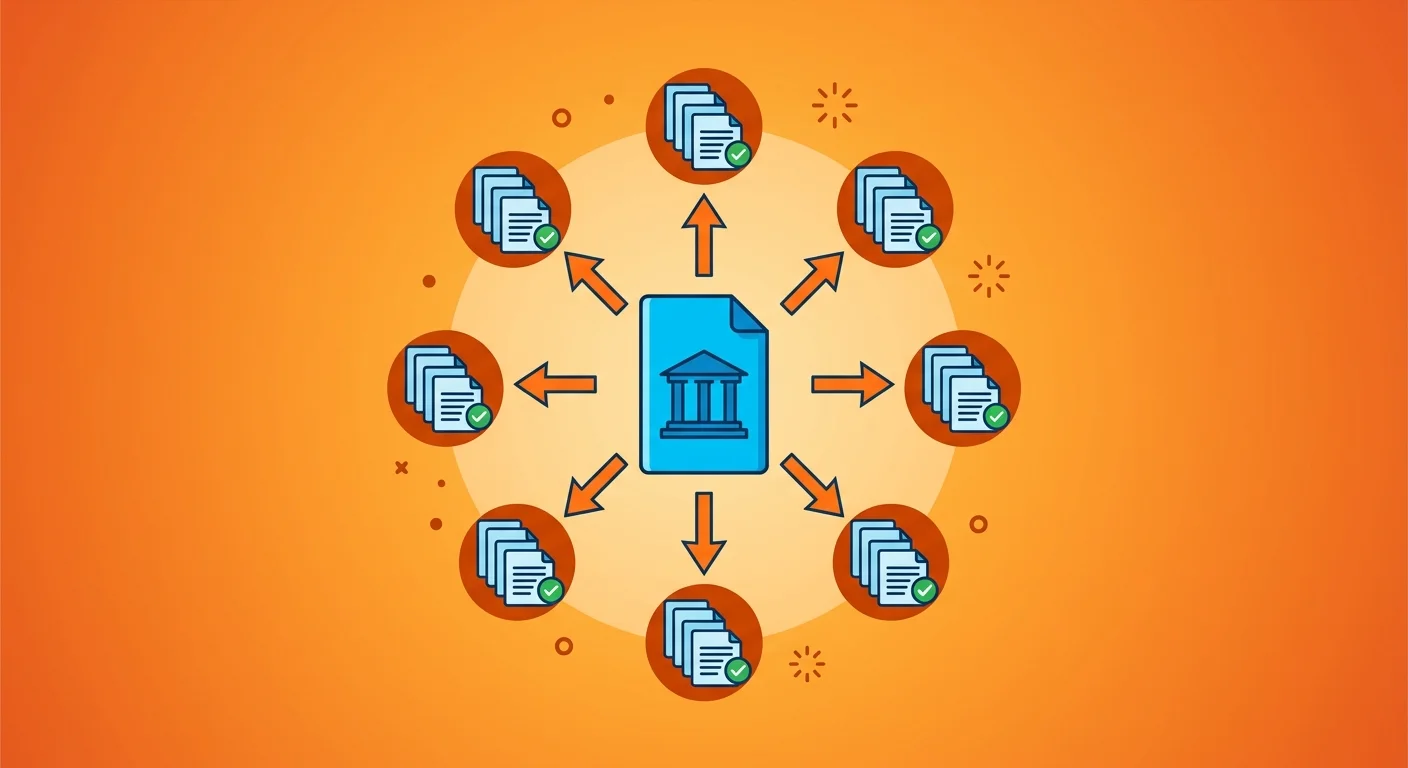
Here's what a content cluster actually is. One pillar page covers the broad topic. Multiple cluster articles dive deep into specific angles under that umbrella. Every cluster article links back to the pillar. The pillar links out to every cluster article. That creates a semantic web AI can crawl to confirm your expertise.
The pillar page acts as a hub for a specific topic, linking out to more in-depth cluster pages that are all interlinked. It's not a landing page. It's not a service page. It's a resource that answers the core question and points to deeper exploration. Cluster articles address specific questions, objections, or use cases that fall under the pillar's umbrella.
This isn't new. HubSpot popularized the pillar-cluster model years ago. But most agencies treated it as a content marketing tactic—a way to organize blog posts. We build it as Authority Infrastructure. The structure doesn't just help users find what they need. It tells AI engines exactly what you're an authority on and proves you've done the work to earn that authority.
The Pillar-Cluster Architecture
The pillar page sits at the center. It covers the broad topic in enough depth that someone could read it and walk away with a complete understanding. It doesn't go deep on every subtopic. That's what the cluster articles do.
Each cluster article targets a specific question or angle within the pillar's topic. If the pillar is about chiropractic care for herniated discs, a cluster article might cover "How long does it take for a herniated disc to heal with chiropractic treatment?" or "Can chiropractic adjustments make a herniated disc worse?" Each article is comprehensive on its own. But it's also part of a larger topic ecosystem.
The linking structure is what makes this work. The pillar links to every cluster article. Every cluster article links back to the pillar. Cluster articles can link to each other when relevant. This creates semantic density. AI engines crawl the entire topic web in one session and understand the full scope of your expertise.
Most agencies stop here. They build the structure and call it done. But how semantic search works means the linking alone isn't enough. Semantic search considers user intent, query context, and the relationship between words. The content inside each article must be optimized for entity trust, not keyword density. That's where AEO execution separates infrastructure from decoration.
How Clusters Signal Topical Authority
AI engines don't trust you because you published ten articles on the same topic. They trust you because your content proves comprehensiveness, depth, and interconnectedness. Clusters do that in a way keyword-optimized pages can't.
Google's helpful content system prioritizes people-first content over content created primarily for search engine traffic. A cluster demonstrates people-first intent. You've answered every question a user might have on the topic, not just the one that gets the most search volume. That's the signal AI looks for when determining which entity to recommend.
When your cluster is complete, AI doesn't have to guess whether you're an authority. The structure itself is the proof. The pillar shows breadth. The cluster articles show depth. The internal links show coherence. The content quality shows trustworthiness. That's how you move from competing for a spot on a list to being the answer AI cites.
| Component | Purpose | Content Depth | Linking Pattern |
|---|---|---|---|
| Pillar Page | Serves as the authoritative hub for a broad topic — covers the subject comprehensively without going deep on every subtopic | Wide and complete — addresses the core question from multiple angles, with links to deeper exploration | Links out to every cluster article under its umbrella; receives inbound links from all cluster articles |
| Cluster Article | Dives deep into one specific subtopic, question, or angle within the pillar's umbrella — proves depth on a narrow slice | Narrow and exhaustive — answers one question completely, with context tied back to the pillar topic | Links back to the pillar page; can link to other cluster articles when semantically relevant |
| Internal Linking Structure | Creates semantic density and topic coherence — tells AI engines exactly what you're an authority on by showing the full topic web | Not content itself — the linking pattern is the proof structure that connects all cluster components | Bidirectional between pillar and clusters; lateral between clusters when context supports it |
| Semantic Web | The cumulative effect of pillar + clusters + linking — allows AI to crawl your entire topic ecosystem in one session and verify comprehensive coverage | The whole is greater than the sum — individual articles prove depth, but the web proves authority | Every page in the cluster can be reached from any other page in 1-2 clicks; no orphan content |
How We Execute Content Clusters for Authority
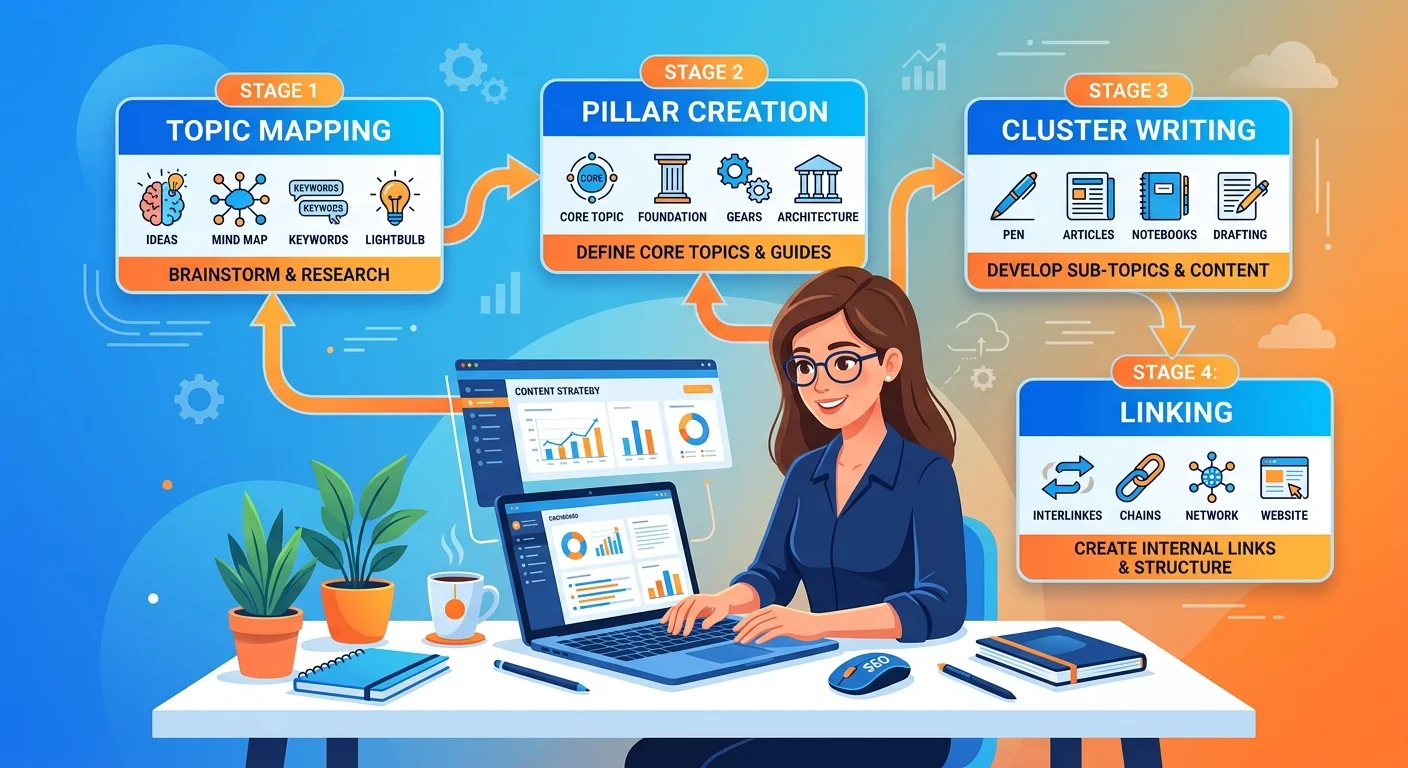
The theory is settled. Here's how we actually build this for clients—step by step.
Our AI Authority Engine doesn't start with keyword research. We start with topic selection and authority mapping. We identify the core topics your business needs to own. We map the question ecosystem around each one. We build a cluster architecture that proves depth before we write a single word.
This isn't content marketing. It's Authority Infrastructure. The pillar page sits at the center. Cluster articles branch out to cover every angle. Internal links create semantic density. And every piece is optimized to be the direct answer AI engines cite—not just another page competing for a click.
Step 1: Topic Selection and Authority Mapping
We don't start with what you want to rank for. We start with what your audience is actually asking. Not three-word keyword phrases. Full questions. The kind people type into ChatGPT or ask Siri while they're driving.
We map those questions into topic clusters. Each cluster has one pillar—the broad topic—and eight to twelve supporting articles that address specific subtopics, objections, and use cases. If the pillar is chiropractic care for herniated discs, the cluster articles cover healing timelines, treatment options, risks, costs, and everything else someone might ask before booking an appointment.
This is where most agencies fail. They pick topics based on search volume. We pick topics based on authority potential. Search volume measures existing demand. Authority potential measures whether a topic can establish your business as the singular trusted answer in your market. Those aren't the same thing.
Step 2: Pillar Page Architecture
The pillar page is a hub. Not a service page. Not a landing page. It's a deep resource that answers the core question and proves to AI you've covered the topic from every angle. It links out to more in-depth cluster pages, and all of them are interlinked back. That's the structure.
We build pillar pages to be the answer. Not a page competing for clicks. The answer AI shows when someone asks the question. That means the content gets structured for entity trust — not keyword density.
Every pillar includes schema markup that identifies your business as the entity behind the content. We're structuring your entity identity with schema so AI engines can verify who you are, what you do, and why you're qualified to answer. Without that, the content is orphaned. It exists, but it's not tied to your business in a way AI can parse.
The pillar also links out to every cluster article. Not buried in body copy. Clearly. Intentionally. In a way that tells AI this is part of a larger topic ecosystem. That structure is what proves comprehensiveness. AI doesn't trust you because you wrote one long article. It trusts you because you built a web of interconnected content that covers the topic from every angle.
Step 3: Cluster Article Production
Every cluster article we produce is optimized to be the singular, authoritative answer for conversational AI and answer boxes. Not a blog post. Not an SEO or AEO article. The direct answer AI cites when someone asks the question.
Each cluster article targets one specific question within the pillar's topic. The content is deep enough to stand alone, but it's also part of a larger authority structure. We don't write filler. Every paragraph delivers information. Every section addresses intent. And every article links back to the pillar and to other relevant cluster articles.
We don't publish ten articles at once and call it done. We build clusters in phases — pillar first, then supporting articles over time. That lets us refine the structure as we go, adapt to what's working, and keep consistency in voice and depth. A cluster isn't a project. It's infrastructure that compounds as it grows.
Step 4: Internal Linking and Semantic Density
Internal linking is where most agencies treat clusters like an afterthought. They build the content, throw in a few links, and hope it works. That's not how semantic density works.
Every cluster article links back to the pillar. Every pillar links out to every cluster article. Cluster articles link to each other when relevant. The result is a web AI engines can crawl in one session, understanding the full scope of your authority on the topic. That's semantic density—not keyword density.
We don't build this once and walk away. Clusters need maintenance. New questions emerge. Search behavior shifts. AI engines update how they parse content. If your cluster stays static, it decays. Authority isn't built once. It's maintained, expanded, and refreshed. That's why an authority engine requires monthly maintenance—because the Authority Infrastructure we build is permanent, but the work to keep it authoritative is ongoing. The Engine runs. We keep it fueled.
| Execution Phase | Deliverable | Timeline | Authority Impact |
|---|---|---|---|
| Topic Selection and Authority Mapping | Core topic identification, question ecosystem map, cluster architecture blueprint | Week 1–2 | Establishes topical authority foundation by mapping comprehensive coverage before content creation |
| Pillar Page Architecture | Comprehensive pillar page with schema markup, internal linking structure, entity identification | Week 3–4 | Acts as hub linking to in-depth cluster pages, proving breadth of expertise to AI engines |
| Cluster Article Production | 8–12 comprehensive articles optimized as direct answers, each targeting specific subtopic questions | Ongoing (monthly phases) | Formatted to be singular authoritative answer for conversational AI and answer boxes |
| Internal Linking and Semantic Density | Bidirectional links between pillar and clusters, lateral cluster interconnections, ongoing link maintenance | Continuous (with each new article) | Creates interconnected web AI engines crawl to understand full scope of authority on topic |
What Makes Our Cluster Execution Different

Plenty of agencies say they do this. Here's what separates execution that works from execution that wastes time.
Most agencies build clusters like they're checking boxes. Pillar page. Ten supporting articles. Internal links. Done.
They miss the part where AI engines validate authority. AI doesn't count pages. It verifies consistency, depth, and trustworthiness across every piece of content in the cluster.
We don't publish content until it's passed our Two-AI Validation System. Every article integrates entity trust at the infrastructure level. Every article is written to be the answer AI cites.
Not optimized for AI. Written to be what AI recommends.
Two-AI Validation System
Every article we produce goes through two AI engines before it goes live. Gemini researches and validates data accuracy. Claude writes and refines structure. Then Gemini validates again—checking facts, sources, and compliance with the cluster's semantic framework.
This isn't a quality check. It's a verification layer. Every claim is grounded. Every source is institutional. Every piece of content fits into the larger authority structure.
We don't publish vibes. We publish receipts.
Most agencies write content and hope AI trusts it. We validate content against the same engines that will recommend it. If Gemini flags a claim as unsupported, it doesn't ship. If Claude can't verify a source, it doesn't ship.
That's the difference between content that exists and content that gets cited.
Entity Trust Integration
Google's helpful content system prioritizes people-first content over content created for search traffic. But people-first doesn't mean ignoring entity trust.
It means building content that proves your business is the authoritative source. Not just a website that covered the topic.
We're building entity trust into every pillar and every cluster article. Schema markup ties the content to your business. Internal linking creates semantic coherence. And the content itself demonstrates expertise, not just coverage.
That's how you move from competing for attention to being the entity AI recommends.
Entity trust isn't built by writing about a topic. It's built by proving your business is the singular authority on that topic.
Clusters do that. Individual keyword pages don't. That's why we don't retrofit clusters onto existing blogs. We build them as infrastructure from the ground up.
AEO-First Writing
AEO is distinct from traditional SEO in its focus on being the singular, authoritative answer for conversational AI and answer boxes. That changes how every sentence is written.
We're not writing for readers who are comparing five options. We're writing to be the answer AI gives when someone asks the question.
That means no hedging. No 'it depends' conclusions. No vague generalizations.
Every article lands somewhere. Every section delivers information. And every paragraph is structured so AI engines can extract the answer without parsing the full page.
Traditional SEO taught writers to stuff keywords and optimize for rankings. AEO teaches writers to answer questions completely, structure content for extraction, and prove authority through depth.
Those skills aren't interchangeable. Most agencies still write like they're competing for page one. We write like we're building the permanent answer.
And because authority decays if it's not maintained, every cluster we build stays active. New questions get added. Content gets refreshed. Links get audited.
That's why an authority engine requires monthly maintenance. You're not renting a spot on a list. You're building infrastructure that compounds—but only if it's maintained.
Frequently Asked Questions
Let's address the most common questions we get about shifting to a cluster model.
These aren't theoretical concerns. They're the real friction points businesses hit when they realize keyword tactics don't work anymore.
If you've been sold on SEO packages that promised rankings but delivered nothing you can point to, these answers will clarify what actually builds authority.
And what just wastes time.
How is a topic cluster different from just writing a lot of blog posts about the same subject?
A cluster isn't just volume. It's structure.
Writing a lot of blog posts about the same subject gives you content. A topic cluster gives you Authority Infrastructure. The difference is in how the content is connected. The pillar page acts as a hub for a specific topic, linking out to more in-depth cluster pages that are all interlinked.
Random blog posts don't signal comprehensiveness to AI. They signal you wrote about something a few times.
A cluster signals you own the topic — because every piece links back to a central authority page, and every article reinforces the semantic relationship between questions. That's what AI engines verify when they decide who to recommend.
Do keywords still matter in an AEO content strategy that uses clusters?
Keywords matter. Keyword density doesn't.
Semantic search considers user intent, query context, and the relationship between words to provide more relevant results. That means AI engines don't count how many times you used a phrase. They evaluate whether your content actually answers the question behind the phrase.
We still research keywords — but we use them to identify the questions people're asking, not as a checklist for repetition.
The content answers the question. The cluster proves you're the authority on the topic. That's what gets you recommended.
How long does it take to establish topical authority with content clusters?
Authority compounds over time. It's not built in a sprint.
We won't promise you'll dominate AI recommendations in 90 days. Some markets see traction within a few months. Others take longer. The variable isn't effort. It's competition. If your competitors have been building clusters for a year, you're starting behind.
But here's what doesn't change: every month you build, you compound.
Every month you wait, your competitors compound while you stay invisible. Authority isn't a milestone. It's infrastructure that grows.
What is the difference between a pillar page and a cluster page?
The pillar is the hub. Cluster pages are the spokes.
Your pillar page is the authoritative overview of the entire topic. It covers the breadth. It links out to every cluster article. And it's the page AI engines verify as your central authority on the subject.
Cluster pages go deep on one specific question within that topic.
Each one is a standalone answer, but it links back to the pillar and to other relevant cluster articles. The pillar proves you own the topic. The cluster articles prove you can answer every question about it.
Can you give an example of a topic cluster for a local business?
Let's say you're a chiropractor.
Your pillar page might be 'Chiropractic Care for Lower Back Pain.' That's the hub. Cluster articles would cover 'What Causes Lower Back Pain in Active Adults,' 'When to See a Chiropractor vs. a Physical Therapist,' 'How Long Does Chiropractic Treatment Take for Lower Back Pain,' and 'Can Chiropractic Care Prevent Future Back Injuries.'
Each article answers one specific question. Each links back to the pillar.
And together, they prove your practice is the authority on lower back pain treatment. That's what gets your name recommended when someone asks ChatGPT who to see.
How does a content cluster strategy help my business get recommended by AI like ChatGPT or Gemini?
AI engines don't recommend businesses that covered a topic. They recommend the entity that proves authority on that topic.
A cluster does that by creating a web of interconnected content that AI can crawl in one session. It sees your pillar page. It sees every supporting article. It sees the internal links proving semantic coherence. And it verifies through schema markup that your business is the entity behind all of it.
That's how you move from 'here are five chiropractors in your area' to 'based on your question, I recommend this practice.'
The cluster isn't just content. It's the proof structure AI uses to verify you're the trusted answer.
The Authority Compounds or It Doesn't
You can't buy authority. You can't shortcut it. You can't rent it from an agency that promises rankings without infrastructure.
Authority gets built through consistent, comprehensive content that proves you're the singular trusted answer in your market.
Or it doesn't get built at all.
The shift from chasing keywords to building clusters isn't a marketing upgrade.
It's renting visibility vs. owning infrastructure.
One compounds. The other disappears the second you stop paying for it.
Every month you wait, your competitors are building that infrastructure. They're answering the questions your prospects are asking. They're establishing the entity trust AI engines verify.
And they're compounding authority while you're still optimizing for a list that matters less every quarter.
If you're ready to stop chasing lists and start building the infrastructure our AEO Content Writing delivers — run your AI Visibility Check.
It takes fifteen minutes. You'll see exactly what AI says when someone asks who to trust in your market.
If it's not your name, you'll know why. And you'll know what to do about it.
You're not competing for a spot on a list anymore. You're competing to be the singular answer AI gives when someone asks who to trust in your market. That shift doesn't happen by accident. It happens when you stop renting visibility and start owning the permanent Authority Infrastructure that proves you're the entity worth recommending.
621 Enterprises, Inc. | Copyright 2026 | All rights reserved