
Why Your Authority Engine Requires Monthly Maintenance and Refreshes
An AI Authority Engine requires monthly maintenance because authority signals decay. Not slowly. Not eventually. Constantly.
Search engines and AI models update their ranking systems daily. Your content sits still. The gap widens every week you wait. Traffic declines through a measurable process called content decay—your pages lose visibility as competitors publish fresher, more complete answers. The math doesn't care about your intentions.
Maintenance isn't about chasing algorithm updates. It's about reinforcing the machine-readable trust signals AI engines use to decide whose name to say. Entity data. Semantic density. Citation velocity. Without structured refreshes, even solid content degrades as search intent shifts and competitors move.
The difference shows up in the numbers. Refreshing old content can increase organic traffic by as much as 106%. Most businesses treat their website as a monument. Build it once, walk away, wonder why the phone stops ringing six months later.
Your Authority Engine is living infrastructure. It requires continuous reinforcement against decay. Monthly maintenance means spotting pages with declining traffic, updating for accuracy and depth, and improving on-page elements so AI engines keep trusting your entity as the authoritative source.
Static authority becomes invisible authority. Maintained authority compounds.
Last Updated: June 8, 2026
- • What Authority Engine Maintenance Actually Means
- • The Authority Decay Problem
- • Why Static Content Becomes Invisible to AI
- • What a Monthly Refresh Cycle Actually Involves
- • Authority Engine Maintenance vs. Traditional SEO Retainers
-
• Frequently Asked Questions
- • How often does my AI Authority Engine really need to be updated?
- • What specific tasks are involved in a monthly Authority Engine refresh?
- • What happens if I build an Authority Engine but then don't maintain it?
- • Isn't Authority Engine maintenance just a different name for a traditional SEO retainer?
- • How do updates to AI models like ChatGPT and Gemini affect my existing authority signals?
- • Can I perform my own Authority Engine maintenance, or does it require a specialist?
- • The Compounding Cost of Neglect
What Authority Engine Maintenance Actually Means
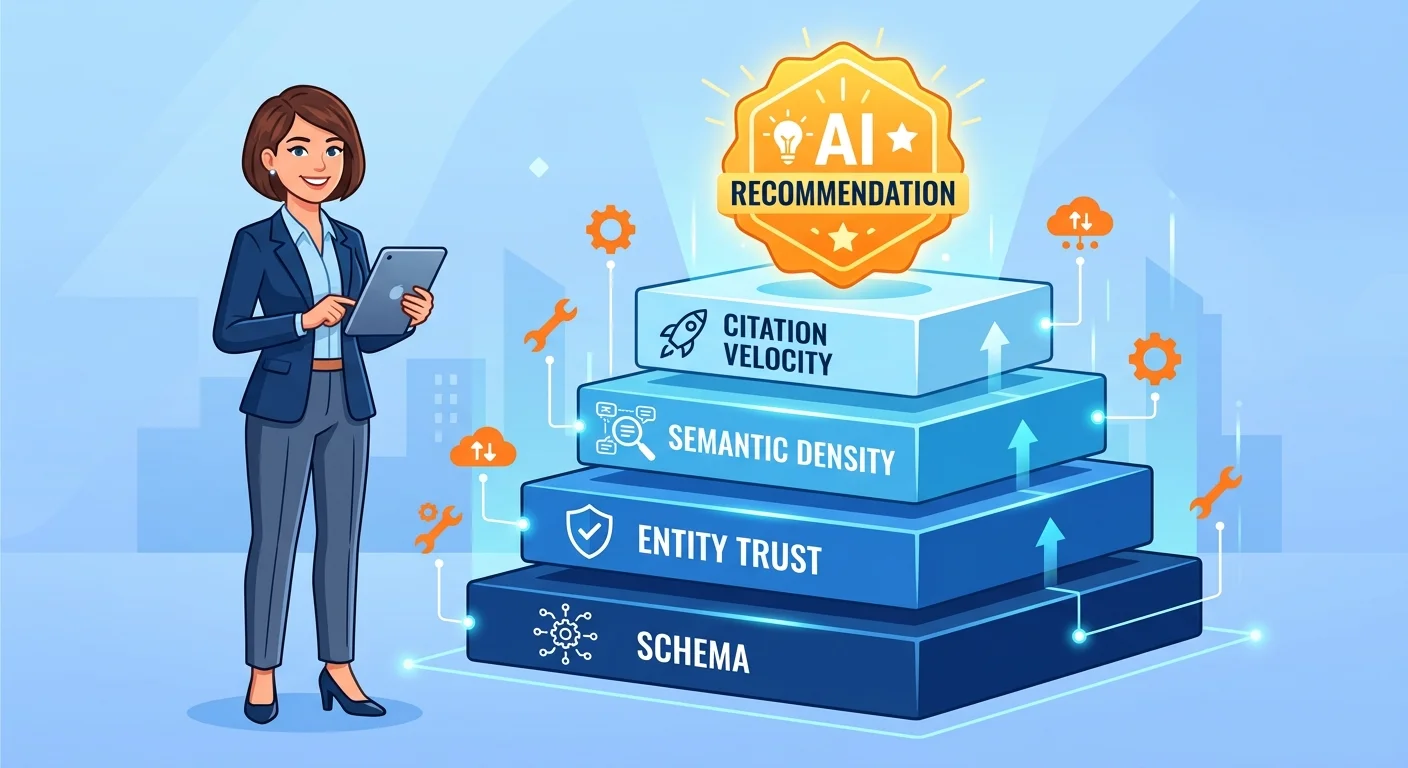
Authority Engine maintenance is asset protection. Not website updates. Not the monthly retainer you've been sold.
Your AI Authority Engine is the infrastructure that tells ChatGPT, Gemini, and Grok who you are. Schema that anchors your entity. Semantic density that proves expertise. Internal linking architecture that maps authority across your domain. It's machine-readable trust. And like any asset, it degrades without reinforcement.
Maintenance means reinforcing those signals against decay. Identifying where entity data has drifted. Refreshing content that's losing semantic density. Re-anchoring internal links that no longer serve the authority structure. Ensuring AI engines continue to see your business as the authoritative source. Not as one option among many.
The Asset Protection Model
Think of maintenance as asset protection for a compounding system. You built the Authority Engine. Now you protect it from degradation.
Google's ranking systems — multiple automated ranking systems — update constantly. AI models retrain every few months. Search intent shifts. Competitors publish. Even the concept of 'evergreen' content requires maintenance because the environment never sits still.
Static authority becomes invisible authority. The signals AI engines trusted six months ago lose strength as competitors publish fresher material. Your schema drifts out of sync with live business data. Your internal links point to outdated anchor concepts. That's content decay — and monthly maintenance reverses it before your visibility drops.
What Maintenance Is Not
Here's what maintenance is not. It's not keyword stuffing. It's not backlinking. It's not SEO retainer busywork.
Legacy SEO agencies sell monthly retainers that optimize for rankings and traffic. Metrics that mean nothing if AI engines don't name you. Authority Engine maintenance optimizes for entity trust and citation velocity. We're reinforcing machine-readable signals. Not gaming a Page One algorithm that's already being replaced.
The Authority Decay Problem
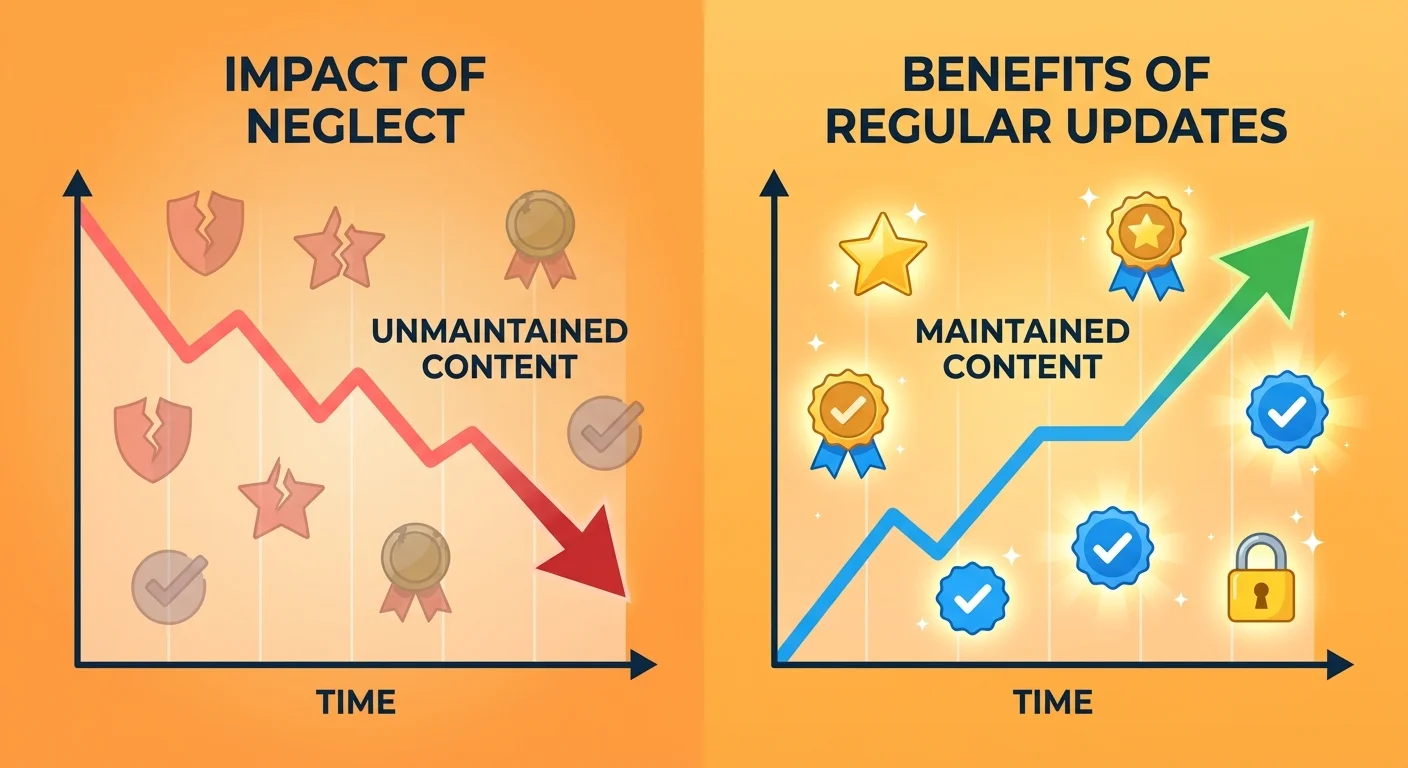
Here's what they don't tell you when the site goes live. Authority isn't a monument. It's infrastructure. And infrastructure degrades.
Your Authority Engine generates trust signals AI models read to decide if you're the answer. Those signals decay. Content decay is a measurable process where a web page's search traffic declines over time without updates. Not eventually. Constantly.
The problem isn't algorithm updates. The problem is your competitors don't stop publishing. They add depth. They add semantic signals. They refresh their citations. AI engines prioritize recency, depth, semantic density. If your infrastructure sits still, you disappear.
Why Content Loses Visibility Over Time
AI models don't reward past authority. They reward current entity trust signals.
Every month you leave your Authority Engine untouched, someone else is publishing. They're adding semantic depth. They're building fresher citations. AI engines notice. You fall behind.
The gap between maintained and unmaintained authority compounds. This isn't slow drift. It's accelerating disadvantage.
The Measurable Decline in Traffic
Here's where the data gets uncomfortable. Refreshing and republishing old blog posts can increase their organic traffic by as much as 106%.
That's not marginal improvement. That's the difference between visible and buried.
The measurable decline isn't theoretical. Pages lose traffic steadily without updates. The solution isn't hoping the trend reverses. It's structured maintenance that continuously reinforces the entity trust AI engines require.
| Content State | Traffic Trajectory | Authority Signal Strength |
|---|---|---|
| Freshly Published | Immediate upward climb as search engines index and validate authority signals | Peak strength—schema fresh, semantic density high, entity trust building |
| 6 Months Unmaintained | Plateaus, then begins gradual decline as competitors publish fresher content | Moderate degradation—schema drifts out of sync, internal links age, semantic density erodes slightly |
| 12 Months Unmaintained | Steady downward trend as AI engines prioritize recency and comprehensiveness elsewhere | Significant decay—entity data outdated, competitors cited preferentially, citation velocity stalls |
| 18+ Months Unmaintained | Sharp drop-off—page becomes invisible to AI engines, traffic collapses to near-zero | Critical failure—schema obsolete, semantic density weak, authority signals unrecognizable |
| Monthly Maintenance Active | Sustained upward trajectory with compounding gains over time | Continuously reinforced—entity trust grows, semantic density refreshed, AI engines cite consistently |
Why Static Content Becomes Invisible to AI

AI engines don't see your website the way you do. They don't see design. They don't see compelling copy or clever navigation.
They see entity data. Semantic signals. Structural markers that either confirm authority or flag ambiguity.
That's it.
But here's what happens when content just sits there.
Entity data drifts out of sync with your live business. Semantic density erodes as language shifts and search intent evolves. The internal linking that once mapped authority now points to anchor concepts nobody searches for anymore.
Every signal AI trusted six months ago? Weaker now.
Static content becomes invisible because AI engines read signal decay as authority loss.
Your content didn't change. The signals AI uses to determine trust—entity clarity, semantic relevance, citation velocity—did.
And without maintenance, that decay accelerates until you're not in the conversation.
Entity Drift and Signal Ambiguity
Entity drift happens when the machine-readable data about your business no longer matches reality.
Your schema says you're at an old address. NAP data conflicts across pages. Service descriptions reference offerings you discontinued eighteen months ago.
AI engines don't know you updated your operations. They see signals that conflict.
AI engines resolve entity identity by cross-referencing signals. When those signals conflict, ambiguity increases.
Ambiguity is the opposite of authority.
ChatGPT and Gemini won't recommend a business they can't confidently identify.
Building Entity Trust requires clean, consistent, up-to-date entity data across every page.
Static content accumulates drift. Monthly maintenance prevents it.
Semantic Staleness
Semantic staleness is what happens when your content still answers yesterday's questions.
Search intent shifts. The way people phrase queries evolves. The context AI expects around a topic changes as the competitive field moves.
Your content didn't break. It stopped matching the question being asked.
Even evergreen content degrades because the language around it doesn't stay evergreen.
The terms people use to describe your service change. The adjacent topics they care about shift. The depth they expect from an answer increases as competitors publish more thorough material.
Evergreen was never a promise. It was wishful marketing.
Static content loses semantic density over time. Not because the words changed. Because the context around those words evolved.
AI engines prioritize content that matches current search intent. If your semantic signals are anchored to eighteen-month-old language patterns, you're invisible.
The Competitive Context Shift
Google's ranking systems update constantly. AI models retrain on fresh data. And every month, competitors publish newer, deeper content that resets the baseline for what 'authoritative' looks like in your market.
You're not competing against a static target. The target moves.
You're not competing against the content you published last year. You're competing against everything published since.
Static authority loses because the competition never stops moving. Monthly maintenance keeps you in the race.
What a Monthly Refresh Cycle Actually Involves

Monthly maintenance is tactical work. Structured. Deliberate. Not chasing algorithm updates or keyword rankings.
It's about finding where entity data has drifted. Where semantic density has eroded. Where internal architecture no longer serves the authority structure AI engines read.
This is the work that prevents signal decay before it costs you visibility.
A structured content refresh process involves identifying pages with declining traffic, updating for accuracy and comprehensiveness, and improving on-page elements so AI engines continue to trust your entity as the authoritative source.
This is the core of monthly maintenance. Reinforcing the machine-readable signals that determine whether ChatGPT names you or your competitor.
The work happens in three layers: schema and entity signal reinforcement, content accuracy and semantic density updates, and citation velocity management. Each layer addresses a specific form of decay. Each layer compounds when executed consistently.
Skip any layer, and the entire system weakens.
Schema and Entity Signal Reinforcement
Schema and entity data are the foundation AI engines use to confirm your identity. When that data drifts out of sync with reality—outdated addresses, discontinued services, stale NAP information—AI engines see ambiguity. Not authority.
Ambiguity disqualifies you from being the answer.
Monthly maintenance audits your schema for accuracy. We verify that structured data reflects your current business state. We reconcile entity signals across pages to eliminate conflicts.
We ensure the machine-readable identity AI engines reference stays consistent, clean, and authoritative.
This isn't a one-time setup. Schema drifts every time your business changes. New services launch. Staff turns over. Locations update.
Without monthly reconciliation, your entity identity fractures. AI engines stop trusting the data. Your Authority Engine stops working.
Content Accuracy and Semantic Density Updates
Content accuracy means ensuring your articles still answer the questions AI engines prioritize. With the depth, language, and comprehensiveness the current competitive baseline demands.
Search intent evolves. Competitors publish fresher material. Static content loses semantic density as the context around it shifts.
We identify and refresh underperforming content every month. That means updating outdated statistics. Expanding thin sections. Refining anchor concepts to match current search intent. Reinforcing the semantic signals that prove expertise.
The goal is to meet or exceed the comprehensiveness standard AI engines now expect.
And we do it before traffic drops.
That's the difference. Most agencies react to decay after visibility collapses. We prevent it by maintaining semantic density month over month, so AI engines never see a reason to deprioritize your content.
Citation Velocity and Source Freshness
Citation velocity is how frequently your content references fresh, authoritative sources. AI engines prioritize material that's anchored to current data.
If your article cites a 2022 study and a competitor's cites 2025 research, the competitor wins. Even if your analysis is stronger.
Monthly maintenance refreshes your external citations to keep pace with the competition. We replace outdated sources with newer institutional research. We add references to emerging studies.
We ensure the evidence layer supporting your claims stays current, so AI engines see your content as freshly validated. Not stale.
This is how we execute AEO content at scale. Not as a one-time build, but as a compounding system where every monthly refresh strengthens the signals AI engines use to determine whose name to recommend.
Static authority becomes invisible authority. Maintained authority compounds.
| Maintenance Task | Frequency | Authority Impact | What It Prevents |
|---|---|---|---|
| Schema & Entity Signal Audit | Monthly | Prevents entity drift and ambiguity that disqualifies you from AI recommendations | Outdated NAP data, discontinued service references, conflicting schema markup across pages |
| Content Accuracy & Semantic Density Refresh | Monthly | Maintains comprehensiveness baseline AI engines expect; prevents semantic staleness | Traffic decline from outdated statistics, thin sections, language anchored to old search intent |
| Citation Velocity Management | Monthly | Signals fresh validation; keeps evidence layer current against competitor publications | Loss of trust from outdated sources while competitors cite newer institutional research |
| Internal Linking Architecture Review | Quarterly | Reinforces authority flow; ensures anchor concepts align with current semantic strategy | Link rot, orphaned pages, anchor text drift that weakens topical authority signals |
| Performance Analytics & Decay Detection | Monthly | Identifies declining pages before visibility collapses; enables proactive intervention | Reactive fixes after traffic drops; allows competitors to claim authority ground first |
| Content Element | Decay Signal | Refresh Action | Expected Timeline |
|---|---|---|---|
| Schema & Entity Data | Outdated NAP information, stale service descriptions, conflicting entity signals across pages | Audit schema for accuracy, reconcile entity signals, update structured data to reflect current business state | Monthly verification cycle |
| Content Accuracy & Semantic Density | Outdated statistics, thin sections, language patterns anchored to old search intent | Update data points, expand shallow coverage, refine anchor concepts to match current competitive baseline | Monthly content audit |
| Citation Velocity | References to outdated studies, lack of current institutional sources, stale evidence layer | Replace old citations with fresh research, add emerging studies, anchor claims to current data | Monthly source refresh |
| Traffic-Declining Pages | Measurable drop in organic visibility, loss of AI engine citations, reduced click-through from zero-click searches | Identify underperforming content, refresh semantic signals, republish with updated comprehensiveness | As traffic decline is detected |
| Internal Linking Architecture | Broken anchor concepts, outdated semantic clusters, links pointing to deprecated content | Audit internal link structure, update anchor text to current terminology, ensure authority flow aligns with updated hierarchy | Quarterly deep audit with monthly spot checks |
Authority Engine Maintenance vs. Traditional SEO Retainers

Most chiropractors have been pitched an SEO retainer at some point.
You know the drill. Monthly payments. Reports filled with keyword rankings, backlink counts, traffic numbers. They publish a few blog posts. They adjust meta descriptions. The metrics move, so it feels like progress.
But here's the thing. AI engines still don't name you when someone asks for a recommendation.
Authority Engine maintenance isn't that. Not even close.
The difference matters because one model chases signals Google is deprioritizing. The other reinforces the entity trust and semantic density AI engines actually use to decide whose name gets recommended.
What Legacy SEO Retainers Actually Do
Traditional SEO retainers were built for Google's old algorithm. The one that ranked pages by keyword density, backlink counts, and domain authority scores.
So the work focused there. Building links. Optimizing for target keywords. Tracking first page rankings.
But patients stopped Googling. They're asking ChatGPT and Gemini who to trust.
And those engines don't care about your domain authority score or how many backlinks you've built. They care whether your entity data is clean. Whether your semantic signals prove expertise. Whether the content you published answers the questions they're being asked—right now, not eighteen months ago.
Google still sends traffic. But the game changed. AI engines decide whose name gets said out loud.
Legacy retainers optimize for metrics that used to correlate with visibility but no longer determine whether AI engines cite you. They chase rankings on a platform patients are leaving. They report on backlinks AI engines don't prioritize.
And they treat the concept of 'evergreen' content as something you publish once and forget. Which is exactly why static authority becomes invisible authority.
The Authority Asset Model
Authority Engine maintenance operates on a different premise.
Your Authority Engine is an asset. Not an expense. Not a recurring service fee with no residual value. A compounding authority asset that strengthens every month you maintain it and weakens every month you don't.
The work isn't designed to move vanity metrics. It's designed to prevent signal decay.
We audit entity data to eliminate drift. We refresh semantic density so your content matches current search intent. We update citations so AI engines see your material as freshly validated. Every task reinforces the machine-readable signals that determine whether ChatGPT names you or skips you.
And because the work compounds, the gap between maintained and unmaintained authority widens every month.
Practices that invest in monthly maintenance see traffic increase as competitors' decays. Practices that skip maintenance watch their visibility erode—not because they did something wrong, but because they stopped doing what's required to stay the answer AI engines trust.
| Service Model | Focus | Outcome Metric | What Happens When You Stop |
|---|---|---|---|
| Traditional SEO Retainer | Keyword rankings, backlink counts, domain authority scores | Page-one rankings, monthly traffic reports, link acquisition velocity | Rankings drop gradually. Links decay. Traffic erodes. No residual asset remains. |
| Authority Engine Maintenance | Entity trust reinforcement, semantic density preservation, citation freshness | AI engine citation frequency, entity data consistency, content comprehensiveness vs. competitive baseline | Authority signals degrade. Semantic density erodes. AI engines deprioritize your content. Competitors gain ground every month you stay static. |
| Legacy Blog Post Writing | Publishing new content to target keywords | Number of posts published, word count, keyword insertion | Content stops. Growth stops. No compounding effect. Published posts decay without refresh. |
| Structured Content Refresh | Updating existing content for accuracy, comprehensiveness, and current search intent | Traffic recovery on refreshed pages, semantic signal strength, entity trust consistency | Existing content decays. Traffic drops. AI engines cite fresher competitors. Authority infrastructure weakens. |
| Set-It-and-Forget-It Website | One-time build with no ongoing reinforcement | Launch metrics only. No ongoing measurement. | Immediate decay. Entity signals drift. Schema becomes outdated. Content loses relevance. AI engines stop citing you within months. |
Frequently Asked Questions
So here are the questions that always come next.
Some are objections. Some are implementation logistics.
All of them matter before you decide whether maintaining your Authority Engine is worth the cost—or whether you're fine letting authority signals decay while your competitors build.
How often does my AI Authority Engine really need to be updated?
Monthly. Not quarterly. Not when traffic tanks.
Authority signals don't wait for your quarterly review to decay. Schema drifts the moment your services change. Semantic density erodes the day a competitor publishes something fresher. Citation velocity ages every time newer research drops.
Monthly maintenance catches decay before AI engines notice. Quarterly maintenance reacts to decay after your visibility already collapsed.
What specific tasks are involved in a monthly Authority Engine refresh?
Entity data audit. Schema reconciliation. Content accuracy verification. Citation velocity refresh.
We verify your structured data matches your current business reality. We update statistics and expand thin content. We swap aged sources for current institutional research. We confirm your semantic density meets the competitive baseline AI engines expect.
Every task reinforces machine-readable trust. Nothing chases vanity metrics. Everything protects entity trust.
What happens if I build an Authority Engine but then don't maintain it?
It decays. Not overnight. Slowly.
Your schema drifts out of sync. Your content loses semantic density as competitors publish newer material. Your citations age, anchoring your expertise to outdated evidence while competitors reference current research.
AI engines don't penalize you. They just stop naming you. Because someone in your market maintained their signals—and their entity data is cleaner, denser, and fresher than yours.
Isn't Authority Engine maintenance just a different name for a traditional SEO retainer?
No. Different work. Different premise.
Legacy SEO retainers chase rankings and backlinks. They optimize for metrics Google is moving away from. They treat content as static and report on vanity signals that don't determine whether AI engines cite you.
Authority Engine maintenance reinforces entity trust and semantic density. It prevents decay before visibility collapses. The work isn't designed to move dashboard numbers. It's designed to keep you the answer.
How do updates to AI models like ChatGPT and Gemini affect my existing authority signals?
Every model update shifts what counts as authority.
ChatGPT and Gemini prioritize different entity signals with each release. They refine how they parse schema, evaluate semantic density, and weigh citation freshness. Authority built for an earlier model becomes invisible when the baseline moves.
Monthly maintenance keeps your signals aligned. We adapt entity data and semantic density as AI engines evolve. Your Authority Engine stays the answer because the signals they prioritize stay reinforced.
Can I perform my own Authority Engine maintenance, or does it require a specialist?
You can try. But most practices who start DIY maintenance quit within three months.
Authority Engine maintenance isn't intuitive. It requires systematic entity audits, semantic density analysis, and citation refresh at scale. You won't see the work in Google Analytics. And skipping even one piece breaks the system.
Specialists maintain authority month over month because the work compounds. DIY maintenance produces sporadic effort, inconsistent execution, and eventual abandonment—which is worse than doing nothing, because half-maintained signals confuse AI engines more than static ones.
The Compounding Cost of Neglect
Authority decay isn't a risk you might face someday. It's already happening.
Every month you skip maintenance, your schema drifts. Your semantic density erodes while competitors publish fresher material. Your citation layer ages while they reference current research.
AI engines see it.
They don't penalize you. They just stop naming you. Because somewhere in your market, another practice kept their AI Authority Engine current. Their signals are cleaner, denser, and more recent than yours.
So AI engines name them instead.
The gap compounds. That's what most practices miss until it's already too late.
A maintained AI Authority Engine strengthens every month. Entity trust deepens. Semantic signals expand. Citation velocity keeps pace. The infrastructure becomes more authoritative with every refresh—not because you're chasing algorithm updates, but because you're reinforcing the machine-readable trust signals AI engines prioritize.
An unmaintained AI Authority Engine weakens every month. Your schema drifts. Content decays. Citations age.
And every month you wait, the cost of recovery climbs. You're not catching up to where you were. You're catching up to where your competitors are now.
Here's the thesis. Your AI Authority Engine is not a monument you build once. It's living infrastructure that requires continuous reinforcement.
Maintenance isn't an expense. It's the cost of staying the answer. Every month you invest in reinforcing entity trust and semantic density, you compound the authority signals AI engines use to decide whose name to recommend.
Every month you skip, you hand that ground to whoever kept going.
Authority signals decay. Not because you built it wrong. Because you stopped maintaining it.
So here's the choice.
You can maintain your AI Authority Engine—audit entity data, refresh semantic density, update citations—and watch your visibility compound while your competitors' decays.
Or you can skip maintenance, treat your website as a static asset, and watch AI engines stop naming you.
There's no third option. Authority either compounds or decays.
The only question is which trajectory you're willing to fund.
So here's where we start. The AI Visibility Check takes fifteen minutes. It shows you what ChatGPT, Gemini, and Grok say when someone asks who to trust in your market. If your name comes up — you've got a baseline worth protecting. If it doesn't — you'll see the gap. And you'll know exactly what happens if you let it sit.
621 Enterprises, Inc. | Copyright 2026 | All rights reserved