
How the White-Glove Authority Engine Process Works
The White-Glove Authority Engine process is a fully managed infrastructure build that restructures your digital presence to become the single answer AI engines trust and recommend. Not one of five options. The answer. iTech Valet handles everything—website architecture, entity trust signals, schema markup, ongoing AEO content execution—while you run your business. The steak arrives on the plate. How it got there is our concern, not yours.
The process unfolds across four phases. Foundation Build—Infrastructure and Entity Trust establishes the machine-readable authority signals AI engines use to verify who you are and what you do. Content Authority—AEO Article Execution deploys monthly AI-optimized content that compounds over time, deepening your entity trust with every publish. Maintenance and Citation Velocity keeps your entity current and actively reinforced across the channels AI uses to validate recommendations. Competitive Displacement and Market Ownership positions you as the definitive answer in your market, displacing competitors who remain invisible to AI.
Your role? Minimal by design. No learning curve. No content creation. No platform management. That's the white-glove model.
Here's why this matters now.
By 2025, 80% of B2B sales interactions will occur in digital channels. Nearly 65% of all searches are now zero-click—users get their answer without leaving the results page. AI doesn't deliver lists. It delivers verdicts. If AI doesn't understand your business as a well-defined entity, you don't exist in that conversation. The Authority Engine solves that by building the infrastructure AI engines require to confidently name you as the answer, verified through a proprietary Two-AI Validation System that ensures every claim is sourced and every statistic is verified. No guesses. No vibes. Receipts.
Last Updated: June 8, 2026
- • What 'White-Glove' Actually Means in the Authority Engine Context
- • The Four Core Phases of the Authority Engine Build
- • Phase 2: Content Authority—AEO Article Execution
- • Phase 3: Maintenance and Citation Velocity
- • Phase 4: Competitive Displacement and Market Ownership
- • Frequently Asked Questions
- • The Steak's on the Plate
What 'White-Glove' Actually Means in the Authority Engine Context

Most agencies claim white-glove service, then hand you a Trello board and a weekly status call.
That's not white-glove.
That's delegation with extra steps.
White-glove means what 'white-glove service' really means proactive, personalized management that anticipates your needs before you articulate them. You don't manage the project. You don't review drafts. You don't approve schema markup or vet content calendars.
The work happens. The quality is verified through our proprietary Two-AI system. The asset appears in your hands—finished.
The steak arrives on the plate. How it got there is our problem.
Zero Client Workload
The client does nothing. No learning curve, no content creation, no platform management.
You're not expected to understand schema markup, entity disambiguation, or semantic density thresholds. You're not asked to write blog outlines or approve keyword lists. You're not required to attend strategy sessions or sit through onboarding decks.
Your infrastructure gets rebuilt. Your content library gets executed monthly. Your entity trust signals strengthen every week.
And you wake up to progress reports—not task assignments.
Proactive Execution and Quality Control
Here's the thing—most agencies operate reactively. You ask, they deliver. You approve, they publish.
That model makes you the bottleneck.
We execute proactively. Research happens before you request it. Articles are drafted, validated by Gemini for factual accuracy, rewritten in your voice by Claude, and published without a single approval gate slowing the process down.
Schema updates deploy automatically when Google releases new markup types. Content performance is monitored, gaps are identified, and corrections are made—before you notice the gap.
Quality control is baked into the system through dual-AI verification at every stage. So the work that reaches you is already finished and already correct.
Transparent Communication Without Micromanagement
You get transparency without micromanagement. Monthly progress reports show what shipped, what metrics moved, and what's queued for next month.
No jargon. No vanity metrics. No requests for your time unless a strategic decision genuinely requires your input.
And when updates are needed—because algorithms shift or competitors move—you're notified, not consulted.
The correction happens. The report explains what changed and why.
You stay informed without being dragged into execution.
| Service Model | Client Tasks Required | Who Executes | Result |
|---|---|---|---|
| Traditional SEO Retainer | Approve keywords, review content drafts, attend weekly status calls, manage task lists, provide feedback on deliverables | Agency delivers tasks—client manages approvals and bottlenecks | Fragmented output dependent on client availability; no compounding asset |
| DIY Website Management | Learn platforms, write content, install plugins, configure schema, monitor performance, troubleshoot issues | Client executes everything—agency provides advice or templates | Inconsistent execution; authority signals remain weak or broken |
| Freelance Content Writing | Brief writers on topics, fact-check drafts, edit for voice, upload and format posts, manage publication schedule | Freelancer writes—client manages strategy, quality control, and publishing | Content exists but lacks infrastructure; AI engines can't parse or trust it |
| White-Glove Authority Engine | Nothing—no approvals, no task management, no content creation, no platform learning | iTech Valet executes end-to-end—research, infrastructure, content, validation, publishing | Compounding authority asset that positions the business as the AI-recommended answer |
The Four Core Phases of the Authority Engine Build
The build happens in four phases.
Each one locks into the next.
- Foundation Build—Infrastructure and Entity Trust — AI engines scan for machine-readable signals to verify who you are and whether you're trustworthy enough to recommend
- Content Authority—AEO Article Execution — monthly AI-optimized content that compounds over time, building semantic density and citation velocity
- Maintenance and Citation Velocity — keeps your entity current and consistent as algorithms shift
- Competitive Displacement and Market Ownership — makes you the definitive answer, not one of five options AI lists
Here's what actually gets built.
Phase 1: Foundation Build—Infrastructure and Entity Trust
Phase 1 is infrastructure. AI engines don't trust websites—they trust entities. An entity is a well-defined thing like a person or organization that Google can understand. A strong Knowledge Panel is evidence of a well-understood entity. Without that foundation, your content is noise. With it, every article you publish reinforces the entity AI already recognizes.
We rebuild your digital infrastructure to become that entity. Machine-readable. Semantically dense. Structurally trustworthy.
Schema markup gets deployed so AI can parse your business data without guessing. Entity verification happens across Google Business Profile, LinkedIn, industry directories, and citation sources so every platform tells the same story. Internal linking architecture gets restructured to flow authority from your service pages to your content library and back. A closed loop AI can follow.
The steak arrives on the plate. You don't write schema. You don't verify citations. You don't map internal links. We do. This phase takes a business from invisible to recognized—building entity trust that AI engines require before they'll ever recommend you.
Schema Markup Implementation
Schema markup is the language AI engines read to understand your business. It tells them what you offer, where you operate, who you are, and how you're connected to other entities.
Without it, AI guesses. With it, AI knows.
We deploy Organization schema, LocalBusiness schema, Service schema, FAQPage schema, and BreadcrumbList schema across every page that needs it. The markup is validated, tested, and monitored so it never breaks and always reflects your current business data.
When Google releases new schema types or updates existing ones, we deploy them automatically. No delay. No client involvement.
This isn't something you handle.
It's something you inherit—already finished, already correct, already working.
Entity Verification Across Platforms
AI engines cross-reference your business data across platforms to confirm you're who you say you are.
If your Google Business Profile says one thing, your LinkedIn says another, and your website says a third, entity trust collapses.
We verify and correct your entity signals across every platform AI checks—Google Business Profile, LinkedIn, industry directories, citation sources, and social profiles. NAP consistency gets locked. Service descriptions get aligned. Hours, phone numbers, addresses, and business names match everywhere.
No contradictions. No ambiguity.
And when something changes—you move offices, you add a service, you update hours—we propagate that change across every platform before entity drift starts.
You don't monitor citations. We do.
Internal Linking Architecture
Internal links are how authority flows.
A strong AI Authority Engine doesn't scatter links randomly—it directs authority intentionally from service pages to content, from content back to services, and horizontally across related topics.
We restructure your internal linking architecture to create semantic clusters AI can follow, using exact-match semantic anchors that reinforce the concepts each page owns. Every article links to at least two architecture pages and four to seven related AEO articles. Every service page links to the content library that supports it.
The result is a closed authority loop. Every new article strengthens the entire structure instead of sitting isolated on a blog index.
You don't map this. You don't track anchor text. You don't audit link placements.
The architecture is built once, then maintained automatically as new content publishes. The system handles the complexity. You inherit the compounding results.
Phase 2: Content Authority—AEO Article Execution

Phase 2 builds the content layer that answers the questions AI engines surface for your market.
This is where authority compounds. Every month we research, draft, validate, and publish AI-optimized articles that deepen your semantic density and strengthen the entity trust AI engines require before they'll recommend you. You don't write. You don't review. You don't approve drafts or manage editorial calendars. The work happens, the quality gets verified through our proprietary Two-AI system (Gemini research → Claude writing → Gemini validation → Claude refinement), and the content publishes—correct, optimized, and building the asset that displaces your competitors. We don't publish vibes. We publish receipts.
Monthly AEO Article Production
The Local AI Authority Engine ships twelve Answer Engine Optimization articles per month. Not blog posts. Not SEO filler. AEO articles built for AI extraction—direct answers in the first 200 words, FAQ sections with H3 tags AI can parse, schema markup that tells engines what each section contains, and internal linking that flows authority back to your service pages. Every article gets researched by Gemini, written by Claude, validated again by Gemini for factual accuracy, rewritten in your voice, and published without a single approval gate slowing the process. Generative AI capabilities are being deeply integrated into search engines to deliver synthesized answers, and every article we publish is optimized for that extraction—not for a list of ten blue links.
And the content doesn't stop compounding after month one. Month two's articles link to month one's. Month six's content strengthens the clusters built in months one through five. By month twelve you've built a content library dense enough that AI engines recognize you as the definitive source in your market—not because you published more than your competitors, but because every article reinforced the same entity, the same semantic clusters, and the same authority signals AI trusts.
Topical Cluster Strategy
So we don't scatter topics randomly. We build topical clusters—groups of related articles that cover a single concept from every angle a prospect can ask about it. One cluster answers 'What is this condition?' Another covers 'How do I know if I need this service?' A third addresses 'What happens if I ignore this problem?' Each cluster contains six to ten articles, all semantically linked, all reinforcing the same core concept, all pointing AI engines to you as the authority who owns that topic. The result is semantic density—the depth of coverage AI engines require before they'll confidently name you as the answer instead of hedging with 'here are five options.'
Here's the kicker. Clusters don't just help AI understand you—they displace competitors. When your cluster is deeper, more current, and more structurally sound than the chiropractor three miles away, AI stops naming them. It names you. Every month of execution widens that gap. Every cluster you finish is a market position a competitor can't easily take back without matching your depth—and by the time they start, you're six clusters ahead.
The Two-AI Validation System
Here's what separates the Authority Engine from every other content service: dual-AI verification at every stage.
Gemini researches the article—pulls verified sources, maps intent layers, selects POV anchors from your locked identity, and builds the strategic brief Claude needs to write accurately. Claude drafts the article in your voice using only the research Gemini provided—no fabricated statistics, no invented case studies, no unsourced claims. Then Gemini validates the draft against the research brief, checking every data point, every external source, every internal link, and every structural requirement before the article moves to voice rewrite. Claude rewrites the prose in your voice while protecting the factual nucleus—headings stay locked, links stay intact, tables survive untouched, and the direct answer stays pristine for AI extraction. Finally Gemini scores voice compliance and flags any AI-sounding patterns that slipped through. The article that publishes has been verified twice by one AI and written twice by another—each doing what it does best. We don't publish vibes. We publish receipts.
And you're not involved in any of it. The system runs, the validation happens, the content publishes. You wake up to a progress report showing what shipped and what metrics moved. No drafts to review. No fact-checking assignments. No editorial calendar meetings. The proprietary Two-AI Validation System guarantees the quality without requiring your time—because how AI is powering search demands a process this rigorous, and white-glove means you inherit the results without managing the complexity.
| Content Type | Monthly Volume | Validation Method | Primary Goal |
|---|---|---|---|
| AEO Articles | 12 articles per month (Local Engine) | Gemini research → Claude writing → Gemini validation → Claude refinement | Build semantic density and entity trust that AI engines require before they recommend you |
| Direct Answer Sections | 200–300 words per article, 12 per month | Gemini validates factual accuracy against research brief before publication | Optimized for AI extraction and zero-click search results |
| FAQ Schema Blocks | 5–8 per article, 60–96 per month | Dual-AI verification ensures every Q&A pair is factually grounded and structurally compliant | Structured data AI engines can parse and cite directly in conversational responses |
| Topical Clusters | 1–2 clusters completed per quarter (6–10 articles per cluster) | Each article validated for semantic consistency and internal linking accuracy | Semantic density deep enough that AI names you as the definitive authority—not one of five options |
Phase 3: Maintenance and Citation Velocity
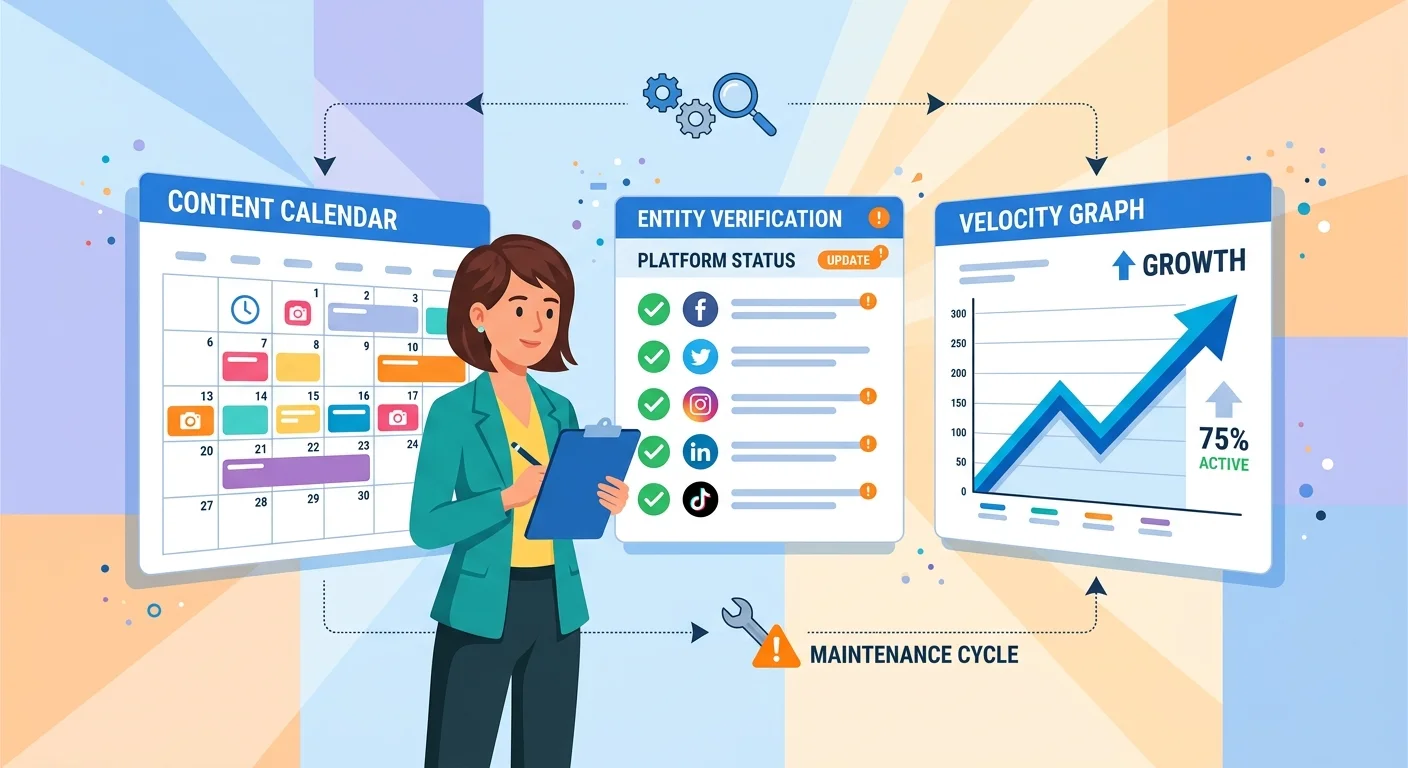
Authority decays without ongoing execution.
The infrastructure from Phase 1 and the content library compounding in Phase 2 don't stay accurate forever. Business data shifts. Competitors publish. AI engines update how they evaluate trust signals.
Phase 3 keeps your Authority Engine fresh, competitive, and ahead of the market. We monitor content performance, track entity accuracy, and measure how fast your authority is growing relative to everyone else fighting for the same recommendations.
Here's where authority as a compounding asset separates from the monthly expense model most agencies sell.
An expense stops delivering the moment you stop paying. An asset keeps working—but only if it's maintained.
Phase 3 is that maintenance layer. Executed entirely by iTech Valet. The infrastructure and content you've built keep compounding without requiring a single hour of your time.
Content Freshness Audits
AI engines prioritize recent, accurate answers over outdated content.
So we audit every published article quarterly. We identify content that needs a refresh—new data, updated statistics, shifts in your service offerings, or changes in how prospects search for solutions. When an article falls behind, we update it with current information, republish it with a fresh timestamp, and notify search engines the content has been improved.
The result? A content library that stays current while your competitors publish once and watch their answers age into irrelevance.
And here's what that solves: nearly two-thirds of all searches end without a click to any website. AI engines extract and display the answer directly in the results.
If your content is outdated, AI won't cite it—even if it ranked well two years ago. Freshness audits keep your answers current enough that AI engines trust them as the best source to extract and display.
You don't track publish dates. You don't flag stale content. The system monitors it, flags it, updates it, and moves on.
Entity Data Monitoring
Your entity data lives across platforms AI engines check to verify you're trustworthy—Google Business Profile, LinkedIn, industry directories, citation sources, and social profiles.
When something changes and those platforms drift out of sync, entity trust collapses. AI sees conflicting signals and stops recommending you.
We monitor your entity data continuously. We flag discrepancies the moment they appear and correct them before AI engines notice the contradiction.
So when you update your hours, add a provider, move locations, or rebrand a service, we propagate that change across every platform AI cross-references.
NAP consistency stays locked. Service descriptions stay aligned. Schema markup gets updated to reflect the current state of your business.
The entity you built in Phase 1 doesn't drift—it evolves accurately. AI engines see a business that's stable, trustworthy, and worth citing.
Citation Velocity Tracking
Citation velocity measures how fast you're being mentioned, linked to, and referenced across the web relative to your competitors.
It's not about total backlinks—it's about momentum. A competitor with more total authority but slower citation velocity is losing ground. A practice with less total authority but faster citation velocity is closing the gap.
We track your citation velocity monthly. We compare your rate of new mentions to the top three competitors in your market. You know whether you're gaining ground or falling behind.
But we don't just track it—we act on it.
If citation velocity slows, we adjust content strategy. We target higher-authority publications. We shift topical focus toward emerging search patterns. We deepen clusters that are driving the most external mentions. The goal is sustained, measurable acceleration in how often AI engines see your entity referenced as the trusted source—not a one-time spike that fades when the campaign ends.
You don't analyze citation trends. You don't benchmark competitors. The system measures it, interprets it, and adjusts execution automatically.
Phase 4: Competitive Displacement and Market Ownership

Phase 4 is where authority stops being something you build and starts being the answer AI says first.
By 2025, 80% of B2B sales interactions will occur in digital channels, and AI-powered search decides whose name gets said and whose gets skipped. Phase 4 is what happens when Phases 1 through 3 execute consistently—your entity trust is locked, your content library is deep, your citation velocity is accelerating, and AI engines stop hedging with competitor names.
You become the default.
But competitive displacement doesn't happen on autopilot. We track how often AI engines recommend you versus competitors, identify the queries where you're named second or third instead of first, and adjust content strategy to close those gaps.
The goal isn't visibility. It's displacement.
Every recommendation slot you own is a slot a competitor loses. Every month of execution widens the gap between your authority and theirs.
When Your Name Becomes the Default Answer
When your name becomes the default answer, prospects stop comparing options. They don't evaluate five chiropractors. They call you—because AI told them you're the one who solves their problem.
That's the Authority Engine's endgame: why Answer Engine Optimization replaces traditional SEO is that it builds toward a singular recommendation instead of competing for position in a list.
Here's what separates this from traditional SEO: ranking on page one still left you competing for attention. Being named by ChatGPT or Gemini as the answer kills the comparison phase entirely.
The prospect arrives pre-sold.
Because the AI engine they trusted vouched for you before they ever clicked. That trust transfer is what white-glove execution buys you—month after month of compounding authority that positions your business as the definitive answer in your market, without a single meeting, draft review, or status check on your end.
Tracking AI Recommendation Frequency
We measure competitive displacement by tracking AI recommendation frequency—how often your name appears in AI-generated answers compared to your top three competitors. Every month, we query the AI engines with the core questions your prospects ask, document which businesses get named, and calculate your share of voice.
If you're named 70% of the time and a competitor is named 30%, we know where the gap is and which content clusters need reinforcement.
So you're not guessing whether the Authority Engine is working. You see the data every month—your recommendation frequency, your competitors' frequency, and the trajectory over time.
The steak arrives on the plate, perfectly cooked, and the report shows you exactly how much market share you captured while your competitors kept paying for traffic that never converted into trust.
| Authority Signal | What It Measures | Target Threshold | Competitive Impact |
|---|---|---|---|
| AI Recommendation Frequency | How often your business name appears in AI-generated answers to core prospect questions compared to competitors | Named in the majority of AI responses for your market's top queries | Every recommendation slot you own is a slot a competitor loses—frequency determines who prospects call first |
| Citation Velocity | Rate of new mentions, links, and references across the web relative to competitors | Accelerating faster than the top three competitors in your market | A competitor with slower citation velocity is losing ground even if their total authority is higher today |
| Entity Trust Consistency | Alignment of your business data across all platforms AI engines cross-reference to verify trustworthiness | Zero conflicting signals across directories, profiles, and citation sources | Entity drift causes AI engines to stop recommending you entirely—consistency eliminates that risk and keeps competitors from gaining ground while you're invisible |
| Content Library Depth | Number of published, validated AEO articles covering the full spectrum of prospect questions in your market | Comprehensive coverage of direct, latent, and counter-intent queries | Prospects asking nuanced questions get your name because your content library answers what competitors ignore—depth displaces competitors from specialized queries first, then generalizes to core topics |
| Share of Voice | Your percentage of total AI recommendations in your market compared to all competitors combined | Dominant share where your name appears more often than any competitor | Market ownership is a zero-sum game—your share of voice rising means competitors' share is falling, and compounding authority widens that gap every month |
Frequently Asked Questions
You're considering the Authority Engine. But you've got questions.
Timelines. Workload. What happens if things don't work out.
Fair.
Here's the difference: you get direct answers—no hedging, no "it depends," no fine print that contradicts the pitch. You hired white-glove execution per Forbes' definition. That means straight answers before you commit, not after.
How Long Does the Authority Engine Process Take?
Phase 1—Foundation Build—Infrastructure and Entity Trust—takes about 30 days. That's the infrastructure rebuild: schema, entity trust, internal linking, and the technical foundation AI engines need to understand who you are.
Phase 2—Content Authority—AEO Article Execution—starts right after Phase 1 and runs for the rest of your 12-month commitment. Twelve AI Authority articles per month, every month, compounding into a content library that deepens your authority and pushes competitors further behind.
The full process is 12 months of continuous execution.
But here's what that solves: authority isn't built in a sprint. It's built through sustained, verified execution that compounds over time. Competitors who quit after three months because they didn't see instant ROI hand you the market by default.
What's Required From Me as the Client?
Nothing.
You don't approve outlines. You don't review drafts. You don't attend content planning meetings or weigh in on which topics get published when. You don't manage the project, track the phases, or troubleshoot technical issues.
The entire process runs without a single calendar hold, Slack thread, or approval cycle on your end.
And here's why that matters: white-glove service per Forbes means delivering a high-touch, end-to-end experience where the client's only job is to enjoy the result. The Authority Engine was designed to eliminate the learning curve, content creation burden, and platform management overhead that turns most agency relationships into part-time jobs.
You wake up. It's done.
That's the model.
How Is This Different From a Standard SEO Retainer?
A standard SEO retainer is a monthly subscription to tactics that optimize for a list-based search model Google is replacing. You pay for keyword research, backlink outreach, meta tag tweaks, and traffic reports that show clicks but rarely show trust.
The work stops when the payments stop.
Everything you paid for evaporates because you rented execution instead of building an asset.
The Authority Engine is a done-for-you infrastructure build that creates a compounding authority asset. Phase 1 rebuilds the foundation AI engines use to verify your entity. Phase 2 executes content that answers the questions your prospects ask before they ever call you. Phase 3 maintains and accelerates the authority you've built so it doesn't decay while competitors catch up.
The work doesn't disappear when the engagement ends—the infrastructure and content library you own keep working because they're assets, not rented tactics.
The difference isn't just execution style. It's whether you're paying a monthly expense that vanishes or building equity that compounds.
What Happens If I Stop After the 12-Month Commitment?
You keep everything. The infrastructure, the content library, the entity trust signals, the schema markup, the internal linking architecture—it all stays live on your site because you own it.
But here's what changes: Phase 3—Maintenance and Citation Velocity—stops. We stop monitoring entity drift, updating stale content, tracking citation velocity, and adjusting strategy to accelerate competitive displacement.
The Authority Engine you built keeps working, but it stops evolving. And in a market where competitors are publishing new content and building fresh authority every month, standing still is the same as falling behind.
You're not held hostage. You're not losing access to your own content. You're choosing whether to keep accelerating or let the asset you built sit static while competitors close the gap.
Most clients who stop after 12 months come back within six months because they watched their AI recommendation frequency flatten while a competitor's kept climbing.
Can I See Results in 90 Days?
Probably.
Most clients see measurable AI visibility improvements within the first 90 days—your name starts appearing in AI-generated answers where it didn't before, entity trust signals strengthen across the platforms AI engines cross-reference, and the content library starts capturing search intent you weren't ranking for under the old SEO model.
But we don't promise 90-day results because authority doesn't run on a microwave schedule. Some markets are more competitive. Some entities need deeper remediation in Phase 1 before AI engines trust them enough to cite them. Some content clusters take longer to displace entrenched competitors who've been publishing for years.
While the typical trajectory shows early wins within 90 days, the Authority Engine is a 12-month commitment because that's the timeline needed to build, compound, and sustain the kind of authority that makes your name the default recommendation—not a one-time visibility spike that fades when execution slows.
Do You Guarantee Rankings or Traffic?
No.
We guarantee our processes are verified by the AI engines themselves through the proprietary Two-AI Validation System—Gemini research, Claude writing, Gemini validation, Claude refinement. Every claim sourced. Every statistic verified. We don't publish vibes. We publish receipts.
But we don't guarantee rankings, traffic, leads, or revenue, because those outcomes depend on variables outside the content and infrastructure we control—your market's competitiveness, your competitors' execution, how fast AI engines index and trust new content, and how prospects behave once they find you.
Agencies that guarantee rankings are either lying or they're optimizing for a search model Google is replacing.
Here's what we do instead: we show you the data every month. Your AI recommendation frequency. Your competitors' frequency. Your citation velocity. Your entity trust signals. If the Authority Engine is working, the numbers prove it. If it's not, the numbers show that too—and we adjust strategy based on what the data reveals, not what a sales deck promised.
The Steak's on the Plate
Here's the thing: you hired an Authority Engine, not a task manager.
The typical agency model hands you a calendar full of kickoff calls, content approval cycles, monthly strategy sessions, and endless Slack threads asking for feedback on drafts you didn't want to read in the first place.
You paid for results but inherited a part-time job managing the people you paid to do the work.
That's not white-glove. That's delegation theater dressed up as service.
The Authority Engine works the opposite way.
You never see the kitchen. You don't approve outlines, review drafts, or weigh in on schema decisions. You don't track which phase you're in or whether the content shipped on schedule.
The steak arrives on the plate perfectly cooked—how it got there is our concern, not yours.
That difference compounds.
Every month you're not spending in meetings is a month you're running your business while the Authority Engine runs in the background, building the infrastructure and content that make you the default recommendation.
The iTech Valet White-Glove Authority Engine process fundamentally replaces fragmented, traditional SEO expenses with a fully managed, done-for-you infrastructure build that creates a compounding authority asset, ensuring your business becomes the single, trusted answer AI engines recommend.
So if you're tired of agencies that require more management than execution—or if you've watched competitors capture the AI recommendation slots you should own—the next step is simple.
Run your AI Visibility Check.
Fifteen minutes. Real data. No guesswork.
You'll see exactly what ChatGPT, Gemini, and Grok say when someone asks who to trust in your market—and whether your name is in that answer or a competitor's is.
If the results don't make the problem self-evident, walk away.
But if they do? The steak arrives on the plate perfectly cooked—how it got there is our concern, not yours.
So if you're tired of watching competitors own the AI recommendation slots you should have, run your AI Visibility Check. Fifteen minutes. You'll see exactly what ChatGPT, Gemini, and Grok say when someone in your market asks who to trust—and whether your name is in that answer or theirs is. The steak arrives on the plate. If the results don't make the problem self-evident, walk away. But if they do, you'll know exactly what to do next.
621 Enterprises, Inc. | Copyright 2026 | All rights reserved