
The Practitioner's Guide to Authority Asset Investment: Beyond Monthly AEO Retainers
You can't own what you're renting.
An authority asset investment is a one-time infrastructure build that permanently embeds a business into the systems AI engines use to decide who to recommend. It is the structural opposite of a monthly retainer — where visibility is rented and disappears the moment payments stop.
Traditional search engine volume is projected to drop 25% by 2026 as users shift to conversational AI tools that return a single answer, not a ranked list. That single answer comes from a business with trusted entity infrastructure — structured data, machine-readable content hierarchies, validated authority signals. Businesses without that infrastructure aren't recommended. They're invisible.
The rent-vs-own distinction is the entire framework. A monthly retainer optimizes for a search algorithm that is actively losing users. Every dollar spent produces results that expire when billing stops. An authority asset investment builds infrastructure that compounds on the business's own digital footprint. It doesn't disappear when a contract ends.
Only about 8% of U.S. businesses were actively using generative AI to produce goods or services in early 2024. That adoption gap is a measurable early-mover window. The businesses building AI-readable authority infrastructure now are locking in citation signals before competitors recognize the shift has already happened.
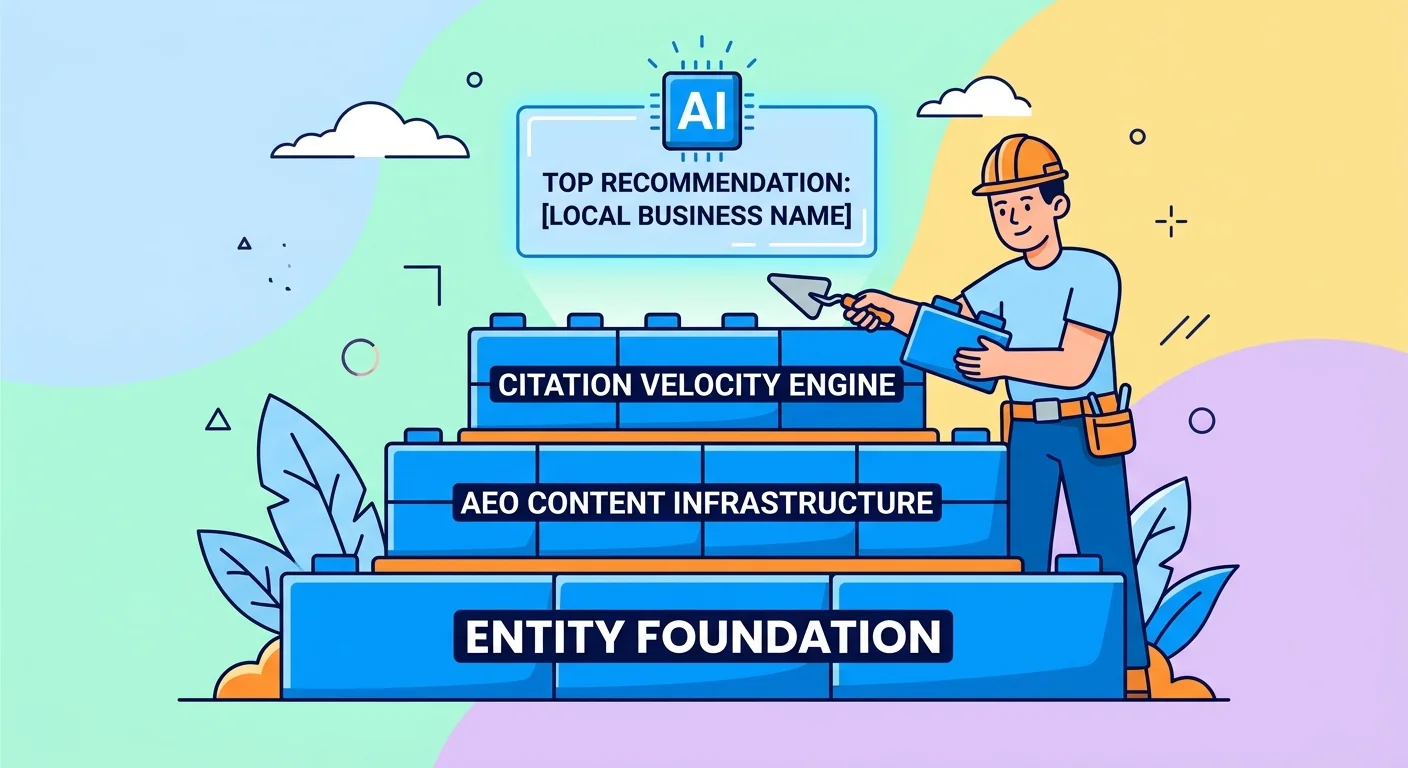
An authority asset investment operates across three compounding layers: an Entity Foundation that makes the business machine-readable, an AEO Content Infrastructure that signals topical depth, and a Citation Velocity Engine that builds trust across third-party validators. Each layer builds on the last. None of it expires.
Last Updated: June 16, 2026
- • Why the Retainer Model Is a Visibility Trap
- • What an Authority Asset Actually Is
- • How to Evaluate an Authority Asset Investment
- • Who This Is — and Is Not — For
-
• Frequently Asked Questions
- • What is the difference between a monthly SEO retainer and an authority asset investment?
- • Why do traditional SEO strategies fail to secure recommendations on AI search engines?
- • How does iTech Valet's Two-AI Validation System prevent misinformation in authority content?
- • How long does it take to build compounding authority infrastructure compared to ranking keywords?
- • What is an AI Visibility Check and how does it diagnose my local authority gaps?
- • Can I replicate an AI Authority Engine approach on my own without an agency?
- • The Bottom Line on Authority Asset Investment
Why the Retainer Model Is a Visibility Trap
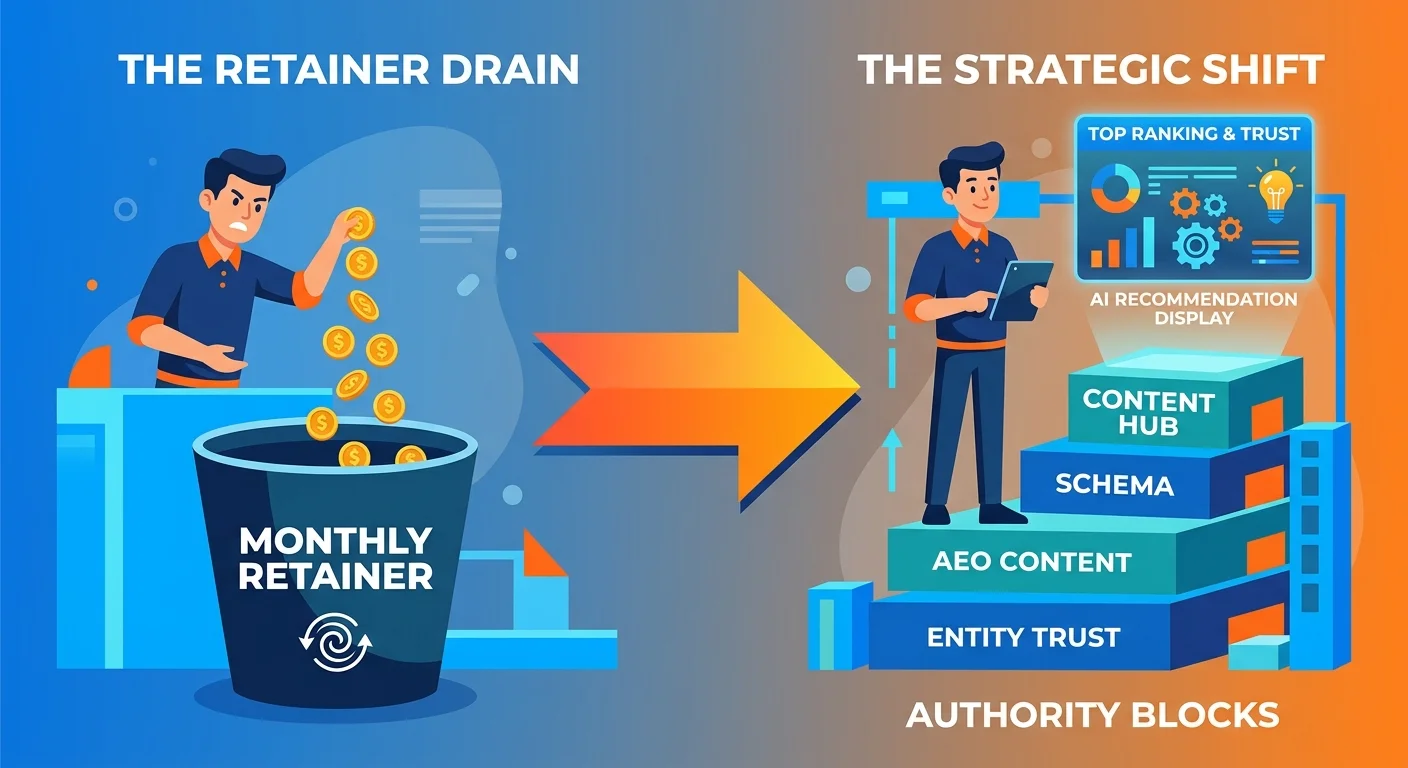
Here's the thing about a monthly retainer: you don't own a single thing when it ends.
You're renting visibility. The moment billing stops, the visibility stops.
That's not a metaphor. That's the structural mechanic — and it's the reason the retainer model is a trap dressed up as a service.
And the platform those retainers optimize for is shrinking.
Traditional search engine volume is projected to drop 25% by 2026 as users shift to AI-driven conversational tools that return a single trusted answer — not a list of ten options.
Ranking on that list means less every quarter. Being the single answer means everything.
So the question isn't whether monthly retainers deliver activity. Most do.
The question is whether that activity builds anything you'll still own in three years.
Most practitioners never run that math before signing the contract. The hidden cost math changes that conversation fast.
The Rent-Seeking Mechanism Nobody Talks About
The rent-seeking mechanism is straightforward. Almost nobody in the agency world has an incentive to explain it.
A retainer creates a dependency loop: you pay monthly, the agency maintains your position, you stop paying, the position dissolves.
The agency's revenue model requires that dissolution. If the work compounded permanently, you'd eventually stop needing them.
That's not a conspiracy. It's just how the incentive structure is built.
Monthly retainers are designed to produce ongoing dependency — not compounding assets.
The output disappears when the invoice does.
But here's the kicker — only about 8% of U.S. businesses were actively using generative AI to produce goods or services in early 2024.
That means the overwhelming majority of your competitors are still funding this rent-seeking loop, assuming the platform will hold.
It won't. And every month they spend renting is a month you could spend building.
Why Traditional SEO Retainers Cannot Build AI Authority
Here's what nobody in the retainer world will tell you: they're solving the wrong problem.
Keyword density, backlink counts, page rank signals — those are inputs to a search algorithm. AI answer engines don't use that algorithm.
They use entity trust signals: structured schema, validated data sources, machine-readable content hierarchies. A standard monthly retainer isn't built to produce any of those — and no amount of optimization on the old system gets you into the new one.
The Local AI Authority Engine is built on a completely different architecture — and that difference isn't cosmetic.
It constructs the Entity Foundation first. Then layers in the AEO Content Infrastructure. Then builds the Citation Velocity Engine on top.
Each layer compounds on the last. None of it dissolves when a billing cycle ends.
A retainer's output isn't just temporary. It's structurally incompatible with what AI engines need to trust a business.
You can't keyword-optimize your way into an AI recommendation. Full stop.
The trust signals that matter to ChatGPT, Gemini, and Grok aren't keyword signals at all.
Some practitioners hear this and think it's a pricing argument — a way to dress up a higher number in technical language.
It isn't. The architecture is different at the foundation level.
Retainers rent you a position inside a declining platform. Authority infrastructure puts your name inside the system AI engines use to answer questions. You can't own what you're renting — and those two things aren't variations of the same product.
| Model | What You're Paying For | What Happens When You Stop Paying | Who Owns the Asset |
|---|---|---|---|
| Monthly SEO Retainer | Temporary position rental inside a declining search algorithm | Position dissolves — no residual asset remains on your balance sheet | The agency owns the dependency loop; you own nothing |
| Authority Asset Investment (AI Authority Engine) | Permanent infrastructure build — Entity Foundation, AEO Content Infrastructure, Citation Velocity Engine | Infrastructure remains fully intact — it compounds on your own digital footprint regardless of billing status | You own the infrastructure outright — it sits on your balance sheet, not the agency's |
| Paid Ads / Sponsored Visibility | Rented placement inside a paid auction system | Visibility stops the moment the budget does — zero residual authority | The platform owns the placement; you own no underlying asset |
| Traditional Content Marketing (Commodity) | Volume of generic articles optimized for keyword density | Content orphans with no structural authority signals — AI engines cannot validate the entity | Output exists but carries no compounding machine-readable trust — not an asset, a library |
What an Authority Asset Actually Is
An authority asset isn't a service you subscribe to.
It's infrastructure you own — permanently embedded in the systems AI engines use to decide whose name gets spoken.
Most practitioners have never heard this distinction laid out. That's not an accident — the agency world doesn't benefit from explaining it.
A retainer produces ongoing activity. An authority asset produces a compounding structure that sits on your own digital footprint. And what happens when that structure is never built is authority decay — the slow, invisible erosion of the signals AI engines use to confirm who you are.
The asset is built in three layers: Entity Foundation, AEO Content Infrastructure, Citation Velocity Engine.
Each layer feeds the next. None of it evaporates when a billing cycle ends.
Asset Layer 1: Entity Foundation
Entity Foundation is the base layer. Nothing else works without it.
It's the structured schema, business entity data, and machine-readable signals that tell AI engines exactly who you are, what you do, and whether you're worth trusting. Get this wrong and every layer above it is built on sand.
AI engines don't read websites the way humans do. They parse structured signals — entity identifiers, schema markup, NAP consistency, verified data sources.
If those signals are missing or contradictory, the AI can't confirm your authority. So it doesn't. It recommends someone else.
But when Entity Foundation is properly built, it doesn't need to be rebuilt every month. The AI already knows who you are.
Everything stacked on top of it compounds from a position of confirmed trust — not ambiguity.
Asset Layer 2: AEO Content Infrastructure
AEO Content Infrastructure is where the compounding starts to show up.
This is the system of AI Authority articles, structured content hierarchies, and semantic coverage that gives AI engines the depth of evidence they need to confidently name your business — not a competitor's.
This isn't about publishing generic articles and hoping the algorithm notices.
Every piece of AEO Content Writing Services is engineered to satisfy specific AI retrieval logic — answer-first structure, entity reinforcement, and semantic density that retainer-produced content doesn't come close to replicating.
Here's what makes this layer an asset and not a cost: the content doesn't disappear.
Each article permanently deepens AI's understanding of your entity. It adds to the evidence base. It compounds with every subsequent piece. The more you build, the more it locks in.
That's a balance sheet entry — not a line item you're paying to keep the lights on.
Asset Layer 3: Citation Velocity Engine
The Citation Velocity Engine is the third layer — and it's the one that closes the loop.
It's the system of external validators, structured citations, and third-party authority signals that confirm your business to AI engines from outside your own infrastructure. Internal signals alone aren't enough. AI needs external proof.
AI engines cross-reference what you claim against what verified external sources say about you.
When those signals align — consistent entity data across directories, publications, and institutional sources — the AI's confidence threshold clears and your name gets spoken. When they don't align? Hallucination rates in complex retrieval tasks run up to 10%. That's not a software bug. That's a missing citation layer.
So the full asset is this: a confirmed identity layer, a compounding content layer, a validated citation layer — all three working together on infrastructure you own outright.
That's what AI engines trust. And that's what no monthly retainer is structured to build.
| Authority Asset Layer | What It Builds | How It Compounds | Retainer Equivalent (What's Missing) |
|---|---|---|---|
| Entity Foundation | Structured schema, verified business entity data, and machine-readable signals that establish exactly who you are across AI retrieval systems | Permanent — once built, it anchors every subsequent content layer from a position of confirmed trust rather than ambiguity | No equivalent — retainers optimize page-rank signals; they don't construct the entity identity layer AI engines use to validate a business |
| AEO Content Infrastructure | A system of AI Authority articles and structured content hierarchies that give AI engines the depth of evidence required to confidently recommend your business | Each article permanently deepens AI's understanding of your entity — the more content layers added, the stronger the evidence base becomes | Generic content published for keyword density — it produces activity, not compounding evidence, and dissolves in value when the retainer billing stops |
| Citation Velocity Engine | External validators, structured citations, and third-party authority signals that confirm your business to AI engines from outside your own infrastructure | External confirmation signals accumulate over time — each new validated source increases AI confidence and reduces the risk of being excluded from a recommendation | No systematic external validation layer — retainers rarely build the cross-referenced citation signals that AI engines require to clear their confidence threshold |
How to Evaluate an Authority Asset Investment
Knowing the asset model beats the retainer model is step one.
But knowing whether your infrastructure is already failing AI engines right now — that's the conversation that actually changes what you do next.
Most practitioners think their digital presence is fine.
AI engines don't send rejection notices. They just recommend someone else — quietly, every day, to every person asking.
That gap between what you assume and what AI actually says about your business is exactly what balance sheet asset framing exposes.
So run a real diagnostic before you commit to anything.
Not a keyword audit. Not a backlink report.
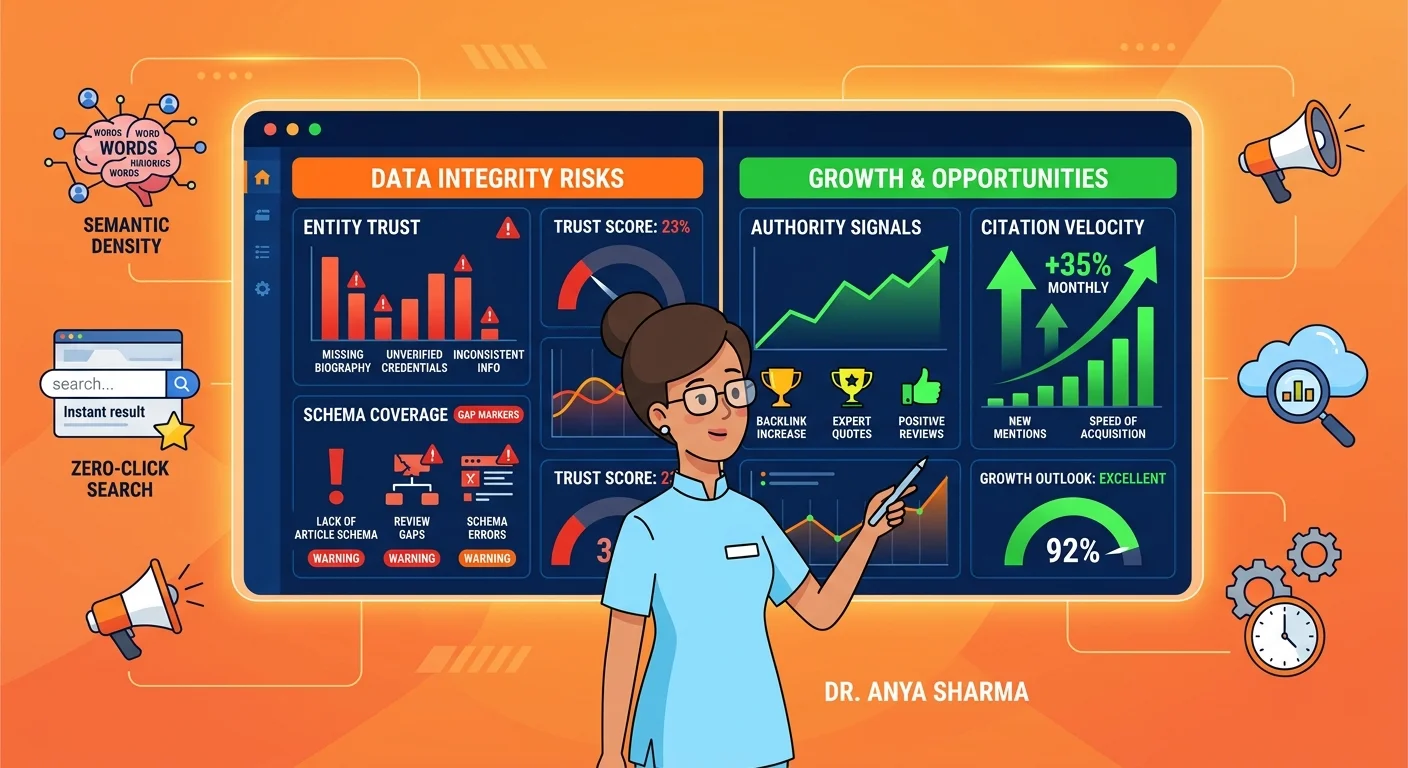
A structural check of whether AI engines can confirm your identity, trust your authority signals, and retrieve your entity data without guessing.
The AI Visibility Diagnostic: What to Check First
The AI Visibility Check is where you start.
Fifteen minutes. It shows you exactly what ChatGPT, Gemini, and Grok say when someone in your market asks who to trust.
Most practitioners don't like what they find.
But the check isn't just about whether your name shows up.
It's about whether AI engines can confirm your entity data consistently. Whether your schema signals are structured. Whether your authority evidence comes from sources AI actually treats as validators — not sources AI ignores.
Traditional search engine volume is already projected to drop 25% by 2026 as users shift to conversational AI. The practitioners running this diagnostic now are the ones who'll own the authority signals before that window closes.
Here's what you're actually checking for.
Can an AI engine confirm who you are without ambiguity? Do verified external sources corroborate your entity data? Does your content answer questions directly — or does it read like a brochure AI has no way to parse?
Those three questions tell you exactly which of the three asset layers you're missing.
Signals That Your Current Infrastructure Is Failing AI Engines
Awareness of AI isn't the same as AI-readiness.
Roughly 90% of U.S. adults know what AI is. But only about 8% of U.S. businesses were actively using generative AI to produce goods or services in early 2024.
That gap between knowing and building — that's exactly where most practices are stuck right now.
The signals that your infrastructure is failing AI engines aren't subtle.
Your entity data is inconsistent across directories. Your schema markup is missing or incomplete. Your content is generic enough that AI can't distinguish your authority from a competitor two blocks away.
And when someone asks an AI engine who to trust in your market, your name doesn't come up.
That last signal is the one practitioners discover too late.
Every month that gap goes unaddressed, a competitor is stacking authority signals instead of you. You can't own what you're renting — and every billing cycle on expiring visibility is a month of compounding you're handing to someone else.
The diagnostic just tells you where you're starting from.
| Evaluation Signal | Healthy Authority Asset | Retainer-Only Symptom | Action Required |
|---|---|---|---|
| Entity data consistency | Business name, address, phone, and category are identical across all directories, schema markup, and third-party validators — AI engines confirm identity without ambiguity | NAP data conflicts across platforms; schema markup is missing or generic; AI engines can't confirm who you are and default to a competitor with cleaner signals | Audit every directory listing and structured data tag for consistency; implement complete schema markup tied to a verified entity profile |
| Content structure | AI Authority articles are built answer-first with semantic density and entity reinforcement — AI engines can parse, retrieve, and cite specific answers directly from the content | Content reads as a brochure or keyword-stuffed page with no retrieval logic; AI engines have no mechanism to extract a direct answer and skip the source entirely | Rebuild content architecture around AEO retrieval logic — answer-first structure, topic depth, and semantic coverage that compounds with each new piece |
| External citation signals | Third-party institutional sources, directories, and publications independently corroborate your entity data — AI engines cross-reference and confirm authority from outside your own infrastructure | No external validators beyond a few inconsistent directory listings; AI engines can't confirm your claims from independent sources and treat your authority as unverified | Build a Citation Velocity Engine — structured citations and external authority signals from sources AI treats as validators, not just directory spam |
| Authority persistence | Infrastructure layers — Entity Foundation, AEO Content Infrastructure, Citation Velocity Engine — remain active on your digital footprint whether or not a billing cycle is running | Visibility disappears or degrades the moment retainer payments stop; no compounding structure exists because none was ever built | Shift investment from recurring visibility rental to infrastructure ownership — each layer built is permanently embedded, not leased |
| AI recommendation outcome | When someone asks an AI engine who to trust in your market, your business name appears with corroborating signals — entity confirmed, authority validated, answer served | Your name is absent from AI recommendations; a competitor with stronger entity signals fills the answer regardless of how long you've been in the market | Run an AI Visibility Check to see exactly what AI engines say right now — then identify which asset layer is missing and address the root cause, not the symptom |
Who This Is — and Is Not — For
Here's the thing: this isn't for everyone.
That's not a disclaimer. That's a filter.
The Authority Engine is built for a specific kind of practitioner. If you're not that practitioner, no amount of infrastructure will deliver what you're actually looking for.
Only about 8% of U.S. businesses were actively using generative AI to produce goods or services in early 2024.
That's not a criticism. That's a window.
The practitioners who move now build authority signals before the market saturates. The ones who wait get to compete for second place.
So let's get honest about fit before this goes any further.
The wrong buyer and the right buyer look identical on the surface. Both want more patients. Both are sick of what they've tried.
The difference shows up in what they're actually willing to do next.
The Practitioner Who Gets Results From This
The practitioner who gets results from this is already established.
Not the biggest name in the market. But running a real practice — real revenue, real skin in long-term visibility.
They're done paying rent on visibility that evaporates every billing cycle. They've run the retainer model. They've seen the reports — impressions, clicks, "ranking improvements" — and they've noticed that none of it produces the one thing that actually matters: patients who found them because AI said their name.
That's the break point. When the reports stop feeling like progress and start feeling like expensive noise, the investment decision gets obvious. That's the frame that makes how authority ROI compounds click.
They also understand — or they're willing to accept — that authority is built in layers.
Entity Foundation first. AEO Content Infrastructure second. Citation Velocity Engine third. It doesn't skip steps. It doesn't compress into a 30-day sprint.
But once it's built, it sits on their balance sheet permanently. That trade-off isn't a limitation. It's the entire point.
Who Should Stop Reading Now
If you're hunting for a 90-day miracle, stop here.
This isn't a short-term visibility tactic with a new coat of paint. The Authority Engine is a capital investment. It behaves like one.
If you need a guaranteed ROI before you'll commit, this isn't your fit either.
The FTC is explicit: commercial AI claims require verifiable, scientific backing — not marketing promises. iTech Valet won't make guarantees that can't be substantiated.
And any agency promising a specific ranking or revenue outcome from AI visibility is making a claim they can't stand behind. That's not a caveat. That's a red flag.
And if you're a budget-first buyer comparing this to a $500-a-month retainer, the math won't work for you.
Not because the value isn't there. Because you're measuring two completely different things.
A retainer is an operating expense. This is infrastructure. Comparing them on monthly price is like comparing a lease payment to a down payment. You can't own what you're renting — and the unit of measure you're using won't let you see that.
What the Investment Timeline Actually Looks Like
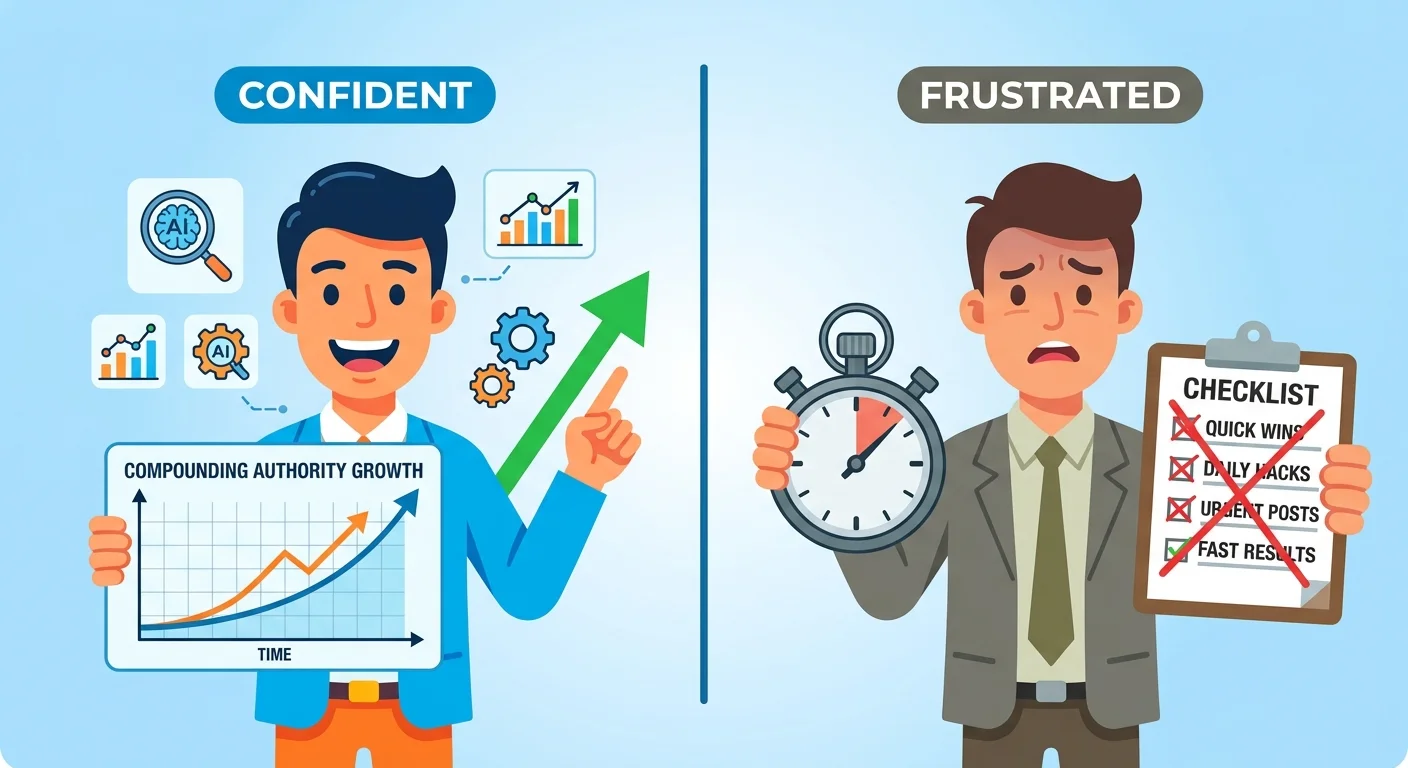
Here's the honest answer on timeline: authority compounds, but not on day one.
The Entity Foundation is built once and stays. AEO Content Infrastructure deepens over months of consistent execution. The Citation Velocity Engine strengthens as external validators align.
What practitioners actually experience is incremental confirmation.
AI engines start referencing their entity data first. Then their content. Then their third-party citations. It's not a linear ramp — it's a compounding curve.
The early months build the base. The later months accelerate from it.
Here's the kicker: the practitioners who check our case studies aren't looking for a timeline guarantee.
They're looking for proof the model works at all. That's the right question.
Because once the three asset layers are in place, the infrastructure keeps compounding without your ongoing participation. That's what it means to own visibility instead of rent it. You can't own what you're renting — and this is where that stops being a phrase and starts being a decision.
| Buyer Profile | Investment Mindset | Timeline Expectation | Right Fit for Authority Engine |
|---|---|---|---|
| Established practitioner with real revenue and a long-term stake in market visibility | Treats authority as a capital asset that compounds on the balance sheet — not a monthly operating cost | Understands that Entity Foundation, AEO Content Infrastructure, and Citation Velocity Engine build in sequence over time | Yes — built for this buyer |
| Practice owner burned by retainer agencies that delivered impressions and click reports instead of patient bookings | Done paying rent on visibility that expires each billing cycle — ready to own infrastructure instead | Accepts that compounding curves accelerate in later months, not the first 30 days | Yes — this is exactly who the Authority Engine is designed for |
| The 90-Day Miracle Seeker — expects measurable ROI before the foundation layers are even built | Views every spend as a short-term expense to be justified each billing cycle | Needs visible wins within weeks or loses confidence in the model | No — the timeline mismatch makes failure inevitable regardless of execution quality |
| The Guarantee Demander — requires contractual promises on rankings, revenue, or AI citations before committing | Conflates verifiable process integrity with guaranteed outcomes — two fundamentally different things | Won't invest without a defined ROI milestone attached to a specific date | No — no credible authority methodology can make those promises and stay honest |
| The Budget-First Buyer — shopping on monthly price and comparing authority infrastructure to a retainer line item | Measures a capital investment against an operating expense using the same unit of measure | Expects the asset model to compete on cost with the rent model | No — the comparison frame is wrong before the conversation even starts |
| The Set-It-and-Forget-It Buyer — wants to build authority once with no ongoing content execution | Treats the Entity Foundation as the finish line instead of the starting layer | Assumes authority maintains itself without AEO Content Infrastructure or Citation Velocity Engine adding depth over time | No — authority without continued execution eventually decays as competitors compound past it |
Frequently Asked Questions
Good. You've done the homework. Now here are the questions that actually matter.
No hedge language. No "it depends." If I don't believe in the model enough to answer directly — you should walk.
What is the difference between a monthly SEO retainer and an authority asset investment?
A monthly retainer is an operating expense. It produces activity — reports, impressions, "ranking improvements" — and the moment billing stops, it stops existing. Nothing carries forward. Nothing compounds. You rented visibility and now it's gone.
An authority asset investment is different in kind, not degree. The Entity Foundation gets built once. The AEO Content Infrastructure compounds with every article published. The Citation Velocity Engine strengthens as external validators align with your entity data. None of that expires at the end of a billing cycle.
The retainer rents you visibility. The asset investment gives you ownership of it.
That's the whole argument. You can't own what you're renting — and once that distinction lands, the decision gets a lot clearer.
Why do traditional SEO strategies fail to secure recommendations on AI search engines?
Traditional SEO was built for a ranked list. You optimized a keyword, built backlinks, chased page-one placement — on a platform where users still clicked through results. That chain worked.
It doesn't anymore.
When someone asks ChatGPT or Gemini who the best practitioner in their market is, AI doesn't serve a list. It gives one answer. The entity it trusts most. Keyword density doesn't earn that trust. Backlinks don't earn it either.
What does? Entity signals. Schema structure. Validated authority infrastructure that AI engines can read, confirm, and cite with confidence.
And here's the urgency behind that: Brookings Institution research confirms AI is rapidly consuming traditional web search behavior — with the shift to conversational AI accelerating fast enough that Gartner projects traditional search engine volume will drop 25% by 2026. Optimizing for the old model isn't just a missed opportunity. It's the wrong bet — placed on a platform that's already shrinking.
How does iTech Valet's Two-AI Validation System prevent misinformation in authority content?
Short answer: most AI content can't be trusted. Research shows unvalidated AI responses hallucinate up to 10% of the time in complex retrieval tasks. That's not a hypothetical edge case. That's a documented failure rate.
The Two-AI Validation System exists specifically to close that gap. Every claim in every piece of authority content runs through Gemini research first — sources verified, data confirmed — before a single word gets written. Then Gemini validates what was produced. Two independent AI passes on every claim. No invented statistics. No fabricated citations.
The FTC is explicit on this: commercial AI claims require substantiation. We build content that meets that standard — not because it's legally required, but because authority built on unverifiable claims isn't authority. It's liability.
How long does it take to build compounding authority infrastructure compared to ranking keywords?
They're not comparable. They measure different things on different timelines.
Keyword ranking is a short-term visibility signal. It fluctuates with every algorithm update. Stop execution, the signal degrades. That's not a criticism — that's just how the model works.
Authority infrastructure doesn't work that way. The Entity Foundation is built once. The AEO Content Infrastructure compounds over months of consistent execution. The Citation Velocity Engine strengthens as external validators align with your entity data. There's no 30-day sprint that replicates that arc.
But here's what the arc produces: infrastructure that AI engines trust permanently — not a ranking that disappears the next time an algorithm shifts.
Only about 8% of U.S. businesses were actively using generative AI in early 2024. The practitioners building authority infrastructure right now aren't racing a crowded field. They're building before the field shows up.
What is an AI Visibility Check and how does it diagnose my local authority gaps?
It's a 15-minute call. You find out exactly what ChatGPT, Gemini, and Grok say when someone asks who to trust in your market.
But it's not just a name-check.
The AI Visibility Check surfaces the structural gaps that cause AI engines to skip your entity entirely — inconsistent NAP data, missing schema signals, authority content that AI can't parse or retrieve with confidence.
It diagnoses three things: whether AI can confirm your identity without ambiguity, whether verified external sources corroborate your entity data, and whether your content is structured to answer questions directly.
Most practitioners who run it discover they're invisible in at least one of those three dimensions. That's where the Authority Engine work begins — not with a guess, but with a map.
Can I replicate an AI Authority Engine approach on my own without an agency?
Technically? Some of it.
But replicating the system isn't the same as executing it at the depth and consistency that produces compounding authority signals.
The Two-AI Validation System, the schema architecture, the AEO Content Infrastructure cadence, the Citation Velocity Engine alignment — each layer requires ongoing coordination across research, writing, technical implementation, and external validator sourcing.
That's not a learning curve you clear in an afternoon.
Even among the 8% of U.S. businesses actively using generative AI in early 2024, the ones getting results built systems — not one-off experiments.
If you want to learn the model and run it yourself, that's a valid choice. But if you want it executed correctly, consistently, and without needing to become an AEO specialist — that's exactly what the Local AI Authority Engine is built for.
The Bottom Line on Authority Asset Investment
You can't own what you're renting.
That's not a tagline. That's the structural mechanic of how the retainer model is designed to work — for the agency, not for you.
Retainers produce reports. The Authority Engine produces infrastructure — embedded in your own digital footprint, compounding whether you're watching it or not.
The three layers — Entity Foundation, AEO Content Infrastructure, and Citation Velocity Engine — aren't a subscription you maintain.
They're a permanent asset on your balance sheet.
And here's what that actually means: once they're built and aligned, AI engines don't need to be re-convinced every billing cycle. The trust signal is already baked into the infrastructure. Your competitors are still paying rent on a result that disappears the moment they stop. You're not. That's the only distinction that matters when search behavior shifts — and it already has.
So stop asking whether the Authority Engine beats a retainer. It does. That's not a pitch — it's just what happens when you compare a compounding asset to a recurring expense.
The only question that still matters: can AI engines confirm your authority right now — or are they quietly recommending someone else every time a prospective patient asks?
Gerek Allen built the AI Visibility Check at iTech Valet for exactly that moment. Not for when you're curious. For when you're done assuming your digital presence is fine and need to know where it actually stands.
Here's the thing — reading about authority infrastructure and actually knowing where you stand are two different conversations. Run the AI Visibility Check. Find out what ChatGPT, Gemini, and Grok say when someone in your market asks who to trust. If the results don't make the problem self-evident, walk away. But if they do? You'll know exactly what to do next.
621 Enterprises, Inc. | Copyright 2026 | All rights reserved