
What Is Schema Drift, and Why Does It Undermine Clinic Trust?
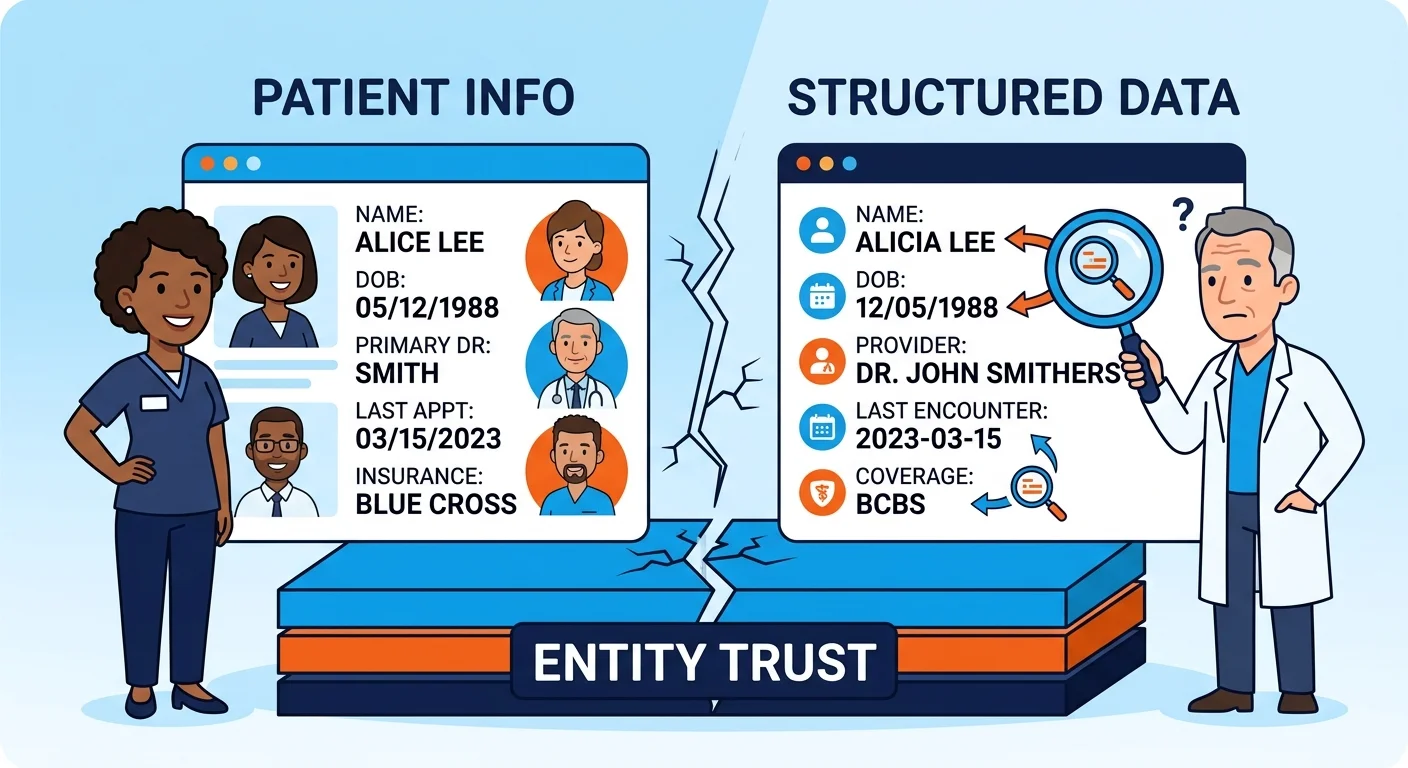
Here's the thing about schema drift: it never announces itself. It just sits there in the code while the clinic hums along like nothing's wrong.
And that quiet is exactly what makes it one of the most persistent, most overlooked problems hitting multi-location businesses. Nobody catches a stale `parentOrganization` reference until an AI system serves up the wrong location to a patient searching for care.
So the real damage isn't technical at all. It's what happens when a clinic's structured data flat-out contradicts the page a patient is staring at — an entity confusion event, where the system trying to verify who the clinic is can't tell which version is the real one. That's a core piece of what standalone AEO content boundaries actually protect for any local business trying to keep its digital footprint straight across every location.
For a local clinic, where patient trust is the whole game, data that fights the page sends a bad signal to search engines. And that signal doesn't stay put on one page. It tells every system reading that markup the clinic's data can't be taken at face value — and once you're flagged as unreliable, that trust is brutal to win back.
Why Patching Schema Errors One at a Time Never Actually Fixes the Problem

Most agencies treat schema drift like a stack of separate errors. Find a broken markup field, patch it, move on to the next clinic on the list.
But that mistakes the symptom for the disease. Fixing one stale `parentOrganization` reference does nothing to stop the next location update from spawning a fresh one.
So the clinic keeps paying for the same fix, over and over, on a rotating cast of pages. Nothing about the underlying system ever changed.
| Approach | What It Actually Fixes | What Keeps Breaking |
|---|---|---|
| Manual markup patching | Corrects the specific field an agency happened to flag, like a stale parentOrganization reference or an outdated service list entry. | The next location update, provider change, or template refresh reintroduces the exact same mismatch on a different page. |
| Scheduled schema audits | Catches accumulated errors at a fixed check-in point, giving the clinic a temporary snapshot of where markup and content agree. | Drift that occurs between audits goes unnoticed, so AI systems keep reading contradictory identity data until the next scheduled scan. |
| Template-based content packages without markup review | Publishes location pages, provider bios, and service updates quickly across an entire clinic footprint. | Every templated page skipping location-specific review adds a new silent point of divergence, multiplying inconsistencies instead of resolving them. |
| Schema-first content architecture | Treats structured data as inseparable from the content describing it, so location, provider, and service updates move together by design. | Nothing, because the markup can no longer fall out of sync with the page it describes — the entity confusion the other approaches keep reintroducing has no gap left to occupy. |
The Reactive Fix Cycle Most Agencies Sell You
Here's the pattern. An agency runs a scan, finds a handful of validation errors, and corrects them by hand inside the markup. The invoice goes out, the clinic feels reassured, everyone moves on.
Thing is, that only holds until the next content update. A new provider joins, a service list changes, a location page gets refreshed — and the markup slips out of sync all over again.
Why? Because the content and the structured data were never architecturally connected in the first place. They got fixed together once, by hand, then left to drift apart on their own.
And this isn't just a clinic-website thing. In cloud data pipelines, schema drift is recognized as one of the failure causes that demands manual diagnosis and remediation rather than an automated correction.
That parallel says a lot. Even in engineering environments built for automation, schema drift shrugs off the one-time patch and keeps coming back until the system itself gets redesigned to stop it.
How Automated Content Packages Quietly Multiply the Damage
Now watch what happens when that same instability meets scale. Automated content packages have made it dramatically easier to push out location pages, service updates, and provider bios across a clinic's entire footprint.
The rise of these packages has accelerated the problem, creating widespread schema inconsistencies that are brutal to track and resolve by hand. Every templated page that skips location-specific markup review drops in another silent point of divergence.
So understanding how standalone content connects to a site's existing markup matters here, because content produced outside that structure is exactly what multiplies drift fastest. One clinic can absorb one drifted page. A content package applied across a dozen locations turns one oversight into a dozen — a pattern well documented in research published through the arXiv preprint server on pipeline failure modes.
Where Multi-Location Clinics Feel Schema Drift the Hardest
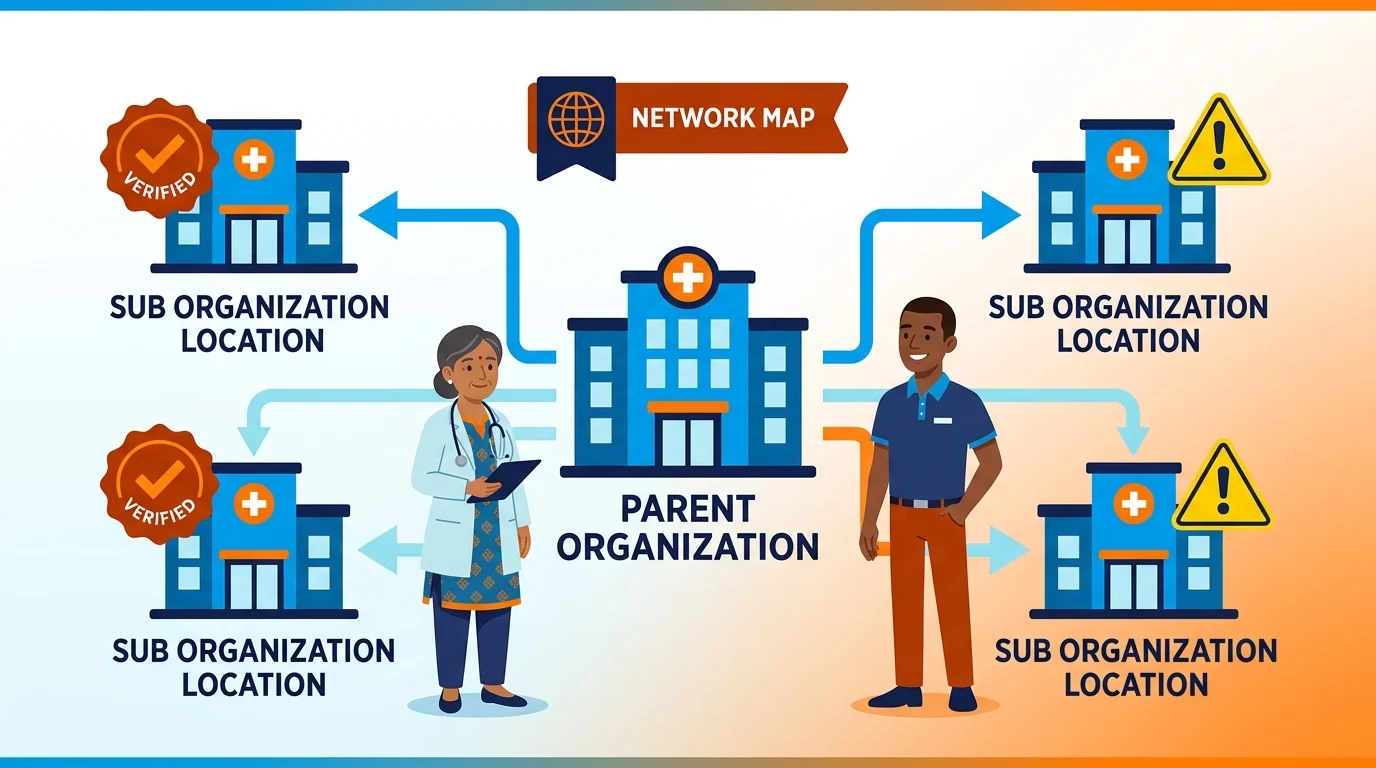
Schema drift doesn't spread evenly. It piles up hardest at the seams — the exact spots where one clinic entity splits into branch locations, individual providers, and location-specific service lists.
Those seams are where a schema-first AI Authority System either holds or breaks. So the pages worth examining aren't random. They're the structural junctions where multi-location clinics crank out the most entity confusion per page published.
| Business Scale | Verification Path | Schema Implication |
|---|---|---|
| Single-location clinic | Individual listing verification | Manual schema patches remain survivable at this scale |
| Multi-location clinic under 10 locations | Individual verification still standard | Drift risk rises with each added location page |
| Clinic exceeding 10 locations | Bulk verification path applies | Manual per-location markup handling becomes unmanageable |
| Clinic with branch entities | Parent-branch hierarchy declared in markup | parentOrganization must correctly link each subOrganization |
What Google's Verification Rules Reveal About Scale
Google's own verification rules show how fast this turns into a real operational headache. Own more than 10 locations of the same business, and every one of them has to be verified individually or through bulk verification.
That threshold isn't arbitrary. It's Google admitting that past a certain footprint, handling each location by hand stops working — something more systematic has to take over.
Now, those rules cover location listings, not the markup itself. But the same logic holds for structured data: a clinic running a handful of locations can survive manual schema patches, while one crossing into double digits can't. Every location you add is another point where a schema-first AI Authority System either scales clean or starts breaking in silence.
The Entity Hierarchy Clinics Get Wrong
Here's where most clinics quietly blow it: the entity hierarchy. Schema.org built the `parentOrganization` property for one job — to name the larger organization that contains a given organization as a subOrganization.
That property exists precisely for clinics with a main location and satellite branches. Use it right, and it tells an AI system exactly how each branch ties back to the parent entity. No ambiguity.
Use it inconsistently — on some branch pages, missing on others, still pointing at an old parent reference after a rebrand — and it does the exact opposite. It hands the search system a hierarchy that argues with itself from page to page, which is the failure mode Google's documentation on business verification is built to head off at scale.
This is exactly the distinction schema-first content built to hold this hierarchy together covers, because generic content packages rarely account for parent-child relationships at all. The property itself gets spelled out plainly enough as a published academic reference style definition of organizational containment. But documentation alone won't stop a clinic from applying it inconsistently across a dozen location pages, one template at a time.
Building a Schema-First Architecture That Cannot Drift

So what does the fix actually look like? Here's the thing: resolving schema drift isn't a one-time job. It takes a systematic approach to content architecture that guards data integrity from the very start.
That means markup and content stop being two separate projects wrapped up on two separate days. They're built from one source, updated by one action, published in one motion.
A schema-first AI Authority System works this way by design. Location data, provider records, and service listings all live in one structured source, and every page — human-facing and machine-facing — pulls from it instead of copying it by hand.
| Schema Type | Best Fit | Key Properties |
|---|---|---|
| LocalBusiness | A single-location clinic with no branch hierarchy to manage | Address, phone, hours, and geographic markup describing one physical entity |
| MedicalClinic | A healthcare provider needing specialty, insurance, and provider affiliation precision beyond generic business markup | Medical specialty, accepted insurance, provider affiliations, and services distinct from a generic listing |
| parentOrganization / subOrganization pairing | A clinic with a main location and one or more branch locations sharing a single business identity | Explicit parent-child linkage so every branch page resolves back to the same named entity |
| Schema-first unified source structure | Multi-location groups where content and markup must update together without manual per-page patching | One structured data source feeding location, provider, and service records into every page automatically |
This Is Not for Clinics Looking for a One-Time Patch
Now, this approach isn't for every clinic. If a location just wants a quick markup patch before a launch and nothing more, this isn't it.
A schema-first system asks a clinic to rebuild how content gets made and maintained, not just how errors get fixed. That's a bigger ask than swapping out one broken field.
But clinics stuck on the rotating cycle of validation fixes? They're the ones who end up needing this. Patch-and-move-on was never going to hold past the next location opening or the next provider change.
MedicalClinic vs LocalBusiness: Choosing the Right Foundation Schema
Picking a foundation schema type is the first structural call, and plenty of clinics botch it before they ever hit the location-hierarchy problem. `LocalBusiness` is the generic parent type Schema.org defines for any physical business location.
`MedicalClinic` is the more specific subtype built for healthcare providers. It carries properties that spell out medical specialties, accepted insurance, and provider affiliations far more precisely than a generic business listing ever could.
Using `LocalBusiness` where `MedicalClinic` belongs isn't exactly wrong. It's just imprecise — and imprecision is where entity confusion starts to take root before a single location page even multiplies.
Mapping parentOrganization and subOrganization Across Locations
Once the foundation type is locked, the real work starts at the seams between locations. This is where why generic content fails to get pulled into AI answer summaries matters directly, because content written without the entity hierarchy in mind rarely maps cleanly onto it later.
Schema.org's `parentOrganization` property was built for exactly this junction. It names the larger organization that contains a given entity as a subOrganization, handing a main clinic and its branches an explicit, machine-readable relationship instead of an implied one.
Mapped right, every branch location's markup points back to the same parent entity, using the same identifying details, every single time. No branch page invents its own version of the parent's name, address format, or provider list.
Mapped wrong, each location turns into its own unverified island. That's the exact condition a schema-first system is built to prevent — not by patching each island after the fact, but by never letting them separate in the first place.
Keeping Content and Structured Data in Permanent Sync
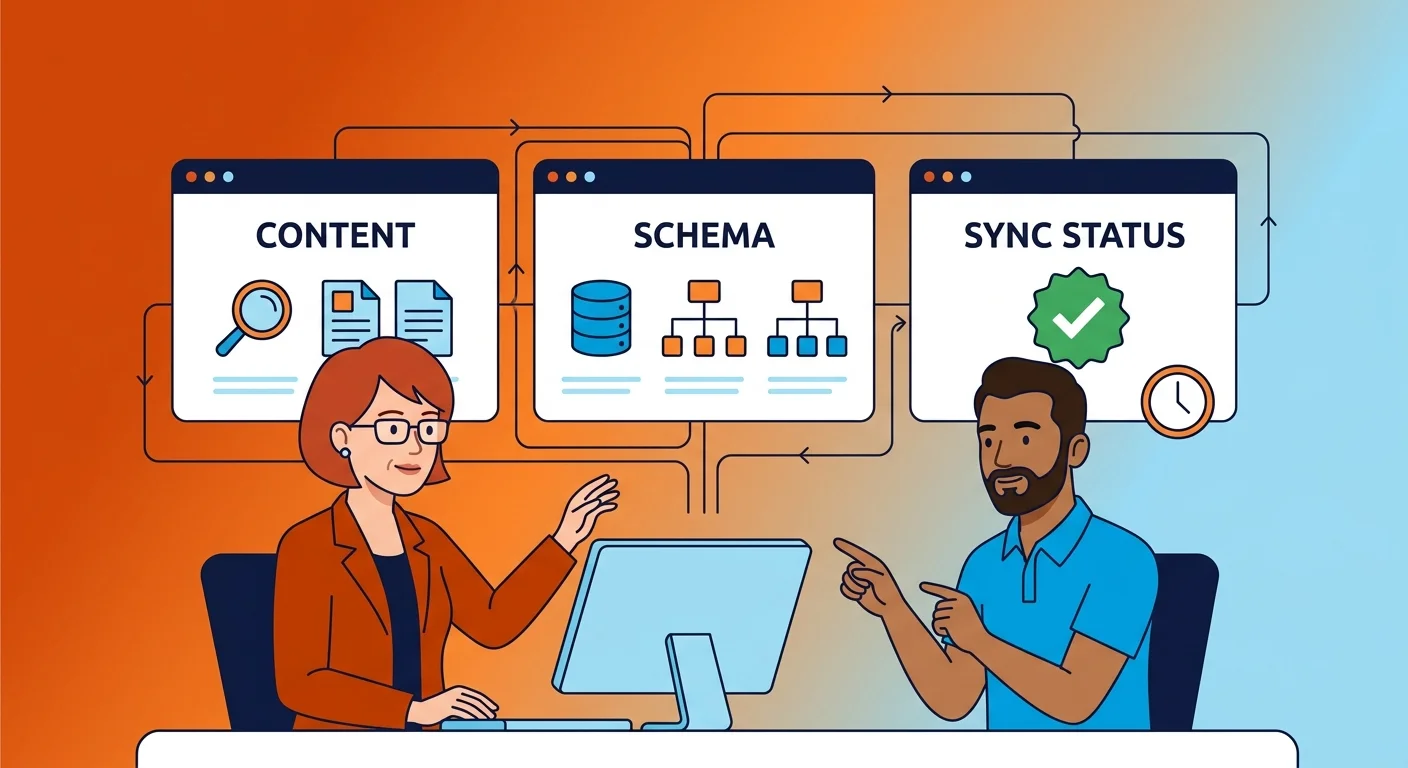
Architecture solves the structural problem. But structure alone doesn't stay accurate forever — it needs a maintenance layer sitting on top of it.
That layer has two jobs. It has to catch drift before a patient or an AI system ever sees the contradiction, and it has to keep the sync running without a human re-checking every field by hand.
Here's where most clinics stop short. They build the schema once, call it done, and never touch it again until something breaks out in public.
| Audit Stage | What Gets Checked | Who Owns It |
|---|---|---|
| Initial Build Review | Confirms markup type matches entity — MedicalClinic versus generic LocalBusiness — and that parentOrganization references resolve correctly across every branch page | Schema-first content architecture, established before any location page goes live |
| Content Change Trigger | Checks any edit to a provider bio, location address, or service list against the structured source, catching the moment a page and its markup could diverge | Whoever publishes the content update, working from the same structured source |
| Recurring Sync Audit | Compares displayed page content against live markup on a standing schedule, flagging mismatches before an AI system or a patient encounters the contradiction | The maintenance layer of the schema-first AI Authority System, not a one-off manual reviewer |
| Rebrand or Expansion Event | Verifies every parentOrganization reference still points to the correct entity after a name change, new branch opening, or provider departure | Whoever manages the structured source, since a single update here should propagate everywhere at once |
Auditing for Drift Before It Reaches Your Patients
An audit isn't a one-time cleanup pass. It's a recurring check that lines up what the markup says against what the page actually shows.
That comparison catches the failures nobody spots on their own — a provider listed on the page but missing from the schema, a location address updated in one spot and not the other.
Left uncaught, those small mismatches are exactly the entity confusion this article opened with. Every one is a data point telling an AI system the clinic isn't a reliable source about itself.
So the audit runs on a schedule tied to content changes, not to a calendar. Every new provider bio, every location update, every edit to a service list is a trigger point worth checking — not an afterthought to catch later.
Automating the Sync Without Losing Control of Accuracy
Once the audit exists, the next question is what happens with what it finds. Manual correction, even when it's fast, is still the same patch-and-move-on pattern the clinic is trying to escape.
A schema-first AI Authority System closes that gap by generating markup straight from the same structured source that fills the page. When the source updates, the markup updates with it — no second step where a human has to remember to translate the change.
That doesn't kill the need for oversight. It just moves the human from re-typing fields to verifying the automated output still matches the entity it describes — a smaller, more sustainable job than chasing drift across every location page by hand.
Frequently Asked Questions
The architecture above settles the structural question. But clinics stuck in schema drift right now usually have sharper, narrower questions than architecture can answer alone.
Here are the edge cases that come up most.
What is schema drift and why is it a critical problem for local medical clinics?
Schema drift is when a clinic's structured data quietly stops matching what's on the page or out in the real world. For a local clinic, that mismatch reads as entity confusion — the exact signal that erodes an AI system's trust in the clinic as a source about itself.
How can I audit my website for schema drift across multiple clinic locations?
Go location by location, comparing what each page's markup claims against what the page actually shows. The real risk isn't one bad page. It's the same small mismatch repeating quietly across every branch.
What are the most common triggers for schema drift in healthcare content packages?
Provider changes, address updates, and new service listings are the usual triggers. Automated content packages make it worse. They spit out pages faster than anyone's checking whether the markup underneath still agrees with them.
Does using AI for content creation make schema drift worse?
It can. That happens when the AI only writes page copy and never touches the structured data behind it. That gap between fast content and static markup is exactly where entity confusion takes root.
What's the difference between MedicalClinic and LocalBusiness schema, and when should I use each?
`LocalBusiness` is Schema.org's generic type for any physical business location. `MedicalClinic` is the healthcare-specific subtype. It carries medical specialties, accepted insurance, and provider affiliations that a generic listing can't express precisely.
How do you fix schema drift at scale without manually editing every page?
You stop editing pages one at a time. Instead, you generate markup straight from a single structured source. A schema-first AI Authority System updates every page from that one source, so drift has nowhere left to start.
The Bottom Line on Schema Drift
Schema drift was never a coding error. It's an entity confusion event — the moment a clinic's own data stops agreeing with itself, and every system reading it clocks that before a single patient ever does.
A patch fixes the page that broke. It does nothing for the next one, because the source of the contradiction never got touched. That's the whole case for a schema-first AI Authority System — not a better fix, but an end to needing one on a loop.
So the real choice in front of a multi-location clinic isn't about markup at all. It's whether the entity gets defined once, correctly, at the source — or defined again and again, imperfectly, on every page someone remembers to check. If your clinic's data hasn't been reviewed for exactly this kind of drift, an AI Visibility Check is where you find out where the entity confusion already lives.