
How Do You Measure the ROI of an Authority Asset in a Healthcare Practice?
AI doesn't hand patients a list. It names one practice and moves on.
That is the entire ROI equation. Not clicks. Not impressions. Not keyword rankings. The question is whether your practice earned the verdict — or whether a competitor did.
Over 80% of healthcare consumers start their provider search online. But the behavior that matters has shifted. ChatGPT, Gemini, and Grok don't return ten options for patients to browse. They synthesize the query and deliver a single recommended clinical solution. One practice gets named. Everyone else is absent.
Roughly 90% of prospective patients rely on trust signals and online reviews before booking. Consistent clinical credentials across reputable directories can increase that trust by up to 70%. Those are the infrastructure inputs AI engines read to decide whose name comes back.
Traditional clinical marketing attribution fails to capture up to 40% of real patient acquisition pathways. That gap isn't a rounding error. It's exactly where authority-driven AI recommendations live — high-intent patients who bypassed search lists entirely and booked because an AI engine named a practice without prompting.
An authority asset is not a monthly campaign. It is a compounding infrastructure investment built across three phases — Foundation, Compounding, and Yield — each with trackable signals: entity trust consistency, citation velocity, semantic density, and direct AI recommendation frequency.
Measuring ROI comes down to one question: when a prospective patient asks an AI engine who to trust in their market, does a specific practice's name come back? If it does, the asset is working. If it doesn't, the investment hasn't reached the verdict yet — and a competitor is collecting the patients that practice isn't seeing.
Last Updated: June 17, 2026
- • Why Traditional ROI Metrics Fail Healthcare Practices in the AI Era
- • The ROI Framework AI Search Actually Rewards
- • How Authority Compounds Into a Financial Asset Over Time
- • Putting the Framework Into Practice: What to Track and When
-
• Frequently Asked Questions
- • What is the difference between traditional digital marketing ROI and authority asset ROI in healthcare?
- • How do AI answer engines like ChatGPT and Gemini evaluate a clinic's online authority?
- • Why does a template website make a healthcare practice invisible to conversational AI search?
- • How long does it take to see a compounding return on healthcare authority infrastructure?
- • What are the core metrics used to track entity trust and citation velocity in clinical practices?
- • Can a practice measure authority asset ROI without switching away from its current marketing provider?
- • The Verdict on Authority Asset ROI
Why Traditional ROI Metrics Fail Healthcare Practices in the AI Era
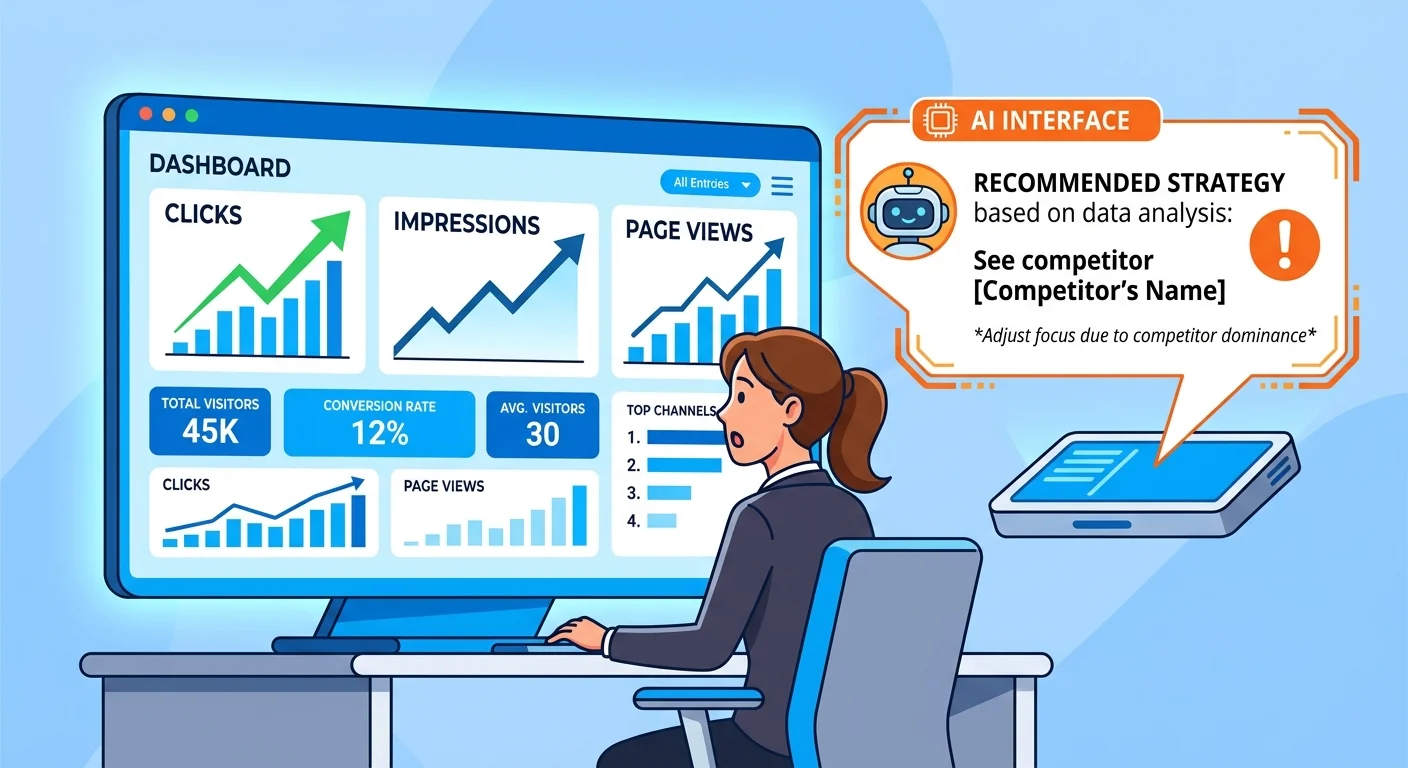
Traditional ROI metrics were built for a different game. That game is over.
Clicks. Impressions. Keyword positions. These were never the signal — they were proxies for attention inside a system where patients browsed a list and made their own choice.
That system is gone.
Generative AI platforms synthesize the query and deliver a singular recommended clinical solution. There is no list to browse. There is a verdict. And either your practice earned it or someone else did.
So the dashboard your practice runs every Monday — bounce rates, session durations, cost-per-click — tells you nothing about whether AI is recommending you or the practice down the street.
Those metrics cannot see the channel where the decision is now being made.
That gap is not a campaign problem. It is a structural one. And patching it with more ad spend or a better landing page does not fix it. the authority asset model
Why Vanity Metrics Cannot Measure What AI Search Produces
Vanity metrics were built to measure visibility inside a ranked list. AI search does not produce a list. That mismatch is the whole problem.
Over 80% of healthcare consumers begin their provider search online. That number gets used constantly to justify digital ad spend and click-based campaigns.
But it misreads the behavior.
Those patients are not browsing ten results and picking one. They are asking a question and receiving a single answer. A click-through rate has no column for that outcome.
Here's what stings: a practice can run strong click-through rates, solid impression share, and a clean landing page — and still be invisible inside every AI recommendation in its market.
The vanity metrics look fine.
The authority signals that determine whether your practice earned the verdict sit completely outside their field of view.
The Attribution Gap Traditional Marketing Can Never Close
Traditional clinical marketing attribution models fail to capture up to 40% of real patient acquisition pathways. That is not a measurement inefficiency. That is the exact blind spot where authority-driven AI recommendations live — and most practices have no idea it exists.
When a patient asks ChatGPT who the best chiropractor in their area is and books directly from that answer, no attribution pixel fires. No UTM parameter captures it. No CRM source field logs the origin.
The patient simply arrives.
And the practice has no data trail to explain why. That missing trail is exactly where the real ROI of an authority asset accumulates — and it is completely invisible to the metrics frameworks most practices still run. It is also the core dynamic behind how weak entity trust signals lose patients before a practice ever knows it happened.
The attribution gap cannot be closed by adding more tracking tools.
The channel itself — conversational AI search — produces a verdict, not a click. You cannot tag a verdict. You cannot pixel-fire a recommendation.
Measuring that outcome requires a different framework entirely: one built around entity trust consistency, citation velocity, and direct AI recommendation frequency. That is what authority asset ROI actually measures.
| Metric Type | What It Measures | What It Misses | Verdict in AI Search |
|---|---|---|---|
| Click-Through Rate | How many users clicked a link in a search result | Whether AI named your practice at all — no link is ever clicked in a conversational AI verdict | Invisible — AI search produces no clickable list to measure |
| Keyword Rankings | Where a practice's website appears in a traditional search results page | Whether AI engines have enough entity trust to recommend the practice by name in a synthesized answer | Irrelevant — AI does not rank pages; it issues a single recommended verdict |
| Impressions and Session Data | How often a website appeared in results and how users behaved once they arrived | High-intent patients who bypassed search entirely and booked directly from an AI recommendation | Blind — the entire AI recommendation channel produces no session, no impression, no page visit |
| Cost Per Click / Ad Spend ROI | Revenue generated relative to paid ad expenditure in traditional search environments | Authority-driven patients who arrived without a paid touchpoint because an AI engine named the practice unprompted | Unmeasurable by design — authority asset returns accumulate outside the paid acquisition channel |
| Bounce Rate and Dwell Time | How engaged website visitors were after arriving via a search result | Whether the practice's entity signals — schema, citation consistency, semantic density — are strong enough to earn an AI recommendation in the first place | Misaligned — engagement metrics reflect behavior after discovery; AI authority determines whether discovery happens at all |
| Attribution Source Tracking | Which marketing channel receives credit for a patient booking in a CRM or analytics platform | Patients who arrived directly after receiving an AI recommendation — no UTM parameter, no pixel, no source field captures the AI verdict channel | Structurally broken — the attribution model has no column for conversational AI as an acquisition source |
The ROI Framework AI Search Actually Rewards

Here's the thing: ROI inside a conversational AI engine looks nothing like a marketing dashboard.
There is no click funnel. There is a verdict.
The framework AI search actually rewards runs on three measurable signal categories: entity trust, citation velocity, and semantic density. These are the inputs ChatGPT, Gemini, and Grok evaluate when they decide whose name gets said — and whose doesn't. The practices that understand this shift their measurement entirely. The ones that don't keep optimizing for a game that no longer determines the outcome. Tracking authority metrics that predict practice growth
None of these signals show up in Google Analytics. That is not an accident — it is the point.
The Local AI Authority Engine is built specifically to establish and compound these signals. Because the practices that build them earliest lock in the authority position AI engines reference every time a patient asks.
Entity Trust: The Foundation Signal
Entity trust is the foundation signal.
AI engines won't say your name until they trust your identity. That's not a metaphor — it's the literal first gate.
Generative AI platforms synthesize a patient's query and return a single recommended answer — not a list. To earn that recommendation, your practice identity has to be consistent, credible, and verifiable across every surface these engines index: directories, listings, schema markup, structured content.
Consistent clinical credentials across reputable online directories can increase consumer trust by up to 70%. That consistency is exactly what entity trust measures. It is what AI reads before it decides whether your name belongs in the answer.
Roughly 90% of prospective patients rely on trust signals and online reviews to evaluate a provider before booking. AI engines are doing that same evaluation — at machine speed, across hundreds of signals simultaneously.
A practice with fragmented, inconsistent, or thin entity data fails that evaluation before a patient ever asks the question. The AI never gets to the verdict. It just skips to the next practice.
Citation Velocity and Semantic Density: The Compounding Signals
Citation velocity and semantic density are the compounding signals.
This is also where most practices completely fall apart — not because the signals are complicated, but because they require consistency over time. And most practices quit before the compounding starts.
Citation velocity measures how often your practice gets referenced across authoritative sources over time. Semantic density measures how completely your content ecosystem covers the topic space your patients are actually searching.
Separately, each signal builds credibility. Together, they tell AI engines something specific: this practice isn't just credible — it is the credible answer for this clinical question, in this market. That's the difference between being indexed and being named.
And here is where the compounding dynamic becomes real.
Every authoritative reference, every AEO article that covers a topic with depth and precision, every schema signal that reinforces the practice's clinical identity — these stack. The practice that built Foundation signals in month one is earning Compounding returns in month six.
The practice that waited is still laying Foundation while its competitor has already earned the verdict.
| Authority Signal | What It Measures | How AI Engines Use It | Trackable Indicator |
|---|---|---|---|
| Entity Trust | Consistency of clinical credentials, NAP data, schema markup, and structured identity signals across every surface AI engines index | Used to verify the practice is a real, credible, and correctly classified clinical entity before issuing a recommendation | Directory listing consistency score; schema markup completeness; structured data accuracy across Google, Bing, and third-party directories |
| Citation Velocity | Rate at which a practice earns authoritative references across reputable external sources over time | Used to determine whether the practice is recognized as a trusted voice in its specialty — not just once, but repeatedly and across diverse sources | Frequency of new authoritative mentions per month; breadth of referring source types; rate of AEO content indexed and referenced |
| Semantic Density | Depth and breadth of the practice's content ecosystem covering the topic space patients are actively querying | Used to match the practice's expertise to specific patient questions — practices with thin content coverage are bypassed for those with complete topical authority | Number of AEO articles covering core clinical topics; topical cluster completeness; depth of coverage per subject area relative to market competitors |
| Direct AI Recommendation Frequency | How often the practice is named as the recommended answer when AI engines are queried for providers in its specialty and market | This is the output signal — the measurable result of all three input signals combined; the practice either earns the verdict or it does not | Manual AI query testing across ChatGPT, Gemini, and Grok; frequency of named recommendation vs. competitor; variation by query phrasing and geography |
| Trust Signal Completeness | Presence and quality of online reviews, credentials, and patient-facing social proof across indexed platforms | Used to validate the human credibility layer of the practice's identity — AI engines cross-reference trust signals as part of recommendation synthesis | Review volume and recency across key directories; credential verification status; consistency of patient-facing claims with structured data |
| Foundation-to-Yield Progression | The practice's movement through the three authority phases — Foundation, Compounding, and Yield — as measured by the compounding of the signals above | Used as the cumulative authority score that determines whether a practice is in the early build stage or has locked in a dominant recommendation position | Phase gate completion checklist; month-over-month improvement in entity trust, citation velocity, and semantic density; AI recommendation frequency trend over time |
How Authority Compounds Into a Financial Asset Over Time
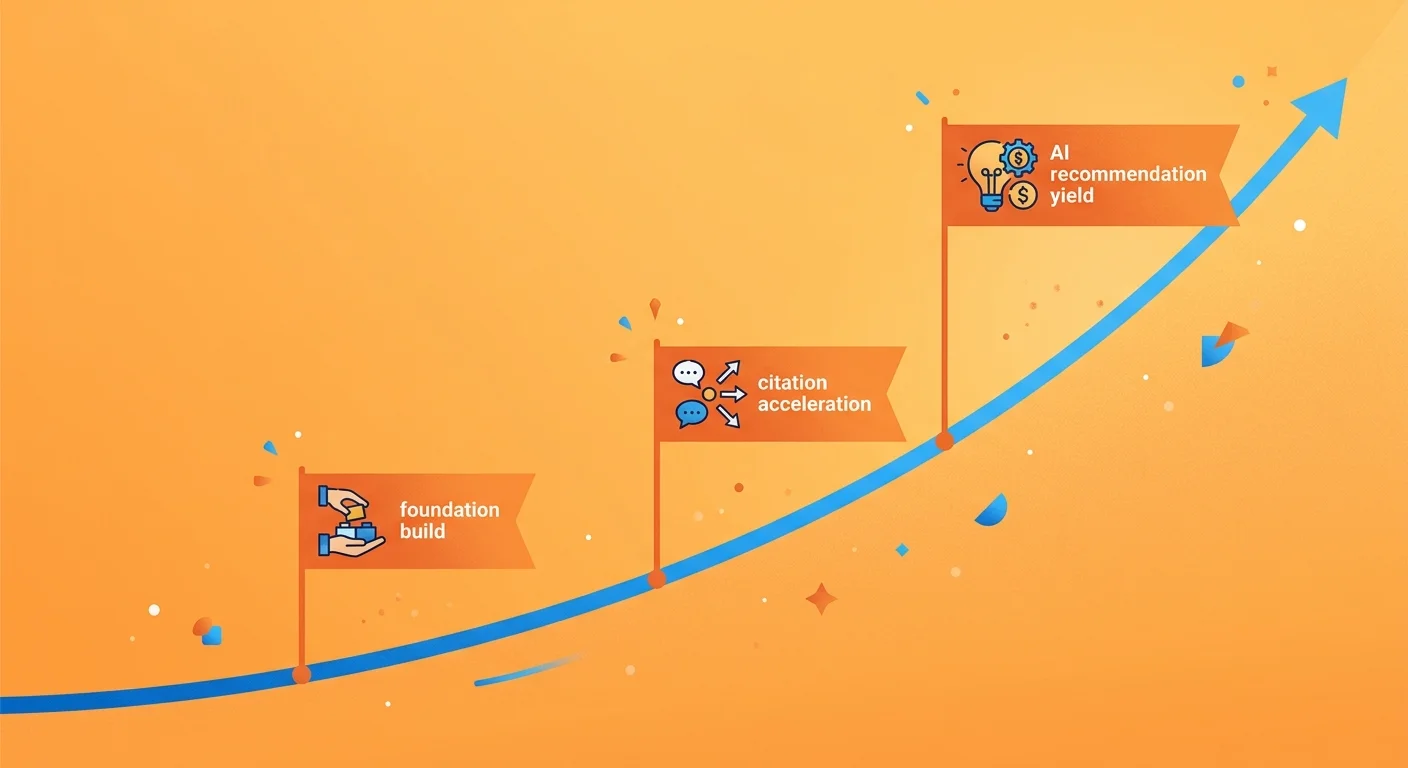
Authority is not a campaign.
It is infrastructure. And infrastructure appreciates.
That distinction changes everything about what a practice is actually buying.
A paid ad campaign costs money every month and stops the moment payments stop. Authority built on entity trust, citation velocity, and semantic density does the opposite. Each month of execution adds to the structural foundation AI engines reference when they decide whose name gets said.
The asset grows. The cost stays flat.
That is the compounding dynamic — and it is what separates authority infrastructure from every other line in a practice's budget.
Generative AI platforms don't hand you a list. They produce a verdict.
That verdict isn't random. It's the output of a machine-speed audit — every trust signal a practice has built, or failed to build, weighed at once. The practices that understood this early started stacking signals at Foundation. They are now in Compounding.
The ones still chasing list-based visibility haven't entered the evaluation at all.
The Authority Compounding Curve
The curve doesn't look the way most practices expect it to.
In Foundation, nothing looks like it's working.
Schema gets structured. Directory listings get aligned. Entity signals get consistent across every surface AI engines index. No dashboard lights up. No attribution report improves.
But Foundation is what everything else is built on. Skip it, and no amount of content production reaches Compounding — because the signals it would build on don't exist yet.
Roughly 90% of prospective patients rely on trust signals and online reviews before they book. AI engines run the same check. A fractured Foundation fails that check silently — before the patient ever types the question. digital.gov
Compounding is where the curve bends.
Every authoritative reference added, every AEO article with real semantic depth, every schema signal that reinforces clinical identity — none of it resets. It stacks on what Foundation already put in place.
By the time a practice reaches Yield, AI recommendation frequency is high enough that the cost of weak signals becomes visible in reverse. Patients who were previously invisible in attribution start booking directly — sourced from a verdict the practice earned through months of consistent execution. That's what it means to predict practice growth with authority metrics.
Who This Framework Is Not For
Here's the thing — this framework is not for everyone.
That is by design.
If a practice needs measurable ROI in 90 days or less, authority infrastructure isn't the answer. That's not a soft disclaimer — it's a hard disqualifier.
The compounding curve doesn't run on a sprint schedule. Foundation takes time. Compounding requires consistent execution. Yield is the product of both — and doubling ad spend or batch-publishing thin content doesn't compress that timeline. It just wastes the budget.
The FTC requires that all health-related advertising claims be backed by competent and reliable scientific evidence. The same standard applies here. Authority compounds. It doesn't sprint — and no honest methodology claims otherwise.
And if a practice wants a guarantee — a contractual promise of AI rankings, patient volume, or revenue inside a defined window — this model isn't a fit.
Authority is built, not claimed. The practices getting named as the verdict in their market committed to the infrastructure before the results were obvious. Not after. Before.
The ones waiting for proof before investing are handing compounding returns to whoever kept going. That gap doesn't pause while a practice thinks it over.
It widens every month.
| Investment Type | Month 1–3 Outcome | Month 4–9 Outcome | Month 10+ Outcome |
|---|---|---|---|
| Paid Advertising | Immediate visibility while spend is active; no structural residue if paused | Continued visibility requires continued spend; no compounding effect; stops the moment budget stops | Zero accumulated asset value; every month starts from zero; competitor authority widens the gap |
| Entity Trust Infrastructure (Foundation) | Schema structured, directory listings aligned, entity signals consistent across all indexed surfaces; nothing visible in dashboards yet | Foundation signals validated by AI engines; practice enters the evaluation pool for conversational AI recommendations | Structural base is permanent; every subsequent signal layer builds on a verified identity AI engines already recognize |
| AEO Content Execution (Compounding) | Early articles begin establishing semantic density in the practice's core topic space; minimal AI citation frequency | Citation velocity increases as content volume and topical authority deepen; AI engines begin referencing the practice as a credible answer | Content ecosystem reaches critical semantic mass; practice is named consistently across ChatGPT, Gemini, and Grok for high-intent patient queries |
| Citation Velocity Signals (Compounding) | Few authoritative external references; AI engines evaluate the practice as emerging, not established | References accumulate across directories, structured platforms, and AEO content; AI engines treat the practice as a recurring trusted source | High citation frequency signals dominant local authority; AI recommendation verdicts favor the practice by default in its market |
| Combined Authority Asset (Yield) | No Yield is possible without Foundation in place; practices that skip Foundation cannot reach this phase regardless of content volume | Compounding returns become measurable — direct bookings from AI-sourced patients begin appearing without trackable attribution pixels | Authority asset produces ongoing AI recommendation verdicts that compound independent of ad spend; each month of prior execution increases the return |
| Template Website / No Infrastructure | Generic schema, inconsistent listings, thin entity signals; AI engines cannot verify the practice's clinical identity | AI engines continue to exclude the practice from recommendation synthesis; competitor authority deepens during the same window | Structural invisibility hardens; closing the authority gap requires rebuilding Foundation from scratch while the competitor is already in Yield |
Putting the Framework Into Practice: What to Track and When
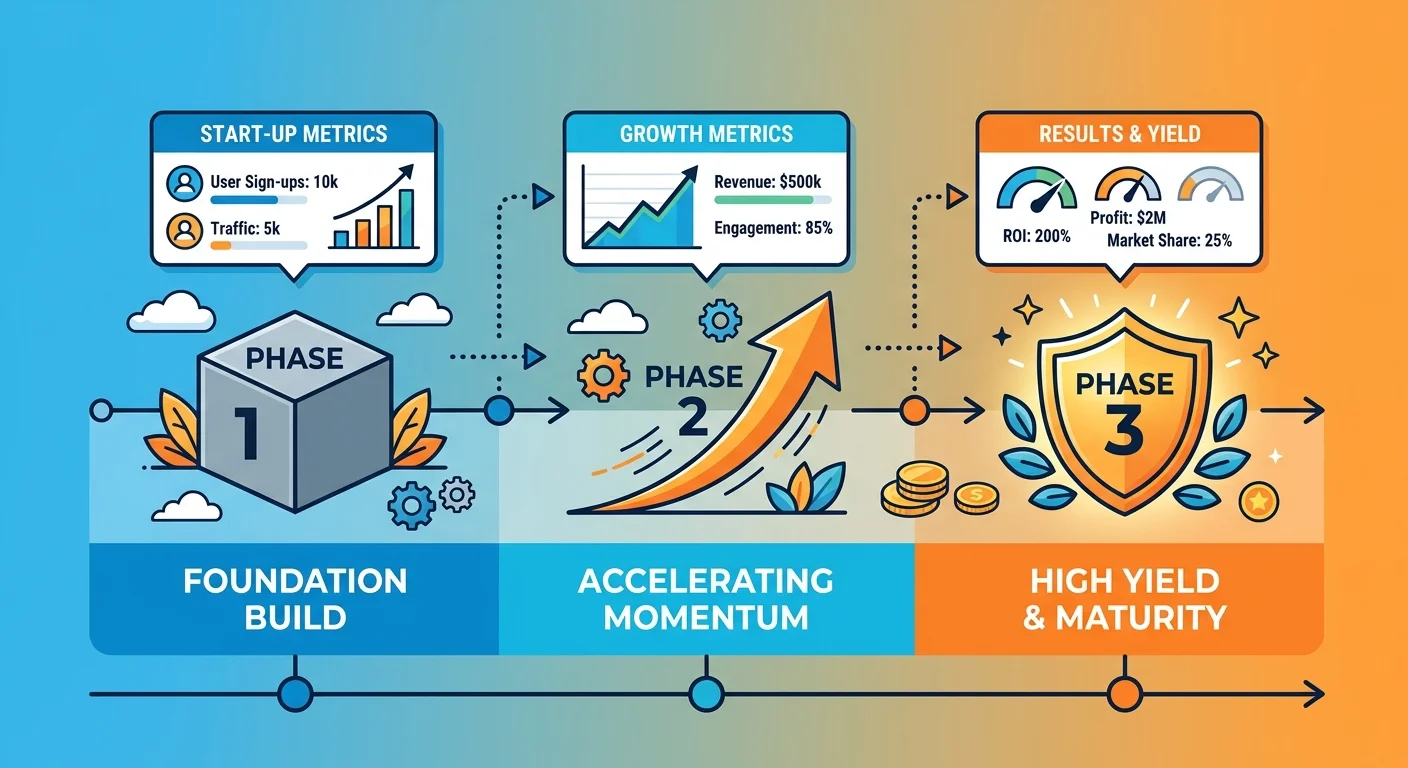
Here's where theory ends and tracking begins.
Over 80% of healthcare consumers start their provider search online. That evaluation is already underway before a patient ever picks up the phone. A practice that can't measure where it stands in that evaluation has no way to move inside it.
Traditional attribution models fail to capture up to 40% of real patient acquisition pathways.
That is not a rounding error. That is nearly half the story your current dashboard is not telling you. The tracking protocol below is built around what that other half actually looks like.
The metrics break into three phases — Foundation, Compounding, Yield — because what matters in month two looks nothing like what matters in month ten.
Trying to measure Yield-level returns during Foundation is exactly how practices lose confidence before the model has had time to work. Match the metric to the phase. That's the only read that means anything. what this model is built on
Phase 1 Metrics: Foundation (Months 1–3)
Foundation metrics aren't performance metrics.
They're structural readiness checks. The question at this stage is whether the infrastructure AI engines need to evaluate your practice is actually in place — entity trust, NAP consistency, schema markup, clinical credentials aligned across every directory and platform AI engines index.
Consistent clinical credentials across reputable online directories can increase consumer trust by up to 70%. That's the Foundation benchmark.
Enter Compounding with fragmented directory data, mismatched schema, or thin structured content, and the signals have nothing solid to stack on. Everything built in Compounding requires Foundation to already be clean.
The readiness check is direct. Ask ChatGPT, Gemini, and Grok who the best provider in your market is. See if your name comes back. That's the AI Visibility Check — and it's the clearest Foundation signal available.
Phase 2 Metrics: Compounding (Months 4–9)
Compounding metrics are about velocity, not structure.
Foundation is done. Now the question is whether the signals built on top of it are growing. Citation velocity is the primary indicator — how often is the practice being referenced across authoritative sources? Is the AEO content library expanding with genuine semantic depth, or is it producing thin content that AI engines evaluate and skip past?
Roughly 90% of prospective patients rely on trust signals and reviews to evaluate a provider before booking. AI engines run that same evaluation — at machine speed.
In Compounding, the tracking question is whether that evaluation is returning a stronger signal this month than it did last. Three checkpoints: AI recommendation frequency across ChatGPT, Gemini, and Grok; volume of authoritative third-party references added; and AEO article coverage of the clinical topic space patients are actively querying.
Directional growth across all three is the health signal. Flat or declining across any one of them is a structural gap — not a patience problem.
Phase 3 Metrics: Yield (Month 10 Onward)
Yield is where the framework pays off.
The practice that built Foundation and executed consistently through Compounding is now earning AI recommendations with enough frequency that the downstream effect shows up in patient bookings from sources no campaign pixel can explain. That's not a tracking failure.
That's earning the verdict.
The healthcare authority case studies show what Yield looks like in practice: patient volume that doesn't drop when ad spend pauses, AI recommendation consistency across platforms, and a competitive position that compounds rather than resets every billing cycle.
The metric that confirms Yield isn't a dashboard number.
Ask the engines who the authority in your market is. If the answer is your practice, the framework worked. If it's a competitor, Compounding is still unfinished — and every month that passes is a month that competitor's position deepens.
| Phase | Phase Name | Primary Metric to Track | What a Positive Signal Looks Like | Red Flag to Watch |
|---|---|---|---|---|
| Phase 1 | Foundation | Entity trust consistency across directories and schema | Practice name, credentials, and NAP data return clean and consistent when queried across ChatGPT, Gemini, and Grok | AI engines return inconsistent or missing information when asked about the practice — or return a competitor instead |
| Phase 1 | Foundation | Structured schema coverage | Schema markup accurately reflects clinical specialties, service areas, and credentials across all indexed surfaces | Schema is absent, incomplete, or mismatched with what directories and content pages describe |
| Phase 2 | Compounding | Citation velocity — rate of authoritative third-party references accumulating | New authoritative references are added each month and AI recommendation frequency increases directionally | Citation volume is flat or declining — AEO content is being published but AI engines are not surfacing it in recommendations |
| Phase 2 | Compounding | AEO content semantic depth across patient-queried clinical topics | Content library covers the full topic space patients query, with each article reinforcing the practice's clinical identity | Content is thin, generic, or duplicates topics already covered — AI engines evaluate and discard rather than cite |
| Phase 3 | Yield | AI recommendation frequency across the three major platforms | Practice is named as the recommended provider when target market queries are run on ChatGPT, Gemini, and Grok | Competitor is named consistently instead — Compounding phase signals are still insufficient to earn the verdict |
| Phase 3 | Yield | Patient booking attribution independent of paid campaigns | Patient volume holds or grows when ad spend pauses — bookings arrive from sources that trace back to AI recommendation rather than a specific campaign | All patient volume collapses when paid campaigns stop — no compounding authority signals are generating organic AI-driven demand |
Frequently Asked Questions
That's usually when the objections arrive.
Good. They should.
These aren't surface-level doubts. These are the questions from practitioners who've already been burned by agencies selling the wrong model. They deserve straight answers — not reassurances.
What is the difference between traditional digital marketing ROI and authority asset ROI in healthcare?
Traditional digital marketing ROI resets to zero the moment the spend stops. Clicks, impressions, cost-per-lead — gone the second the campaign pauses. Authority asset ROI does the opposite.
The infrastructure built in month three still earns returns in month eighteen. Entity trust signals, structured schema, and an AEO content library don't expire. They stack.
But the deeper difference is what gets measured. Traditional attribution tracks campaign performance inside a system built on lists. Authority ROI tracks whether AI engines name your practice as the verdict when a patient asks who to trust in your market.
Generative AI search platforms synthesize user queries to deliver a singular recommended clinical solution — not a ranked list. That makes the return on authority infrastructure binary. Your practice is named, or it isn't. No amount of ad spend changes that evaluation.
How do AI answer engines like ChatGPT and Gemini evaluate a clinic's online authority?
AI answer engines don't crawl your site and hand back a score. They synthesize signals — schema markup, directory consistency, third-party references, AEO content depth — and issue a verdict about which practice they trust enough to name.
Roughly 90% of prospective patients rely on trust signals and online reviews before booking. AI engines run the same evaluation at machine speed, across every indexed source simultaneously.
Consistent clinical credentials across reputable directories can increase consumer trust by up to 70%. That same consistency is what AI engines use to confirm a practice's identity.
Fractured NAP data. Missing schema. Thin content. These aren't minor gaps. They're disqualifying signals in an evaluation that produces exactly one recommended answer. The practice that clears the evaluation gets named. Everyone else isn't on a lower page — they're absent from the conversation entirely.
Why does a template website make a healthcare practice invisible to conversational AI search?
A template website was built for human visitors. Not machine evaluation. And those are two completely different requirements.
It produces no schema markup that confirms clinical identity. No entity signals that tell AI engines what the practice specializes in, where it operates, or why it should be trusted. To a human, it looks like a practice. To an AI engine, it looks like a digital brochure with no verifiable identity behind it.
Generative AI platforms synthesize queries and deliver a singular recommended clinical solution. To earn that recommendation, a practice needs AI-readable infrastructure — structured data, entity-confirmed credentials, and AEO content that answers the questions patients are actually asking.
A template website answers none of those requirements. It doesn't fail the evaluation. It never enters it.
How long does it take to see a compounding return on healthcare authority infrastructure?
There isn't a fixed window. Anyone who gives you one is selling you something.
Foundation takes time to build correctly. Compounding requires consistent execution month over month. Yield is the product of both — and it can't be shortcut by doubling content output or layering a campaign on top of fractured infrastructure.
A practice entering Compounding with a broken Foundation isn't accelerating. It's stacking signals on an unstable base. Returns come when the structure is right and the execution is sustained — not when the spend goes up.
Authority compounds. It doesn't sprint. The practices that reach Yield committed to Foundation before the results were obvious. The ones that waited for proof first gave that ground to whoever kept going.
What are the core metrics used to track entity trust and citation velocity in clinical practices?
Entity trust is the Foundation metric. Track it through directory consistency — clinical credentials, NAP data, and schema markup aligned across every platform AI engines index. Consistent clinical credentials across reputable directories can increase consumer trust by up to 70%. That same consistency is the baseline AI engines check first.
Citation velocity is the Compounding metric. Watch how frequently the practice gets referenced across authoritative third-party sources — and whether that frequency climbs month over month. Flat citation velocity during Compounding means the AEO content isn't producing genuine semantic depth. That's a structural problem, not a patience problem.
AI recommendation frequency is the Yield metric. How often do ChatGPT, Gemini, and Grok name the practice when a patient asks who to trust in its market?
That single signal is the most honest summary of everything else. It reflects the verdict the engines have already reached — and it's the number that actually tells you whether the asset is working.
Can a practice measure authority asset ROI without switching away from its current marketing provider?
Yes. And measuring doesn't require changing anything else first.
Running an AI Visibility Check costs nothing and requires no commitment. It shows exactly what AI engines say about a practice right now — across every platform that matters. That read is available regardless of who the current marketing provider is.
Roughly 90% of prospective patients rely on trust signals and online reviews before booking. AI engines are running that same check on every indexed signal — whether the practice tracks it or not. The evaluation is already happening.
So the real question isn't whether a practice can measure authority asset ROI alongside its current provider. The real question is whether the current provider is building toward a verdict — or optimizing for metrics that vanish the moment the spend pauses.
Two different models. Measuring which one is working is always the right first move.
The Verdict on Authority Asset ROI
Here's the verdict.
Generative AI search platforms synthesize the query and name one practice. Not a list. Not a directory. One answer.
Everyone else is absent from it.
That is not a metaphor. That is the literal mechanics of how patients are now being directed to providers. It is the only reality that matters when you ask what an authority asset is actually worth.
So the ROI question has one honest answer inside that reality.
A practice either built Foundation, executed through Compounding, and earned the Yield — or it did not. There is no partial credit in an AI verdict. The practice that built authority infrastructure is the one the engine names. The one that spent those same months on short-term campaigns is simply not in the evaluation.
iTech Valet was built around one conviction: authority is the asset, and the AI verdict is the return.
The practices that understood this first are compounding every month. The ones still waiting for the shift to become undeniable are ceding ground that gets harder to reclaim with every billing cycle that passes.
The gap between the practice that owns the answer and the one that lost it is not measured in clicks or impressions. It is measured in the name an AI says — and right now, in your market, that name belongs to someone.
The verdict is already being issued. Right now, in your market, AI engines are naming one practice and skipping the rest. Find out if you've earned the verdict — or if a competitor already has.

621 Enterprises, Inc. | Copyright 2026 | All rights reserved