
Beyond AI Citations: 5 Authority Metrics That Predict Practice Growth
AI answer engines don't rank websites. ChatGPT, Gemini, and Grok name trusted entities — and that single distinction is the most important thing a healthcare practice can understand right now.
Traditional search engine volume is predicted to drop 25% by 2026 as patients migrate to conversational AI. The practices that survive that shift won't win because of backlinks or keyword density. They'll win because their digital infrastructure signals trust to machines — not just appeal to humans.
Five specific metrics determine whether AI names your practice or a competitor's.
Entity Trust is the degree to which structured, verifiable signals confirm to AI systems that your practice is real, credible, and authoritative. Citation Velocity is the rate at which your practice is referenced across authoritative sources over time — a signal of growing relevance. Semantic Density is the depth and topical completeness of your content, indicating genuine expertise rather than surface-level familiarity. Zero-Click Search Presence is your visibility inside AI-generated responses, where the recommendation is the destination. Authority Infrastructure is the machine-readable foundation — schema markup, structured data, entity signals — that allows AI systems to parse, trust, and cite you.
These five metrics are not a checklist. They operate as a compounding system. Weakness in one undermines the others.
Up to 90% of U.S. adults are now aware of conversational AI tools, and a substantial share of modern health searches are shifting toward AI-mediated summaries. The scoreboard has changed. Most practices are still looking at the wall where the old one used to hang.
Last Updated: June 17, 2026
- • AI Citations Are Not a Growth Strategy
- • Metric 1: Entity Trust — The Foundation AI Engines Build On
- • Metric 2: Citation Velocity — How Fast Your Authority Compounds
- • Metric 3: Semantic Density — Teaching AI What You Actually Do
- • Metric 4: Zero-Click Search Presence — Winning Before the Click
- • Metric 5: Authority Infrastructure — The Machine That Holds It All Together
-
• Frequently Asked Questions
- • What is the difference between an AI citation and actual practice growth?
- • How does Entity Trust influence local patient acquisition in conversational search?
- • Why does Citation Velocity matter for healthcare practices optimizing for AI engines?
- • Can a high-quality custom website make up for weak machine-readable authority infrastructure?
- • What metrics should a chiropractor track to measure ROI on AEO content investment?
- • The Scoreboard Is Back — If You Know Where to Look
AI Citations Are Not a Growth Strategy
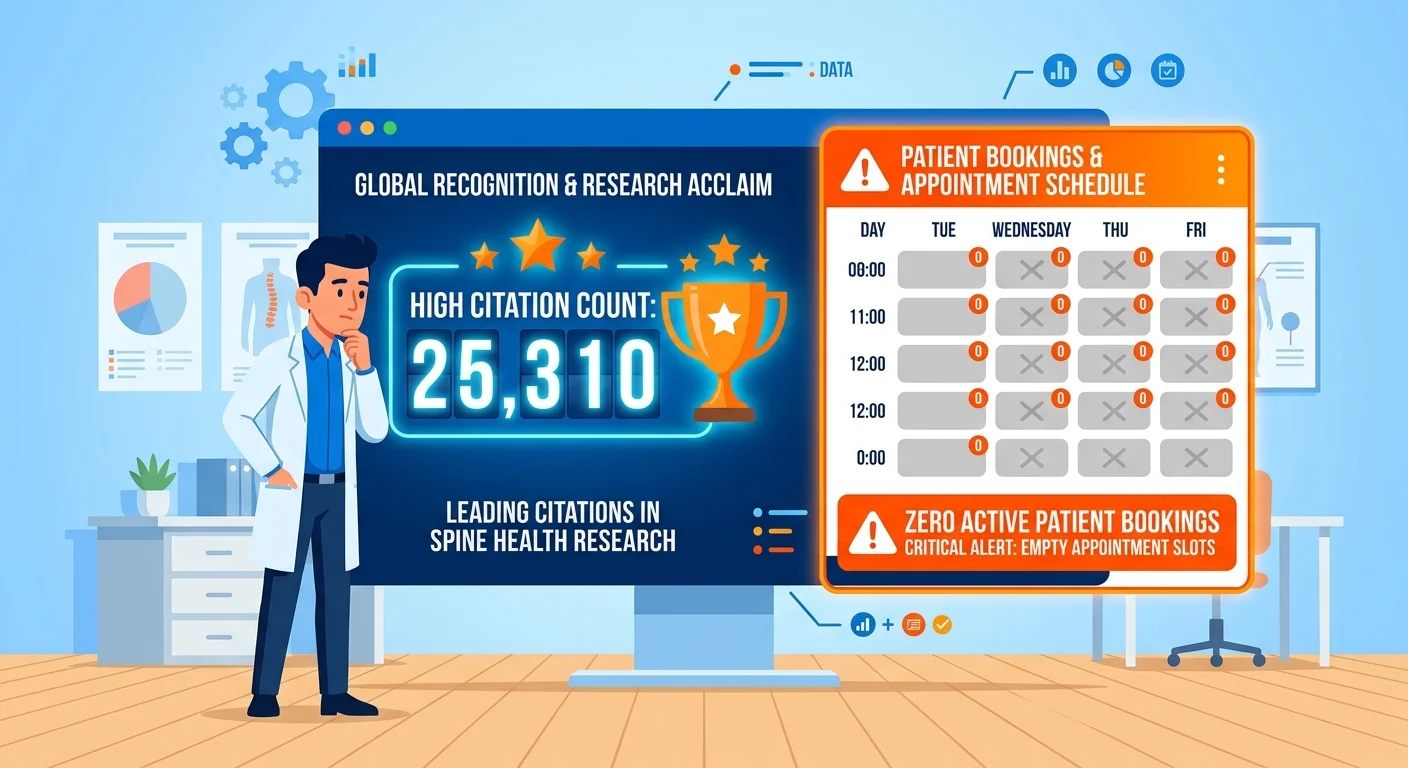
Getting cited by an AI engine feels like progress.
It isn't.
Here's the thing: an AI citation is a symptom of authority, not the source of it.
Chasing citations without building the underlying infrastructure is like watching the scoreboard without ever playing the game. The number moves. Nothing else does. Patients still call the competitor whose name the engine trusts more consistently — in more contexts, across more queries, day after day.
Gartner projects traditional search engine volume drops 25% by 2026. That's not a slow bleed — it's a cliff. And the practices that get pushed off it are the ones that spent those years tracking the wrong numbers.
Entity Trust, Citation Velocity, Semantic Density, Zero-Click Search Presence, and Authority Infrastructure — those are the five inputs that determine who AI recommends. Not citation counts. Not keyword rankings. Those five. the difference between asset investment and retainer dependency
Why Tracking AI Citations Misses the Point
Most practices tracking AI recommendations are measuring the wrong output entirely.
A citation count tells you AI acknowledged your existence. That's it. It doesn't tell you whether that acknowledgment drove a patient decision. It doesn't tell you if it repeated across relevant queries. It doesn't tell you if anything compounded. You got a mention. You have no idea what it means.
Patients are already making referral decisions inside the AI response. Not after clicking through to a website. Not after comparing three options. Inside the answer.
So here's the split that citation counts completely hide: the practice that gets named once in a niche query is not in the same competitive position as the practice that gets named consistently across every 'who do I trust near me' query. Citation count treats them like they're identical. They're not even in the same league.
Here's the broken approach: treating an AI mention as the goal, then stopping there.
Tracking citation counts as a growth metric is like counting how many times someone said your name at a party and calling it relationship-building. The mention happened. The trust was never built. And when a patient asks the engine for a recommendation tomorrow, the engine reaches for whoever it trusts — not whoever showed up most recently.
The Local AI Authority Engine runs on a different premise. Citations aren't the goal. They're what happens when the goal is done right.
Entity Trust, Citation Velocity, Semantic Density, Zero-Click Search Presence, and Authority Infrastructure — those are the inputs. Build all five into the foundation and citations follow. Consistently. In the queries that actually move patients to book.
That's the real scoreboard. And right now, most practices don't know it exists.
| What Practices Track | What It Actually Measures | What AI Engines Actually Use to Decide |
|---|---|---|
| AI citation count | How many times AI acknowledged your existence | Whether your entity signals are strong enough to recommend consistently across query types |
| Keyword rankings | Where your page appears in a traditional search results list | Semantic Density — the topical depth and completeness that signals genuine subject authority |
| Website traffic volume | How many users clicked through to your site from any source | Zero-Click Search Presence — whether your practice is named inside the AI response before a click ever happens |
| Backlink count | How many external pages link to your domain | Citation Velocity — the rate at which authoritative sources reference your practice over time |
| Website design quality | Visual appeal and user experience for human visitors | Authority Infrastructure — the machine-readable schema, structured data, and entity signals that allow AI systems to parse and trust your practice |
| Social media mentions | How often your brand appears in social feeds and conversations | Entity Trust — verified, structured signals across your digital footprint that confirm your practice is a real, credible, authoritative provider |
Metric 1: Entity Trust — The Foundation AI Engines Build On
Entity Trust isn't one of five equal metrics.
It's the foundation.
If AI engines can't confirm your practice is real, credible, and authoritative — through structured, verifiable signals — the other four metrics don't run. You can't build Citation Velocity on a shaky entity. You can't hold Zero-Click Search Presence without it. Entity Trust is where the entire framework starts. And it's where most practices are quietly bleeding out.
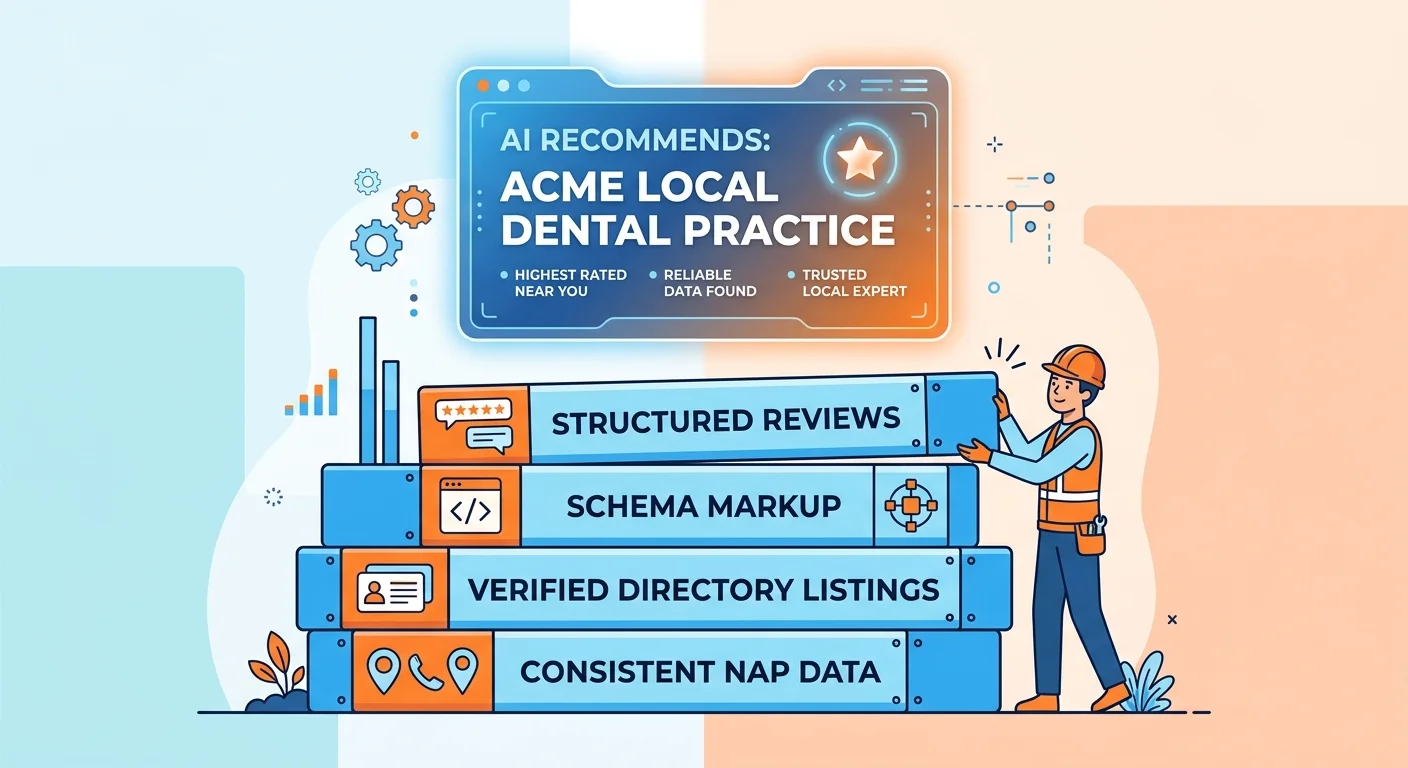
Here's what Entity Trust means in machine terms: it's how completely your digital footprint — NAP consistency, structured schema, verified directory listings, review profiles — confirms to an AI system that you are who you say you are.
And those AI systems are already making clinical-referral decisions for your future patients. They're not reading your homepage copy. They're not impressed by your logo.
The practice with cleaner entity signals gets the recommendation. The one with the prettier website gets nothing.
Structured reviews and verified directory listings aren't busywork. They're the exact data automated platforms parse when deciding who gets cited.
Most practices treat them like a checkbox. AI engines treat them like a credentialing file.
That reframe changes the math on everything. If you want to understand what that trust signal is worth in real growth terms, the numbers are not small.
What Breaks Entity Trust Without You Knowing
Entity Trust doesn't collapse overnight.
It erodes. And that's exactly what makes it dangerous.
The pattern looks like this: a phone number slightly different on Yelp than on Google. An address format that doesn't match between the website and a healthcare directory. A physician's name listed under two different spellings across platforms.
None of it feels serious. Every bit of it reads as unreliable to an AI engine.
Unreliable entities don't get recommended. The cost of waiting to fix these signals is measured in missed recommendations — every single day those discrepancies exist.
Here's what makes this harder than traditional SEO ever was.
Old rankings gave you something to look at — a position, a click count, a report to screenshot and feel good about. Entity Trust gives you nothing visible. The signal either exists or it doesn't. The AI names you or it names someone else. There's no dashboard.
That invisibility is exactly why most practices assume they're in good shape. I've run the AI Visibility Check with practices that were convinced their entity was solid. Most weren't even close.
| Entity Trust Signal | Strong Signal Example | Broken Signal Example | Impact on AI Recommendation |
|---|---|---|---|
| NAP Consistency (Name, Address, Phone) | Identical business name, address, and phone number across every directory, schema markup, and review platform | Phone number formatted differently on Google vs. Yelp vs. website; address abbreviations inconsistent across listings | Inconsistent NAP signals unreliability to AI engines — entities with conflicting contact data are deprioritized in recommendations |
| Structured Schema Markup | LocalBusiness and MedicalBusiness schema fully implemented with accurate specialty, hours, and service area data | No schema markup present, or schema contains outdated information that contradicts live website content | Without machine-readable schema, AI engines cannot parse what the practice is or who it serves — recommendation probability drops significantly |
| Verified Directory Listings | Practice listed accurately on authoritative healthcare and business directories with consistent, verified information | Listings missing from key directories, or present with outdated provider names, wrong specialties, or duplicate entries | Unverified or absent directory presence reduces the volume of corroborating signals AI engines use to confirm entity legitimacy |
| Review Profile Integrity | Active, factual reviews on Google, Healthgrades, and relevant platforms — consistent provider name and practice name across all | Review profiles under slightly different business name variations, or sparse review presence with no recent activity | AI engines parse review platforms as credentialing documents — thin or inconsistent review profiles weaken the trust confirmation signal |
| Provider Name Uniformity | Physician or practitioner name spelled and formatted identically across the website, schema, directories, and social profiles | Two or more spelling variations of the provider's name appearing across platforms (e.g., 'Dr. J. Smith' vs. 'James Smith, DC') | Name inconsistency creates entity ambiguity — AI systems struggle to confirm the provider is a single, verified entity rather than multiple partial matches |
| Website Entity Alignment | Website content directly corroborates every signal in the practice's external digital footprint — same services, same location, same provider details | Website describes services or locations that don't match what directories and schema report — creating a signal conflict AI engines flag as untrustworthy | Misalignment between the website and external entity signals forces AI engines to treat the practice as an unreliable source — reducing recommendation frequency |
Metric 2: Citation Velocity — How Fast Your Authority Compounds
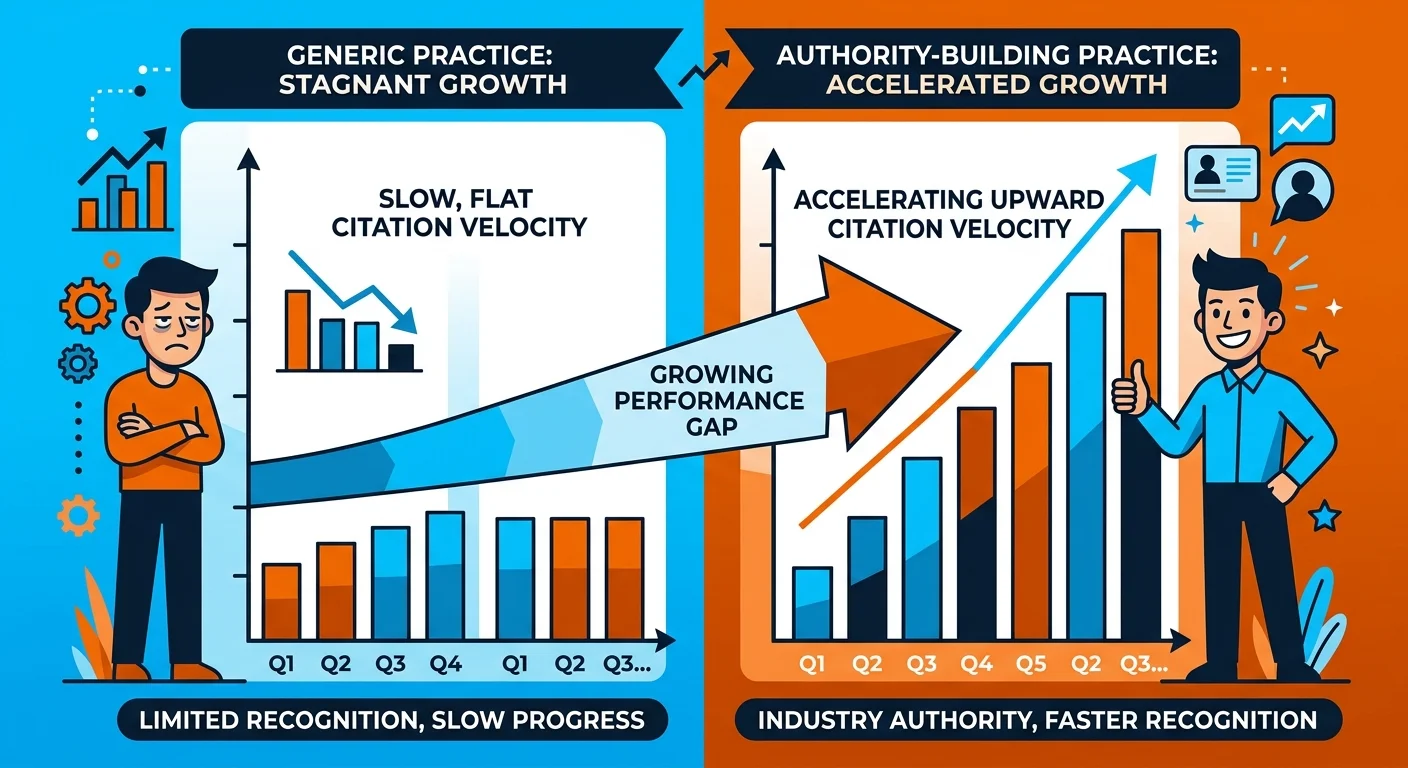
Entity Trust is the foundation. Citation Velocity is what makes it visible.
The rate at which your practice gets referenced across authoritative sources — that's the signal AI engines use to decide if your authority is growing or quietly dying. Not a vanity metric. A verdict.
Traditional search engine volume is predicted to drop 25% by 2026 as queries migrate into conversational interfaces. That migration doesn't reward practices with static authority signals.
A practice cited once in a healthcare directory six months ago looks completely different to an AI engine than a practice being referenced across new credible sources every month. One has velocity. One has a memorial.
Citation Velocity isn't about gaming anything. It's about building something real — consistently enough that AI engines register the momentum.
Here's the math nobody talks about: a 25% drop in traditional search volume means unprepared practices don't just rank lower. They disappear from the conversation entirely. The practices that survive are the ones whose authority signal is still accelerating when the shift becomes undeniable.
Flat velocity isn't neutral. It's a slow bleed — measured in missed recommendations, every month the number sits still.
The Compounding Gap: Why Slow Velocity Lets Competitors Win
Slow Citation Velocity doesn't feel like losing. That's exactly the trap.
A practice can hold steady for months — same directory listings, same review count, same content output — and never notice the competitor two miles away being referenced across new healthcare platforms, earning new structured citations, publishing new AI Authority articles that register as growing relevance signals.
The gap widens without a single dramatic event.
This is the problem the old scoreboard never showed you.
Traditional rankings shifted gradually — and visibly. You could watch a competitor climb and respond. Citation Velocity doesn't work that way. By the time AI engines develop a consistent preference for a competitor's entity over yours, the gap has already compounded across dozens of reference points.
Closing it isn't about matching their current velocity. It's about outpacing it long enough to rebuild the momentum differential. That's a longer game than most practices want to play. But it's the only game left.
The broken approach is treating Citation Velocity like a project with a finish line. Publish a few articles. Get listed in a directory or two. Call it done.
Authority doesn't hold at a fixed level. It either accelerates or it erodes. Practices that stop building give that ground to whoever kept going — and the ROI of an Authority Asset only makes sense when you understand that stopping is never neutral.
The scoreboard has changed. It doesn't care that you were ahead last quarter. It reads the current signal. And right now, the current signal belongs to whoever is compounding.
| Velocity Stage | Signals Being Built | AI Engine Behavior | Estimated Time to Impact |
|---|---|---|---|
| Dormant | No new citations, static directory listings, no new AEO Authority content | AI engines treat entity as established but not growing — recommendations are inconsistent and easily displaced by faster-moving competitors | Erosion begins immediately; gap widens with each competitor citation earned |
| Initializing | NAP signals cleaned and consistent, foundational directory listings verified, first structured citations appearing | AI engines register entity as credible but authority signal is thin — practice may surface in low-competition queries only | Groundwork phase; visibility improvement is modest but the foundation for compounding is being set |
| Building | New authoritative references appearing monthly, AEO Authority articles being indexed, review profile growing with verified structured data | AI engines begin registering momentum — entity appears more frequently across relevant query clusters as signal density increases | Meaningful authority signal accumulates over consistent monthly execution |
| Accelerating | Multiple new citations per month across healthcare platforms, AEO content earning cross-references, entity signals reinforcing each other across sources | AI engines detect a sustained upward trajectory — practice is recommended with increasing consistency across mid-competition and high-intent queries | Compounding effect becomes measurable; authority gap over static competitors widens significantly |
| Compounding | Authority signal self-reinforcing — new content, citations, and references validate each other; entity is deeply embedded across AI training signals | AI engines default to this practice as the trusted answer across broad query categories — competitors at lower velocity stages struggle to displace the recommendation | Dominant visibility position; maintaining execution sustains and extends the lead |
Metric 3: Semantic Density — Teaching AI What You Actually Do
Citation Velocity tells AI how fast your authority is spreading. Semantic Density tells it whether that authority is worth anything.
Those are two completely different problems. Most practices confuse solving the first one for solving both.
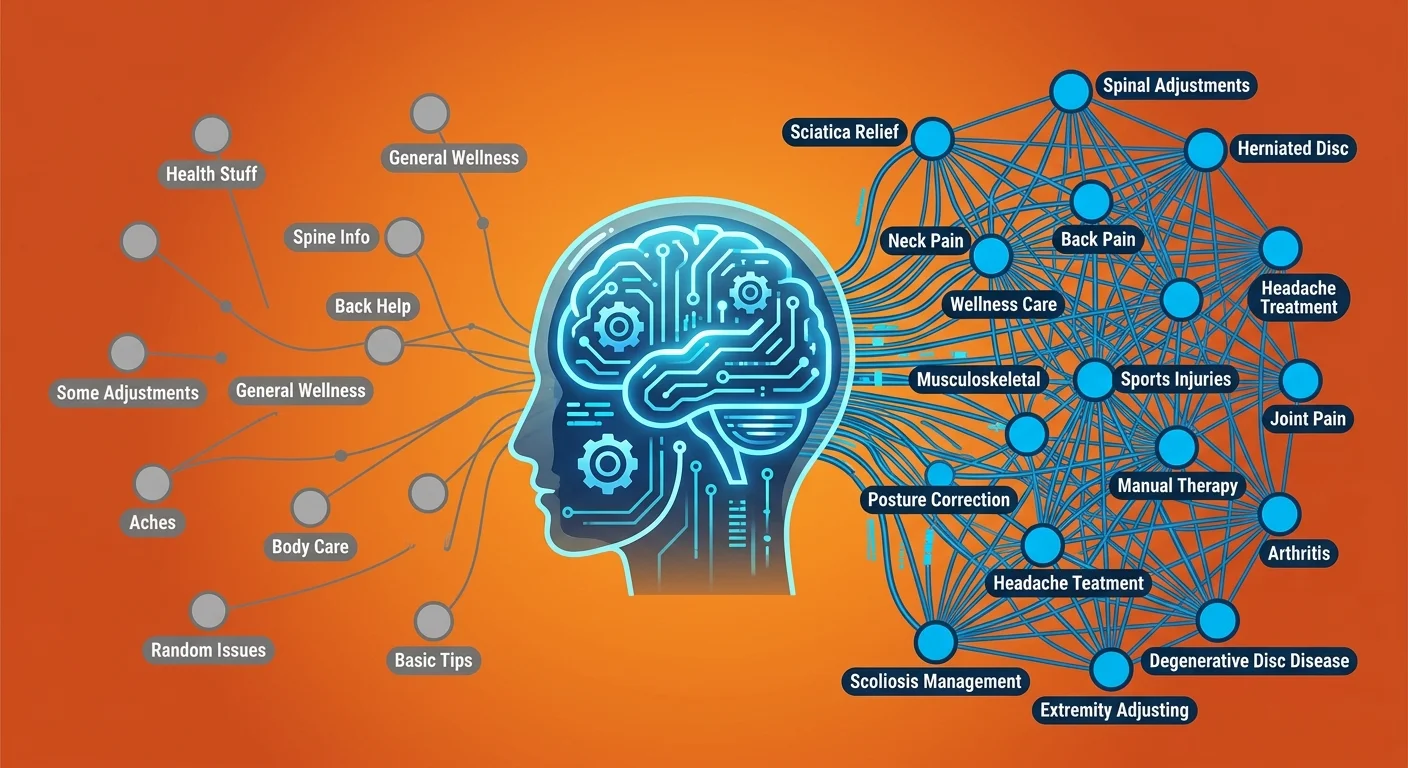
Here's what Semantic Density actually measures: how deeply your digital content teaches AI engines what your practice specifically does, who it specifically serves, and why it's credible in that domain.
A substantial share of modern health searches are already shifting toward AI-mediated summaries — and those engines don't guess at expertise. They read signal density.
If your content speaks in generalities, the engine files you under "chiropractor" and moves on. If your content builds layered, topic-specific depth, the engine starts to understand you as an authority on specific conditions, specific patient populations, and specific outcomes.
That's the shift from being known to being understood. And it's not subtle.
Organizations adopting generative AI reached 55% globally — and those systems aren't skimming for keywords. They're constructing entity models. They're asking: does this practice's content cohere around a specific area of expertise, or does it look like every other generic healthcare website?
The answer determines whose name gets said. How that model gets built
How Generic Content Destroys Semantic Density
Generic content isn't neutral. It's a liability.
It actively destroys Semantic Density. Most practices don't know this is happening — and they won't, until AI stops saying their name.
The broken approach looks like this: five service pages that each say "we treat back pain, neck pain, and headaches" — written for a human reader, structured for no one.
No condition-specific depth. No patient-population specificity. No treatment philosophy that separates this practice from the clinic two miles away with an identical homepage.
To a human visitor, the site looks professional. To an AI engine parsing it for entity modeling, it looks like a placeholder. Healthcare consumers are increasingly relying on AI systems for clinical-referral decisions — and those systems reward the practices whose content teaches them something. Not the ones that state the obvious and stop there.
Here's where it stings most.
Traditional SEO gave you a keyword ranking — something visible, something you could screenshot and call progress. Semantic Density gives you nothing you can see in a dashboard. No score. No confirmation that the engine has built a coherent model of your expertise.
The signal either exists or it doesn't. The engine either understands what you do — deeply, specifically, authoritatively — or it lumps you in with every other generalist and names whoever has the clearest signal.
One article about lower back pain doesn't build Semantic Density. What builds it is a structured body of AI Authority content that maps your expertise across conditions, patient types, and treatment approaches — published consistently, built on verified entity signals. That's the difference between a practice AI understands and one it ignores.
| Content Type | Semantic Density Score | What AI Engines Infer | Recommendation Likelihood |
|---|---|---|---|
| Generic service page ('We treat back pain, neck pain, and headaches') | Very Low | Undifferentiated generalist — interchangeable with hundreds of similar practices | Near zero — engine defaults to the entity with the clearest, deepest signal |
| Condition-specific page with treatment philosophy and patient context | Moderate | Practice has defined expertise in a specific condition category | Improved — engine begins building a domain-specific model of the practice |
| AEO Authority article targeting a patient symptom with layered clinical depth | High | Practice understands patient language, intent, and the path from symptom to care | Strong — engine associates practice with specific patient decision-making journeys |
| Structured content cluster mapping expertise across multiple related conditions | Very High | Practice is a coherent, authoritative entity within a defined specialty domain | Dominant — engine consistently names practice when queries align with its mapped expertise |
| Schema-backed entity profile with verified credentials, services, and patient population signals | Maximum | Practice's digital footprint coheres into a trusted, machine-readable authority model | Highest — engine treats practice as a primary reference for its defined area of focus |
Metric 4: Zero-Click Search Presence — Winning Before the Click
Semantic Density teaches AI what you know. Zero-Click Search Presence is where that knowledge cashes out.
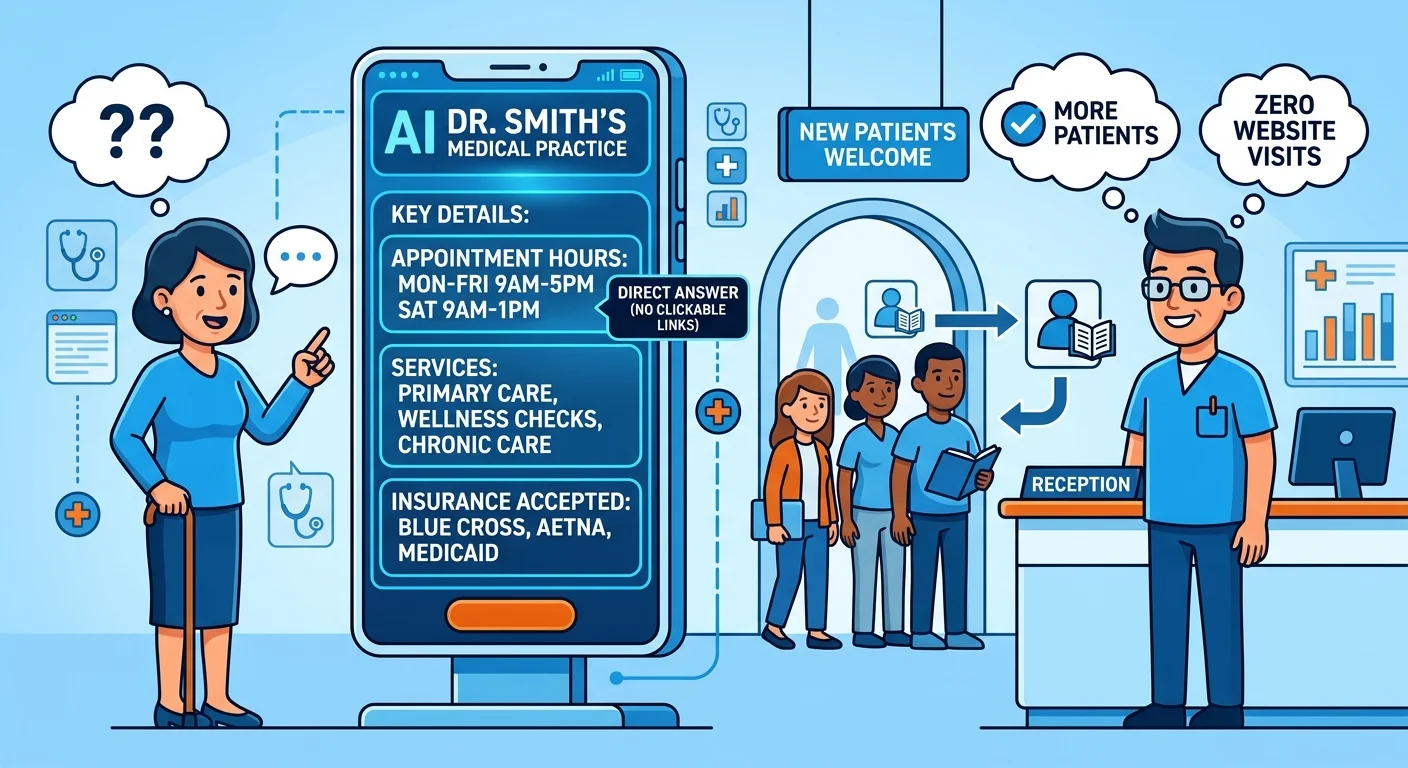
Your practice named in the answer. Before anyone clicks. Before anyone visits your website. Before any conversion path exists at all.
Here's the shift most practices miss. Traditional search was a referral to a list. Conversational AI is a verdict.
When a patient asks ChatGPT who the best chiropractor for lower back pain is in their area, the engine doesn't serve ten blue links and step aside. It names someone. That someone either gets the patient's next thought — or doesn't.
Traditional search engine volume is predicted to drop 25% by 2026 as that migration accelerates into conversational interfaces. The practices showing up in those AI-generated answers aren't winning because they ranked. They're winning because the engine already built a model of their authority deep enough to state it as a recommendation.
Up to 90% of U.S. adults are now aware of basic conversational AI tools. That's not a future trend.
That's your current patient base — already asking AI engines who to trust, already receiving answers, already making decisions before your website ever loads.
Zero-Click Search Presence determines whether your name is the answer those patients hear. And it compounds. The more consistently the engine names your entity, the more reinforced your authority model becomes — and the harder you become to displace.
Why a Beautiful Website Can't Save a Zero-Click Gap
Here's the part that breaks practitioners who've poured money into their website.
A beautiful custom site — fast, professionally designed, full of compelling visuals — cannot compensate for a weak machine-readable footprint. AI engines don't browse. They parse. They extract structured signals from schema, from directory data, from AI Authority content, from entity relationships.
If those signals are sparse or inconsistent, the engine has no model to work from. And an engine with no model names someone else.
But most practices are still pouring money into the wrong thing.
Better photography. A faster load time. A homepage video. All of it invisible to the engine making the recommendation.
That's an aesthetics-first strategy in a machine-first environment. And the proof of how badly it fails shows up in Zero-Click. Traditional SEO gave you a ranking report — something to point to, something to optimize against. Zero-Click gives you nothing. Either the engine names you or it doesn't. No dashboard softens that gap.
What closes the gap isn't a redesign.
It's verified entity signals. Consistent Citation Velocity. Semantic Density built through AI Authority content. Technical Authority Infrastructure that makes all of it machine-readable. Not one of those in isolation — all of them working together.
When that stack is in place, Zero-Click Search Presence isn't luck. It's the predictable output of a practice that stopped optimizing for browsers and started building for the engines that make recommendations. At iTech Valet, we call this the moment a digital brochure becomes an authority asset — and it's the only moment that actually changes the answer a patient hears.
| Scenario | Traditional SEO Outcome | Zero-Click Authority Outcome |
|---|---|---|
| Patient asks AI who treats lower back pain nearby | Engine returns a list of links; patient clicks through multiple sites to evaluate options | Engine names the practice directly in the answer; patient decision begins before any website loads |
| Practice invests heavily in website design and UX | Site ranks for target keywords; click-through depends on position and competition | Machine-readable signals are sparse; engine has no authority model to cite — a competitor with structured infrastructure gets named instead |
| Practice publishes general service pages covering common conditions | Pages index for broad terms; rankings fluctuate with algorithm changes | Generic content builds no Semantic Density; engine cannot distinguish the practice from dozens of identical local competitors |
| Competitor increases Citation Velocity across structured platforms | Competitor gains backlink equity; traditional rank may shift over weeks or months | Engine reinforces competitor's authority model in real time; practice loses named-answer position without any visible ranking signal |
| Practice measures performance through clicks, impressions, and rank reports | Metrics confirm content is findable; conversion depends on the patient choosing to click | Zero-Click presence leaves no dashboard trail — either the engine names the practice in a conversational answer, or it doesn't |
Metric 5: Authority Infrastructure — The Machine That Holds It All Together
Here's the thing about the first four metrics.
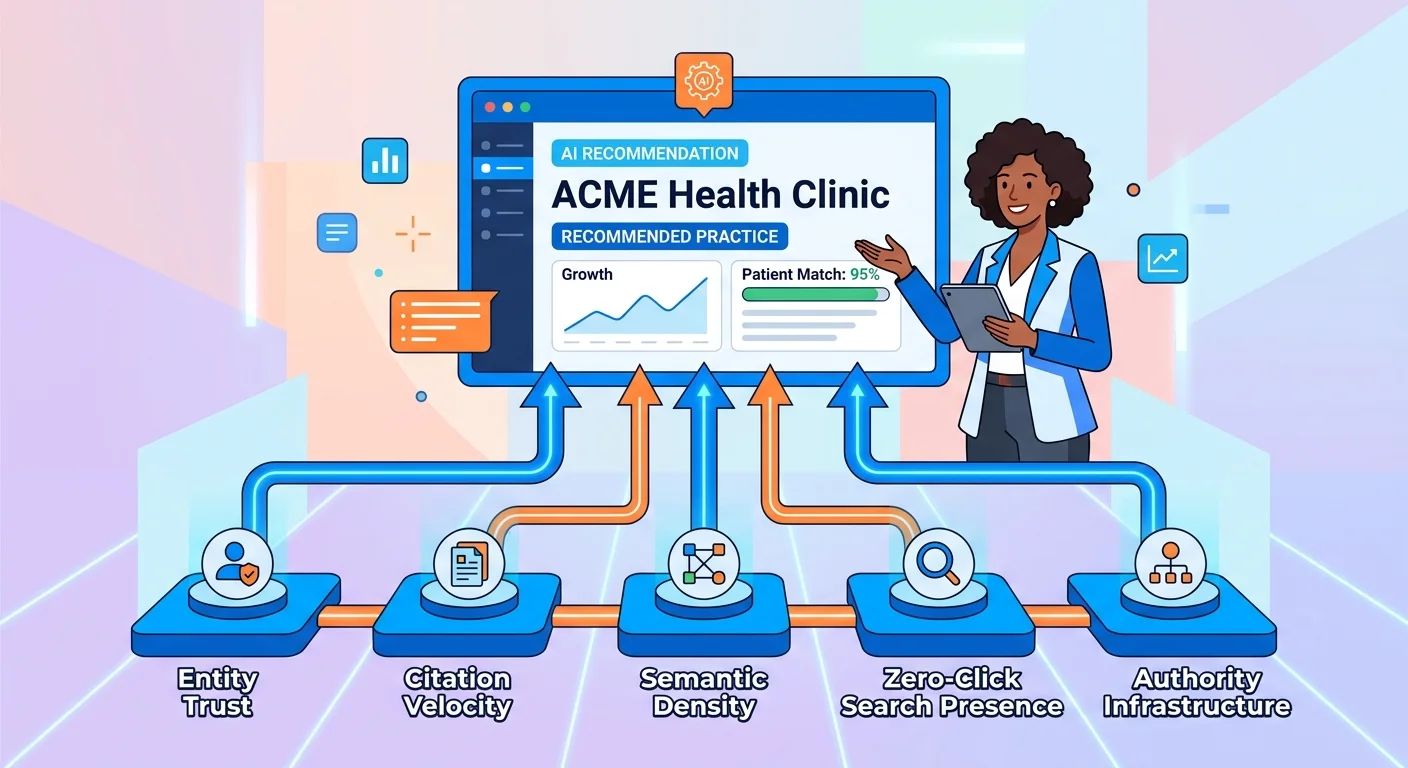
Entity Trust, Citation Velocity, Semantic Density, Zero-Click Search Presence — none of them generate themselves. They're outputs. Authority Infrastructure is the machine that produces them. And without it, the other four metrics don't move.
Authority Infrastructure is the complete machine-readable architecture underneath your practice's digital footprint.
Schema markup that tells AI engines exactly who you are and what you treat. Verified directory listings that build consistent entity signals across every platform that matters. Structured AEO Authority content organized around specific conditions, patient populations, and treatment expertise. Technical site architecture built for parsing — not just browsing.
With 55% of organizations globally already adopting generative AI, the engines reading your infrastructure aren't experimental. They're operational. They're making recommendations right now — based on whatever signals your current infrastructure is, or isn't, sending.
The mistake most practices make? They build it once and walk away.
A 25% drop in traditional search volume by 2026 doesn't pause while your infrastructure ages. The engine keeps reading. Competitors keep compounding.
Authority Infrastructure isn't a setup task. It's a living system that either accelerates or decays. The scoreboard reads your current signal — not last year's.
Who This Framework Is Not For
This framework isn't for everyone.
Not a polite disclaimer. A qualification gate.
If you want to flood your schedule in the next 90 days, this isn't it. Authority Infrastructure compounds — it doesn't spike.
If you need a guarantee that a specific number of patients will book by a specific date, we're not your fit. If you're comparing this to a low-cost monthly retainer that promises rankings and calls impressions a win, the math won't work for you.
The Budget-First Buyer, the Guarantee Demander, the 90-Day Miracle Seeker — this framework wasn't built for them.
But if you're tired of watching AI engines name a competitor when patients ask who to trust — if you've paid agencies that delivered dashboards instead of growth — if you're done buying expenses that disappear the moment payments stop — you already know what these five metrics are pointing at.
The question is whether you're ready to build the infrastructure that makes them move.
Reading the New Scoreboard: What These Metrics Look Like in Practice
So what does it look like when all five metrics are actually working?
Entity Trust is stable — your practice is recognized consistently and correctly across every platform AI engines consult. Citation Velocity is positive — new structured references are appearing at a rate that signals active, growing authority. Semantic Density is deep — your content teaches AI engines what you treat specifically, not just that you treat it. Zero-Click Search Presence is active — your name is appearing in conversational AI answers before a patient ever visits your website.
And Authority Infrastructure holds all of it. The schema, the verified listings, the structured content architecture — the technical foundation that makes every other signal machine-readable.
That's the new scoreboard.
Not page-one rankings. Not click-through rates. Not monthly impressions in a PDF nobody reads.
Five metrics that determine whether AI engines recommend you — or your competitor — every time a patient asks.
The scoreboard metaphor wasn't decorative.
Traditional SEO gave practices a number to watch. You could see yourself moving. You could see a competitor climbing and respond. That feedback loop is gone.
These five metrics don't live in a dashboard you can pull on a Tuesday morning. They live in the inference layer of AI engines already making recommendations — right now, in your market — based on signals most practices have never intentionally built. An AI Visibility Check is the fastest way to see exactly what those engines are saying about your practice today.
The practices that will own AI recommendations six months from now are building Authority Infrastructure today.
Not because they saw the shift coming with perfect clarity. Because they understood the scoreboard changed — and refused to keep playing by the old rules.
iTech Valet was built to engineer exactly that outcome. A silent digital brochure becomes the single trusted answer AI recommends. The infrastructure is the investment. The recommendation is the return.
| Authority Metric | Healthy Signal | Broken Signal | What to Fix First |
|---|---|---|---|
| Entity Trust | Practice name, specialty, and location are recognized consistently across every platform AI engines consult — schema, directories, and AEO content all agree | Inconsistent NAP data, missing schema, or conflicting entity signals cause AI engines to deprioritize or misrepresent the practice | Audit and standardize all directory listings; implement complete schema markup with verified entity data |
| Citation Velocity | New structured references are appearing across authoritative platforms at a steady, compounding rate — signaling an active, growing practice | Citation count is static or declining; no new structured references are being created; authority model stagnates | Establish a consistent publishing cadence for AEO Authority content and structured directory submissions to generate ongoing citation signals |
| Semantic Density | Content architecture teaches AI engines the specific conditions treated, patient populations served, and clinical expertise that differentiates the practice | Generic, thin content gives AI engines nothing condition-specific to extract — practice blends into a crowded category with no differentiation | Build AEO Authority content organized around specific conditions and treatment expertise rather than broad, undifferentiated topic pages |
| Zero-Click Search Presence | Practice name appears in conversational AI answers before a patient ever visits the website — entity is recommendation-ready across ChatGPT, Gemini, and Grok | Engine has no authority model strong enough to state a recommendation; a competitor's name fills the answer instead | Strengthen Entity Trust, Citation Velocity, and Semantic Density in parallel — Zero-Click Presence is the output of those three signals working together |
| Authority Infrastructure | Schema, verified listings, structured AEO content, and technical site architecture operate as a unified, machine-readable system that compounds over time | Infrastructure was built once and left — schema outdated, directory listings unverified, content architecture unmaintained; the system decays while competitors compound | Treat Authority Infrastructure as a living system requiring ongoing execution, not a one-time setup; conduct regular audits across schema, listings, and content structure |
Frequently Asked Questions
Good questions live here. That means you're actually paying attention.
Entity Trust, Citation Velocity, Semantic Density, Zero-Click Search Presence, Authority Infrastructure — five concepts that hit practitioners differently. Here's where the sharpest objections tend to land.
What is the difference between an AI citation and actual practice growth?
An AI citation means the engine noticed you exist. That's the whole prize — if you stop thinking there.
It doesn't book appointments. It doesn't mean the engine trusts you reliably. It doesn't mean patients are choosing you over the competitor named in the very next query.
Growth happens when Entity Trust is stable and Semantic Density is deep enough that AI engines name you consistently — across platforms, across query types, across time. A health search shifting toward AI-mediated summaries means a citation is the opening signal, not the finish line.
Building infrastructure that makes citations consistent — that's growth. Tracking the citation count and calling it done is the mistake.
How does Entity Trust influence local patient acquisition in conversational search?
Entity Trust determines whether AI engines say your name. Without it, you're not losing ground to a competitor — you simply don't appear in the answer.
Verified directory listings and structured review data aren't reputation tools. They're credentialing documents. Factual, undeceptive reviews serve as critical trust data parsed by automated platforms — which means the FTC's guidance on consumer review integrity isn't just about marketing. It's about machine-readable authority signals.
When those signals are consistent across every platform AI engines consult, local patient acquisition stops depending on link clicks. It starts depending on whether the engine names you when a patient asks who to trust nearby.
One signal out of sync — a phone number that doesn't match, an address format that drifts — and the engine classifies you as unreliable. Consistency isn't a nice-to-have. It's the whole game.
Why does Citation Velocity matter for healthcare practices optimizing for AI engines?
Citation Velocity measures whether your authority is expanding or stagnating. AI engines prioritize entities with active, growing signals — not ones that built something once and stopped.
Traditional search engine volume is predicted to drop 25% by 2026 as patients move into conversational interfaces. That window — between now and when your market's AI recommendation layer hardens — is the one that actually matters.
A practice publishing AEO Authority content, earning new structured references, and expanding its verified directory presence is compounding month over month.
A practice that stopped building three months ago is losing ground — quietly, invisibly — to whoever didn't.
Can a high-quality custom website make up for weak machine-readable authority infrastructure?
No. And this is probably the most expensive misconception in practice marketing right now.
A custom website — even a great one — is not a machine-readable footprint. AI engines don't browse design. They parse schema markup, structured data, entity signals, and AEO Authority content.
Traditional search engine volume is predicted to drop 25% by 2026. The patients who used to find you through Google are already asking an AI engine instead. That engine doesn't see your site's aesthetics. It reads your infrastructure.
A beautiful website sitting on weak Authority Infrastructure is a digital brochure in a machine-first environment — not an authority asset. The investment went into the wrong layer entirely.
What metrics should a chiropractor track to measure ROI on AEO content investment?
Track the five metrics. Not impressions. Not click-through rates. Not a PDF summary delivered at month's end.
Here's what the scoreboard actually looks like:
* Entity Trust — Are your signals consistent and verified across every directory AI engines reference? * Citation Velocity — Is the volume of structured references to your practice growing month over month? * Semantic Density — Is your content expanding the specific clinical territory AI engines associate with your practice? * Zero-Click Search Presence — Is your name appearing in conversational AI answers before a patient visits any website? * Authority Infrastructure — Is the machine-readable foundation — schema, verified listings, structured content architecture — intact and actively maintained?
Factual, verified signals parsed by automated platforms determine the return. Those five metrics are the real ROI dashboard.
Anything else is measuring a scoreboard that no longer runs the game.
The Scoreboard Is Back — If You Know Where to Look
The scoreboard didn't disappear. It moved.
Traditional SEO gave you a number to check on a Tuesday morning — a rank, a position, a report that told you exactly where you stood. That feedback loop is gone now. What replaced it are five metrics — Entity Trust, Citation Velocity, Semantic Density, Zero-Click Search Presence, and Authority Infrastructure — running inside the inference layer of AI engines that are already making recommendations in your market. Right now. Today.
Most practices are still running plays for a game that ended.
Here's what the framework actually delivers: the scoreboard is back — but you have to know where to look.
A practice with strong Entity Trust, positive Citation Velocity, deep Semantic Density, active Zero-Click Search Presence, and machine-readable Authority Infrastructure holding it all together isn't guessing at whether AI recommends them. It's building the conditions that make the recommendation predictable. The Case Studies bear this out — practices that moved on these five metrics stopped being invisible and started being named.
That's the difference between a digital brochure that sits there and an authority asset that compounds.
Not reading this scoreboard isn't a neutral position.
It's a choice — made by default, usually unintentionally — to let a competitor take the spot AI reserves for the practice it trusts most. The practices owning recommendations in your market are building this infrastructure right now. Every month is a month of compounding they have and you don't.
The gap between the practice AI names and the practice AI ignores doesn't close on its own — it widens, quietly, until the distance is the whole game.
Your competitors are being named right now. Run the AI Visibility Check and see exactly what ChatGPT, Gemini, and Grok say about your practice — in your market, today.
621 Enterprises, Inc. | Copyright 2026 | All rights reserved