
How to Build AI Authority Without Selling: A Compliance-Safe Guide for Practitioners
Building AI authority without selling means structuring a practice's digital presence so that AI engines — ChatGPT, Gemini, Grok — can extract, verify, and cross-reference its credentials independently, without relying on promotional claims, paid placements, or persuasive ad copy.
AI answer engines do not rank websites. They render verdicts. When a patient asks which practitioner to trust, the engine has already processed structured data, citation patterns, and third-party verification signals across dozens of sources before returning a single recommended name. Promotional language does not influence that process. Verified, machine-readable entity data does.
72 percent of internet users seek health information online, which makes digital authority a baseline operational necessity for any clinical practitioner. But the discovery channel is shifting. Gartner projects a 25 percent drop in traditional search engine volume by 2026, driven by consumers moving to conversational AI interfaces. Practices optimized only for keyword rankings are being systematically excluded from the new discovery layer.
The Federal Trade Commission requires that health and safety claims be supported by competent and reliable scientific evidence. That makes hype-based advertising not only ineffective but legally risky. AI authority building sidesteps that exposure entirely — it relies on objective, structured data rather than subjective promotional assertions.
Consumer trust in outbound advertising has declined steadily, and AI engines reflect that shift. They are built to surface neutral, credible, externally validated information — not marketing copy. Patient trust online correlates directly with explicit credentialing and objective verification signals, not self-promotional content.
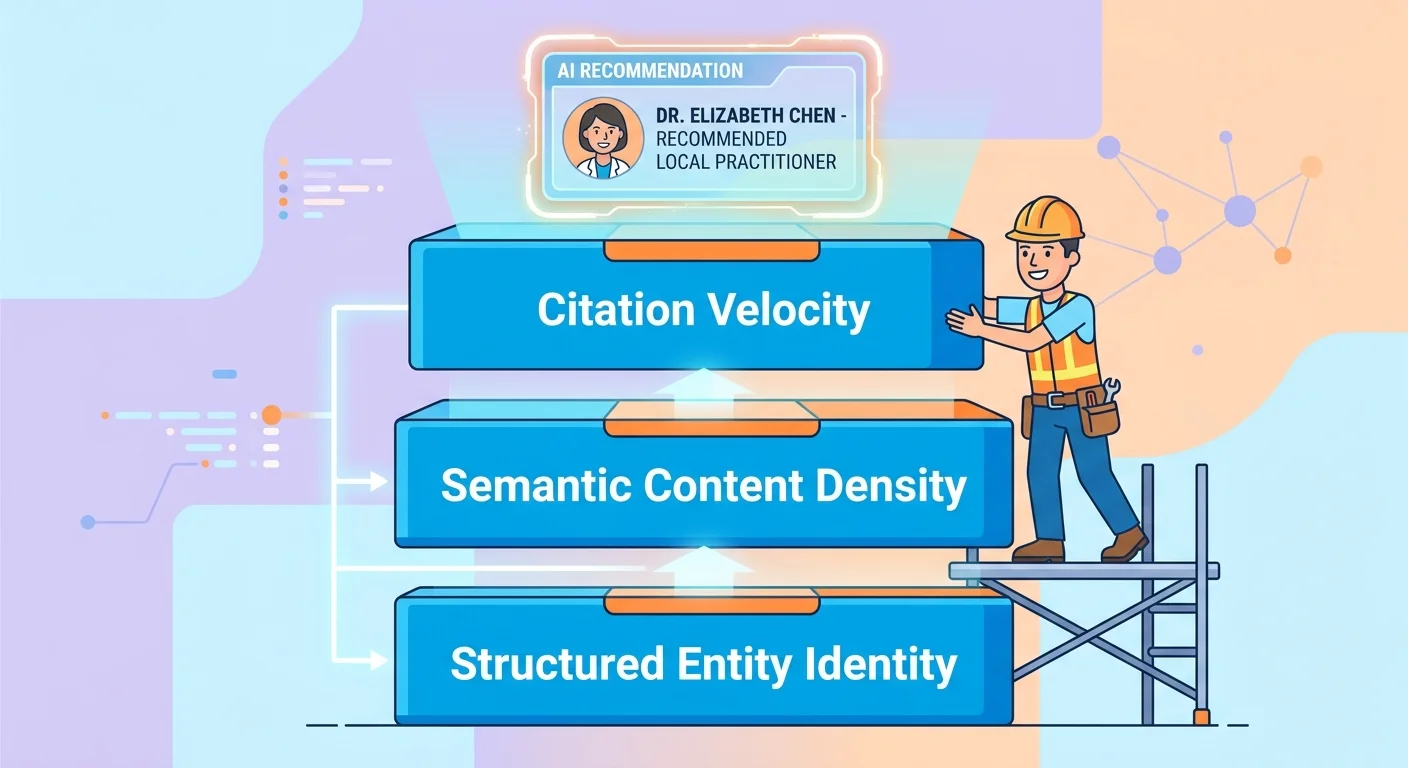
AI authority is built through three sequential layers: Structured Entity Identity establishes who the practitioner is in machine-readable terms. Semantic Content Density ensures the practice's content answers the exact questions AI engines retrieve on behalf of patients. Citation Velocity builds the cross-referenced verification trail AI engines use to confirm credibility. Each layer compounds. None of them require a sales pitch.
Last Updated: June 17, 2026
- • Why Selling to AI Engines Backfires — and What the FTC Has to Do With It
- • The Entity Trust Infrastructure Every Practitioner Needs
- • What Compliance-Safe AI Authority Actually Looks Like in Practice
- • The Anti-Persona: Who This Guide Is Not For
-
• Frequently Asked Questions
- • How does conversational AI choose which local practitioners to recommend in my market?
- • Why does traditional search engine optimization fail to secure listings in ChatGPT or Gemini?
- • How does building structured Entity Trust keep a practice compliant with strict advertising guidelines?
- • Will building AI authority take longer to generate patient leads than running paid ads?
- • What specific technical infrastructure changes are required to make a practice website AI-readable?
- • Can a practitioner build AI authority without hiring an agency to do it for them?
- • The Verdict Is Already Being Rendered
Why Selling to AI Engines Backfires — and What the FTC Has to Do With It

AI engines don't read sales pitches. They render verdicts.
And you can't sell a verdict.
When a practice website is packed with "Top-rated," "Best in the area," "Trusted by thousands" — that copy was written for a human audience AI has already replaced.
The engine processing that page isn't persuaded by superlatives. It's cross-referencing structured data, third-party citations, and entity signals.
Promotional language registers as noise. Noise doesn't get recommended.
According to this source, here's where it gets worse. The FTC requires that any health or safety claim be backed by competent and reliable scientific evidence — and active enforcement means the exposure is real, not theoretical.
Hype-based ads don't clear that bar.
Authority building isn't just the smarter strategy. For practitioners making clinical claims online, it's the compliant one.
Why Promotional Marketing Fails the AI Jury Test
Think about how a jury actually works.
You don't walk in and sell them. You present evidence — credible, documented, independently verifiable. The jury weighs it and renders a verdict.
AI engines work exactly the same way. That one reframe changes everything about how a practice should build its digital presence.
Here's the thing — consumer trust in outbound ads has been declining for years. Harvard Business Review tracked this shift directly: patients aren't clicking banner ads to decide who to trust with their spine.
They're asking AI.
And when they do, the engine surfaces neutral, externally validated information — not a practice's own promotional copy. The practitioner who built the better ad loses to the practitioner who built the better entity record. Every time.
Most practitioners don't know this distinction exists until they run a check.
Then they see a competitor's name where theirs should be. That moment is clarifying. It's also avoidable.
The AI Authority System was built specifically around that insight — authority is earned through machine-readable infrastructure, not marketing volume.
Stacking promotional tactics on top of a weak entity foundation is like shouting in a library. The institution doesn't move for volume.
Ad spend evaporates the moment it stops. Entity Trust compounds the moment it starts.
That math only goes one direction. See how authority investment compounds.
| Marketing Signal Type | How AI Engines Interpret It | Compliance Risk Level | Impact on AI Recommendation |
|---|---|---|---|
| Promotional superlatives ("Best in the area," "Top-rated," "Trusted by thousands") | Registers as unstructured noise — no entity signal, no cross-referenceable data point | High — subjective claims without substantiation violate FTC competent and reliable evidence standards | Negative — promotional language is filtered out; entity record remains thin and unverifiable |
| Paid ad copy (PPC headlines, display banners, boosted social posts) | Invisible — AI engines do not crawl paid placements or factor ad spend into entity verification | High — health and safety claims in ad copy trigger active FTC enforcement scrutiny | Zero — ad-driven visibility disappears the moment spend stops; no authority compounds |
| Unstructured website copy (keyword-dense paragraphs, no schema markup) | Partially readable at best — engines extract fragments but cannot confirm identity or credentials | Moderate — vague clinical language without substantiation creates latent compliance exposure | Weak — practice may appear in older search results but is excluded from AI recommendation layers |
| Structured Entity Identity (schema markup, consistent NAP, verified credentials) | Fully machine-readable — engines extract, cross-reference, and confirm practitioner identity across sources | Low — structured factual data contains no subjective health claims requiring FTC substantiation | Strong — verified entity records are the foundation AI engines use to render practitioner recommendations |
| Third-party citations and directory listings (objective, externally validated signals) | High-value verification anchors — engines treat external citations as independent corroboration of entity claims | Minimal — neutral directory data carries no promotional assertions and requires no substantiation | Compounding — each new citation adds to the verification trail AI engines weigh when selecting a recommended name |
| Semantic Content Density (AEO-optimized articles answering patient questions) | Directly retrievable — engines pull structured Q&A content to satisfy conversational queries in real time | Low — factual, educational content aligned with evidence standards presents no compliance exposure | Accelerating — content depth signals topical authority and increases the probability of being the named answer |
The Entity Trust Infrastructure Every Practitioner Needs
AI engines aren't reading your digital presence. They're running a verification process against it.
They extract and cross-reference clinical entity data across multiple channels simultaneously. If your infrastructure isn't structured for that extraction, the engine moves to the next practitioner who is.
That's not a ranking penalty. That's an invisibility verdict.
Patient trust signals online depend on explicit credentialing and objective verification — not on how confidently a practice describes itself.
The practitioner with the cleaner entity record wins.
The one with the better ad copy doesn't.
So the question isn't how to market better. It's how to become the practitioner AI engines trust by default.
Great clinical outcomes don't get recommended. The infrastructure carrying those outcomes determines whether the engine sees them at all.
That's the gap most practitioners never close — and it's exactly why clinical results are no longer enough for AI visibility.
The Three Infrastructure Layers AI Uses as Evidence
Back to the jury analogy.
Evidence wins verdicts. Not charisma. Not volume. Not ad spend.
AI engines process the digital equivalent of a case file. That file is built from three infrastructure layers — each one a category of evidence, each one machine-readable, none of them requiring a sales pitch.
Layer 1 — Structured Entity Identity establishes who the practitioner is in terms AI engines can parse without interpretation.
Name, credentials, specialization, location signals, schema markup — these aren't cosmetic details. They're the foundational claims the engine cross-references against third-party sources.
If the entity data is inconsistent, incomplete, or missing, the engine can't confirm the record. A practitioner it can't confirm doesn't get recommended.
Layer 2 — Semantic Content Density ensures the practice's content answers the exact questions AI engines retrieve on behalf of patients.
This isn't keyword stuffing. It's structured, factually grounded content that maps directly to patient intent — content an AI engine recognizes as authoritative because it mirrors the way verified, credentialed sources speak.
Layer 3 — Citation Velocity is the cross-referenced verification trail: mentions, links, and structured citations from third-party sources that confirm the entity record is real.
Together, these three layers don't just improve visibility. They build the evidentiary record AI engines use to render a verdict in your favor.
| Infrastructure Layer | What It Contains | What AI Engines Extract From It | Consequence If Missing |
|---|---|---|---|
| Structured Entity Identity | Practitioner name, credentials, specialization, business address, schema markup, NAP consistency across directories | The foundational identity record the engine cross-references against third-party sources to confirm the practitioner exists and is who they claim to be | The engine cannot confirm the entity record. An unconfirmed entity doesn't get recommended — it gets skipped entirely. |
| Semantic Content Density | Structured, intent-mapped content that answers the exact questions patients ask AI engines — written in the factual register of credentialed sources | Topical authority signals, question-answer alignment, and content patterns that match how verified clinical sources communicate | The engine finds no trustworthy content to surface. A practitioner with thin or promotional content reads as an authority gap, not an authority signal. |
| Citation Velocity | Third-party mentions, structured citations, directory listings, and inbound links from sources the engine already recognizes as credible | The cross-referenced verification trail that confirms the entity record is externally validated — not just self-reported | The entity record is self-contained and unverified. Without external confirmation, the engine has no corroborating evidence to anchor a recommendation. |
What Compliance-Safe AI Authority Actually Looks Like in Practice
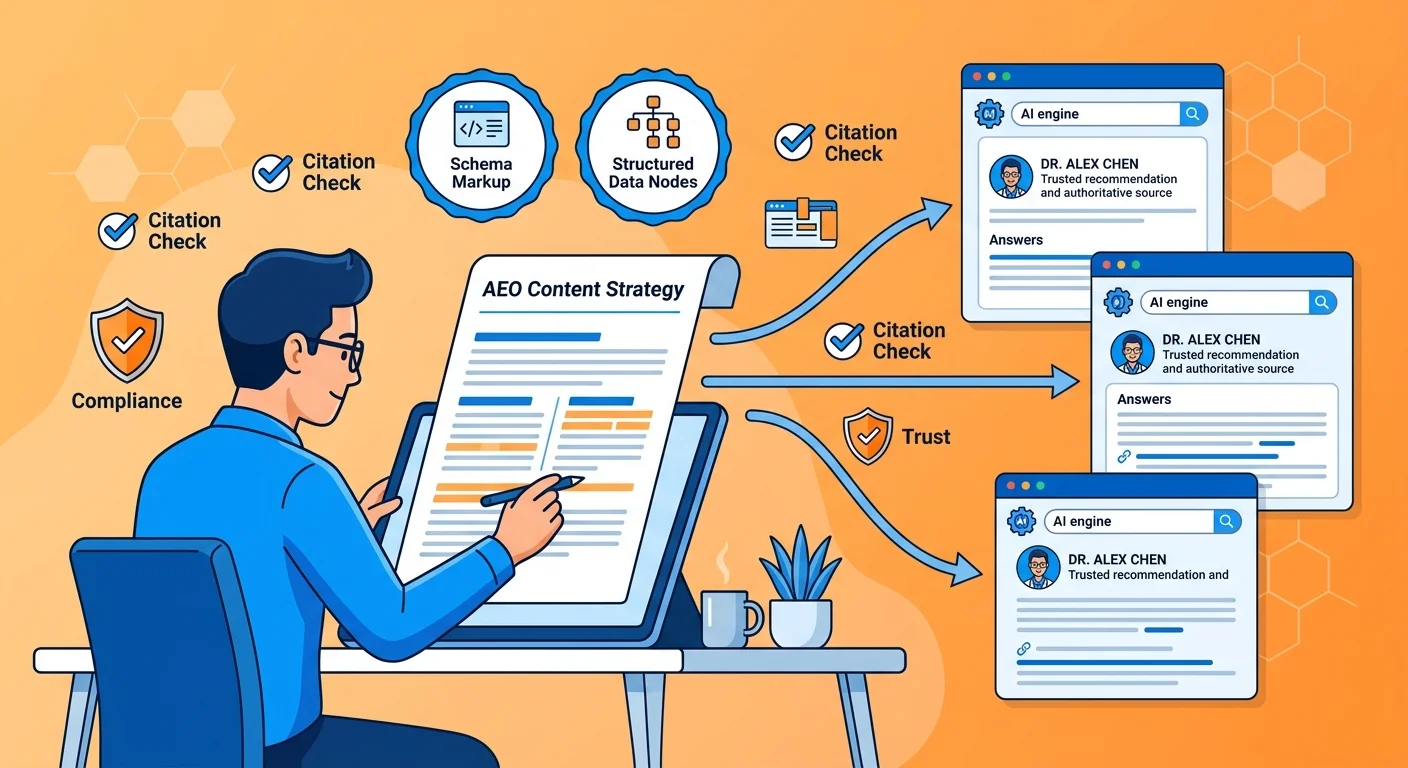
Compliance-safe AI authority isn't a mindset shift. It's a set of specific infrastructure decisions that produce machine-readable signals — the kind AI engines already favor over ad copy, promotional volume, or keyword density.
Not philosophy. Infrastructure.
According to this source, here's the math. Pew Research found that 72% of internet users search for health information online. And AI engines are now the first layer those users hit — before they ever reach a practice website.
The entity data the engine finds — or doesn't find — determines who gets recommended.
Not a content problem. An infrastructure problem.
One approach evaporates the moment spending stops. The other compounds every month — structured in exactly the form AI engines are built to extract, verify, and act on.
That contrast doesn't get softer over time. It gets sharper.
That's the argument behind renting attention versus owning entity trust.
AEO Content That Builds Trust Without Making Claims
Here's what Layer 2 looks like when it's actually built.
AEO content isn't about writing more. It's about writing in a way that maps directly to how AI engines retrieve and evaluate clinical information on behalf of patients.
No hype. No superlatives. No promotional claims written to persuade a human reader who no longer controls the discovery layer.
Instead: factually grounded answers to the exact questions patients ask — structured so an AI engine recognizes the content as credible. Not because it's polished. Because it mirrors how verified, objective sources speak.
The engine isn't reading for tone. It's reading for evidence.
This is where compliance safety lives. Content built on substantiated, objective information doesn't trigger FTC enforcement exposure. It doesn't make clinical promises it can't back up.
It demonstrates expertise through precision and depth. Those are the same qualities that build patient trust — and the same qualities AI engines use to evaluate credibility.
The pitch disappears. The authority stays.
The Semantic Density Standard AI Engines Actually Require
AI engines don't skim content. They run verification loops — extracting clinical entity data across multiple channels and cross-referencing it against third-party structured databases.
That process has a standard.
Most practice websites don't clear it.
And it has nothing to do with word count or keyword frequency.
It's about whether the content answers patient intent with enough specificity, structure, and external corroboration that the engine treats it as a verified source — not a promotional brochure.
That's a hard threshold. Content built around conversion copy almost never clears it.
Practitioners who clear that threshold don't stumble into it. They build content the way you'd build evidence — documented, precise, externally referenced.
That's Semantic Content Density in execution. Layer it on top of Structured Entity Identity. Follow it with Citation Velocity.
The result is an evidentiary record AI engines can read, verify, and act on — without a single promotional claim in sight.
AI engines render verdicts. They don't read ads.
| Content Type | Compliance Status | AI Extraction Value | Authority Signal Strength |
|---|---|---|---|
| Schema-marked entity profile (name, credentials, specialization, location) | Compliant — no clinical claims, no promises | High — directly structured for machine parsing and cross-referencing | Strong — establishes the foundational record AI engines verify first |
| Factually grounded Q&A content mapped to patient intent | Compliant — substantiated, objective, no hype or superlatives | High — mirrors how verified clinical sources present information | Strong — signals credibility through precision and depth, not volume |
| Third-party citations and structured directory listings | Compliant — external validation, no self-promotion involved | High — feeds the verification loop AI engines run across multiple channels | Strong — each external mention reinforces the entity record independently |
| Promotional ad copy (banner ads, PPC landing pages, campaign-driven content) | Risk exposure — clinical claims without substantiation trigger FTC scrutiny | None — AI engines treat promotional assertions as unverifiable noise | None — disappears the moment ad spend stops; builds no lasting record |
| Keyword-stuffed SEO content (optimized for index ranking, not patient intent) | Borderline — depends on claim specificity, but structurally non-compliant in tone | Low — AI engines extract meaning and intent, not keyword frequency | Weak — indexed by search engines but unreadable as credible evidence by AI |
| Testimonials and self-reported outcome claims | High risk — FTC guidelines require rigorous substantiation for health outcome claims | None — AI engines do not treat first-party outcome assertions as objective signals | None — self-promotional framing actively undermines entity credibility |
The Anti-Persona: Who This Guide Is Not For
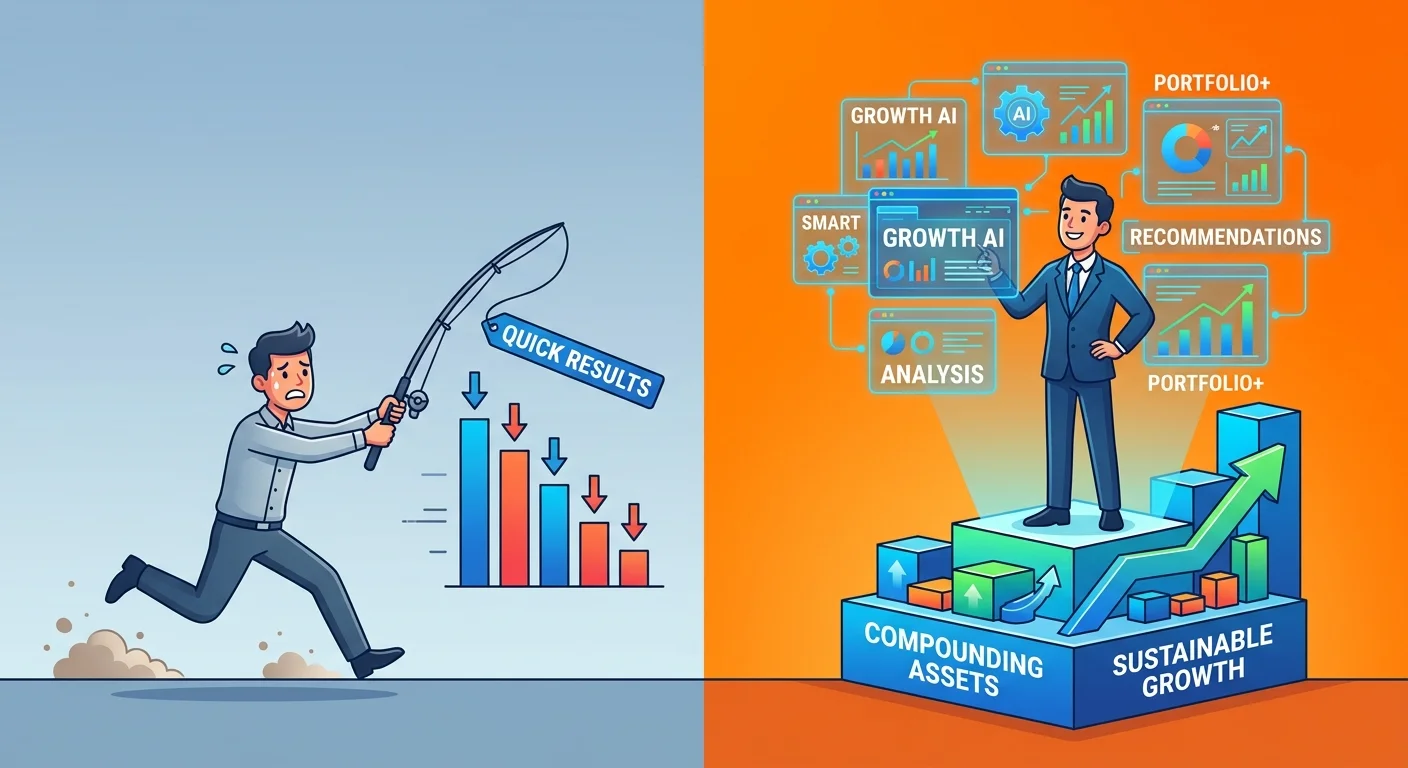
But this model isn't for everyone.
Here's a filter. If you recognize yourself in either description below — stop here. Not an insult. A qualification.
If you need booking volume in the next 60 to 90 days or you're pulling the plug — walk away.
Entity Trust doesn't microwave. It compounds. Every month of execution builds on the last. Every month a competitor waits, that gap gets wider and harder to close.
The practitioners who win here aren't chasing a dashboard that lights up fast. They're building an asset. Those are two completely different games.
If you need a written guarantee that AI will say your name by a specific date — this isn't your playbook either.
Gartner put traditional search decline at 25 percent by 2026. The engines replacing it don't respond to guarantees — they respond to evidence. Full stop.
Anyone selling you a guaranteed AI citation is selling you something that doesn't exist. This guide is for practitioners who know the difference between a process guarantee and an outcome promise. One is real. The other is fiction.
Who Gets Left Behind and Why the Gap Accelerates
So what happens to the practitioners who don't build?
The gap doesn't hold steady. It accelerates. Every month a competitor adds to their evidentiary record — Structured Entity Identity, Semantic Content Density, Citation Velocity — the AI engine's confidence in that record deepens.
The practitioner who waited isn't just behind. They're competing against a compounding asset from a standing start. That math gets worse every month.
Consumer trust in outbound ads keeps eroding. Patients aren't being won by louder campaigns — they're being won by whoever AI surfaces as the credible answer.
Every dollar spent on a paid campaign that disappears when the card is charged is a dollar not building something permanent. The practitioners still renting attention while competitors build an entity record aren't holding steady.
They're falling further behind with every spend cycle. the ROI math on this
Think about how a trial works.
The side that waits to build its evidentiary record until the trial starts has already lost. The verdict gets shaped by the record that exists — not the one someone planned to build.
AI engines work exactly the same way. The practitioners who built the record get recommended. The ones who didn't aren't penalized — they're simply absent. And in a market where AI renders one verdict, absence is invisible.
| Practitioner Behavior | Why It Fails the AI Authority Model | What It Signals to AI Engines |
|---|---|---|
| Expects measurable booking volume within 60–90 days of starting | Entity Trust is a compounding asset — it builds in layers over time. Short timelines cut the process before the evidentiary record reaches the threshold AI engines require to render a confident recommendation. | Sparse, thin record. Insufficient cross-referencing. Engine treats the entity as unverified and defaults to a competitor with a deeper record. |
| Demands a contractual guarantee that AI will cite their practice by a specific date | AI engines respond to evidence, not promises. Outcome guarantees don't exist in this model — and any vendor claiming otherwise is selling a fiction. The process is controllable; the engine's verdict is not. | Nothing — because the guarantee is irrelevant to the engine. The record either clears the threshold or it doesn't. A contract doesn't change what the engine finds. |
| Shops on price — compares authority infrastructure investment to a low-cost monthly retainer | The comparison is structurally wrong. A retainer rents temporary visibility. Authority infrastructure builds a compounding asset that survives when payments stop. Treating them as equivalent signals a fundamental misread of what is being purchased. | Nothing — because the practitioner never builds the record. Low-cost retainers rarely produce the structured entity signals AI engines cross-reference. |
| Believes a one-time build is sufficient — no ongoing content execution planned | Authority decays without execution. Semantic Content Density requires continuous, structured content that maps to evolving patient intent. A static build gives the engine a single snapshot — not a deepening evidentiary record. | A record that stops growing looks stale. AI engines update their confidence continuously — a practitioner who stops executing falls behind competitors who don't. |
| Wants to manage or replicate the system internally after a brief explanation | The system requires sustained technical execution across three interdependent layers — Structured Entity Identity, Semantic Content Density, and Citation Velocity. DIY attempts produce inconsistent entity signals, which actively undermine the record rather than building it. | Inconsistent or contradictory entity data across sources. The engine can't confirm the record, so it withholds the recommendation. |
| Refuses to specialize — wants to position the practice as everything to everyone | AI engines surface practitioners who answer a specific patient intent with precision and depth. A generalist positioning creates thin semantic coverage across too many topics — none of it dense enough to clear the credibility threshold for any single query. | Diluted semantic record. The engine finds no authoritative depth on any specific patient concern and routes the recommendation to a specialist with a denser, more targeted evidentiary record. |
Frequently Asked Questions
The model makes sense. The gap is obvious. But there's always a 'but what about' moment before someone commits. Here's where those live.
Straight answers. No hedging.
How does conversational AI choose which local practitioners to recommend in my market?
It doesn't run a popularity contest. It runs a verification loop.
The engine pulls entity data from everywhere at once — your website schema, third-party directories, structured databases, published content. Then it cross-references all of it for consistency and credibility.
The practitioner with the most complete, most consistent, most machine-readable record gets named. No auction. No bid. Just the evidence that exists.
Why does traditional search engine optimization fail to secure listings in ChatGPT or Gemini?
Traditional SEO was built for a ranked list. AI search produces a single verdict. Those aren't variations of the same problem — they're different games with different rules.
Keyword density doesn't factor into how ChatGPT or Gemini evaluate clinical credibility. Neither does backlink volume. They're looking for structured entity data, verified credentials, and content that answers patient intent with enough specificity to trust.
SEO optimizes for discoverability. AI authority optimizes for trustworthiness. The engines replacing traditional search don't rank — they recommend. And they recommend the practitioner with the strongest evidentiary record, not the highest domain authority.
How does building structured Entity Trust keep a practice compliant with strict advertising guidelines?
The FTC requires that health and safety claims be backed by competent, reliable scientific evidence. Entity Trust is built on exactly that standard.
You're not making promises. You're documenting credentials, structuring factual service descriptions, and publishing content grounded in objective, substantiated information.
That's compliance by design — not a guardrail bolted on afterward. The content that builds AI authority is content that doesn't make unverifiable clinical claims. The build process and the protection process are the same work.
Will building AI authority take longer to generate patient leads than running paid ads?
Paid ads produce leads the day you fund them — and zero leads the day you don't. Entity Trust doesn't work on a microwave schedule. But it doesn't evaporate either.
Every month of execution deepens the evidentiary record AI engines use to render verdicts. Gartner projects traditional search volume will drop 25% by 2026 as conversational AI replaces index-style queries. The practitioners with a built record are the ones who capture that layer.
The question isn't which one is faster. It's which one still works in two years.
What specific technical infrastructure changes are required to make a practice website AI-readable?
Start with schema markup — the structured data layer that tells AI engines exactly who you are, what you treat, and where you operate. Then audit your NAP consistency across every directory that matters.
From there, the work moves into Semantic Content Density: AEO articles that answer patient questions with enough specificity and external corroboration that AI engines treat the content as a verified source.
Then Citation Velocity — ensuring third-party structured databases and authoritative directories carry consistent, credible entity data. These aren't bolt-ons. They're a build sequence, and each layer depends on the one before it.
Can a practitioner build AI authority without hiring an agency to do it for them?
Technically? Yes. Practically? Most don't get far.
The build sequence — schema implementation, semantic content architecture, citation network development — requires technical execution, content precision, and ongoing iteration. Most practices don't have the bandwidth to sustain that alongside patient care.
But the real issue isn't capability. It's compounding. AI engines run continuous verification loops, which means the authority record requires consistent, ongoing execution — not a one-time setup. Practitioners who go the DIY route tend to build the first layer and stall. The gap their competitors are closing in the meantime doesn't pause while they troubleshoot their schema.
The Verdict Is Already Being Rendered
The verdict isn't coming. It's already been rendered.
In your market, for your specialty, for every patient who asked an AI engine who to trust — the engine didn't wait. It evaluated the evidence that existed and returned the name with the strongest record.
That name either is yours or it isn't. AI engines render verdicts — they don't read ads.
Gartner projects traditional search volume drops 25% by 2026. The conversational AI layer taking its place doesn't care who spent the most on ads last quarter.
Structured Entity Identity. Semantic Content Density. Citation Velocity. Those are the three categories of evidence AI engines use to decide whose name gets said.
You don't win that decision by selling. You win it by building a record so complete, so consistent, and so machine-readable that the engine has no credible alternative to name.
iTech Valet was built on one conviction: AI gives one answer, and the businesses that aren't that answer are invisible.
The practitioners who get this — who stop renting attention and start building an evidentiary record — are compounding authority right now, in their markets, while their competitors wait.
The jury has already convened. Your competitor's case file is already in front of it. The only question left is whether you're building yours — or watching someone else win the verdict by default. AI engines render verdicts — they don't read ads.
The verdict is already being rendered. AI engines don't read your ads, your reviews, or your good intentions — they read your infrastructure. Find out what they're actually saying about your practice right now. The AI Visibility Check takes 15 minutes and shows you exactly what ChatGPT, Gemini, and Grok say when a patient in your market asks who to trust.

621 Enterprises, Inc. | Copyright 2026 | All rights reserved