
AI Authority Engine vs. AEO Retainer: A Side-by-Side Authority Asset Comparison for Chiropractors
The AI Authority Engine and an AEO retainer are not two versions of the same service.
One builds a permanent, compounding authority asset. The other rents visibility on land you do not own. When payments stop, the exposure stops with them.
An AEO retainer delivers the content layer. AI Authority articles published monthly, authority signals strengthened incrementally, entity trust growing over time. There is no infrastructure rebuild. No schema overhaul. No entity restructuring. It is valuable — but it is built on whatever foundation already exists underneath it.
The Local AI Authority Engine is the full system. It starts by rebuilding the digital infrastructure AI engines use to verify, trust, and recommend a practice. Schema markup, entity signals, internal architecture, structured data — rebuilt from the ground up to be machine-readable and AI-trustworthy. Then the monthly AI Authority content execution layer activates on top of that foundation. The result is a compounding asset, not a recurring expense that disappears when payments stop.
The timing creates urgency. Gartner projects a 25% drop in traditional search engine query volume by 2026 as patients migrate to conversational AI. Roughly 40% of adults under 30 have already used ChatGPT to find information. More than 70% of modern patients expect integrated digital experiences when selecting a provider. An estimated 8.4% of all US adults use chiropractic services in any given year — a substantial, stable patient pool that is actively shifting to AI-driven discovery.
The chiropractors ChatGPT, Gemini, and Grok recommend are not the ones with the most backlinks. They are the ones whose digital infrastructure told AI engines exactly who they are, what they treat, where they operate, and why they can be trusted.
That infrastructure does not build itself. And an AEO retainer alone does not build it.
Last Updated: June 17, 2026
- • Why the SEO Retainer Model Is Rented Land for Chiropractors
- • Who This Comparison Is — and Isn't — For
- • Side-by-Side: AI Authority Engine vs. AEO Retainer at a Glance
- • How the Local AI Authority Engine Works Under the Hood
- • Making the Decision: Signals That Point to Each Path
-
• Frequently Asked Questions
- • What is the difference between an AEO retainer and the AI Authority Engine?
- • Why are monthly SEO retainers a wasting asset for local chiropractors?
- • How does the iTech Valet Two-AI Validation System ensure accuracy?
- • What is the realistic timeline for seeing chiropractic recommendations inside ChatGPT and Gemini?
- • Is the AI Authority Engine built on rented land like traditional local SEO?
- • Can a chiropractor run an AEO retainer and the Authority Engine at the same time?
- • Stop Renting. Start Owning.
Why the SEO Retainer Model Is Rented Land for Chiropractors
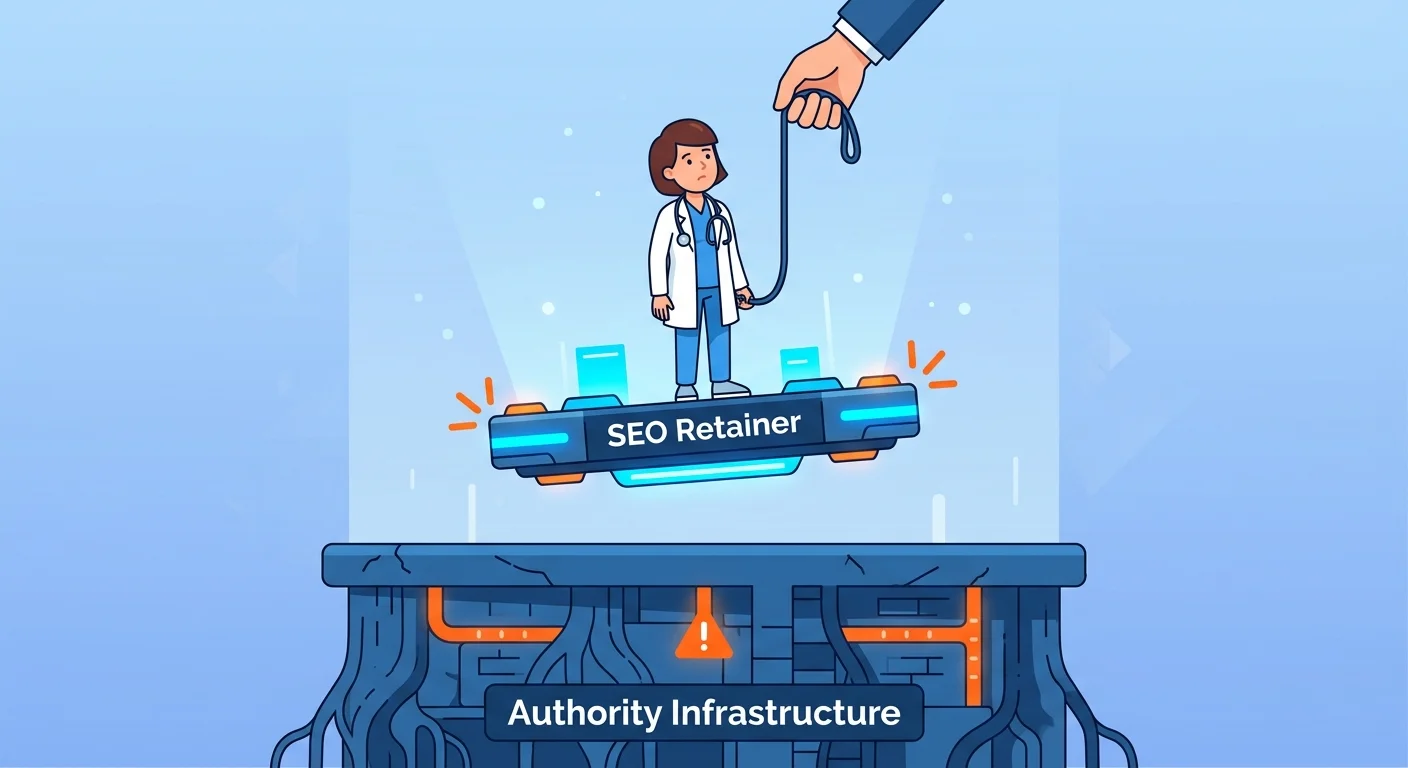
Every SEO retainer you've ever paid for left you with exactly one thing: nothing you own.
Every invoice is a lease payment. You're renting a position on a list Google controls. You're renting visibility that disappears the moment you stop paying. You're renting access to an algorithm that changes without your input — and has already started losing patients to conversational AI.
Gartner projects a 25% drop in traditional search engine query volume by 2026. The landlord isn't just raising rent. The landlord is selling the building.
That's the rented-land problem. It's not your agency's fault. It's not fixable by switching firms or negotiating a lower monthly rate.
The model itself is built on ground you'll never own. Every month you keep leasing, a competitor somewhere is quietly buying. That gap doesn't stay flat — it compounds.
Why Traditional SEO Retainers Fail Chiropractors
SEO retainers were built for a world where patients typed a symptom into Google, skimmed a list, and clicked whoever looked credible. That world isn't coming back.
Patient acquisition now runs on localized digital verification. The kind that determines which practice gets named when someone asks ChatGPT a direct question. Backlink counts don't answer that. Keyword density doesn't answer it.
Structured entity data does. Schema does. A machine-readable infrastructure does. None of those things are what a traditional SEO retainer builds.
Here's what a traditional retainer actually does: it optimizes a foundation it never touches. Your schema stays broken. Your entity signals stay weak. Your internal architecture stays invisible to the machines making the referrals now.
The agency polishes the surface. The infrastructure underneath keeps failing. And every month you pay for that polish, the practices building real infrastructure through the Local AI Authority Engine compound further ahead.
And when the retainer stops — because it always stops, whether from budget pressure, a bad quarter, or a pivot to a new agency — everything stops with it. Rankings drift. Visibility fades. The work doesn't compound.
It just ends.
That's not an investment. That's a subscription you've been calling one.
| What You're Paying For | What You Actually Own | What Happens When You Stop Paying |
|---|---|---|
| Monthly keyword optimization and content updates | Nothing — visibility exists only while the retainer is active | Rankings drift, visibility fades, and the agency relationship resets to zero |
| Incremental polish on an existing (often broken) website foundation | Nothing structural — the underlying infrastructure is never touched | The foundation remains weak, invisible to AI engines, and unchanged from day one |
| Access to an agency's reporting dashboard and process | Nothing — the dashboard, the data, and the workflow belong to the agency | You lose access to every tool, report, and system the agency controlled |
| Temporary list-based positioning on a shrinking search platform | Nothing — the position is leased from Google's algorithm, not earned by your infrastructure | The list position disappears; no compounding authority remains |
| Ongoing backlink activity and citation management | Nothing permanent — citations decay and backlink value erodes without maintenance | The authority signals weaken over time rather than compounding forward |
| Content published to a site with no schema, no entity structure, and no AI-readable architecture | Nothing machine-readable — AI engines cannot verify, trust, or recommend a practice without structured entity data | The content orphans itself on infrastructure that AI engines still can't read or trust |
Who This Comparison Is — and Isn't — For
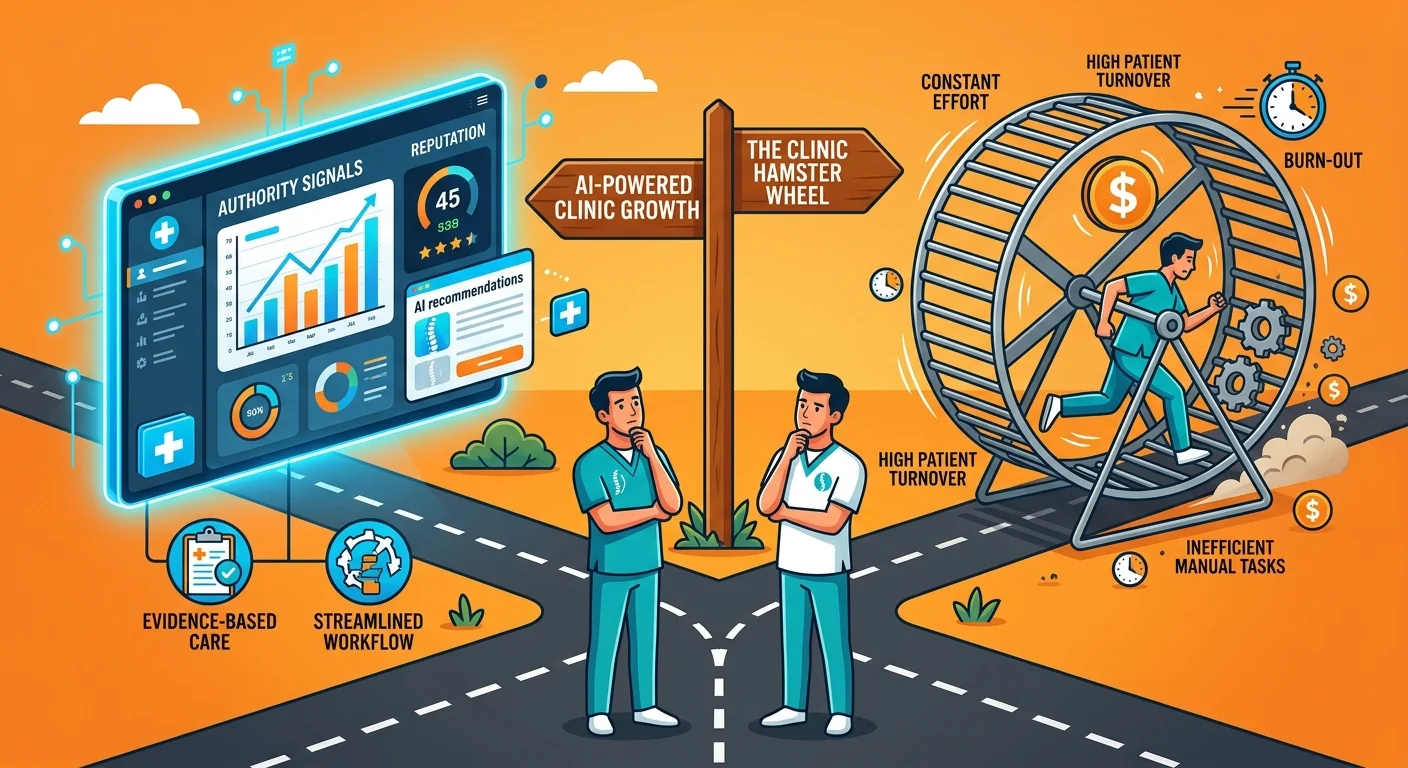
This isn't a cheaper-versus-pricier conversation.
These two paths build different things entirely. Which one fits you depends on what you've already tried, where your practice sits right now, and what you're actually building toward.
The market isn't small. An estimated 8.4% of all US adults use chiropractic services in a given year — a large, stable patient pool actively seeking care. That pool is migrating to AI-driven discovery right now. Roughly 40% of adults under 30 have already used ChatGPT to find information.
The shift isn't coming. It's here. The only question is whether your practice shows up as the answer — or someone else's does.
Renting visibility month-to-month and owning it permanently aren't variations of the same strategy. They produce different outcomes, for different practices, on completely different timelines. Take sixty seconds to figure out which side of that line you're on — that's exactly what this comparison is built around.
The Chiropractor Who Will Get the Most From This
This comparison was built for the chiropractor who's already been through the retainer cycle.
You've paid the agency. You've seen the dashboard reports. You still can't answer one question: does ChatGPT recommend my practice?
You're the right fit if you're running an established practice and you're done paying for visibility you can't keep when the invoice stops. You want something that builds. Infrastructure you own — not a subscription that evaporates the moment you miss a payment.
You've watched competitors get named by AI engines and you can't explain why your practice never comes up. That's the gap this closes.
The AI Visibility Check exists for exactly this moment — when you suspect the problem is structural but haven't seen the data yet.
Stop guessing. See where you actually stand.
If This Sounds Like You, This Isn't the Right Fit
Here's the blunt version: if you're expecting measurable ROI inside 90 days, this isn't for you.
Authority infrastructure isn't a microwave. It doesn't produce a result the week after it's built.
It compounds — slowly at first, then faster, then in ways that are very hard for competitors to displace. If your decision needs a guaranteed outcome inside a quarter, you're describing a different kind of engagement. One that, frankly, has already been sold to you several times. And delivered the rented-land problem you're standing in right now.
If you shop on price, compare this to a $500-a-month retainer, or need guaranteed rankings before you'll commit — we're not the right fit. Full stop.
The practices this was built for aren't looking for the cheapest option. They're looking for the last one they'll need to buy.
| Buyer Signal | Right Fit: Authority Engine | Wrong Fit: Step Away |
|---|---|---|
| Decision timeline | Willing to build over months — understands authority compounds and the asset grows with each layer added | Expects measurable ROI within 90 days — needs a guaranteed outcome before the next invoice |
| How you evaluate cost | Frames the investment as infrastructure — compares it to owning land versus leasing it month-to-month | Shops on price — compares this to a low-cost monthly retainer and expects roughly equivalent results |
| What you've already tried | Has been through the retainer cycle, seen the dashboard reports, and still can't confirm AI engines recommend the practice | Has never invested in authority infrastructure and believes a new agency or a better keyword strategy will close the gap |
| What you're building toward | Wants infrastructure you own — something that keeps working after payments stop and can't be evicted by an algorithm update | Wants a quick visibility boost — is looking for a short-term fix before re-evaluating |
| Relationship to specialization | Operates a defined practice with a clear patient focus and a market worth owning | Serves every condition for every patient — hasn't narrowed focus and isn't ready to |
| Tolerance for process | Comfortable with a done-for-you system — doesn't need to manage it, learn it, or direct it | Wants to stay hands-on, oversee the work, or replicate the methodology internally after a brief explanation |
Side-by-Side: AI Authority Engine vs. AEO Retainer at a Glance
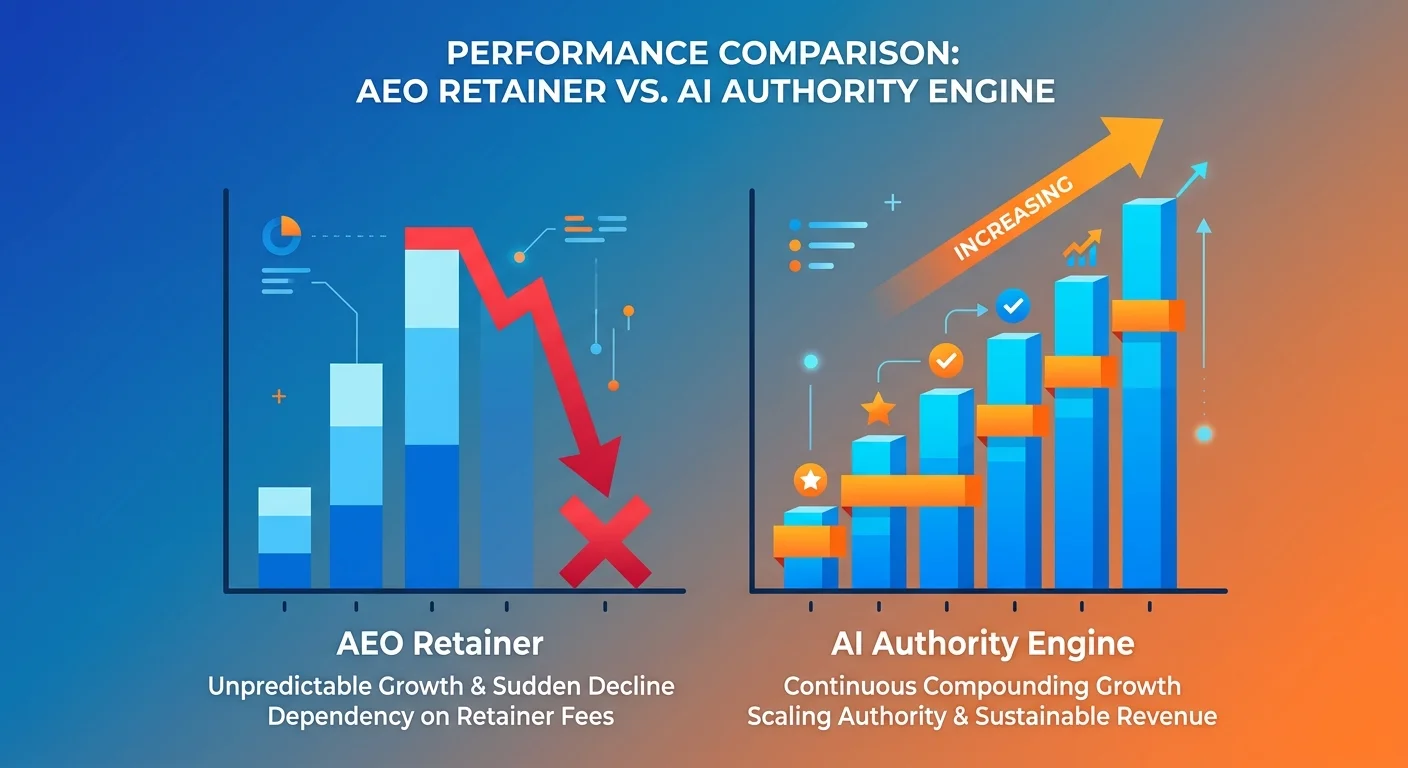
Here's the comparison most agencies bury. Lay both models side by side — what each one builds, what happens when payments stop, what each one does to your AI visibility over time — and the difference isn't a preference call. It's structural.
The AEO retainer is a content execution layer. Month after month, AI Authority content execution strengthens authority signals, publishes AI Authority articles, and builds entity trust incrementally. That's real value. But it only works if the infrastructure underneath is already machine-readable. If it isn't, you're stacking content on a foundation AI engines can't parse. The content works harder than it should. The results plateau faster than they need to.
The Local AI Authority Engine fixes the foundation first. Then it layers content execution on top. That sequence is almost everything. More than 70% of modern patients expect integrated digital experiences when selecting a provider — and that experience has to be built into the infrastructure before it can be found by anyone. One model builds an asset you keep. One builds an asset you rent. Read what that shift means.
What Each Model Actually Builds Over 12 Months
Twelve months of an AEO retainer produces a meaningful library of AI Authority articles. Authority signals are stronger than they were at month one. Entity trust has grown. That's not nothing — especially if your existing website infrastructure is already solid. But if payments stop, that content sits on whatever foundation it was always sitting on. The compounding slows. The visibility drifts. You're right back to rented land.
Twelve months of the Local AI Authority Engine produces something different. Phase one rebuilds the digital infrastructure — schema markup, structured data, entity signals, internal architecture — everything AI engines use to verify and trust a practice. That rebuild happens once. It doesn't require ongoing payment to stay intact. By month twelve, the content layer has been compounding on top of a machine-readable foundation. The clinical credibility signals AI engines need to make a confident recommendation are already baked into the structure — not bolted on top of it.
According to this source, here's the real question: which model leaves you owning something when the engagement ends? Traditional search engine query volume is projected to drop 25% by 2026 as patients move to conversational AI. The practices that own their AI visibility before that shift locks in will be very hard to displace. The ones still renting visibility on a dying platform will be scrambling for a solution after the window closes. Peer-reviewed credibility signals are exactly what AI engines weight when generating recommendations. Building those signals into your infrastructure is the work the Local AI Authority Engine does that an AEO retainer alone can't.
That's the twelve-month scoreboard. Not rankings. Not impressions. Not dashboard metrics that vanish when the retainer ends. Twelve months from now — does your practice own its AI authority, or is it still one missed payment away from invisible?
| Dimension | Local AI Authority Engine | AEO Monthly Retainer |
|---|---|---|
| What it builds | Permanent, machine-readable infrastructure — schema, entity signals, internal architecture — that AI engines use to verify and trust your practice | A growing library of AI Authority articles that strengthen authority signals month over month, layered on whatever foundation already exists |
| Ownership model | You own the infrastructure outright — the rebuild happens once and stays intact regardless of future payments | You lease the output — content compounds while payments continue, but the underlying foundation remains unchanged |
| What happens when payments stop | The infrastructure remains. Entity signals, schema markup, and structured data don't decay when the engagement ends. | Content delivery stops. Authority signals plateau. Visibility drifts without the ongoing execution layer. |
| Where it starts | Foundation-first — digital infrastructure is rebuilt before a single piece of content is published | Content-first — AI Authority articles go out immediately, regardless of whether the infrastructure underneath is machine-readable |
| AI engine compatibility | Built specifically for how ChatGPT, Gemini, and Grok verify and recommend local practices — structured data and entity trust are the deliverables | Improves authority signals over time, but cannot fix schema gaps, entity drift, or structural invisibility on its own |
| Compounding behavior | Infrastructure compounds passively; content compounds on top of it — two compounding layers reinforcing each other | Content compounds actively during the engagement; compounding slows or stops if the foundation was never fixed |
| Right fit for | Established practices that are done renting visibility and want to own their AI authority permanently | Practices with solid existing infrastructure that need consistent AI Authority content execution to deepen entity trust over time |
How the Local AI Authority Engine Works Under the Hood
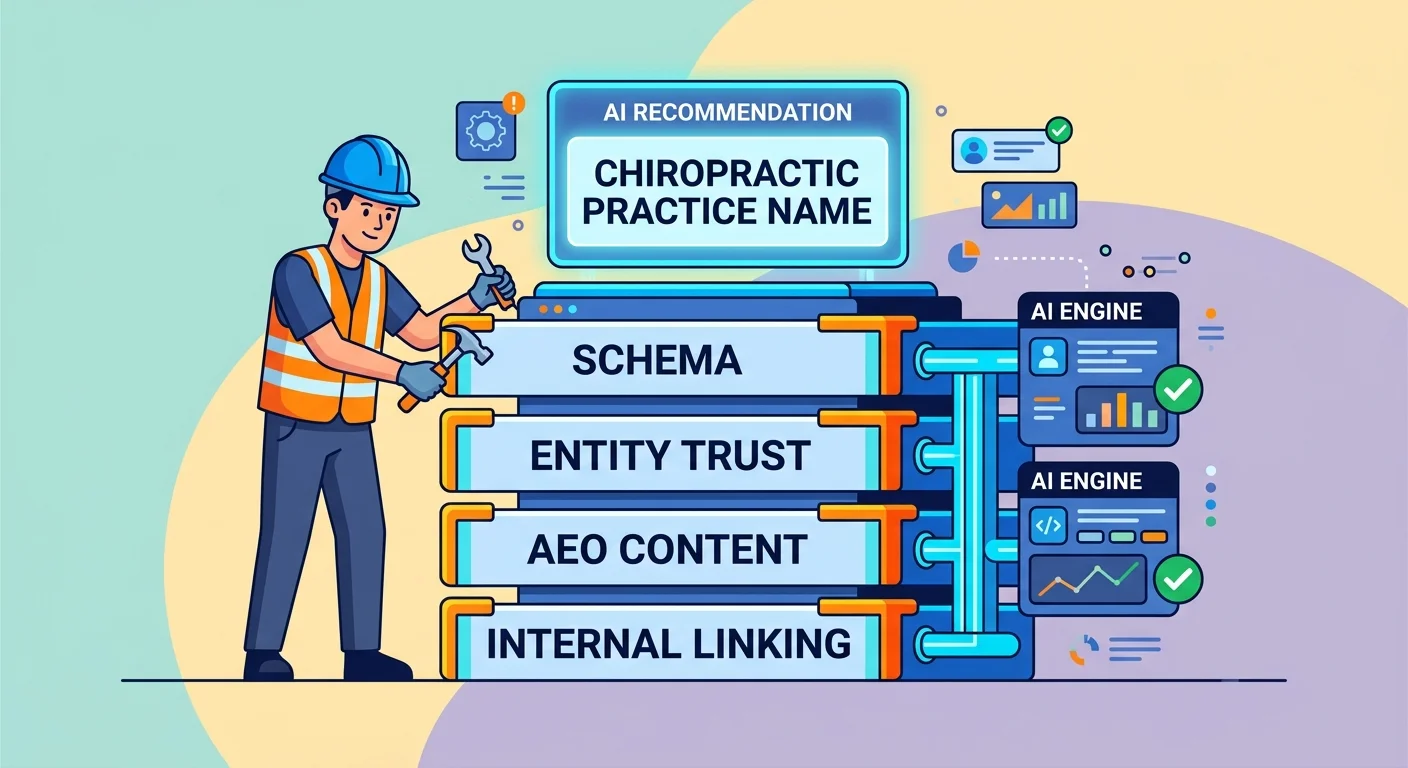
Numbers don't mean anything if you don't know what's generating them. So let's open the hood.
Most practices that come to iTech Valet have already been through the retainer cycle. They've got content. They've got a website. What they don't have is a machine-readable foundation that AI engines can actually verify. That's the gap clinical results alone can't close
Patient acquisition has shifted toward localized digital verification channels. AI engines aren't just surfacing names anymore — they're running entity verification before they recommend anyone. If your infrastructure can't pass that check, your name doesn't appear. Doesn't matter how strong your clinical outcomes are.
The Two-AI Validation Process
Here's what separates this from every other agency selling content. Every piece produced inside the Authority Engine runs through two AI systems before it touches your website. Every single one.
Gemini researches the article. Claude writes it. Gemini validates the output. Claude refines based on what Gemini flags. That loop — research, write, validate, refine — is what Gerek Allen built the system around. It exists because authoritative health content signals demand verified accuracy, not approximation. The FTC has been explicit: clinical and technological claims must be backed by solid, scientifically valid evidence. No generic exaggeration. That's not a disclaimer. That's the operating standard the two-AI process is engineered around.
The result isn't just accurate content. It's content AI engines can recognize as verified, structured, and trustworthy. We don't publish vibes. We publish receipts.
What Gets Built Into Your Infrastructure
The infrastructure rebuild comes first. Schema markup gets installed correctly — not the generic boilerplate most websites ship with. Structured data specific to your entity, your services, your geographic authority signals. Built so AI engines know exactly who you are before they read a single article.
Then internal architecture gets restructured so AI engines can follow the hierarchy of your content. They understand what your practice does, who it serves, and why it's the most trusted option in your market. And here's the part retainer buyers never get: that architecture doesn't decay when payments stop. It's built into the site. It stays.
Then the AEO Content Writing Services layer goes on top of that rebuilt foundation. AI Authority articles compound month over month, each one strengthening the entity trust signals already embedded in the infrastructure. That's a fundamentally different dynamic than stacking content on a broken foundation. The content works the way it's supposed to — because the machine underneath it is finally speaking the right language.
That's the sequence. Infrastructure first. Content compounding second. The retainer model skips step one entirely — and that's not an oversight. It's a structural limitation baked into the business model. An AEO retainer builds authority signals on top of whatever foundation already exists. The Local AI Authority Engine builds the foundation itself. One model assumes the infrastructure is fine. The other doesn't leave that to chance.
| Infrastructure Component | What It Does for AI Visibility | Retainer Equivalent (or Lack Of) |
|---|---|---|
| Schema Markup (Entity-Specific) | Tells AI engines exactly who your practice is, what services you provide, and where you operate — using structured data that machines can read and trust, not just humans | No retainer installs or rebuilds schema — content is layered on top of whatever schema (or lack of schema) already exists on the site |
| Internal Architecture Restructure | Creates a content hierarchy AI engines can follow — linking service pages, authority articles, and entity signals in a logical structure that confirms your practice as the trusted local answer | Retainer content is published into the existing site structure — if the hierarchy is broken or shallow, new articles inherit that structural weakness |
| Geographic Authority Signals | Embeds localized entity data — service area, proximity signals, community relevance — directly into the site infrastructure so AI engines can confidently recommend your practice for local queries | Retainer articles may reference location naturally in prose, but geographic entity signals are not rebuilt at the infrastructure level |
| Two-AI Validation Loop (Gemini + Claude) | Every AI Authority article is researched by Gemini, written by Claude, validated by Gemini, and refined by Claude — producing content that AI engines can recognize as verified, structured, and accurate | Standard retainer content moves through a single editorial pass — no cross-AI verification loop, no systematic accuracy validation against a second model |
| AEO Content Layer (Compounding) | AI Authority articles publish monthly on top of the rebuilt foundation — each one strengthening entity trust signals that are already embedded in the infrastructure, compounding authority over time | Retainer content compounds authority signals too, but only as fast as the underlying foundation allows — a machine-unreadable site limits how far that compounding can go |
| Permanence of Build | Schema, internal architecture, and entity signals are built into the site itself — they don't require ongoing payment to stay intact; the foundation holds whether or not you're actively publishing | Retainer-generated authority exists primarily in published content — if publishing stops, compounding stops; no permanent infrastructure change is left behind |
Making the Decision: Signals That Point to Each Path
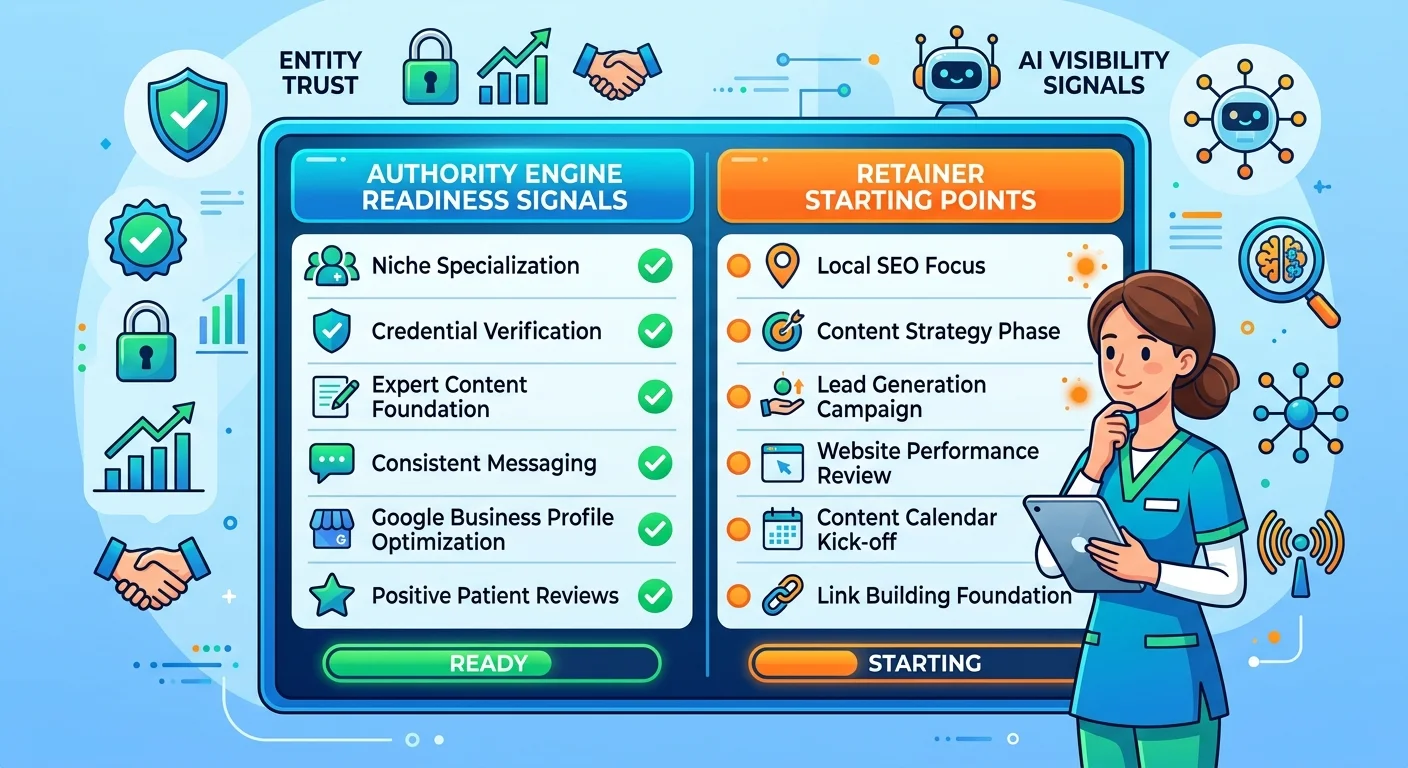
So here's where we land. You know what each model builds. You know what each one leaves you with when the payments stop. The only question left is which path matches where your practice actually is right now.
This isn't a complicated call. The signals are specific. Read them honestly and the answer usually becomes obvious.
Roughly 40% of adults under 30 have already used ChatGPT to gather information. More than 70% of modern patients expect integrated digital experiences when selecting a provider. That's not a trend on the horizon. That's your current patient base, already using the tools that decide whether your name comes up. The signal pointing you toward the right path is sitting inside your existing digital foundation. You just have to be willing to look at it honestly.
Signs You're Ready for the Authority Engine
Your website was built to impress people. Not to be read by AI. Beautiful design, zero schema, weak entity signals, architecture that no AI engine can parse — that's a content layer with no floor under it. No retainer fixes that. The foundation has to be rebuilt before any content can do its job. If that's your situation, the Authority Engine is the only path that addresses the actual problem.
You've already run a content strategy — a retainer, a blog push, an agency relationship — and watched the results plateau faster than they should have. That plateau isn't a content problem. It's almost always a foundation problem. The Authority Engine was built for exactly that diagnosis. The content wasn't wrong. The ground it was sitting on was.
And you're ready if you're done renting. If what you actually want is infrastructure that doesn't disappear the moment payments stop — authority signals embedded in the structure, AI visibility that compounds instead of evaporates — that's the frame Gerek Allen built the entire system around. An estimated 8.4% of US adults use chiropractic therapy in a given calendar year. That's a large, stable market. It's worth owning permanently. Not leasing month to month.
Signs an AEO Retainer Might Be the Starting Point
But here's when the retainer is the right starting point: your foundation is already solid. Schema in place. Entity signals properly structured. Architecture that AI engines can actually read and verify. If that's where you are, the missing piece is content execution — and a retainer delivers exactly that. The infrastructure is doing its job. The retainer builds on top of it. That's the only version of this where the retainer makes sense from day one.
It's also the right fit if you're earlier in the process — newer practice, less competitive market, and your priority right now is building an authority signal library rather than rebuilding infrastructure underneath it. The retainer compounds when the foundation isn't broken. That's the condition. If it's met, the retainer is a legitimate path. If it isn't, you're stacking content on a structure that can't hold it.
Here's what the retainer is not: a shortcut to AI visibility when the foundation is broken. It's not a substitute for the infrastructure rebuild. Choosing it because it's cheaper per month is the wrong decision framework — and it's exactly the reasoning that sends practices back to square one six months later. The right path isn't the cheaper one. It's the one that matches where your foundation actually is. Get that diagnosis right and the decision makes itself.
| Decision Signal | What It Means | Recommended Path |
|---|---|---|
| Your website was built for aesthetics, not AI readability | Schema is missing or generic, entity signals are unstructured, and AI engines can't verify your practice — content execution on top of this foundation stalls regardless of volume | Local AI Authority Engine |
| You've tried content execution and results plateaued early | A plateau in authority signals almost always traces to a foundation problem, not a content problem — the infrastructure underneath is limiting everything built on top of it | Local AI Authority Engine |
| You're done renting visibility month to month | You want authority that stays embedded in your site's structure — signals that compound over time rather than evaporate when payments stop | Local AI Authority Engine |
| Your infrastructure is already solid — schema in place, entity signals structured, foundation machine-readable | The core problem isn't the foundation; it's the missing content execution layer — a retainer delivers exactly that without rebuilding what already works | AEO Retainer |
| Your practice is newer or your market is less competitive | You need to build an authority signal library and your existing foundation isn't broken — the retainer compounds effectively on top of infrastructure that's already doing its job | AEO Retainer |
| You're choosing based on monthly cost alone | Price-first decision-making ignores the foundation question entirely — practices that choose the cheaper path because it's cheaper routinely return to square one within months | Neither — re-evaluate the foundation first |
Frequently Asked Questions
The tables are done. The comparison is on the page. But you still have questions — the specific ones, the ones that don't fit neatly into a side-by-side grid.
Here's what comes up most. No hedging. No spin.
What is the difference between an AEO retainer and the AI Authority Engine?
One builds your foundation. The other builds on top of it.
An AEO retainer is a content execution layer. AI Authority articles published monthly, authority signals compounding over time, entity trust deepening incrementally. It's real value — but it assumes your infrastructure is already machine-readable. It never touches the foundation.
The Local AI Authority Engine doesn't make that assumption. It starts by rebuilding the infrastructure itself — schema, entity architecture, internal hierarchy — and then layers AI Authority content execution on top of that rebuilt foundation. That's not a minor distinction. That's the whole ballgame.
Why are monthly SEO retainers a wasting asset for local chiropractors?
Because everything it produces is tied to a platform you don't own. Stop paying — the compounding stops. In many cases, the visibility evaporates with it.
Gartner projects a 25% drop in traditional search engine query volume by 2026 as patients migrate to conversational AI. So you're not just leasing visibility on a rented platform — you're paying an increasing price for shrinking reach every single month you stay on that model.
A wasting asset isn't a metaphor. It's math. A retainer's output has no durable equity. When the contract ends, the agency's dashboard goes dark. Nothing stays behind. That's not an investment. That's a subscription you've been calling one.
How does the iTech Valet Two-AI Validation System ensure accuracy?
According to this source, every piece of content produced inside the Authority Engine runs through a two-AI loop before it touches your website. Gemini researches the topic and surfaces verified sources. Claude writes the article against that research brief. Gemini runs a validation pass — checking structure, accuracy, and AEO compliance. Claude refines based on those findings.
The FTC has been explicit: claims in digital environments must be backed by solid, scientifically valid evidence — not approximation, not generic statements, not AI-generated content that nobody verified. That's the operating baseline the two-AI process is built around.
The result isn't just accurate content. It's content ChatGPT, Gemini, and Grok can cross-reference, trust, and cite. That's not a feature. That's the mechanism the whole system runs on. We don't publish vibes. We publish receipts.
What is the realistic timeline for seeing chiropractic recommendations inside ChatGPT and Gemini?
Here's the honest answer: I won't give you a month count. Anyone who does is guessing — and probably closing a deal.
What compounds doesn't move linearly. The infrastructure rebuild sets the foundation. The first wave of AI Authority content execution starts stacking signals on top of it. AI engines begin recognizing the entity structure. Citations appear. Recommendations follow. How fast that sequence moves depends on your market, your starting infrastructure, and whether execution stays consistent.
Roughly 40% of adults under 30 have already used ChatGPT to gather information. Those patients are querying AI engines for recommendations right now — not next year. The window isn't a future consideration. Every month of execution compounds on the last. Every month you're not building is a month someone else is.
Is the AI Authority Engine built on rented land like traditional local SEO?
No. That's the entire point.
Traditional local SEO is rented land by definition. You optimize for an algorithm you don't control, on a platform that changes the rules without notice, and the visibility you built disappears the moment you stop paying. Localized digital verification channels now directly govern initial clinical selection — patients use those channels to confirm your authority before they ever contact you. If that visibility lives on a rented platform, the confirmation is borrowed.
The Authority Engine is the exit from that model. The schema is embedded in your site. The entity architecture is baked into your infrastructure. The AI Authority content lives on your domain and compounds over time. None of that disappears when payments stop. That's what owned land actually looks like. You can't own the land if you're still paying rent — and the Authority Engine is the first model built to change that.
Can a chiropractor run an AEO retainer and the Authority Engine at the same time?
Not simultaneously — and not as a long-term parallel strategy.
The Authority Engine's infrastructure phase requires rebuilding your site's architecture. Running a retainer on top of a site that's actively being restructured means you're layering authority signals onto a foundation that isn't finished yet. That's not a sequencing preference. It's a technical problem.
The right sequence is Local AI Authority Engine first. Once the infrastructure rebuild is complete and the foundation is solid, the AEO retainer is exactly how you keep the compounding going at scale. These two models aren't competitors — they're sequential. The Authority Engine builds the land. The retainer cultivates it. Running both at once means doing neither one correctly.
Stop Renting. Start Owning.
Every retainer you've ever paid was a lease payment.
You got visibility for as long as the check cleared. The moment it didn't, the landlord took the keys. That's not a flaw in the agency you hired. That's the structural reality of renting someone else's platform, optimizing for someone else's algorithm, and calling it an investment.
The Local AI Authority Engine is the model that lets a chiropractor own the land.
Not rent a spot on a list that's already shrinking. Not lease visibility on a platform that can evict you without notice. Own it — through infrastructure embedded in your site, entity trust signals that don't decay when payments stop, and AI Authority content that compounds on a foundation built to last.
That's the difference between a marketing expense and an authority asset. That's the frame iTech Valet built this entire system around. You can't own the land if you're still paying rent.
The window is open right now.
The practices that move first will be nearly impossible to displace once this shift consolidates. Every month you wait is a month a competitor spends buying the land you're still renting.
The question isn't whether the shift is real. It's whether your name is the answer AI gives — or someone else's is.
The comparison is done. Now the question is whether your name is the one AI says — or your competitor's. You can't own the land if you're still paying rent. And AI engines aren't waiting for you to decide. Run the AI Visibility Check and find out exactly where you stand right now.
621 Enterprises, Inc. | Copyright 2026 | All rights reserved