
How AI Authority Content Amplifies Your Clinical Voice
AI Authority Content doesn't create clinical credibility. It amplifies the credibility that's already there.
That's the distinction most providers miss. When someone asks ChatGPT or Gemini to recommend a specialist, the engine doesn't return a ranked list. It produces a verdict. The practice it names isn't necessarily the most experienced or the longest-established. It's the one whose authority signals are clearest, most verifiable, and most consistently structured for machine comprehension.
AI Authority Content closes that gap by building four compounding signals into every piece of content: Entity Clarity, Verified Citation Architecture, Semantic Density, and Consistent Publication Cadence. Together, these signals tell AI engines exactly who the provider is, what conditions they treat, what evidence backs their clinical positions, and whether they're an active, trustworthy voice in their field.
This matters more in healthcare than in almost any other industry. Patients already approach AI-generated health information with real skepticism — Pew Research found that 60% of Americans would feel uncomfortable with providers relying on AI for their clinical care. Generic, un-cited content doesn't clear that bar. Expert-verified content structured around machine-readable authority signals does.
The FTC is equally direct: health-related claims require substantiation through competent and reliable scientific evidence. AI Authority Content is built to that standard — every clinical claim grounded in verifiable proof, every article reinforcing the provider's entity as a trusted, credentialed source.
A stethoscope amplifies the signal that's already there — it doesn't create one. AI Authority Content works the same way. For clinical practices, this isn't a content strategy. It's an infrastructure decision. Structure your clinical voice for AI readability, and you become the answer. Don't, and you become invisible — regardless of how skilled you are or how long you've been practicing.
Last Updated: July 10, 2026
- • What Conversational Search Actually Listens For
- • Why Commodity SEO Content Gets Ignored by AI Engines
- • The Four Signals That Make a Clinical Voice Machine-Readable
- • Who AI Authority Content Is Actually For — And Who It Isn't
- • How to Audit Your Current Clinical Content for Authority Gaps
-
• Frequently Asked Questions About AI Authority Content
- • What is AI Authority Content, and how does it differ from standard SEO blogging?
- • How do conversational search engines like ChatGPT and Gemini evaluate a clinician's online authority?
- • Is AI Authority Content safe from regulatory and compliance risk for healthcare providers?
- • Why do high-volume content mills fail to build genuine entity trust for clinical practices?
- • How does the AI Visibility Check help a practice identify its recommendation gaps?
- • The Signal Was Always There
What Conversational Search Actually Listens For
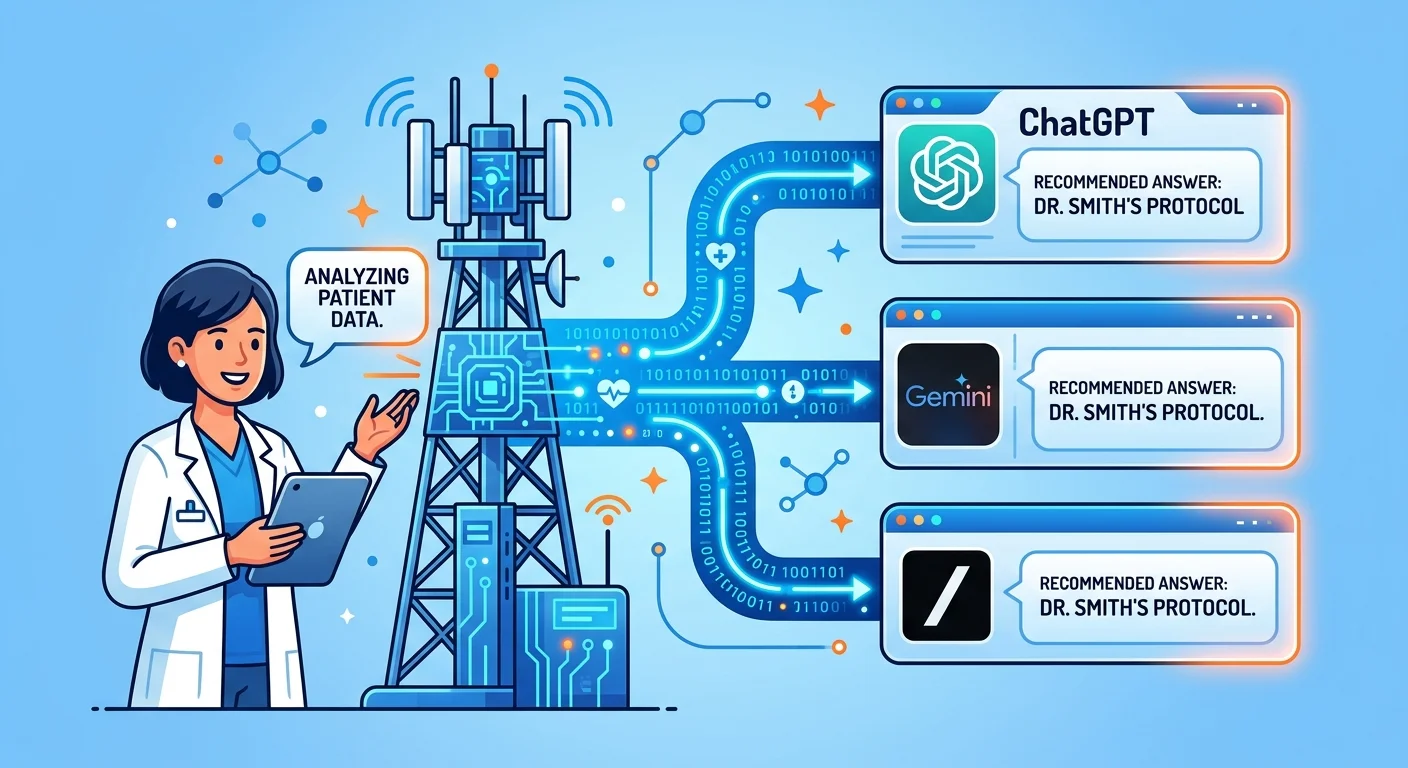
Conversational AI doesn't rank. It selects.
When a patient asks ChatGPT who the best sports chiropractor in their city is, the engine isn't handing them a list to scroll through. It's producing a verdict. One name. And that name was chosen from a very specific set of signals the engine has already parsed, cross-referenced, and decided to trust.
Here's what those signals aren't: popularity metrics, publishing frequency, or keyword density.
What they are is structural credibility. The engine needs to confirm who the provider is, what conditions they treat, what clinical evidence backs their positions, and whether they've kept a consistent, verifiable presence over time.
Generic, un-cited content fails every one of those tests. That's why skilled, experienced clinicians are invisible to the very tools their patients now use to find care.
That's why the shift from blogging to AI Authority articles isn't cosmetic. It's structural.
AI Authority Content is engineered around the four signals conversational engines actually evaluate: Entity Clarity, Verified Citation Architecture, Semantic Density, and Consistent Publication Cadence.
Miss any one of them and the engine has no reliable way to confirm your clinical credibility. Not because your expertise is lacking — because it isn't legible to the machine.
Why the Stethoscope Only Works if the Signal Is Structured
Think of a stethoscope. It doesn't create a heartbeat — it amplifies one that's already there.
AI Authority Content works the same way. It doesn't manufacture clinical credibility. It takes the real expertise a provider already has and structures it so AI engines can hear it, trust it, and say the provider's name when a patient asks.
But the signal has to be structured first.
NIH-published research confirms that patient trust in conversational AI search engines depends heavily on clear, expert-verified source citations. That's not a soft preference. It's a hard requirement.
A clinical voice without verifiable, cited proof doesn't register as authoritative. It registers as noise. And noise doesn't get recommended.
Most providers are stuck right here.
Deep clinical expertise. Complex cases. Real results. But none of it is structured in a way AI can parse, verify, or cite. The expertise is real. The credibility is earned. The signal just isn't reaching the engine.
That's the exact problem the Local AI Authority Engine is built to solve — turning an existing clinical voice into machine-readable authority signals that conversational engines can find, trust, and repeat.
| Search Type | How Results Are Determined | What Wins | What Fails |
|---|---|---|---|
| Traditional keyword search | Keyword density, backlink count, page authority score | Pages optimized around high-volume search terms with strong domain metrics | Thin, un-cited content — even if it ranks briefly, it doesn't earn AI trust |
| Conversational AI query | Entity clarity, citation structure, semantic coherence, publication consistency | Providers whose clinical voice is structured into machine-readable authority signals | Generic content with no verifiable citations, no structured entity data, no clinical specificity |
| AI recommendation (ChatGPT, Gemini, Grok) | Confidence in the entity — who they are, what they treat, what evidence backs them | A single named provider whose authority is confirmed across multiple verifiable signals | Any provider whose digital presence can't be parsed, verified, or cited by the engine |
| Patient trust formation | Verified expert authorship, cited clinical evidence, consistent presence over time | AI Authority Content structured around Entity Clarity and Verified Citation Architecture | High-volume commodity content with no expert voice, no citations, no entity reinforcement |
Why Commodity SEO Content Gets Ignored by AI Engines
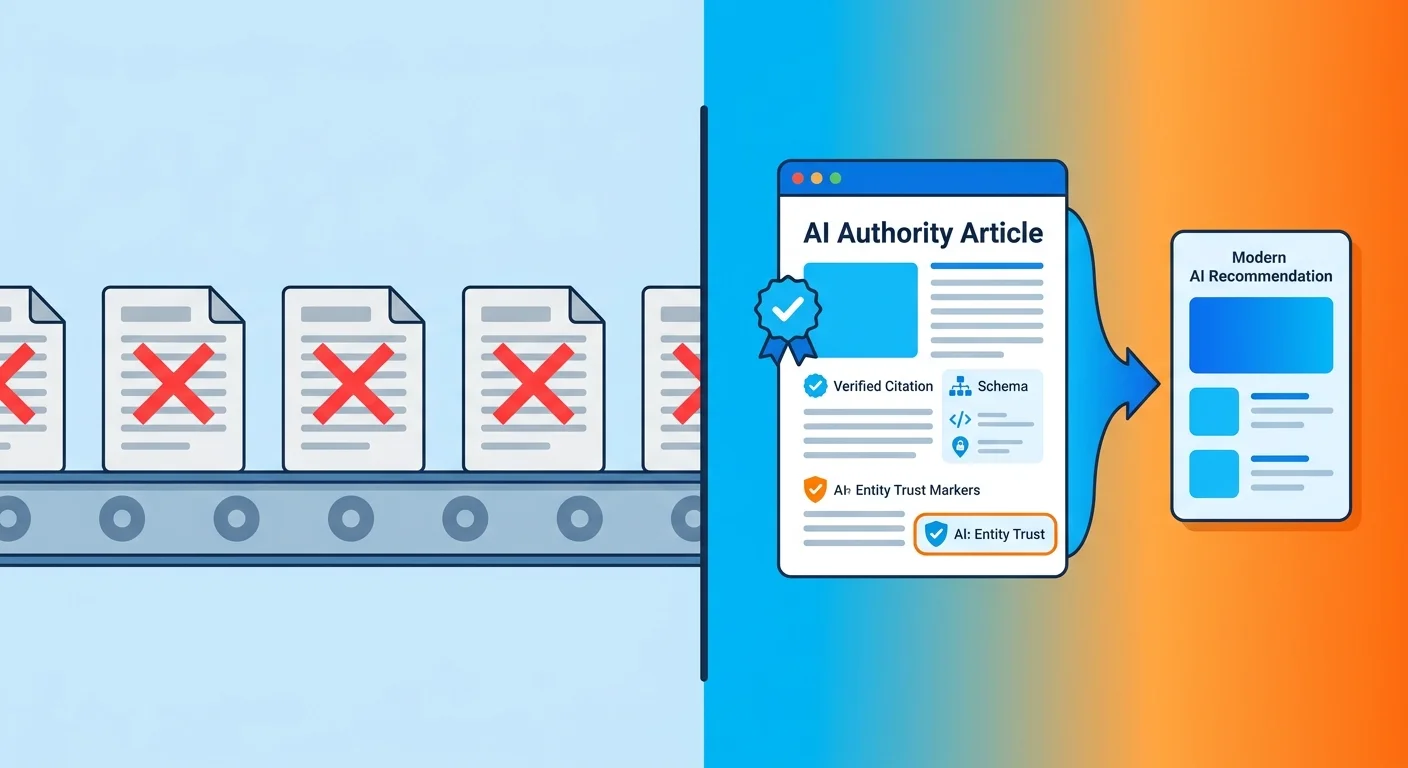
Here's what most agencies won't tell you: AI engines don't reward volume.
They reward verifiability.
A generic, un-cited article — no matter how polished or keyword-dense — registers as noise to a conversational engine that's actively hunting for structured proof of clinical credibility. There's no workaround for that. Either the proof is there, or the engine moves on.
That's a hard truth for practices that have been churning out commodity content for years. The articles exist. The publishing history exists. But if the content lacks Entity Clarity, Verified Citation Architecture, Semantic Density, and Consistent Publication Cadence, the engine has nothing reliable to evaluate.
No signal. No recommendation. No name in the answer.
A competitor who built their authority the right way gets the verdict instead. And that gap compounds every single month.
Over 70% of patients searching for medical solutions online already prioritize platforms with verified, expert-authored clinical voices. That number comes from PubMed — and published patient trust data shows that preference isn't softening.
Patients want proof. AI engines require it.
Commodity content doesn't meet that bar. It never did. AI engines are just making a gap that already existed impossible to hide.
Why High-Volume Content Mills Are the Wrong Prescription
High-volume content mills run on one assumption: more content equals more visibility.
That assumption was already shaky in traditional search.
In conversational AI, it's dead on arrival.
The problem isn't the volume. It's what's missing underneath it.
Mill-produced articles are built to match keyword patterns — not to establish who the provider is, what conditions they treat, or why any engine should trust their clinical positions. No verified citations. No entity reinforcement. Just words filling a page.
What that produces is a growing content library the engine simply can't use. Going deeper rather than broader is exactly what commodity mills are structurally incapable of delivering — and exactly what AI engines require.
Here's where it gets worse. The FTC's compliance framework requires that health-related claims be backed by competent and reliable scientific evidence.
Mill content almost never clears that bar. It hedges. It generalizes. It cites nothing.
When an AI engine is deciding whether a clinical voice is worth recommending — that absence of proof isn't a formatting problem. It's an automatic disqualifier.
That's why AI Authority content safety and compliance is a completely different conversation from commodity output. The standards aren't in the same category.
Medical LLMs already carry real risk of incomplete or inaccurate answers. Providers who flood the content space with un-verified, un-cited articles don't offset that risk. They add to it.
The stethoscope can only amplify a real signal. A mill can't manufacture one.
| Content Type | Volume Goal | Citation Depth | Entity Signals | AI Engine Response |
|---|---|---|---|---|
| Commodity Mill Content | Maximum output — frequency over depth | None — claims are unsubstantiated and generalized | Absent — no entity reinforcement, no clinical specificity | Ignored or deprioritized — no reliable signal to evaluate or cite |
| Keyword-Optimized Blog Articles | Rank-chasing — built around search patterns, not clinical proof | Minimal — occasional links, rarely verified clinical sources | Weak — provider identity is incidental, not structurally embedded | Low trust — content reads as generic, not authoritative enough to recommend |
| AI Authority Articles | Depth over volume — each piece builds compounding authority | Deep — every clinical claim backed by verifiable, cited proof | Strong — Entity Clarity, Semantic Density, and Verified Citation Architecture baked into every piece | High trust — engine can confirm identity, expertise, and evidence; names the provider |
| Unstructured Clinical Content (no schema, no citation) | Ad hoc — published without a structured authority framework | Inconsistent — evidence present in some pieces, absent in others | Fragmented — no Consistent Publication Cadence, no coherent entity signal | Unreliable — engine cannot confirm trustworthiness; provider stays invisible |
The Four Signals That Make a Clinical Voice Machine-Readable
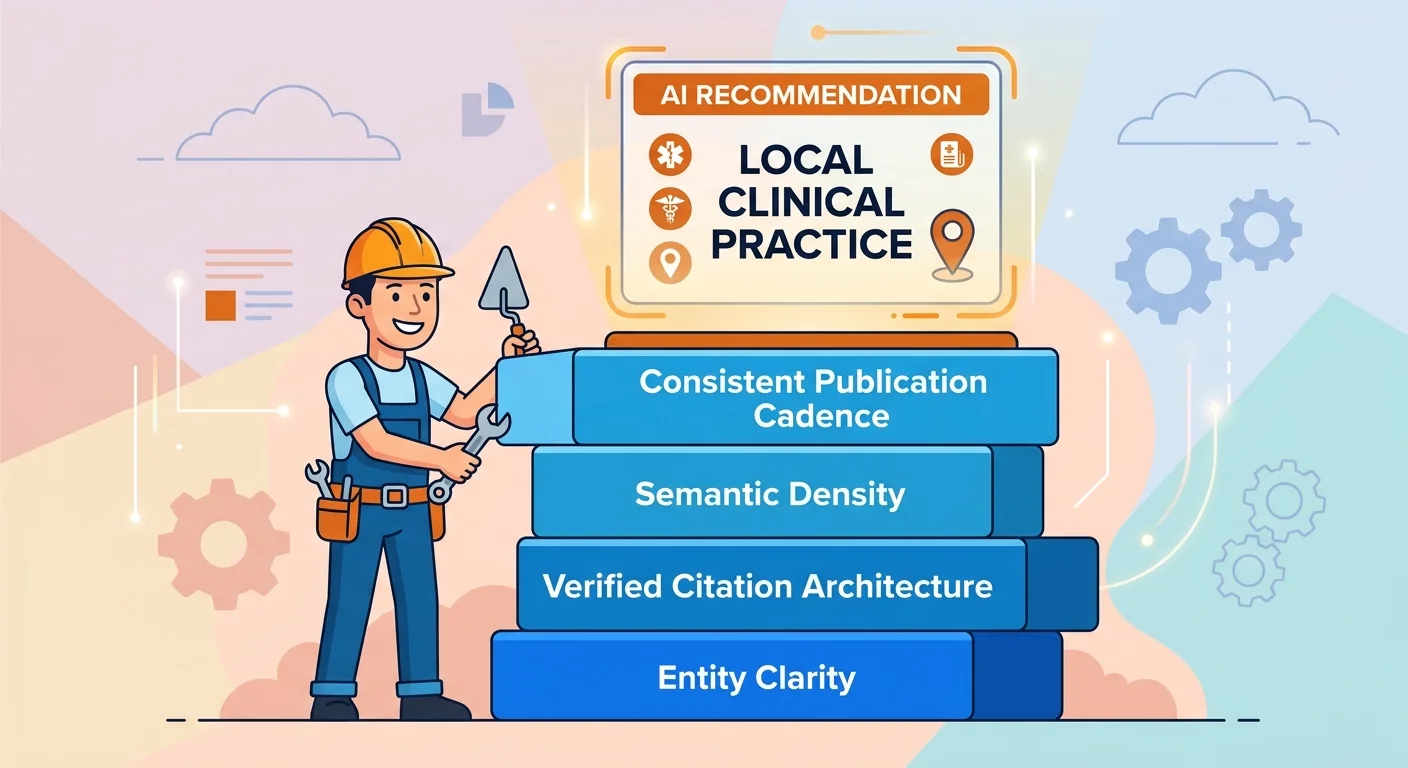
Four signals. Every piece of AI Authority Content is engineered to reinforce all four — at once, not in isolation.
Miss one and the engine has a gap. Miss two or three and your clinical voice doesn't register as trustworthy — no matter how many patients you've helped or how long you've been in practice.
Signal 1: Entity Clarity
Entity Clarity is the foundation. It answers the engine's most basic question: who is this provider, exactly? Not vaguely. Specifically. What conditions do they treat? What credentials do they hold? What clinical positions do they take? What geographic market do they serve?
When the engine can't answer those questions from your content, it defaults to whoever's entity is clearest. That's not always the most experienced clinician in the market. It's the one whose identity is most consistently and precisely structured across their digital presence. Experience doesn't win here. Clarity does.
The stethoscope doesn't create a heartbeat — it amplifies one that's already there. Entity Clarity works the same way. It takes the real clinical identity you already have and makes it legible to the engine, so relevant queries start returning your name.
Signal 2: Verified Citation Architecture
Verified Citation Architecture is what separates a clinical voice from an opinion. AI engines evaluating healthcare content aren't looking for confidence — they're looking for proof. Every clinical position needs to be anchored to a verifiable, credible source the engine can cross-reference. Without that, the claim doesn't exist as far as the engine is concerned.
This isn't a stylistic choice. PubMed-published research confirms that patient trust in conversational AI search engines depends directly on clear, expert-verified source citations. The engine applies the same standard. An uncited clinical claim doesn't register as authoritative. It registers as unverifiable — and to a conversational AI system, unverifiable is functionally the same as untrustworthy.
That's why citation architecture is a structural requirement — not a formatting preference. Every claim grounded. Every position verifiable. Every article reinforcing the provider's entity as a credentialed, trustworthy source. Build it that way from the start, or don't expect the engine to treat you as one.
Signal 3: Semantic Density
Semantic Density is about depth of coverage, not length of content. A semantically dense article covers a clinical topic completely — the conditions, the mechanisms, the treatment protocols, the contraindications, the patient considerations. When you do that well, the engine has no reason to look anywhere else for the answer.
PubMed-published research confirms it: structuring medical knowledge into machine-readable semantic schemas directly increases visibility in conversational AI systems. The engine doesn't reward thin coverage spread across many topics. It rewards complete coverage of focused ones — content that functions as a genuine clinical reference, not a surface-level overview. How AI Authority Content Creates Deeper, More Authoritative Healthcare Content is built on exactly that principle.
Here's the real-world proof: over 70% of patients searching for medical solutions online already prioritize platforms with verified, expert-authored clinical voices. Semantic Density is what makes a provider's content qualify as that kind of resource. It's the difference between an article that mentions a condition and one the engine trusts enough to cite.
Signal 4: Consistent Publication Cadence
Consistent Publication Cadence is the signal that tells the engine your clinical voice is still active. One well-structured article establishes a data point. The engine is looking for a pattern — and a pattern requires showing up more than once.
Cadence compounds. Each new AI Authority article reinforces your entity, expands your semantic footprint, and gives the engine more verified proof to pull from when a patient asks a relevant question. Stop publishing and the compounding stops. Authority signals don't vanish overnight — but they stop growing while competitors who kept going widen the gap every single month.
Consistent Publication Cadence isn't about content quotas. It's about maintaining the kind of active, verifiable clinical presence that conversational engines are built to trust. The practices that sustain it become the standing answer. The ones that stop become progressively harder to find — even when they're the most qualified option in the room.
| Signal | What AI Engines Evaluate | Content Requirement | Failure Mode Without It |
|---|---|---|---|
| Entity Clarity | Whether the provider's identity — conditions treated, credentials held, geographic market served, and clinical positions taken — is consistently and precisely structured across their content | Every AI Authority article must reinforce who the provider is, what they treat, and why they are the authoritative voice for that clinical niche | The engine defaults to whichever provider's entity is clearest — typically not the most experienced clinician, but the one whose identity is most legible to the AI |
| Verified Citation Architecture | Whether clinical positions are anchored to verifiable, credible sources the engine can cross-reference — not just stated with confidence | Every claim must be grounded in evidence the engine can evaluate; uncited clinical positions are treated as unverifiable, which conversational AI systems treat as untrustworthy | An uncited clinical voice registers as an opinion, not an authority — the engine has no proof structure to validate and no reason to recommend that provider over one who built citation architecture correctly |
| Semantic Density | Whether a clinical topic is covered completely enough — conditions, mechanisms, treatment protocols, contraindications, patient considerations — that the engine has no reason to look elsewhere for the answer | AI Authority articles must function as genuine clinical references, not surface-level overviews; depth of coverage on focused topics outperforms broad, thin coverage of many topics | Thin content signals incomplete authority; the engine routes patient queries to a provider whose content covers the topic fully, regardless of which clinician has deeper real-world expertise |
| Consistent Publication Cadence | Whether a provider's clinical voice is actively maintained over time — a pattern of ongoing, structured output rather than a single data point | Regular AI Authority article publication reinforces the provider's entity, expands their semantic footprint, and gives the engine a growing body of verified proof to pull from on patient queries | Publishing stops, compounding stops — authority signals plateau while competitors who maintained cadence continue to widen the gap, making the inactive provider progressively harder to find even when they are the most qualified option |
Who AI Authority Content Is Actually For — And Who It Isn't
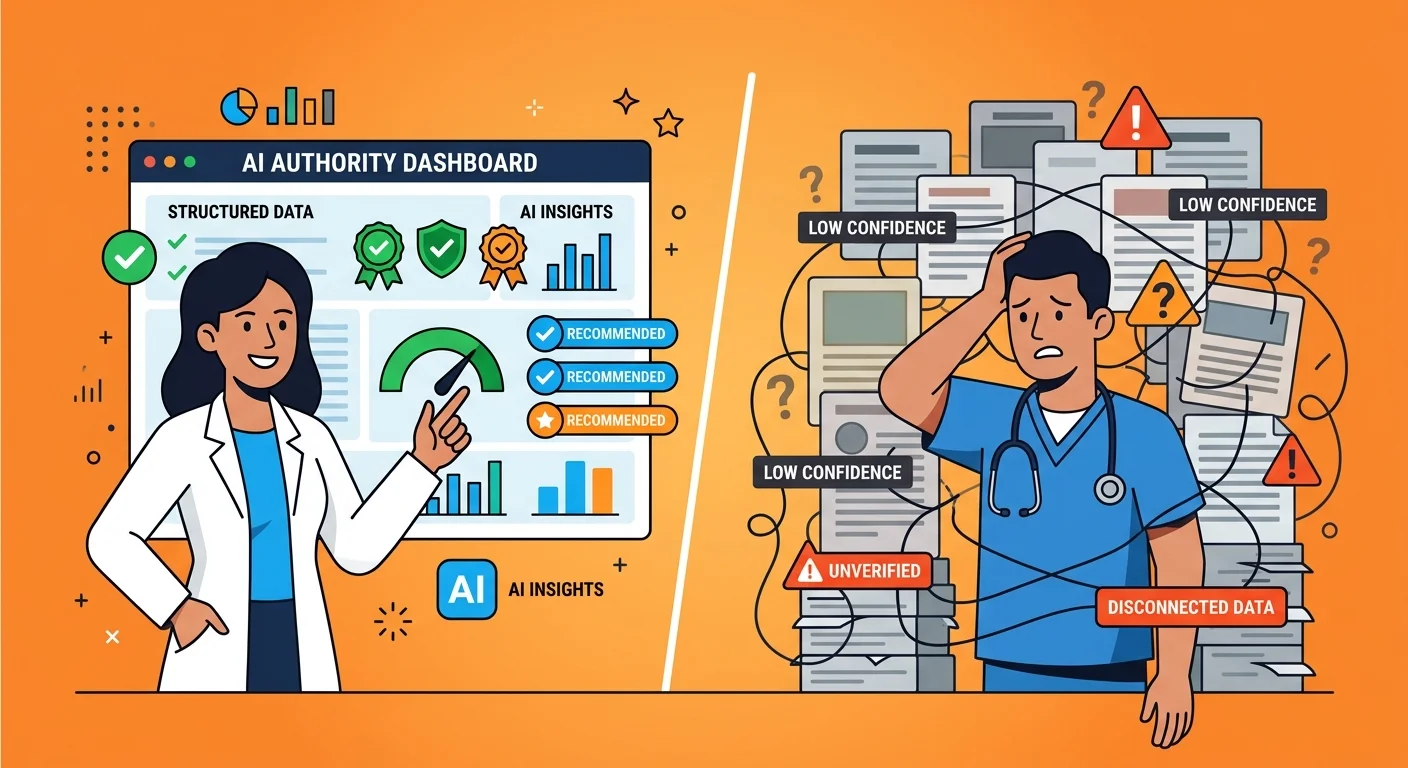
Not every practice is ready for this.
That's not a criticism. It's a filter.
AI Authority Content isn't a volume play. It's a structured authority build.
It requires a real clinical voice to amplify, a commitment to verified proof over generic opinion, and the patience to let compounding do its work. Pew Research found that 60% of Americans already feel uncomfortable when healthcare providers lean too heavily on AI — which means the practices that win won't be the ones pushing the most automated output. They'll be the ones whose genuine clinical expertise is the most clearly, consistently, and verifiably structured for the engines now making the calls.
The stethoscope metaphor holds here. A stethoscope amplifies the signal that's already there — it doesn't create one.
This works the same way. It takes real clinical expertise and makes it legible to the engine. But if the clinical signal isn't there — the credentials, the specific positions on patient care, the genuine depth — there's nothing to amplify. That's not a content problem. That's a different problem entirely, and no amount of structured output fixes it.
The Practices That Win With This Approach
The practices that win with this approach have already done the hard part.
They've built real clinical depth in their market. They hold specific positions — on treatment protocols, on the conditions they specialize in, on patient outcomes — and they can back those positions with verifiable evidence. They're not trying to serve every patient with every complaint. They know exactly who they treat and why they're the right clinician for that patient.
And they're done paying for content that doesn't compound.
They've watched generic output pile up without producing the AI visibility that turns into patient bookings. They're ready to do it differently. For providers who want to understand what that looks like in practice, a clear 3-step framework breaks the build into sequenced, manageable moves — without requiring the clinician to become a content strategist.
That's who AI Authority Content was built for.
Not the biggest budget in the market. The real clinical signal — and the infrastructure that gives the engine every reason to hear it, trust it, and repeat it.
If This Sounds Like Too Much, It Probably Is — For You
If you're looking to flood your schedule in the next 60 days, this isn't it.
Authority is built in layers. The FTC's compliance framework requires that health-related claims be substantiated through competent and reliable scientific evidence — and real authority content holds itself to that standard by design. That takes time, structure, and a willingness to build something that lasts instead of something that just looks busy.
If that timeline doesn't fit your decision framework, that's a fair answer. But if you're a provider who's tired of content that disappears the moment you stop paying for it — and ready to build authority that actually compounds — the AEO Content Strategy library is a solid place to understand what that build looks like from the inside.
This isn't for the practice that wants to set it and forget it. It isn't for the provider who distrusts AI entirely, or the one who thinks a single strong article closes the gap.
It's for the clinician who already knows conversational engines are naming someone in their market — and has decided they'd rather be that name than spend another month wondering why they're not.
| Practice Profile | Readiness Indicator | Authority Outcome | Wrong Fit Signal |
|---|---|---|---|
| The Specialized Clinician | Has deep expertise in a defined condition set and can articulate specific clinical positions backed by evidence | AI engines recognize a clear, consistent entity — practice name surfaces in relevant patient queries over time | Wants to rank for every condition in their specialty without prioritizing any of them |
| The Evidence-Driven Practitioner | Already grounds clinical communication in verified sources and expects content to meet the same standard | Verified Citation Architecture builds compounding trust signals — each article reinforces the entity as a credible, citable voice | Expects generic content volume to substitute for substantiated clinical depth |
| The Authority-Minded Builder | Understands that compounding takes time and has stopped optimizing for short-term content output | Consistent Publication Cadence expands semantic footprint — authority signals grow with each new AI Authority article | Needs measurable ROI within weeks or requires a contractual guarantee before committing |
| The Done-With-Commodity Provider | Has tried high-volume content approaches and watched them produce visibility metrics without patient trust or bookings | Structured AI Authority Content replaces accumulated noise with a coherent, machine-readable clinical identity | Is still evaluating whether AI search is real enough to warrant a change in approach |
How to Audit Your Current Clinical Content for Authority Gaps
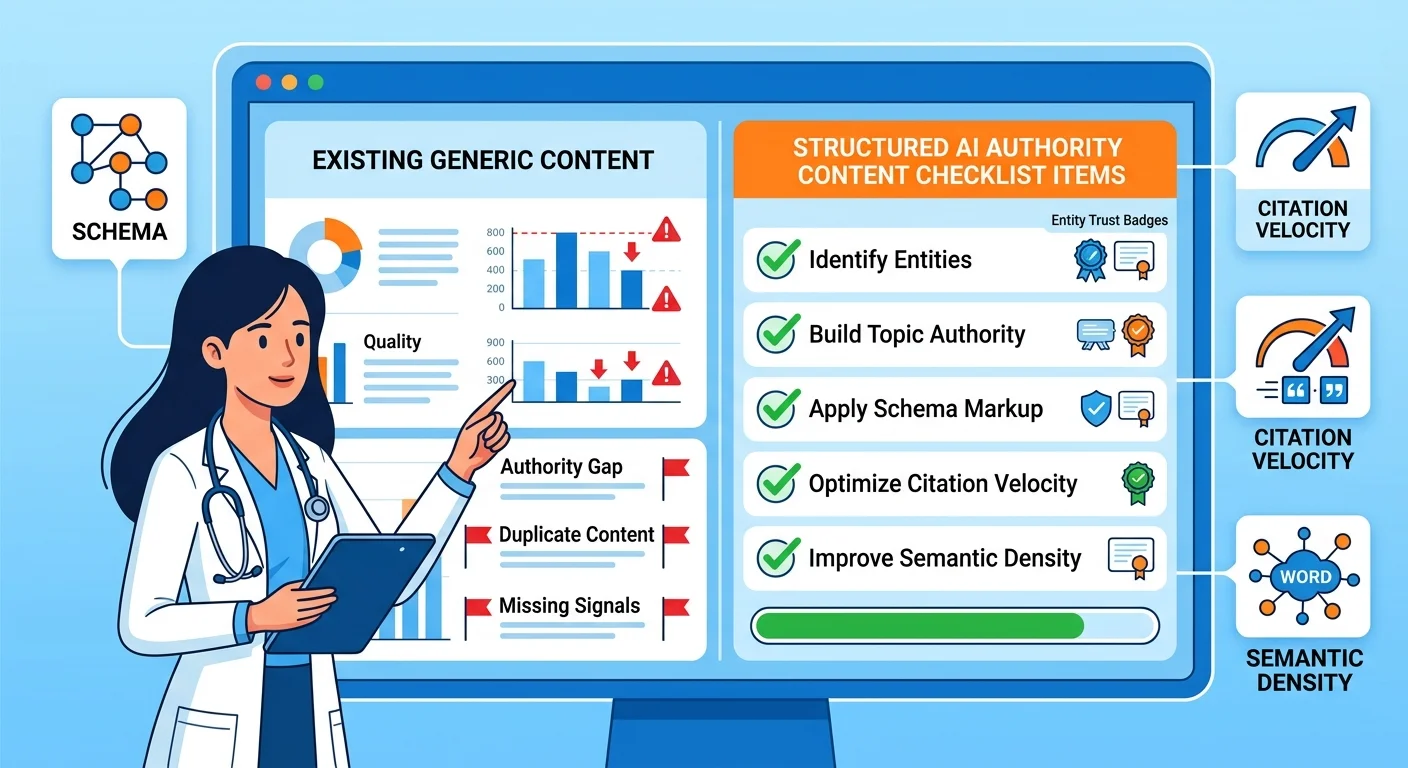
Here's the step most providers skip entirely.
Before you build authority, you need to know what's already there — and what isn't.
An authority audit isn't complicated. But it's uncomfortable.
It forces you to look at whether your existing clinical content actually functions as a trust signal to a conversational engine — or whether it's just sitting there, taking up space, doing nothing.
Here's the thing — you can't amplify a signal that the engine can't detect.
The audit tells you whether your clinical voice is coming through clearly, whether it's muffled, or whether the engine is picking up nothing at all. Those three outcomes require three completely different responses.
The Three Questions Every Clinician Should Be Able to Answer
Three questions cut straight to the authority gap.
If a clinician can't answer all three — with evidence behind each one — their content isn't building entity trust. It's just accumulating.
First: can a conversational engine identify exactly who you are, what you treat, and what market you serve — from your content alone?
Entity Clarity requires specificity. Broad strokes don't register. If your content reads like it could describe any provider in your specialty, the engine can't confidently attach your name to a patient's query.
Second: are your clinical positions verifiably sourced? Patient trust in conversational AI search depends directly on expert-verified citations. State a clinical position without anchoring it to credible, cross-referenceable proof, and the engine treats that position as unverifiable. An unverifiable claim is functionally invisible — it doesn't matter how accurate it is.
Third: is your content still active? Entity trust built six months ago doesn't sustain itself. Consistent Publication Cadence is what tells the engine your clinical voice is current — not archived and abandoned.
What the AI Visibility Check Actually Reveals
The AI Visibility Check surfaces exactly what a conversational engine sees — and what it doesn't — when a patient asks who to trust in a provider's market.
It's not a ranking report. It's a real-time read of whether your entity is registering as authoritative across ChatGPT, Gemini, and Grok.
What it reveals is almost always a gut-check.
Most providers find the engine either can't identify them specifically, can't verify their clinical positions, or hasn't seen enough consistent structured content to treat them as an active authority presence. That's not a content volume problem. It's an Entity Clarity, Verified Citation Architecture, and Semantic Density problem — three different gaps that need three different fixes.
Knowing which one is widest tells you exactly where to build first.
Pew Research found that 60% of Americans already feel uncomfortable when healthcare providers lean too heavily on AI. That number matters here. The practices that earn trust in this environment won't be the ones publishing the most.
They'll be the ones whose clinical signal is the clearest, the most consistently structured, and the most verifiably grounded.
The AI Visibility Check tells you exactly how far your current content is from that standard — and where the gap is most urgent to close.
| Audit Area | What to Examine | Healthy Signal | Red Flag |
|---|---|---|---|
| Entity Clarity | Does your content identify who you are, what you treat, and what market you serve — specifically and consistently across every article? | A conversational engine can attach your name, specialty, and geographic market to a patient query without ambiguity | Content reads like it could describe any provider in your specialty — no specific identity signal the engine can anchor to |
| Verified Citation Architecture | Are your clinical positions sourced to credible, cross-referenceable evidence — or do they stand as unsupported assertions? | Every clinical claim links to verifiable institutional proof that a conversational engine can independently cross-reference | Clinical positions stated without sourcing — the engine treats unverifiable claims as invisible regardless of their accuracy |
| Semantic Density | Does each piece of content go deep on a specific condition, treatment, or patient outcome — or does it skim across multiple topics at surface level? | Articles function as genuine clinical references — specific, layered, and structured around a single authoritative topic | Content mentions a condition without clinically explaining it — broad overviews that no engine would trust enough to cite |
| Consistent Publication Cadence | Is your clinical content still active and growing — or is there a publishing gap that signals an archived, inactive presence? | A steady, structured pattern of new AI Authority articles that expands the provider's semantic footprint over time | A cluster of older articles with no recent additions — the engine sees a snapshot, not an active clinical voice |
Frequently Asked Questions About AI Authority Content
These are the questions you ask after you've already decided commodity content isn't the answer.
Not the basics. The ones that come when you're done wondering and ready to build.
These aren't theoretical. Compliance concerns, edge-case objections, implementation realities — the stuff the article body didn't have room to fully unpack.
They build on each other. Read them that way.
What is AI Authority Content, and how does it differ from standard SEO blogging?
The core difference isn't topic or length. It's architecture.
Standard content volume plays are built to match keyword patterns. AI Authority articles are built around four signals conversational engines use to determine whether a clinical voice is trustworthy enough to name: Entity Clarity, Verified Citation Architecture, Semantic Density, and Consistent Publication Cadence.
Generic content accumulates. AI Authority Content compounds. One occupies space. The other builds a position the engine will defend every time a patient asks who to trust.
How do conversational search engines like ChatGPT and Gemini evaluate a clinician's online authority?
They don't rank it. They evaluate it for trust.
PubMed-published research confirms it: patient trust in conversational AI search depends directly on expert-verified source citations. The engine isn't asking whether your content is popular. It's asking three things — is this clinical voice identifiable, is it verifiably sourced, and is it consistently present?
If your content can't answer all three — clearly, structurally, in machine-readable form — the engine won't name you. It'll name whoever's content can.
Is AI Authority Content safe from regulatory and compliance risk for healthcare providers?
Yes — but only when it's built correctly.
The FTC's Health Products Compliance Guidance requires that health-related claims be substantiated through competent and reliable scientific evidence. AI Authority Content holds itself to that standard by design. Every clinical position is anchored to verified, cross-referenceable proof.
That's not a workaround for compliance. That's what genuine Verified Citation Architecture looks like in practice.
The risk isn't in the approach. It's in cutting that standard and calling it a content strategy anyway.
Why do high-volume content mills fail to build genuine entity trust for clinical practices?
Because volume isn't a trust signal.
Conversational engines aren't counting articles. They're evaluating whether a clinical entity is specific, verifiable, and consistently active. Mill-produced content reads the same regardless of which provider it's attached to — and that's exactly the problem.
Harvard Health has documented what's already clear to anyone paying attention: medical chatbots and LLMs frequently produce incomplete answers. Engines compensate by prioritizing content with clear expert authorship and structured citation over content that's merely plentiful.
A content mill can produce noise. It can't build Entity Clarity.
How does the AI Visibility Check help a practice identify its recommendation gaps?
It tells you what a conversational engine actually sees — and what it doesn't — when a patient asks who to trust in your market.
Most providers find one of three gaps: the engine can't identify them specifically, can't verify their clinical positions, or hasn't seen enough structured content to treat them as an active authority. PubMed-published research confirms that structuring medical knowledge into machine-readable semantic schemas directly increases visibility across conversational AI systems like ChatGPT, Gemini, and Grok.
The check shows you exactly how far your current content sits from that threshold.
It's not a ranking report. It's a real-time read of your authority gap — and knowing which gap is widest tells you exactly where to build first.
The Signal Was Always There
Here's the thing about a stethoscope — it doesn't create the heartbeat. It amplifies a signal that was already there.
That's exactly what AI Authority Content does. It doesn't manufacture clinical credibility you don't have. It takes the real expertise, the verified positions, the genuine clinical depth you've spent years building — and structures it so conversational engines can actually detect it, trust it, and say your name when a patient asks who to see.
Entity Clarity, Verified Citation Architecture, Semantic Density, Consistent Publication Cadence — none of it works if the underlying clinical voice isn't real. That's the part no infrastructure build can fake.
But when the voice is real and the infrastructure is built correctly? The engine doesn't have to guess. It has everything it needs to name you with confidence.
That's the difference between a practice that shows up in conversational search and one that's technically qualified but functionally invisible. The expertise isn't the gap. The structure is.
Your clinical signal has always been there. The real question is whether a conversational engine can hear it.
If it can't — that's not a credibility problem. It's an infrastructure problem. And infrastructure can be built.
ITech Valet builds it. The only question is whether you build it before your competitor does. A stethoscope amplifies the signal that's already there — it doesn't create one.
Your clinical signal is already there. The only question is whether ChatGPT, Gemini, and Grok can actually find it — or whether a competitor is getting named instead of you. The AI Visibility Check shows you exactly what those engines see when a patient asks who to trust in your market, and where your gap is widest.

621 Enterprises, Inc. | Copyright 2026 | All rights reserved