
Future-Proofing Your Practice: Why Foundation Models Are Changing Patient Education
Foundation models are large-scale AI systems trained on massive datasets — medical literature, clinical notes, patient interaction records — that generate human-like answers to health queries. When a patient asks an AI engine about their symptoms, their treatment options, or what a chiropractic adjustment actually does, a foundation model produces the answer. That answer is now the patient's first point of education.
The new patient pamphlet is a machine-generated verdict.
This shift is not speculative. On January 18, 2024, the World Health Organization released formal guidance outlining over 40 specific recommendations governing how large multi-modal AI models should be developed and deployed in healthcare settings. That is not a minor footnote. It is a regulatory signal that foundation models have moved from experimental to institutional.
For medical practices, the stakes are immediate. Generative AI has demonstrated the potential to address significant operational burdens across healthcare — with projections ranging from $200 billion to $360 billion in potential annual savings through documentation automation and administrative efficiency. But the more urgent issue for clinicians is not administrative. It is educational.
When a patient turns to a conversational AI engine and asks who to trust, what to expect, or how a treatment works, the foundation model renders a verdict. That verdict is built from the data it was trained on and the authoritative sources it can verify. Clinical evaluations confirm that patient-facing content from generic AI systems requires expert human oversight to ensure accuracy. The risk is not that AI produces wrong answers on purpose — it is that AI cites whatever it can confirm.
Harvard Medical School researchers have noted that AI systems can bridge patient health literacy deficits by translating complex medical terminology into accessible formats. But that translation only includes the sources the model trusts.
For a medical practice to remain visible in the post-search era, its clinical knowledge must be structured, verified, and readable by the AI engines that now govern patient education.
Last Updated: July 10, 2026
- • What Foundation Models Actually Are (And Why Your Patients Already Use Them)
- • How Foundation Models Deliver Patient Education Right Now
- • What Makes Clinical Knowledge AI-Readable
- • The Regulatory and Safety Landscape Practices Can't Ignore
-
• Frequently Asked Questions About Foundation Models and Patient Education
- • What is a foundation model in healthcare?
- • How do medical foundation models change traditional patient education?
- • Are AI-generated health education materials safe for my chiropractic patients?
- • Why does my medical practice need specialized AI-readable infrastructure?
- • How does clinical AI authority prevent answer engine hallucinations?
- • What is the difference between a generic AI response and a validated clinical answer?
- • The Clinic Pamphlet Is Gone — What You Build Next Decides Who Gets Cited
What Foundation Models Actually Are (And Why Your Patients Already Use Them)
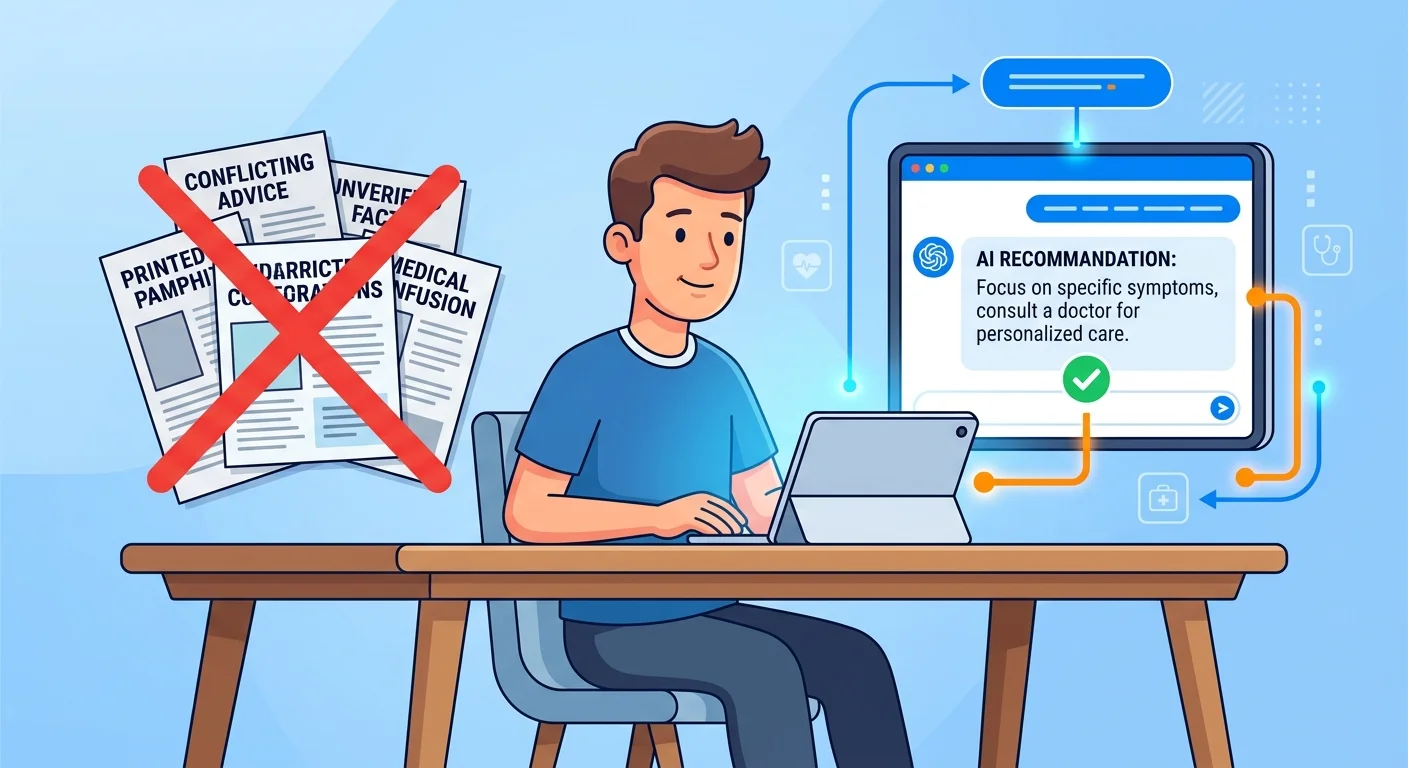
Here's what a foundation model actually is. A large-scale AI system trained on an enormous volume of text — medical literature, clinical notes, research abstracts, patient records — until it can generate human-like answers to nearly any health question a patient asks. Not summaries. Not links. Answers.
That capability is already in your patients' hands. When someone types "what does a chiropractic adjustment actually do" into ChatGPT or Gemini, a foundation model answers in seconds. No list of links. A verdict.
That verdict is now the first point of patient education. Not a pamphlet. Not a brochure your front desk hands out. The foundation model answers first — and for most patients, it answers last.
From Search Results to Conversational Verdicts
The shift from search to conversational AI isn't a trend worth monitoring. It's already the default for a growing share of patients asking health questions. Traditional search handed back a ranked list. Patients clicked, compared, and decided. That process gave your clinic a shot at being chosen.
Conversational AI collapsed that entire process into one response. There's no page two. There's no "here are ten results, take your pick." There's a verdict. And that verdict either includes your practice's expertise or it doesn't.
NIH performance evaluations of AI systems answering medical inquiries confirm that patients find these responses clear and credible. That's exactly the problem. The model is confident whether or not your clinic's clinical expertise is actually in its source pool. It doesn't hedge. It doesn't say "I'm not sure about this practice." It just answers. And your expertise either shows up in that answer or it doesn't exist as far as the patient is concerned. That's the engine behind the AI content paradigm shift that has accelerated so sharply — the content foundation models trust is a fundamentally different category from anything traditional online publishing ever produced.
Why the Old Patient Education Channel Is Already Obsolete
The printed pamphlet wasn't a bad idea. It was the right tool for the era it served. Patients came in, got educated by a clinician or a handout, left with something tangible. That channel worked because it was the only channel.
That era is over. Harvard Medical School researchers have highlighted that AI can bridge patient health literacy deficits by translating complex clinical terminology into accessible formats. And it's doing that translation automatically, at scale, every time a patient asks a question — right now, without your involvement. The problem isn't that AI is doing the translating. The problem is that it can only translate what it can verify.
So if your clinical expertise isn't structured into machine-readable, entity-verified digital assets, the foundation model can't confirm it exists. And it won't include it. The pamphlet era required you to hand information to patients directly. The foundation model era requires you to build infrastructure that hands your expertise to the AI first — before the patient ever asks the question.
| Patient Education Channel | How It Worked | Who Controlled the Message | Current Status |
|---|---|---|---|
| Printed pamphlet / handout | Clinician or front desk staff distributed materials at the point of care | The practice — content was written, printed, and delivered by the clinic | Obsolete as a first-contact education channel — patients seek answers before they ever walk in |
| Practice brochure / direct mail | Mailed or displayed in-clinic to introduce services and establish credibility | The practice — messaging was curated and brand-controlled | Largely ignored — patients now query AI engines before contacting a clinic |
| Traditional search results | Patients searched keywords and evaluated a ranked list of pages to find answers | Shared — clinics competed for visibility across many results | Declining — conversational AI collapses the ranked list into a single verdict |
| Healthcare directory listings | Patients browsed platforms to compare providers by rating, location, and specialty | Partially shared between the platform and the practice | Still active but subordinate — foundation models now synthesize and cite directory data as one input among many |
| Conversational AI / foundation model | Patient asks a natural-language health question and receives a single synthesized answer instantly | The AI engine — answer is generated from verified, machine-readable sources the model trusts | The dominant first-contact education channel — the verdict that shapes patient expectations before any clinical interaction |
How Foundation Models Deliver Patient Education Right Now

Foundation models didn't supplement the patient education pipeline. They replaced it.
The printed pamphlet had one job: get your clinical expertise into a patient's hands before they left the building. Foundation models do the same job. But they do it before the patient ever picks up the phone to book. They intercept the question at 10pm, generate an answer, and deliver a verdict. Your practice either fed that verdict or it didn't.
This isn't a trend worth monitoring from a distance. It's already running inside the patient workflow — from initial symptom search to post-appointment follow-up questions. The practices that recognize this early are building infrastructure that puts their clinical expertise inside those answers. Everyone else is waiting for a pamphlet era that isn't coming back.
The Mechanism: How AI Answers a Health Question
Here's what actually happens. A patient has a health question at 10pm. No one to call. They open ChatGPT or Gemini and type it in plain language — not a search query, not a keyword string. A real question, the way they'd ask their doctor.
The foundation model pulls from its training data — medical literature, clinical evaluations, peer-reviewed research, and any entity-verified content it can confirm as authoritative. It synthesizes all of that into one conversational response. No ranked list. No links to skim. One direct answer in plain language. That's the whole process — and it happens before your front desk opens in the morning.
That synthesis is also where your practice either shows up or doesn't. If your clinical expertise has been structured into getting started with AI authority content that AI engines can verify, the model draws from it. If it hasn't, the model treats your practice as if it doesn't exist. Because from its perspective, it doesn't.
Why Generic AI Content Puts Patients at Risk
Here's what should keep every clinician up at night: foundation models are confident whether or not they're right.
Published clinical analysis confirms that patient-facing content from generic AI systems requires active human expert oversight to catch factual and clinical inconsistencies. The model doesn't flag uncertainty the way a cautious clinician would. It answers with the same confident tone whether it's drawing from rigorously validated research or from low-quality, uncited training data. The patient can't tell the difference. That's the problem.
And scale doesn't fix it. Multi-modal clinical evaluations show that large language models demonstrate genuine utility across medical processing tasks — but they must be continuously validated against trusted professional frameworks to stay clinically safe. That validation burden can't live entirely inside the AI. It has to be built into the content infrastructure the model draws from. So your practice's published clinical content has to clear a higher bar than a generic article or a social media post. Full stop.
The risk isn't that AI will eventually get healthcare wrong. The risk is that it already is — and patients can't tell the difference. Practices relying on unvalidated AI-generated content, or that haven't structured their clinical expertise into machine-readable assets, are feeding the exact problem they're hoping to avoid. That's why AEO Content Writing Services exist: because this gap widens every month it goes unaddressed.
| Query Type | What the Foundation Model Does | Clinical Risk Level | Infrastructure Requirement |
|---|---|---|---|
| Symptom inquiry (e.g., "is my back pain serious?") | Synthesizes training data into a plain-language verdict — no links, no ranked results, one answer | High — model answers with equal confidence regardless of source quality | Practice's clinical explanations must be structured into entity-verified, machine-readable content assets |
| Treatment question (e.g., "what does a chiropractic adjustment actually do?") | Draws from medical literature and any authoritative content it can verify — generates a conversational explanation | Moderate to High — generic or unverified training data may produce plausible but clinically inaccurate responses | Detailed, expert-authored clinical content published in formats AI engines can parse and confirm as authoritative |
| Provider trust query (e.g., "who is the best chiropractor near me?") | Renders a recommendation based on entity signals, structured data, and verified authority indicators it has on file | Low clinical risk — high visibility risk for practices with weak or absent entity infrastructure | Robust Entity Trust signals: consistent NAP data, schema markup, and a library of validated authority content |
| Post-appointment follow-up (e.g., "what should I expect after my adjustment?") | Answers from its existing knowledge base — your practice's specific aftercare protocols are included only if they've been published in AI-readable form | Moderate — generic aftercare advice may conflict with a practice's specific clinical approach | Practice-specific clinical guidance published as structured, entity-linked digital assets the model can attribute back to the source |
| Condition comparison (e.g., "chiropractic vs. physical therapy for herniated disc") | Synthesizes a comparative verdict from whatever authoritative sources it has confirmed — favoring practices with the strongest entity presence | Moderate — incomplete or unverified comparative content skews the model's verdict toward better-structured competitors | Authoritative, peer-supported comparative content built around the practice's clinical methodology and structured for AI extraction |
What Makes Clinical Knowledge AI-Readable
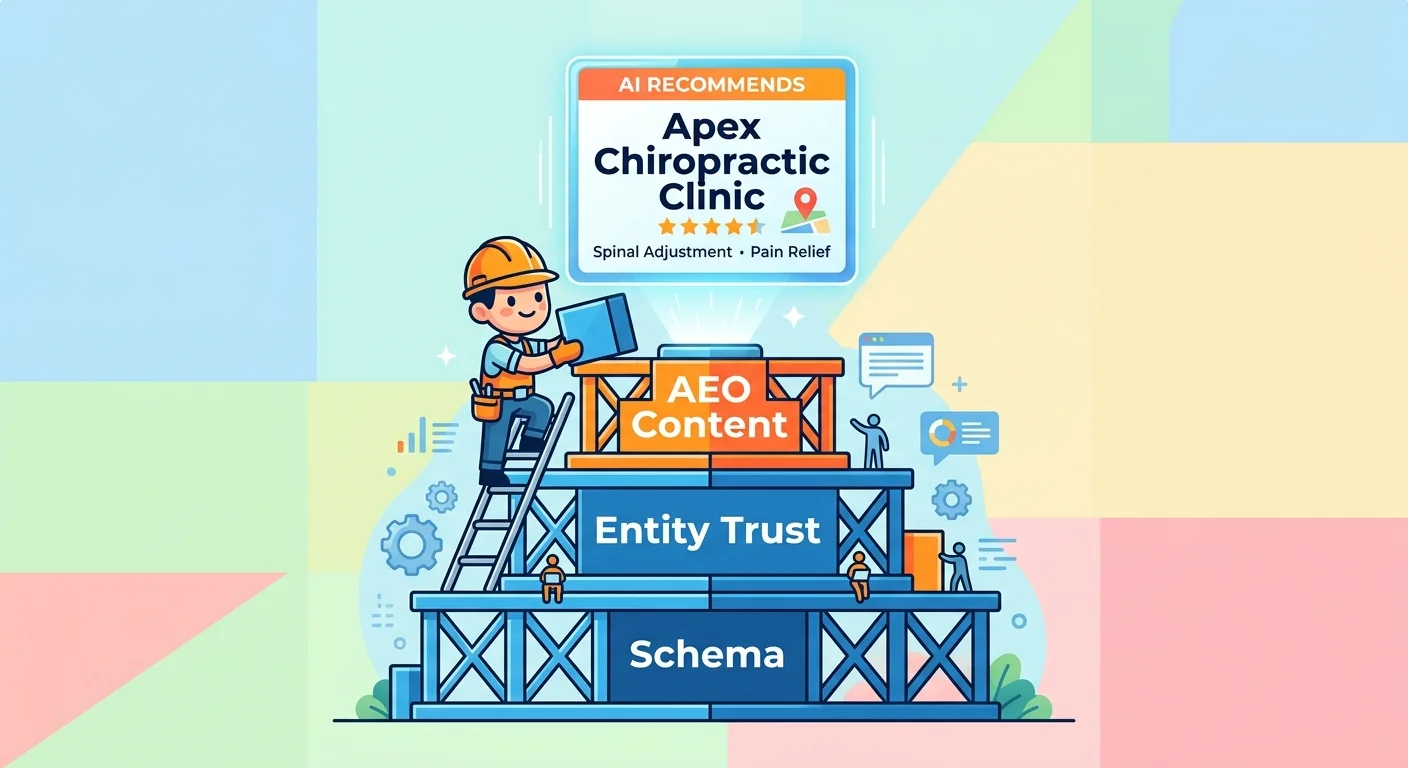
Foundation models are already sourcing patient education. That's settled. The only question left is whether your clinical expertise is structured so they can actually find it.
Most practices have real clinical knowledge. Hard-won, validated, built over years of patient care.
But that expertise lives in the clinician's head, in printed handouts, in appointment notes, in hallway conversations. None of that is machine-readable. None of it feeds the systems answering your patients' questions at 10pm. The knowledge exists. The AI can't confirm it.
The World Health Organization released its AI-in-health guidance on January 18, 2024 — over 40 specific recommendations — and the message is not subtle: the bar for AI-sourced clinical content is rising.
That bar isn't loosening. It's tightening. Generic content doesn't qualify. Verified, entity-anchored clinical authority does. Practices that aren't building toward that standard aren't standing still — they're getting quieter by default.
Entity Trust: The Signal Foundation Models Actually Measure
Entity Trust is the signal foundation models actually measure.
Not how many articles you've published. Not how long your practice has been open. Whether the AI can independently verify you are who you say you are — and that your clinical claims align with sources it already trusts. That's the gate.
Published clinical evaluations confirm it: patient-facing content from generic AI systems needs active expert oversight to catch factual and clinical errors.
Here's the problem the evaluations don't spell out clearly enough. The model doesn't distinguish between a licensed clinician's validated protocol and a random wellness post — not unless the content infrastructure signals that difference explicitly. Entity Trust is how you make that signal unmistakable. Without it, your expertise and everyone else's noise look identical to the model.
Large language models have real clinical utility. They also require continuous validation against trusted professional frameworks to stay safe — and that validation can't be bolted on after the fact.
It has to be built into the content itself. Practices that publish structured, expert-verified clinical knowledge give foundation models a trusted source to draw from.
Everyone else feeds the noise.
This Is Not for Every Practice
This isn't for every practice. And it shouldn't be.
If you want a quick content fix, a template article, or a flood of new bookings by next month — stop reading. That's not this.
Building AI-readable clinical authority means committing to structured, verified, expert-anchored content that compounds over time. It's the kind of ongoing execution that high-volume content mills can't replicate. And quantity without Entity Trust doesn't register with foundation models. At all.
But if you've watched a competitor get named by AI engines while your expertise stays invisible — if you're tired of running a practice that can't be confirmed — then the infrastructure question isn't optional anymore.
The pamphlet era handed expertise directly to patients. The foundation model era requires you to hand it to the AI first. That's not a philosophical shift. It's an operational one.
The practices moving early are compounding. Everyone else is waiting for an era that isn't coming back.
| Infrastructure Element | What It Signals to AI | Without It | With It |
|---|---|---|---|
| Structured clinical entity data | That a licensed, credentialed practitioner with a defined specialty is the source — not an anonymous content producer | Foundation models treat the practice as an unverified entity and exclude it from sourced answers | Foundation models can confirm the practice's identity and weight its clinical content as authoritative |
| Expert-verified clinical claims | That the published knowledge aligns with peer-reviewed frameworks AI engines already trust | AI treats the content as equivalent to generic wellness content — low-trust, low-citation priority | AI draws from the content as a validated source, surfacing it in patient-facing answers |
| Machine-readable content architecture | That the clinical knowledge is organized, semantically clear, and built for AI extraction — not just human reading | The content exists online but is invisible to the systems that synthesize patient education at scale | Foundation models can parse, verify, and cite the clinical expertise in direct, conversational responses |
| Consistent entity signals across published assets | That the practice's identity, specialty, and authority are reinforced across every piece of published content — not just one page | Entity Trust stays fragmented; AI engines can't confirm the practice's scope or credibility with confidence | Entity Trust compounds with every published asset, deepening the model's confidence in citing the practice |
| Ongoing content execution | That the practice is an active, current clinical authority — not a dormant source with outdated information | Foundation models deprioritize the practice over time as fresher, more frequently updated sources compete for the same answers | The practice's authority compounds continuously, widening the gap between its AI visibility and that of inactive competitors |
The Regulatory and Safety Landscape Practices Can't Ignore
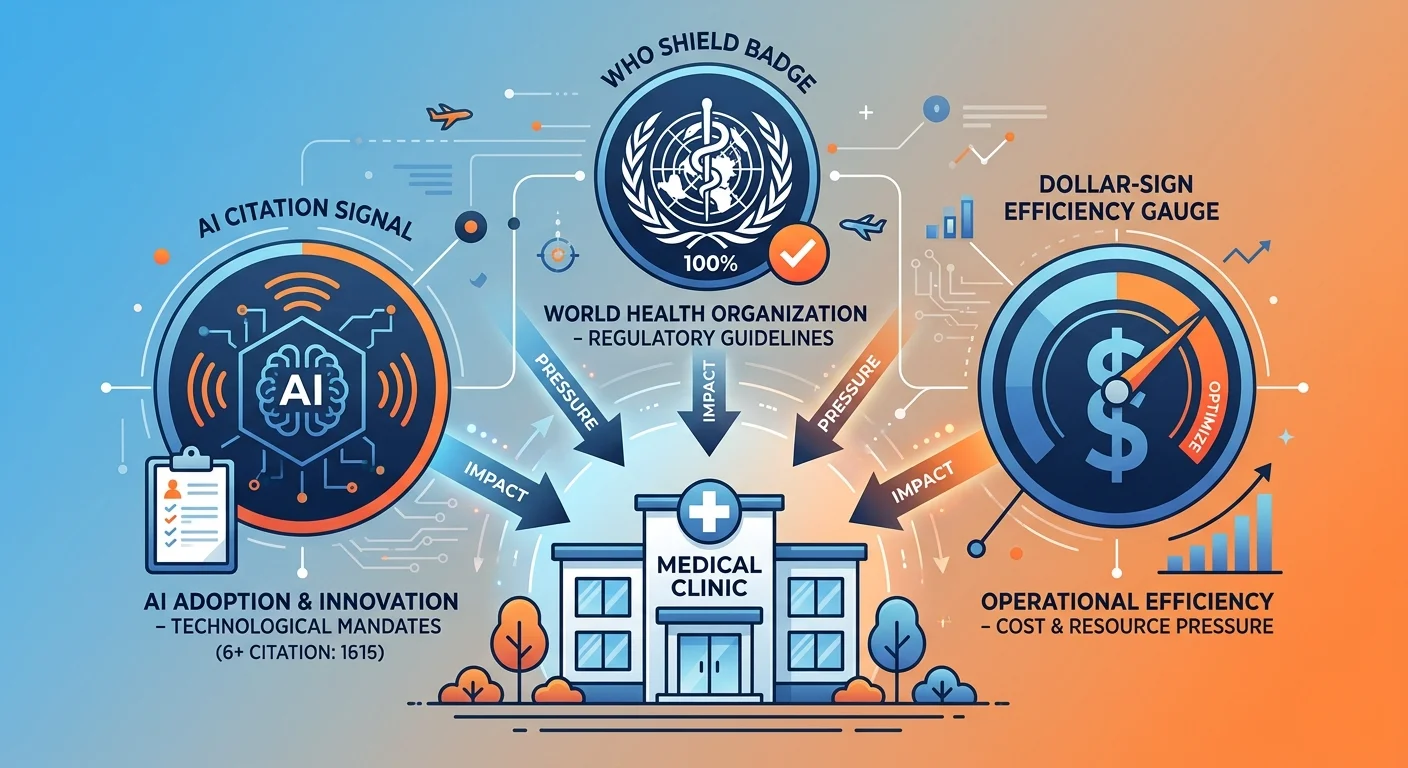
Regulation isn't on its way. It's already here — and most practices haven't noticed.
On January 18, 2024, the World Health Organization released formal guidance on AI in health — outlining over 40 specific recommendations covering ethical deployment, clinical oversight, and accountability frameworks for large multi-modal models. That's not a draft position paper. That's the global health community drawing lines around what foundation models are allowed to do and how the content they source must be structured.
Practices without verified, entity-anchored clinical infrastructure aren't just invisible to AI engines. They're structurally unprepared for what's coming.
What the WHO Guidance Actually Requires
Here's what the World Health Organization's framework actually goes after: the gap between what foundation models are doing with clinical information right now and what responsible deployment looks like. Data quality standards. Sourcing disclosure. Accountability structures that must exist when AI-generated health content reaches a patient. That's not philosophical. That's operational.
That bar isn't holding steady. It's rising. And practices whose published knowledge isn't verified, expert-anchored, and machine-readable don't get a warning when they get filtered out of compliant AI responses — they just disappear. What separates content that survives that filter from content that doesn't is exactly what deeper and more authoritative clinical publishing means in this environment.
Run the AI Visibility Check and you'll see this playing out right now. The foundation models deciding what patients trust aren't waiting for regulatory frameworks to finalize. They're operating today. The practices building Entity Trust now are the ones whose content survives the tightening standards. Everyone else scrambles to qualify after the fact — and scrambling after the fact isn't a strategy.
The Financial Pressure Already Reshaping Clinical Infrastructure
Regulation is one wall closing in. There's another one. And it's moving faster.
McKinsey estimates that generative AI applied to healthcare administration could deliver between $200 billion and $360 billion in potential annual savings — primarily through documentation automation, administrative burden reduction, and streamlined clinical workflows. That's the number institutional healthcare systems are chasing. And chasing it means deploying foundation models deeper into clinical operations, not pulling them back.
So what does that number mean for a single practice? It means the systems setting the standards for AI-sourced clinical content are being built by organizations with resources and urgency you can't match on their terms. The institutions chasing $200 billion to $360 billion in annual savings don't slow down for independent practices to catch up. They set the filter — and the filter closes. The pamphlet era required one practice, one printer, one handout. This era is being shaped at a completely different order of magnitude. But here's the thing — the practices that build verified, machine-readable clinical authority before those standards harden don't need institutional scale. They just need to move before the filter closes. Everyone else gets sorted out quietly. No notice. No recourse.
| Regulatory / Industry Pressure | Source | Direct Impact on Practices | Authority Infrastructure Response |
|---|---|---|---|
| WHO AI in Health Guidance (January 2024) | World Health Organization | Over 40 specific recommendations covering ethical deployment, data quality standards, and accountability frameworks for foundation models used in clinical settings | Publish verified, expert-anchored clinical content structured as machine-readable authority — so your practice's knowledge meets the sourcing standards compliant AI responses will require |
| Ethical framework requirements for multi-modal clinical AI | World Health Organization | Foundation models sourcing patient education must demonstrate traceable, accountable content provenance — practices publishing unverified or generic content face structural exclusion from compliant AI responses | Build Entity Trust signals into all published clinical knowledge so foundation models can independently verify your authority and sourcing against the ethical frameworks now being enforced |
| Institutional AI deployment pressure driven by administrative savings potential | McKinsey | The $200 billion to $360 billion in potential annual savings is accelerating large-scale foundation model integration into clinical operations — setting content and sourcing standards individual practices must meet to stay visible | Adapt content infrastructure now — before institutional systems harden the standards that determine which clinical sources foundation models are permitted to cite |
| Documentation automation and AI-driven clinical workflow adoption | McKinsey | As generative AI models resolve administrative burdens through documentation automation, foundation models embed deeper into clinical operations — increasing their influence over what patient education content gets surfaced and trusted | Structure clinical expertise into AI-readable authority assets continuously, so your practice remains a trusted source as foundation models take on a larger role in patient-facing communication |
Frequently Asked Questions About Foundation Models and Patient Education
The strategy makes sense. The implementation questions are where it gets real.
So let's get into the real questions. The safety concerns. The 'what does this mean for my waiting room' stuff. Straight answers only.
What is a foundation model in healthcare?
A foundation model is a large-scale AI system trained on enormous volumes of text. Medical literature. Clinical notes. Research abstracts. It learns until it can answer almost any health question a patient asks — in plain language, in seconds.
These aren't future systems. Your patients are already using them. And they don't get a list of links to sort through. They get one answer. Your clinical expertise either feeds that answer or it doesn't.
How do medical foundation models change traditional patient education?
The pamphlet handed expertise directly to the patient. Foundation models intercept that handoff before the patient ever steps through your door.
AI delivers the verdict first. Patients trust it. Harvard Medical School researchers have confirmed that AI systems can translate complex clinical terminology into accessible formats — bridging patient health literacy deficits at scale. But that translation only includes sources the model can verify.
Your clinical knowledge either feeds that verdict or it doesn't. The practices whose content is entity-anchored and machine-readable get cited. Everyone else gets bypassed — quietly, without notice.
Are AI-generated health education materials safe for my chiropractic patients?
Not automatically. That's the honest answer.
Published clinical evaluations confirm that AI-generated patient-facing content requires active expert oversight to catch factual and clinical inconsistencies. Generic AI output isn't validated against your clinical protocols. It's assembled from whatever the model could confirm — which may or may not reflect your standard of care.
Your patients are already reading AI-generated health information. That's not a future concern — it's happening now. The question isn't whether AI is educating them. It's whether your expertise is part of what the AI draws from. If it isn't, someone else's is.
Why does my medical practice need specialized AI-readable infrastructure?
Because generic infrastructure is invisible to the engines now answering your patients' questions.
Foundation models don't browse your clinic's pages the way a human would. They verify. They cross-reference. Large language models must be continuously validated against trusted professional frameworks to remain clinically reliable — and that validation burden starts with the content infrastructure they're drawing from.
Your published clinical knowledge has to signal trust explicitly. Structured content. Verified entity data. Machine-readable authority signals. Without those, foundation models can't confirm you exist as a credible source. They cite whoever does. And that competitor's name is the one your patient reads before they ever dial a number.
How does clinical AI authority prevent answer engine hallucinations?
Hallucinations happen when AI engines can't verify a source. They fill the gap with plausible-sounding content drawn from uncited training data.
Published evaluations of AI systems answering medical inquiries confirm this pattern — the model is confident regardless of whether the underlying source is rigorous or fabricated. It doesn't flag uncertainty. It answers. And your patient reads that answer and trusts it.
Clinical AI authority closes those gaps. When your practice's expertise is structured as verified, entity-anchored content, foundation models have something credible to draw from. They don't hallucinate about sources they can confirm. Your structured content becomes the anchor — and the hallucination goes somewhere else.
What is the difference between a generic AI response and a validated clinical answer?
A generic AI response is drawn from the broadest available training data. Unverified. Uncited. Assembled without clinical oversight. The model synthesizes whatever it can find and delivers it with the same confident tone regardless of quality.
A validated clinical answer is different at the source level. It's anchored to expert knowledge, structured so AI engines can trace it back to a credible, entity-verified source. Harvard Medical School researchers confirm that AI systems can translate complex clinical terminology into accessible formats — but only when the source content is structured to support that translation.
The difference isn't the AI. It's what you give the AI to work with. And right now, most practices are giving it nothing.
The Clinic Pamphlet Is Gone — What You Build Next Decides Who Gets Cited
The clinic pamphlet is gone. Not fading. Gone.
The channel patients used to receive clinical expertise has been replaced by a conversational AI engine that renders a single verdict. That verdict either includes your practice or it doesn't. There's no middle position.
Every section of this article has pointed at the same truth: the foundation model era doesn't reward the most experienced practice, the longest-tenured clinician, or the highest patient volume. It rewards whoever structured their clinical knowledge into something AI engines can read, verify, and cite.
That shift isn't approaching. It's already running.
Foundation models are answering your patients' questions tonight — without your input, drawing from whatever clinical content is machine-readable and entity-anchored enough to clear the bar. If your expertise isn't in that pool, it isn't in the answer.
ITech Valet exists because that gap widens every month it goes unaddressed. The practices moving now are compounding authority. Everyone else is waiting for the problem to become undeniable — and by the time it does, the gap won't be closable quickly.
Here's where it lands. You can't hand your expertise directly to patients anymore. You have to hand it to the AI first — structured, verified, entity-anchored, built to survive tightening sourcing standards.
The new pamphlet is a verdict.
The practices that build toward it early don't just get cited. They become the default answer patients receive before they ever pick up the phone. The ones that don't won't notice the loss immediately — they'll just keep watching competitors get named while their own expertise stays invisible to the engines that now decide who gets trusted.
AI is already answering your patients' questions. The only question is whose name it's saying. Find out where you stand.

621 Enterprises, Inc. | Copyright 2026 | All rights reserved