
You Have Your AI Authority Snapshot. Now What? A Decision Framework
The report is not the strategy. The report is the starting gun.
The AI Authority Snapshot shows you exactly where your business stands in the eyes of AI engines — what signals are missing, what infrastructure is broken, and what it would take to become the answer those engines recommend. But the Snapshot itself does nothing. Sitting on it is not a strategy. It is a receipt.
Here is what the Snapshot actually reveals: four structural gaps that determine whether AI engines like ChatGPT, Gemini, and Grok trust your business enough to cite you. Those gaps map directly to four execution priorities — Schema and Structured Data, Entity Trust Signals, AEO Content Execution, and Citation Velocity Building. Each one is a layer. Each layer compounds on the one before it.
The shift driving all of this is real and accelerating. Consumers adopted generative AI tools at a historically unprecedented pace, and the way they find businesses has fundamentally changed. AI engines no longer return a list of links. They synthesize a single answer. One name. One recommendation. Either yours or a competitor's. Gartner projects a 25 percent drop in traditional search engine volume by 2026 as conversational AI agents capture market share.
This decision framework walks you through what to do with your Snapshot results — not in theory, but in sequence. You will understand which gaps to address first, why the order matters, and what executing on each layer actually looks like. You will also understand who this process is built for — and who it is not.
The Snapshot is the map. The businesses winning AI recommendations right now are the ones who started walking.
Last Updated: July 15, 2026
- • What the AI Authority Snapshot Is Actually Telling You
- • Why the Report Alone Changes Nothing
- • The Four-Part Infrastructure Rebuild
- • Reading Your Snapshot Results: What Each Gap Actually Means
- • Who This Process Is Not For
-
• Frequently Asked Questions About Your AI Authority Snapshot
- • What is the difference between an AI Visibility Check and a traditional SEO audit?
- • How long does it take to repair the structural gaps identified in my AI Authority Snapshot?
- • Do I have to completely rebuild my AI-readable infrastructure to become visible to LLMs?
- • What happens if I ignore the gaps shown in my AI Authority Snapshot?
- • Can my current digital marketing agency implement the changes the Snapshot requires?
- • The Map Is Useless If You Don't Move
What the AI Authority Snapshot Is Actually Telling You
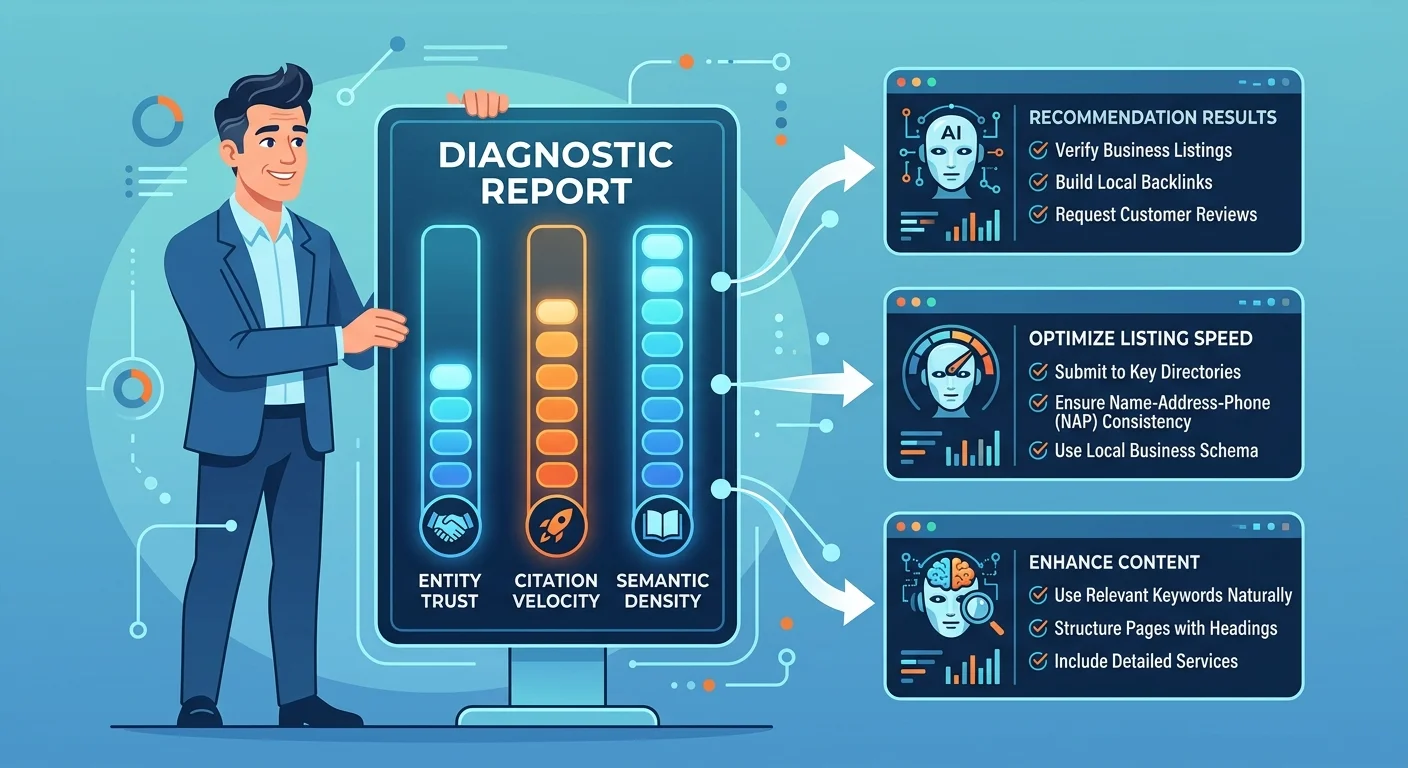
Here's the thing: most businesses get their AI Visibility Check results and immediately ask the wrong question. They ask, "How do I fix my score?" That is the wrong question. The right question is: what is this report actually measuring — and why does it determine whether AI recommends you or someone else?
The Snapshot doesn't care about your logo. It doesn't care about your color palette or how clean your homepage looks on a phone screen. It's measuring the machine-readable authority signals AI engines use to decide whether your business is trustworthy enough to name.
Generative AI engines synthesize a single answer — one name, one recommendation — instead of returning a list of links for users to browse. The old game was showing up on page one. The new game is getting named at all. The Snapshot tells you exactly how close you are to winning that game. And it shows you which structural gaps are keeping you out of it.
The Three Signals the Snapshot Measures
- Structural legibility — whether your digital infrastructure is built in a way AI engines can actually parse, categorize, and verify
- Entity coherence — whether the information about your business is consistent, complete, and corroborated across the sources AI consults when deciding who to trust
- Content authority — whether your published content shows real topical depth, or is generic enough that AI has no reason to prefer you over anyone else
Here's the kicker. None of those three signals show up on a traditional agency audit. Not keyword rankings. Not backlink counts. Not page-load speeds. These are the signals that determine whether an AI engine — trained on published analysis of how AI search changes user behavior — decides you're worth recommending. Full stop.
Once you know what the Snapshot is actually measuring, the gaps stop looking like mystery scores. They become specific, solvable problems with specific causes. That's the whole point of this framework — translating diagnostic language into operational stakes you can actually act on. And if you need to walk a business partner or spouse through what the results mean before any execution decision gets made, that context matters too.
Why Traditional SEO Audits Miss All of This
Traditional SEO audits were built for a different game. They were engineered to help you rank in a list — optimize a page so a crawler places it above a competitor's in a ten-link result set. That model assumed users would see the list, click something, and evaluate you on their own. That assumption is gone.
Generative AI does not work that way. It does not show users a list. It synthesizes one answer and presents it as the recommendation. The user does not evaluate ten options. They act on one. That is a fundamentally different outcome — and it requires a fundamentally different diagnostic to compete for it.
ChatGPT reached 100 million monthly active users within two months of launch, according to Pew Research Center. The behavioral shift happened faster than most agencies updated their playbooks. So what are those agencies still auditing? Title tags. Meta descriptions. Keyword density. Not one of those tells you whether an AI engine has the entity signals it needs to confidently name your business.
The Snapshot isn't a better SEO audit. It's a different instrument measuring a different thing. Now that you know what it's actually reading — and why traditional audits are blind to all of it — you're ready to decide what to build next.
| Signal Measured | What It Reflects | Why AI Engines Care | Consequence of a Gap |
|---|---|---|---|
| Structural Legibility | Whether your digital infrastructure is built in a machine-readable format AI engines can parse, categorize, and verify | AI engines cannot recommend what they cannot reliably identify — schema and structured data are the language AI uses to confirm your business exists and what it does | AI engines skip over your business entirely, even when your services are a direct match for what a user is asking |
| Entity Coherence | Whether information about your business is consistent, complete, and corroborated across the sources AI engines reference when assessing trust | AI engines cross-reference multiple sources before surfacing a recommendation — conflicting or incomplete entity signals create ambiguity that disqualifies you | Your business appears unreliable or unverifiable to AI engines, reducing the likelihood of a citation even when structural legibility is in place |
| Content Authority | Whether your published content demonstrates genuine topical depth — or is generic enough that AI engines have no reason to prefer you over any other business in your category | AI engines favor sources that demonstrate concentrated, specific expertise — shallow content signals low authority and gets deprioritized in synthesized responses | Competitors with deeper AEO content execution get named instead of you, regardless of how long you have been in business or how strong your reputation is offline |
| Citation Velocity | Whether your authority signals are accumulating over time through consistent AEO content execution and external corroboration — or sitting static | AI engines weight recency and momentum — a business actively building authority signals compounds its trust score, while a static presence decays in relative authority | Even a well-structured business becomes progressively less competitive as other businesses compound their authority signals and the gap between you widens each month |
Why the Report Alone Changes Nothing
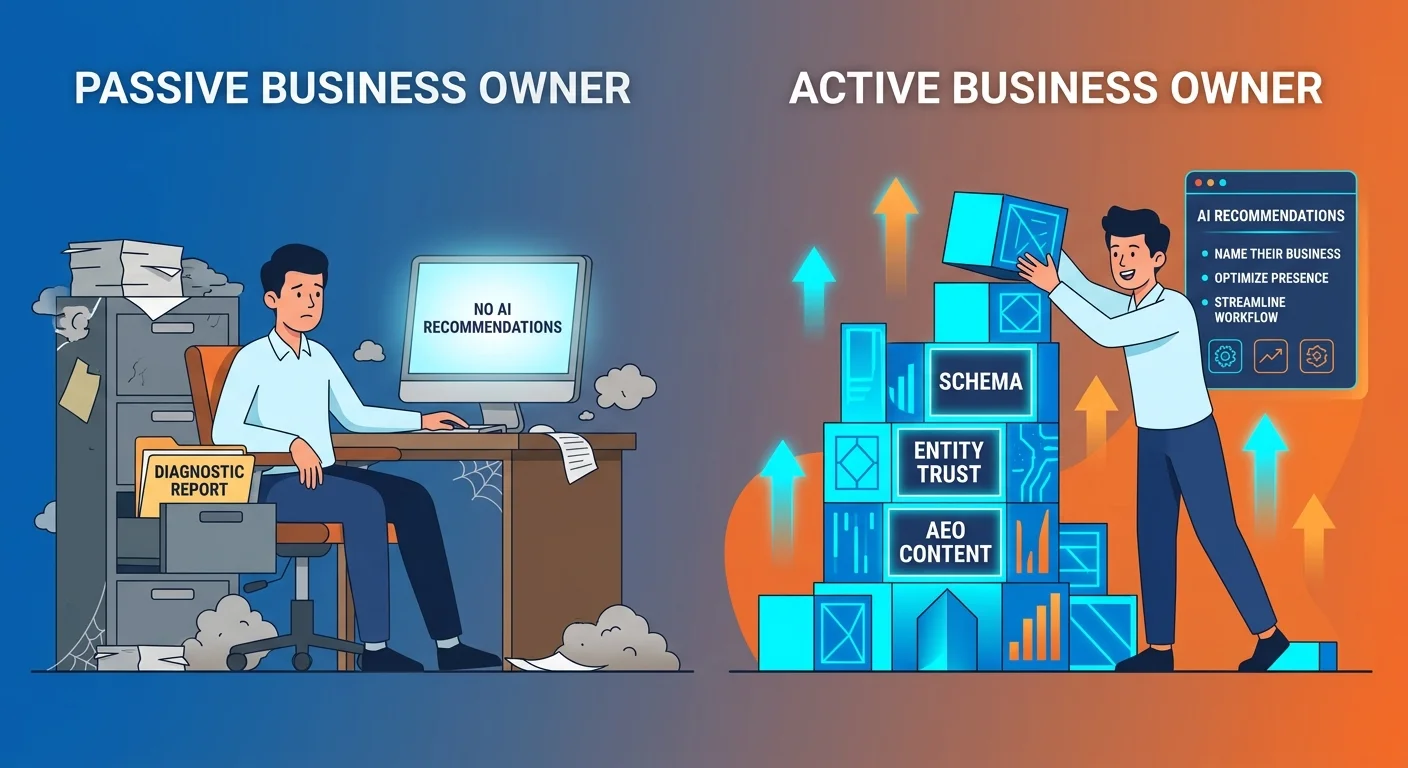
The report is not the strategy.
The report is the starting gun.
Here's the thing: a diagnostic that sits unread is not a competitive asset. It is a receipt.
You paid for the diagnosis. You confirmed the problem exists. And then nothing moved.
That outcome is far more common than most business owners want to admit. And it is the most expensive thing you can do with accurate information.
Generative AI did not slow down to wait for businesses to catch up. Consumer adoption reached 100 million monthly active users within two months of launch, according to Pew Research Center.
The gap between businesses that acted on their diagnostic results and businesses that filed them away is widening every single month.
The AI Authority Snapshot decision framework exists precisely because knowing the gaps is only half the equation. Closing them is the other half.
The Passive Report Collector Problem
The Passive Report Collector is a behavior pattern, not a personality type.
It looks like this: the AI Visibility Check gets completed. The results come back. The gaps are clearly documented. The business owner reviews everything with genuine concern.
Then the concern fades. Other priorities crowd in. The report gets bookmarked. Nothing gets built.
Now, this part matters.
Passive report collection is not neutral. It is not a pause. It is a compounding loss.
Every week without executing on the four infrastructure layers is a week a competitor is either building their authority signals or holding the ones they already have. AI engines do not freeze in place while you decide.
A low score is a recoverable opportunity or a compounding threat — and which one it becomes depends almost entirely on how fast you act.
The report surfaces the gap. But the gap only becomes an advantage if you close it before a competitor does.
Waiting doesn't hold your position. It hands it to someone else.
What Happens to Businesses That Wait
Let's keep it real: the businesses losing ground in AI recommendations right now are not losing because their service is worse.
They are losing because their digital infrastructure is invisible to the engines making the recommendation.
The Snapshot proved that. What happens next is a choice.
Gartner projects a 25 percent drop in traditional search engine volume by 2026 as conversational AI agents capture market share.
That timeline is not hypothetical. It is already in motion.
Businesses waiting for a more convenient moment to act are not staying still. They are falling behind in a race that has already started.
The map is only useful when you move.
The businesses winning AI recommendations right now are not smarter. They are not better funded. They just stopped sitting on their results and started building.
The four execution layers ahead are the path. The only question left is whether you start this week or hand that ground to whoever does.
| Approach | What It Looks Like | What AI Engines See | 12-Month Outcome |
|---|---|---|---|
| Passive Report Collection | Business receives Snapshot results, reviews the gaps with concern, bookmarks the report, and takes no structural action | No change in entity trust signals, schema, or content authority — AI engines continue recommending competitors who have built the infrastructure | Competitor authority compounds; the gap between your business and the AI-recommended alternative widens every month |
| Traditional SEO Response | Business hands the Snapshot results to a conventional SEO agency, which responds by adjusting title tags, meta descriptions, and keyword density | Surface-level optimization that does not address Schema and Structured Data, Entity Trust Signals, or AEO Content Execution — the signals AI engines actually parse | Improved page rankings in a search model that is losing volume; zero improvement in AI recommendation frequency |
| Partial Infrastructure Build | Business addresses one or two gaps from the Snapshot — typically the most visible ones — without executing across all four infrastructure layers | Incomplete authority profile; AI engines can parse some signals but cannot corroborate the full entity picture required for confident recommendation | Marginal gains in niche queries; business remains invisible in the high-value recommendation contexts where competitors with full infrastructure dominate |
| Full Infrastructure Execution | Business executes on all four layers in sequence: Schema and Structured Data, Entity Trust Signals, AEO Content Execution, and Citation Velocity Building | Coherent, machine-readable authority profile that AI engines can parse, verify, and corroborate across multiple trusted sources | AI engines develop the confidence to recommend the business by name — authority compounds with each additional layer of content and citation execution |
The Four-Part Infrastructure Rebuild
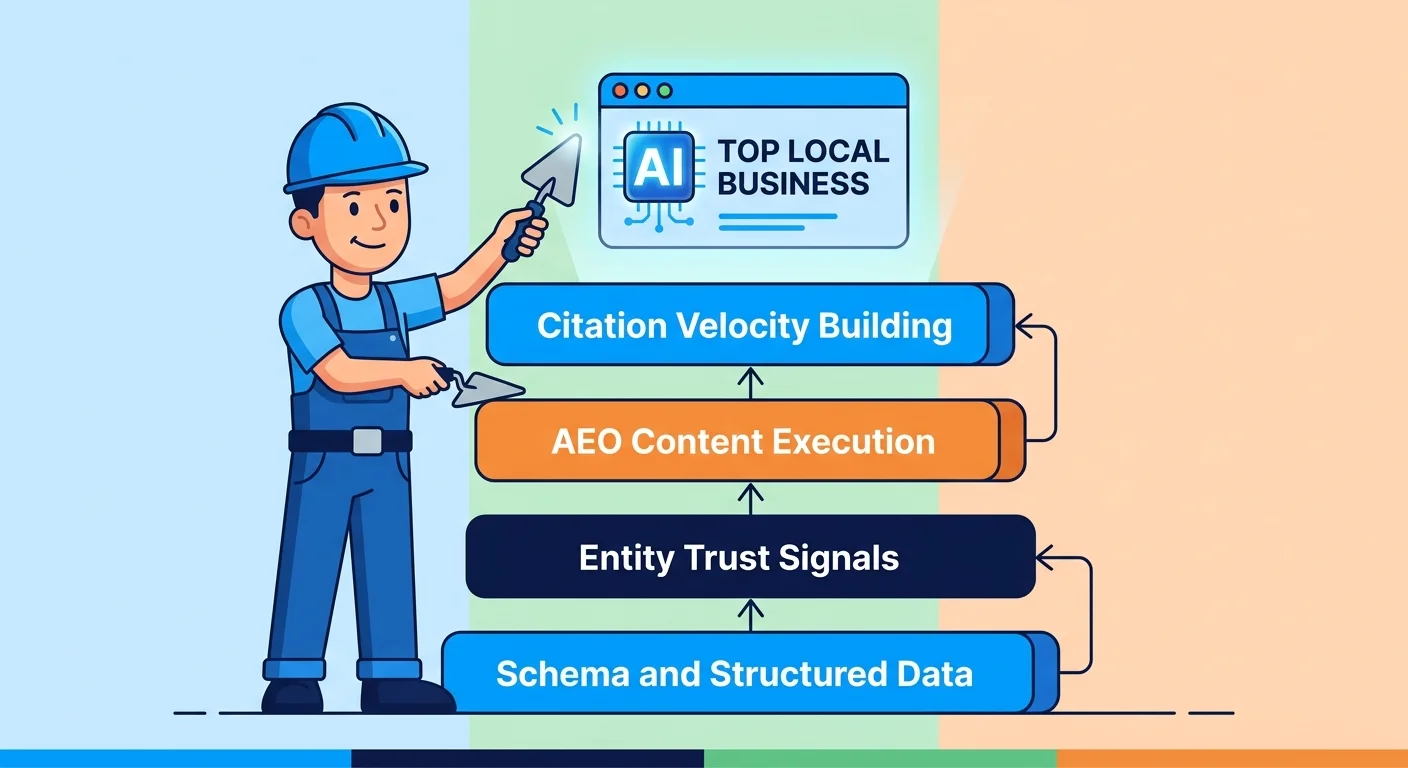
The Snapshot told you what is broken. Now you build.
This is not a single project. It is four sequential layers — each one compounding on the one before it.
Here's the thing: the order matters.
You cannot build Citation Velocity on a foundation of missing entity signals. You cannot frame a house on an unleveled slab. Running these layers in parallel — or skipping ahead — produces noise, not authority.
AI engines don't return a ranked list anymore. They synthesize one answer. One recommendation. One name.
The businesses earning that slot built all four layers. In sequence. On purpose.
Part 1: Schema and Structured Data
Schema and Structured Data is the foundation layer. Full stop.
Before any AI engine can recommend your business, it has to be able to read it. Without structured markup, even a well-run operation is structurally invisible to the machines making that call.
Schema tells AI engines what your business is, what it does, where it operates, and how it maps to the categories they already recognize.
Without it, the engine guesses. And guesses do not produce confident recommendations. They produce omissions.
This layer covers FAQPage schema, LocalBusiness markup, service-level structured data, and breadcrumb hierarchy.
Not glamorous. Nobody's going to congratulate you for it. But skip it — or do it sloppily — and every layer you build on top of it registers as noise. The void AI engines never surface is full of businesses that thought they could skip the foundation.
Part 2: Entity Trust Signals
Now, this part matters.
Schema makes your infrastructure legible. Entity Trust Signals make it credible. Those are two different problems.
Fix one without the other and you end up with technically correct markup that AI engines still will not commit to.
Entity trust is built through corroboration.
The same accurate, consistent information about your business — name, address, phone, service descriptions, credentials — must appear across every external source AI engines consult when deciding who to recommend.
Every inconsistency is a confidence penalty. AI engines reward clean data. They penalize contradiction.
Published index research from Stanford University tracks how data inconsistency and model error directly erode user trust in AI recommendations. That skepticism is real — and AI engines are built to respond to it.
They are incentivized to recommend businesses whose profiles are clean, consistent, and verifiable. Businesses whose data contradicts itself don't get the benefit of the doubt. They get skipped.
Part 3: AEO Content Execution
Let's keep it real: schema and entity signals prove you exist. AEO Content Execution proves you are the authority.
Those are not the same thing. AI engines are not just looking for a business that matches the query. They are looking for the business that demonstrably knows the most about the topic.
AEO content is not a batch of generic articles stuffed with keywords. It is a library of topically dense, machine-readable answers that train AI engines to associate your business with specific areas of expertise.
Each piece compounds on the last. The Local AI Authority Engine is built around exactly this model — structured content that deepens authority signals month over month, not a one-time content dump.
Here's what most business owners don't see coming: AEO content requires a completely different brief than traditional content.
Topical architecture. Semantic density. Internal linking logic. Answer-first structure. Every article has a job beyond being read. Fixing AI invisibility is not a weekend project — and the businesses that tried to shortcut this layer found out the hard way.
Part 4: Citation Velocity Building
The fourth layer is Citation Velocity Building.
This is where authority stops being something you claim and starts being something the wider web confirms. AI engines do not just read your own infrastructure. They read what other authoritative sources say about you.
Citation velocity is the rate at which credible external sources begin referencing your business in ways that reinforce your entity signals.
Directories. Industry publications. Structured citations. Authoritative mentions. The published research on AI model reliability documents the direct correlation between external trustworthiness signals and the confidence AI engines extend to specific entities.
That trust doesn't build by accident. It builds because you showed up consistently, in the right places, with the right data — and kept showing up.
These four layers are not optional modules. They are a sequence.
Schema and Structured Data. Entity Trust Signals. AEO Content Execution. Citation Velocity Building.
The businesses AI engines name have built all four. The businesses that stopped after one or two are invisible in the same conversation — for reasons that are entirely structural and entirely fixable.
| Infrastructure Part | Primary Action | AI Engine Signal Produced | Urgency Level |
|---|---|---|---|
| Schema and Structured Data | Implement FAQPage, LocalBusiness, and service-level markup across all pages; build breadcrumb hierarchy | Legibility — AI engines can identify, categorize, and read the business with confidence | Immediate — nothing built on top of this layer functions without it |
| Entity Trust Signals | Audit and align NAP data, service descriptions, and credentials across all external directories and authoritative platforms | Credibility — corroborated, consistent data reduces AI engine confidence penalties from contradictory profiles | High — inconsistencies are active trust penalties accumulating in real time |
| AEO Content Execution | Publish a structured library of topically dense, answer-first AEO content aligned to your core service areas | Authority — AI engines associate your business with specific expertise domains through repeated semantic density signals | Ongoing — each piece compounds on the last; the library deepens authority month over month |
| Citation Velocity Building | Earn structured citations and authoritative mentions across directories, industry publications, and credible external sources | External corroboration — third-party reinforcement confirms entity signals and expands the web of sources AI engines reference when forming recommendations | Sustained — velocity builds as the external footprint grows; cannot be accelerated by skipping earlier layers |
Reading Your Snapshot Results: What Each Gap Actually Means
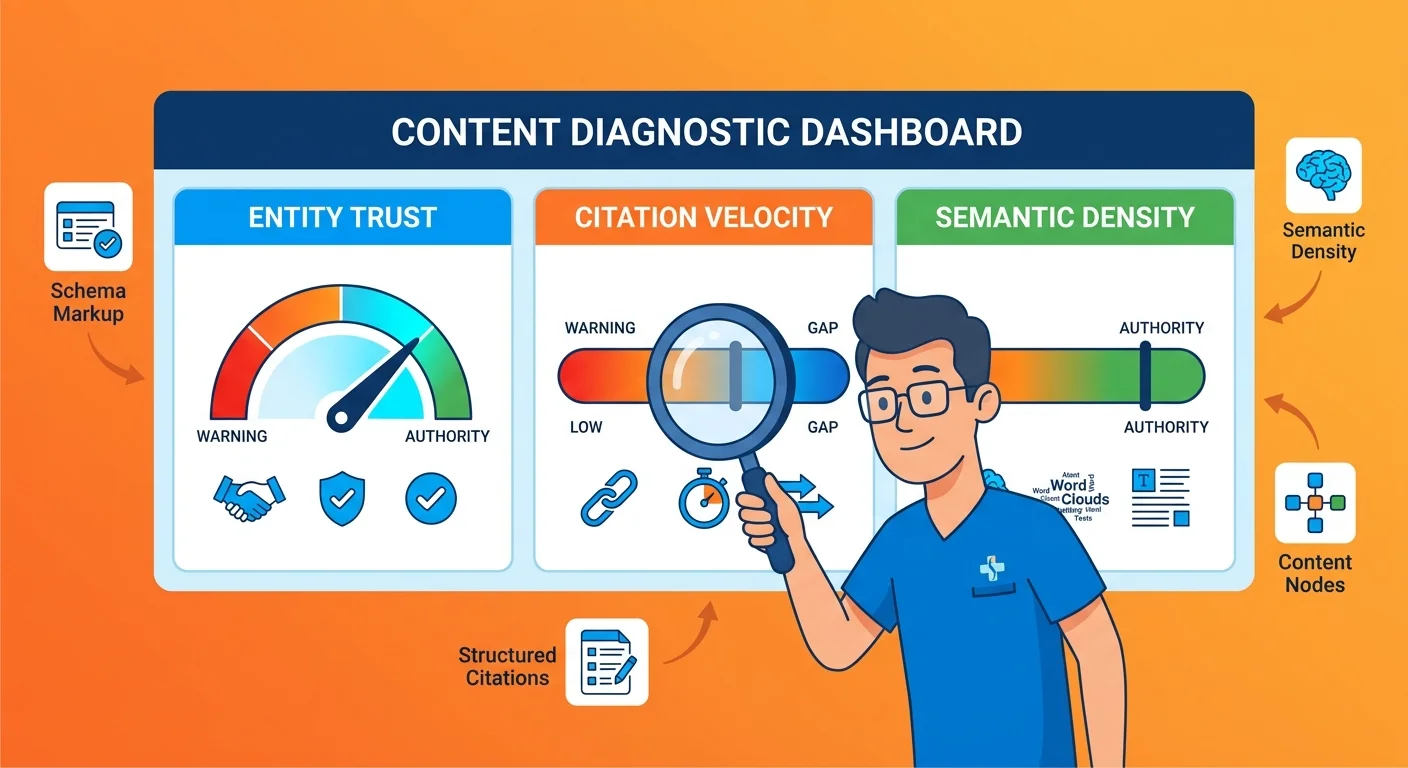
The Snapshot doesn't just tell you something is broken. It tells you which layer is broken. That distinction is everything. A low entity trust score and a low citation velocity are not the same diagnosis. Treating them like they are costs you months rebuilding the wrong thing.
Here's the thing: the gap categories in your results are not surface-level scores. They are structural diagnoses. Each one maps to a specific failure in how AI engines read, trust, or cite your business. And each one has a concrete fix inside one of the four execution layers.
Once you know what each gap is signaling, the first decisions after your AI Visibility Check stop feeling abstract. Below, the three most common gap types get mapped to their root causes and their fixes. Results that looked like a report card translate directly into a work order.
Low Entity Trust Score: What It Signals and What Fixes It
A low entity trust score means AI engines can't confidently confirm who you are. They found inconsistencies — or outright silence — across the external sources they check before making a recommendation. This isn't a content problem. It's a data integrity problem.
Gartner projects a 25 percent drop in traditional search engine volume by 2026 as conversational AI agents capture that ground. The engines filling that gap run on verified entity signals — not keyword proximity. So when your business name, address, phone number, and service descriptions conflict across directories, you've created a liability. The engine can't commit to a business it can't corroborate. The risk of a wrong recommendation outweighs the cost of skipping you entirely.
The fix lives in Part 2 — Entity Trust Signals. Audit every external profile. Correct the inconsistencies. Build a clean, corroborated record that AI engines can verify without contradiction. No amount of content production fixes a broken entity layer. Resolve the foundation first. Everything built on top of a shaky base disappears.
Low Citation Velocity: Why AI Engines Ignore You
Low citation velocity means credible external sources aren't referencing your business. AI engines aren't just reading your own infrastructure. They're reading what the wider web says about you. When that wider web is silent, the engine treats your entity as unconfirmed.
Here's the thing — clean schema and solid entity signals aren't enough if no external voice is reinforcing what you claim. Citation velocity is the rate at which credible directories, publications, and authoritative sources start confirming your existence and your expertise. Without it, you're a business that trusts itself. That's not enough for AI engines to act on.
The SEC's public guidance on AI disclosure requirements shows how seriously institutional bodies take the question of AI reliability. That scrutiny flows directly into how AI engines weight their recommendations. Engines built for trust are incentivized to cite businesses that are externally corroborated — not self-declared. The fix for low citation velocity lives in Part 4 — Citation Velocity Building.
Low Semantic Density: The Invisible Content Problem
Low semantic density means your content library doesn't give AI engines enough topically concentrated signal to associate your business with a specific area of expertise. The engine knows you exist. It may even trust your entity data. But when someone asks a question in your domain, your name doesn't surface — because there's no content depth to anchor the association.
Now, this part matters. Semantic density isn't about volume. Publishing more generic content doesn't fix the problem — it compounds it. What AI engines are measuring is topical concentration: how many pieces return to the same core subject, answer adjacent questions in that space, and interlink in a way that signals deliberate expertise. Random coverage isn't authority. Deliberate architecture is.
The fix lives in Part 3 — AEO Content Execution. That means building a structured content architecture where every piece has a defined topical job, answers a specific question your audience is asking, and compounds on every piece before it. The Snapshot showed you the gap. This layer is where you close it.
| Snapshot Gap | Root Cause | What AI Engines Conclude | First Fix to Execute |
|---|---|---|---|
| Low Entity Trust Score | Inconsistent or conflicting business data across external sources AI engines cross-reference when building recommendations | This entity cannot be safely recommended — the risk of a wrong citation outweighs the value of naming them | Part 2 — Entity Trust Signals: audit and correct every external profile until the record is clean and corroborated |
| Low Citation Velocity | Credible external sources are not referencing the business — the entity is self-declared but not externally confirmed | This business has not been validated by sources we trust — treating the entity as unverified | Part 4 — Citation Velocity Building: build structured citations and earn authoritative external mentions that reinforce entity signals |
| Low Semantic Density | Content library lacks topical concentration — coverage is broad or generic rather than deliberately anchored to a specific area of expertise | This entity has not demonstrated deep knowledge in this domain — no reliable association between business and subject area | Part 3 — AEO Content Execution: build a structured content architecture where every piece answers a specific question and compounds topical authority |
| Schema and Structured Data Gaps | Infrastructure is not machine-readable — missing or malformed markup prevents AI engines from extracting and parsing core business information | This entity's data cannot be reliably interpreted — pass it over in favor of a business whose structure is legible | Part 1 — Schema and Structured Data: implement FAQPage, LocalBusiness, service-level markup, and breadcrumb hierarchy from the foundation up |
Who This Process Is Not For
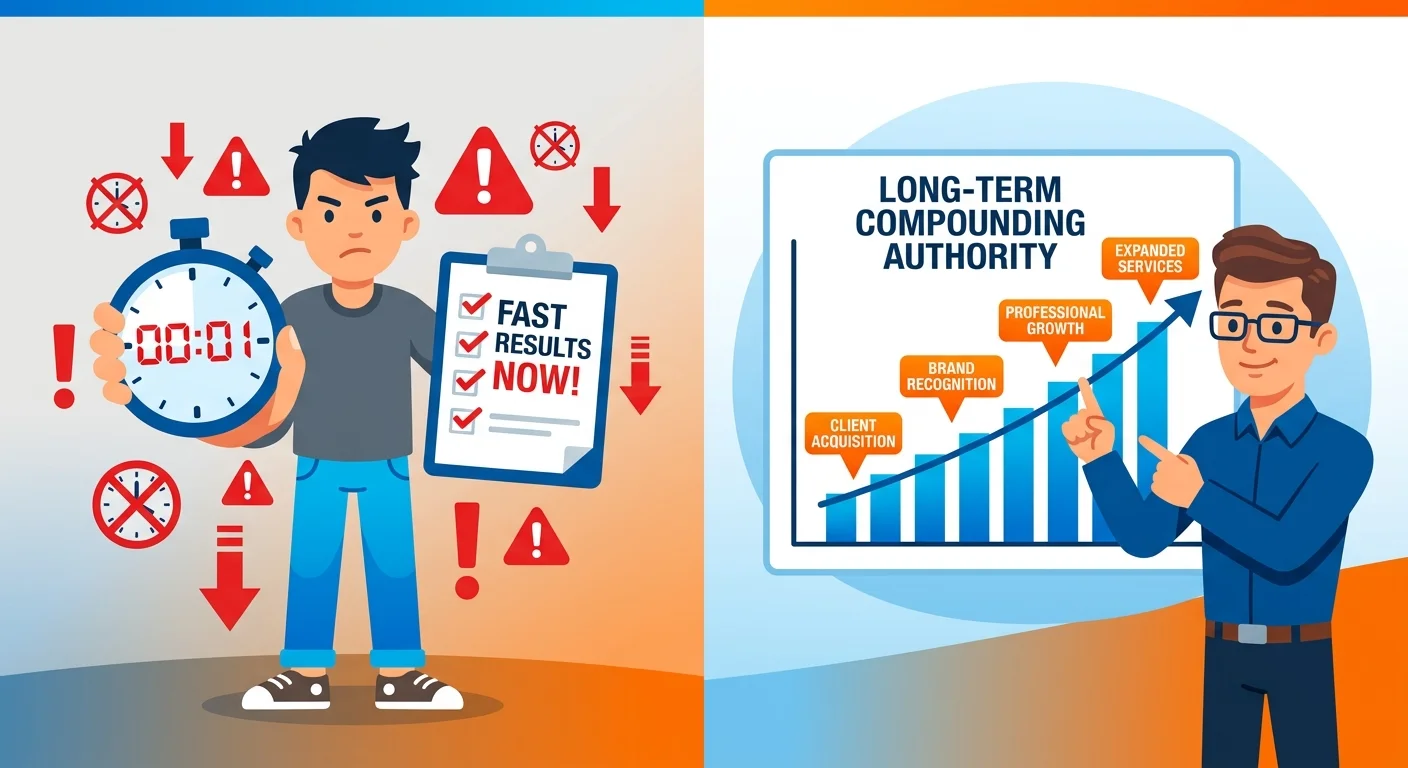
Not everyone who gets a Snapshot is ready for what comes next.
That's not a critique. It's a qualification.
The four-layer rebuild is specific, sequential, and demanding. It rewards operators who are ready to move. It frustrates everyone else.
The Snapshot is the map. A map is only useful when you move.
If you want a document to hand your current agency with a vague instruction to "fix it" — this process will frustrate you.
The execution is the point. The report never was.
Here's the discipline that separates operators who move fast from the ones who spend months rebuilding the wrong layer: use a structured decision matrix to prioritize your next steps when the Snapshot surfaces competing priorities instead of gut instinct.
But that discipline only matters if you're actually committed to doing the work.
A decision framework handed to someone who isn't ready to act is just another document to file away.
The Behaviors That Signal This Is the Wrong Fit
Want a 90-day guarantee? This isn't for you. Full stop.
Authority doesn't run on a microwave schedule.
Any provider telling you otherwise is selling you the exact hopium this process was built to replace.
Planning to hand the Snapshot to your current SEO agency and expect execution? This isn't for you either.
Traditional SEO agencies are built for keyword rankings and clicks. The four-layer infrastructure rebuild this process requires is a different discipline entirely. They weren't built for it — and most of them know it.
The FTC has been explicit: unsubstantiated performance claims in the AI space carry real legal exposure. Agencies promising easy AI visibility wins are either uninformed about that risk or unconcerned by it. Neither is a reason to trust them with this work.
Shopping on price? Comparing a full-stack infrastructure rebuild to a monthly retainer for social posts and keyword tweaks? This isn't for you.
Authority is an asset. Assets require investment.
The businesses treating this as a line item will be invisible while the businesses treating it as infrastructure compound.
What the Right Candidate Actually Looks Like
The right candidate already knows something is wrong.
They've watched AI engines name a competitor when a patient or client asks who to trust. They're not looking for a shortcut.
They want a real fix. And they're ready to execute on one.
They understand that authority is built in layers — Schema and Structured Data, Entity Trust Signals, AEO Content Execution, Citation Velocity Building — and that skipping any one of them produces the same result: a business that's structurally invisible in the conversations that matter most.
The SEC's guidance on AI risk disclosure signals what serious operators already sense. This environment isn't casual. The businesses treating it casually pay a visibility cost that compounds every month they wait.
This market doesn't reward patience. It rewards readiness.
The right candidate wants to be the answer. Not one of several options. Not a footnote in a competitor's recommendation.
They're ready to pick up the map and start walking.
That's exactly who this process was built for.
| Buyer Signal | What It Looks Like | Why It's a Mismatch | Better Fit |
|---|---|---|---|
| The 90-Day Guarantee Seeker | Asks for contractual ROI commitments within a fixed short window; evaluates providers on speed of visible results | Authority infrastructure compounds over time — it cannot be rushed into a microwave timeline without sacrificing the structural integrity that makes it work | Short-term paid advertising or promotional campaigns that deliver fast, transient visibility without building lasting entity trust |
| The Agency Hand-Off Buyer | Plans to forward the AI Authority Snapshot to their current traditional SEO or digital agency and ask them to 'take care of it' | Traditional agencies are optimized for keyword rankings and click metrics — the four-layer infrastructure rebuild requires a fundamentally different discipline they are not built to execute | Continued engagement with their current agency for conventional search optimization while the AI visibility gap widens |
| The Price Shopper | Compares a full-stack authority infrastructure rebuild to monthly retainers for social content or keyword tweaks; selects based on lowest cost | Treating authority as a line item to minimize produces a minimum result — infrastructure built on the cheapest bid is not infrastructure, it is decoration | Lower-cost content or social media packages that match the budget expectation without claiming to solve the AI visibility problem |
| The DIY Underestimator | Believes the Snapshot gives them enough information to replicate the four-layer rebuild internally after a brief explanation | Schema and Structured Data, Entity Trust Signals, AEO Content Execution, and Citation Velocity Building each require precise, sequential execution — partial implementation produces the same structural invisibility as no implementation | Self-directed learning resources or consulting sessions that build internal understanding before committing to full execution |
| The Set-It-and-Forget-It Buyer | Wants to complete the rebuild once and stop — views ongoing AEO content execution as optional maintenance rather than a compounding authority mechanism | Citation velocity and semantic density degrade without sustained execution; authority built once and abandoned hands compounding ground directly to competitors who keep going | A one-time infrastructure audit or single-phase project engagement with no expectation of ongoing content execution |
Frequently Asked Questions About Your AI Authority Snapshot
Here are the questions serious operators ask before they move.
Straight answers only.
What is the difference between an AI Visibility Check and a traditional SEO audit?
A traditional SEO audit measures keyword positions, backlink counts, and click volume. It was built for a world where Google returns a list and users decide who to visit. An AI Visibility Check is measuring something else entirely. It diagnoses Entity Trust, Citation Velocity, and Semantic Density. Those are the signals AI engines use to decide whose name to say. One audit optimizes for a list. The other determines whether you get named at all. Those are not variations of the same thing.
How long does it take to repair the structural gaps identified in my AI Authority Snapshot?
There is no honest single number — and anyone who gives you one is selling you something. What matters is which layers are broken and how far gone they are. Schema gaps close faster than Citation Velocity gaps. Entity Trust inconsistencies depend on how many external profiles need correction. What never changes is the sequence. You fix the foundation first. You do not skip layers. Authority compounds — month one makes month three matter more. Any provider handing you a specific timeline guarantee is not being straight with you.
Do I have to completely rebuild my AI-readable infrastructure to become visible to LLMs?
Not always. Some businesses need a full rebuild. Others have a solid foundation with specific layer gaps. The Snapshot tells you exactly which is which. The goal is not reconstruction for its own sake — the goal is making your business machine-readable and trustworthy to AI engines. If your current AI-readable infrastructure can be retrofitted to accomplish that, retrofit it. If it cannot, the Snapshot will make that clear too.
What happens if I ignore the gaps shown in my AI Authority Snapshot?
The gap does not hold steady. It widens. ChatGPT reached 100 million monthly active users within two months of launch, according to Pew Research Center — that is how fast this became the default. Every month a competitor executes on their authority infrastructure, they compound ahead of you. Gartner projects a 25 percent drop in traditional search engine volume by 2026 as conversational AI agents take over. Those engines are making recommendations right now. Ignoring the Snapshot does not pause the competition. It just means you are watching someone else win it.
Can my current digital marketing agency implement the changes the Snapshot requires?
Most cannot. That is not an insult — it is a scope mismatch. Traditional agencies are built to optimize keyword density, build backlinks, and report on clicks. The infrastructure rebuild the Snapshot requires is a different discipline entirely. The FTC has been explicit that unsubstantiated AI performance claims carry real enforcement risk. Agencies promising easy AI visibility wins are either uninformed about that exposure or indifferent to it. So here is a simple test: ask your current agency to define Entity Trust and Citation Velocity. Their answer will tell you everything you need to know.
The Map Is Useless If You Don't Move
The report is not the strategy. The report is the starting gun.
Every business that gets an AI Authority Snapshot hits the same fork: act on it, or file it away.
The ones who act are the ones AI engines name. The ones who file it away are invisible — not because the diagnosis was wrong, but because a map sitting on a desk has never taken anyone anywhere.
Here's what the Snapshot actually hands you: a build order.
Schema and Structured Data. Entity Trust Signals. AEO Content Execution. Citation Velocity Building.
That's not a menu — pick-and-choose destroys the architecture. Each layer makes the next one matter. Skip one and the whole structure loses integrity. The businesses collecting AI citations right now built all four, in order, on purpose. Not because they had more time. Because they understood that sequence is the strategy.
The Snapshot is accurate. That's not the question.
The question is whether you'll use it.
ITech Valet was built for the operators who will. Not the ones who read the report and wait for a better time. The ones who look at the gap, acknowledge it, and move. The Snapshot is the map. The businesses winning are the ones who started walking.
The Snapshot showed you the map. Now you need to decide if you're going to walk. Run the AI Visibility Check — see exactly which layers are broken, which are holding, and what closing the gap actually takes.
621 Enterprises, Inc. | Copyright 2026 | All rights reserved