
How to Explain Your AI Authority Snapshot to Your Spouse or Business Partner
An AI Authority Snapshot is a diagnostic report that captures exactly what ChatGPT, Gemini, and Grok say when someone asks for a chiropractor recommendation in a specific market — whether a given practice is named as the answer, or a competitor is.
That distinction matters. The Snapshot is not a marketing claim. It is documented AI engine output, pulled in real time, showing a practice's actual AI visibility status.
When a spouse or business partner reviews the Snapshot results, the conversation shifts. It stops being about whether AI matters and starts being about how long this has already been happening. The data makes the problem visible without requiring anyone to take a position on it first.
Traditional search volume is projected to drop by 25% by 2026, driven by the rise of AI chatbots and conversational engines. The channel patients currently use to find chiropractors is shrinking. The channel replacing it produces a single recommended result — not a ranked list. A practice is either that result or it is not.
Approximately 39% of US adults experience back pain in a given year. The prospective patient market is large. The variable is whether AI routes those patients to a specific clinic or to a competitor.
Explaining an AI Authority Snapshot to a skeptical partner does not require a case for AI adoption. It requires showing them the diagnostic output and letting the results speak. A partner who sees that a competitor is being recommended — and their own practice is not — does not need to be persuaded that the problem exists.
The infrastructure investment that follows a Snapshot is a long-term clinical asset. Authority signals compound over time. Every month of execution builds the machine-readable foundation that answer engines use to determine who to recommend. The Snapshot establishes the baseline. What happens after it depends on whether the practice acts on what it shows.
Last Updated: July 15, 2026
- • What the AI Authority Snapshot Actually Shows
- • Why Traditional SEO Stopped Being Enough
- • How to Frame the Investment — Not the Expense
- • What the Competition Is Doing Right Now
-
• Frequently Asked Questions
- • What is an AI Authority Snapshot, and why does my spouse or business partner need to see it?
- • Why can't we just fix our clinic's AI invisibility ourselves instead of paying $15,000?
- • Is a bad AI visibility score really a threat to our chiropractic practice's patient acquisition?
- • How does the Local AI Authority Engine differ from the SEO retainer we are already paying for?
- • What is the realistic timeline to see our practice named in ChatGPT, Gemini, and Grok recommendations?
- • The Bottom Line for Your Practice
What the AI Authority Snapshot Actually Shows
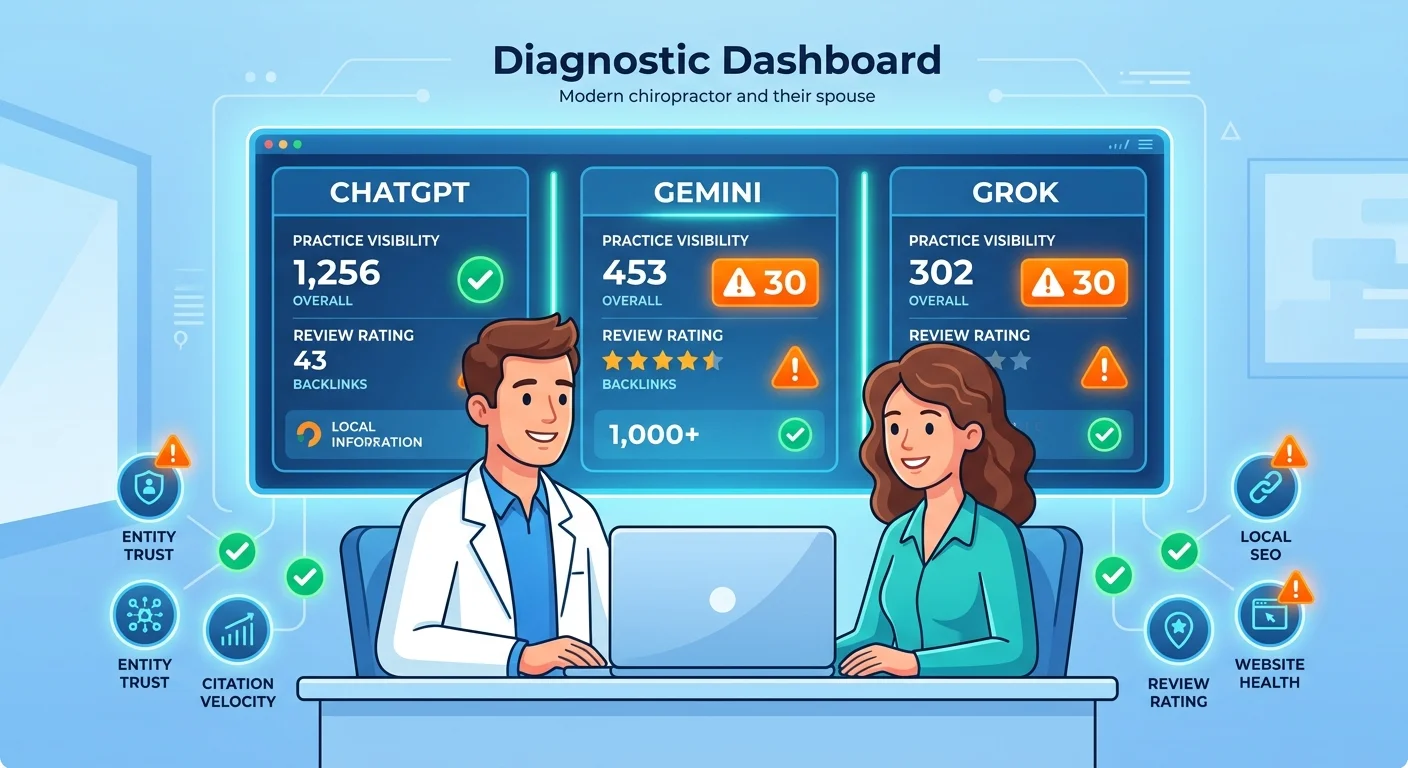
The AI Authority Snapshot isn't marketing collateral. It's a live capture — what ChatGPT, Gemini, and Grok actually say when someone in your market asks for a chiropractor recommendation right now.
Here's what it shows: your practice name — or the absence of it. ChatGPT, Gemini, and Grok don't hand patients a list to scroll through. They produce a verdict. The Snapshot documents that verdict, in the engine's own words, for your exact market and specialty.
That's why this conversation lands differently than every agency pitch your partner has sat through. You're not asking them to trust a projection. You're showing them a screenshot of what AI is telling patients right now. Pew Research found that only 30% of adults can correctly identify all the ways AI is already shaping their decisions. Your partner almost certainly doesn't realize the routing is already happening. The Snapshot makes that impossible to argue with.
Reading the Snapshot: What Each Score Means
Three signals. That's all the Snapshot is measuring. Whether your practice is named at all. How confidently the engine recommends you. And what's driving — or killing — that result.
A strong score means the engine trusts your entity. It knows who you are, what you treat, where you operate, and why you're credible. A weak score tells a different story. The engine can't find enough reliable signals to recommend you — or it's already routing patients to a competitor whose authority infrastructure sends cleaner data. Those aren't the same problem. But they share the same fix. And neither one has anything to do with how good a chiropractor you actually are.
Once the scores make sense, the next question is what to do. That answer depends entirely on which gaps the Snapshot surfaces. That's exactly why the AI Visibility Check happens before any investment conversation.
Why Most Chiropractors Are Shocked by Their Results
Most chiropractors walk in expecting to be fine. Years in practice. Solid reviews. An agency handling SEO. They assume the work has been done.
What they actually see is a competitor's name. Sometimes two or three of them. Not because those practices are better — because their authority infrastructure sends cleaner signals to the engine. That's it. That's the whole explanation.
Here's the context that makes the shock make sense. Gartner projects traditional search volume will drop 25% by 2026. The channel that used to send patients your way is shrinking. The channel replacing it doesn't hand anyone a list — it picks one answer. So when your partner sees a competitor's name staring back at them? That's not a failure. That's the Snapshot doing its job. Showing you where you stand before the gap gets any wider.
| Snapshot Signal | What It Measures | What a Low Score Means for Patient Acquisition |
|---|---|---|
| Practice Name Recognition | Whether ChatGPT, Gemini, and Grok name your practice when a patient asks for a chiropractor recommendation in your specific market | Patients asking AI for a recommendation never see your name — they see a competitor's. You don't lose the patient in a comparison. You lose them before they know you exist. |
| Recommendation Confidence | How decisively the engine endorses your practice versus hedging, listing alternatives, or directing the patient elsewhere | The engine doesn't commit to your practice as the answer. It routes patients toward whoever it trusts more — regardless of your clinical quality or years in practice. |
| Entity Signal Strength | Whether the engine can confirm who you are, what you treat, and where you operate — the foundational signals that determine AI trust | Your authority infrastructure is too thin or inconsistent for the engine to verify your identity with confidence. Weak entity signals produce weak or absent recommendations. |
| Competitive Gap | How your practice's AI visibility compares to other chiropractors in your market who are actively appearing in AI-generated recommendations | A competitor with stronger authority infrastructure is filling the recommendation slot your practice should occupy. Every month that gap holds, it compounds in their favor. |
| Supporting Signal Gaps | The specific infrastructure deficiencies — missing schema, thin content, inconsistent citation data — that are causing the engine to under-recommend or ignore your practice | Without knowing which gaps exist, there's no clear path to closing them. The practice stays invisible not because it lacks quality but because the engine lacks the signals it needs to trust it. |
Why Traditional SEO Stopped Being Enough
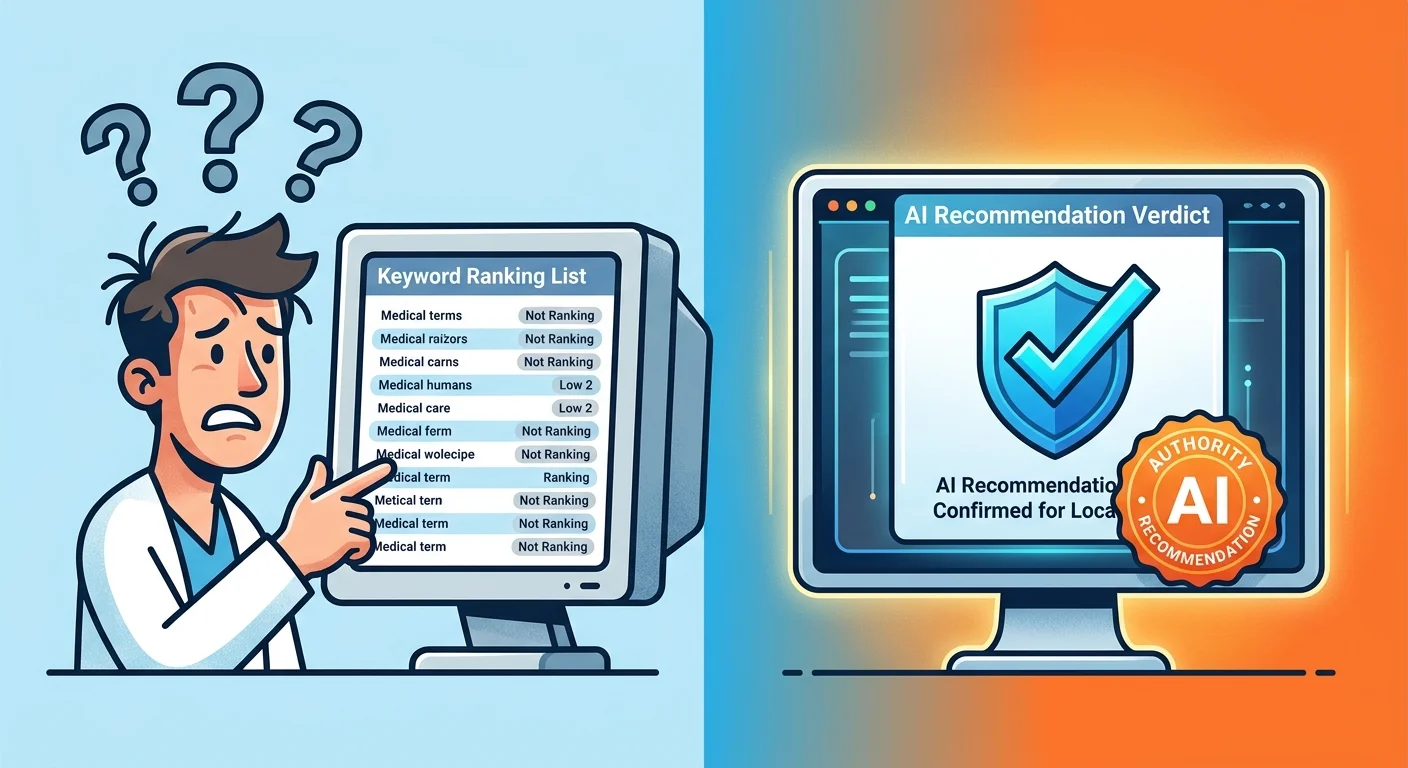
Gartner projects traditional search volume will drop 25% by 2026. Not someday. Already in motion.
The patient acquisition model your practice built — Google search, keyword rankings, page-one placement — was engineered for a world where patients type a query and scroll a list. That world is contracting. The channel replacing it doesn't hand patients options. It produces one answer.
So when a partner asks why what worked before isn't enough anymore, here's the straight answer: the old approach was built for a different game. Authority infrastructure isn't a rebrand of traditional SEO. It's a fundamentally different asset, built for a fundamentally different engine.
The Mechanism That Made Keyword Rankings Irrelevant
Here's how the break actually happened. Traditional search rewarded keyword density, backlink counts, and page-load speed. Those signals told Google's crawler how to sort a list. AI answer engines don't sort lists. They synthesize a recommendation. And the signals they use to do that are entity-based, not keyword-based.
An AI engine is asking a specific set of questions: does this entity exist? Is it consistent across every platform it appears on? Does the surrounding content confirm what it claims about itself? When those answers are unclear or contradictory, the engine doesn't rank the practice lower. It routes patients somewhere else entirely.
Whether that score is recoverable — or signals something structurally broken — depends entirely on which signals are missing. That's the exact question understanding the real stakes of a low score forces a practice to answer before any remediation plan makes sense. The gap varies. The urgency doesn't.
Why the Agency Retainer Your Practice Is Paying Does Not Solve This
Most agency retainers are still running the old playbook. Backlinks. Keyword research. Meta description tweaks. None of that is worthless — it's just aimed at the wrong target. According to McKinsey, one-third of organizations are already deploying generative AI regularly in core business functions. The behavioral shift in how patients search isn't on the horizon. It's done.
An agency retainer doesn't tell an AI engine who you are. It doesn't build entity trust. It doesn't create the structured, machine-readable signals that ChatGPT and Gemini use to decide whether your practice is credible enough to recommend. It optimizes for a ranked list that fewer patients are consulting every single month.
That's the gap the AI Authority Snapshot surfaces. Not that the agency failed. That the agency was solving a different problem than the one now costing your practice patients. A skeptical partner who sees that distinction doesn't keep arguing about the price. They start asking why nobody showed them this sooner.
| Approach | How It Works | What It Optimizes For | Whether AI Answer Engines Use It |
|---|---|---|---|
| Keyword-based content | Researches high-volume search terms and builds pages around them | Google crawler rankings — placement on a list of results | No — AI answer engines synthesize recommendations from entity signals, not keyword density |
| Backlink building | Acquires links from other sites to signal domain authority to search crawlers | Domain authority scores and page-rank flow for ranked list placement | No — AI engines evaluate entity consistency and structured signals, not link volume |
| Meta description optimization | Crafts short page summaries to improve click-through rates from search result pages | Click-through rate on a ranked list a patient is already scrolling through | No — AI engines don't serve a list for patients to scroll; they produce a single verdict |
| Authority infrastructure | Builds entity trust through structured, machine-readable signals — schema, consistent NAP data, semantic content, and citation velocity | AI engine confidence that your practice is real, credible, and worth recommending | Yes — this is the primary signal set AI answer engines use to determine who to name |
| AI Authority content execution | Publishes ongoing AEO-optimized content that reinforces entity signals and deepens topical authority over time | Compounding authority that makes AI engines more confident in recommending your practice every month | Yes — consistent content execution is one of the core trust signals AI engines track |
How to Frame the Investment — Not the Expense
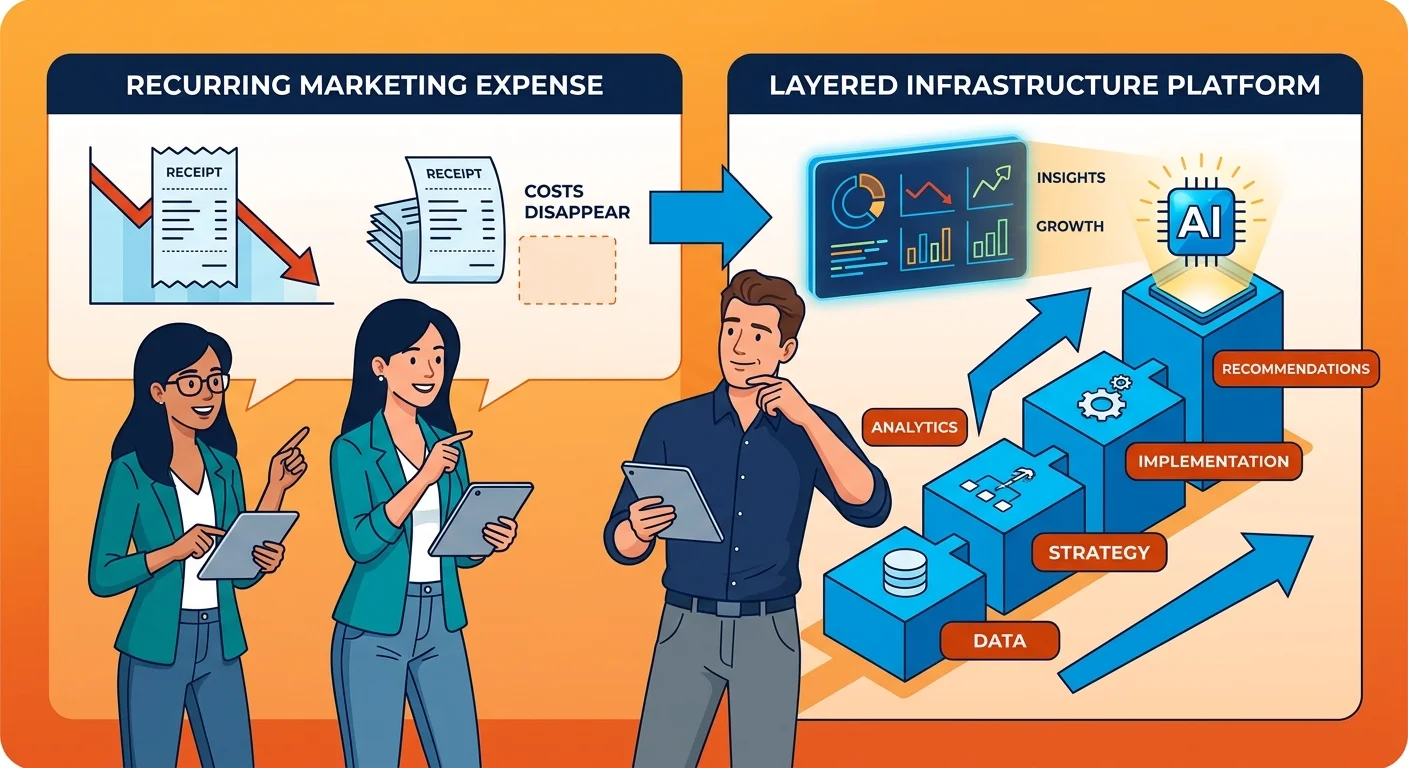
The hardest part isn't the number. It's the frame.
A $15,000 investment looks enormous sitting next to a $500/month SEO retainer. Put it next to a different question — what does permanent AI invisibility cost your practice? — and the math changes completely.
That's the shift. Not "we're buying marketing." We're building the infrastructure that determines whether AI recommends us — or routes patients to a competitor — every single day.
Authority infrastructure isn't a campaign. It doesn't run three months and report impressions.
It builds entity trust — the structured, machine-readable signals AI answer engines use to decide who's credible enough to name. That's an asset. A paid ad disappears the moment the budget stops. Authority compounds. Each signal added deepens the engine's trust in your practice. Nothing resets at zero when the invoice lapses.
The Asset vs. Expense Distinction Your Partner Needs to Hear
A marketing expense disappears the moment you stop paying for it.
Authority infrastructure doesn't. The schema, the entity signals, the AI Authority articles, the structured content hierarchy — these keep working after they're built. The engine's trust deepens with every signal added. That's what makes this a different category of decision entirely.
Here's the one that lands: nobody calls an X-ray machine a marketing expense. It's equipment. It enables diagnosis. It serves patients for years.
Authority infrastructure is the same category. It's the equipment that makes your practice findable in the channel replacing traditional search. You don't expense equipment. You invest in it.
That distinction matters most when the partner is holding this up against a retainer.
A retainer rents access to a platform's algorithm. Authority infrastructure builds something your practice owns — a structural position inside the entity graphs that ChatGPT, Gemini, and Grok rely on when producing a recommendation. One is a recurring lease. The other is equity. Those aren't variations of the same thing.
This Is Not the Right Conversation for You to Have Alone
This conversation carries real stakes beyond the budget line.
FTC guidance is explicit: businesses that make unsubstantiated claims about AI performance — or fail to verify what their AI-driven systems are actually doing — face federal enforcement exposure. So the partner asking "is this real?" isn't being paranoid. They're asking exactly the right question. The Snapshot answers it with documented engine output. Not a sales deck.
The SEC investor alert made the same point: the AI space attracts exaggerated claims and unverified assertions. A partner who's been burned by agency promises before isn't wrong to demand proof.
That's exactly why the Snapshot matters. It doesn't ask your partner to trust a claim. It shows them the engine's actual words — what ChatGPT, Gemini, and Grok produce when someone in your market asks for a recommendation right now. No projections. No theory.
And this is where trying to rebuild AI visibility without professional execution runs into a wall — not because practitioners aren't capable, but because the infrastructure work requires technical and content architecture depth that doesn't reduce to a checklist.
The partner who insists on handling it internally is usually the partner who comes back six months later with the same Snapshot scores. And half a year of lost ground.
Who This Investment Is Not Right For
Not every practice is the right fit for the Local AI Authority Engine.
That's worth saying plainly.
If you're expecting measurable ROI in 90 days, this isn't the right investment. Authority doesn't run on a microwave schedule.
If you need a contractual guarantee of rankings or patient volume, walk away. If you're comparing this to a $500/month retainer on price alone — stop. These are different categories of asset. That comparison doesn't translate.
But if you're a practice that's tired of paying for tactics that disappear when the invoice stops — and your partner just watched a competitor's name come up in the Snapshot results — you're exactly who this is built for.
The question isn't whether to act. It's whether you act now or hand the competition another month of compounding authority while you wait.
| Investment Type | What You Pay | What You Get | What Happens When You Stop Paying |
|---|---|---|---|
| Monthly SEO Retainer | Recurring monthly fee for ongoing access | Keyword rankings on a shrinking list-based search channel; backlinks and meta optimizations that tell Google's crawler how to rank you | Everything stops. Rankings drift. The access you rented disappears the moment the invoice does. |
| Paid Advertising | Recurring ad spend to rent visibility on a platform | Clicks and impressions for as long as the budget runs; no lasting structural position | Traffic drops to zero immediately. No residual authority. No compounding effect. The spend is gone with nothing built. |
| Authority Infrastructure Build | One-time investment in entity trust, schema architecture, and AI Authority content hierarchy | A machine-readable structural position inside the entity graphs that AI answer engines use to produce recommendations — something your practice owns | The infrastructure remains. Entity trust compounds. The AI engine's signals don't reset when execution pauses — they build on what's already there. |
| Ongoing AI Authority Content Execution | Monthly investment in AEO content that deepens semantic density and citation velocity | A growing library of AI Authority articles that reinforce your practice's entity signals across every relevant topic cluster | Content already published continues working. New authority signals stop accumulating, but existing infrastructure doesn't disappear. |
| Template Website Rebuild | One-time or low recurring fee for a visually updated site | A presentable digital brochure that humans can navigate but AI engines cannot read or trust as a credible entity signal | The site persists, but so does the invisibility. Nothing changes in how AI engines evaluate or recommend your practice. |
What the Competition Is Doing Right Now
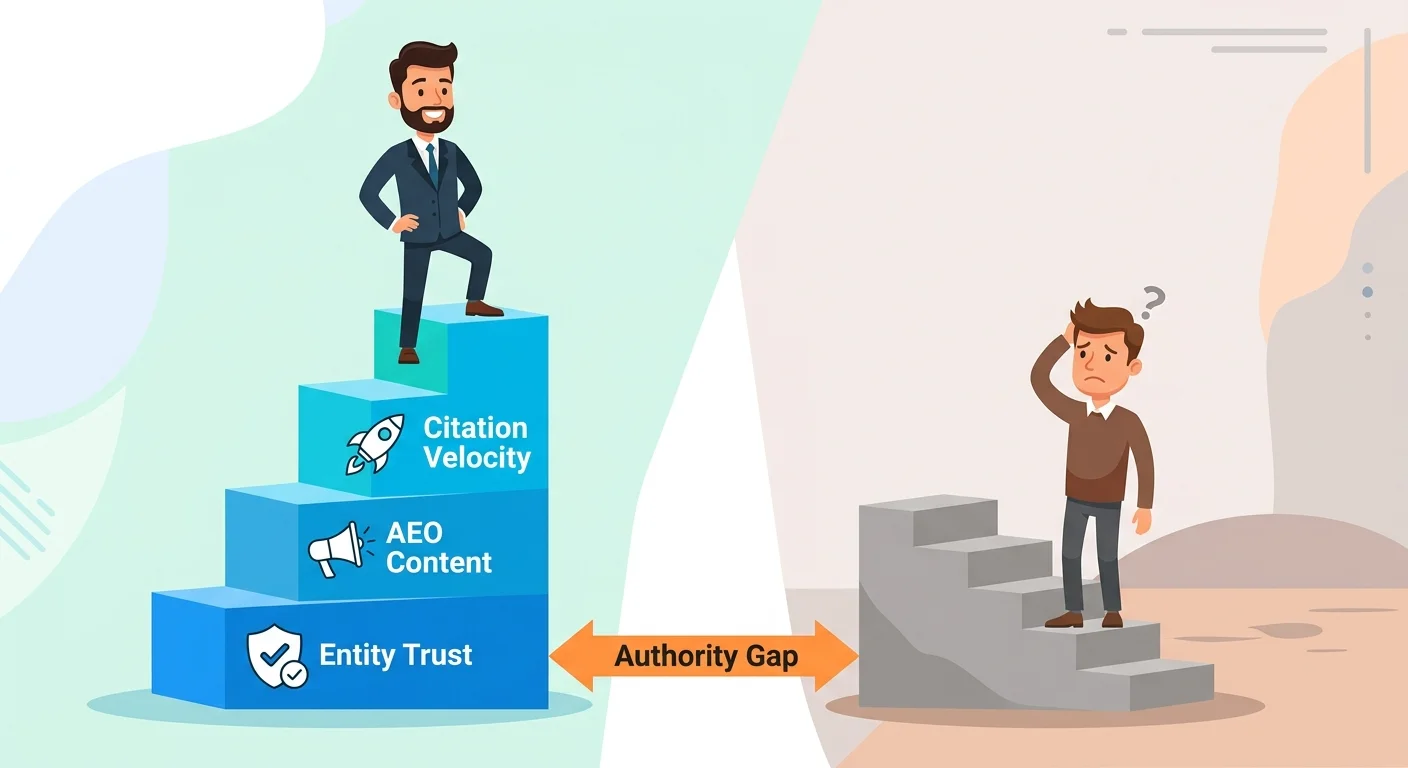
This isn't a waiting game. Your competitors aren't waiting. Every month they build, the gap gets harder to close.
The practices showing up in your AI Authority Snapshot didn't get there by accident. They built first — entity signals, structured content hierarchies, machine-readable architecture. And here's the part that should bother you: their lead isn't staying flat. It's compounding. Every month you wait, the gap grows faster than the month before.
According to CDC data, approximately 39% of US adults experienced back pain in a single survey year. That's the market. And the channel that used to route those patients to your front desk — traditional search — is projected to drop 25% by 2026. The patients aren't going away. The engine delivering them is changing. The only question is whose name that engine says when someone finally asks.
How AI Authority Compounds — and Why Timing Matters
AI authority doesn't work like a campaign. It doesn't peak and reset. Every AI Authority article, every entity confirmation, every structured signal deepens the engine's trust — and that trust builds on itself.
That's what makes timing the most consequential call in this conversation. A practice that started building six months ago isn't just six months ahead — they're structurally ahead, because compounding means their lead is accelerating. It's the same reason a sound patient decision framework forces every practice to answer the same honest question before the window closes: are you building, or are you watching someone else build?
Wanting confidence before committing is fair. But waiting doesn't pause the clock. Every month another practice's entity trust deepens, the gap costs more to close.
The Specific Patient Segment Your Practice Is Losing
Here's what makes this concrete. The patients your practice is losing aren't going to a better clinic. They're going to a better-signaled one. The engine isn't comparing your outcomes or your patient reviews. It's comparing entity trust. And if your signals are weak or inconsistent, a practice with worse outcomes but stronger infrastructure gets the recommendation — every single time.
This matters most with high-intent patients — the ones who already know they need a chiropractor and are asking ChatGPT or Gemini who to trust in their area. These aren't casual browsers. They're ready to book. And they're getting routed to whoever built the infrastructure first. As Gerek Allen frames it: the engine gives one answer, and if you're not it, you don't exist.
That's the patient segment the Snapshot makes visible — not the ones you're gaining, but the ones leaving without a word. No cancellation. No complaint. Just a recommendation delivered to a patient who was ready to book, routed to a competitor who built the right infrastructure first. Ignoring the diagnostic doesn't make the problem disappear. It just means you find out later how far it already spread.
| Month | Practice That Acts Now | Practice That Waits | Gap in AI Authority |
|---|---|---|---|
| Month 1 | Completes AI Visibility Check — baseline entity signals documented, infrastructure gaps identified | Reviews Snapshot results, waits for partner alignment, takes no action | Acting practice begins schema buildout and structured content hierarchy; waiting practice has no foundation in progress |
| Month 2 | Authority infrastructure deployed — schema, entity signals, AI-readable content architecture in place | Schedules internal meeting to revisit the decision; no infrastructure work initiated | Acting practice's entity trust begins registering with AI answer engines; waiting practice remains invisible |
| Month 3 | First AI Authority articles published — Citation Velocity building, Semantic Density increasing | Requests a second opinion from a traditional agency; receives a keyword-ranking proposal | Acting practice starts appearing in AI recommendation outputs; waiting practice's competitor gap widens |
| Month 6 | Authority compounding — each new signal deepens engine trust, structural lead accelerates | Decides to act after seeing a competitor named repeatedly in AI results for their market | Waiting practice must now close a six-month compounding gap before reaching parity — the cost to catch up is higher than the cost to start |
| Month 12 | Structurally embedded in AI recommendation outputs — entity trust established across ChatGPT, Gemini, and Grok | Begins authority infrastructure buildout a full year behind the competition | Acting practice's authority is a compounding asset; waiting practice is starting from scratch in a market where the infrastructure lead is already entrenched |
Frequently Asked Questions
These are the questions that actually come up. Not the polished ones. The kitchen-table ones — after a partner sees a competitor's name in the results and wants to understand what they're actually looking at.
These aren't hypothetical. They're the exact friction points that come up when a chiropractor who's ready to move sits down with a partner who needs the reasoning to hold. Here's where it gets stress-tested.
What is an AI Authority Snapshot, and why does my spouse or business partner need to see it?
It's a diagnostic report. Not a sales pitch — a measurement.
The AI Authority Snapshot shows exactly what ChatGPT, Gemini, and Grok produce when someone in your market asks who to trust for chiropractic care. Your practice name is either in that answer or it isn't. There's no interpretation required.
Your spouse or partner needs to see it because a $15,000 investment conversation shouldn't start with someone's opinion. It should start with documented engine output. The Snapshot replaces the speculation with evidence — competitor names that appear instead of yours, entity signals your practice is missing, and how wide the gap already is.
That's not a sales tool. It's the data both partners need before making a decision this size.
Why can't we just fix our clinic's AI invisibility ourselves instead of paying $15,000?
You can try. Most practices that attempt it come back with the same Snapshot scores and months of lost ground.
This isn't a checklist problem. It's a technical and content architecture problem — entity signals, schema, structured content hierarchies, AI Authority articles built to compound over time. Each piece interacts with the others. Miss one and the stack breaks.
And here's what doesn't show up in the DIY conversation: the practices already in your Snapshot results didn't stumble into those positions. They built them deliberately, with execution depth that doesn't reduce to a weekend project. Every month spent attempting it internally is a month those practices extend their lead.
Is a bad AI visibility score really a threat to our chiropractic practice's patient acquisition?
Yes. And the data doesn't leave room for debate.
The CDC reports that approximately 39% of US adults experienced back pain in a single survey year. That's the size of the patient pool your practice competes for. At the same time, Gartner projects traditional search volume will drop by 25% by 2026. The patients aren't going anywhere. The engine routing them is changing underneath you.
This isn't a future scenario — it's already running. One-third of organizations are actively deploying generative AI right now. Pew Research found only 30% of Americans can correctly identify all the ways AI is shaping their decisions. Patients are getting routed by engines they don't even realize they're using.
If your practice isn't signaled correctly, you're invisible to that routing. Not eventually. Right now.
How does the Local AI Authority Engine differ from the SEO retainer we are already paying for?
A retainer rents access to an algorithm that's being replaced. The Local AI Authority Engine builds infrastructure your practice owns.
Traditional SEO retainers optimize for keyword rankings in a search model that Gartner projects will shed 25% of its volume by 2026. Stop paying — the optimization stops. The position disappears. Nothing is left behind.
Authority infrastructure works differently. Entity trust, structured signals, AI Authority articles — these compound. Every signal you add deepens the engine's confidence in your practice. That's not a recurring expense. It's equity — a structural position inside the entity graphs that ChatGPT, Gemini, and Grok rely on when producing a recommendation.
One is a lease. The other is ownership. Those aren't variations of the same thing.
What is the realistic timeline to see our practice named in ChatGPT, Gemini, and Grok recommendations?
There's no honest answer that gives you a specific number of months. Anyone who offers one is selling a guarantee that doesn't exist.
Here's what is true: authority infrastructure compounds from the moment it's built. The structural work — schema, entity signals, AI-readable architecture — starts accumulating trust immediately. AI Authority articles add signals over time. The engine's confidence in your practice deepens with each one.
A practice that started six months ago isn't just six months ahead. They're structurally ahead, because their compounding lead is growing faster now than when they started.
So the real framing isn't "when will we see results." It's "how much ground are we losing while we wait to start."
The Bottom Line for Your Practice
The Snapshot was never the pitch.
It was the evidence.
Competitor names in the results. Entity signals your practice is missing. A channel shift already in motion. Both partners have seen it now. So here's the only honest question left: what do you do with that information?
This was never about marketing spend.
It was always about one thing: does your practice get named, or does it get skipped? Every time a patient asks ChatGPT, Gemini, or Grok who to trust in your area — that question gets answered. Right now. With or without your input. You're either in the answer or you're not.
Entity trust, structured signals, and Local AI Authority Engine content that compounds every month — that's what determines which side of that line you're on. Not impressions. Not click-through rates. The infrastructure either exists or it doesn't. And a practice that sees the diagnostic and sits on it hasn't avoided the problem. It's just decided not to fix it.
Partners who make this call together — Snapshot in front of them, same language, same data — aren't guessing. They're choosing.
The practices that choose early don't just close the gap. They become the name showing up in someone else's Snapshot results. That's not a forecast. That's what's already happening in your market.
Ignoring the diagnostic doesn't make the disease disappear — it just delays finding out how far it's already spread.
You already know something is off. The AI Visibility Check takes 15 minutes and shows you exactly what ChatGPT, Gemini, and Grok say about your practice right now — documented engine output, not projections, not theory. That's the conversation starter. Not a pitch deck. Not a guess. Real data your partner can look at and decide for themselves. Run it. See what it says. Then you'll both know what you're actually dealing with.
621 Enterprises, Inc. | Copyright 2026 | All rights reserved