
Is a Bad AI Visibility Score a Threat or an Opportunity for Your Practice?
A bad AI visibility score is not a verdict. It is a map.
An AI visibility score measures how confidently AI recommendation engines — ChatGPT, Gemini, and Grok — can identify, verify, and cite your practice when a patient asks who to trust. Three signal categories drive that score: whether your authority infrastructure is machine-readable, whether your entity data is unambiguous across the web, and whether your practice appears in the sources AI engines use to validate recommendations. A low score means one or more of those signals is broken.
Most practitioners treat that as bad news. It isn't.
A map doesn't tell you you're stuck. It tells you exactly where to go. A low score shows you which signals are failing, in what order to fix them, and where your competitors are most exposed. Conversational AI is projected to reduce traditional search engine query volume by 25% by 2026. That shift is already happening. Every month your score stays low is a month a competitor builds the authority gap wider.
But here's the thing — that gap works both ways. Most local practices haven't addressed AI visibility at all. A low score in your market almost always means your competitors share the same problem. That isn't a crisis. That is an arbitrage window.
Over ninety percent of consumers consult verified digital health directories before booking a clinical appointment. AI engines pull from those same trust signals. A bad score tells you your practice isn't showing up in that trust layer — yet.
Yet is the operative word. The score didn't show you the wall. It showed you the door.
Last Updated: July 15, 2026
- • What Your AI Visibility Score Is Actually Measuring
- • Why Most Practices Score Low (And Why That's Not an Accident)
- • The Real Threat Hidden Inside a Low Score
- • How a Low Score Becomes a Market Advantage
-
• Frequently Asked Questions
- • What is an AI Visibility Score and how is it calculated?
- • Why does a strong traditional SEO presence still result in a low AI Visibility Score?
- • Is a bad AI Visibility Score an immediate threat to my practice's patient acquisition?
- • How long does it take to improve a low AI Visibility Score?
- • Can I fix my practice's AI visibility myself over a weekend?
- • Your Score Is a Starting Line, Not a Finish Line
What Your AI Visibility Score Is Actually Measuring
Most practices see the score and think they already know what it means. They don't. They map it onto the same dashboard logic their old agency used — traffic, rankings, impressions. That's not what this measures.
Here's the thing: an AI visibility score is a trust audit. Not a performance score. AI recommendation engines don't care how much content you've published. They ask whether they can verify who you are, confirm what you treat, and trust the sources that mention you. Three distinct questions. A low score means at least one of those answers came back unclear.
That distinction changes everything. Because it changes what you fix.
The Three Signals AI Engines Read Before They Name Anyone
Every AI visibility score is a composite read of three signal categories: Structural Invisibility, Entity Ambiguity, and Citation Drought. Each one maps to a different failure mode. Each one requires a different fix.
- Structural Invisibility — your site lacks the schema and machine-readable formatting AI engines need to confirm your identity
- Entity Ambiguity — your practice exists online, but inconsistently, so AI can't confidently say you are who you claim to be
- Citation Drought — trustworthy third-party sources rarely or never mention your name, so AI has no external validation to draw from
Here's what makes that breakdown useful: these three signals don't travel together. A practice can have clean infrastructure and still score low because of Citation Drought. Another can have strong citations and still get buried by Entity Ambiguity. The score tells you which signal is broken — and that tells you exactly where to start.
And the clock is running. According to Gartner, traditional search volume is projected to drop 25% by 2026 as patients shift to asking AI engines directly. The practices named in those answers won't be the ones that ranked well on a list two years ago. They'll be the ones whose three signals are clean.
Why Traditional SEO Metrics Tell You Nothing About AI Visibility
Traditional metrics — keyword rankings, domain authority, backlink counts — were built for one thing: a list-based index. That system is losing ground every quarter. The metrics built on top of it are losing relevance at the same pace.
AI engines don't rank pages. They evaluate entities. The question isn't whether your page has the right keyword density. It's whether your practice exists as a coherent, verifiable identity across the web.
A practice can have a high domain authority score and still land near zero on AI visibility. These two systems read completely different signals. Traditional metrics tell you your position in a system that's being replaced. Understanding what those signals actually mean is the first step toward doing something about it — and most practices skip straight to tactics without ever taking that step.
So the score isn't a reflection of how hard you've worked. It's a reflection of whether that work was aimed at the right target. For most practices, it wasn't — because the target just changed.
| Signal | What AI Engines Read | What a Low Score Reveals | What a High Score Looks Like |
|---|---|---|---|
| Structural Invisibility | Machine-readable schema markup, structured entity data, and authority infrastructure formatting that AI engines can parse without ambiguity | Authority infrastructure is unformatted or incomplete — AI engines cannot confirm who you are or what you treat, so they skip your practice entirely | Clean schema, consistent structured data, and a fully machine-readable authority infrastructure that AI engines can parse and trust on the first pass |
| Entity Ambiguity | Consistency of your practice's name, address, specialty, and identifying details across every platform, directory, and source the AI cross-references | Conflicting or incomplete identity signals across the web — AI engines encounter contradictions and default to the cleaner, more trustworthy result, which is usually a competitor | A unified, verified identity that matches across all directories and citation sources — AI engines can confirm who you are without encountering conflicting signals |
| Citation Drought | The volume and quality of third-party mentions from the verified directories, health platforms, and authoritative sources AI engines use to validate recommendations | Your practice is absent from the trust sources AI engines rely on — citations are sparse, unverified, or missing entirely from the platforms that carry weight in AI recommendations | Consistent, verified mentions across the high-authority directories and citation platforms AI engines treat as trust validators — your practice appears where it needs to appear |
Why Most Practices Score Low (And Why That's Not an Accident)
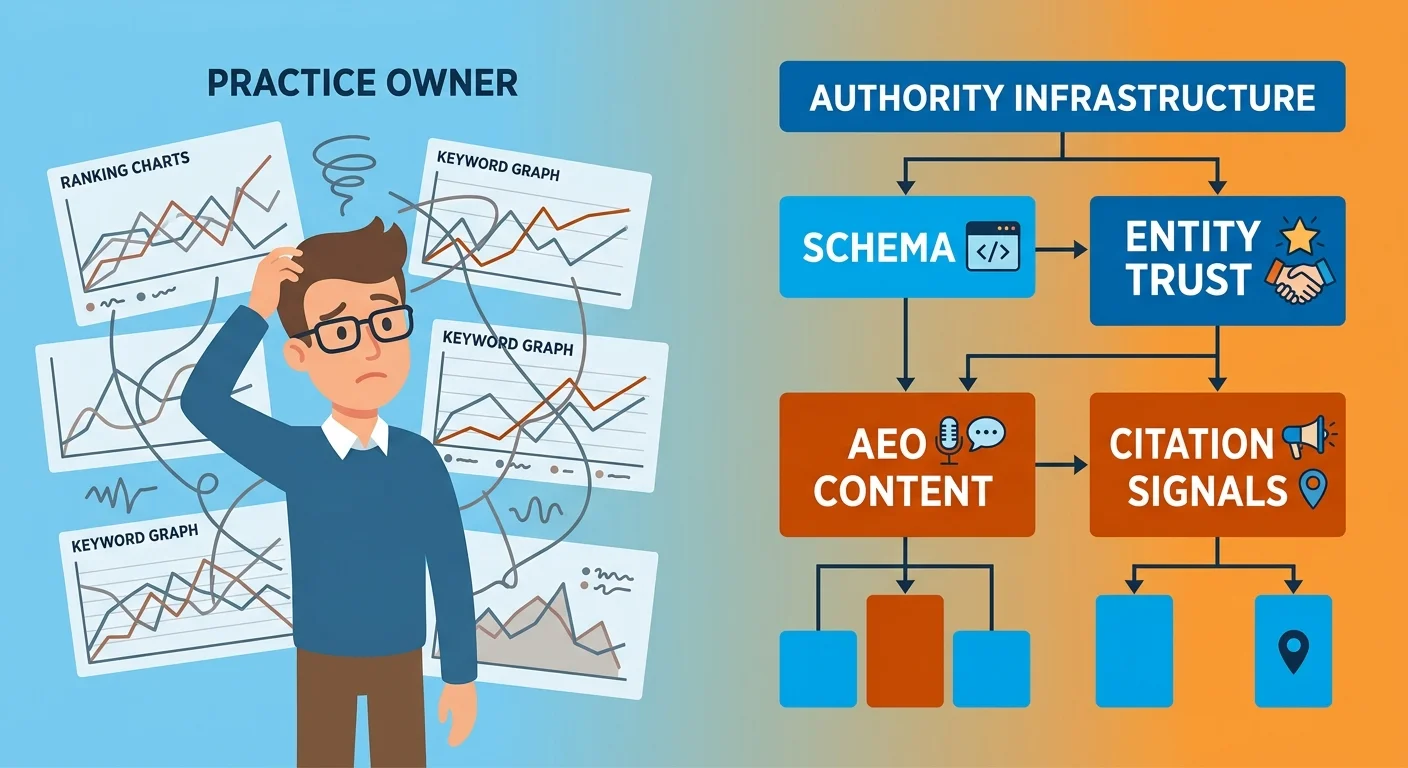
Most practices score low for the same reason. It's not carelessness. It's architecture.
These practices weren't asleep. They did exactly what their agencies told them. Keyword-optimized pages. Directory listings. A polished brand presence. But none of it was built for AI engines. It was built for a list-based index — the kind McKinsey is watching organizations defund as they shift budgets toward systems that evaluate entities, not pages.
That's not a failure of effort. It's a failure of aim. And it's nearly universal — which is exactly what makes this the right moment to move.
The Legacy Infrastructure Problem No One Warned You About
Here's what no agency put in the deck: the infrastructure under your digital presence was engineered for a discovery model that AI engines don't use anymore.
Template-driven pages. Generic directory entries. Unstructured content blocks. That architecture was built to satisfy crawlers that ranked pages in a list. It made sense at the time. But AI recommendation engines don't crawl for rank — they scan for entity coherence. The question they're asking is: is this practice a real, verifiable, trustworthy identity I can confidently name to a patient? Legacy templates don't answer that question. They don't emit the machine-readable trust signals AI engines require. So the practice gets skipped.
The result is Structural Invisibility — not because the practice is unknown, but because its digital presence speaks a language AI engines can't parse. If you've ever tried to explain this gap to a skeptical partner or stakeholder, the framing is the same: it's not about how much content exists, it's about whether the infrastructure underneath it is machine-readable. Legacy setups can't close that gap on their own.
Why Conventional Agencies Keep Selling You the Wrong Fix
And the agencies? Most of them know something changed. They're just selling fixes for the old problem.
More content. More backlinks. Better keyword targeting. None of that is worthless — but it's optimization stacked on top of infrastructure AI engines can't verify. It's painting a building that has no address. The work looks real. The results don't show up in the answers patients are getting. And as investment in generative AI search validation accelerates across every industry, the gap between legacy-optimized practices and entity-optimized practices widens every single month.
The Local AI Authority Engine was built specifically because this gap exists. Closing it requires a different approach entirely — not a louder version of what already isn't working.
This Is Not the Right Practice for Everyone Reading This
Now let's be straight about who this path is actually for.
If you're looking for a quick fix that delivers measurable ROI in 90 days, this isn't it. Authority is built in layers. Structural Invisibility, Entity Ambiguity, and Citation Drought don't resolve overnight. Any agency that tells you otherwise is selling you the same hopium the industry has been packaging for years. The practices that win at AI visibility are the ones willing to rebuild the foundation — not patch the surface and call it a strategy.
But if you're tired of paying for tactics that compound nothing — if you want a strategy where every month of execution builds on the last rather than disappearing when the invoice stops — then a bad AI visibility score isn't a threat. It's your entry point. The score didn't show you the wall. It showed you the door.
| What Conventional Agencies Sell | What It Optimizes For | What AI Engines Actually Need | The Visibility Gap It Creates |
|---|---|---|---|
| Keyword-optimized authority articles | Page ranking in a list-based index | Entity coherence signals that confirm who the practice is and what it treats | Structural Invisibility — AI engines cannot parse the practice as a verifiable identity, so it never gets named |
| Backlink building and domain authority scores | Third-party link volume pointing to a page | Citation signals from trusted, structured sources that validate the practice's expertise and location | Citation Drought — high link counts from irrelevant sources carry no weight with AI recommendation engines |
| Directory listings and brand consistency packages | Uniform name and address display across consumer-facing platforms | Consistent, machine-readable entity data — schema-formatted identifiers that resolve conflicts across the web | Entity Ambiguity — inconsistent or unstructured data forces AI engines to default to a competitor whose signals are cleaner |
| Template-driven page builds and generic content blocks | Visual polish and crawlability for legacy search indexes | Machine-readable infrastructure — structured data, semantic markup, and AI-readable content architecture | Structural Invisibility — legacy templates emit no trust signals AI engines can act on, regardless of how much content sits on top |
The Real Threat Hidden Inside a Low Score

The score isn't the threat. The market is.
While your score sits low, the clock runs. Patients are asking. AI engines are answering. And the name they give out isn't yours.
Every day you're invisible to AI engines, a competitor collects a recommendation you should have received. That patient wasn't browsing. They were ready to book — same specialty, same area, same level of urgency. They just got a different name. The one whose authority infrastructure AI could actually read.
More than 90% of consumers check verified health directories before booking a clinical appointment, according to Pew Research Center. Those directories aren't just for patients browsing options — they're the same trust signals AI engines pull from when generating a recommendation. So when your practice isn't registering in that trust layer, the referral doesn't stall. It just goes to whoever is.
What AI Engines Are Recommending Instead of You Right Now
Here's that moment from the patient's side.
They ask an AI engine for a chiropractor. No ranked list. No ten blue links to scroll through. They get a name — maybe two. That's the entire window.
The practices getting named right now aren't the best in their markets. They're the ones with the cleanest entity signals — name, credentials, location, and specialty structured consistently across every platform AI pulls from. Entity Ambiguity and Structural Invisibility don't just lower your score. They hand the recommendation to whoever doesn't share those problems. And that problem is growing: Gartner projects traditional search engine volume will drop 25% by 2026 as conversational queries take over. More patients asking AI directly means more recommendations going out — and more of them going to someone who isn't you.
The practices already in that conversation are compounding. Every AI recommendation builds a citation record. Every citation strengthens entity trust. Every trust signal makes the next recommendation more likely. That's the loop — and once it's running, it runs without them doing much of anything.
The practices on the outside? They're watching the gap widen. And most of them still don't know it's happening.
The Compounding Cost of Every Month You Stay Invisible
Low AI visibility doesn't show up on a report line. It shows up in a patient acquisition number that never moves — while a competitor's quietly does.
That's the honest accounting most practices never run. They track what they spend on authority content and directory listings. They rarely track what they lose to a competitor who's getting named by AI while they aren't. And closing that gap is far harder than a weekend patch job — because the signals that matter to AI engines aren't surface-level tweaks. They live in the infrastructure underneath everything else.
But here's where the framing shifts.
A low AI visibility score isn't a verdict on your reputation or your clinical quality. It's a diagnostic read of three specific, correctable failures. Structural Invisibility, Entity Ambiguity, Citation Drought — each one is a gap with a defined fix. Not a shrug. Not a rebuild-everything-and-pray. A fix. The score didn't show you the wall. It showed you the door.
| Invisibility Duration | Patient Acquisition Impact | Competitor Authority Gain | Estimated Recovery Timeline |
|---|---|---|---|
| Early stage — score recently identified | Minimal direct loss; competitors have not yet built a compounding citation record in your market | Competitors are beginning to accumulate AI recommendations but authority signals remain early and shallow | Fastest recovery window; Infrastructure Rebuild and Authority Compounding stages can close the gap before a competitor's lead becomes structural |
| Several months of low visibility | Steady referral bleed — patients asking AI engines are consistently routed to competitor practices instead | Competitor citation records are deepening; entity trust signals are being reinforced with each recommendation cycle | Recovery is achievable but requires a full infrastructure rebuild before Authority Compounding can begin to offset the gap |
| Extended period — visibility gap normalized and unaddressed | Patient acquisition channel is effectively absent from AI-driven discovery; organic referral volume reflects the gap | A competitor has established dominant entity trust in the market; AI engines are defaulting to that practice by pattern | Recovery timeline lengthens significantly; the rebuild must overcome an established competitor authority baseline, not just a neutral starting point |
| Gap discovered and infrastructure rebuild underway | New patient acquisition begins responding as entity signals become machine-readable and citation velocity builds | Each month of Authority Compounding narrows the competitor's lead; the gap that widened passively now closes actively | The score that once represented lost ground becomes the baseline against which compounding authority is measured — the map is now a route |
How a Low Score Becomes a Market Advantage
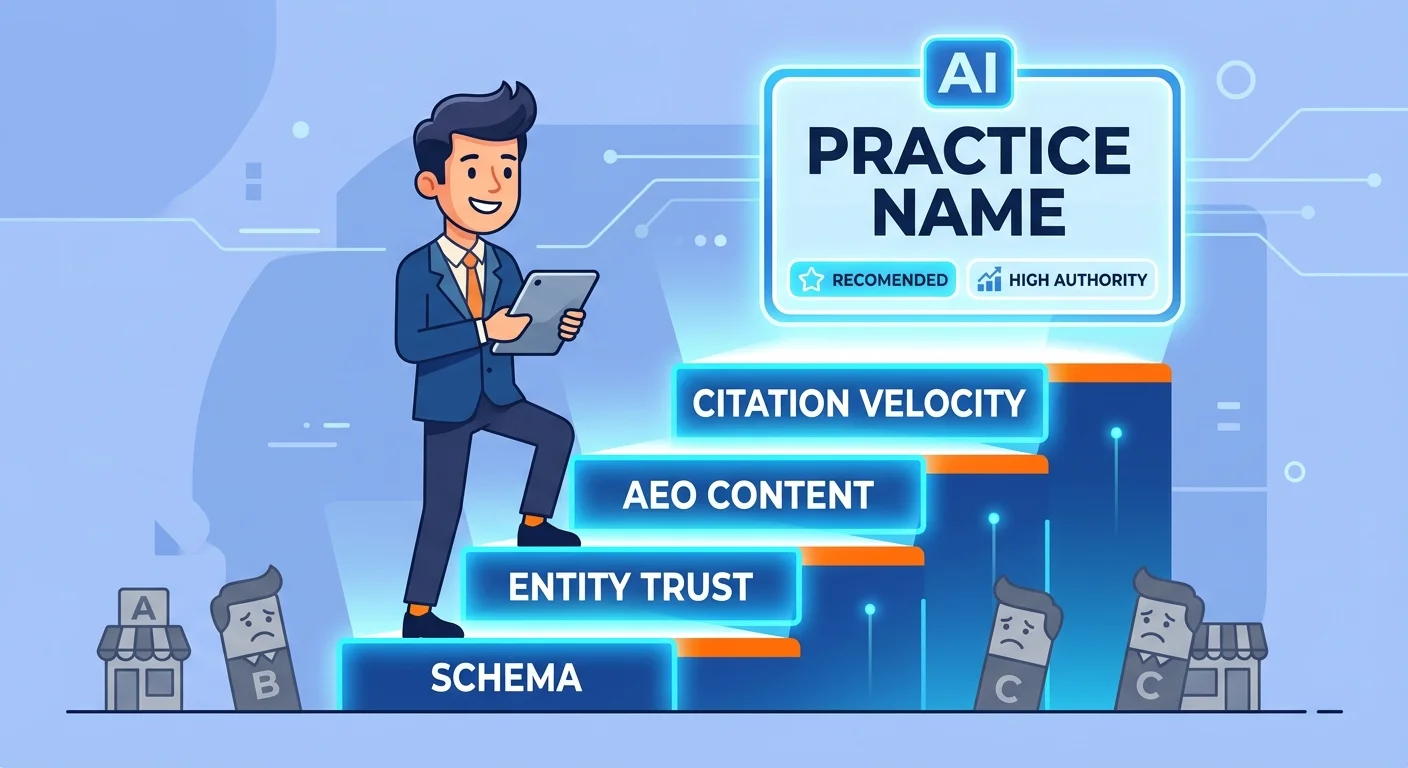
Here's the reframe: a bad AI visibility score isn't the threat. It's the map.
A map doesn't tell you you're stuck. It tells you exactly where to go. The practices that read it as a verdict stay stuck. The ones that read it as a diagnostic start moving — and moving first is everything in a market this slow.
And right now, timing is the whole game.
McKinsey has documented the accelerating shift away from legacy digital architectures across industries. In local healthcare markets, that shift is already creating a split — practices that have rebuilt their authority infrastructure, and practices that haven't. That gap is not staying level. It's widening. Every month of inaction is a month a competitor can use.
So the opportunity inside a bad score is this: your competitors haven't moved yet.
Most of them are still paying legacy agencies for tactics AI engines can't verify. Every month that gap exists, the practice that moves first gains ground that gets harder and harder to take back. That's not a minor edge. That's compounding authority — and it starts accumulating the moment you decide to act.
The Four-Step Authority Arbitrage Process
Here's exactly how it works.
Four steps. Fixed order. Skip one and the whole sequence breaks.
Score Diagnosis is first. Not a gut check — a forensic read of which of the three signal failures are present and how bad each one actually is.
Gap Mapping translates those failures into a prioritized rebuild sequence. The work that moves the needle fastest goes first. Then Infrastructure Rebuild — not a surface patch, but a ground-up reconstruction of the machine-readable architecture that AI engines actually use to evaluate trust.
Last: Authority Compounding. Consistent, structured AEO content execution that stacks citation velocity on top of the new infrastructure — month after month — until the recommendation loop starts feeding itself.
What happens in the first weeks of execution is less dramatic than most practices expect.
But it's more consequential than most agencies admit. The foundation work isn't visible to patients yet. It's what makes everything that follows compound instead of evaporate. The practices that get impatient at this stage are the ones who quit right before the signal starts to stick.
What Changes When You Move First in a Slow Market
The slow market isn't a problem. It's the opening.
Most local chiropractic markets have one practice — maybe two — that has run any kind of AI visibility audit. The rest are operating on the assumption that their existing presence is working fine, because nobody's told them it isn't, and because the damage doesn't show up in their analytics yet. That's the window. It won't stay open indefinitely.
Moving first buys you something specific: citation primacy.
When AI engines start associating your name with your specialty and your geography — when your entity signals are the cleanest in the local pool — the recommendation defaults to you. Pew Research Center has documented how trust in chatbot-generated recommendations behaves differently from traditional search behavior. That divergence is exactly why early authority compounding is so defensible. The practice that owns the AI recommendation doesn't just get one patient. It gets the next one. And the one after that. Because every citation strengthens the trust signal that produced it.
The score didn't show you the wall. It showed you the door.
And most of the practices in your market haven't found it yet. That's not a minor edge. That's a compounding asset — and it starts accumulating the moment you decide to move.
| Arbitrage Step | What Happens | Who Executes It | Compounding Effect Over Time |
|---|---|---|---|
| Score Diagnosis | A forensic read of which signal failures are present — Structural Invisibility, Entity Ambiguity, or Citation Drought — and how severe each one is. No guesswork. No assumptions. The score tells you exactly where the infrastructure broke down. | Authority infrastructure specialist — not a generalist agency running keyword audits | Establishes the precise starting point so no rebuild effort is wasted on the wrong layer |
| Gap Mapping | Signal failures are translated into a prioritized rebuild sequence. The gaps that block AI recommendation most severely get addressed first — not the ones that are easiest or fastest to check off. | Specialist working from diagnostic output — not a templated onboarding checklist | Ensures every hour of execution closes a real gap rather than polishing a surface that doesn't affect recommendations |
| Infrastructure Rebuild | The underlying machine-readable architecture is reconstructed from the foundation up — schema, entity signals, structured data, and authority platform presence. This is not a patch. It is a replacement of what AI engines couldn't trust before. | Done-for-you execution — the practice does not manage, learn, or execute any part of this layer | Creates the stable foundation that makes every future AEO content piece compound rather than evaporate |
| Authority Compounding | Consistent, structured AEO content execution layers citation velocity on top of the new infrastructure month after month. Each piece reinforces entity trust. Each recommendation makes the next one more likely. The loop becomes self-reinforcing. | Ongoing content execution by the authority partner — not a one-time deliverable | The practice that reaches this stage first in its local market builds a citation record that grows harder for competitors to displace with every passing month |
Frequently Asked Questions
Good. The reframe sticks. But questions are still sitting on the table.
How does the score actually work? Why doesn't a strong traditional presence transfer? Can a motivated owner fix this solo? Those aren't objections — they're exactly the right questions to ask. Here are straight answers.
What is an AI Visibility Score and how is it calculated?
An AI Visibility Score measures how confidently AI engines can read, trust, and cite your practice. Three signal categories drive it. Structural Invisibility — whether your authority infrastructure is machine-readable. Entity Ambiguity — whether AI can confirm who you are and what you treat. Citation Drought — whether external platforms are reinforcing your authority at all. Each failure pulls the score down. It isn't a single algorithm — it's a diagnostic read across every layer AI engines use to generate recommendations. Practices with clean entity signals score higher. Practices running on legacy infrastructure score low — regardless of how long they've been in business.
Why does a strong traditional SEO presence still result in a low AI Visibility Score?
Because traditional authority was built for a different system. Ranked lists reward keyword density and backlink volume. AI engines don't produce lists. They produce a single recommended answer. Those two systems read completely different signals. AI engines pull from structured practitioner metadata, verified directory profiles, and machine-readable schema. A practice can have a high domain authority score and still land near zero on AI visibility. The infrastructure is just different. Legacy tactics optimized for the wrong target — and no amount of traditional optimization closes the gap that Structural Invisibility, Entity Ambiguity, and Citation Drought create.
Is a bad AI Visibility Score an immediate threat to my practice's patient acquisition?
Yes. But not the way most practices picture it. A low score doesn't block patients outright. It quietly redirects them. Someone asks an AI engine for a recommendation — your practice can't be verified — and the answer goes to whoever can be. Over ninety percent of consumers consult verified digital health directories before booking a clinical appointment. Those same directories feed the trust signals AI engines use to build recommendations. So every unanswered query is a patient a competitor collects. That's not one lost booking. That's a compounding loss across every query your practice never shows up in — quietly, every single day, with no alert telling you it's happening.
How long does it take to improve a low AI Visibility Score?
There's no honest fixed timeline. Any agency that hands you one is selling you something. Authority builds in layers. Score Diagnosis and Gap Mapping can move quickly. Infrastructure Rebuild takes longer — the machine-readable architecture has to be built correctly, not patched. Authority Compounding is ongoing: consistent AEO content execution stacks citation velocity on top of the new foundation, month after month. What I'll say is this — every month of execution compounds on the last. The practices that start moving now are the ones that own the recommendation when the local market catches up to what's already happening.
Can I fix my practice's AI visibility myself over a weekend?
No. And the reason matters more than the answer. Structural Invisibility, Entity Ambiguity, and Citation Drought aren't surface problems you can patch with a Saturday afternoon and a YouTube tutorial. They require rebuilding the underlying authority infrastructure — schema architecture, entity consistency across every platform AI pulls from, and AEO content that stacks citation velocity over time. Conversational search is projected to displace a significant share of traditional search volume by 2026. The infrastructure that captures that shift has to be built correctly. A DIY sprint doesn't get you there. It gets you busy — which feels like progress right up until a competitor who built it properly starts owning the recommendations in your market.
Your Score Is a Starting Line, Not a Finish Line
Here's the thing — a bad AI visibility score doesn't mean your practice is broken. It means the map finally showed up.
Score Diagnosis. Gap Mapping. Infrastructure Rebuild. Authority Compounding.
That's not a recovery sequence. That's a growth engine. And it starts the moment you stop reading the score as a verdict.
The practices winning AI recommendations right now didn't start with perfect infrastructure. They started with a forensic read that told them exactly where Structural Invisibility, Entity Ambiguity, and Citation Drought were handing patients to a competitor.
And then they moved.
The score didn't show them a wall. It showed them a door. They walked through it while everyone else kept paying for tactics AI engines can't read.
That door is still open in most local markets. But markets don't stay patient.
The practice that moves first compounds first. Every citation builds the next one. Every month of clean entity signals makes the recommendation more automatic — and the competitor's path back harder.
The score didn't show you the wall. It showed you the door.
Most practices in your market still haven't found it. That's not a minor edge. That's a compounding asset — and it starts accumulating the moment you decide to move.
That score isn't a verdict. It's a map. The AI Visibility Check takes fifteen minutes. What comes back is a forensic read of exactly where Structural Invisibility, Entity Ambiguity, and Citation Drought are routing patients to a competitor — and what closing those gaps first is worth in your specific market.
621 Enterprises, Inc. | Copyright 2026 | All rights reserved