
The DIY Trap: Why Fixing AI Invisibility Is Not a Weekend Project
Fixing AI invisibility is an infrastructure problem. Not a content problem. Not a keyword problem. Not something a practice owner can solve over a weekend.
ChatGPT, Gemini, and Grok do not crawl pages looking for keywords. They parse structured data, entity-relationship graphs, and verified authority signals to determine whose name gets spoken when a patient asks who to trust. That is a fundamentally different system than the one traditional search optimization was built to influence.
Traditional search engine query volume is projected to drop 25% by 2026, driven by the rapid shift to conversational AI. That shift is not coming — it is already here. The practices showing up in AI recommendations are not the ones who published the most content. They are the ones whose digital infrastructure was built to be machine-readable, entity-verified, and semantically consistent across every platform AI uses to validate a business.
Building that infrastructure starts with a real diagnostic. Not guesswork. Not a surface-level audit. A full evaluation of how AI engines currently read — or fail to read — a practice's entity data, schema configuration, content architecture, and authority signals.
DIY attempts almost always target the wrong layer. A practice owner may update page titles, add a plugin that generates basic schema, and publish a few articles. None of that moves the needle if the underlying entity structure is inconsistent, the schema is malformed, or the content lacks the semantic density AI engines use to confirm topical authority.
The system being operated on is too consequential for trial and error. Every month a practice stays invisible in AI recommendations is another month a competitor compounds their authority advantage.
Last Updated: July 15, 2026
- • What Conversational Engines Actually Look For (And Why Your Keywords Don't Matter)
- • Why Traditional SEO Muscle Memory Is the Enemy Here
- • The Anatomy of a DIY AI Fix Attempt (And Where It Falls Apart)
- • What a Real AI Visibility Diagnostic Actually Measures
-
• Frequently Asked Questions
- • Why can't I just optimize my own page keywords over a weekend to show up in ChatGPT?
- • Does traditional SEO help at all when generative AI engines assemble their answers?
- • What are the structural risks of deploying amateur schema markup on my practice's pages?
- • How does a low AI visibility score actively send patients to my local competitors?
- • How long does a professional AI authority infrastructure execution take to compound and produce verified citations?
- • The Scalpel Is Not in Your Toolbox
What Conversational Engines Actually Look For (And Why Your Keywords Don't Matter)
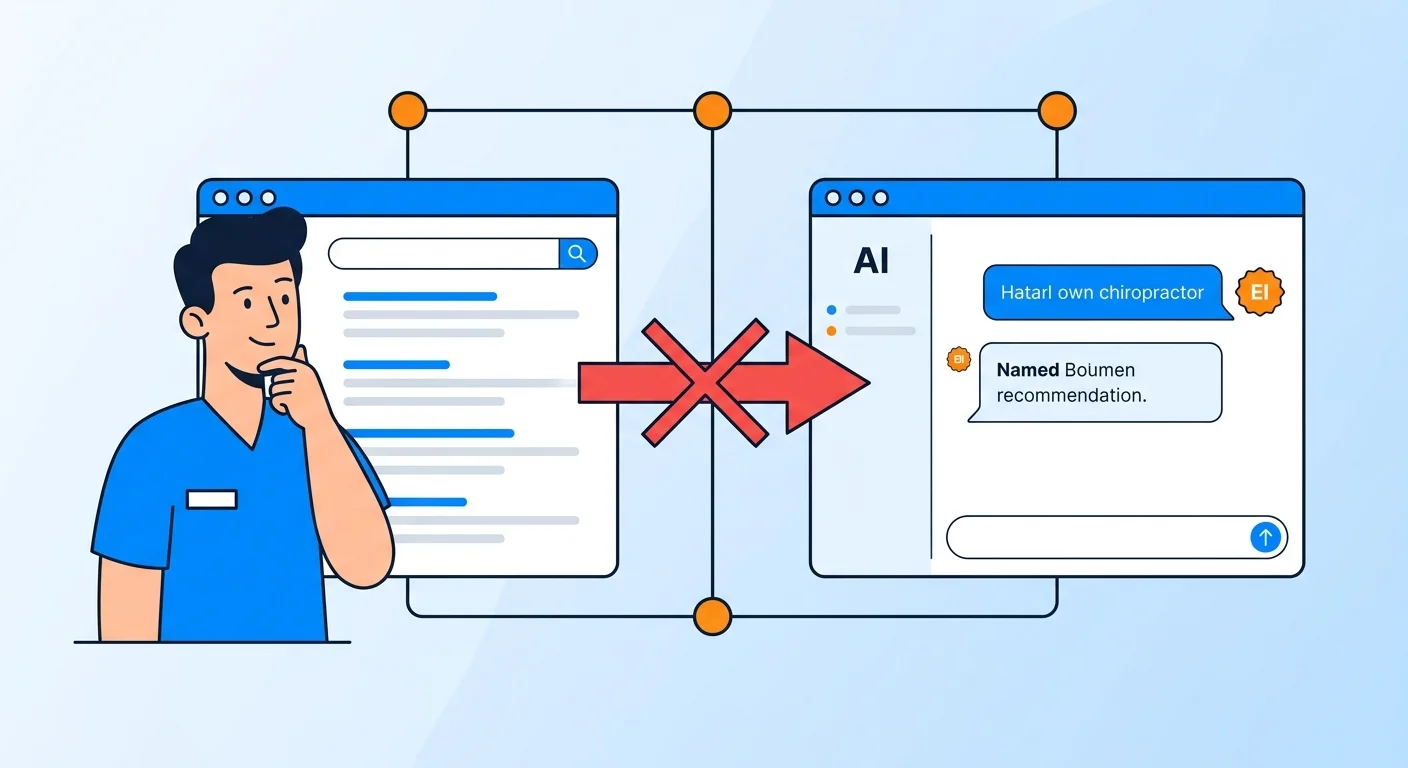
Here's the mistake almost every practice owner makes first. They assume AI engines work like Google did ten years ago — stuff the right words in the right places, and the algorithm rewards you.
That model is dead.
Conversational engines don't crawl for keywords. They query structured entity databases, cross-reference authority signals, and verify that a business is who it claims to be — across every platform, directory, and data source they trust.
That's a different problem. It requires a different fix.
And this isn't a slow-moving shift you can monitor from the sidelines. Gartner projects traditional search engine query volume will drop 25% by 2026 — driven directly by conversational AI adoption.
The practices that come out ahead won't be the ones who optimized hardest for the old system. They'll be the ones who stopped optimizing for it early enough to build for the new one.
The Shift From Keyword Index to Entity Database
Think of traditional search as a library card catalog. You look up a keyword, you get a shelf of results. That's it. That's all it was ever doing.
Conversational AI is not a catalog. It's a verification system. The question it asks isn't 'who mentioned this keyword?' It's: does this entity actually exist, is it genuinely authoritative, and can I confirm that across multiple independent sources I already trust?
Harvard Business Review's published analysis on discovery mechanics confirms what practitioners are learning the hard way: AI engines run on complex entity-relationship graphs — not indexed keyword lists. That's not an academic distinction. It changes everything about what actually moves the needle.
A page title loaded with location keywords does nothing for a system that isn't looking for keywords. What it's looking for is structured proof: schema markup, consistent NAP data across every directory it checks, topical authority clusters, and semantic density that signals real expertise — not just repeated phrases.
Here's where DIY attempts fall apart. A practice owner reads that AI favors quality content, publishes a handful of articles. Reads that schema matters, installs a plugin that auto-generates basic markup. Feels like progress.
None of that touches the entity-relationship layer. That's the layer where AI actually makes trust decisions — and understanding what your diagnostic data means is the first real step toward fixing it. Surface-level changes address what's visible to a human. They leave the machine-readable infrastructure completely untouched.
Why Your Current Digital Footprint Is Invisible to AI
Most practices have a digital footprint that looks credible to a human and is nearly unreadable to an AI engine.
Polished homepage. Service pages. A Google Business Profile that hasn't been touched in months. To a machine parsing entity signals, that's not a presence. That's noise it can't verify — so it doesn't cite you.
The gap shows up fast when an AI engine tries to verify who you are.
Schema missing or malformed — the engine can't confirm your specialization. Entity data inconsistent across directories — it can't trust it. Content without semantic depth on the conditions you treat — no signal that you're the authority.
Every one of those gaps is a reason to recommend your competitor instead of you.
The problem isn't that your practice isn't good enough. The problem is that AI can't read the evidence.
That's not a content fix. That's not a keyword fix. That's a structural rebuild — and it starts with seeing exactly what the machine sees when it looks at you right now. The AI Visibility Check is where that answer lives.
| Signal Type | Traditional Search Engine Uses It | Conversational AI Engine Uses It | What It Requires |
|---|---|---|---|
| Keyword Density | Yes — used to match query terms to indexed pages | No — conversational engines do not crawl for keyword frequency | Topical authority clusters and semantic depth, not repeated phrases |
| Schema Markup | Partial — used for rich snippets and featured results | Yes — required for entity verification and structured data parsing | Correctly configured, complete schema across all relevant page types |
| NAP Consistency (Name, Address, Phone) | Low priority — minor local ranking signal | Critical — inconsistent entity data across directories signals untrustworthiness | Verified, uniform entity data across every platform AI cross-references |
| Entity-Relationship Graphs | No — traditional index does not parse entity relationships | Yes — AI engines map how a business relates to topics, locations, and verified sources | Structured content architecture that connects your practice to the conditions and topics you serve |
| Backlink Volume | Yes — high-authority inbound links elevate page rankings | Minimal — backlinks do not confirm entity trust to a conversational engine | Authoritative citations in structured data sources AI engines already trust |
| Content Volume | Moderate — more indexed pages increases surface area for rankings | Low on its own — volume without semantic density adds noise, not authority | AI Authority articles built around topical depth, not post count |
| Business Profile Completeness | Helpful — fills in local pack data | Essential — incomplete or outdated profiles create entity conflicts AI engines cannot resolve | Fully built, regularly maintained profiles on every platform AI engines query for verification |
Why Traditional SEO Muscle Memory Is the Enemy Here
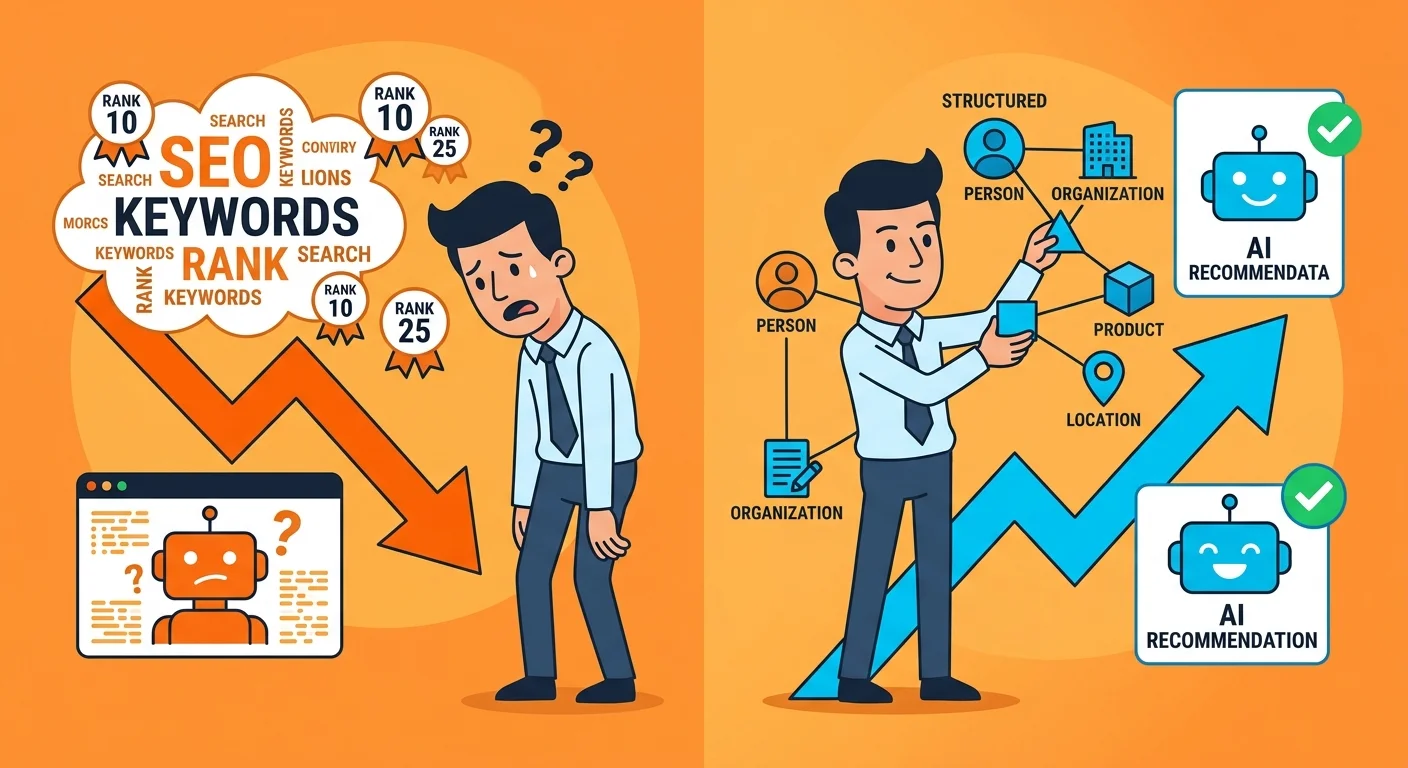
Muscle memory works until the environment changes. Then it's the thing that gets you hurt.
That's exactly what happened when conversational AI displaced the keyword index as the primary discovery mechanism. Everything you already knew how to do — optimized for the wrong system. The ground shifted. The habits didn't.
Every traditional search tactic was built on one assumption: a crawling algorithm would find your page, read your keywords, and rank you accordingly.
That assumption is dead. The system changed. The tactics didn't. And the gap between them is exactly where practices disappear.
According to McKinsey, one-third of organizations now use generative AI regularly in at least one business function. Another 40% plan to increase AI investment. That's not a future trend. That's the competitive environment your practice is inside right now.
Every month on the old playbook is a month spent handing authority visibility to whoever already adapted.
The Broken Logic of Keyword-First Thinking
Keyword-first thinking made sense for fifteen years. Find what patients search for, build pages around those terms, let the algorithm reward you. Sound logic — for a system that read text.
Conversational AI doesn't read text the way a search crawler does. It evaluates structured entity data against a verification graph. That's not a variation of the same process. It's a completely different operation. Treating them as equivalent is where practices go invisible.
So when a practice owner opens a plugin dashboard and starts editing page titles and meta descriptions, they're solving for a system that stopped making the call.
The effort is real. The target is wrong.
Sharpening a knife for a gunfight. Technically an action. Practically irrelevant.
The businesses gaining authority visibility right now aren't the ones who optimized keywords harder. According to published research on AI adoption, generative AI tools are already reshaping operational digital presence at scale.
What's working isn't cleverly arranged words. It's verified identity, confirmed expertise, and semantic consistency across every platform conversational engines use to validate a business. That's a different game entirely.
Why Most Agencies Never Solved the Right Problem
Most agencies never solved the right problem. Because nobody hired them to.
They were hired to move keyword rankings and produce reports that looked like progress. None of that maps to what conversational engines need to trust a business enough to recommend it. The deliverable was always wrong.
The authority infrastructure a typical agency builds is optimized for human eyes and legacy crawlers. Schema gets installed as an afterthought — if at all. Entity data gets scattered across directories with inconsistent NAP entries that quietly destroy every trust signal the practice is trying to build.
And when you later have to explain this gap to a spouse or business partner who approved years of agency invoices, the conversation starts in a brutal place: all that work left the practice invisible where it matters most now.
That's not a condemnation of every agency. It's a structural reality.
Keyword rankings, backlink counts, traffic reports — those were measurable against the old system. The new system evaluates different inputs entirely. Understanding whether a bad AI visibility score represents a threat or an opportunity starts with accepting that most of what agencies tracked before simply doesn't translate.
This Is Not for Every Practitioner
Here's where this gets direct.
Not every practitioner is the right fit for what comes next. Saying that clearly upfront is more useful than letting the wrong person spend six months figuring it out the hard way.
If you need a fix that works in 90 days — this isn't it.
If you need a contractual guarantee of AI citations before you'll commit to rebuilding your infrastructure — this isn't your path.
If your first question is price rather than what invisibility costs you per month in lost AI recommendations — stop reading here.
Authority infrastructure isn't a product you purchase and deploy. It's a system you build layer by layer and maintain with ongoing execution.
The practices that compound the most understood one thing earliest: the advantage belongs to whoever starts first and stays consistent. Not whoever demanded the fastest proof.
| Tactic | What It Was Built For | What AI Engines Actually Measure | Net Effect on AI Visibility |
|---|---|---|---|
| Keyword optimization | Crawl-based text indexing algorithms that matched search queries to page content | Structured entity-relationship graphs that verify business identity across trusted data sources | High keyword density signals nothing to a system that doesn't read keywords — the page registers as unverified noise |
| Meta title and description editing | Click-through rate improvement in a ranked list of search results | Schema markup confirming business type, specialization, and service area with machine-readable specificity | Polished meta copy is invisible to an AI engine parsing structured entity data — it evaluates schema, not display text |
| Backlink building | Domain authority scoring in legacy crawl-based ranking algorithms | Topical authority clusters and semantic density signals that confirm genuine expertise on specific conditions | Backlink volume doesn't translate to AI trust — the engine is measuring content depth and entity consistency, not link counts |
| Google Business Profile updates | Local pack visibility in map-based search results for human browsers | NAP consistency verification across every directory, platform, and data source the engine cross-references | A stale or inconsistent GBP entry actively contradicts entity trust signals built elsewhere — the engine reads the conflict as unreliable |
| Publishing AI Authority articles for volume | Indexing a broader surface area of keyword-targeted pages to capture long-tail search traffic | Semantic density and topical authority depth that signals a business is the verified expert on a subject | Volume without semantic architecture builds no authority — AI engines reward demonstrated expertise, not page count |
| Auto-generated schema plugins | Satisfying basic structured data requirements for legacy search rich results | Precisely configured, entity-specific schema markup that confirms specialization, credentials, and service geography | Generic plugin output produces incomplete or malformed schema — the engine can't confirm your specialization and defaults to a competitor who made it clear |
| Agency performance reporting (rankings, authority visibility, impressions) | Demonstrating value against legacy crawl-based metrics that clients and agencies both understood | Entity trust signals, citation velocity, and semantic consistency — inputs that legacy reporting tools were never designed to measure | Optimizing for the wrong scoreboard — every metric on the report looked like progress while the actual problem compounded in silence |
The Anatomy of a DIY AI Fix Attempt (And Where It Falls Apart)

Here's what actually happens. A motivated chiropractor reads a few articles about AI citations, watches a tutorial or two, and clears a Saturday to fix it themselves.
The intent is real. The execution is surgery on the wrong organ.
Conversational engines don't grade effort. They verify structured proof.
A practice owner who installs a schema plugin, publishes a few AI Authority articles, and updates their Google Business Profile has completed a checklist. Just not the checklist that matters. The system they optimized for is not the system making the recommendation decision.
The DIY playbook breaks in three places. Every time.
Knowing exactly where — and why — is the fastest way to see what a professional rebuild actually fixes.
Step One: The Schema Gamble
Most DIY attempts start here. Install a plugin, let it auto-generate structured data, check the box.
That assumption is wrong.
Auto-generated schema is not correctly configured schema. A plugin that outputs basic LocalBusiness markup has no idea which specializations you hold, which conditions you treat, or how your entity relationships connect across your digital footprint.
AI engines rely on complex entity-relationship graphs — not surface-level markup. Shallow schema tells the machine you exist. It does not tell the machine what you are or why you're worth recommending.
Here's the kicker: malformed schema creates a different problem than no schema at all.
It signals a partial identity — enough for the engine to find you, not enough for it to trust you. And a business AI can find but doesn't trust is still a business AI won't recommend.
Step Two: The Content Volume Mistake
Step Two is where the volume instinct takes over. Publish more AI Authority articles. More content means more authority signals — that's the logic.
That logic belongs to the old system. It doesn't transfer.
Digital discovery has moved from indexed keywords to structured authority evaluations. Content volume without semantic architecture is noise.
It gives AI engines more to process. It gives them no clearer picture of who the entity is or whether it can be trusted. A dozen generic condition pages don't build topical authority. Tightly clustered, semantically dense AI Authority articles that reinforce a specific entity identity do.
Those are not the same thing.
The FTC has stated clearly that unsubstantiated AI claims — including overstated content performance promises — constitute deceptive trade practices.
That matters here because the content-volume shortcut is actively sold. More publishing doesn't accelerate trust. Building the right semantic architecture does.
Those are not the same path. Conflating them is exactly how practices end up invisible.
Step Three: The Verification Gap
Step Three is where the DIY attempt collapses quietly.
Entity verification is not something you can see from inside your own dashboard.
AI engines cross-reference a business's identity across every directory, data aggregator, and platform they trust. If your NAP data is inconsistent — a slightly different suite number here, a missing phone number there — the engine registers a conflict.
Conflicts erode trust. And most practices don't know how many verification conflicts have stacked up until they run a proper diagnostic.
By then, the damage is already compounding.
The FTC has flagged that systems unable to be independently verified create compliance exposure — not just visibility gaps.
A practice owner working from a plugin dashboard has no view into how their entity data appears across the external platforms AI engines actually consult. They're editing one input. The verification system reads from dozens of sources they can't see.
That's not a fixable oversight. That's a structural blind spot. And it's exactly why this isn't a weekend project.
| DIY Action Attempted | What the Practitioner Expects | What AI Engines Actually See | Structural Risk Created |
|---|---|---|---|
| Install a schema plugin and let it auto-generate structured data | AI engines now recognize the practice as a verified local business | Surface-level LocalBusiness markup with no entity-relationship depth, missing specializations, conditions treated, or credential signals | Partial identity signal — engine can find the business but lacks the verification data needed to recommend it |
| Publish a batch of condition and service pages to increase content volume | More pages mean more authority signals and a stronger AI presence | Unstructured content with no semantic clustering, no topical hierarchy, and no reinforcement of a specific entity identity | Content noise — additional inputs for AI engines to process with no clearer picture of who the entity is or why it should be trusted |
| Update Google Business Profile and a few major directory listings | Entity data is now consistent and AI engines will register the practice accurately | Corrected data on two or three platforms while dozens of data aggregators and trusted directories still carry conflicting or outdated NAP information | Verification conflicts compound — each inconsistency across external platforms erodes the trust signal the updated listings were meant to build |
| Add keyword-rich headings and meta descriptions across key pages | Optimized page structure will improve how AI engines evaluate and surface the practice | Text formatted for legacy crawlers, not for entity-relationship graphs — no structured proof of expertise, credentials, or topical authority | Effort invested in a system that is no longer the primary recommendation decision-maker |
| Self-assess authority visibility by searching for the practice name in ChatGPT or Gemini | If the practice appears in a test query, AI citations are working | No view into how entity data is verified across the external platforms AI engines actually consult — a name appearing in one response does not indicate consistent citation authority | False confidence — the practice assumes the infrastructure is solid while verification gaps continue to compound undetected |
| Rely on an agency's existing deliverables — keyword rankings, backlink counts, monthly traffic reports — as proof of AI authority progress | Prior agency work has already built the foundation; the practice just needs to layer AI-specific content on top | A digital footprint optimized for human eyes and legacy crawlers, with schema installed as an afterthought and entity data scattered inconsistently across directories | Structural blind spot — the inputs AI engines evaluate to determine trustworthiness are not present in traditional agency deliverables and cannot be assumed to exist |
What a Real AI Visibility Diagnostic Actually Measures
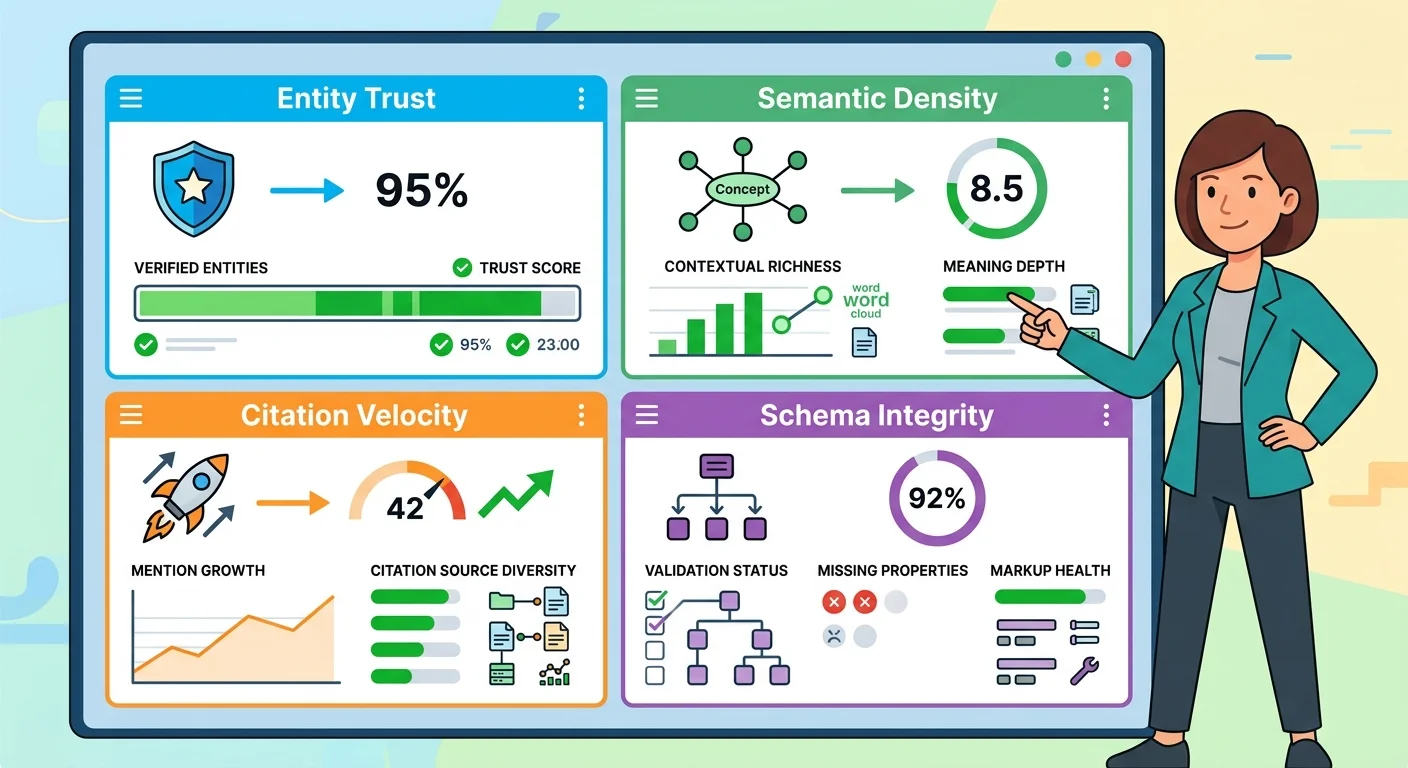
Knowing where the DIY attempt falls apart is useful. But it's a different question entirely to ask what a real diagnostic actually measures.
That gap — between guessing and measuring — is the difference between invisible and cited.
Here's what most practice owners get wrong walking in: they think a diagnostic is an audit of their own setup.
It's not.
A real AI visibility diagnostic measures how conversational engines perceive and verify your business entity. That's a fundamentally different question than whether a page loads correctly or a plugin is active. One checks your settings. The other checks what AI has actually concluded about you.
You can't fix what you can't see.
From inside a plugin dashboard, you're looking at one input. The verification system AI engines run reads from dozens of external sources you don't have access to. That's not a gap you close with a weekend. That's the structural blind spot the diagnostic exists to expose.
Entity Trust: The Foundation AI Engines Verify First
Entity Trust is what AI engines verify before they say your name.
Not your page titles. Not your content volume. Not your backlink count.
The question is whether the entity claiming to be your practice can be independently confirmed — across every platform, directory, and data source the engine trusts. That's the only question that matters at this layer.
A real diagnostic traces that verification chain from the inside out. It checks whether your business name, address, phone number, and specialization data appear consistently across the external platforms AI engines actually consult.
Not just whether that data exists on your own site. Whether it matches everywhere else.
Small discrepancies that look trivial to a human register as trust conflicts to a verification graph. The engine doesn't overlook them. It flags them — and recommends someone cleaner.
Published data on AI attitudes from Pew Research Center shows 52% of Americans now express more concern than excitement about AI — and that number has risen sharply from prior benchmarks.
That public caution translates directly into higher verification standards. When an AI engine surfaces a name, the confidence behind that recommendation has to be airtight.
Entity Trust isn't optional infrastructure. It's the admission ticket. Without it, the engine recommends someone else.
Semantic Density and Citation Velocity
Semantic Density measures how clearly your entity's expertise is defined across your content footprint. Citation Velocity measures how frequently AI engines encounter references to your entity from sources they already trust.
Both inputs matter. And neither one can be gamed by publishing more pages.
A practice that publishes content without semantic architecture is generating noise. The engine sees activity but can't resolve a coherent identity from it.
Tightly clustered AI Authority articles — each reinforcing the same entity identity around the same defined expertise — build the kind of Semantic Density that actually moves the needle.
More pages isn't more authority. The engine knows the difference.
Citation Velocity compounds when Semantic Density is already in place. Build in the wrong order and you're accelerating toward the wrong destination.
That sequencing is exactly what the Local AI Authority Engine is built on — layer by layer, nothing compounding on a broken foundation. If you want to know how to evaluate whether your current setup respects that order, a 7-point checklist for evaluating your post-audit action plan is the right starting point.
Dual-AI Validation and Why One Engine's Opinion Is Not Enough
Here's what most practice owners never think about: ChatGPT, Gemini, and Grok don't use the same verification framework.
A diagnostic that checks one engine's output is a partial picture. Partial pictures produce partial fixes — and partial fixes leave visibility gaps wide open.
The FTC has stated clearly that AI-related claims must be substantiated, not assumed. That same logic applies to visibility diagnostics.
An assessment that checks one engine's recommendation behavior and calls it complete isn't a diagnostic. It's a single data point.
You wouldn't treat a patient on one inconclusive test. Building an infrastructure rebuild on one unverified data point from one source is exactly the kind of assumption the FTC flags as insufficient.
A legitimate diagnostic runs the verification check across multiple engines simultaneously and cross-references the outputs. Where those outputs align, the entity signal is solid.
Where they diverge — where ChatGPT names you and Gemini doesn't, or vice versa — that divergence is where the structural gap lives. Published data on AI attitudes confirms that public trust in AI recommendations depends on perceived accuracy and independent verification. The engines know this. They raise their standards accordingly.
A dual-validation framework doesn't just tell you where you stand. It tells you which specific signals are failing and why.
That's the difference between a weekend guess and a professional rebuild.
| Diagnostic Component | What It Measures | DIY Assessment Accuracy | Professional Diagnostic Accuracy |
|---|---|---|---|
| Entity Name & NAP Consistency | Whether your business name, address, and phone number appear identically across every directory, aggregator, and platform AI engines consult for verification | Practitioner checks their own authority infrastructure — cannot see how external platforms display their entity data | Cross-references entity data across every external source the verification graph reads, surfacing conflicts invisible from inside a dashboard |
| Entity Trust Signals | Whether conversational engines can independently confirm your practice as a credible, well-defined entity — distinct from every other business in your category | Plugin-level checks confirm a signal exists on one platform; cannot assess how that signal is weighted across multiple engine verification frameworks | Evaluates trust signal strength and consistency across the full ecosystem of sources each engine actually consults before surfacing a recommendation |
| Semantic Density | How clearly and consistently your entity's defined expertise appears across your content footprint — whether AI engines can resolve a coherent identity from your published material | Practitioner reviews their own content volume; no visibility into how engines interpret topical coherence or whether content clusters reinforce a single entity identity | Maps content architecture against entity identity to identify gaps where semantic signals are scattered, thin, or contradicting the core entity definition |
| Citation Velocity | How frequently AI engines encounter references to your entity from sources they already trust — and whether that frequency is building or stagnant | Cannot be assessed from inside a single platform; requires cross-engine reference tracking that no plugin or dashboard provides | Tracks entity mentions across trusted third-party sources, identifies which reference relationships are active, and flags where velocity has stalled or reversed |
| Cross-Engine Recommendation Divergence | Whether ChatGPT, Gemini, and Grok return consistent recommendations for your practice — or whether divergence between engines reveals specific structural gaps | A practitioner may check one engine manually; single-engine spot checks miss divergence patterns that only appear when outputs are compared simultaneously | Runs verification checks across multiple engines simultaneously and cross-references outputs — divergence points to the exact signals that need structural correction |
| Schema Configuration Integrity | Whether structured data not only exists but correctly defines medical specializations, entity relationships, and authoritative signals in the format AI verification graphs expect | Auto-generated schema confirms basic markup is present; cannot assess whether specialization data, entity relationships, or authority signals are correctly encoded | Audits schema against engine-specific verification requirements — distinguishing between markup that signals existence and markup that signals trustworthy authority |
Frequently Asked Questions
Good. You should have questions. Here are the ones that come up every time.
These are the shortcuts, objections, and timeline questions every practice owner asks. The answers are direct. No hedging. Grounded in how conversational engines actually work — not how the industry usually explains it.
Why can't I just optimize my own page keywords over a weekend to show up in ChatGPT?
ChatGPT doesn't crawl your pages for keywords. That's the misunderstanding underneath every weekend DIY attempt.
Conversational engines parse structured databases. They verify entity signals across external platforms they already trust. Keyword density on your website isn't an input to that process. It never was.
Keyword optimization gets you ranked in a list. Getting named in an AI recommendation requires verified Entity Trust. That's built at the infrastructure level — not the content level. Those are two completely different systems. Treating them as the same problem is exactly why the weekend fix never works.
Does traditional SEO help at all when generative AI engines assemble their answers?
Traditional SEO isn't useless. But it's optimizing for a system in freefall. Gartner projects a 25% drop in traditional search volume by 2026, driven by conversational AI replacing traditional query behavior.
So if traditional search still sends patients, traditional SEO still has some value. It's a shrinking asset, not a growing one.
But here's the harder truth: traditional SEO does almost nothing to build entity verification signals. It doesn't address schema architecture, NAP consistency, Semantic Density, or Citation Velocity. Those are the inputs conversational engines actually consult. Running the old playbook while ignoring those signals is training for the wrong race.
What are the structural risks of deploying amateur schema markup on my practice's pages?
Malformed schema is worse than no schema. That's not a scare tactic — that's how verification graphs work.
When an AI engine reads structured data that conflicts with information on external platforms, it flags the inconsistency as a trust conflict. Amateur schema implementations introduce mismatched entity identifiers, wrong business category classifications, or incomplete address structures that look fine in a plugin preview and register as verification failures at the engine level.
The FTC has been explicit that deceptive or unverifiable digital configurations create regulatory exposure — not just visibility gaps. Broken schema doesn't just fail to help. It signals to the verification graph that this entity can't be confirmed. That's not a neutral outcome. That's a trust deficit that compounds every month it goes unfixed.
How does a low AI visibility score actively send patients to my local competitors?
A low AI visibility score isn't just a number. It's a reallocation happening right now.
When a patient asks ChatGPT, Gemini, or Grok who the best chiropractor in their area is, the engine names someone. If that someone isn't you, it's a practice down the street whose entity signals are stronger. The patient never sees your name. They don't consider you. They book with whoever got named.
Pew Research Center found 52% of Americans now express more concern than excitement about AI — which means the recommendations that do land carry serious weight. Patients treat engine-named recommendations as authoritative. Every month your score stays low, a competitor's authority compounds. The gap doesn't hold steady. It accelerates.
How long does a professional AI authority infrastructure execution take to compound and produce verified citations?
Authority compounds. It doesn't spike.
There's no honest answer here that involves a specific number of weeks — because integrity matters more than a number that closes a deal. What's true is this: every layer of execution builds on the last. Schema architecture establishes the foundation. Consistent entity verification removes trust conflicts. Tightly clustered AI Authority articles add Semantic Density. Citation Velocity builds as external sources begin referencing a verified entity. Each layer accelerates the next.
Practices that start and stay consistent compound. Practices that wait hand that compounding time to whoever moved first. The question isn't whether the timeline is fast enough. It's whether staying invisible is acceptable. It isn't.
The Scalpel Is Not in Your Toolbox
Here's the thing about scalpels — owning one doesn't make you a surgeon.
A chiropractor wouldn't hand a patient a YouTube tutorial and send them home to fix a herniated disc. The tools exist. The information is online. But the system being operated on is too interconnected to leave to someone working without a verified map of what's actually failing.
This isn't about capability. It's about what's at stake when the wrong layer gets touched first.
That's where the DIY attempt breaks. Not because you're not smart enough. Because conversational engines don't reward effort — they reward verified Entity Trust.
Entity Trust isn't built by editing a plugin on a Saturday morning. It's built by running a real diagnostic across every external platform AI engines consult, finding exactly where the verification chain breaks, and rebuilding the infrastructure in the right sequence so every layer compounds on something solid.
That's what iTech Valet does. Not content. Not keywords. Authority infrastructure — built so nothing is compounding on a broken foundation.
Every month without that foundation, a competitor's entity signal gets stronger. The gap doesn't hold steady. It widens.
The practices that move first don't just get ahead — they make it structurally harder for everyone who waits. That advantage compounds. So does the invisibility.
This isn't a decision you revisit next quarter. The market is making it for you right now, every single month you stay off the diagnostic. You wouldn't hand a patient a scalpel and a tutorial. Don't hand yourself one either.
You already know something's off. That's why you're still reading. The AI Visibility Check shows you exactly which engines are naming you — and which ones are sending patients to someone else. Run it. See what's real.
621 Enterprises, Inc. | Copyright 2026 | All rights reserved