
A 7-Point Checklist for Evaluating Your Post-Audit Action Plan
A post-audit action plan for a chiropractic practice is a structured execution framework that converts diagnostic findings into infrastructure changes. Not a to-do list. Not a keyword report that expires in six months. A build plan.
Most audits diagnose accurately. The plan that follows is where practices collapse. Up to 70% of organizational action plans fail to deliver on target goals due to a lack of defined follow-through metrics. For chiropractic practices, that failure stays invisible — right up until a competitor gets named by AI and they don't.
A PDF sitting on a hard drive diagnosed everything and fixed nothing. That is the trap this checklist exists to close.
A valid post-audit action plan addresses seven specific checkpoints. It names and prioritizes Entity Trust — the foundational signal AI engines use to determine which providers are credible. It establishes an explicit build schedule for Citation Velocity, the rate at which authoritative sources reference the practice across the web. It defines Semantic Density targets so content covers a topic with enough depth and precision that AI engines recognize the practice as an authority. It sets measurable milestones — not just tasks — so progress can be evaluated objectively. It addresses Zero-Click Search exposure, ensuring the practice surfaces in AI-generated answers before a patient ever clicks a link. It incorporates compliance guardrails, because health-related advertising claims must be backed by competent and reliable scientific evidence — and a plan that ignores regulatory exposure creates liability, not authority. And it defines a re-evaluation trigger so the plan adapts as AI search behavior evolves.
According to Pew Research Center, over 35% of U.S. adults go online to find a medical provider — and that behavior is increasingly routed through AI answer engines rather than traditional search results. A checklist that ignores how AI reads and trusts a practice's digital infrastructure is not a strategy. It is documentation of a problem with no path to a solution.
Evaluating a post-audit action plan against these seven checkpoints is how a chiropractic practice stops collecting audits and starts building authority.
Last Updated: July 15, 2026
- • Why Most Post-Audit Action Plans Fail Before They Start
- • The 7-Point Checklist: What a Real Post-Audit Action Plan Must Contain
- • The Accountability Layer: Milestones, Compliance, and Re-Evaluation
- • Who This Checklist Is Not For
-
• Frequently Asked Questions
- • What is a post-audit action plan for a chiropractic practice?
- • How does a decision framework prevent post-audit action plan failure?
- • Why are standard SEO audit checklists insufficient for AI visibility?
- • How often should a chiropractor re-evaluate their digital infrastructure audit?
- • What are the consequences of ignoring Entity Trust in a post-audit strategy?
- • The Difference Between a Diagnosis and a Decision
Why Most Post-Audit Action Plans Fail Before They Start
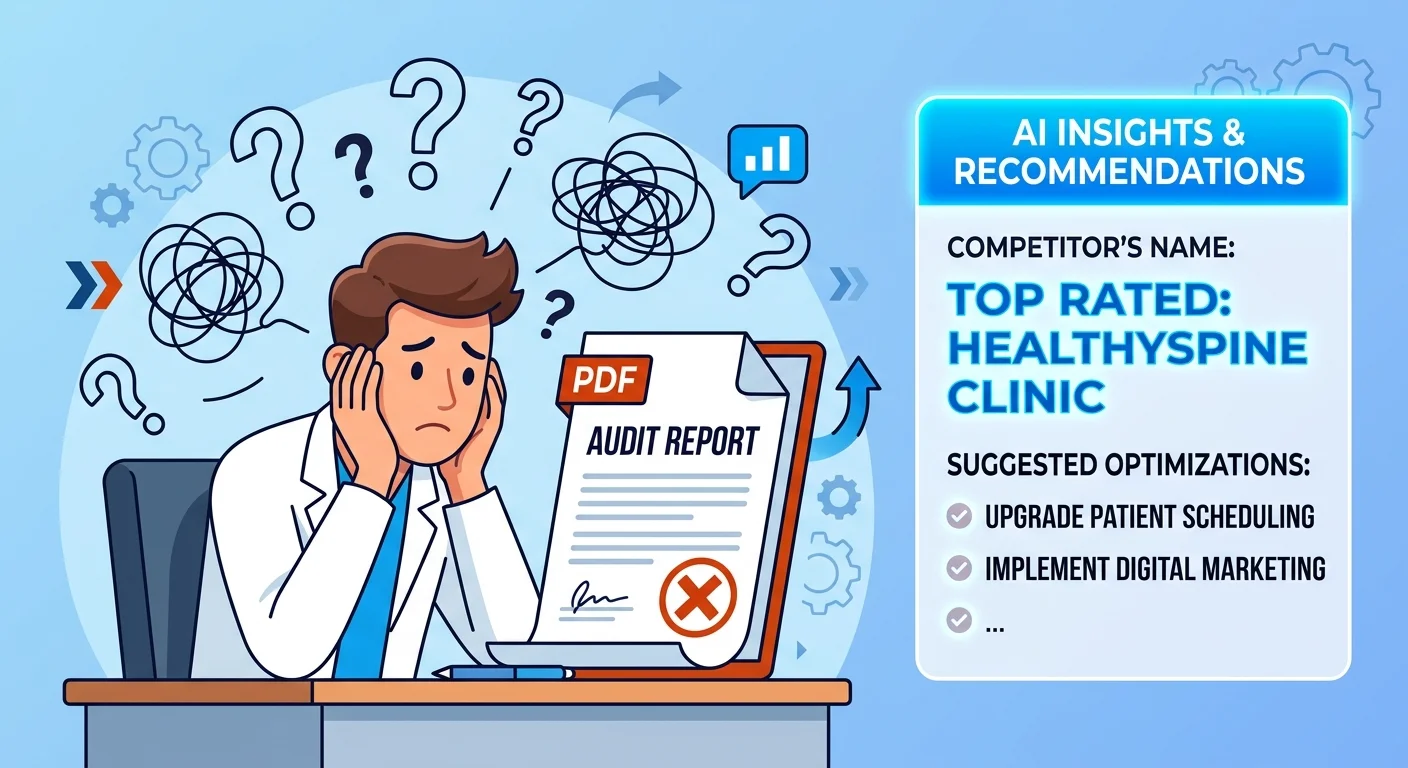
Most practices don't have an action plan problem. They have a follow-through infrastructure problem. Those aren't the same thing — and confusing them is exactly why the audit collects dust.
The audit shows up. Twenty pages. Color-coded priority tiers. A PDF that correctly names every gap.
And then nothing moves.
The agency sends a monthly report full of impressions and click data. The clinic's digital infrastructure stays exactly as broken as it was on day one.
That's not execution. That's documentation with a retainer attached.
Bad data doesn't kill post-audit plans. Missing baselines do.
Without a defined baseline, every month looks like forward motion. Impressions are up. Activity is logged. Reports are filed. Then a competitor gets named by AI — and the practice realizes the audit fixed nothing it was supposed to fix.
The PDF diagnosed the problem and went to sleep. That's the trap. And it's entirely avoidable if the plan carries one non-negotiable requirement: measurable infrastructure change, not documentation output.
Why Standard SEO Audit Reports Miss the AI Visibility Layer
Standard audit reports were engineered for a world that no longer runs patient acquisition.
Keyword density. Backlink counts. Page-load speed. These metrics had a purpose when Pew Research Center found that 77% of online health seekers started at a search engine and clicked through a ranked list of results.
That chain is gone.
AI answer engines don't rank. They recommend.
The signals they use — Entity Trust, Citation Velocity, Semantic Density — don't show up on a standard audit report. Because those reports weren't designed to read what AI reads. They were designed to impress a client on a Zoom call.
So the AI Authority Snapshot lands. The gaps are real. The diagnosis is accurate.
Most agencies answer the 'now what?' with a task list. A task list isn't a system — it's a to-do doc with no decision logic built in. What's missing is a structured decision framework that converts findings into infrastructure — one that closes the gaps AI engines actually measure instead of cataloguing them in another report.
That's the step most practices skip entirely.
That's the gap this checklist closes.
Not because audits are bad. Not because the intentions behind them are wrong. Because a structurally incomplete plan correctly names every problem — and then leaves the clinic visible on paper and invisible to AI.
| Audit Output Type | What It Measures | What It Misses | AI Visibility Impact |
|---|---|---|---|
| Keyword ranking report | Search result positions for target terms | Whether AI engines recognize the practice as a credible entity | Zero — AI answer engines do not rank by keyword; they recommend by entity trust signals |
| Backlink audit | Volume and domain authority of inbound links | Citation Velocity — the rate and consistency of authoritative references across the web | Minimal — link counts without structured citation growth do not accelerate AI recommendation likelihood |
| Technical site audit | Page speed, crawl errors, and mobile formatting | Schema markup completeness and AI-readable infrastructure signals | Low — a technically clean site with no structured entity data is still invisible to AI answer engines |
| Content gap analysis | Missing topic coverage relative to competitors | Semantic Density — whether existing content signals deep, AI-trusted authority on a specific subject | Partial — adding content without Semantic Density targets produces volume, not authority |
| AI Authority Snapshot | How AI engines currently represent the practice across ChatGPT, Gemini, and Grok | Nothing — this is the diagnostic baseline the action plan must be built on | High — identifies exact entity trust gaps, citation blind spots, and Zero-Click Search exposure before execution begins |
The 7-Point Checklist: What a Real Post-Audit Action Plan Must Contain
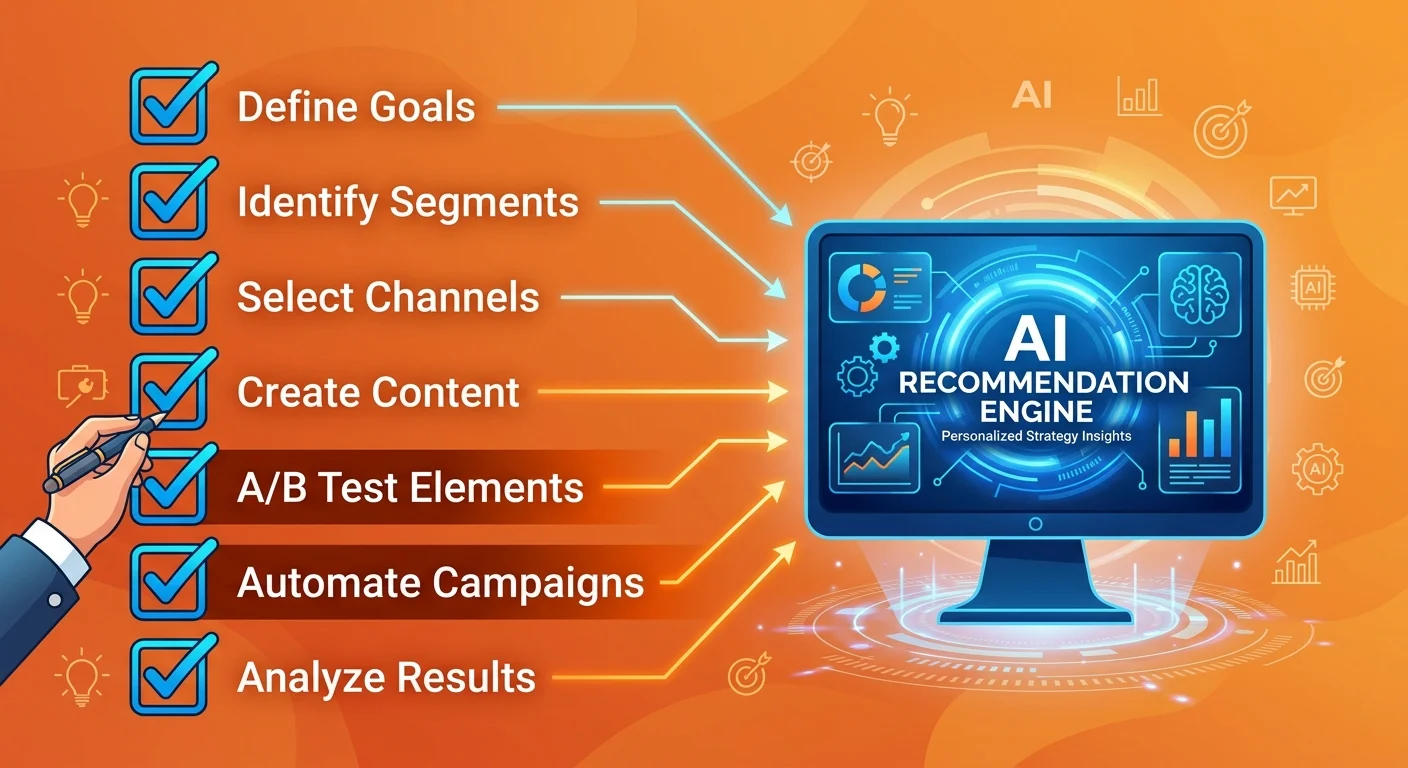
Here's the line that matters: a real post-audit action plan closes gaps that AI engines actually measure. Not gaps that look good in a slide deck. Gaps that determine whether a practice gets recommended or gets ignored.
Run these seven checkpoints against the plan sitting in front of you right now. A missing checkpoint isn't a minor gap. It's a structural failure that shows up as invisible on an AI Visibility Check six months from now.
Checkpoint 1: Entity Trust Is Named and Prioritized
Entity Trust must be named and prioritized by name. Not buried in a schema footnote. Not implied. Not lumped under "local SEO." It appears as a primary line item — or the plan wasn't built for the environment that exists.
Patients shop for chiropractors the way they shop for everything else now. They expect clear authority signals before they pick up a phone. And AI engines are running the exact same evaluation — surfacing providers whose entity signals are explicit, consistent, and machine-readable.
A plan that doesn't name Entity Trust as a priority wasn't built for the system doing the recommending.
One chiropractor who followed a structured decision framework to double new patient calls made one call differently from the start: Entity Trust was the first line item. Not an afterthought. The infrastructure changed. The PDF sat on no one's hard drive.
Checkpoint 2: Citation Velocity Has an Explicit Build Schedule
Citation Velocity needs an explicit build schedule — not a vague promise to "build citations over time." The schedule names which authoritative sources will reference the practice, in what sequence, and at what pace. Vague is not a plan.
Here's where most post-audit plans reveal what they're actually made of. "Increase citations" is a task. A build schedule with defined targets is a system.
NIH clinical research found that structured decision-making protocols reduce assessment errors by up to 15%. That principle doesn't stop at the treatment room. A plan without structure produces drift — and drift doesn't compound.
And if Citation Velocity isn't scheduled, it doesn't compound. It sits on a report next to a checkmark. Someone thought about it once. That's not execution — that's documentation theater.
Checkpoint 3: Semantic Density Targets Are Defined
Semantic Density targets must be defined. Not a topic list. Not a keyword count. Not a posting frequency. Actual depth and precision targets by subject area — the standard AI engines use to decide whether a practice knows what it's talking about.
So when AEO Content Writing Services are part of a post-audit plan, the plan needs a defined standard for what "enough coverage" actually means.
Without that standard, content gets published without ever reaching the depth AI engines need to recognize topical authority. More output isn't more authority. It's more volume with no finish line.
Semantic Density is what makes a practice legible to AI. Skip this checkpoint and the content execution is aimed at nothing — which is exactly where it lands.
| Checklist Point | What to Look For | Red Flag If Missing | AI Authority Signal |
|---|---|---|---|
| Entity Trust Is Named and Prioritized | Entity Trust appears as an explicit, named priority — not implied by schema recommendations or buried under generic audit categories | Plan uses vague language like 'local presence' or 'brand consistency' without naming Entity Trust as a discrete infrastructure objective | AI engines surface providers whose entity signals are explicit, consistent, and machine-readable — unnamed priorities never get built |
| Citation Velocity Has an Explicit Build Schedule | A defined cadence specifying which authoritative sources will reference the practice, in what sequence, and at what pace — not a vague 'increase citations' task | Plan lists citation building as a deliverable with no schedule, no source targets, and no compounding logic | Citation Velocity that isn't scheduled doesn't compound — it stalls as a line item that no AI engine ever registers |
| Semantic Density Targets Are Defined | Specific topical coverage depth is defined by subject area — not a topic list or posting frequency, but an actual density standard for what 'enough coverage' means | Plan commits to a content volume or publishing cadence with no defined standard for topical depth or authority threshold | AI engines recognize topical authority through depth and precision — output without a density target produces content that never reaches the authority threshold |
| The Action Plan Has Measurable Milestones — Not Just Tasks | Each phase of execution has a defined, evaluable milestone — not a checkbox that marks a task complete, but a standard that confirms a gap is actually closed | Plan is structured as a to-do list with completion checkmarks and no criteria for determining whether the underlying infrastructure gap has been resolved | Milestones give AI authority infrastructure a feedback loop — without them, drift goes undetected until a competitor is already named in the recommendation |
| The Plan Addresses Zero-Click Search Exposure | The plan explicitly targets AI-generated answer surfaces — ensuring the practice is surfaced before a patient ever clicks a link, not just indexed in a results list | Plan optimizes for click-through rates and ranked positions with no strategy for the AI answer layer where patient decisions now begin | Zero-Click Search is where AI names its recommendation — a plan blind to this layer is building authority in a channel patients have already moved past |
| Compliance Guardrails Are Baked In | The plan integrates regulatory parameters for health-related claims into every content and infrastructure decision — not addressed in a separate legal review after execution | Plan treats compliance as a post-production filter rather than a structural input, leaving authority content exposed to liability before it ever signals trust to AI | Health-related authority signals that violate FTC advertising standards can be flagged or removed — compliance isn't optional, it's load-bearing |
| The Plan Has a Re-Evaluation Trigger | A defined condition or interval that prompts a structured re-evaluation of the plan — tied to AI search behavior shifts, competitive movement, or infrastructure milestones reached | Plan is written as a static document with no mechanism for adaptation — treated as complete once tasks are checked off rather than as a living framework | AI recommendation patterns evolve — a plan without a re-evaluation trigger is already becoming obsolete the moment it's handed over |
The Accountability Layer: Milestones, Compliance, and Re-Evaluation
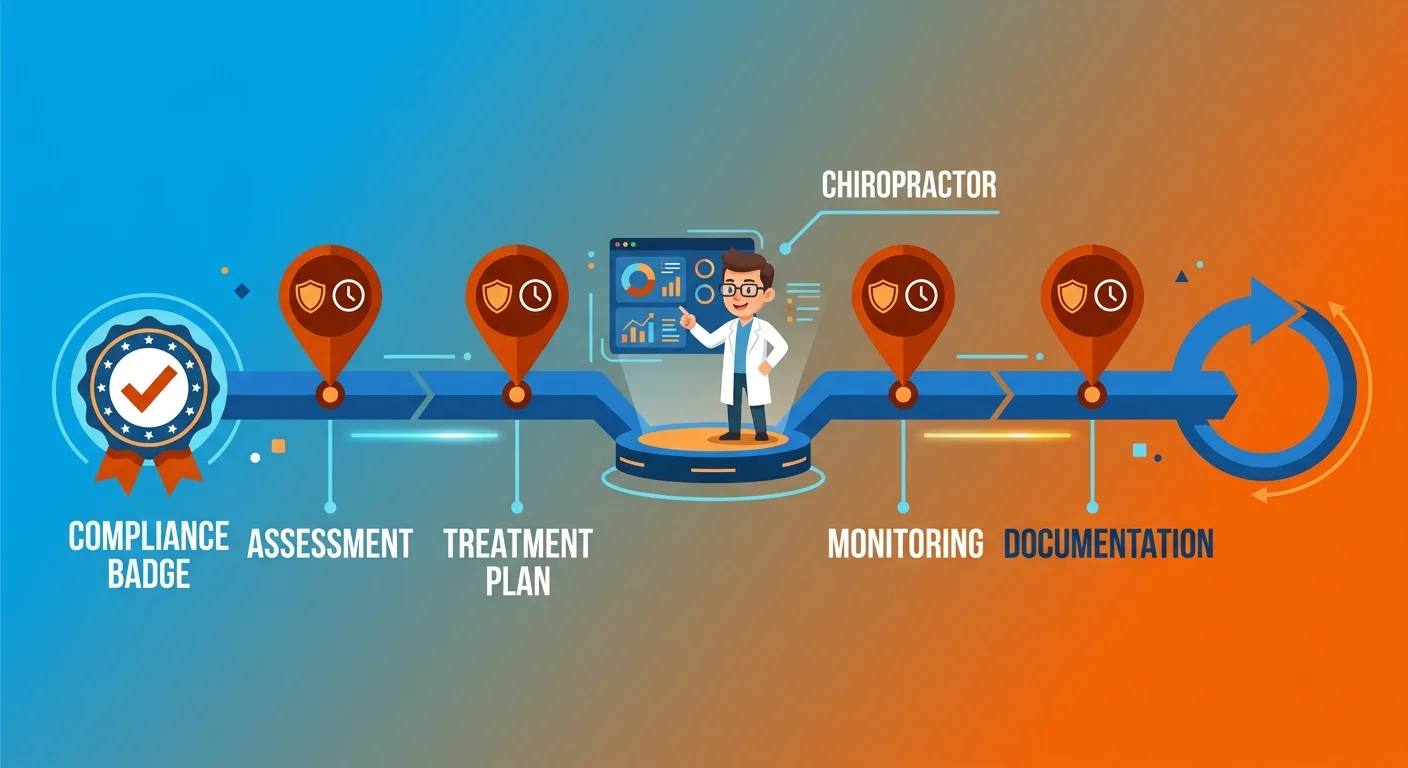
The first three checkpoints build the infrastructure. These next four determine whether anyone is accountable for closing the gaps — or whether the plan just sits there looking official.
Here's the thing: accountability isn't a personality trait. It's a structural feature.
If the plan doesn't have milestones, compliance triggers, and a defined re-evaluation point built into its architecture, the PDF lands on a hard drive and the infrastructure never changes.
That's not a motivation problem. That's a design problem.
Checkpoint 4: The Action Plan Has Measurable Milestones — Not Just Tasks
Up to 70% of organizational action plans fail to deliver on target goals — not because of bad intentions, but because they lack defined follow-through metrics.
That number ends the debate. A task list is not a plan.
A task says "update schema." A milestone says "entity signals are machine-readable and confirmed by a follow-up AI Visibility Check by a specific date."
That's the distinction. One tells you what to do. The other tells you when it's actually done. According to this published analysis, action plans without explicit, non-ambiguous metric tracking are structurally incapable of producing accountable outcomes.
The plan either tells you what confirmed completion looks like — or it tracks nothing real.
Look at the plan in front of you. One question: does it tell you how you'll know when a checkpoint is actually closed?
Not what needs to happen. What confirmed completion looks like.
If the answer is no — you've got tasks. Not milestones.
Checkpoint 5: The Plan Addresses Zero-Click Search Exposure
Zero-Click Search is the environment AI answer engines created. A patient asks a question. AI answers it. No link gets clicked. No result gets evaluated.
The practice either appears in that answer — or it doesn't exist in that moment.
Most post-audit plans weren't built for this environment. They were built for a click-through world — optimize the page, rank the result, earn the visit.
That chain is gone. Patients aren't clicking through a list of results and choosing. They're asking a question and trusting whatever AI says.
A plan that doesn't explicitly address Zero-Click Search exposure is optimizing for a patient behavior that's already been replaced.
And this isn't a future concern. This is the current state of AI-powered patient discovery.
If the action plan doesn't name Zero-Click Search exposure as a distinct checkpoint — with defined content structure, entity signal targets, and confirmation criteria — it's silent on the mechanism that's actually driving how patients decide who to trust.
Silent isn't neutral. Silent means invisible.
Checkpoint 6: Compliance Guardrails Are Baked In
This is the checkpoint most agency-delivered plans skip entirely.
Not because compliance is hard. Because it requires the agency to actually understand what it's doing inside a regulated industry — and most don't.
FTC guidance is unambiguous: all health-related advertising claims — including online chiropractic patient testimonials — must be backed by competent and reliable scientific evidence.
Testimonials must reflect typical patient results or carry clear disclosures.
A post-audit action plan that builds AEO content without baking these guardrails into the execution process isn't just incomplete. It's creating regulatory exposure while trying to build authority.
But here's what compliance guardrails actually protect: the credibility of every authority signal the plan is trying to build.
A single non-compliant testimonial or unsupported outcome claim can undermine the Entity Trust infrastructure the entire plan exists to create.
Compliance isn't a legal checkbox. It's an integrity layer. And without it, the rest of the build is fragile.
Checkpoint 7: The Plan Has a Re-Evaluation Trigger
AI search behavior evolves. The signals that drove AI recommendations six months ago aren't identical to the ones driving them today.
A plan without a re-evaluation trigger treats a moving target like a fixed problem. That's how practices fall behind without realizing it — until the gap is too wide to close quietly.
A re-evaluation trigger isn't a calendar date. It's not a "we'll check in quarterly" commitment that never fires.
It's a specific condition: a confirmed shift in AI engine behavior, a change in how entity signals are weighted, or a meaningful gap that surfaces when an AI Visibility Check is run against the practice's current infrastructure.
When that trigger fires, the plan gets updated. Not reviewed. Updated.
That's the full accountability layer.
Measurable milestones that confirm gaps are closed. Compliance guardrails that protect the authority being built. A re-evaluation trigger that keeps the plan alive as the environment shifts.
Without all three, the audit that diagnosed everything fixes nothing. A PDF sitting on a hard drive doesn't build infrastructure — and neither does a plan that skips the accountability layer that makes execution real.
| Checkpoint | Milestone Marker | Decay Signal to Watch | Re-Evaluation Cadence |
|---|---|---|---|
| Checkpoint 4 — The Action Plan Has Measurable Milestones — Not Just Tasks | Entity signals are confirmed machine-readable via a follow-up AI Visibility Check, not simply marked complete on a task list | Tasks are being checked off but AI recommendation frequency is unchanged or declining | Re-evaluate when any milestone marker cannot be confirmed by an independent AI check |
| Checkpoint 5 — The Plan Addresses Zero-Click Search Exposure | The practice appears as a named answer inside AI engine responses for core patient queries — not just indexed in traditional search results | Patients report finding competitors via voice or AI assistant responses rather than through the practice's content | Re-evaluate when AI engine response behavior shifts or a new query pattern surfaces that the current content structure doesn't address |
| Checkpoint 6 — Compliance Guardrails Are Baked In | Every published claim, outcome statement, and patient testimonial in AEO content has been reviewed against FTC health advertising standards before going live | Any newly published content contains outcome claims or testimonials without explicit disclosures or supporting evidence | Re-evaluate whenever new AEO content is added or existing content is updated — compliance is not a one-time review |
| Checkpoint 7 — The Plan Has a Re-Evaluation Trigger | A defined trigger condition exists in writing — specifying exactly which signal prompts a full plan review and update, not just a check-in | The plan is being followed without modification despite observable shifts in how AI engines surface provider recommendations | Re-evaluate when the trigger condition fires — shift in AI engine weighting, a gap surfaced by an AI Visibility Check, or a confirmed change in entity signal behavior |
Who This Checklist Is Not For
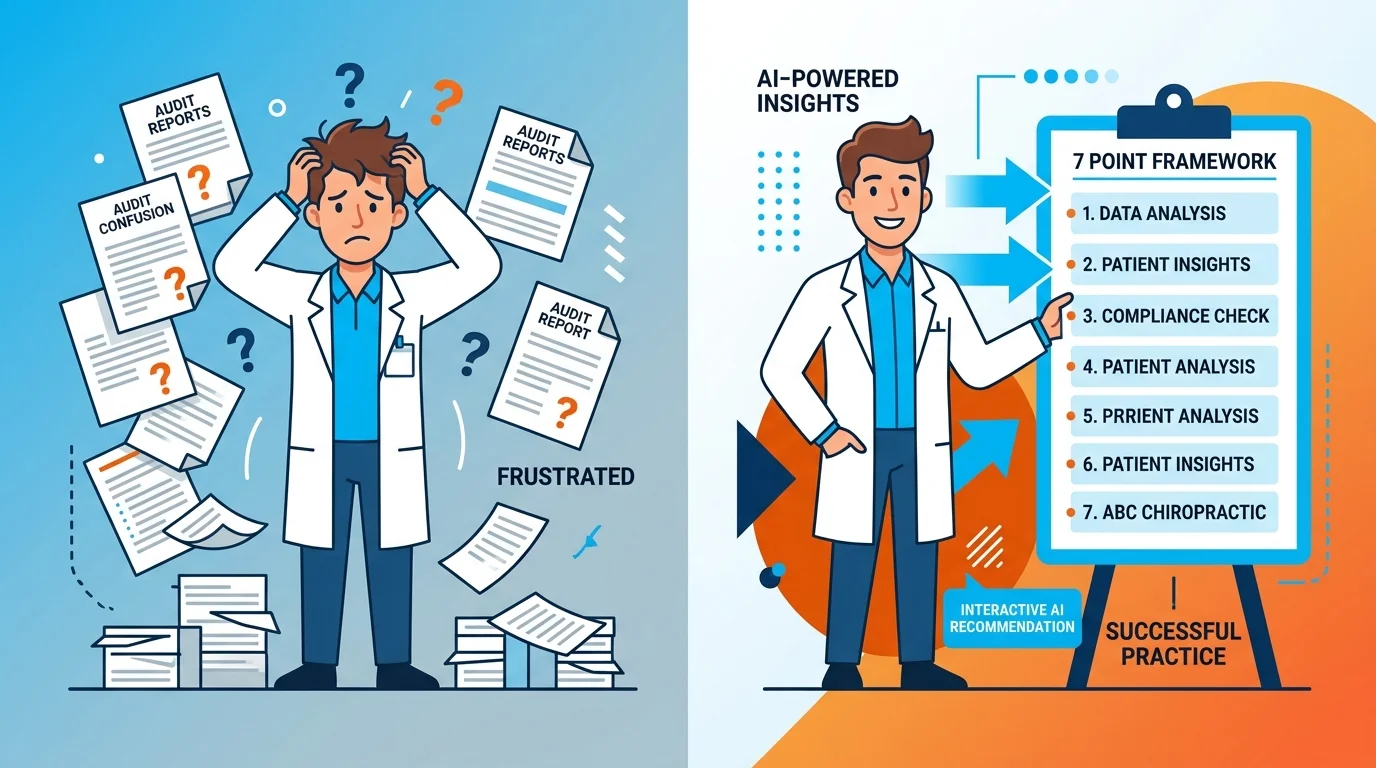
Not every practice belongs here. And that's intentional.
Shopping for a 90-day guarantee? A rank-tracking dashboard? A report that tells you nothing needs to change? This checklist will frustrate you.
It was built for practices that already know something is structurally broken — and are ready to fix it. Not document it.
The Pew Research Center found that 77% of online health seekers once started at a search engine. Most of them now start inside an AI answer instead. The practices capturing those patients built infrastructure AI can read and trust. Aesthetically credible doesn't get you recommended. Machine-readable does.
And it's not for practices whose first question is "how much does this cost?" instead of "what does this actually fix?"
Patients behave like digital consumers now. They expect clear authority signals before they pick up a phone. AI engines run the same evaluation before they name anyone. That expectation has a structural answer — but the commitment to build that structure has to exist before any checklist matters.
If you need a place to start, sorting which gaps to close first is a legitimate move. But prioritization only counts if execution follows.
What a Practice That Passes This Checklist Actually Looks Like
Here's what passing all seven checkpoints actually looks like in practice. The plan is specific enough to test. Accountable enough to track. And compliant enough to protect every authority signal it's building.
That's not a high bar. It just requires that someone actually made the plan — instead of printing the audit report and calling it a strategy.
No PDF collecting dust. No audit that diagnosed everything and changed nothing. The infrastructure moves because the plan was built to make it move.
One practice that ran through a chiropractic decision framework case study learned exactly what that distinction costs when it's missing — and what it produces when it isn't.
The difference between a practice that ran the check and one that became the answer isn't talent. It isn't timing. It's whether the plan in front of them was built to build something.
| Practice Profile | Checklist Fit | Likely Outcome Without It | Recommended First Move |
|---|---|---|---|
| The 90-Day Guarantee Seeker | Poor fit | Abandons the framework before Entity Trust compounds, hands authority ground to competitors who stayed the course | Run the AI Visibility Check to see the gap clearly — then decide if the problem is urgent enough to act on without a timeline guarantee |
| The Budget-First Buyer | Poor fit | Selects the cheapest post-audit option, receives a keyword checklist instead of infrastructure, and repeats the same diagnostic cycle in twelve months | Reframe the question from 'what does this cost?' to 'what does this fix?' — the answer determines whether the investment makes sense |
| The DIY Underestimator | Poor fit | Attempts to replicate the decision framework internally, misses the machine-readable infrastructure layer, and produces content with no Entity Trust foundation | Acknowledge the complexity of Citation Velocity and Semantic Density execution before committing to an in-house build |
| The Report Collector | Poor fit | Receives the audit, files the PDF, makes no structural changes — the hard drive gains a document and the infrastructure stays broken | Identify one specific checkpoint from the seven-point framework and commit to closing that gap before requesting another audit |
| The Established Practice Ready to Act | Strong fit | N/A — this framework was built for this profile | Evaluate the post-audit action plan against all seven checkpoints and confirm Entity Trust is named as a primary priority before execution begins |
Frequently Asked Questions
Good frameworks generate questions. That's how you know they're actually being used.
Here's what comes up when a practice runs these seven checkpoints against a real post-audit plan.
What is a post-audit action plan for a chiropractic practice?
It's a build plan. Not a recommendations slide. Not a task list with color-coded priority tiers.
A real post-audit action plan names specific signals — Entity Trust, Citation Velocity, Semantic Density — assigns measurable milestones to each, and defines what confirmed completion looks like.
Up to 70% of organizational action plans fail because they lack defined follow-through metrics. A post-audit action plan for a chiropractic practice is designed to be the exception. It treats the audit as the starting line. Not the finish.
How does a decision framework prevent post-audit action plan failure?
It kills the place where inaction hides: ambiguity.
Every recommended action gets forced through one filter. Is this closing a named gap — or just generating motion? Those aren't the same thing.
Research published through the National Institutes of Health found that structured decision-making protocols reduce clinical assessment errors by up to 15%. The same logic applies outside the treatment room. When a framework names the checkpoint, assigns the milestone, and defines the re-evaluation trigger, there's no interpretive gap left.
The plan either passes the seven checkpoints. Or it doesn't.
Why are standard SEO audit checklists insufficient for AI visibility?
Standard audit checklists were built for a click-through world. Keyword positions. Page rankings. Backlink counts.
AI answer engines don't use any of that.
What they use is entity signal strength — how clearly the practice is identified, how consistently that identity is reinforced across authoritative sources, how semantically dense the content is on the topics patients actually ask about.
Gartner's framework for digital marketing audits requires precise operational baseline benchmarks to prevent metric decay during execution. Standard checklists don't establish those baselines. They were never designed to.
How often should a chiropractor re-evaluate their digital infrastructure audit?
Not on a calendar. On a trigger.
Quarterly reviews and annual check-ins are how practices drift. A trigger is different. It fires when something specific changes — a confirmed shift in how AI engines weight entity signals, or a gap that surfaces when a new AI Visibility Check is run against current infrastructure.
Gartner's audit framework requires structured baselines specifically to prevent metric decay during execution. When the baseline shifts, the plan updates.
Not on a schedule. On a signal.
What are the consequences of ignoring Entity Trust in a post-audit strategy?
The practice becomes invisible. Not underperforming. Absent.
Entity Trust is the signal AI uses to confirm a practice is real, credible, and clearly defined. Without it, there's nothing to cite. No name to recommend.
The infrastructure exists — the hours, the credentials, the clinical outcomes. But AI can't read it. So it doesn't say it.
A practice that ignores Entity Trust isn't losing ground in a race. It's not in the race. The conversation patients are having with AI is already happening — and that practice isn't in it.
The Difference Between a Diagnosis and a Decision
One thing separates a practice that runs an audit from one that gets recommended by AI.
What they do after the PDF lands.
A diagnosis names the gap. A decision closes it.
Seven checkpoints. That's all this framework is. And most post-audit plans fail every single one — not because the audit was wrong, but because the plan was never built to produce anything. They document what's broken, hand over a report, and call it strategy.
But Entity Trust doesn't get built by documentation. Citation Velocity doesn't compound because someone flagged it as a priority on a slide deck. Semantic Density doesn't reach the depth AI engines require because a topic list got approved in a meeting.
Every one of those signals requires a plan that was designed from the start to produce infrastructure. Not insight. Infrastructure.
That's the decision.
The practices that become the answer AI gives don't have better audits. They have plans built to build something — and they started before the gap got wider.
Every month that plan sits unexecuted, a competitor's entity signals get stronger. Their name gets cited. Their infrastructure compounds. And the gap between where you are and where they are doesn't hold steady — it widens.
The practices that moved didn't wait for a perfect window. They looked at what the audit found, built the plan to close it, and executed. The ones still invisible? A PDF sitting on a hard drive.
That PDF audit isn't doing anything. It's sitting there while a competitor's infrastructure compounds another month without you in it. Find out exactly where your practice stands — right now, before the gap gets any wider.

621 Enterprises, Inc. | Copyright 2026 | All rights reserved