
Why Opportunity Cost Is the Wrong Frame for the AI Era

Opportunity cost is the hidden tax on inaction. And most businesses picture that tax as one lost lead or one missed conversion — something that shows up once, then vanishes.
That picture's incomplete. Slow decisions don't just cost you a sale today. They create information vacuums, and generative AI fills that vacuum with your competitors' information while you're still deciding.
Here's the reaction first: counting only missed leads is a rookie mistake dressed up as caution. It treats indecision like a pause button. Truth is, it behaves like a leak — and AI engines are actively drinking from it.
Every week your authority infrastructure stays thin, a competitor's data fills the gap in the model's head. Still weighing whether the upgrade is worth it? this breakdown of why authority infrastructure carries the cost it does shows you exactly what that money buys — and the longer you sit on it, the pricier the fix gets.
How AI Engines Actually Score What They Find About You

AI engines don't size you up the way a person would. They score signals — structured, repeatable, machine-readable ones that either confirm who you are or leave you a question mark.
And that gap matters more than most owners ever clock. You can look rock-solid to a human visitor and still read as unresolved, thin, or flat-out contradictory to the systems deciding who to cite.
Here's why this changes your math. The opportunity cost stops being some fuzzy risk and turns into a set of measurable signals — ones you're either winning on right now or bleeding on.
| Signal | What Weak Infrastructure Looks Like | What AI Engines Read Instead |
|---|---|---|
| Entity Resolution | Name, category, and location shift or contradict each other across directories and site schema. | A brand that never resolves the same way twice, treated as ambiguous rather than authoritative. |
| Schema Configuration | No FAQ Schema or structured markup, leaving pages to be interpreted rather than declared. | A page with no explicit signal of what it is or means, easy to skip when a citation is chosen. |
| Directory and Citation Consistency | Third-party listings that disagree with the business's own site on basic facts. | Conflicting confirmations of the same entity, weighed as unreliable rather than verified. |
| Structured Data Depth | Thin or missing markup across most pages, with only a handful fully configured. | A partial profile of the business, filled in with guesses instead of declared facts. |
Why Counting Lost Leads Misses the Real Ledger
Most opportunity cost talk dead-ends at the sales funnel. But counting only lost leads misses the real ledger AI engines keep on you.
That ledger tracks something closer to reputation than revenue. It's a running record of whether your name, your category, and your location keep resolving the same way across every source a model touches.
Businesses fixated on missed conversions treat delay like a closed chapter. It isn't. If you're weighing what happens once the budget for outside help dries up, what stops flowing into a pipeline when agency support ends makes the stakes concrete.
The gap between a lead-only count and a full one is the gap between a symptom and the disease. One shows up on a monthly report. The other compounds in a model's memory.
Entity Resolution and Why It Breaks Silently
One of the clearest signals in this ledger is entity resolution. It's the measure of whether an AI system actually knows who you are.
Researchers track this across brands as entity-resolution rate — the share of citations where a brand gets pegged correctly. Right name, right category, right location. And a low rate isn't bad luck.
It means the model's confused, and that confusion traces straight back to weak or contradictory data feeding it. Worst part? This breakage is silent by design. No error message, no alert, no dashboard raising a hand.
You just stop showing up correctly — or stop showing up at all — and nothing in your day-to-day tells you why. Independent analysis of how these systems weigh trust signals treats this as published research data worth building whole measurement frameworks around, not some footnote.
Schema, Citations, and the Widening Gap Between Sites
Schema is where entity resolution gets reinforced or left to chance. It's the structured markup that tells a machine, flat-out, what a page is and what it means.
And the gap between sites that use it well and sites that don't? Not cosmetic. Pages set up with FAQ Schema pulled AI Overview citations at a rate 3.2 times higher than pages with no Schema at all.
That's not a rounding error. It's a structural edge compounding every single day it goes unaddressed, and one independent measurement study treats it as published research data worth citing directly — not a marginal little tweak.
Building the Actual Opportunity Cost Calculation
So how do you actually build this? You move past theory and into a formula. It's got three inputs, and skip any one of them and your number lies to you — it'll read lower than the real cost every time.
Input one is lost revenue during the delay window. That part's familiar to anyone who's ever run a traditional opportunity cost model.
Inputs two and three are where most calculations fall apart. They ask you to estimate how fast AI systems soak up bad data — and how long clawing that back takes once it's locked in.
| Decision Speed | Infrastructure State | AI Engine Outcome |
|---|---|---|
| Fast decision, immediate action | Schema updated, listings corrected, entity data made consistent across sources | AI engines resolve the entity correctly and reinforce that resolution with every new citation cycle |
| Fast decision, partial follow-through | Some structured data corrected, other gaps left open | Mixed signals slow resolution but stop short of active misidentification |
| Slow decision, infrastructure left untouched | Thin schema, inconsistent listings, contradictory location or category data persists | AI engines learn the ambiguity as fact and repeat it across future citations |
| Delayed indefinitely, no owner assigned to the fix | Infrastructure decays further as new content and platforms outpace what's already inconsistent | Entity resolution degrades further, and competitors with cleaner data fill the citation gap |
| Pipeline Stage | Results at This Stage | What It Means for Citation Odds |
|---|---|---|
| Searches Returned | 785 results generated across the tracked production runs | This is the top of the funnel, the widest point, and the least predictive of citation |
| Passed Pre-Fetch Filter | 681 of those results survived initial filtering | A business whose data is thin or contradictory can already be dropping out here, invisibly |
| Fetched | 503 results were actually retrieved for closer inspection | Only results that clear the filter stage ever reach this point, so weak infrastructure compounds its losses early |
| Verified by Extractor | 201 results were confirmed accurate by an extractor | Verification is where inconsistent or unresolved entity data gets caught and discarded before it ever reaches a citation |
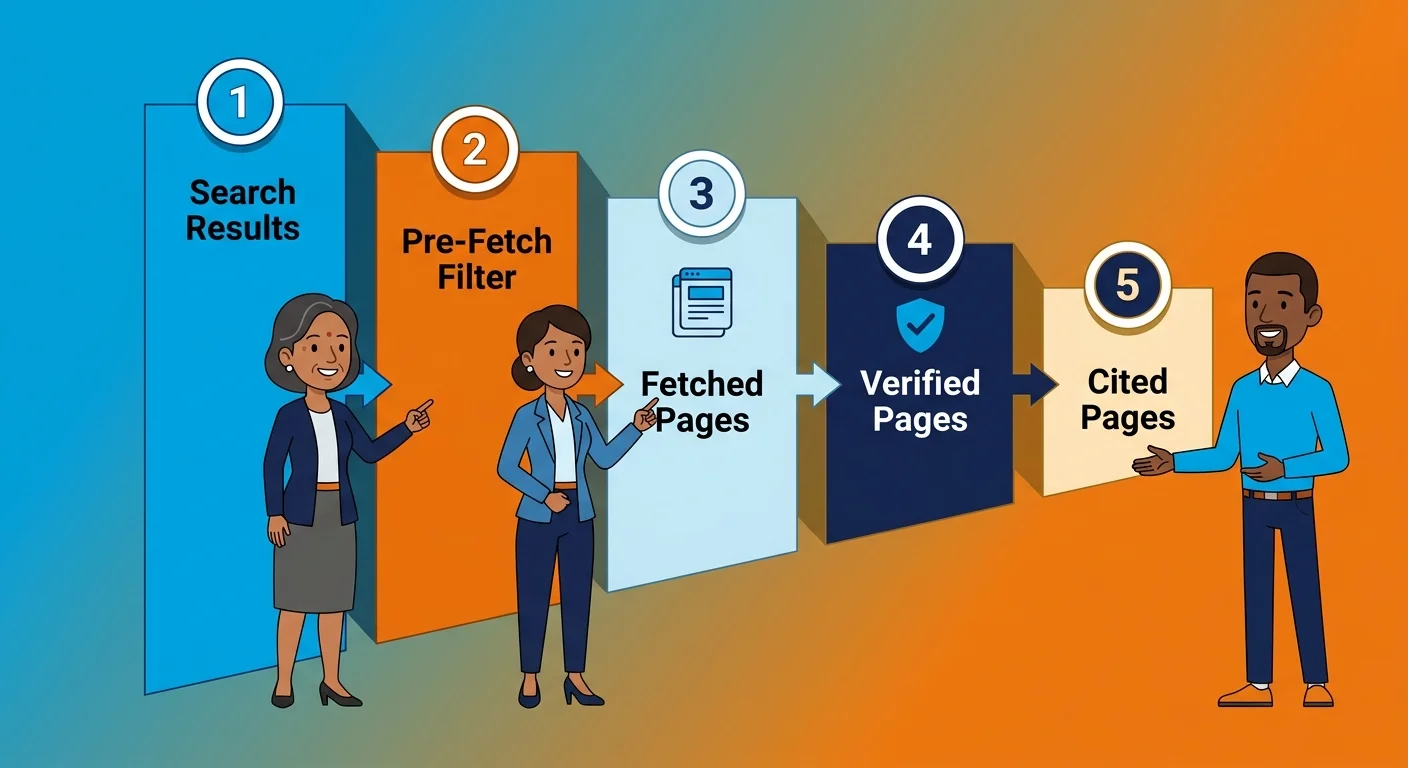
| Ultimately Cited | 76 results survived the full funnel to become a citation | Roughly one citation for every ten search results returned, which means most of a weak entity's presence never makes it this far |
The Inputs Your Calculation Cannot Skip
Start with the delay window itself. How many weeks or months has your entity gone with thin or contradictory data sitting out there, and what did that stretch cost you in missed leads alone?
Next comes the acquisition layer. And this is where most owners are flying blind. Generative engines don't cite you because you exist — they cite you because a pipeline of searches, filters, fetches, and verification steps decided your information was worth surfacing.
That pipeline gets measured, not guessed at. Across 22 production runs of a 12-article AEO/SEO content cluster, the pipeline's searches returned 785 results; 681 passed its pre-fetch filter, 503 were fetched, 201 were verified by an extractor, and 76 were ultimately cited — roughly one citation for every ten search results returned. Every stage is a filter your own data has to survive, and weak infrastructure fails earlier in that funnel than most owners ever guess.
iTech Valet tracked that exact funnel across its own runs, and the drop-off between search results and final citation is the clearest proof going that acquisition — not just existence — drives visibility. You can pressure-test your own assumptions against iTech Valet's measured pipeline data before you build a calculation on guesswork.
A Worked Comparison of Fast Versus Slow Infrastructure Decisions
Picture two businesses in the same category, both sitting on the same fix: inconsistent listings, thin schema. One moves within weeks. The other tables it for a quarter while everybody argues about budget.
The fast mover starts feeding cleaner signals into the pipeline right away, and its entity-resolution rate climbs while the slow mover's flatlines. Want a structured way to see which of your assets you actually own versus rent? Start with auditing what your agency actually built for you — because the slow mover isn't just delaying a fix, it's paying quietly into a debt every single week that traditional search optimization was never built to measure or repay.
Turning the Calculation Into an Infrastructure Fix
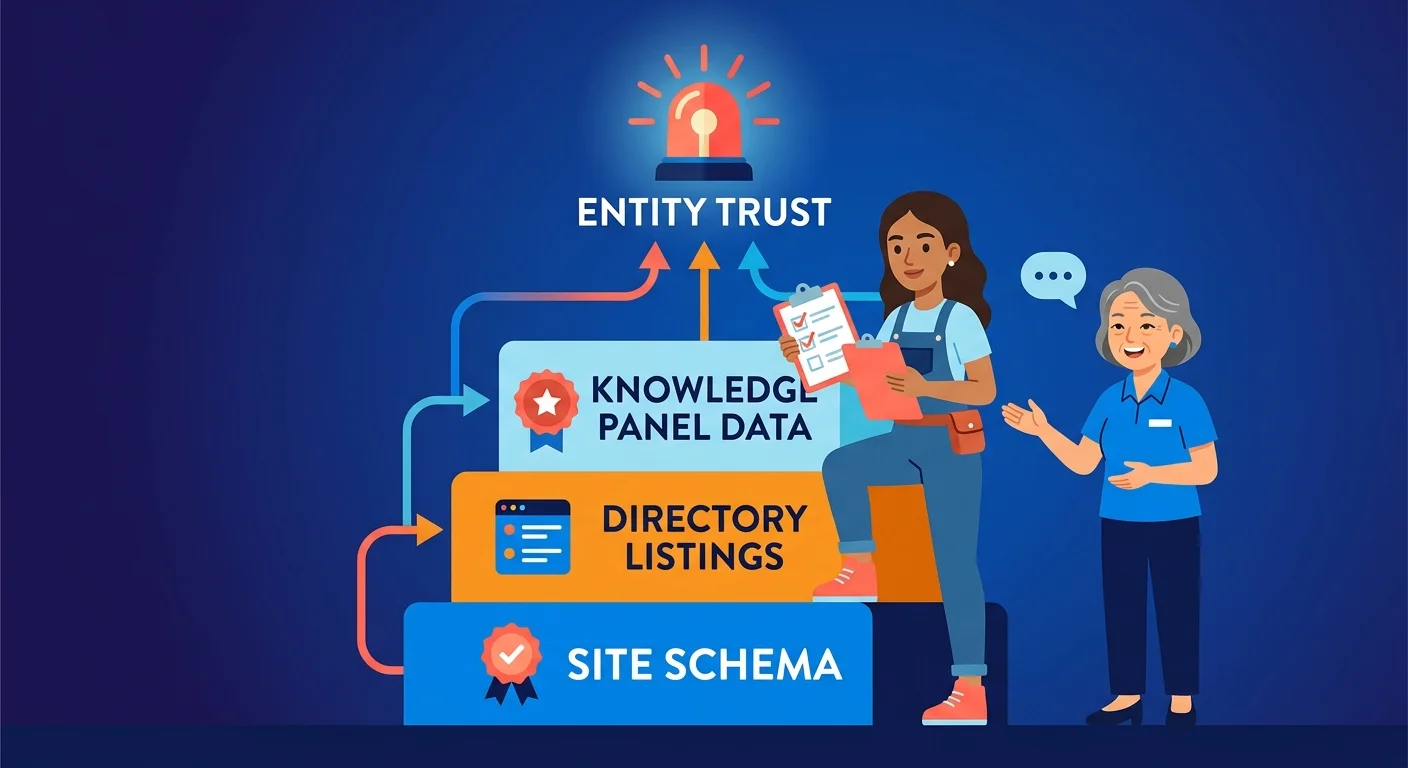
The math is done. Now it's a build problem, not a spreadsheet problem.
Turning a calculated cost into fixed infrastructure means treating your entity's data like any other asset on a balance sheet. Every gap the calculation surfaced becomes a line item to close — not a number to feel bad about.
Here's the reframe that matters. In the age of AI, your digital authority isn't just a marketing asset — it's the training data engines use to understand who you are. Which means every fix you make is literally rewriting what the model believes.
| Audit Step | Data Point Checked | Why It Matters to AI Engines |
|---|---|---|
| Name, Category, and Location Consistency | Whether the business's identity matches across every third-party directory and citation source it appears in | This is the raw material entity resolution depends on. A model can't confidently place a business whose identity keeps shifting from source to source. |
| Schema Markup Depth | Whether the site's structured data explicitly labels what each page is and what it means | Schema is the clearest language a business has for telling a model what it's looking at. Thin or missing schema forces the model to guess. |
| Cross-Platform Contradictions | Phone numbers, hours, and service descriptions checked against each other across every platform | Each mismatch is a small ambiguity, and ambiguity is exactly what a low entity-resolution rate is measuring. |
| Directory and Citation Coverage | Whether third-party directories reflect current, verifiable, structured data about the business | Authority infrastructure lives in this verifiable, structured data trail. Gaps here are gaps in the training data the model builds its understanding from. |
| Secondary Signal Expansion | Deeper FAQ coverage and richer directory presence layered on top of the foundational data | These only compound once the foundation is stable. Layered in early, they just multiply the ambiguity the model is already struggling with. |
Where This Breaks Down for Certain Businesses
Not every business carries the same exposure here, and pretending otherwise flattens the problem.
A single-location business with one clean service line has fewer data points to reconcile than a multi-location entity with overlapping categories or a franchise setup. Fewer data points means fewer places for contradiction to hide.
That doesn't make the smaller business safe. It just makes the failure mode different. A complex entity breaks down through the sheer volume of contradictory listings; a simple one breaks down through neglect — thin schema nobody built, directory entries nobody claimed.
Auditing the Data Points AI Engines Already Read
Before anything gets rebuilt, someone has to know what's actually broken. That means pulling the data points AI systems already read — not the ones a business assumes it's presenting.
Start with name, category, and location consistency across every third-party directory and citation source. This is the same ground entity resolution rests on, and it's worth saying plainly: a brand that resolves ambiguously across sources is a brand a model can't confidently place.
Next, audit the schema markup on the site itself. Structured data is the most direct language you've got for telling a model what a page means, and thin or missing schema leaves that translation to guesswork.
Finally, hunt for the outright contradictions. Different phone numbers on different platforms, mismatched hours, service descriptions that don't line up. Each one's a small ambiguity — and ambiguity is exactly what that entity-resolution problem was measuring all along.
Sequencing the Fix Without Creating New Delay
Sequencing matters as much as the fix itself. Get it wrong and you spin up a second delay while trying to close the first one.
Fix the foundational layer first: name, category, location, and core schema. That's the data every downstream signal leans on, and building on top of it before it's stable just multiplies the rework later. If you're still deciding whether a full rebuild beats reinforcing what's already there, the case for treating authority as infrastructure rather than another site overhaul lays out exactly why the sequencing favors reinforcement over rebuilds.
Only once that foundation is solid does it make sense to layer in the secondary signals — expanded citations, deeper FAQ coverage, richer directory presence. Sequenced this way, every week of work compounds instead of fighting itself.
Frequently Asked Questions
Same objections come up every time this calculation lands on the table. So let's take them head-on.
How can I quantify the cost of a delayed website redesign in terms of lost authority?
Count the delay in weeks, then price the leads you missed in that window the way any opportunity cost model would. Now add what those weeks taught AI engines about you from thinner, messier data. That second cost keeps compounding long after the first one stops.
What's the difference between traditional search optimization opportunity cost and AI-driven authority cost?
Traditional search optimization opportunity cost stops at missed leads and site visits. AI-driven authority cost goes further. Every delayed fix becomes a data point a model uses to decide who you are, and that call doesn't reset when you finally act.
Is there a simple formula to estimate the daily cost of indecision on a major marketing initiative?
There's no single universal formula, and anyone selling you one is skipping steps. You need the lost-revenue figure, an honest read on how fast bad data gets absorbed, and a realistic estimate of how long reversing it takes.
How does weak internal data management translate to a tangible opportunity cost in search visibility?
Weak internal data management is exactly what breaks entity resolution. Inconsistent names, categories, and locations confuse the model quietly. No alert, no dashboard, until the business just stops surfacing correctly.
If we fix our authority infrastructure now, how long does it take for AI search engines to recognize the changes?
There's no fixed clock here, and pretending there is oversimplifies it. What's certain: cleaner signals start feeding the pipeline the moment you fix them. The entity-resolution rate starts climbing instead of sitting flat.
Does fixing authority infrastructure replace the need for traditional search optimization entirely?
No, and treating it that way misreads the problem. Traditional search optimization still has a role. It just can't repay a debt built from thin schema and contradictory listings, because that debt lives in a different ledger entirely.
Where This Leaves You
The ledger's been open this whole time. The entire stretch you've spent debating whether to act.
And every day you wait is a debit AI engines record against your entity — whether you're watching or not.
Weak authority infrastructure was never a footnote. It's the training data a model uses to decide who you are. Traditional search optimization can't repay a debt it was never built to measure — only fixing the underlying data does that.
So the real question isn't whether opportunity cost is real. It's how large a balance you're willing to keep carrying before you close the gap.
If you want a clear read on where your entity actually stands with the systems now deciding your visibility, find out what your AI visibility check reveals.