
What Entity Resolution Actually Means When a Machine Reads Your Business

Here's the thing: getting found by humans used to be the whole game. In AI-driven search, a business also has to be understood by machines, and that matters just as much as being found.
Picture an AI search engine as a detective trying to match one face in a crowd to a single verified ID card. A template site hands that detective a blurry photo with no name tag. Structured authority infrastructure, the kind a full-stack authority engine is built on, hands over a fingerprint.
Why Identical Templates Leave AI Engines Guessing
So what is entity resolution, really? It's how an AI search engine ties scattered facts to one verified, real-world business, and it happens before a single word of the answer gets written.
Template infrastructure wrecks that matching step at scale. More pages off the same template don't buy more visibility. They pile up duplicate signatures for a model to sort through, with zero distinguishing markers in the stack.
| Signal Type | Template Website Output | Resolved Entity Requirement |
|---|---|---|
| Business Name Formatting | Repeated across a shared template, often inconsistent between homepage, footer, and directory listings | A single, consistently formatted name string tied to one verified identity across every page and platform |
| Service Descriptions | Boilerplate text duplicated from the same template library across unrelated businesses | Original descriptive content that distinguishes this entity's specific services from every similarly structured competitor |
| Structured Data Markup | Minimal, generic, or absent schema that does not reflect the page's actual visible content | Explicit, page-matched structured data that gives machines an unambiguous identity marker to confirm |
| Location Signals | Generic location mentions reused across template instances with no distinguishing structural detail | Consistent, verifiable location markers that connect the entity to one confirmed place rather than a category |
| Content Uniqueness | Near-identical phrasing and structure repeated across thousands of unrelated sites built from the same template | Unique, original content patterns that give an AI system a distinguishing fingerprint instead of a blurry copy |
The Sea of Sameness Problem
Look, template-based sites show up across a lot of industries. And they tend to build a sea of digital sameness that's missing the unique signals AI needs to resolve an entity with confidence.
The volume of pages built from one template never fixes that gap. A thousand identical structures still read as one unresolved signature, because the system was never measuring distinction in the first place.
Why Word-Based Matching Breaks Down on Ambiguous Pages
Word-based matching bets that shared vocabulary means shared meaning. Bad bet. Even academic search trips on it: word-based ranking models used by Semantic Scholar may fail to capture the semantic meaning behind concept queries, and that can be a significant source of ranking errors.
Published research data reports word-based ranking models used by Semantic Scholar may fail to capture the semantic meaning behind concept queries, and this can be a significant source of ranking errors. A template site hands a model the same raw material: words without the structure that confirms what they mean. That missing structure is precisely what connected medical schema markup is built to supply.
How a Template Site Fails the Moment an AI Model Has to Choose
A template site breaks at the exact moment an AI model has to pick one answer from a lineup of look-alikes. Rankings never measured that moment (they couldn't). A page could win the old results-page game for years and still hand a resolution engine nothing distinct to confirm.
| Benchmark Finding | What It Measured | Why It Matters for Entity Resolution |
|---|---|---|
| Chain-of-thought and few-shot prompting performance | Whether advanced prompting techniques close the ambiguity gap in query resolution | The study tested ambiguous user questions, not websites. It shows prompting alone did not make models reliable at spotting ambiguity. |
| Hallucinated atomic facts across domains | The share of generated atomic facts that were hallucinated across fourteen models on nine HALoGEN domains | Even the best-performing models tested produced hallucinations. Hallucinated atomic facts reached up to 86% depending on the domain. |
The Mechanics of Confident Misidentification
Rankings counted visibility, not verifiability. That measurement gap is what template infrastructure exposes: a page could hold a spot in classic search listings while remaining unresolvable as a single confirmed entity. The failure happens at the identification step, before any answer gets generated. The ACL Anthology reports current large language models may have limited practical utility in identifying and clarifying ambiguous user queries, even when enhanced with chain-of-thought and few-shot prompting. Chain-of-thought prompting was built to help models reason through ambiguity, and it still does not close this gap reliably.
Picture two chiropractic clinics running the same purchased template, with the same stock service list and the same boilerplate about text. To an AI model, that's two duplicate structural signatures with zero identity markers, so it can't confirm which clinic holds which address, which credential, or which review. Converting a static site into structured data swaps that duplication for markers tied to one verifiable identity.
Why Hallucination Risk Rises Where Signals Are Thin
Thin signals do not just confuse resolution. They leave room for a model to fill the gap with an invented detail instead of an accurate one. University of Washington reports even the best-performing models may produce hallucinations, with hallucinated atomic facts reaching up to 86% depending on the domain. Across fourteen models tested on nine domains, hallucinated atomic facts reached as high as 86% depending on the domain. Bespoke structured data gives the model verifiable material to cite instead of a gap to fill.
What Google's Own Guidance Reveals About Entity Signals

Google publishes its own standard for how structured data has to behave, and that's a documented fact, not an industry opinion. Now, that doesn't make AI visibility traditional search optimization with new vocabulary. The same demand for accurate, verifiable markup now decides something bigger: whether a model can resolve an entity at all, not just whether a page can rank.
The Rules Structured Data Has to Follow
The rule is specific. Structured data must sit on the page it describes and must never mark up content invisible to the reader. Per Google, Google's guidance says structured data should be placed on the page it describes and should not mark up content that is not visible to readers of that page. A template page copying boilerplate markup across unrelated businesses violates that rule by design, feeding machines data that does not match what a visitor actually sees. Clinics that need markup tied to a real page and a real identity typically turn to done-for-you AEO services rather than retrofitting a template after the fact. There is more on done-for-you AEO services if this is the part that matters to you. Google's rules say structured data (schema) must match what's actually visible on the page.
How Knowledge Graphs Turn Scattered Facts Into One Resolved Entity
A knowledge graph takes scattered facts and pins them to one resolved node. Rankings stopped predicting who gets cited the day answers replaced links, because a graph doesn't care where a page sits in a list. It cares whether the name, the location and the credential all point to the same verified entity.
| Architecture Layer | What It Connects | Outcome for Discovery |
|---|---|---|
| Structured Data Markup | Business name, location, services, and credentials tied to a single page | Machines read a confirmed identity instead of guessing from surrounding text |
| Linked Data Model | Separate facts about an entity scattered across a site into one connected node | Discovery improves because bots interpret the entity as one record, not fragments |
| Original Descriptive Content | Unique language and context that distinguishes one entity from similarly structured competitors | Resolution confidence rises because the model has no duplicate signature to confuse with another business |
| Consistent Identity Markers | The same name, address, and credential details repeated accurately across every page and data source | A knowledge graph can cross-reference every mention back to one verified entity instead of several candidates |
What a Library's Linked Data Model Demonstrates About Discovery
Library systems offer a working model of this discovery problem. Per published research data, implementing a knowledge graph linked data model within HTML markup may improve discovery and interpretation of libraries by bots and search engines — a single reported case. A linked data model inside HTML markup gives bots and search engines the same distinguishing structure a business entity needs. Scattered facts stop reading as separate fragments once a graph ties them to one identity.
Building the Entity Signals a Template Cannot Generate
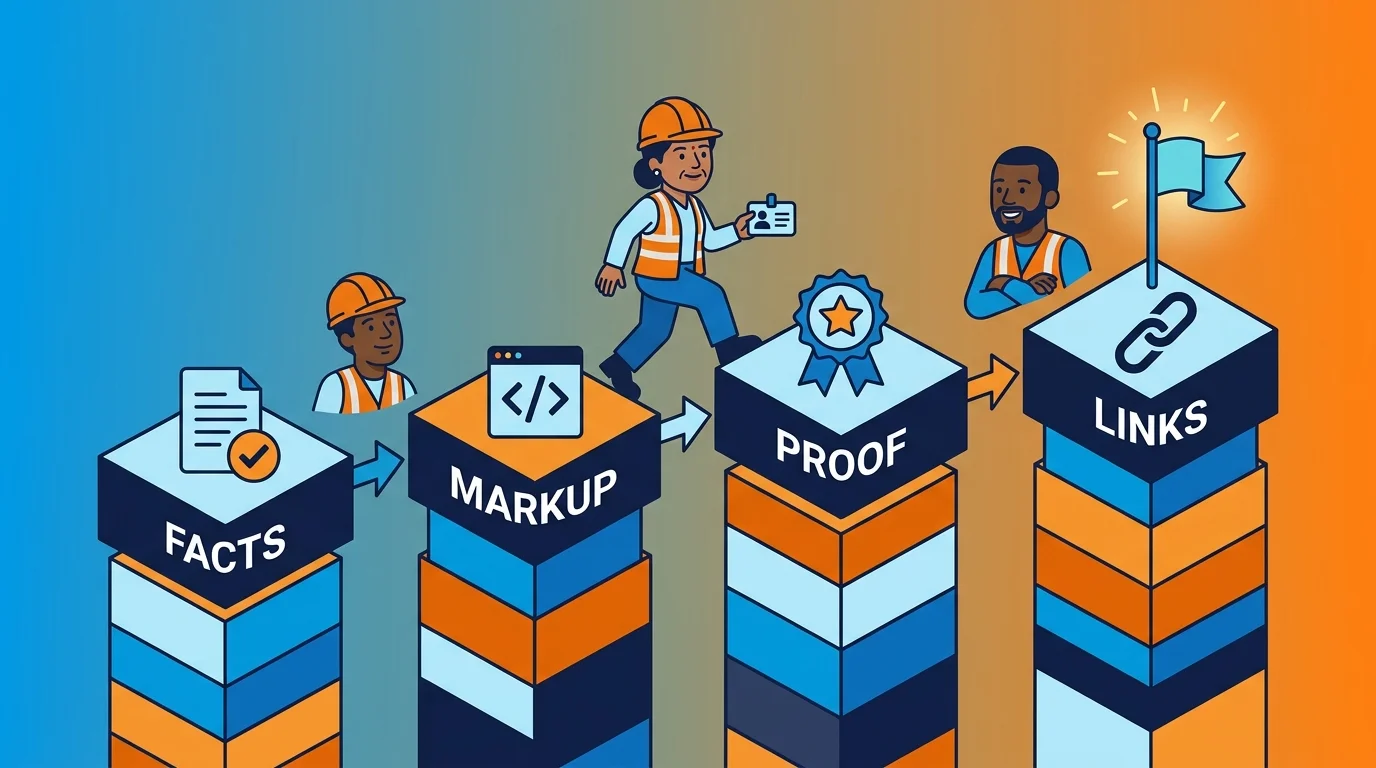
So let's be clear: a verifiable, machine-readable digital identity is the deliverable, and no good-looking page hands it over as a side effect. It's built from structured data sitting on the exact page it describes, never from boilerplate that doesn't match what a visitor actually sees.
| Build Step | What It Establishes | Template Gap It Closes |
|---|---|---|
| Structured Identity Markup | A single, verifiable record linking business name, location, services, and credentials to one entity | Removes the duplicated structural signatures that make template pages indistinguishable from thousands of others |
| Original Descriptive Content | Language unique to one operation, written from its own facts rather than a shared service list | Closes the word-based ambiguity that lets identical templated phrasing read as the same entity across unrelated businesses |
| Page-Matched Schema Placement | Markup that mirrors exactly what a visitor sees on that specific page | Closes the mismatch created when boilerplate markup is copied across pages it was never written to describe |
| Consistent Cross-Source Identity Signals | Confirmation that the same name, address, and claims appear identically everywhere the entity is referenced | Eliminates the conflicting fragments that force an AI model to guess which record is accurate |
| Linked Data Connections | A node in a knowledge graph tying scattered facts back to one resolved identity instead of separate listings | Replaces the isolated, unconnected data points a template produces with a traceable chain a machine can follow without guessing |
The Sequence That Separates a Resolved Entity From a Guessed One
Let's keep it real: page count doesn't decide which entity gets resolved. Alignment does. The winner is the business whose name, location, service claims and credentials all trace back to one confirmed source, in an order a machine can follow without guessing.
Frequently Asked Questions
The questions below cover the mechanics this article has already walked through, condensed into direct answers. Each one addresses a gap a researcher still has after the definition, the failure mode, and the fix.
What is entity resolution for AI search engines?
Entity resolution is the matching step. It's how an AI search engine pins scattered facts to one verified, real-world business. And it happens before any answer gets written.
How do knowledge graphs help AI with entity resolution?
A knowledge graph ties a name, location, service, and credential into one resolved node. That structure gives a model a single confirmed point to cite instead of several unconnected fragments to guess between.
Why can't a basic website template provide enough data for AI entity resolution?
A basic template repeats the same service descriptions and code structure across thousands of unrelated businesses. That sameness gives a model no distinguishing signal, so it reads as duplication rather than a confirmed identity.
What kind of data signals do AI search engines need to resolve an entity correctly?
They need structured data sitting on the exact page it describes, tied to original content a model can actually verify. Boilerplate text repeated across sites works against that. So does markup that doesn't match what's visible on the page.
If my business information is correct on my site, why would an AI get it wrong?
Because correct isn't the same as clear. Facts scattered through unstructured text look ambiguous to a model matching words, not meaning. Accuracy without structure just hands the system something correct to misread.
Does duplicate content across different platforms confuse AI entity resolution?
Duplicate content across platforms multiplies ambiguity instead of resolving it. A model sees the same phrasing in several places with no structured markers confirming which instance belongs to the real entity.
How does schema markup help solve entity resolution failures?
Schema hands a model explicit, machine-readable confirmation of facts that would otherwise hide in prose. Placed right, it turns a page from a guess into a verifiable source. That's something a model can cite with confidence.
The Bottom Line
So back to the detective. Matching a blurry photo to a suspect isn't confirming anything, it's guessing, and template infrastructure hands AI search engines that exact blurry photo: a face it can almost place, buried in a crowd of thousands of lookalike businesses.
Bespoke authority infrastructure hands over the fingerprint instead. One verifiable identity, structured data sitting on the page it describes, original claims a model can confirm instead of guess at. That's what turns your ambiguous signal into a cited source.
My verdict, straight up: if your business wants to be the answer and not just another listing, it needs infrastructure built for resolution, not decoration. Start with an AI Visibility Check.