
What Machine Trust Actually Requires From Medical Schema
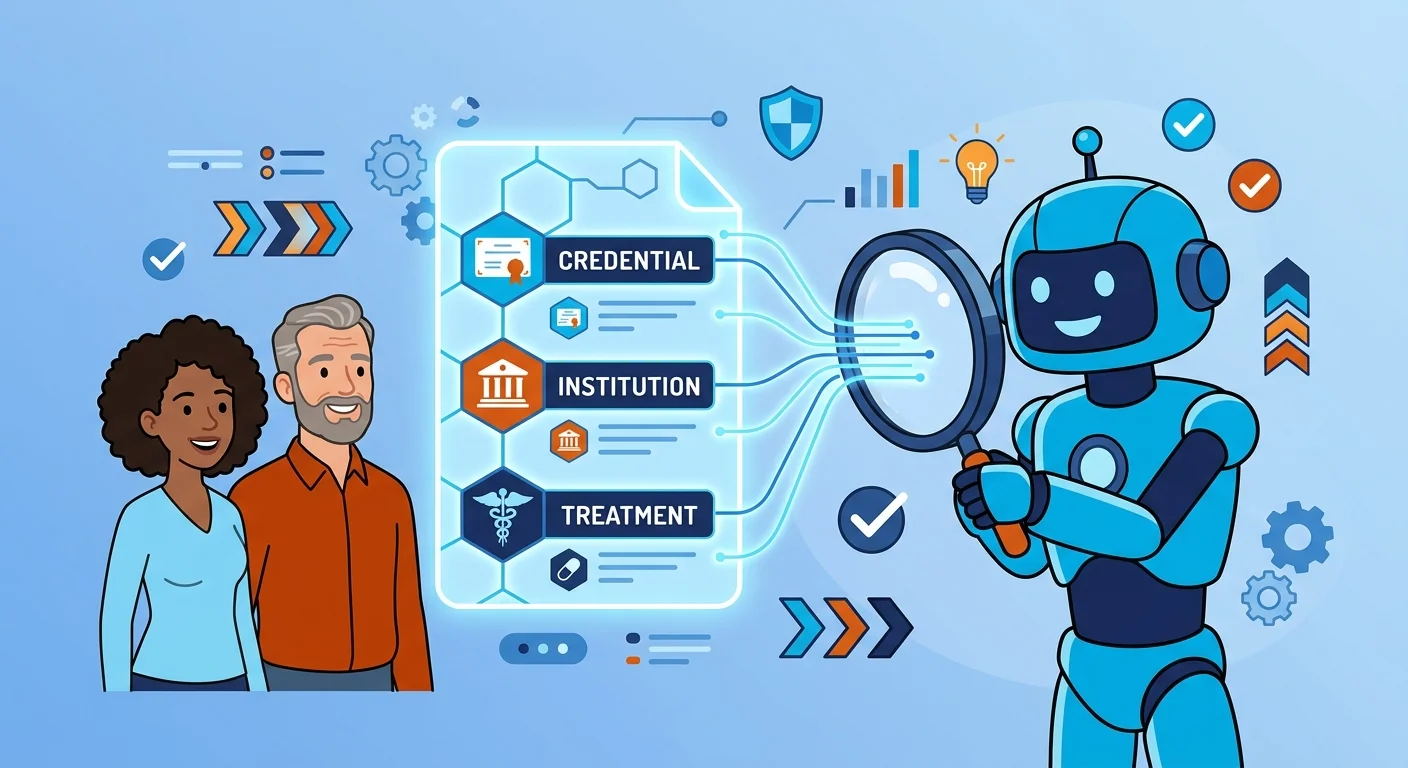
Machine trust isn't a sentiment. It's a data property. An AI system can either verify a claim against structured, unambiguous records, or it can't. Tone, polish, persuasive copy? None of it registers. And that's a hard reset for anyone still treating credibility as something a page says instead of something a page proves.
Correct information on a page doesn't earn trust anymore. Answer engines won't reward accuracy they can't confirm, yet the field keeps treating AI visibility as traditional search optimization in new clothes. What separates a practice's pages that get cited from ones that only get indexed is full-stack authority architecture, not markup alone.
Why Checklist Schema Fails the Entity Test
Here's where most healthcare organizations go wrong: they treat schema as a checklist item, something a developer bolts on after the page is built. That habit misses the whole point of the markup. Schema isn't a visibility tactic — it's an identity layer, and a checklist mindset never once asks whether an entity actually resolves.
Why Flat MedicalBusiness Markup Falls Apart Under Scrutiny
Flat MedicalBusiness markup names an organization and stops. It doesn't tie that organization to the clinicians inside it, or those clinicians to the credentials that qualify them. Advanced medical schema builds the graph instead — clinician to credential, credential to institution, institution to specific treatments. A checklist leaves you isolated tags a system can only skim, and that's exactly the gap entity resolution failures expose the moment an AI tries to walk the connections and finds nothing there.
Architecting the Verifiable Entity Graph
| Entity Layer | What It Connects | Machine-Readable Signal |
|---|---|---|
| Clinician Entity | Individual credentials, licensure, professional history, and authored clinical content | Person entity properties (schema.org also has IndividualPhysician for a single practitioner) linked to credential markup and cross-referenced through sameAs to verified professional profiles |
| Institutional Entity | Organizational identity, accreditation, and every clinician affiliated with it | MedicalOrganization entity resolving outward to each linked Person entity it employs |
| Credential Layer | The qualification that connects a named clinician to the authority to make a clinical claim | Credential properties nested inside the clinician's Person entity rather than stated as unstructured text |
| Treatment or Claim Layer | The specific procedure, condition, or recommendation the institution and clinician stand behind | MedicalGuideline or MedicalStudy markup tracing a claim back to its evidence basis |
| Evidence Grading Layer | Multiple grading systems for clinical recommendations, reconciled into one appraisable standard | A meta schema connecting existing grading systems so ungraded recommendations can still be appraised |
Connecting Clinician, Credential, and Institution
That graph isn't a flat directory. It's a chain of connected proofs — credential to clinician to institution to treatment — until the whole record reads as one verified identity. Evidence schemas work the same way: a meta schema connects existing grading systems to increase transparency and appraise previously ungraded recommendations, and that's the exact model an entity graph borrows to make a clinician's credentials mean something a machine can check.
Extending Trust Outward With sameAs and External Verification
Trust doesn't stop at the institution's own site. sameAs properties push the graph outward, cross-referencing a clinician's profile against external records the way how a clinician's credentials get mapped into that graph spells out. A record an AI can verify against outside sources gets pulled into an answer; one that only describes itself gets skimmed and left behind, the same transparency principle documented in Vienna University of Technology research on grading frameworks.
Where the Data Confirms What Gets Cited
| Pipeline Stage | Volume | What It Filters For |
|---|---|---|
| Search Results Returned | 785 results across 22 production runs | Raw volume before any verification filter is applied to a 12-article content cluster |
| Cited After Verification | 76 results ultimately cited | Whether a claim survives extraction and verification to reach a final citation |
| AI-Generated Source Share | 16% of unique cited sources | How often the four engines tested cited a source that was itself AI-generated |
| Grading Transparency Layer | Meta schema connecting existing grading systems | Whether an ungraded recommendation can be appraised against a transparent evidence standard |
How Unverified Entities Fail Under Generative Search Conditions
An entity graph that can't resolve fails quietly, not loudly. Generative search engines already cited AI-generated sources in about 16% of unique cited sources across four engines tested, per research from Northwestern University. An unverified clinician entity doesn't get flagged as suspicious — it just never gets pulled into the answer at all, because rankings stopped predicting who gets cited the day answers replaced links.
Grading the Evidence Behind Clinical Claims
Evidence schema hits the same test long before a claim ever reaches an answer engine. Across 22 production runs of a 12-article AEO/SEO content cluster, the pipeline's searches returned 785 results; 681 passed its pre-fetch filter, 503 were fetched, 201 were verified by an extractor, and 76 were ultimately cited — roughly one citation for every ten search results returned. That funnel, drawn from iTech Valet's measured pipeline data, runs on the same grading logic entity resolution depends on: a claim with no traceable evidence path gets filtered out well before citation, which is exactly why treating markup as an identity layer instead of a checklist changes what actually survives. Structuring that layer right is what AI Authority System services exist to build.
Implementing the Entity Graph in Sequence
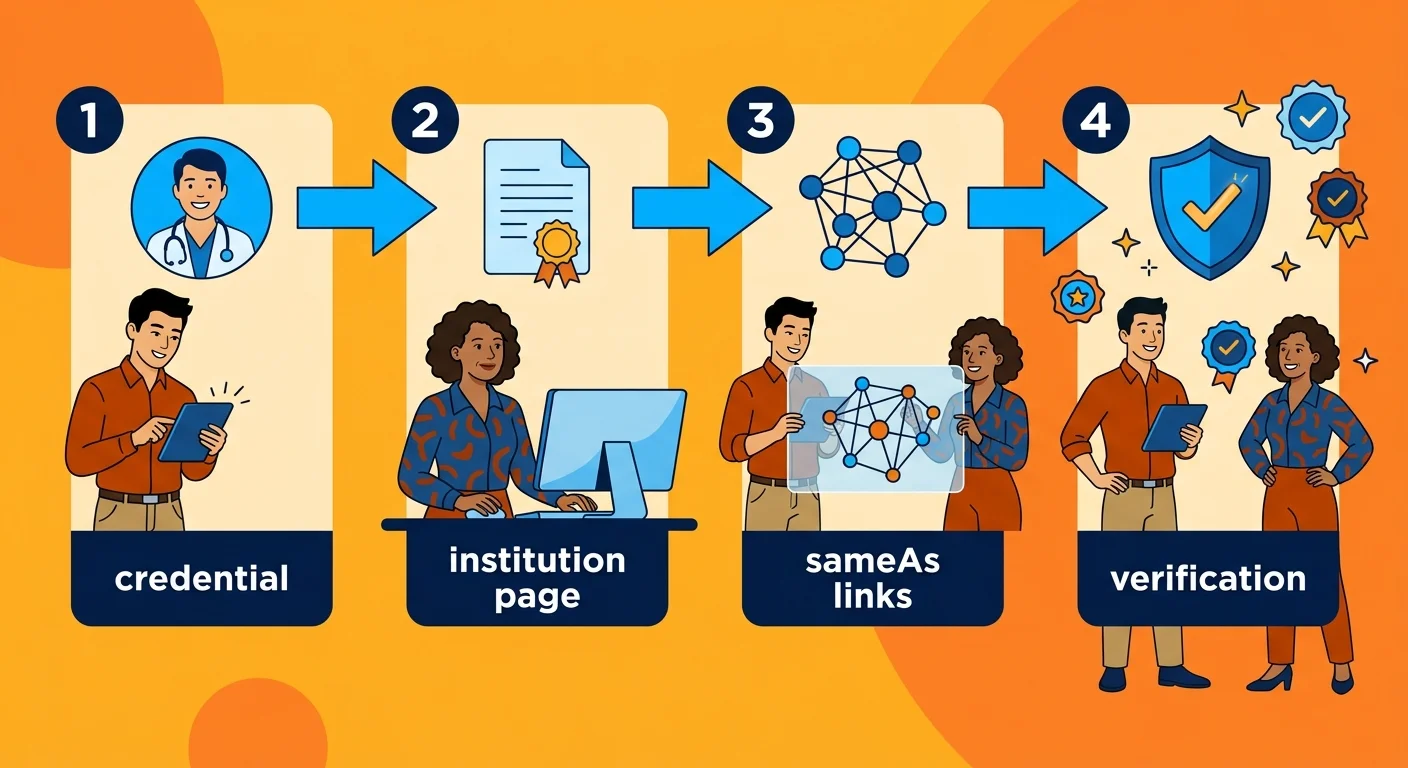
So where does the build actually start? Not with content. It starts with the clinician entity itself, because every other node in the graph resolves back to that one identity.
| Step | Action | Entity Layer Reinforced |
|---|---|---|
| Establish the Clinician Entity | Build a Person entity for the clinician and tie it to verified credentials before any other markup gets attached. | Clinician credential layer |
| Attach the Institutional Record | Connect the credentialed clinician to a verified MedicalOrganization entity, confirming the affiliation itself resolves. | Institutional identity layer |
| Layer in Evidence Structures | Add MedicalGuideline or MedicalStudy markup only once the clinician-institution link resolves cleanly, giving clinical claims a traceable basis. | Clinical evidence layer |
| Consolidate Through External Profiles | Use sameAs properties to cross-reference the record against outside professional profiles, extending trust beyond the practice's own site. | Cross-verification layer |
| Audit the Graph for Dead Ends | Check every connection to confirm each entity resolves into the next, rather than leaving isolated tags with nothing behind them. | Full entity graph integrity |
Sequencing Credential, Content, and Consolidation Layers
Credentials go first: tie each clinician's Person entity to verified qualifications before anything sits on top. Content markup comes second, then consolidation, when sameAs properties link the record out to external profiles. Skip the order and the graph fills with connections that point back to nothing verified.
Frequently Asked Questions
Same questions come up every time this gets explained. Here are the straight answers.
How does medical schema help AI distinguish a research paper from a clinical service?
MedicalStudy and MedicalGuideline markup flags peer-reviewed research with an evidence trail. MedicalBusiness and MedicalProcedure markup flags an operational service tied to a licensed provider. An AI system reads the entity type first, then checks what's hanging off it.
Can incorrect schema markup for a doctor's credentials negatively impact trust with AI engines?
Yes, and the damage stays quiet instead of loud. A credential claim that won't resolve against verified records never gets flagged as wrong. It just gets skipped, and that clinician's entity stops being a source any answer engine will cite.
What specific schema types matter most for a multi-location medical practice?
MedicalOrganization markup for each location, Person markup for every clinician at that location, plus address and geo properties tying the two together. On schema.org, Physician is a type for the practice, not for a person; IndividualPhysician exists for a single practitioner. Skip that layering and a multi-location practice reads as one blurred entity instead of several verifiable ones.
Is MedicalBusiness schema enough, or do individual clinician pages need their own markup?
No, MedicalBusiness markup alone doesn't cut it. It names the organization but says nothing about who practices there or what qualifies them. Each clinician page needs its own Person markup, credentialed and linked back to that organization.
How does sameAs schema for a physician's professional profiles build machine trust?
sameAs properties cross-reference a clinician's profile against outside records an AI already treats as authoritative. That external confirmation turns a self-described claim into a verified one. A page that only describes itself never earns that lift.
Beyond Google, what other platforms consume medical schema markup?
Large language models trained on structured web data, AI assistants, and health information aggregators all parse Schema.org markup on their own, no single search engine required. Build the structured entity data right and it serves every one of them at once.
The Bottom Line
A checklist proves nothing. A graph proves everything, because a machine can walk it — clinician to credential to institution to treatment — and confirm every link on its own.
That's the whole shift, right there. Basic markup describes a page. Advanced medical schema markup credentials an identity, and only one of those makes it through an AI system's verification pass.
So the direction's clear: build the graph before the content, and let identity resolve before you attach anything else to it. If you want to see where your own entity graph stands right now, start with an AI visibility check.