
Why a Clinician's Credentials Mean Nothing to a Machine Until They're Structured
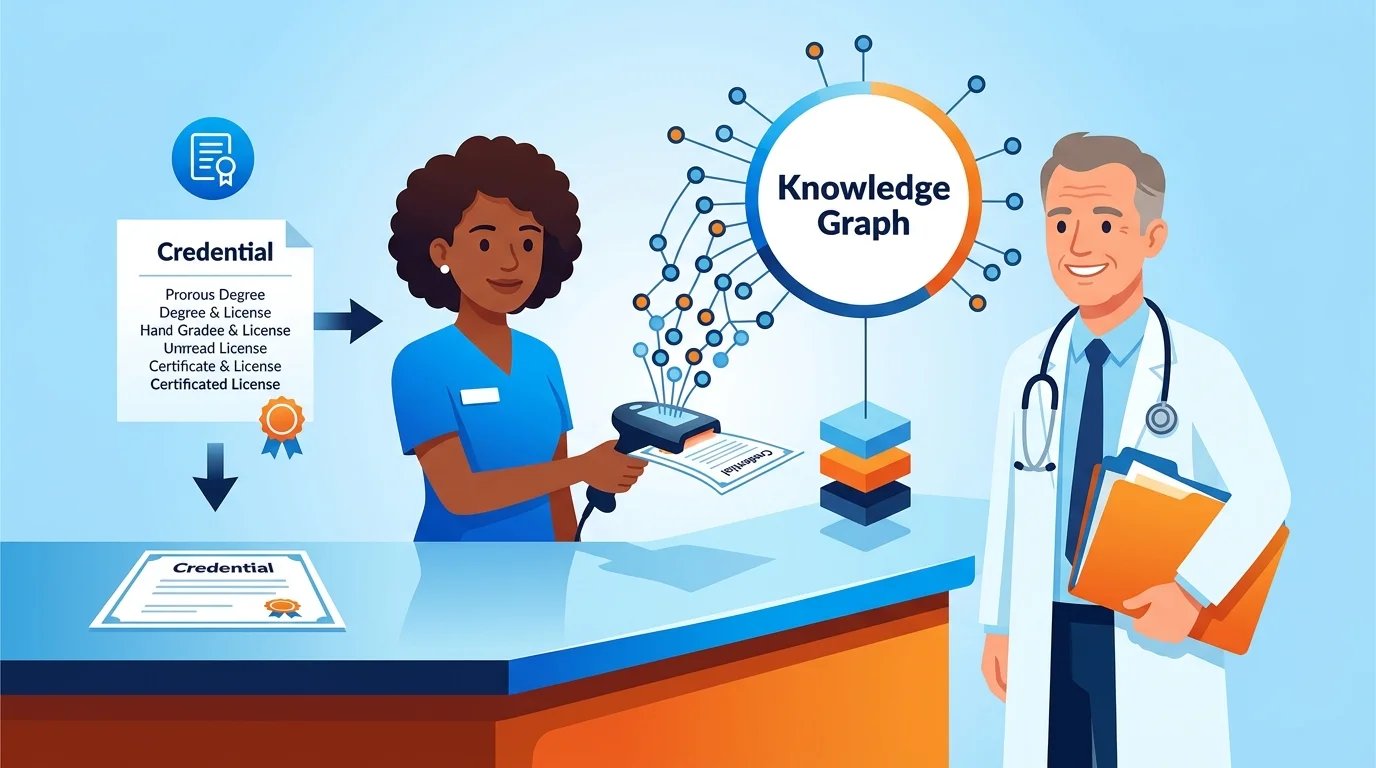
A credential printed on an About page is written for a human visitor, and a machine barely notices it. Google's Knowledge Graph works like a digital encyclopedia, and a credential only counts once it's recorded there in language a system can verify. So mapping clinician credentials now means translating them, not just listing them.
Structured data is the bridge between what a webpage says and what a search engine actually understands about an entity. And that bridge exposes the real gap, because AI visibility keeps getting treated as old-school search work with new vocabulary. The system underneath has already changed, and that shift is worth studying before anyone adapts strategy around the full authority engine stack.
Why Keyword Position Tracking Never Answers the Question an AI Is Actually Asking
Results-page position numbers tell you where a page sits in a stack of links, and that's it. They say nothing about whether an AI understands, verifies, or trusts an entity enough to quote it inside an answer. So chasing a better spot in classic search listings means polishing a surface that AI answers keep skipping right past.
Plenty of healthcare organizations pour hours into human-readable About Us pages while the machine-readable data that actually powers AI results never gets built, and that gap gets wider as citation behavior shifts.
A page doing great under old-school search work can still be invisible to the system deciding who gets quoted, which is why entity clarity through schema markup a machine can trust matters more than a position number ever did.
How Google Tells Two Clinicians With the Same Name Apart
| Disambiguation Approach | Data Input Type | Test Set | Reported F1 Score |
|---|---|---|---|
| Flat text matching | Name strings and plain text mentions | General web text corpora | Not reported for this approach |
| Graph-based relationship encoding | Wikidata graph triplets | Wikidata-Disamb test set | 91.6% |
| Directory and licensing cross-reference | Structured identity records from external profiles | Not a formal benchmark test set | Not reported for this approach |
The Disambiguation Problem Underneath Every Common Name
Two clinicians, one name, and a system that only reads names is stuck. So Google skips the name and follows relationships instead, tying a credential to a degree, a license, a published article, and a specialty until exactly one entity is left standing. That's the mechanical question sitting underneath consistent directory listings for a practice.
What the Wikidata-Disamb Benchmark Shows About Graph-Based Methods
Graph-based disambiguation has a published benchmark on this exact problem. Work available through Contextscout indicates a Bi-directional Long Short-Term Memory (Bi-LSTM) encoding of Wikidata graph triplets is associated with the best-performing approach to named entity disambiguation, scoring an F1 value of 91.6% on the Wikidata-Disamb test set. Now, that figure belongs to the Wikidata-Disamb test set, not to search performance in general. But it shows how far relationship data can go in sorting out a shared name.
The Properties That Carry the Weight: alumniOf, hasCredential, knowsAbout
| Schema Property | What It Establishes | Data Format Expected |
|---|---|---|
| alumniOf | The institution where clinical training or education occurred, tying the clinician to a verifiable academic source | An EducationalOrganization entity, referenced by name and linked identifiers rather than plain text |
| hasCredential | The specific board certification, license, or professional qualification held by the clinician | An EducationalOccupationalCredential entity specifying credential name, issuing body, and credential category |
| knowsAbout | The clinician's topical expertise, the signal AI Overviews reference when selecting who speaks with authority on a subject | A list of topic entities or descriptive terms tied directly to the clinician's profile markup |
| sameAs | Identity resolution across the web, confirming that separate mentions of the clinician point to one entity | A set of URLs to authoritative external profiles such as licensing boards or professional directories |
What Each Property Tells the Graph
Each property does one job, and alumniOf names the school where the training actually happened. Then hasCredential pins on the specific board certification or license. And knowsAbout declares the topics a clinician genuinely covers, which is the link AI Overviews lean on when deciding who gets to speak on a subject.
How These Properties Compound Into an Authority Signal Over Time
Authority you own compounds, while attention you rent expires. As Google reports, Google recommends listing every author shown on a web page in the markup as a separate entry, using the Person type for people and the Organization type for organizations. Every article published through AI search optimization services carries author markup that points back to one clinician entity, so credibility stacks with each piece instead of resetting.
Where Credential Schema Breaks Down Across a Multi-Clinician Practice
| Failure Pattern | Mechanism | Operational Cost |
|---|---|---|
| Duplicate entity listings | Two clinicians at the same practice share near-identical markup, so alumniOf and hasCredential values resolve to overlapping rather than distinct identities. | A system defaults to merging or ignoring both profiles, so neither clinician accumulates a trusted individual record. |
| Inconsistent sameAs links | One clinician's profile links to a licensing board and directory page, another's links to only one or none, breaking the cross-reference pattern a practice otherwise establishes. | The unresolved entity cannot be verified against outside sources, so its credentials sit unread even where markup exists. |
| Author markup applied unevenly | Some articles carry proper author entries tied to a clinician entity, others default to a generic staff byline or the organization alone. | Published work splits across two identities instead of compounding into one, diluting the authority each article was meant to build. |
| Stale knowsAbout declarations | A clinician's specialty or focus changes, but the markup from an earlier build-out never gets updated across every page referencing them. | AI systems keep citing outdated topical expertise, so the entity record drifts away from what the clinician actually practices now. |
| One clinician left out of the rollout | A practice maps credentials for its newest or most visible clinicians and treats the rest as an afterthought. | That unmapped clinician stays invisible to entity-based retrieval no matter how much other content the practice site carries. |
Why a Single-Page FAQ Trick Can't Substitute for Entity Architecture
A single FAQ page stacked with questions can't stand in for entity architecture spread across a practice site. Google's documentation says Google's guidelines state that QAPage markup should not be used on FAQ pages, blog posts, how-to guides, or pages with multiple questions per page, and that users must be able to submit answers to the question. QAPage markup is built for pages where users submit their own answers, not for a clinic answering its own questions once, so piling more text onto one page just adds words a system still can't tie to a credentialed person.
How Author and Reviewer Markup Reinforce the Clinician Entity
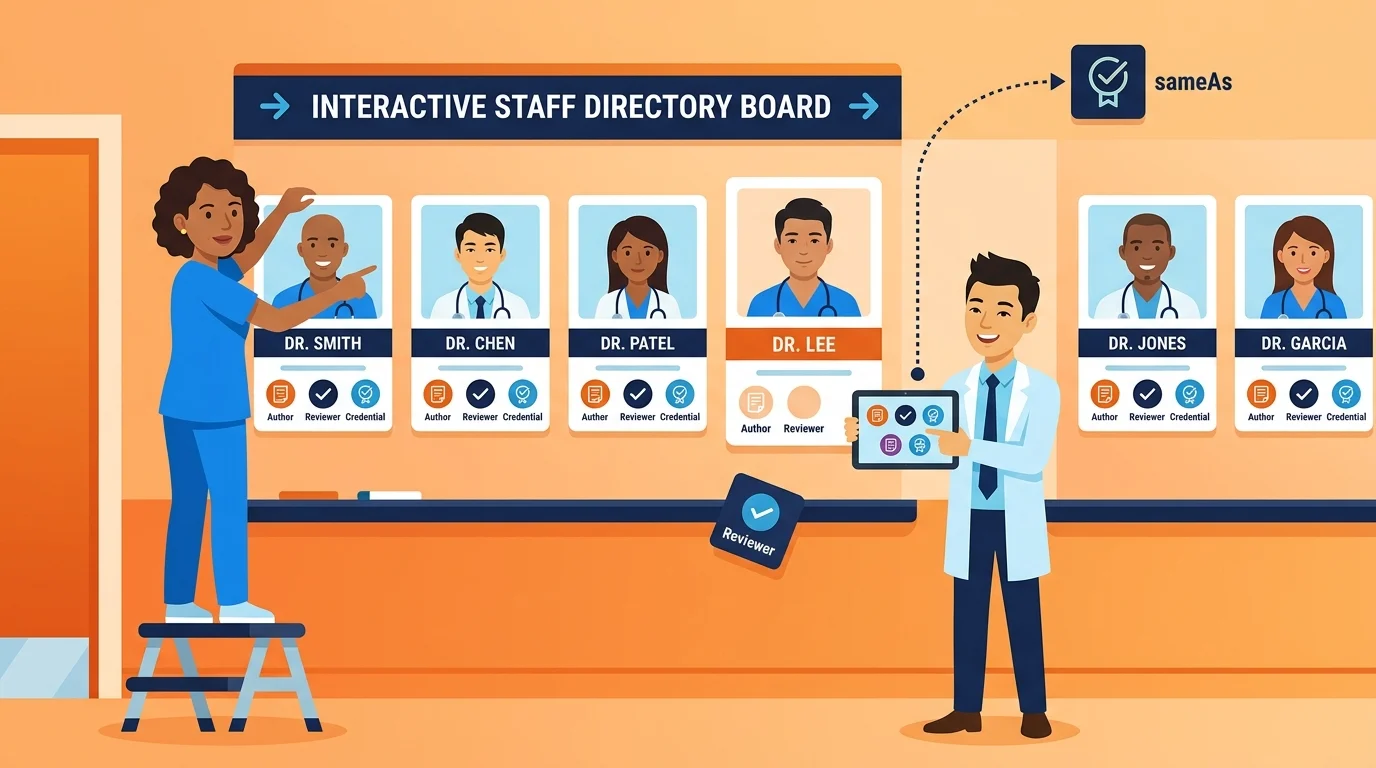
Author markup was already tying each article back to one clinician entity, and reviewer markup stretches that same logic to content a clinician checked but didn't write. Both feed the same entity record instead of spawning a new one. That's why consistency across every byline beats publishing volume every single time.
Closing the Loop With sameAs and External Verification
Now… this part matters: sameAs closes the loop by pointing back to the licensing boards, directories, and institutional pages already describing that clinician. Across a multi-clinician practice, every profile needs its own consistent set of external links. Skip one clinician and that entity stays unresolved, no matter how much other content the site carries.
Frequently Asked Questions
Once a practice actually starts building this, the mechanical questions show up fast. Here's what operators hit first, answered straight.
What specific schema properties are most critical for defining a clinician's credentials for AI search engines?
Four properties carry the most weight: alumniOf, hasCredential, medicalSpecialty, and knowsAbout. Each one states a distinct, verifiable fact instead of a fuzzy description. That's exactly what disambiguation systems need to lock onto one entity.
Can incorrect schema markup for credentials negatively affect how a clinician is represented in AI-generated answers?
Yes, and it's worse than doing nothing. Bad or mismatched markup can pin a credential on the wrong entity, or leave it unresolved. Either way, the clinician ends up outside the generated answer instead of inside it.
How does Google verify the clinician credentials provided in structured data?
Google checks the markup against signals published elsewhere. Think licensing boards, directories, and institutional pages. Consistency across those sources earns the trust, not the markup on its own.
Is it better to use Schema.org's Physician type or the more general Person type for a clinician's profile?
Use Person for an individual clinician; schema.org also has IndividualPhysician for a single practitioner. Physician describes the practice: on schema.org it is an organization type, not a kind of Person. So the practice carries Physician and each clinician carries a Person record.
How long does it typically take for Google's Knowledge Graph to update after new credential schema is added to a website?
There's no fixed timeline, and anyone quoting one is guessing. Reconciliation depends on how consistently the new signals match what's already published about that clinician.
Why should FAQPage markup never be used to simulate credential verification on a bio page?
FAQPage markup is for questions and answers a site writes itself. It describes a list of questions, not a person, so it tells a system nothing about who a clinician is or what credentials they hold. QAPage is a different type, meant for pages where users submit their own answers. A bio page needs entity markup, not borrowed Q&A formatting.
The Bottom Line
Think of the Knowledge Graph as a reference book that only records what's written in its own language. A credential printed on a webpage for human eyes? It never makes the cut.
Structured, verifiable markup does, and that's the line deciding whether an AI system can cite a clinician at all. Expect that line to get sharper as generated answers keep eating into classic search listings.
Here's the verdict: rented attention dies the second a position number slips, while owned, machine-readable authority compounds with every credential, byline, and cross-reference added to the record. Building that record on purpose starts with your own AI Visibility Check.