
What AI Search Engine Consensus Actually Means
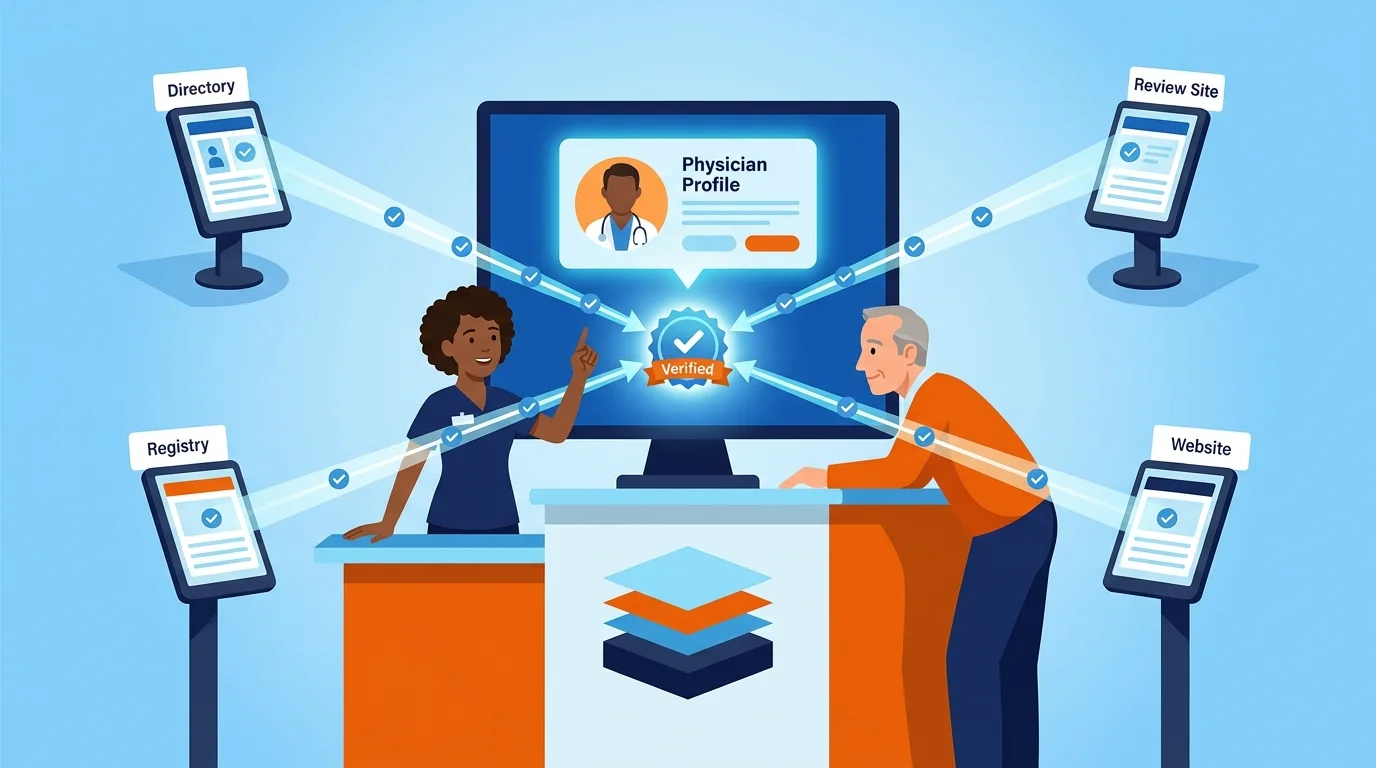
Here's the thing: search engines stopped treating a practice's website as the final word on a doctor a while ago. Now they build a working model of that entity, checking what one page claims against what every other page says.
Consensus is what happens when that checking lands on agreement. Directories, profiles and association records all describe the same identity, credentials and location with zero contradictions, so the knowledge graph gets one verifiable entity instead of several competing versions. The framework for building that kind of durable entity lives in the guide to full-stack authority engines.
Why Legacy Directory Tactics Fail
Directories used to be a legacy search optimization play, prized for inbound links and raw citation volume. That job's gone. Now they're a distributed database an AI engine checks to verify who you are, not a scoreboard counting how many places list a name.
Where Citation Volume Breaks Down
Selling citation volume today means selling a game that ended, because rankings rewarded count while generative answers reward agreement. One definitive answer needs facts that match everywhere, so a knowledge graph checks identity instead of tallying mentions, which is the logic behind credential mapping for clinicians. Here's the kicker: a few accurate listings now beat a pile of messy ones.
How Knowledge Conflicts Get Resolved Inside the Model
Here's what's actually happening under the hood: a large language model regularly hits a knowledge conflict, where what it learned in training disagrees with the information sitting right in front of it. According to UC Berkeley and University of Washington, large language models often encounter knowledge conflicts between their internal parametric knowledge and non-parametric information provided in the prompt context. When a directory listing is pulled into that context, a mismatch it carries is one more conflict for the model to settle.
| Data Source Type | Role in Entity Verification | Trust Weight Signal |
|---|---|---|
| Google Business Profile | Primary anchor for name, address, phone, and category data the knowledge graph checks first | High — treated as a direct signal from the platform operating the local knowledge graph itself |
| Major healthcare directory listing | Secondary witness confirming credentials, specialty, and practice location against the primary anchor | Moderate — weighted by how consistently the listing matches every other independent source |
| Professional association record | Independent confirmation of licensure and credential claims separate from commercial directories | Moderate to high — treated as harder to fabricate than a self-submitted business listing |
| Practice website structured data | Non-parametric context the model reads directly, shaping how it resolves a conflict in real time | Conditional — only trusted once it agrees with what external sources already report |
| Unverified or outdated directory entry | A dissenting witness the model must reconcile against the surrounding agreement | Low — down-weighted or discarded when it conflicts with the broader consensus |
How Entity Data Gets Verified Across the Web
Human-reviewed data used to come from in-house review or offshore contracting. Published research data documents that human-reviewed data for enterprise content systems has traditionally been produced by in-house editorial efforts or outsourced offshore contracting, and emerging applications attempt to collect it automatically at Internet scale. That paper predates AI search: it describes collecting reviewed data at scale. The practical point today is narrower: linked, consistent facts are easier to check than a long list of mentions, and sameAs linking through a Wikidata record shows how that linking works.
The Role of Structured Data in Signaling Trust
Structured data hands the knowledge graph a machine-readable statement of identity to check against every directory listing, so a practice stops hoping the AI engine guesses right. WordLift documents that enhanced entity pages that add llms.txt-style agent instructions, breadcrumbs, and neural search may improve RAG accuracy by +29.6%, while JSON-LD markup alone provides only modest gains. Translation: markup on its own doesn't carry the full weight, so the entity signal needs backup from somewhere else.
| Schema Element | What It Verifies | Where It Applies |
|---|---|---|
| Organization Schema | Legal name, address, phone number, and medical specialty as a single declared identity | Practice website homepage and about page, matched against Google Business Profile and directory listings |
| Physician Schema | Individual clinician credentials, degree, and affiliation separate from the practice entity itself | Provider bio pages, linked back to the parent Organization markup |
| sameAs Property | Confirms that external directory and association profiles describe the same entity as the website | Nested inside Organization or Physician markup, pointing outward to verified third-party profiles |
| Breadcrumb Markup | Site structure and topical hierarchy, giving crawlers a clear map of how pages relate | Category and service pages, reinforcing the entity's organizational context |
Linking Identity Across Platforms with sameAs
That backup is the sameAs property, which points from the practice's own Organization markup straight to its other verified profiles. According to Google, Schema.org Organization markup can include a sameAs property listing URLs of other pages with additional information about the organization, such as social media or review profiles. Used right, it chains Google Business Profile, directory listings and association records into one declared identity (the structural work our AI visibility services are built around), so the AI engine never has to guess at the connection.
Building the Consensus Layer Step by Step
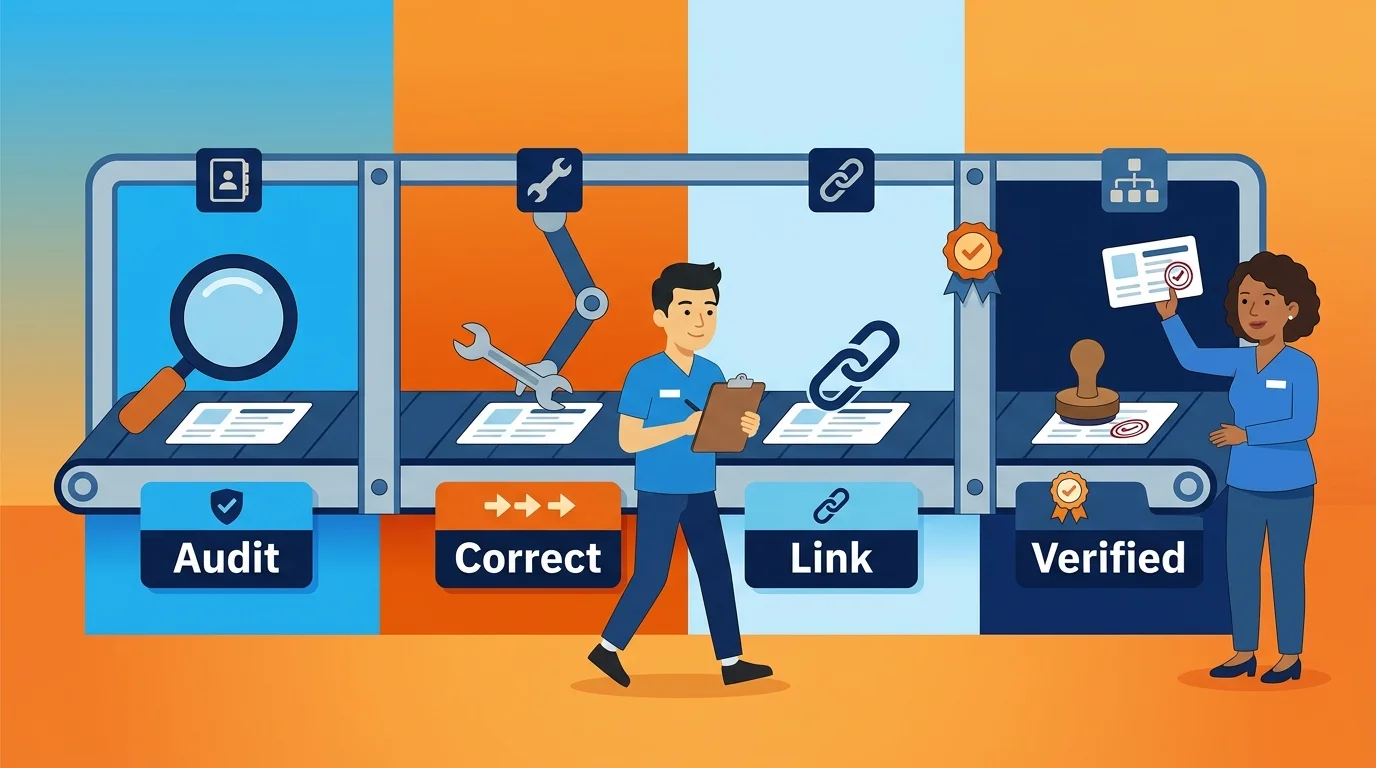
| Step | Action | What It Resolves |
|---|---|---|
| Audit Existing Listings | Pull every directory, profile, and association record where the practice name appears and lay them side by side against the practice's own system of record. | Surfaces every point of disagreement before any correction begins, rather than guessing which source is wrong. |
| Correct At The Source | Fix name formatting, degree credentials, address, and phone number inside each directory and profile itself, not only on the practice website. | Removes the conflicting testimony an AI engine would otherwise have to weigh and resolve on its own. |
| Reinforce With Structured Data | Update the practice website's Organization markup and sameAs property to reference the cleaned-up set of verified profiles. | Gives the knowledge graph a machine-readable statement that chains every witness to one declared identity. |
| Re-Check For Drift | Revisit the same listings on a recurring basis, since directories update independently and can reintroduce inconsistency over time. | Prevents a single stale profile from reopening a knowledge conflict the practice already resolved. |
Auditing Directory Listings for Conflicts
Auditing starts by pulling every listing that carries the practice name and lining them all up side by side. Now, this part matters: name format, degrees, address and phone each get checked against the practice's own system of record, never against each other. According to Google, businesses with complete and accurate information in their Google Business Profile may be more likely to appear in local search results.
Sequencing Schema and Directory Updates
Fix the directories first, then point the website's structured data at the cleaned-up set. Schema that links to messy outside profiles just hands the model the same fight all over again. Do it in this order and every witness tells the same story before the jury ever sits down.
Frequently Asked Questions
Once the build order clicks, the mechanical questions show up fast. Here are the ones that actually matter.
How do AI search engines like Google verify the credentials listed in healthcare directories?
Short answer: cross-referencing, not one trusted document. The AI engine compares credential claims across every source it can find. Agreement counts as confirmation.
Does having more directory listings improve my practice's chances of being cited in an AI Overview?
No. Volume was the old-school search work play, and generative systems weigh agreement and accuracy instead. A handful of consistent listings beats a pile of contradictory ones.
What is the most common point of failure when using directories for entity consolidation?
The big one is fixing the website while the original directory listing stays wrong. Schema pointing at a bad source just hands the model a fresh fight.
If my practice information is inconsistent across directories, how does that affect AI search consensus?
It forces the model to pick which source to trust. Often it down-weights the entity instead of guessing. That uncertainty is what keeps a practice out of the cited answer.
Can structured data on my website override incorrect information in a major healthcare directory?
Not reliably. Schema states a claim the AI engine still checks against outside sources. An uncorrected directory error stays a contradiction the system has to weigh.
What does the sameAs property do when it appears in Organization schema markup?
It links a practice's own Organization markup to its other verified profiles. Think social media pages or review listings. So the knowledge graph gets a declared connection instead of a guess.
The Bottom Line
An AI engine doesn't rent space to whoever pays the most. It cross-examines every witness your practice has on record. And it trusts the ones whose stories match.
That's the whole shift. Legacy search optimization rewarded volume, but answer engine consensus rewards consistency across directories, profiles and structured data that all point back to one identity. My verdict, no hedging: agreement beats volume.
The practice that earns the citation is the one whose witnesses never contradict each other. So start with an honest look at what your own data says right now, which is exactly what the AI Visibility Check is built to surface.