
How Search Itself Changed Underneath Every Agency Pitch
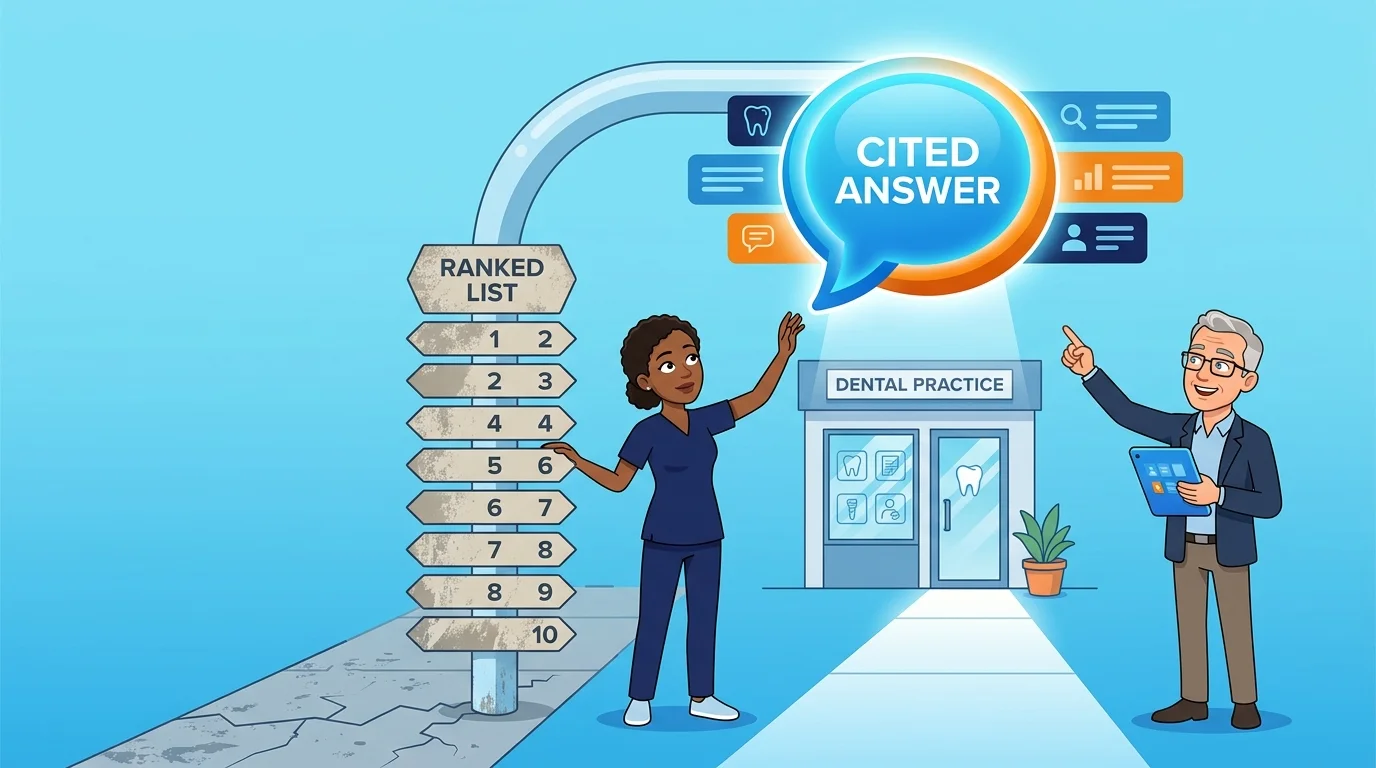
Search used to hand back a list of links, ranked by relevance. Now a generative answer engine hands back one synthesized answer, and a lot of the time there are no links at all.
That shift changes what an agency has to know to be useful. Vetting one got harder because the system it claims to optimize for changed shape underneath it. The city got rebuilt, and plenty of pitches are still selling the old map.
From Ranked Lists to Generated Answers
A ranked list rewarded a page for matching a query closely enough to land near the top. A generated answer rewards something else entirely: a source trustworthy enough to get cited inside the answer itself.
Plenty of agencies still report the old metrics, like search position reports. Those numbers often miss true visibility inside the generated answer, because a page can hold a strong position and still never show up in the response a patient actually reads.
Why the Old Vocabulary No Longer Describes the Work
Here's the thing: the vocabulary built for ranked lists doesn't describe what happens inside an answer engine. Placing in traditional ranked results and getting cited by name inside a synthesized response were never the same mechanism.
AI visibility keeps getting sold as traditional search optimization with new vocabulary. But the measurement itself broke, since a rank-tracking report shows a position and can't show whether an answer engine chose to name a practice at all. That gap is exactly why how clinics should weigh boutique versus large agency options matters before anyone signs a contract.
Why Rank-Tracking Reports Are a Method That Already Failed
Some proposals still lead with search position reports. A number climbing in a spreadsheet looks like progress, even when it describes a system that no longer decides what a patient sees.
That number was built to describe a ranked list. Generated answers aren't a list. So a report built for one can't verify performance inside the other.
The Old Report Card Problem
The old report card problem is simple to state. A page can hold a strong position number and still never get named inside a generated answer, because position and citation stopped measuring the same thing.
Alright, quick reality check: a practice can watch its numbers climb for months (and feel pretty damn good about it). Meanwhile the answer a patient actually reads never mentions that practice once.
What That Report Never Measured
What a rank-tracking report never measured is structure. Google's documentation says there are no additional technical requirements for AI Overviews or AI Mode beyond being indexed and eligible to show with a snippet, and no special schema is needed. Eligibility is basic indexing; structure is good practice, not a gate.
Being a listed address stops mattering once the list stops being the thing patients read. An agency still selling position reports is still protecting an address on a list that's disappearing, which is exactly why how direct founder contact continues after the sale matters once a contract is signed — someone needs to keep explaining how that structure holds up as the terrain keeps shifting.
How a Citation Actually Gets Built Inside an AI Answer
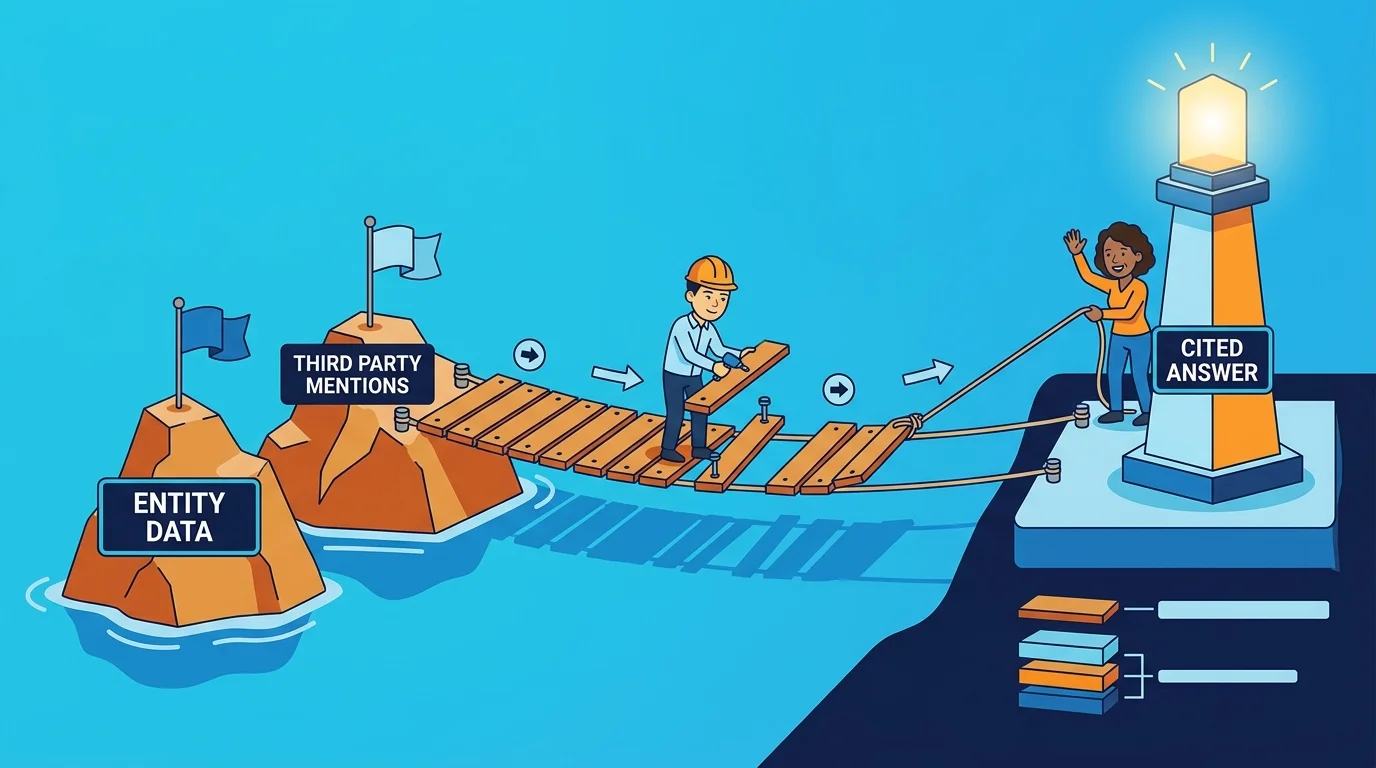
A citation inside a generated answer doesn't show up because a page ranked well. It shows up because a system decided that page's entity was trustworthy enough to name out loud.
| Signal | What It Does | Where It Lives |
|---|---|---|
| Structured Data | Helps search engines understand the page; Google says no special markup is needed for AI features | Schema markup embedded in a practice's own pages, matched to the text patients and systems both read |
| Entity Resolution | Maps a mention of a practice to the correct real-world entity in a knowledge base, disambiguating it from similarly named businesses | Knowledge graphs and the context surrounding each mention, not any single page a practice controls |
| Third-Party Citation Signals | Supplies the outside confirmation an answer engine weighs before naming a source inside a generated answer | Directories, reviews, and independent sites a practice does not own and cannot directly edit |
| Content Structure | Gives an answer engine clean headings, tables, and lists it can pull a direct answer from without extra interpretation | A practice's own published pages and articles, formatted for extraction rather than for scanning alone |
Where Entity Linking Fits Into the Picture
Dalton & Dietz (UMass Amherst) note that entity linking is the task of mapping mentions in documents to entities in a knowledge base, with attention to the disambiguating context of each mention. That's a useful way to think about it: an answer engine may be resolving which real-world practice a mention actually refers to, in context, before it decides whether to cite it.
An agency that can't describe that process is still thinking in rankings, not resolution. Ask one to explain spotting the difference between custom and automated workflows, and the answer should name entities and context, not position numbers.
Why Third-Party Sources Carry the Weight
Much of what a generated answer cites about a practice may not live on that practice's own website. Being the cited source beats being a listed address, because an address on a list disappears the moment the list does.
What Happens When an Agency Never Updates Its Own Playbook
An agency that never updates its playbook keeps selling volume: more articles, more pages, more posts pushed out on a schedule, all drawn from the same old map. That pitch rests on the belief that more content equals more visibility.
| Legacy Practice | Why It Fails Now | What It Costs |
|---|---|---|
| Reporting search position reports as the main performance metric | Position numbers no longer predict whether a generated answer names a practice at all | Months of reporting that show movement while the practice stays invisible inside the answers patients actually read |
| Publishing keyword-targeted articles on a fixed schedule without structural upgrades | Volume was never the mechanism an answer engine uses to decide what to cite | A growing archive of content that never earns a citation, while the real cost sits in time and budget spent chasing the wrong signal |
| Treating acquiring inbound links as the primary trust signal | Entity trust now depends on consistency and context across third-party sources, not link counts alone | A practice stays dependent on its own homepage for credibility it was supposed to earn elsewhere |
| Explaining visibility only in terms of placing in traditional ranked results | That framing can't describe a system that returns one synthesized answer instead of a list of links | A prospective client can't tell whether the agency understands the system it was hired to influence |
The Cost of Running an Outdated Process on Current Infrastructure
Running an outdated process on current infrastructure has a cost: output that never gets cited. A practice can publish constantly and still never appear inside a generated answer.
The fix isn't more output. It's structure, entity consistency, and citation-worthy sourcing, which is what our authority infrastructure services (authority infrastructure services) are built around.
The Questions That Separate a Real Process From a Recycled One
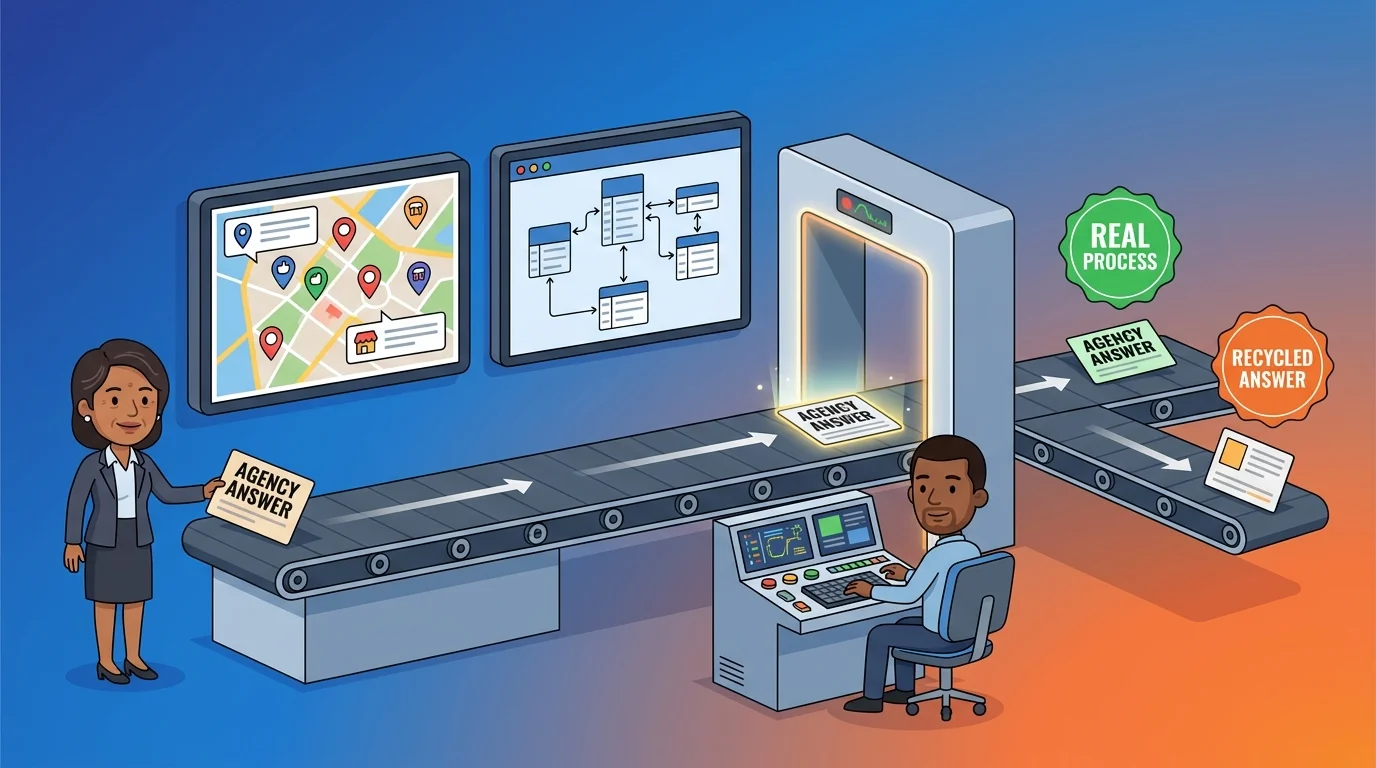
Good questions test whether an agency can name a mechanism, not just wave around a metric. So ask how they verify a citation actually happened. Then ask what entity consistency means across a practice's listed locations and profiles (and watch how fast the confidence drains).
| Question You Ask | Signal of a Weak Answer | Signal of a Strong Answer |
|---|---|---|
| How do you confirm a citation inside a generated answer? | Points to a search position report or a ranking tool as proof of visibility. | Describes checking actual AI-generated answers directly for mentions of the practice by name. |
| Which schema types apply to a clinic's pages, and why? | Gives a generic answer about adding markup without naming specific types or their purpose. | Names specific schema types tied to a clinic's structure and explains how each supports entity recognition. |
| How does entity consistency get managed across directories and map listings? | Treats directory listings as a one-time setup task, unrelated to ongoing citation. | Explains how mismatched listings confuse an answer engine's resolution of which practice a mention refers to. |
| What happens if a page is published but never cited in a generated answer? | Recommends publishing more content on the same schedule as a fix. | Diagnoses structure, entity consistency, or sourcing gaps before recommending any new output. |
| How does local search data factor into AI-generated recommendations? | Discusses it only in terms of map pack position or traditional local listings. | Explains how an answer engine resolves a practice's identity across local sources before naming it in a response. |
Reading the Answer on Structured Data
A credible agency should walk through which schema types fit a clinic's pages, and why each one belongs there. If the answer goes fuzzy on markup, bet on the process underneath being just as fuzzy.
Reading the Answer on Local Search Data
Local search data behaves differently from a national result set. An agency should describe how an answer engine resolves which practice a mention refers to, across directories and map listings, before it ever names one. Vague answers here usually mean the old map is still being used on terrain that no longer matches it.
Frequently Asked Questions
Here are the direct answers to the mechanical questions that come up once a contract is actually on the table. Each one tests a specific part of the verification process covered above.
How can I tell if an agency's proposal is based on outdated search optimization methods?
Listen for heavy emphasis on search position reports or acquiring inbound links as the main deliverable. If the proposal never mentions citations or entity consistency, it may have been built for a search environment that no longer exists.
What specific questions should I ask about how they'll report on AI search visibility?
Ask if reporting covers citation appearances inside generated answers, not just results-page position numbers. A credible agency explains how it checks for mentions across AI-generated responses. Where a page sits in a list is the least interesting part.
What are the biggest red flags in an agency's answers about getting cited in generative AI?
Biggest red flag: confidence without mechanism. An agency promising citations without explaining entity resolution may be guessing. And if third-party source behavior draws a blank too, there may be no process there.
How should a prospective agency explain their process for building my practice's entity authority?
A strong answer names schema types and consistent listings across directories. It also explains how a practice gets told apart from similarly named businesses. Vague talk about general online promotion instead of entity-specific work is a weak answer.
What does a good answer about managing my practice's local search data for AI engines sound like?
A good answer describes how an answer engine resolves which practice a local mention actually refers to, across map listings and directories. It should sound like a resolution problem, not a ranking problem.
If an agency guarantees they can get me cited in AI Overviews, is that a credible claim?
No. Guaranteed citation inside AI Overviews is not a claim any credible agency can back up, because no agency controls what a generative system chooses to cite. An honest agency explains the structure it builds toward instead of promising an outcome.
The Bottom Line
An old map doesn't go useless the second the city changes. It gets dangerous. It still looks official while it sends a practice down streets that aren't there anymore.
So the agencies worth hiring tossed that map in the trash. They drew a new one from the terrain answer engines actually reward: structured entities, verifiable citations and authority built for a system that reads your practice. Not a ranked list.
Before you sign anything, make the agency show you its new map. Start with an AI Visibility Check and see where your practice really stands.