
What Structured Code Actually Tells an AI Engine About a Practitioner
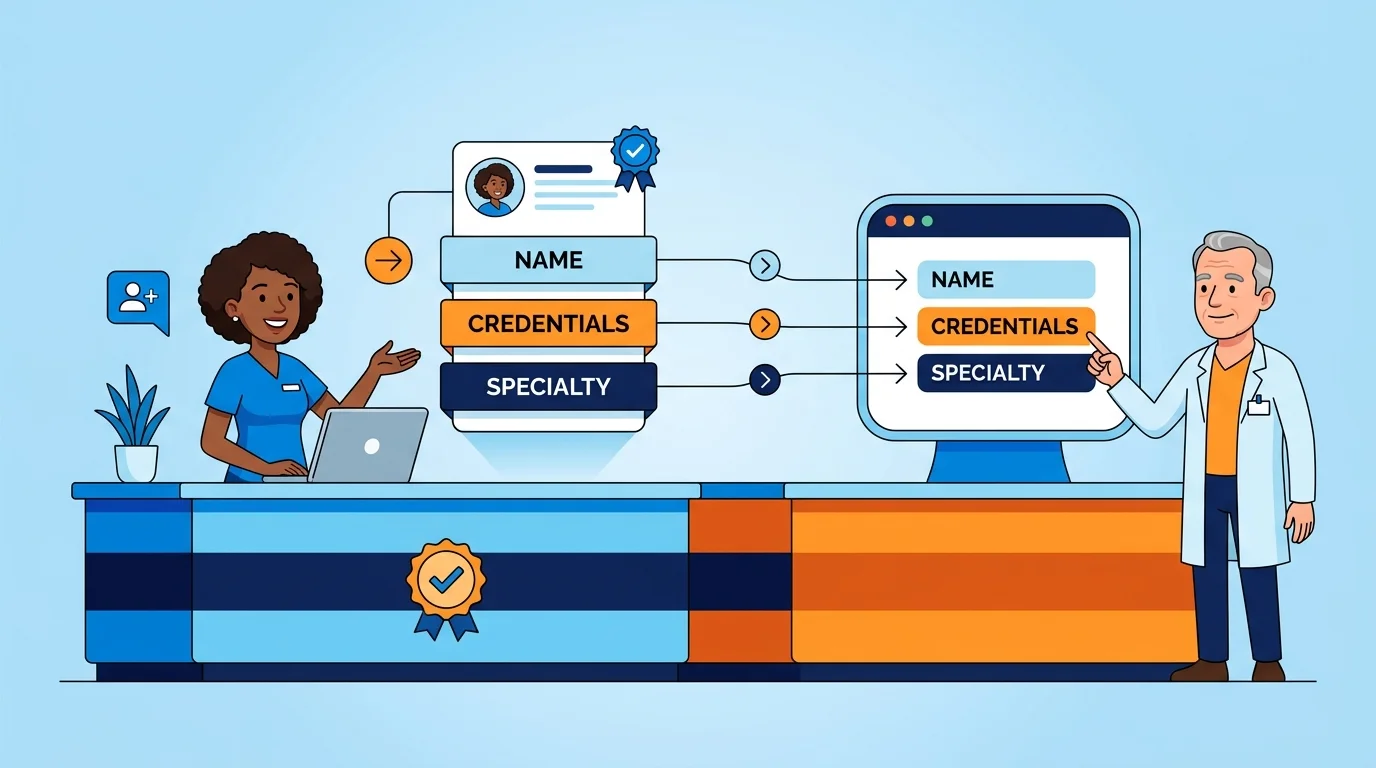
Structured code, in the form of Schema.org vocabulary, labels a website's content so search engines and AI can understand its meaning rather than just read the words. A practitioner's name sitting next to a credential in plain text is not the same as that credential being tagged as hasCredential. The tag tells AI systems exactly what the fact is, not just that the fact exists nearby.
A practice name and address on a page used to be enough. In the era of AI-generated answers, AI needs to understand the entities within a practice — the practitioners themselves. That gap is also why directory listings drift out of sync in the first place, which is part of what makes how to correct a clinic's online listings worth understanding alongside schema. Name and address identify the business; practitioner-level markup identifies the people AI is actually being asked about.
Why a Listed Address Stopped Being Enough
A practice name and a street address used to be the whole job. Back when search meant matching keywords to a listing, that was plenty.
AI Overviews and AI Mode work differently. Google's documentation says AI Overviews and AI Mode have no additional technical requirements beyond being indexed and eligible to be shown in Search with a snippet. Matching structured data to the visible page text sits among the practices Google lists for appearing in those features, which makes a labeled record a different kind of asset than a listed address.
| Query Type | AI Overview Activation Rate | What This Means for a Practice Listing |
|---|---|---|
| Trending queries sampled, overall average | 13.7% | Most trending queries sampled did not show an AI Overview |
| Question-form queries | 64.7% | A page built around a name and address was never built to answer a question as an entity, only to be found by one. |
| Any indexed, snippet-eligible page | No added technical bar beyond indexing | Google states there are no additional technical requirements beyond being indexed and eligible to be shown in Search with a snippet. |
Why Treating AI Visibility as Old Search Work in New Clothes Falls Short
Let's keep it real: calling AI visibility old results-page work with a new label misreads what actually changed. The question-form query is the clearest proof of that shift.
In a 2026 preprint by Xu, Iqbal & Montgomery (Washington University in St. Louis), overall AI Overview activation across the trending queries sampled was 13.7%, rising to 64.7% for question-form queries. Question-form queries can be how a patient asks which practitioner treats a condition. A page optimized only for keyword match was never built to answer that as an entity lookup, which is the gap the difference between service and practitioner markup exists to close. Rankings stopped predicting who gets cited once answers replaced links as the interface. Google's structured data guidelines say markup must be a true representation of the page content, and not to mark up content that is not visible to readers of the page.
Why Directory-Based Identity Resolution Breaks Down
Directory-based identity resolution breaks down for a simple reason: every database a chiropractor shows up in is run separately, by a different organization, on its own update schedule. A state licensure record and a federal provider database can both describe the same doc, and neither one necessarily checks the other.
A study comparing Connecticut licensure records with NPPES records for nurse midwives, nurse practitioners and dentists shows the pattern up close.
Cook, Yao & Wang (BMC Medical Informatics, 2019) found provider directory matching may struggle when practitioners changed their names, moved, listed different addresses across databases, had name misspellings, or had incorrect taxonomies in the federal database.
The Mechanics of a Practitioner Record Drifting Out of Sync
Here's the kicker: once a doc's details change, no single directory owns the correction. A license address update has no path into the federal taxonomy record or the insurance panel listing at the same moment. It's the same mismatch problem from before, just set off by an edit instead of a one-time data-entry slip.
Agencies selling directory placement as the fix are selling a game that already ended, because a listing can't resolve an identity conflict a listing helped create. The real fix lives somewhere else, in defining authoritative medical directories for AI engines, which draws the line between a directory an AI engine treats as authoritative and one it merely scrapes.
How Conflicting Records Compound Into Misattributed Expertise

One wrong address? Minor slip. But stack that wrong address on top of a misspelled name and an outdated taxonomy code, and as far as an AI system can tell, you've got a different practitioner entirely.
AI engines may try to build a professional profile for a practitioner. Without a labeled source to pull from, they can pull from conflicting, outdated, or incomplete third-party directories instead, stacking each small gap on top of the last. Structured code on the practice site, delivered through AI Authority System services, gives AI one labeled record it can resolve against.
| Record Discrepancy | Source Database | Resulting AI Confusion |
|---|---|---|
| Name change not reflected across databases | State licensure record vs. federal provider database | AI may treat the pre-change and post-change name as two separate practitioners, splitting credentials between them |
| Practitioner moved locations but old address persists | Insurance directory vs. practice website | AI may attribute the practitioner to a clinic they no longer work at, misdirecting any specialty association |
| Name misspelling in one record only | Federal provider database vs. state licensure record | AI may not be able to confirm the two records describe the same person, weakening confidence in either listing |
| Incorrect or outdated taxonomy code | Federal provider database | AI may misclassify the practitioner's specialty, surfacing them for the wrong condition-based queries |
| Conflicting affiliations across multiple directories | Insurance directory vs. federal provider database vs. practice website | AI may have no single authoritative record to resolve against, so it can default to the most common denominator rather than the most accurate one |
How AI Engines Weigh Credential Signals Once Structured Code Is Present
Once practitioner schema is on the page, AI may not treat every labeled property the same. Some may carry more weight than others, because they point to a credential someone can verify instead of a claim someone typed.
A property like hasCredential points to a license or certification, something that can in principle be checked. A property like description does not carry that same weight, because it is free text rather than a structured fact.
| Schema Property | What It Verifies | Why AI Engines Treat It as Evidence |
|---|---|---|
| hasCredential | A specific license or board certification tied to a recognized issuing body, on the clinician's Person markup | Names a credential that can in principle be checked against an issuing authority, rather than describing it in free text |
| alumniOf | The educational institution where a practitioner trained, on the clinician's Person markup | Points to a named institution rather than a vague claim of training, giving AI a fixed anchor to resolve identity against |
| medicalSpecialty | The clinical domain the practice works within, on its Physician or MedicalClinic markup | Narrows the entity to a defined specialty category instead of leaving specialization as a descriptive phrase buried in prose |
| knowsAbout | The specific conditions or topics a practitioner is positioned to address | Links a practitioner directly to subject matter, which is what question-form queries about conditions are actually asking AI to resolve |
| description | General descriptive text about a practitioner's background or approach | Carries less evidentiary weight because it is unstructured prose, not a labeled fact an AI system can verify against anything |
Which Schema Properties Carry the Most Evidentiary Weight
Properties like alumniOf, hasCredential, and medicalSpecialty work as evidence because they name a specific school, license, or clinical domain instead of a vague claim. And Schema.org actually tracks how widely each of these terms gets used across the web.
Schema.org's documentation says a monthly Public Usage Statistics dataset, compiled from Google's public web crawling infrastructure, may show how often each Schema.org term is used, with domain counts grouped into range buckets such as "10K – 100K" domains.
Building and Verifying Practitioner Schema Without Guesswork
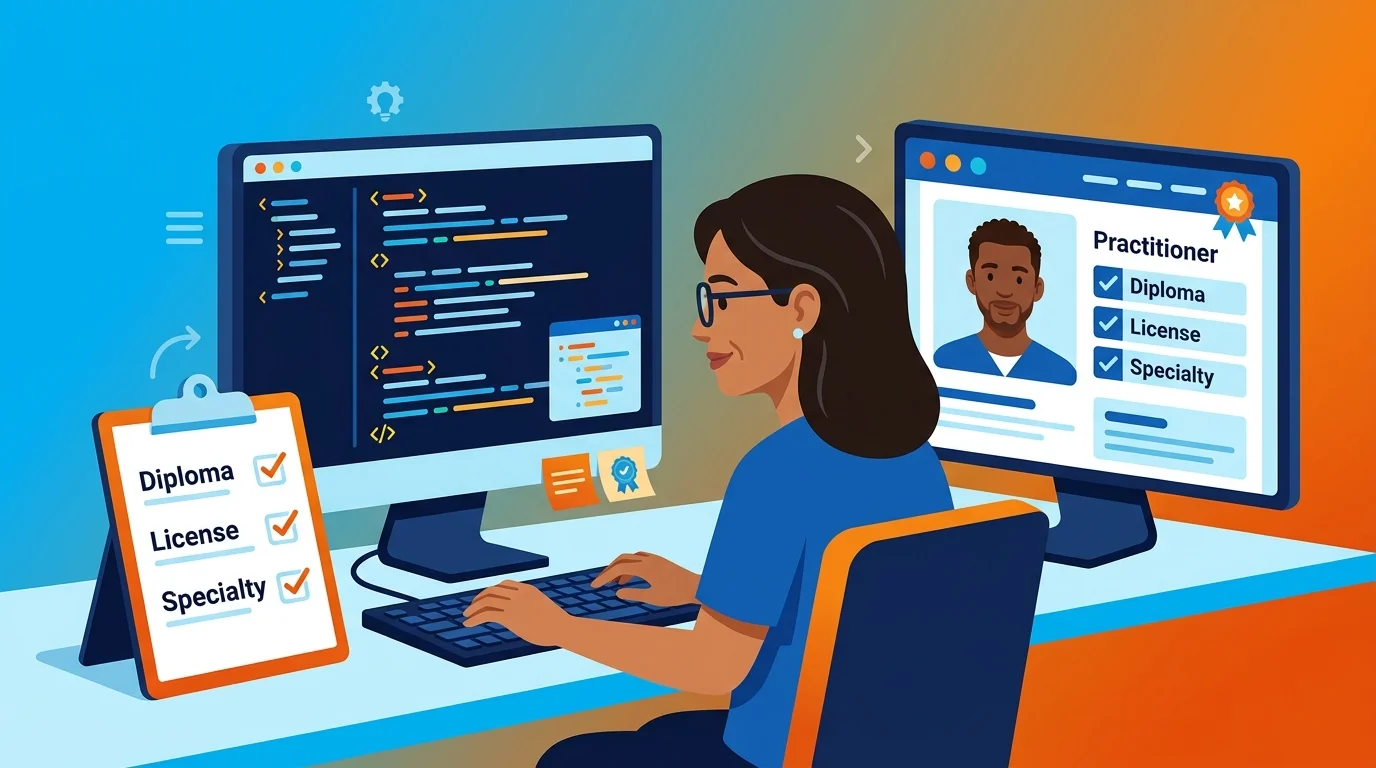
Knowing why schema works doesn't build it. Every property needs a verification source behind it, or the markup is just the same old claim wearing a different outfit.
| Implementation Step | Verification Source | Common Mistake to Avoid |
|---|---|---|
| Inventory each practitioner's credentials, licenses, and specialty terms | Licensing board record or certifying body listing, named as that body lists it | Restating a job title as a credential instead of citing the license behind it |
| Map each verified fact to the matching Schema.org property, such as hasCredential, alumniOf, or medicalSpecialty | Schema.org vocabulary documentation for property definitions and accepted formats | Choosing a free-text description field for a fact that has a dedicated structured property |
| Write the markup so every labeled fact matches the visible page text word for word | Side-by-side comparison of the rendered page against the underlying structured code | Letting the schema and the visible copy drift apart after an update to one but not the other |
| Validate the completed markup before publishing | A structured data testing tool that checks syntax and required properties | Publishing markup that passes a syntax check but still contradicts the page's visible claims |
| Revisit the markup whenever a practitioner's credentials or affiliations change | The same verification source used during initial setup, checked again at the time of the change | Treating practitioner schema as a one-time task rather than a record that needs upkeep |
Mapping Each Practitioner Property to a Verification Source
A hasCredential entry needs a license number or certifying body behind it, not a job title dressed up in schema form. An alumniOf entry needs the school's name exactly as the school lists it, and a medicalSpecialty entry needs a term that matches recognized clinical taxonomy instead of a marketing phrase. Here's the thing: each property is only as trustworthy as the record it came from.
Confirming the Markup Matches What AI Engines Actually See
Markup that contradicts the visible page text is a liability, plain and simple. An AI system comparing the two may side with the version a reader can actually see. So test the rendered page against the underlying code, because that's the only way to confirm the two still agree.
Frequently Asked Questions
Once a practice actually starts building this, the mechanical questions show up fast. Here are the ones that matter most.
What's the difference between my Google Business Profile and practitioner schema on my website?
A Google Business Profile is a listing one platform owns and displays its own way. Practitioner schema lives on the practice's own site. It labels credentials and specializations as structured fields any AI system can read directly.
How long does it take for AI engines to recognize new structured data on my site?
There is no fixed recognition window published for this. What's documented is that structured data factors into ordinary crawling and indexing, not a separate approval queue.
Will adding schema for my credentials and specializations help my practice get recommended for specific conditions?
Labeling a medicalSpecialty as a structured field gives AI a clean entity to match against a condition query. That is a stronger starting point than hoping prose text gets parsed correctly, though no source ties labeled schema to a guaranteed recommendation outcome.
Is this a one-time fix or does practitioner schema need to be updated regularly?
Treat it as maintenance, not a one-time fix. A new credential, a new specialty, or a changed institution name needs to update the markup, or the labeled record drifts out of sync with reality the same way a directory listing does.
The Bottom Line
Your website was always going to be a listing. The real question is whether AI cites that listing as a source or treats it as a rumor to double-check somewhere else. Practitioner schema is how you tip that answer your way.
Every directory gap traced above comes back to one problem: no third-party source owns the correction. Structured code fixes that by handing AI one labeled record built from your own site, instead of scraps pulled from databases that never talk to each other. That's the move from passive address to citable source.
A practitioner's expertise, credentials, and specializations deserve a verified record, not a guess stitched together from outdated listings. Checking where that record stands now is the logical next step, and it starts with an AI Visibility Check.