
Why Checking Your Own Website Isn't Verification
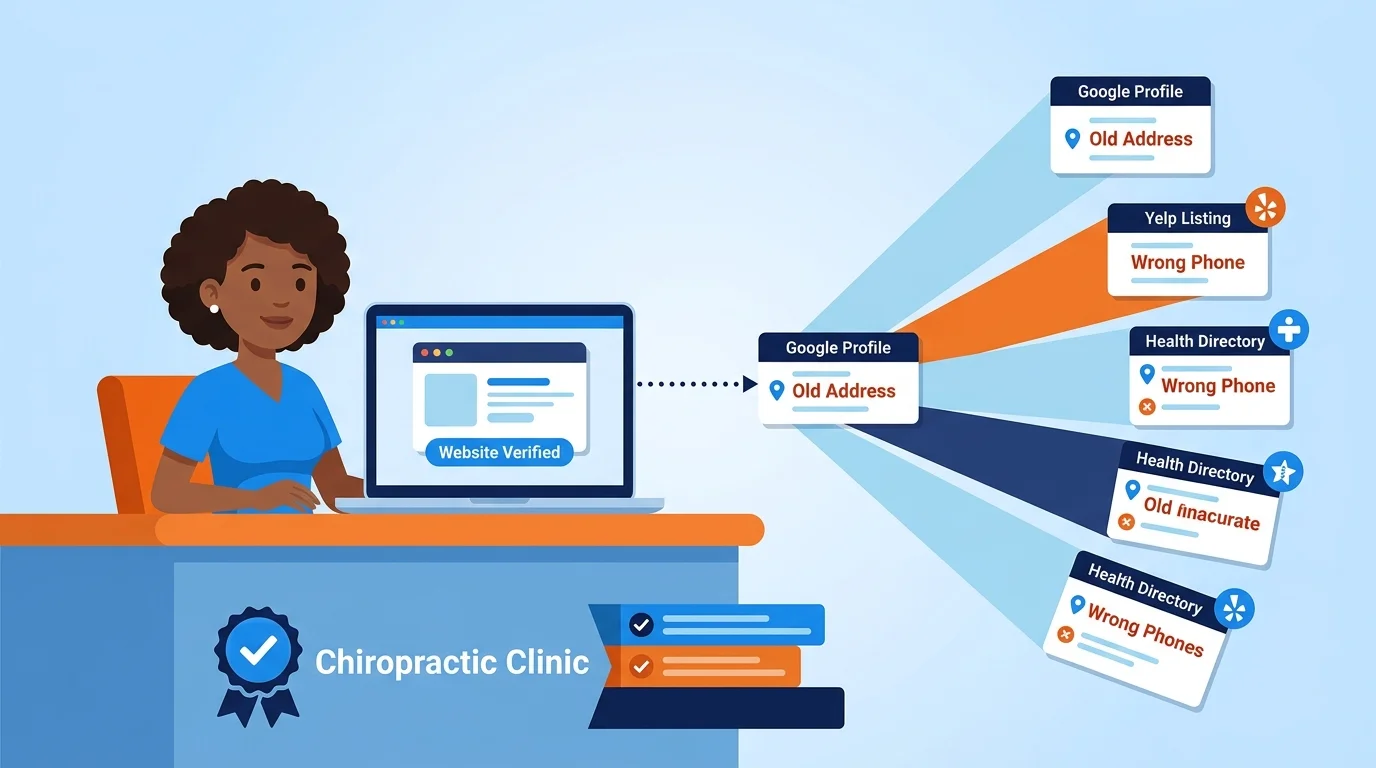
A common assumption treats one corrected listing as a solved problem. That assumption is wrong. Listing verification is the process of confirming that updated business information has not only been received but has been correctly published and syndicated across the web, and a single screen can never confirm that wider syndication.
Checking a practice's own site confirms exactly one stop in a much bigger propagation network. Treat AI visibility like traditional search optimization with new vocabulary and you'll stop at that one stop and call it done (kinda like checking one tire and calling the car inspected). That's why turning clinic listings into AI-readable entity infrastructure starts with treating the update as a signal you trace, not a field you glance at once.
The Gap Between Submitted and Published
Submitted and published are two different events, and a crawl cycle sits between them. A submitted edit can wait in line until the platform's systems come back around and accept it.
For website pages, not listing edits, Google's documentation says most sites see pages checked and indexed in about three days or more. For what that queue means on a clinic's own timeline, the breakdown on estimating the time required for listing correction walks through every variable involved.
| Stage | What Happens | Typical Signal |
|---|---|---|
| Submission | The business owner enters a corrected field into a platform's intake form or a data aggregator's portal. | A confirmation message or success screen appears immediately on the submission interface. |
| Internal Queue | The platform holds the change in a review queue, waiting for its own systems to revisit and process the edit. | No visible change on the live listing yet, even though the submission was accepted. |
| Crawl and Validation | Automated systems or human reviewers check the submitted change against the platform's existing record before accepting it. | The live listing still shows the old field, and no notice is sent to the business during this stage. |
| Publication | The platform updates its own live, publicly visible record with the corrected information. | The field changes on that specific platform when searched directly, but not yet anywhere else. |
| Syndication | Secondary directories and aggregators that source data from the primary platform pull the newly published change into their own listings. | Smaller directories and aggregator-fed sites begin to match the corrected primary record, though not all at once. |
What Counts as a Verified Listing
A verified listing is not a single confirmed field. It is agreement across every platform, aggregator, and structured data source that touches the business.
And that agreement won't hold itself in place. Business environments shift and sources drift apart. A corrected entry on one platform tells you nothing about its neighbors.
| Layer | Role in Verification | Why It Matters |
|---|---|---|
| Primary Profile | The source record a practice controls directly, where corrections are first submitted and published | Secondary directories and aggregators typically source their own data from this profile, so an error here propagates outward instead of staying contained |
| Secondary Directories and Aggregators | The wider network of platforms that redistribute business data pulled from the primary profile and from each other | A corrected primary profile means nothing to a reader or an automated system still seeing an outdated version on one of these secondary sources |
| Structured Data on the Business's Own Site | The Schema.org markup embedded on the practice's website that states its name, address, phone, hours, and category in machine-readable form | Keeping the site's markup accurate and matching the visible page is good practice, and it's the part the practice controls |
| Cross-Platform Agreement | The state where every layer above states the same information with no discrepancy between any two sources | This is the condition that satisfies verification, since any single unconfirmed layer leaves a point of conflict the network can still surface |
The Databases That Matter Most
Kaufman, Lovasi et al. (BMC Research Notes, 2015) found the mix of health-related businesses in the New York City area changed considerably over 21 years. Authority that a practice holds on its own structured data and primary profile compounds over time. Attention rented from a single confirmation screen expires the moment the next crawl cycle runs. A system built only to glance once at one source cannot track that drift, which is exactly why what a clinic name change requires across listings becomes a separate verification event rather than a footnote to the original update.
Why Directory Mismatches Survive Even After a Fix
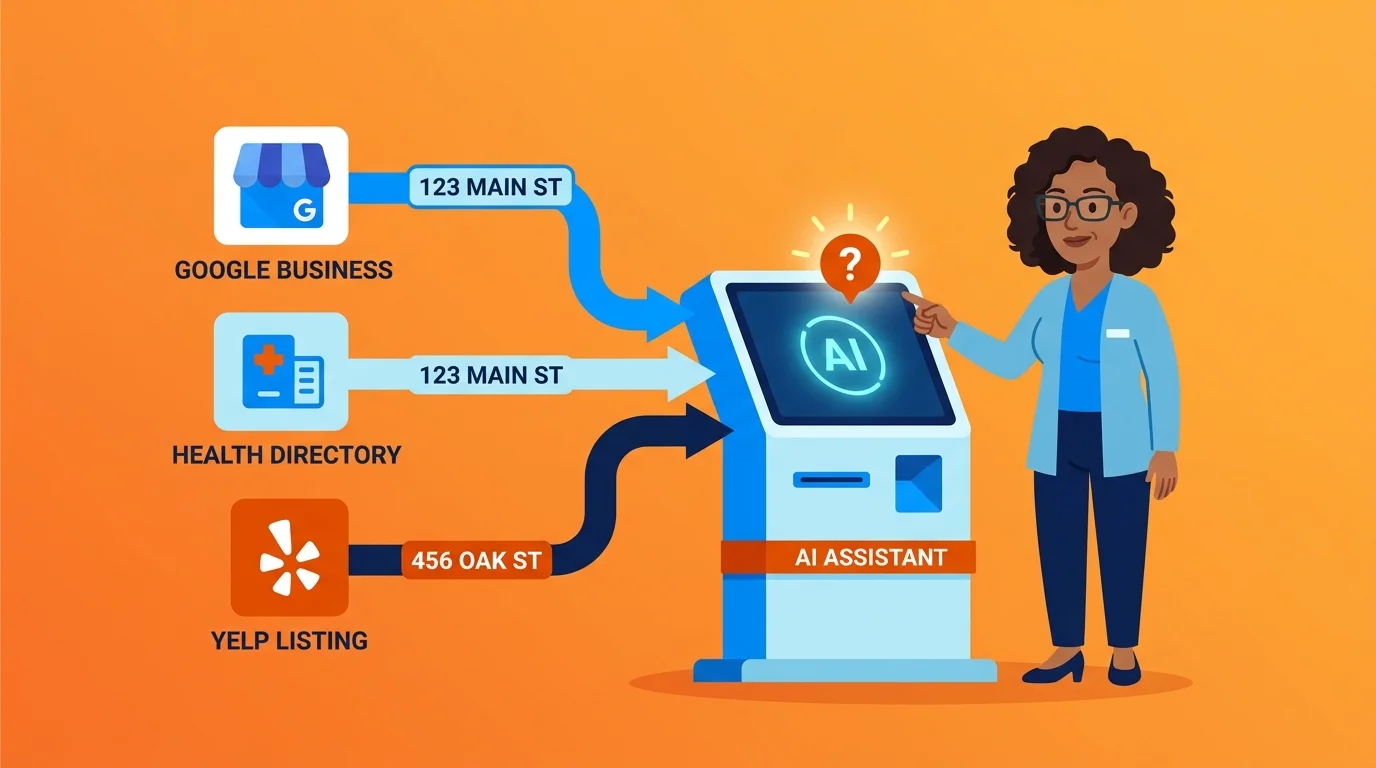
Here's the kicker: a corrected listing can sit right next to a conflicting one on the platform next door. The fix held on the one node a practice checked, but the network's a lot bigger than that node.
Manual checking treats verification as a single glance rather than an ongoing audit of a live network. That approach is attention rented from one confirmation screen, and rented attention expires the moment the next crawl cycle runs somewhere else in the network.
How Mismatched Data Confuses an AI Answer Engine
An answer engine assembling a response may not consult just one directory. It can pull from whatever sources it can retrieve, and those sources do not always agree with each other. Wang et al. (UNC Chapel Hill) found retrieved internet documents can be conflicting, noisy, and unreliable, and the Madam-RAG method addresses this by assigning each document to an independent LLM agent that generates a response based solely on that document.
That instability is a known property of retrieval-based systems generally, not a flaw unique to local business data. A practice's own structured data and primary profile are the parts it controls, which is part of what our AI search optimization services are built to maintain.
Why Two Trusted Databases Can Disagree
A 2010 study by Hoehner and Schootman (Washington University School of Medicine) found two commercial business databases agreed on only about a third of St. Louis businesses (about a quarter for health-care services).
Confirming one source correct says nothing about what a second source still shows.
A Verification Sequence That Actually Confirms a Fix
A verification sequence treats each platform as a checkpoint in a chain, not a single pass or fail event. More listings checked once is not the same as one listing checked correctly over time. The sequence that holds is the one built to revisit sources, not the one built to cover the most ground in a single sweep.
Setting a Realistic Recheck Timeline
A realistic recheck timeline respects the crawl cycle we already traced, instead of pretending one pass settles it. Your first recheck confirms the primary profile. Later rechecks catch the aggregators and directories that pull from it on their own schedule (and they're never in a hurry).
Spacing rechecks like this keeps you from reading a false negative off a platform that just hasn't come back around yet. And it keeps an early win from passing as proof the whole network caught up.
Reading Structured Data as Your Verification Layer
Google's documentation says AI Overviews and AI Mode have no additional technical requirements beyond standard Search eligibility, and that making sure structured data matches the visible text on the page is one of the SEO fundamentals worth following for appearing in AI features. Let's keep it real, that guidance makes accurate structured data the baseline, not some advanced move saved for sites already sunk deep into old-school search work.
Running the Verification Sequence Step by Step
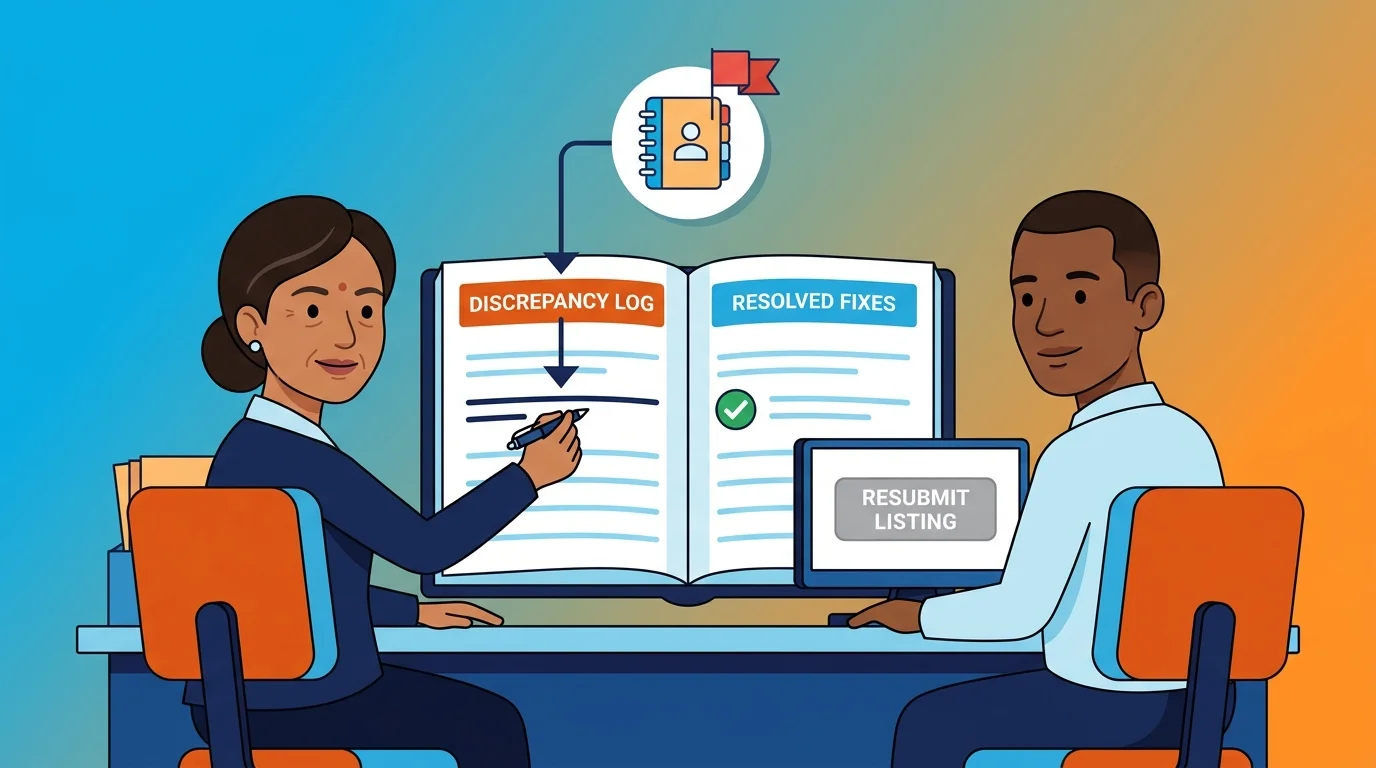
In the past, verifying a listing was as simple as checking your spot on a results page, but in the age of AI answers, the stakes are much higher. The sequence below turns that bigger stakes problem into an ordered checklist. Each step confirms one layer of the network before moving to the next.
| Step | Action | Check Before Proceeding |
|---|---|---|
| Confirm the primary profile | Check the business name, address, phone number, hours, and category against the corrected submission | All fields match the intended correction with no partial updates left in place |
| Check the major aggregators and directories | Compare each platform's listing against the primary profile rather than against memory of the old listing | Each source reflects the same corrected details, not just an acknowledgment that an edit was received |
| Cross-check structured data on the practice's own site | Confirm the Schema.org markup matches the visible, updated text on the page | The structured data and the visible page agree, with no leftover reference to the prior information |
| Log any discrepancy found | Record the platform, the exact field, and the gap between what it shows and what it should show | The discrepancy is documented before any resubmission is attempted |
| Schedule a recheck on a realistic interval | Revisit the primary profile first, then the aggregators that draw from it on their own schedule | Enough time has passed for the platform's own crawl cycle to have run at least once |
Logging Discrepancies Before You Resubmit
Found a mismatch mid-sequence? Log it before you resubmit anything: the platform, the exact field, and what it shows versus what it should show. Resubmit first and you've wiped out the evidence you need to prove whether the next fix actually held.
Frequently Asked Questions
The sequence above covers the ordered checklist. Some edge cases fall outside that order and deserve a direct answer on their own.
How long should I wait after an update before I check if my listings are fixed?
Crawl cycles, not calendar days, decide when a check is meaningful. Wait past the window the platform itself cites before reading a check as final, and treat an early recheck only as a status update, not a verdict.
What tools can I use to check multiple listings at once?
This article does not endorse a specific named tool for checking listings at scale. Any tool chosen should check the primary profile, the major aggregators, and structured data together, since a single-source checker only confirms one node in the network.
If one directory is correct but another is wrong, which one do search engines believe?
No single directory wins by default. An answer engine can pull from whatever sources it can retrieve.
Can incorrect information on a minor directory really affect my visibility in AI Overviews?
It can. Agreement between major commercial databases runs low, so a minor directory holding outdated information is not a rounding error.
What's the first thing I should do if my verified listing reverts to old information?
Log the exact field and platform before you resubmit anything. Reverting data usually points to a sync conflict with another source feeding that platform. It's rarely a random glitch.
Does structured data on my website override what directories report?
Structured data does not override a directory by force. Keeping the site's markup accurate and matching the visible page is good practice, and it's the part the practice controls.
The Bottom Line
Here's the thing: a listing update was never a field you change on one screen. It's a signal you send into a propagation network, and verification means tracing that signal across every platform it touches.
Checking a rank never answered that question. Confirming data integrity across a primary profile, its aggregators, and a practice's own structured data does.
That confirmed consistency can help an answer engine cite a practice as the ground truth, rather than one conflicting voice among many. Owning that verified position is worth more than chasing a rank ever was, and a structured AI Visibility Check is where tracing that signal starts.