
When patients were asked which part of Google they trust most when researching a doctor, AI Overviews came out on top at 37%. That was well ahead of organic results (the regular blue links) at 20%, the local map pack at 13%, and sponsored results at 7%. In a preregistered, randomized experiment with a large group of people that represents the U.S. population, people trusted generative AI (GenAI) search less than traditional search on average. Still, reference links and citations significantly increase trust in GenAI, even when those links and citations are incorrect or hallucinated (made up).
Where Patients Place Their Trust on a Google Results Page
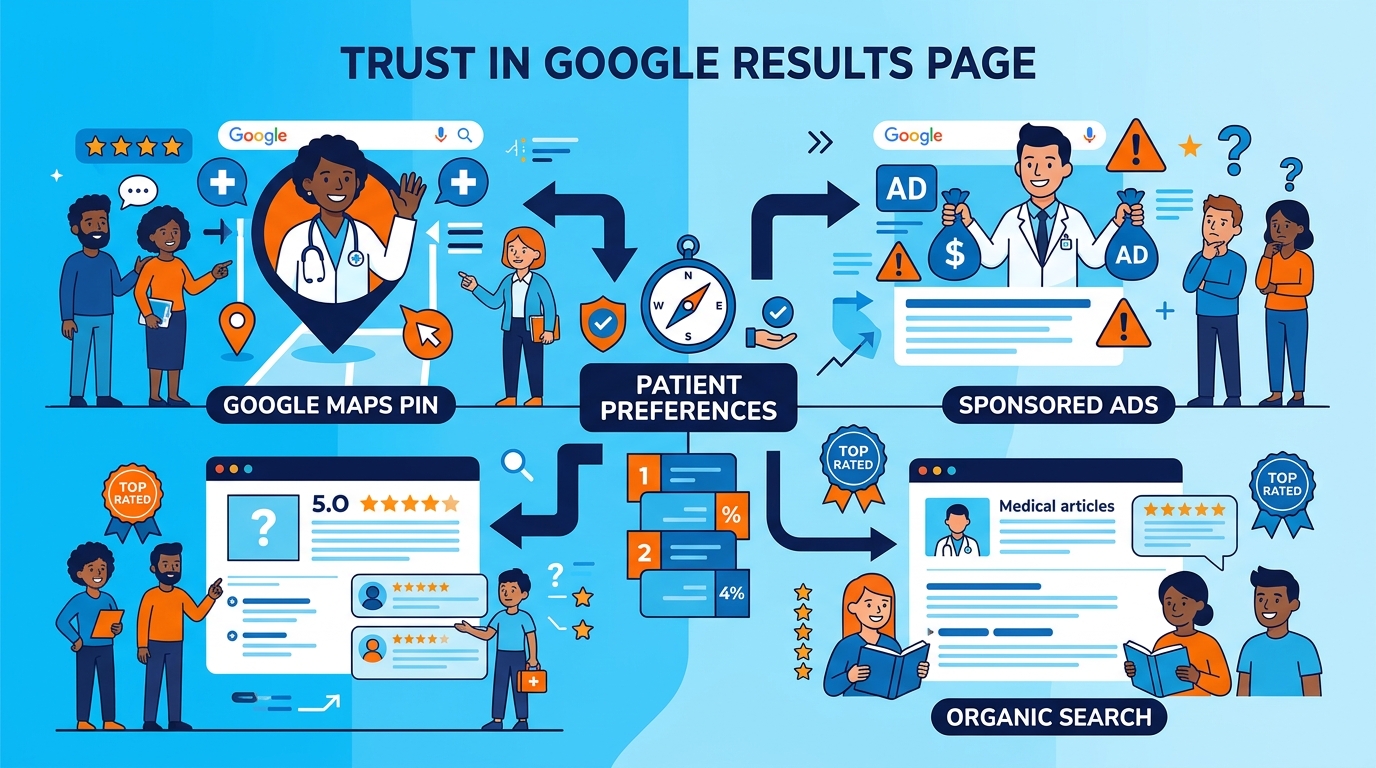
Here’s the thing. Patients were asked which part of Google they trust most when researching a doctor, and AI Overviews came out on top at 37%. Organic results, the regular blue links, came next at 20%. The local map pack got 13%. Sponsored results got 7%.
The table shows the full split.
| Results section | Share who trust it most |
|---|---|
| AI Overviews | 37% |
| Organic results | 20% |
| Local map pack | 13% |
| Sponsored results | 7% |
The paid slot sits at the bottom of that list.
I’d rather your practice be the source an AI names and draws on than one more name in a list of businesses. I go after being relied on, not just being present. iTech Valet’s AI Visibility Check looks at how artificial intelligence (AI) answers treat your practice.
Why Shoppers Treat Sponsored Listings With Suspicion
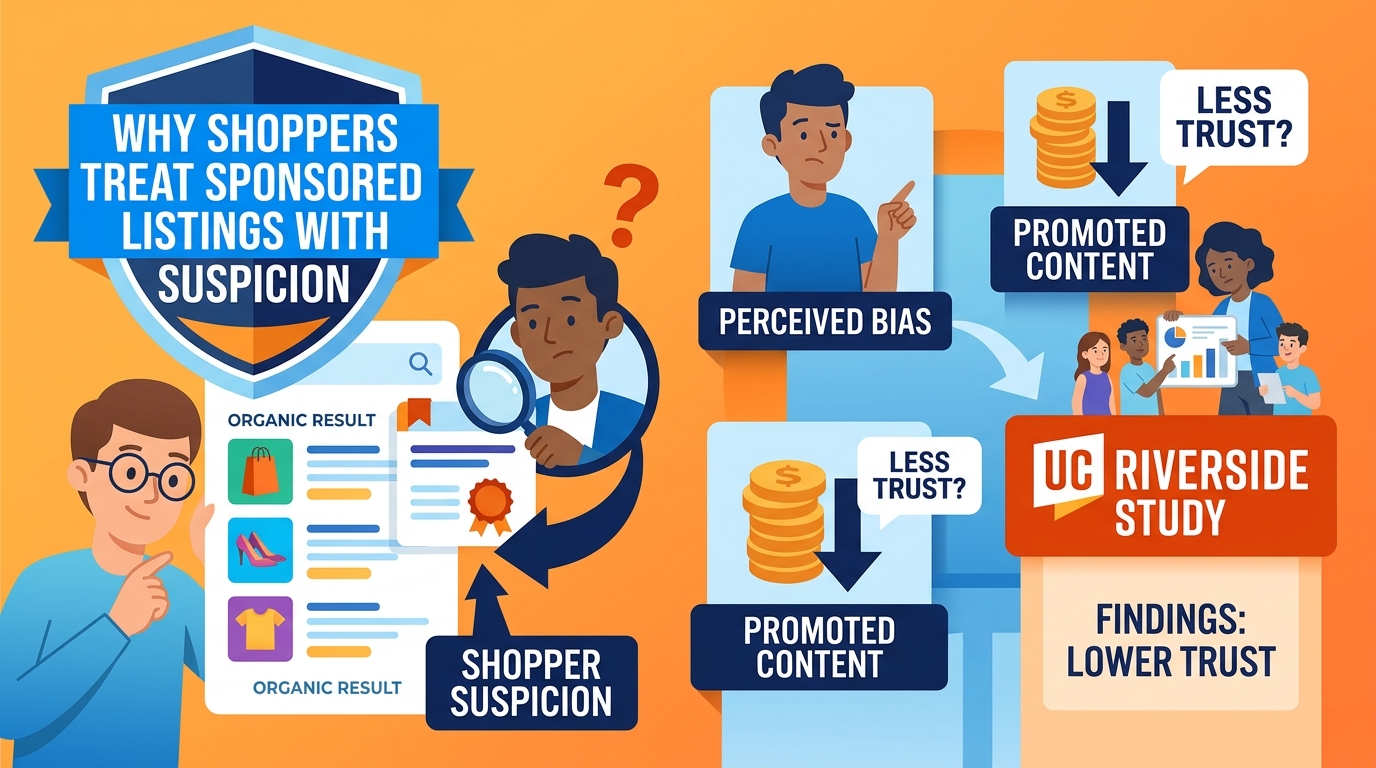
A study led by the University of California, Riverside found that shoppers tend to look at sponsored listings with suspicion. They often prefer to click listings that show up high in their product search results without being sponsored. Those are called organic listings.
It gets worse for the seller. The study found a sponsored listing can hurt you when it takes the place of your organic listing that would have shown up in the top few spots. In those cases, shoppers are more likely to click and buy the same product when it shows up as an organic listing.
The lead author, Joo, said high-ranking organic listings come with a sense of a third-party stamp of approval. Shoppers see the platform’s algorithms that rank seller listings as a credible evaluator.
The study also looked at products that lead to later experiences with the user, such as consumer electronics. For those, shoppers prefer to buy from a source they trust. That means the highly ranked organic listing.
So I put your effort into what you own: clear, credible information about your practice. That kind of visibility is what I count on to keep paying and to grow over time. I don’t rent visibility through ads that stops the day the spending stops. I make the same case when I compare older paid media with AI recommendations in Newspaper Ads vs. AI Recommendations: Where New Patients Actually Come From.
The research comes from Online consumers shy away from sponsored product listings at UC Riverside News.
How Many Adults Ask AI About Their Health, and What They Do Next
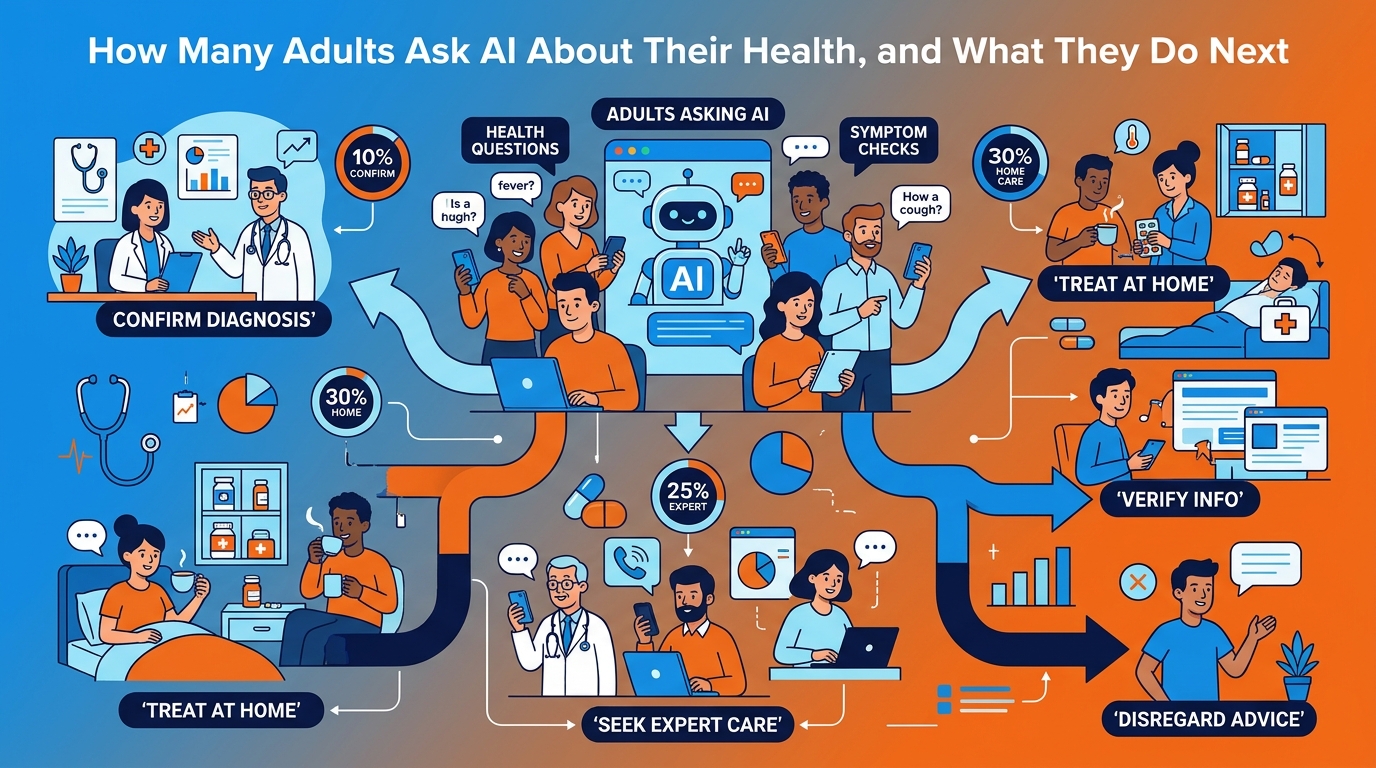
KFF’s latest Tracking Poll on Health Information and Trust finds about a third (32%) of adults are turning to AI for health information and advice. That includes about 3 in 10 (29%) who say they used AI tools in the past year for information or advice about their physical health.
They haven’t left the old sources behind, though. In the past year, large shares of people looked for physical or mental health information and advice from a health care professional (80%) or from an internet search engine (68%).
Here is what people used AI for in the past year on physical health:
- About 1 in 4 adults (27%) looked up symptoms or general information about health conditions.
- About 1 in 5 (19%) used it to understand and compare treatment options.
- About 1 in 6 (16%) used it to help decide whether to see a doctor or seek medical care.
And here’s where you come in. About 6 in 10 adults (58%) who used AI for physical health advice in the past year say they later followed up with a doctor or health care provider after consulting an AI tool.
Why do they use it? Most people who use AI for health (65%) say wanting quick or immediate information or support is a “major reason.” Many give other major reasons too. One is wanting to look up information before deciding whether to see a provider (41%).
The numbers come from KFF Tracking Poll: Use of AI For Health Information and Advice.
What Raises Trust in an AI Answer
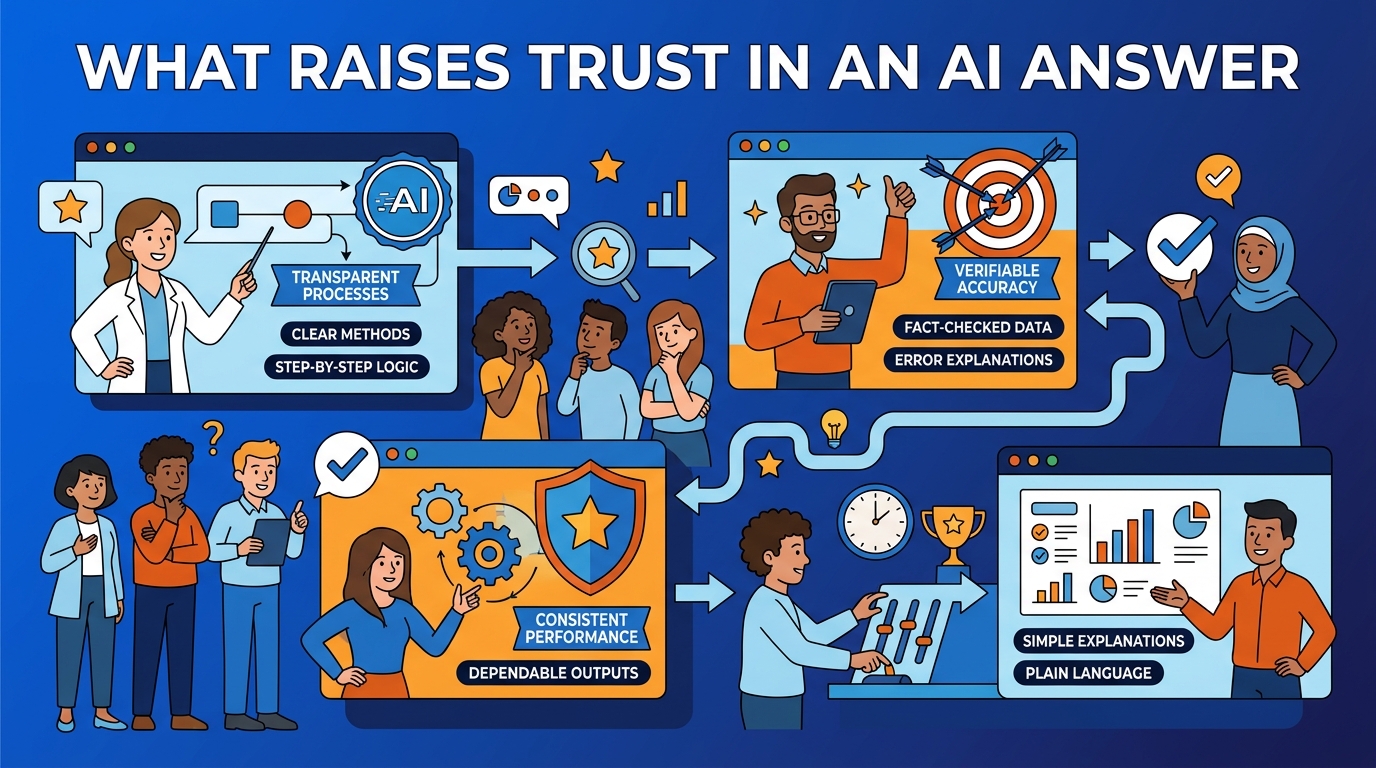
A preregistered, randomized experiment used a large study sample representative of the U.S. population. On average, people trusted generative AI (GenAI) search less than traditional search. Still, reference links and citations significantly increase trust in GenAI. That holds even when those links and citations are incorrect or hallucinated, meaning made up.
Trust predicts what people do. People who trust GenAI more click more, and they spend less time checking the results.
People were also asked how important different factors are when deciding whether information is factual. Explaining how the information was gathered ranked highest. Seven in ten (71%) said it was “extremely” or “very” important. That finding is part of the KFF Women’s Health Survey: trusted sources of information.
At least 6 in 10 adults who have used AI for advice about their physical or mental health say they trust AI tools “a great deal” or “a fair amount” to provide reliable information. That’s 69% for health and 62% for mental health. Among adults who have not used AI for physical health advice, trust in AI for health information drops to about 1 in 5 (18%).
I don’t publish for volume, and I don’t believe frequency wins a recommendation. I write for an AI that has to grasp your information easily. I’d take one clear, factual page that shows its sources and runs in a sensible order over a pile of posts.
Doctors Remain the Most Trusted Source
Doctors and other health care providers are the public’s most trusted source of health information. That’s what polling finds. Trust in government health agencies and officials is much more divided.
Look at KFF’s 2026 Women’s Health Survey. More than eight in ten reproductive-age women (86%) said they trust health care providers “a great deal” or “a fair amount” for reliable information. Only a quarter (25%) said the same about artificial intelligence (AI) tools and chatbots. And fewer still (15%) said it about social media and social media influencers.
The table lays out those three numbers.
| Source | Share who trust it “a great deal” or “a fair amount” |
|---|---|
| Health care providers | 86% |
| AI tools and chatbots | 25% |
| Social media and social media influencers | 15% |
A majority of reproductive-age women (87%) report looking for health information or advice online through internet search engines, social media, or AI tools.
Influencers don’t get the same pull on health that they get elsewhere. Among social media users, 4 in 10 say they regularly get news and politics information from social media influencers. But far fewer (15%) say they turn to influencers for health information and advice. And across social media platforms, fewer than half of users say they find at least “some” of the health information they see there to be trustworthy.
Want more trust data? It’s on the KFF Health Information and Trust Polling Dashboard.
Where Trust in AI Health Answers Runs Ahead of Accuracy
One study found that between half (50%) and nine out of ten (90%) large language model (LLM) answers are not fully supported by the sources they cite. Sometimes those sources flat-out contradict the answer.
Google says that for topics like news and health, it already has strong guardrails (protections) in place.
A KFF Health Misinformation Tracking Poll finds that most of the public (63%), including most AI users (56%), are not confident that AI chatbots provide accurate health information.
Trust depends on the topic. Most AI users say they trust chatbots’ answers about practical tasks (66%) and technology (61%) at least a fair amount. Far fewer say so about answers on health (36%) and politics (24%).
When asked about AI chatbots generally, most of the public (56%) say they are not confident they can tell what information in the responses is true and what is false.
So what makes people see information as factual? People were asked how likely various qualities would make them to consider information factual. Being based in data ranked highest. Six in ten (60%) said that would make them “extremely” or “very” likely to consider it factual.
The poll is here: Poll: Most Who Use AI Doubt AI Chatbots Provide Accurate Health Information.
What Patients See in Google’s AI Summaries
In Pew Research Center’s study, about 6 in 10 people (58%) did at least one Google search in March 2025 that produced a summary written by AI. Count by searches instead of people, and 18% of all the Google searches in the study generated one.
So which searches trigger a summary?
- Just 8% of one- or two-word searches resulted in an AI summary. For searches with 10 words or more, that share rose to 53%.
- Six in ten (60%) search queries that began with question words such as “who,” “what,” “when” or “why” resulted in an AI summary.
What do the summaries draw on? The vast majority (88%) cited three or more sources. And some 6% of the sources linked in AI overviews were .gov websites, compared with just 2% for standard search results.
How do sessions end? People ended their browsing session on 26% of pages with an AI summary, compared with 16% of pages with only traditional search results. Google users who encountered a summary also rarely clicked a link in the summary itself. That happened in just 1% of all visits to pages with such a summary.
I treat getting picked by AI answer tools as its own discipline. It’s not classic search work with a new name. I don’t chase keywords, inbound links or ranking position, because that aims at the wrong target. These systems are trying to work out who a company is and whether it’s credible. So I put the work into making that easy for them to read. For how assistant answers connect to bookings, I wrote How Assistant Answers Impact Bookings: A Complete Guide.
The figures come from Pew’s Google users are less likely to click on links when an AI summary appears.
Frequently Asked Questions
Does paying for a sponsored placement ever pay off?
It can. The UC Riverside study found that sponsorships can pay off when a seller’s listing shows up far down in the shopper’s product search results on its own and may not be seen often.
How satisfied are people with AI health answers?
Mostly satisfied, but not thrilled. Large majorities say they were at least “somewhat satisfied” with the quality of the answers they got about their physical health (92%) or mental health (85%). But relatively small shares say they were “very satisfied”: 19% for physical health and 27% for mental health.
How often do adults run into AI-generated content?
Often. Overall, 4 in 10 adults (39%) say they actively use AI tools at least several times a week. Eight in 10 say they come across AI-generated content at least several times a week, even if they are not actively looking for it.
Do people think AI health information is as reliable as a provider’s?
Some do. About 1 in 5 people who use artificial intelligence (AI) for health (18%) say a “major reason” was that they felt the information was as reliable as what a health care provider would tell them. Most users (65%) say this was at least a “minor reason.” Watch the difference. The 18% counts only a major reason. The 65% counts a minor reason or more.
Which sites do Google’s AI summaries cite most?
In Pew’s study, Wikipedia, YouTube and Reddit collectively accounted for 15% of the sources listed in the AI summaries examined. They made up a similar share (17%) of the sources listed in standard search results.
Patients Put the Answer Ahead of the Paid Slot
Patients were asked which part of Google they trust most when researching a doctor. AI Overviews came out on top at 37%. Organic results (the regular blue links) had 20%. The local map pack had 13%. Sponsored results had 7%.
Patients put the answer at the top of the page ahead of the paid slot. So that trust has to be earned with clear, citable information. I explain how the work is done on the iTech Valet Service Plans & Pricing page. To see how AI answers treat your practice today, Run My AI Visibility Check.