
Google says no one can guarantee a #1 ranking on Google. It warns people to beware of search optimization providers who claim to guarantee rankings, allege a “special relationship” with Google, or advertise a “priority submit” to Google. Google also says advertising with Google won’t have any effect on your site’s presence in its search results. If a search optimization provider creates deceptive or misleading content on your behalf, Google says your site could be removed entirely from Google’s index. Ultimately, it says, you are responsible for the actions of any companies you hire.
No One Can Guarantee a Top Google Spot
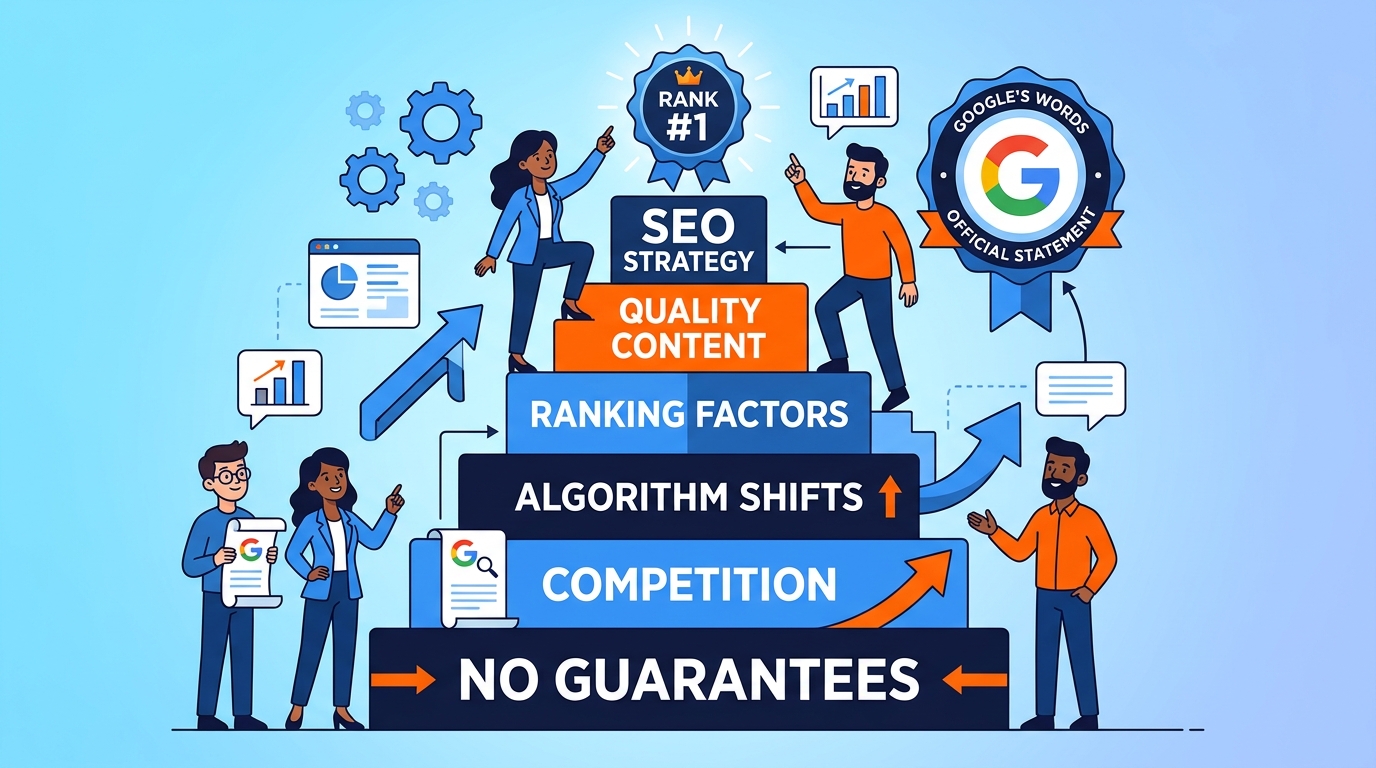
Google’s own words are plain: “No one can guarantee a #1 ranking on Google. Beware of SEOs that claim to guarantee rankings, allege a “special relationship” with Google, or advertise a “priority submit” to Google.” SEOs here means search engine optimization providers. That comes from Google’s page Do you need an SEO?
The same page also says, “Many SEOs and other agencies and consultants provide useful services for website owners.”
So here’s where I land. I walk past any cheap monthly deal sold on guaranteed results. To me it only looks like a bargain. I count it as thin work, little real progress, and your money tied up in a contract that builds nothing.
When an agency still sells you the old search playbook, I hold the industry’s offer responsible, not you as the buyer. The conditions that playbook relied on have changed. I won’t charge you for tactics aimed at a landscape that’s gone.
Paid Ads Sit Apart From Organic Results
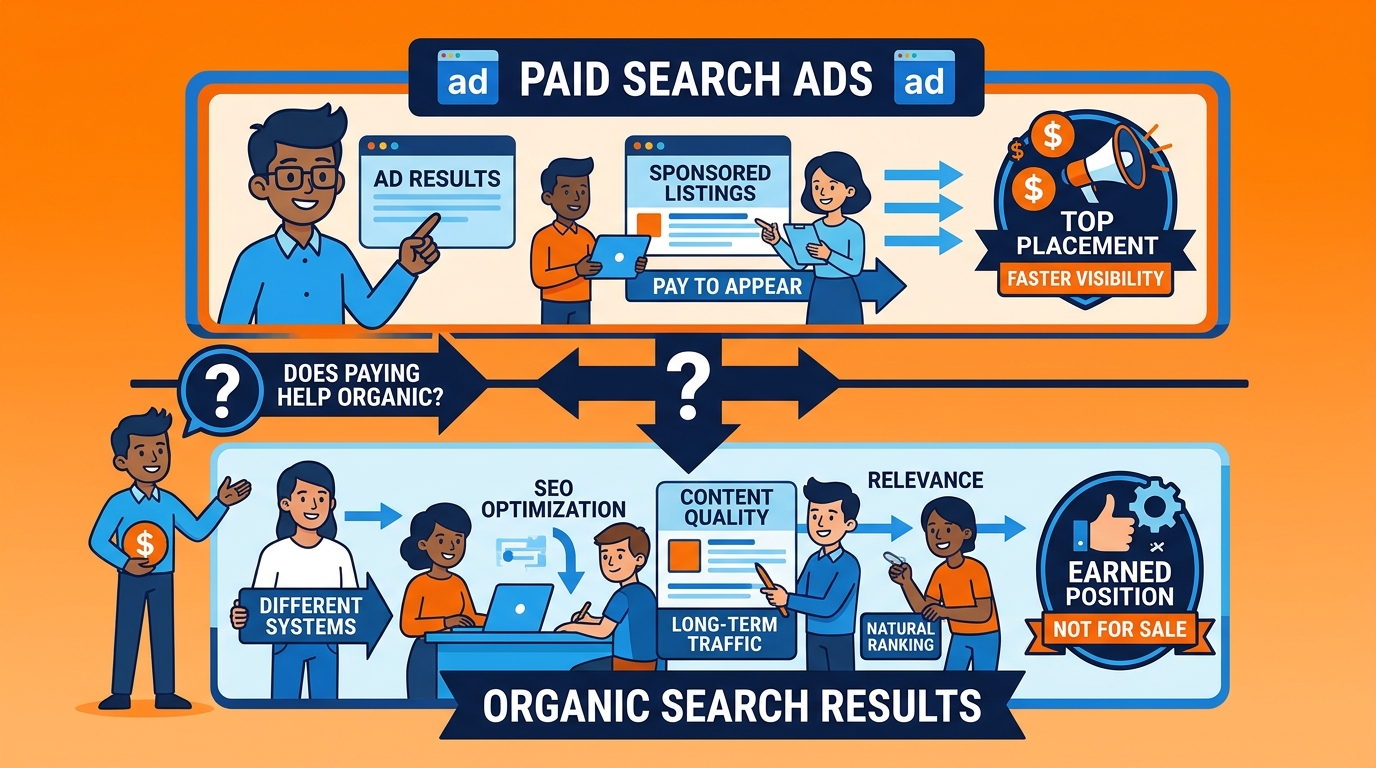
Can paying Google buy you a better spot in the regular, unpaid results? Google says no: “Advertising with Google won’t have any effect on your site’s presence in our search results.” It adds, “Google never accepts money to include or rank sites in our search results, and it costs nothing to appear in our organic search results.” Both lines are on Do you need an SEO?
Search Engine Journal looked at the same question in Is Your Usage Of Google Ads An Organic Search Ranking Factor? Its answer: “This one is clear: Google does not use Google Ads as a search ranking signal.”
John Mueller of Google, quoted by Search Engine Journal, said: “…these systems are completely separate on our side. The ranking within the ads, the ranking within search are completely separate systems and there’s essentially no real connection there.”
There’s one catch, and Search Engine Journal spells it out: “So while buying an ad isn’t an organic search ranking factor, Google’s ads absolutely can impact the visibility and placement of your site on the SERPs.” SERPs are search engine results pages, the pages of results Google shows.
| What is paid for | What Google and observers say |
|---|---|
| Advertising with Google | Won’t have any effect on a site’s presence in Google’s search results |
| Being included or ranked in results | Google never accepts money to include or rank sites; it costs nothing to appear in organic results |
| Ads ranking vs. search ranking | Completely separate systems with essentially no real connection |
| Ads as a ranking signal | Google does not use Google Ads as a search ranking signal |
| Ads on the results page | Can impact a site’s visibility and placement on the SERPs |
Here’s where I’d put your effort and your money: visibility built on assets you control. That means clear, credible information about your practice. I’d back that over paid placement every time. Owned visibility keeps paying off and grows, while paid placement stops the moment the spending stops.
What Marketing Can Claim About Results
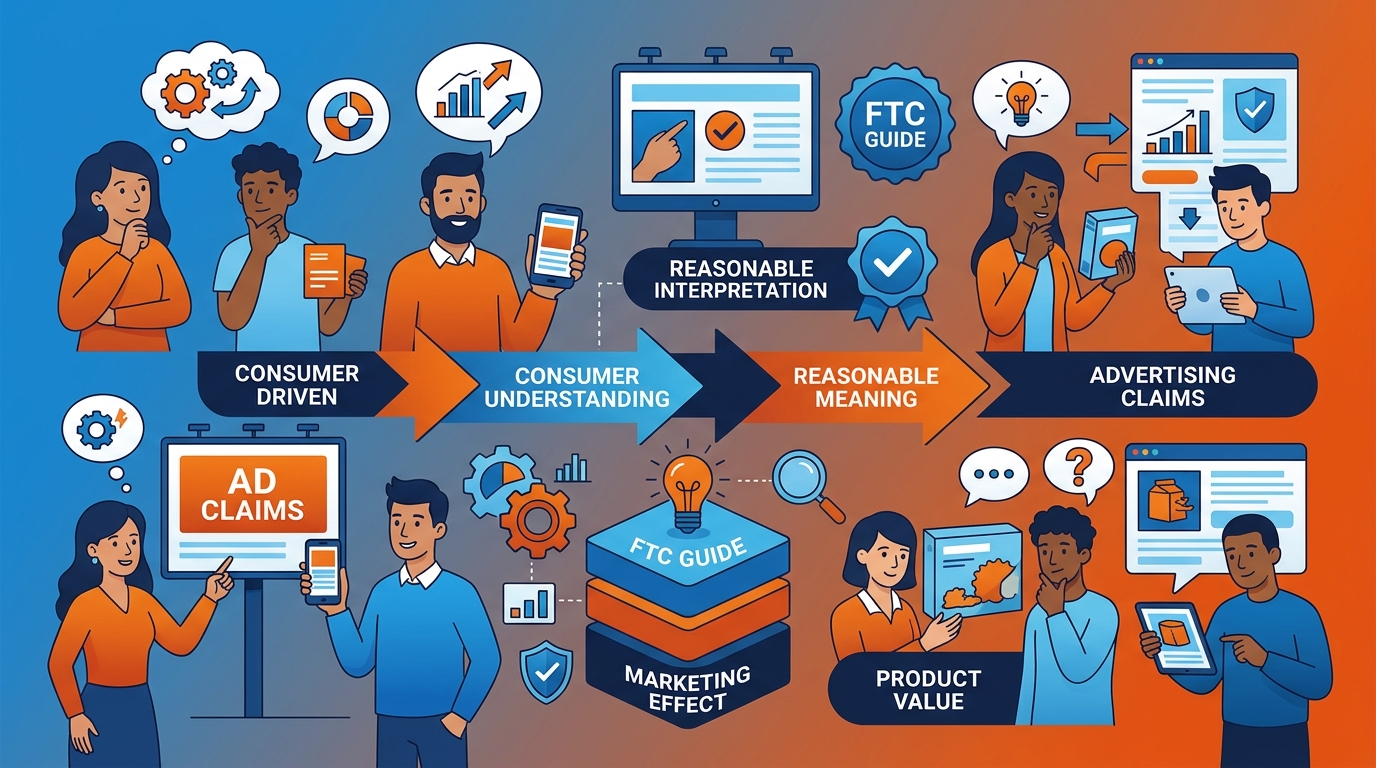
The Federal Trade Commission (FTC) says: “The determination of what claims are made in marketing is consumer-driven – in other words, what reasonable consumers understand the advertising or marketing materials to communicate about the product.”
The FTC also says, “Before a company runs an ad, it has to have a “reasonable basis” for the claims.”
The advertiser isn’t the only one on the hook. The FTC says, “In addition to the advertiser, the advertising agency also may be held legally responsible for misleading claims in ads. Advertising agencies have a duty to make an independent check on the information used to substantiate ad claims. They may not rely on an advertiser’s assurance that the claims are substantiated.”
Health claims carry their own requirement. The FTC says, “As a general rule, however, claims about the health benefits or safety of foods, dietary supplements, drugs, and other health-related products require substantiation in the form of competent and reliable scientific evidence.”
Reviews and testimonials get their own FTC rule too. It’s announced in FTC Announces Final Rule Banning Fake Reviews and Testimonials.
Review Rules the Practice Must Follow
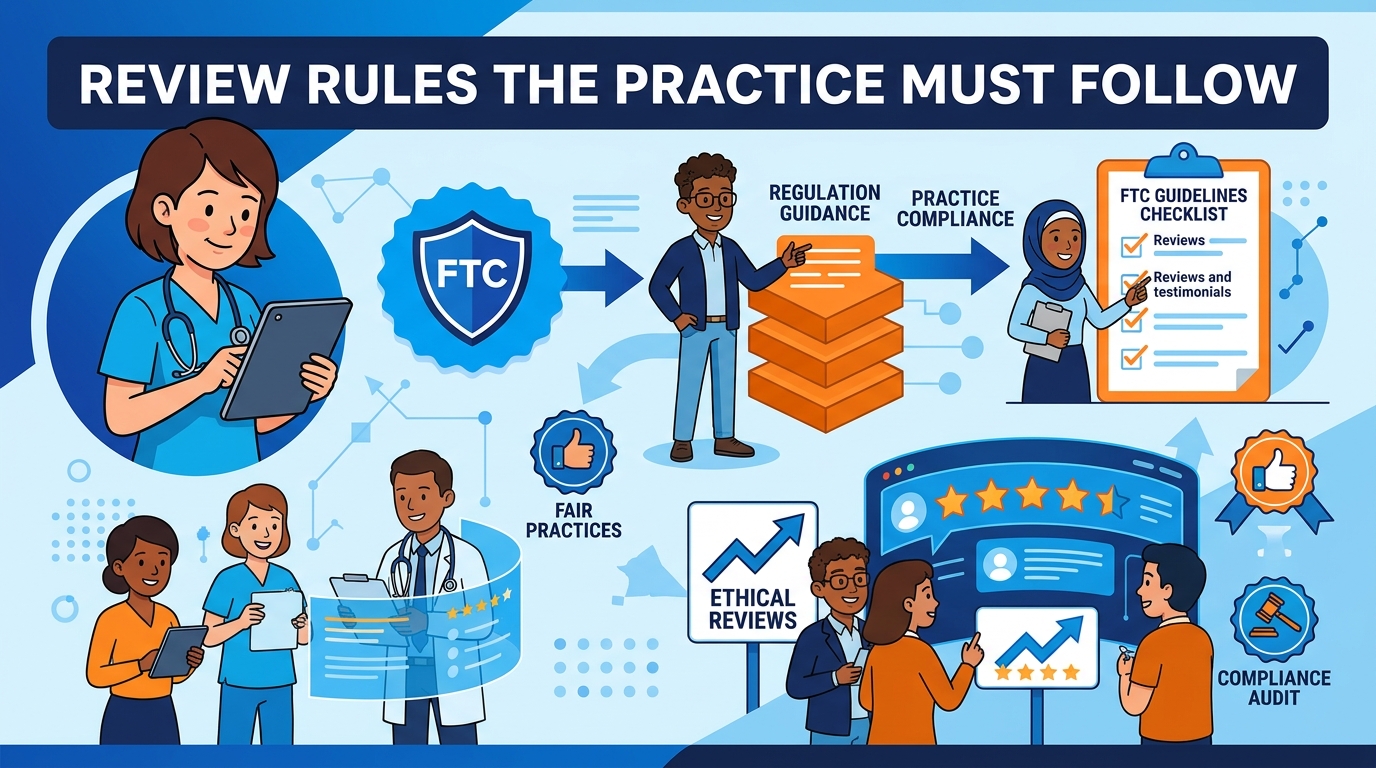
Here’s what the Federal Trade Commission (FTC) did. Its press release, FTC Announces Final Rule Banning Fake Reviews and Testimonials, says the final rule will “combat fake reviews and testimonials by prohibiting their sale or purchase and allow the agency to seek civil penalties against knowing violators.” Civil penalties are fines. And they’re aimed at people who break the rule knowingly.
What the rule bans
- Pay for a certain sentiment. The rule “prohibits businesses from providing compensation or other incentives conditioned on the writing of consumer reviews expressing a particular sentiment, either positive or negative.” You can’t pay for a feeling.
- Threats against bad reviews. It “prohibits a business from using unfounded or groundless legal threats, physical threats, intimidation, or certain false public accusations to prevent or remove a negative consumer review.”
- Fake social media influence. It “prohibits anyone from selling or buying fake indicators of social media influence, such as followers or views generated by a bot or hijacked account.” A bot is a computer program.
- Suppressing bad reviews. Morgan Lewis, in FTC Issues Final Rule on Consumer Reviews and Testimonials, says the rule “prohibits businesses from attempting to suppress negative or unfavorable reviews, except in limited circumstances.”
- Undisclosed ties. Morgan Lewis also says an officer or manager of a business may not write or create a consumer review or consumer testimonial about the business, or its products or services, without clearly and conspicuously disclosing their “material relationship to the business.” In plain terms, if you or your manager write a review of your own practice, you have to say plainly and obviously who you are.
What breaking the rule can cost
Alston & Bird, in FTC Issues Final Rule on Fake Reviews and Testimonials, says the rule “gives the FTC authority to pursue significant monetary penalties against violators – currently $51,744 per violation – as well as consumer redress.”
That’s fifty-one thousand, seven hundred forty-four dollars per violation. Consumer redress means making things right for consumers.
When a third party handles reviews
Alston & Bird adds, “If a company uses a third party, it is important to understand the third party’s processes as well.” So if an outside company handles reviews for your practice, you need to know how that company works too.
HIPAA Marketing Rules Apply to the Practice
The U.S. Department of Health & Human Services (HHS) sets out the rule in Marketing (HIPAA Privacy Rule guidance). HIPAA stands for the Health Insurance Portability and Accountability Act.
When marketing needs authorization
HHS says, “The Privacy Rule defines “marketing” as making “a communication about a product or service that encourages recipients of the communication to purchase or use the product or service.” Generally, if the communication is “marketing,” then the communication can occur only if the covered entity first obtains an individual’s “authorization.””
A covered entity is a health care provider or plan covered by the rule. Authorization is permission. So if a message is marketing, get the person’s permission first.
Selling patient lists
HHS says, “Simply put, a covered entity may not sell protected health information to a business associate or any other third party for that party’s own purposes. Moreover, covered entities may not sell lists of patients or enrollees to third parties without obtaining authorization from each person on the list.”
Each person on the list. Not one blanket okay.
The exceptions
HHS says, “A communication does not require an authorization, even if it is marketing, if it is in the form of a face-to-face communication made by a covered entity to an individual; or a promotional gift of nominal value provided by the covered entity.” Nominal means very small.
The Practice Answers for Anyone It Hires
Google puts the duty on you, the site owner. On Do you need an SEO? it talks about search engine optimization (SEO) providers and says, “If an SEO creates deceptive or misleading content on your behalf, your site could be removed entirely from Google’s index. Ultimately, you are responsible for the actions of any companies you hire.”
Removed entirely from Google’s list of sites. And the responsibility is yours.
Google also gives a rule for audits: “If your SEO offers to do an SEO audit for you, be sure to carefully consider what’s involved and only grant read access to Search Console (at this stage, don’t grant them write access).” Read access only.
What your practice keeps once the work is done is set out in What a Clinic Owns After an Authority Engine Install, and What Decides It. How the work is done is explained on iTech Valet Service Plans & Pricing.
Frequently Asked Questions
Where can a practice report a provider’s deceptive practices?
The Federal Trade Commission (FTC). Google notes that in the United States, the FTC handles complaints about deceptive or unfair business practices.
Does the FTC rule ban using AI around reviews?
No. The use of generative artificial intelligence (AI), the kind that writes text, is not prohibited. But if you use it, take steps to make sure your AI is not generating fake reviews or improperly suppressing negative reviews.
Can a practice offer a discount for leaving a review?
Yes, but not one tied to a five-star review. Offering customers $5 off a future purchase in exchange for a product review is not inherently unlawful. Offering $5 off a future purchase in exchange for a five-star review, or the equivalent, is unlawful.
When did the FTC review rule take effect?
The final rule was published in the Federal Register, the government’s official daily record of rules, on August 22, 2024. It went into effect on October 21.
Do review sites have to check that reviews are real?
No, not platforms that simply publish consumer reviews. The FTC rule does not require them to verify that the reviews are true.
Authority Work Is Inputs, Not Promised Results
Inside these limits, I describe authority-building as the work we put in, not as a promised result. iTech Valet builds AI Authority for local service businesses, chiropractic practices first, through its Local and National AI Authority Engines, AI Authority articles and Authority Infrastructure. We serve the whole country, mainly the United States, and we can also serve other English-speaking countries. There is no local targeting by place-based searches.
The AI Visibility Check is free and diagnostic, and it does not sell. Want to see what AI engines find when they look at your practice? Run My AI Visibility Check.