
A Swedish study of maintenance care (ongoing check-up care) in chiropractic found four factors that get in the way: cost that is demanding, a sense of low value, care seen as unavailable, and fear of treatment. California’s Board of Chiropractic Examiners says the chiropractor should end the first visit by recommending a treatment plan made just for the patient, saying how long the care is expected to last, and going over costs and payment plan options. Premera Blue Cross, one Washington insurer, lists the frequency and duration of visits and an anticipated date of discharge to self-care as parts of a plan of treatment. A trial found maintenance care did better than treatment based only on symptoms, with fewer total days of bothersome pain over 52 weeks, but with more treatment visits on average.
The Worries Patients Bring: Cost, Value, Visit Count and Fear of Treatment
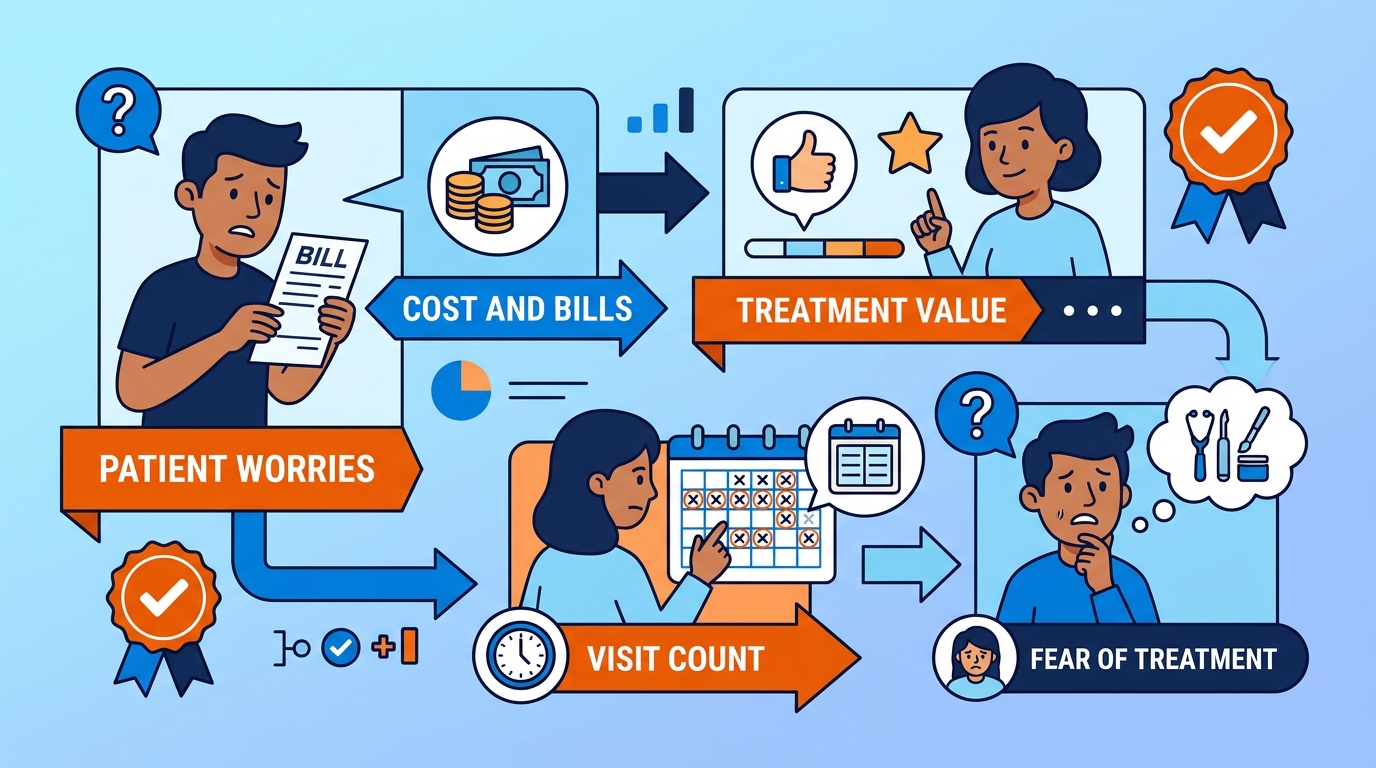
Start with what patients are up against. A study in Sweden looked at maintenance care in chiropractic, the ongoing check-up kind. It found four things standing in the way: cost that is demanding, a sense of low value, care seen as unavailable, and fear of treatment. The study is The Nordic maintenance care program: patient experience of maintenance care—a qualitative study.
California’s Board of Chiropractic Examiners suggests patients ask three things: how much a visit costs, what their payment options are, and how often they will have to come.
Only about one in three surveyed consumers (36%) say they are very familiar with chiropractic care. And many patients don’t tell their main doctor they see a chiropractor. Part of the reason is that they worry the doctor will disapprove.
I write about these worries in plain words as part of AEO Content Writing. How that work is done is on iTech Valet Service Plans & Pricing.
What the First Visit Should Spell Out, and Why It Builds Trust

California’s board says the first visit should end in three steps. You recommend a treatment plan made just for the patient. You say how long the care is expected to last. And you go over the costs and payment plan options. The board’s A Consumer’s Guide to Chiropractic Care also says that once a patient has checked the chiropractor’s license, they should ask you and your office about your treatments and costs.
Consent is a duty, not a nicety. In California, breaking the chiropractic informed consent rule counts as unprofessional conduct. It may lead to disciplinary action against the license holder. The rule is Cal. Code Regs. Tit. 16, § 319.1 – Informed Consent.
The Swedish study found one factor that patients in every subgroup saw as helping maintenance care. Care that is patient-centered.
I’d rather your practice be the source artificial intelligence names and draws on than one more line in a directory. I build for being relied on, not just listed. The first visit is where a patient starts to rely on you, so I’d want the plan, the length of care and the costs said out loud there.
What a Treatment Plan With an End Point Contains

I don’t count posts, and I don’t chase posting volume to get your practice named by artificial intelligence. I build for clear facts in a sensible order. A plan with an end point is exactly that: what the care is, how often and how long it runs, and where it stops.
The table below lines up what Medicare and one private insurer say a plan must state or respect.
| Source | What the plan must state or respect |
|---|---|
| Medicare treatment plan (Noridian) | Recommended duration and frequency, goals based on the patient’s condition, and objective measures |
| Medicare coverage of active care | Up to 3 months when active care is documented and improvement expected, with visits decreasing over time |
| Premera Blue Cross initial plan (one Washington insurer) | No projection of care beyond a 30-45-day interval |
| Premera Blue Cross plan contents | Visit frequency and duration to achieve the functional improvement goals, and an anticipated date of discharge to self-care |
Medicare’s Plan Requirements
Noridian, a Medicare contractor, says a Medicare chiropractic treatment plan must state how long and how often the treatment is recommended. It must also list specific goals based on the patient’s condition. And it must name the objective measures you’ll use to check whether the treatment works. The details are in Chiropractic Documentation Guidelines – Initial vs Subsequent Visits.
The Centers for Medicare & Medicaid Services says Medicare covers treatment if you document active care and expect the patient to improve. Care may last up to 3 months, with fewer visits as time goes on.
One Private Insurer’s Example
Premera Blue Cross, a Washington insurer, is one payer’s example. Its chiropractic policy says your first treatment plan shouldn’t project care beyond a 30-to-45-day period.
It also lists what a plan of treatment holds. One part is the frequency and duration of visits, meaning how often and how long, for the treatments meant to reach the functional improvement goals. The other is an anticipated date of discharge to self-care. That’s the date the patient is expected to move from care to caring for themselves. The full text is in Chiropractic medical policy 8.03.501.
Where Payers Say Care Becomes Maintenance
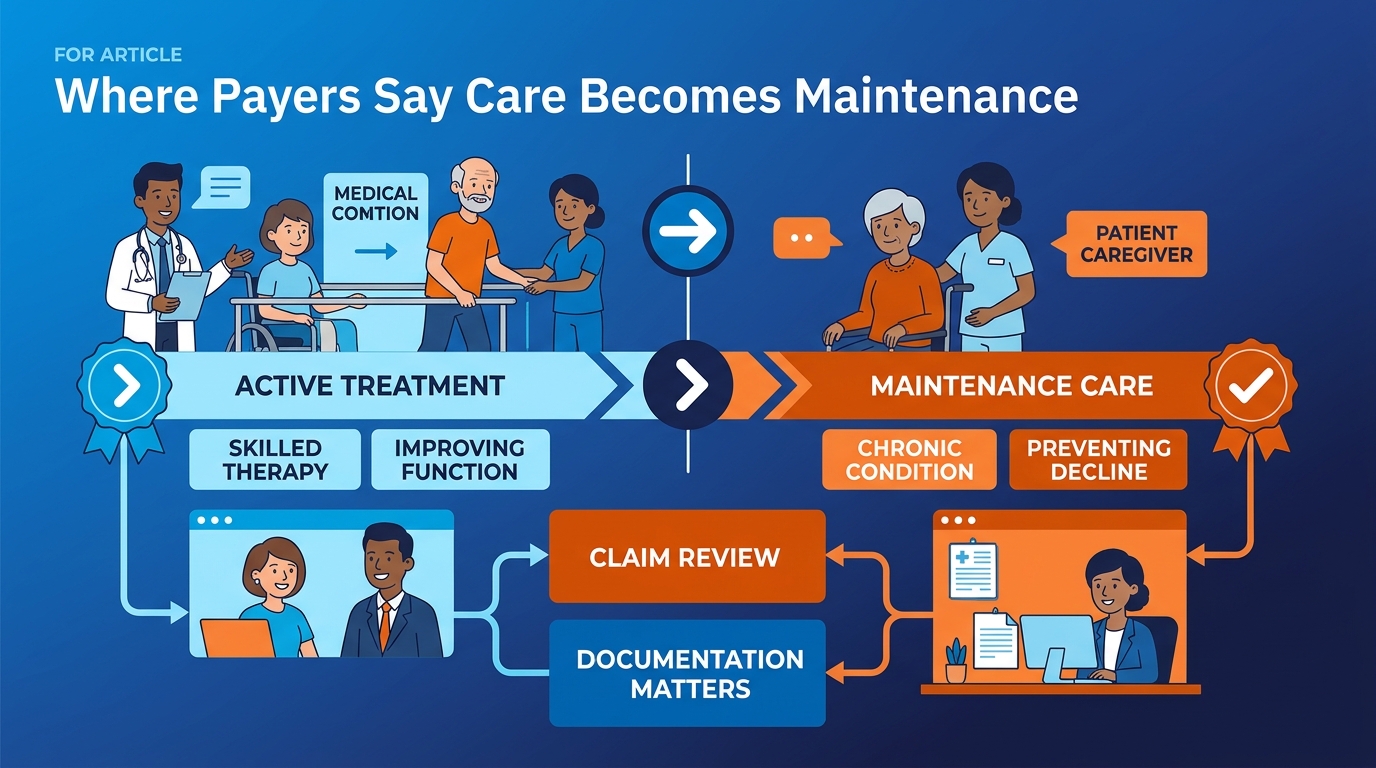
Medicare draws a clear line. The Centers for Medicare & Medicaid Services calls chiropractic treatment maintenance therapy when more improvement isn’t expected and the care turns supportive instead of corrective.
Once the injury is stable, more treatment is maintenance therapy. And Medicare doesn’t cover it.
Noridian is a Medicare contractor, and it says the same thing. Under the Medicare program, chiropractic maintenance therapy isn’t considered medically reasonable and necessary. So Medicare doesn’t cover it.
Premera Blue Cross is one Washington insurer, and its chiropractic policy is shown here as an example.
It lists ongoing repeated treatment as maintenance therapy when there’s no clearly defined clinical endpoint and no evidence to support a reasonable expectation that the patient will improve.
It also names two things as not medically necessary. One is continuing chiropractic care when the muscle, nerve and bone condition being treated is not resolving and/or is not improving. The other is treatment for preventive or maintenance therapy.
Here’s the rule. The Centers for Medicare & Medicaid Services says you must base treatment on the patient’s condition and response.
It also says treatment that goes on a long time or is repeated is more likely to get a medical review.
Want the details? Read Medicare Documentation Checklist for Chiropractic Doctors (MLN1232664, April 2025).
Your records matter too. Noridian says records that look the same from one visit to the next, or from one Medicare patient to another, may not be enough to show the care was medically necessary.
They may lead to a denied claim.
What the Page Can Honestly Claim About Maintenance Care
Start with the definition. A 2024 study, Chiropractic students’ motivation toward new evidence on maintenance care, defines chiropractic maintenance care as checking and treating patients at regular, planned times, whatever their symptoms are.
It starts after they’ve gotten the most benefit from an initial care plan. The goal is to prevent future episodes and keep conditions from getting worse.
Now the honest part. The authors say research has not yet properly backed up maintenance care. Even so, chiropractors have traditionally used it as a long-term way to manage many muscle and bone problems, such as low back pain.
Wondering what belongs on your hub page? It’s laid out in What Belongs in a Spinal Condition Hub, and What Does Not.
The study’s qualitative analysis of the students’ answers found a need to make the words used for maintenance care clearer. It also found things that push students to take up new evidence, such as its quality and how well it fits their beliefs about health care.
Your claims get policed too. California’s Board of Chiropractic Examiners has authority over other kinds of complaints as well. These include, but are not limited to, a conviction for a crime, deceptive or misleading advertising, and practicing without a license.
You can see the process at File a Complaint.
Patients It Helped
Some patients fall in a group called “Dysfunctional.” They have low back pain that keeps coming back or doesn’t go away.
When they get maintenance care, they report fewer days when pain limits their activity. Fewer sudden bad pain episodes. Longer stretches with no pain. The comparison is with patients treated only when they need it.
A trial found that maintenance care did better than treatment based only on symptoms. Patients had fewer total days with bothersome pain over 52 weeks.
But there’s a trade-off. Maintenance care meant more treatment visits on average.
Patients It Did Not Suit
A later look at the data from that trial reported something different for people called adaptive copers. Maintenance care increased their pain and their number of visits.
That suggests maintenance care is not right for that group.
Naming the Stability Phase and What It Aims For
CareCredit says preventive chiropractic care is best viewed as a stability phase. It’s designed for patients who have reached functional goals and want to reduce recurrence of a problem that was treated before. In other words, cut the chance that it comes back.
The article is Chiropractic Financing Options for Preventive Care and Practice Growth.
In clinical terms, CareCredit says, this phase is less about ongoing treatment. It’s more about monitoring, early action and reinforcing self-management, so small issues don’t turn into sudden (acute) flare-ups.
Look at the odds. Up to two-thirds of people who have low back pain will have another episode within 12 months of recovery.
Putting Costs and Payment Options on the Page
Here’s what the 2026 ChiroIQ survey found about money.
A little more than one in four consumers (28%) were unsure what chiropractic care typically costs. A little over half (56%) said flexible payment or financing options are important when they think about chiropractic care.
And about two in three existing patients (63%) said they would likely purchase a discounted prepaid visit package to support ongoing care.
Those figures come from New CareCredit Research Finds Americans Want to Stay Active and Age Well, but Many Overlook Chiropractic Care.
Frequently Asked Questions
How often do Medicare chiropractic claims contain errors, and why are they denied?
About one in three. A 2024 review by the Comprehensive Error Rate Testing Program, which checks Medicare claims for errors, found errors in 33.6% of chiropractic claims.
Common denial reasons? Missing or inadequate treatment plans. An unclear chief complaint. Failing to document all treated spinal regions.
Does citing back pain guidelines change how patients see chiropractic?
For a little over half of those surveyed, yes. National guidelines from the Centers for Disease Control and Prevention and the American College of Physicians recommend non-drug therapies, including chiropractic care, before opioids (strong prescription painkillers) for many types of back pain.
In the 2026 ChiroIQ survey, only about one in four respondents (26%) knew that. After being told, 54% said they view chiropractic care more positively.
Keep the two figures straight. The first measures who already knew. The second measures views after learning.
How much of chiropractic practice is maintenance care?
In studies of Scandinavian chiropractors, around 22% to 41% of all visits were for maintenance care (ongoing check-up care).
Do patients’ views of chiropractic change after treatment?
Yes, they go up. Positive perceptions rise from 73% (about three in four) before treatment to 96% (more than nine in ten) after care.
Among chiropractic patients in the survey, 91% say they trust chiropractors. And 93% believe the care is safe, while 95% believe it plays an important role in overall health and mobility.
How large was the ChiroIQ survey behind these figures?
It had 1,310 respondents. Synchrony ran the 2026 ChiroIQ study between June 11 and June 26, 2026.
Run Your AI Visibility Check
Your hub answers the worry about open-ended care by stating your plan.
California’s Board of Chiropractic Examiners says the first visit should end with a treatment plan made just for the patient, how long care is expected to last, and the costs and payment plan options.
Premera Blue Cross lists how often and how long, plus an anticipated date of discharge to self-care, as parts of a plan. That’s the date the patient is expected to move from care to caring for themselves.
The same study in Sweden found one factor that patients in every subgroup saw as helping maintenance care: care that is centered on the patient.
So say the plan. How often. How long. Where care ends. What your stability phase is for. And say it in a patient-centered voice.
I’d put your practice’s effort and money into your own stated plan first. It’s an asset you own, and it keeps paying off. Ads and paid placements are different. Their visibility stops the moment the spending does.
iTech Valet writes AI Authority articles and builds AI-readable infrastructure for chiropractic practices. Our AI Visibility Check shows how AI assistants answer when someone nearby asks who to see.
Want to know whether AI names your practice right now? Run My AI Visibility Check.