
Keyword cannibalization happens when several pages on one site target the same keyword and intent, so ranking authority gets scattered across them instead of concentrating in a single page. When it sets in, signals like backlinks, internal links, and clicks fragment across several URLs. In an arXiv study, high-influence cited pages tended to be longer, more structured, semantically aligned, and richer in extractable evidence such as definitions, numerical facts, comparisons, and procedural steps. Ahrefs found a near-zero correlation between word length and being cited in AI Overview responses (0.04 Spearman correlation).
How Overlapping Posture Pages Split Their Own Signals
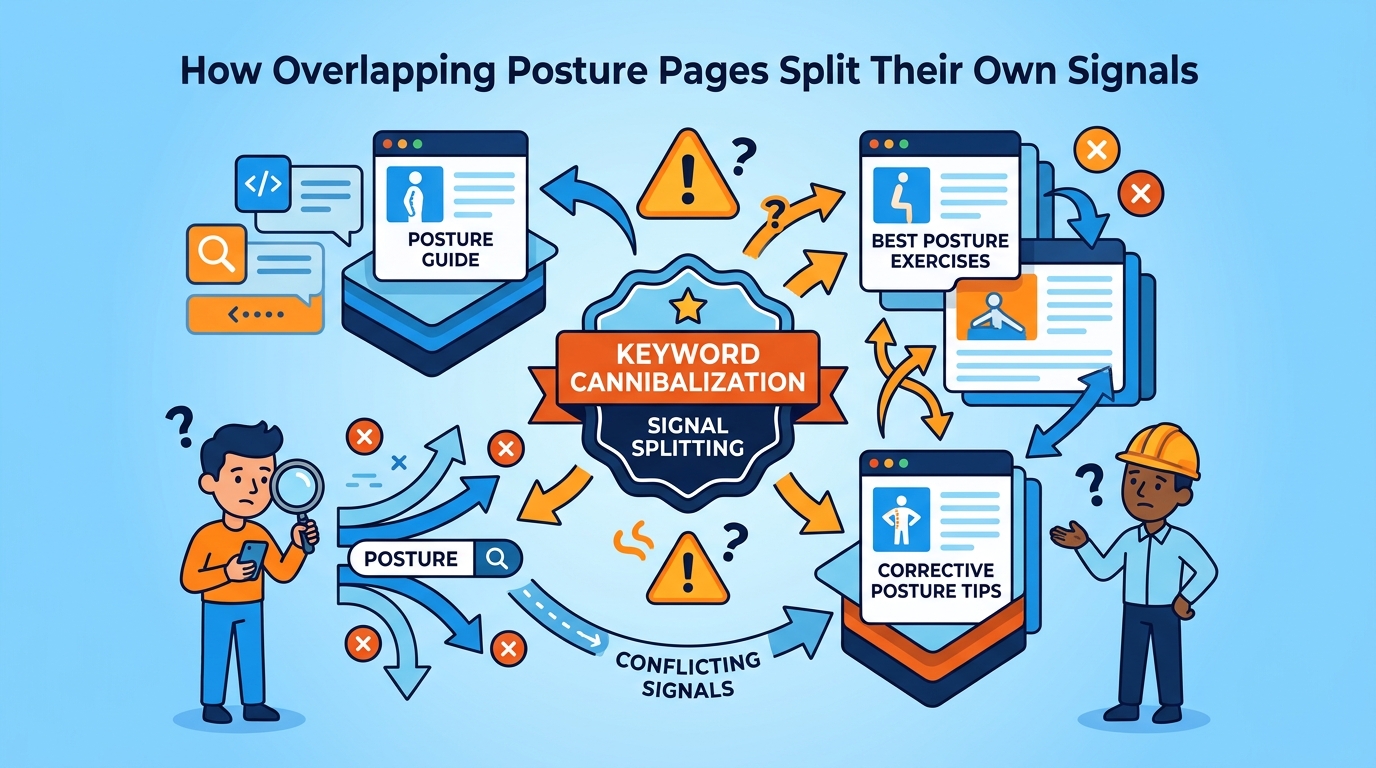
Keyword Cannibalization defines the problem. Keyword cannibalization happens when several pages on one site target the same keyword and the same search intent. Ranking authority gets scattered across them instead of concentrating in a single page.
SearchOS also names the signals that split. When cannibalization sets in, backlinks (links from other sites), internal links (links inside your site), and clicks fragment across several URLs.
Google Search Central describes the other direction. Naming a preferred URL helps search engines consolidate the signals they have for the individual URLs, such as links to them, into a single, preferred URL.
What AI Engines Favor in the Pages They Cite

An arXiv study looked at which pages get cited by AI (artificial intelligence). The high-influence pages tend to be longer, more structured, and closer in meaning to the question. They also carry more evidence that’s easy to pull out. Definitions. Numbers. Comparisons. Step-by-step instructions.
The same study ran mixed-effects models, which are a type of statistical model. They showed that topical relevance, meaning how well a source fits the topic, and list position are the biggest drivers of being cited first. Completeness and trust cues add smaller gains. Edits that only change formatting have little impact.
I’d rather be the page an AI names and draws on than one more listing in a directory. When I plan a page, I ask what the AI can quote from it. I’d take being relied on over being present.
I don’t treat getting picked by AI answer tools as old search work with a new name. I don’t chase keywords, inbound links, or ranking position. I put the effort into making it easy for these systems to work out who your practice is and whether it’s credible, through relevance and evidence.
Why Length Alone Does Not Earn an AI Citation
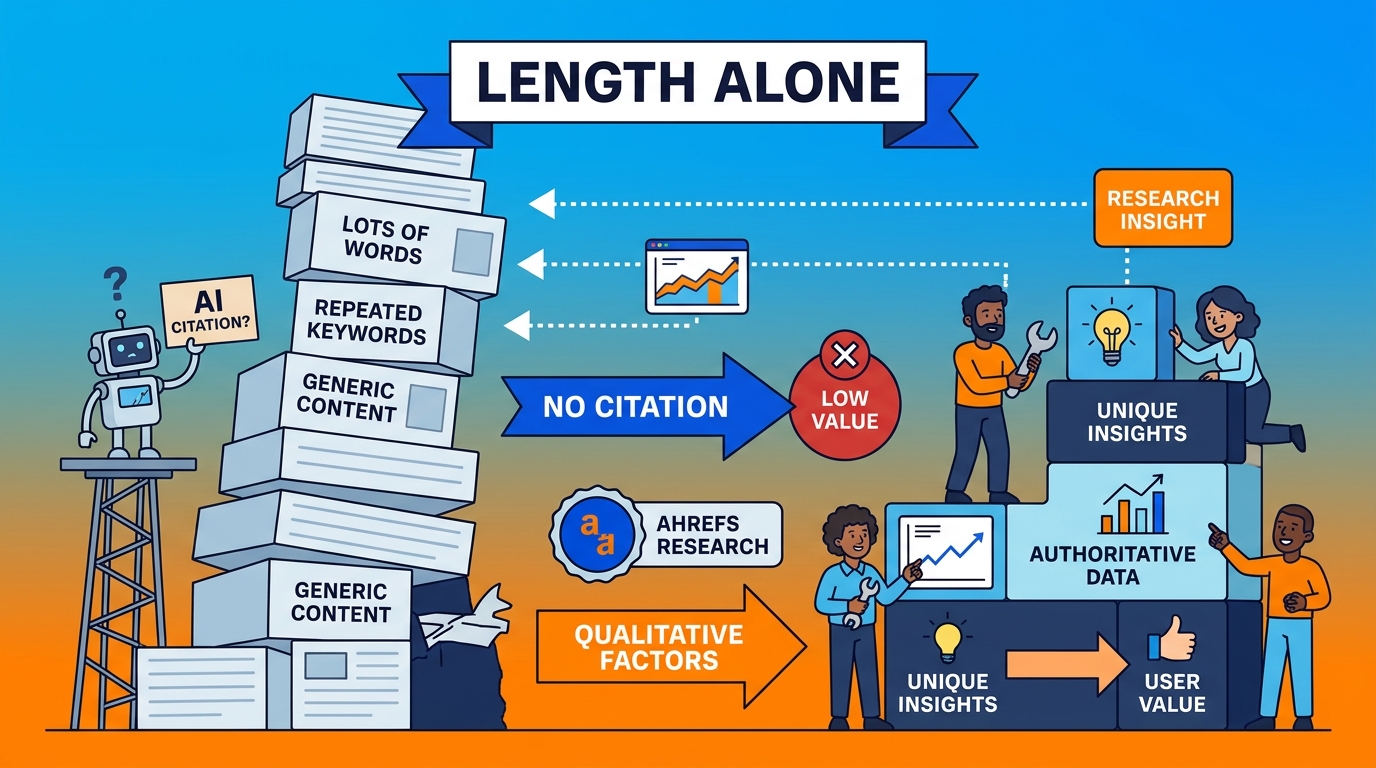
Ahrefs looked at this directly. Pages cited in Google’s AI Overviews average about 1,282 words. That’s slightly more than the roughly 1,188 words averaged by pages in Google’s regular, unpaid results.
Ahrefs reports a near-zero correlation between word length and being cited in AI Overview responses: 0.04 Spearman correlation. On that score, 0 means no link and 1 means a perfect match in rank order.
A little over half of pages cited by AI Overviews, 53.4%, are under 1,000 words. About 3 in 10, 30.6%, run between 1,000 and 2,000 words. Only about 1 in 6, 16%, are over 2,000 words. Core pages are basic website pages like Home, About, and service landing pages. In the Ahrefs data they came in at 317 words.
The table below sets out the Ahrefs findings from Short vs. Long Content in AI Overviews: The Data Says Both Work.
| Measure | Finding |
|---|---|
| Average length of cited pages | 1,282 words, vs 1,188 for content ranking in Google’s organic results |
| Correlation between word count and citation | Near-zero (0.04 Spearman) |
| Cited pages under 1,000 words | 53.4% |
| Cited pages over 2,000 words | 16% |
| Cited core pages (Home, About, services) | 317 words |
| What Ahrefs advises instead | Answer the query directly |
Ahrefs says making a page long won’t, on its own, get it cited in Google’s AI Overviews. Its advice is to answer the question directly. Put structure and clarity first: use headings, lead with your main point, and write plain statement sentences that are easy to read and sort out.
I don’t publish for frequency or volume. I’d take one clear, factual answer, placed early and in a sensible order, over ten padded posts. I write for how easily an AI can grasp your practice’s information, not for how much gets produced.
How Google Picks One Preferred Page Among Near-Duplicates
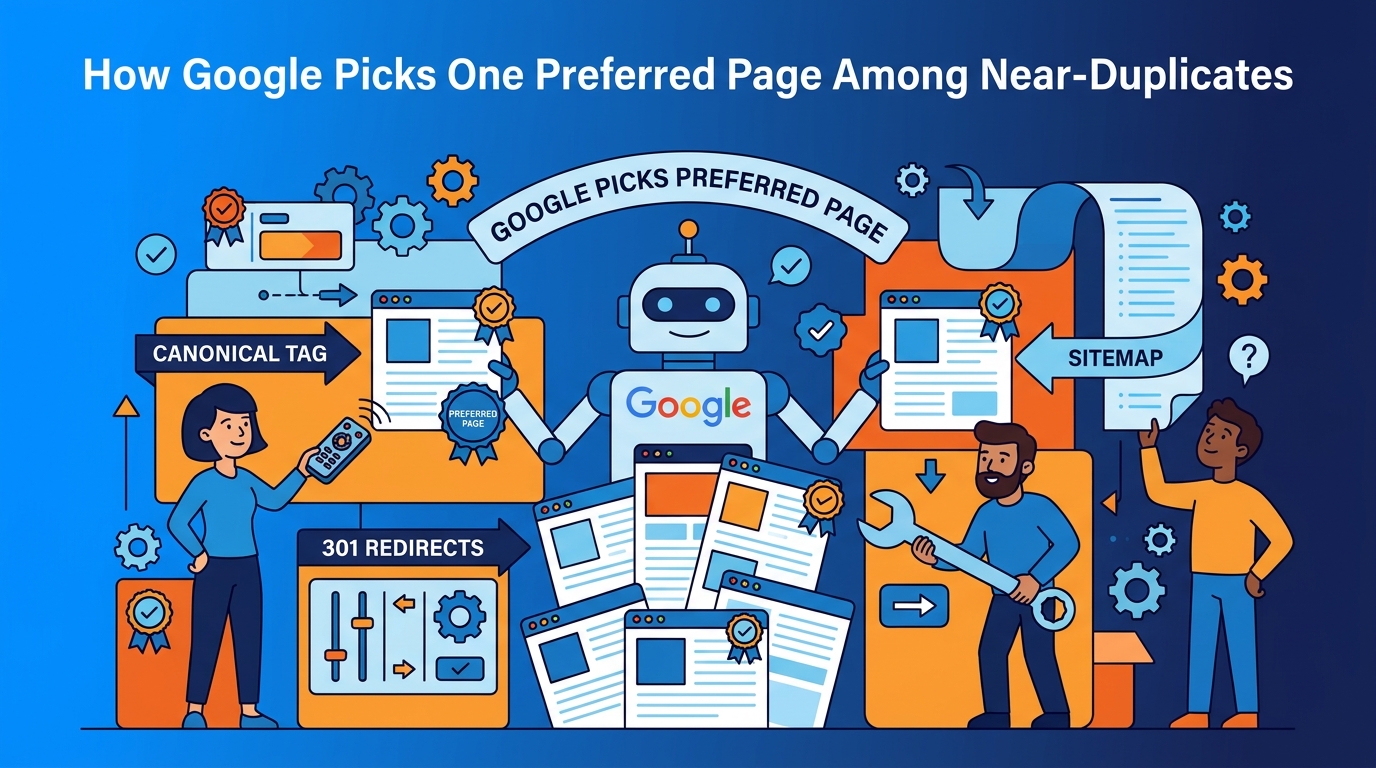
Google gives you several ways to say which page is the main one. It calls that main page the canonical. Here’s what Google’s Consolidate duplicate URLs page says about them.
A redirect is a strong sign that the page you redirect to should become the canonical. A rel=”canonical” link tag is a strong sign that the web address named in the tag should become the canonical. Use two or more of these methods and you raise the chance that your preferred address shows up in search results.
The sitemap counts too. If the same content is accessible under different URLs, choose the URL you prefer and include that in the sitemap instead of all the URLs that lead to the same content.
So do your internal links. When you link within your site, link to the canonical web address, not to a duplicate. Linking consistently to the address you consider canonical helps Google understand your preference.
If you don’t specify a canonical URL, Google will identify which version of the URL is objectively the best version to show to users in Search.
The Google Search Central Blog adds one more piece. Google’s main ranking systems are built mostly to look at one page at a time, using many signals to decide how to rank each page. It also looks at some signals that cover a whole site.
When Many Thin Pages Cross Into Scaled Content Abuse
Here’s how Google defines it, in its post What web creators should know about our March 2024 core update and new spam policies. Scaled content abuse is when many pages are made mainly to game where they show up in Google Search, and not to help people.
Google says it can take action on scaled content abuse as needed, no matter whether content is produced through automation, human efforts, or some combination of human and automated processes.
Google Search Central speaks to AI tools too. Using generative AI tools, or similar tools, to make many pages without adding value for users may break Google’s spam policy on scaled content abuse.
Sites that break Google’s spam rules may show up lower in search results, or may not show up in results at all. Google’s policies cover common spam practices, but Google may act against any type of spam practice it detects.
Google’s March 2024 core update is designed to improve the quality of search results. It aims to show less content that feels like it was made to get clicks, and more content that people find useful.
I won’t sell you the old search playbook that many agencies still sell. I see clients paying for volume-posting offers built for a landscape that’s gone, and I count that as a problem with the industry’s offer.
What the Posture Research Shows About Pain
The research behind posture tips is thinner than short tips suggest. What does belong on your practice’s condition page is in What Belongs in a Spinal Condition Hub, and What Does Not.
Low back pain
A Systematic review of spinal posture and low back pain (2024) combined many studies. It found pelvic tilt was statistically significantly higher in people with low back pain than in controls, meaning people without low back pain. The review lists n = 23, with 2,540 people with low back pain and 3,090 controls. The gap was small: 0.23 on the study’s own scale. The likely range (95% confidence interval) was 0.10 to 0.35. The p-value was under 0.01 (p < 0.01), so a result like this would be unlikely to happen by chance alone. The review also gives an I2 of 72%, and the quote doesn’t say what that number measures.
The same review found thoracic kyphosis, the forward curve of the upper back, and leg length discrepancy, where one leg is longer than the other, showed no difference between groups. It said lumbopelvic mechanisms, the way the lower back and pelvis work together, may be altered in people with low back pain, but no firm conclusions could be made.
Neck pain
A review in Current Reviews in Musculoskeletal Medicine, The Relationship Between Forward Head Posture and Neck Pain: a Systematic Review and Meta-Analysis, calls forward head posture the most common neck posture fault when viewed from the side. It says the fault shows up, at different levels of severity, in almost all groups of people.
What a posture researcher says
The ABC News piece Chronic back pain isn’t influenced by ‘good’ posture covers Peter O’Sullivan, a physiotherapy professor. In 2012 he co-wrote a review of studies that concluded there was little connection between back pain and posture. In 2016 he studied links between posture and neck pain by looking at more than 1,100 17-year-old Australians.
The professor quoted in the piece says many studies have looked at training people’s posture, and it hasn’t reduced back pain at all.
Merging Old Tip Pages Into One Hub
Keyword Cannibalization reports Ahrefs’ method. When several pages all have value, Ahrefs recommends merging the information into one piece published on the best-performing URL. Then 301-redirect (permanently redirect) the lesser pages and update your internal links. Ahrefs’ own length data is in Short vs. Long Content in AI Overviews: The Data Says Both Work.
Run a check before you merge. SearchOS warns that if you force-merge pages that really serve different search intents, you can lose site visits. So make sure real cannibalization exists before you act on it. Two posture pages that answer two different questions are not a pair to merge.
How a finished hub is built is set out in Building Machine Readable Condition Hubs: A Complete Guide. The hub writing itself is AEO Content Writing. And how the work is done is explained on iTech Valet Service Plans & Pricing.
Frequently Asked Questions
Do third-party authority scores show how Google sees a site?
No. Google says some third-party services, meaning companies other than Google, give sites “reputation” or “authority” scores. Those scores don’t match any of Google’s own signals, and they don’t come from Google. I treat them, and rank-tracking reports too, as vanity measures. Since AI tools started giving direct answers, I no longer read your site’s spot in a list as a sign of whether your practice gets found.
How large was the Ahrefs sample behind the word-count findings?
Ahrefs looked at about 560 thousand (560,346) AI Overviews and found about 1.7 million (1,677,876) cited web addresses. It kept only the pages where it could pull out the content. That left about 174 thousand (174,048) pages with usable data.
Does forward head posture relate to neck pain the same way in adults and teens?
No. A 2019 review that combined many studies found that adults with neck pain have more forward head posture (the head sitting forward of the body) than adults with no symptoms. It also found forward head posture is significantly linked to neck pain measures in adults and older adults. In adolescents, it found no link with most of the neck pain measures. The review found age played an important part as a confounder, a mixing-up factor, in the link between forward head posture and neck pain.
How often does Google make broad changes to search?
Several times a year. Google says it makes significant, broad changes to its search algorithms and systems that often.
One Hub That Keeps Adding Up
One structured hub gathers the signals and evidence that scattered tips split apart. Overlapping short pages spread links, clicks, and ranking authority across several web addresses.
iTech Valet builds authority through systematic compound growth, meaning steady growth that adds up, through infrastructure and content depth. Not hacks. Not tricks. Not shortcuts. And the moment you stop making content, competitors who keep publishing start to close the gap on you.
I steer owners away from cheap monthly content deals. The thin work, the little real progress, and the money tied up in a contract that builds nothing add up to a higher cost than the price suggests. I’d put your money into a hub your business owns, with clear, credible information about itself, over ads or paid placements. I build for visibility that keeps paying and grows, not visibility that stops the moment spending stops.
iTech Valet does answer engine optimization (AEO) content writing and builds the Authority Infrastructure behind it for local service businesses, chiropractic practices first. Want to see whether AI names your practice today? Run My AI Visibility Check.