
What Is a Chiropractic Entity Authority Guide in 2026?
A Chiropractic Entity Authority Guide is the playbook that turns your clinic into a verified entity in the AI Knowledge Graph — the data layer ChatGPT, Gemini, and Perplexity query when a patient asks who they should see.
Not an SEO package. Not a rebrand. Not a content calendar.
It's the infrastructure that makes AI engines confident enough to recommend you — by giving them machine-readable proof of exactly what your practice is, where it operates, what conditions you treat, and why dozens of independent authoritative sources agree you're legitimate.
The guide covers five specific components: NAP consistency across every platform AI checks, MedicalBusiness schema markup that tells AI exactly what kind of provider you are, cross-platform citation depth that builds the consensus AI needs before it'll recommend anyone, review sentiment that clears the confidence threshold, and topical authority content that answers every question your patients are asking AI right now.
Get all five aligned and AI can verify your clinic confidently enough to recommend it. Miss one and it hedges. When AI hedges, it recommends someone else.
In 2020, authority meant backlinks. In 2023, it meant content volume. In 2026, it means entity trust — how confidently AI can verify your clinic is real, consistent, and worth recommending across every source it cross-references.
Gartner forecasts traditional search engine volume will drop 25% by end of 2026 as AI platforms become the default answer engine. When your next patient asks "who's the best chiropractor for back pain near me" — they're not scrolling ten results anymore. They're reading one answer.
A Chiropractic Entity Authority Guide determines whether that answer is your name or your competitor's.
Last Updated: March 24, 2026
The AI Discovery Problem Docs Are Paying For
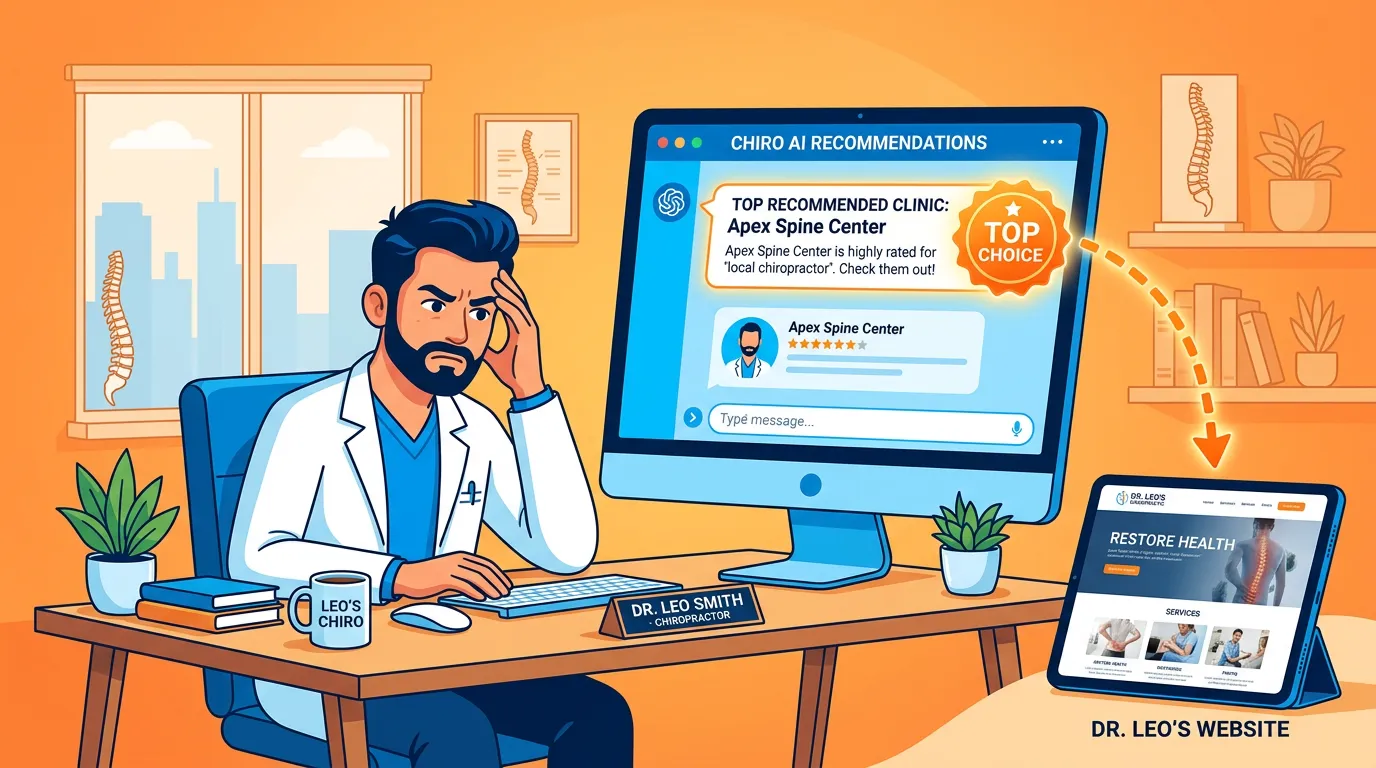
Something's off and you feel it.
New patients are flat. Or the numbers were growing and then just... stopped. And the weird part is your online presence looks solid. Five-star rating. Professional website. A team page with everyone in matching scrubs.
But type "best chiropractor for back pain near me" into ChatGPT — and your clinic's not in the answer.
That's not a rankings problem. That's an entity authority problem. And it's costing practices real patients while the docs running them have no idea why.
The Digital Brochure Fallacy
A beautiful website is a liability if AI can't read its entity signals.
Most agencies won't tell you that. They sell you polished design, some keywords, a few backlinks, and a Google review strategy. That worked when Google was the only gatekeeper.
AI engines don't care about your header font.
They don't care about your color palette or your hero image. They care about structured, machine-readable data — the kind that lets them classify your clinic as a verified healthcare entity and recommend you with confidence.
Most chiropractic websites, even the expensive ones, were built for humans scrolling a page. I've watched practices pay $20k for a site that looks incredible. AI can't read a word of it.
When AI can't read your entity signals, it skips you. Moves to the clinic that built authority infrastructure instead of a nice-looking digital brochure.
That's the Digital Brochure Fallacy. As an AI Authority Agency, it's the first thing we find in nearly every new engagement. The clinic invested in aesthetics. The competitor invested in infrastructure. Aesthetics doesn't win the citation.
Why Traditional SEO Can't Build AI Consensus Trust
Traditional SEO was built for one job: rank a website in a list of ten blue links.
That environment — ten links, human clicks, keyword density — is a shrinking slice of how patients find healthcare providers now. Gartner forecasts traditional search engine volume will drop 25% by the end of 2026 as AI platforms absorb the queries that used to go to Google. SEO isn't dead, but it's not the whole game anymore.
Here's the part that actually stings: traditional SEO tactics work against entity authority.
Keyword stuffing signals to AI that your content is gaming an algorithm. Filtered out.
Link building from irrelevant sources signals manufactured authority — not the earned, cross-platform consensus AI needs to recommend you confidently.
Templated content? To AI, your site looks identical to thousands of other templated chiropractic sites. It can't distinguish you as the specific, verified local authority.
Traditional SEO treats your website like a document competing for clicks. AI needs your clinic recognized as an entity earning citations.
Completely different games.
Backlink counts don't factor into AI citation decisions. Keyword rankings don't either. What triggers a recommendation: NAP consistency, schema completeness, citation depth across trusted third-party sources, and the consensus that fires when multiple independent platforms describe your clinic the same way.
No shortcut to building that. None.
What's Actually Inside a Chiropractic Entity Authority Guide
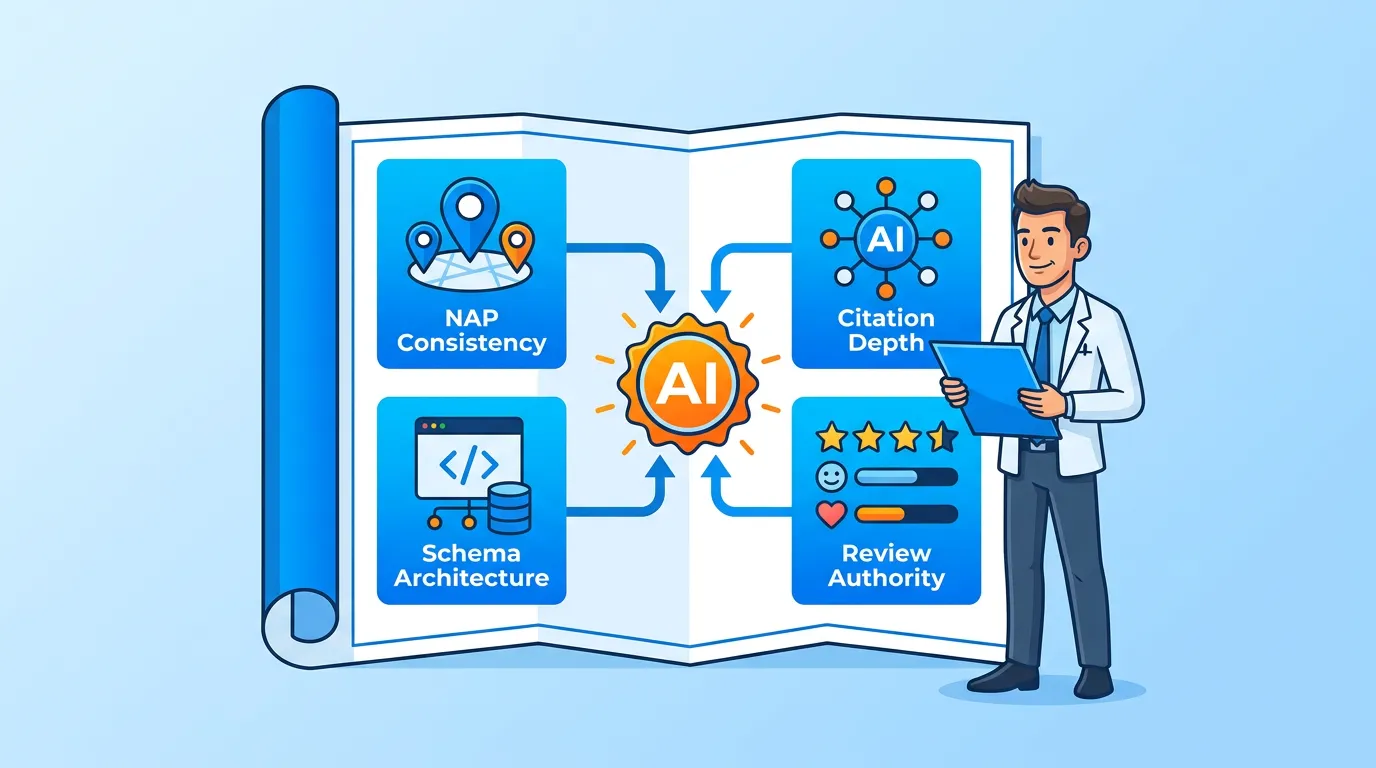
Most docs have never heard the term "entity authority." That's exactly why their competitors are showing up in AI answers and they're not.
The guide isn't a rebrand or a content strategy. It's a technical framework that teaches AI engines what your practice is — a verified, locally-anchored healthcare entity with consistent data everywhere AI looks.
Entity vs. Website: Why the Difference Matters
A website is a destination for humans. An entity is something different.
An entity is a verified record that AI engines can independently recognize and reference — whether or not anyone clicks your website at all.
When ChatGPT recommends a chiropractor, it's not reading your homepage copy.
It's querying training data and real-time sources to find which clinics have enough verified entity signals to recommend confidently. That verification comes from a specific stack: Google Business Profile data, directory listing accuracy, schema markup, NAP consistency, and review sentiment.
Your website is one input. AI recommendations require all five to align.
| Signal Type | What AI Evaluates | Why It Matters |
|---|---|---|
| NAP Consistency | Name, Address, Phone matching across 50+ platforms | AI cross-references sources to confirm the entity is real |
| Schema Markup | MedicalBusiness, LocalBusiness, FAQPage JSON-LD | Machine-readable entity classification AI can act on directly |
| Citation Depth | Mentions across directories, news, healthcare platforms | Cross-source consensus that triggers trust |
| Review Sentiment | Star average and keyword patterns in review text | AI uses reviews as a confidence filter, not a ranking signal |
| Content Authority | Topical depth across conditions and locations | Subject matter authority AI can independently verify |
Get four of five right and you might still not get recommended. Get all five aligned and you become very hard to displace.
The Technical Pillars
These aren't separate tactics. Each one makes the others stronger.
- MedicalBusiness Schema — JSON-LD markup that declares your entity type, services, location, and credentials in machine-readable format. Without it, AI infers. With it, AI knows. AI doesn't recommend what it has to guess about.
- NAP Infrastructure — Your Name, Address, Phone matched character-for-character across every directory AI checks: Google, Yelp, Healthgrades, Vitals, WebMD, Zocdoc, Apple Maps, Facebook, and more. One inconsistency creates entity fragmentation. AI sees two records and loses confidence in both.
- Cross-Platform Citation Consensus — Whitespark's local search ranking factor research confirms NAP consistency and review sentiment are top-weighted signals for modern local visibility. The more independent authoritative sources that describe your clinic consistently, the more confident AI becomes recommending you.
- Topical Authority Content — AI-readable content covering every layer of patient intent around your conditions and services. Not blogging for the sake of it. AEO architecture that makes your domain the most citable source on every topic your patients ask AI about.
- Review Sentiment — SOCi's 2026 Local Visibility Index found ChatGPT recommended only 1.2% of analyzed locations — averaging 4.3 stars or higher. AI treats reviews as a confidence filter, not a ranking signal. Drop below the sentiment threshold and you're excluded entirely, regardless of everything else.
The 1.2% Reality Check
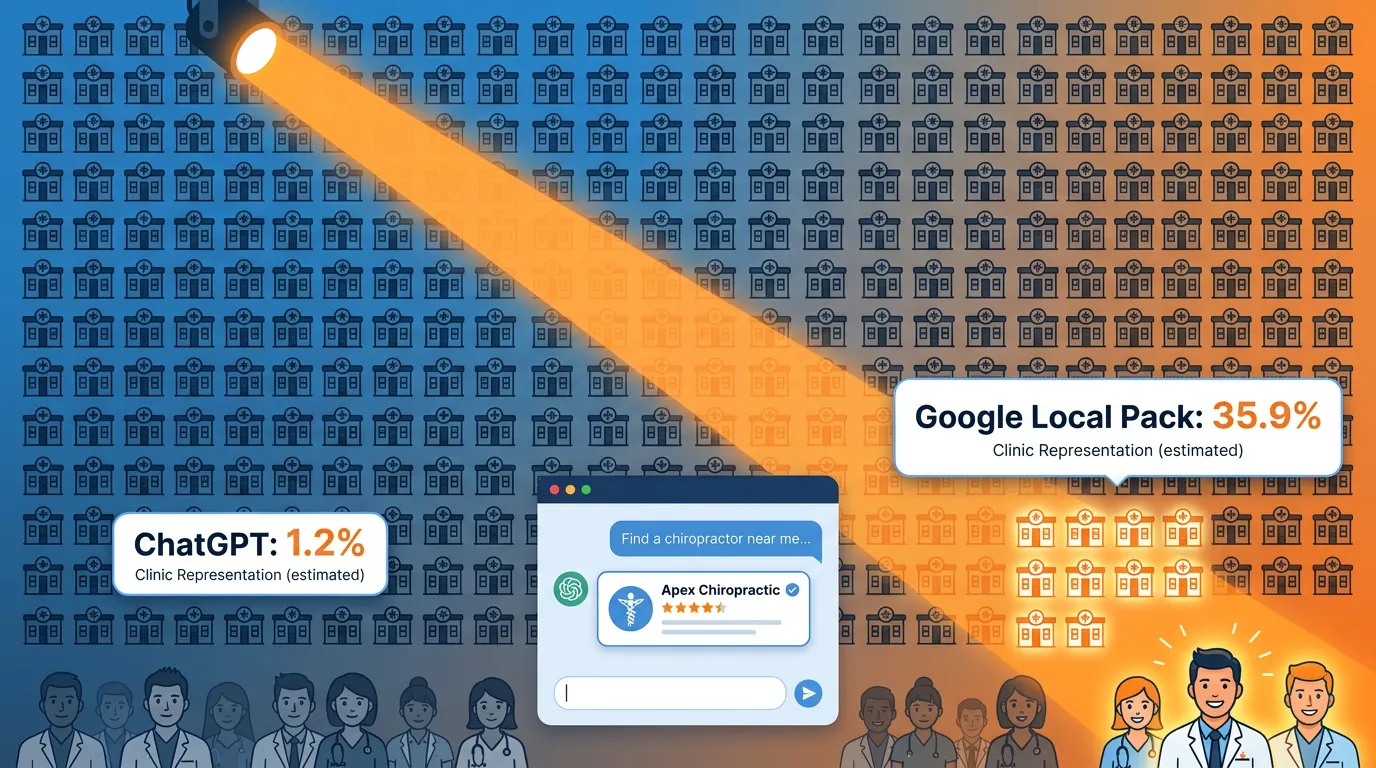
Most docs assume AI search works like traditional search. Show up in the right places, keep a decent rating, and you'll be visible.
That assumption is expensive.
SOCi's 2026 Local Visibility Index analyzed nearly 350,000 locations across 2,751 brands. ChatGPT recommended just 1.2% of them. Gemini: 11%. Perplexity: 7.4%.
Google's local 3-pack showed 35.9% of those same locations.
AI is 3 to 30 times harder to crack than traditional local search. And it gets more selective every month.
The Citation Monopoly Problem
The practices already winning AI recommendations didn't stumble into it.
They're on Clutch, UpCity, Healthgrades, Vitals, WebMD, Zocdoc, Apple Maps — everywhere AI looks to validate a business. Their data is consistent. Their schema is complete. Their reviews run deep.
When AI queries those sources for "most trusted chiropractor in your city" — it finds them on every platform, described the same way, with consistent data confirming the same entity.
Your clinic? Partial data on some platforms. Inconsistent data on others. And on the exact sources ChatGPT cross-references most? Maybe not there at all.
That's a structural blockade. Not a visibility problem.
Every month those incumbents maintain their footprint, the gap widens. Catching up requires infrastructure work — not more ad spend, not a new website, not another social media strategy.
This Guide Isn't for Everyone
If you want to build authority once and never touch it again — stop reading.
AI recommendation criteria aren't static. Platforms update their sourcing logic. Citation weight shifts. Schema requirements evolve. This is a living framework, not a one-time setup.
Plenty of agencies will sell you a one-time fix. (Same agencies selling you the next fix six months later when the first one stops working.)
What a Chiropractic Entity Authority Guide delivers is a compounding authority asset — one that gets harder to displace the longer you maintain it.
That distinction matters a lot. The wrong mindset leads to underinvestment in the ongoing execution that makes this work. First, audit your clinic's AI visibility to identify where your actual infrastructure gaps are — before assuming the problem is simpler.
The Four Components
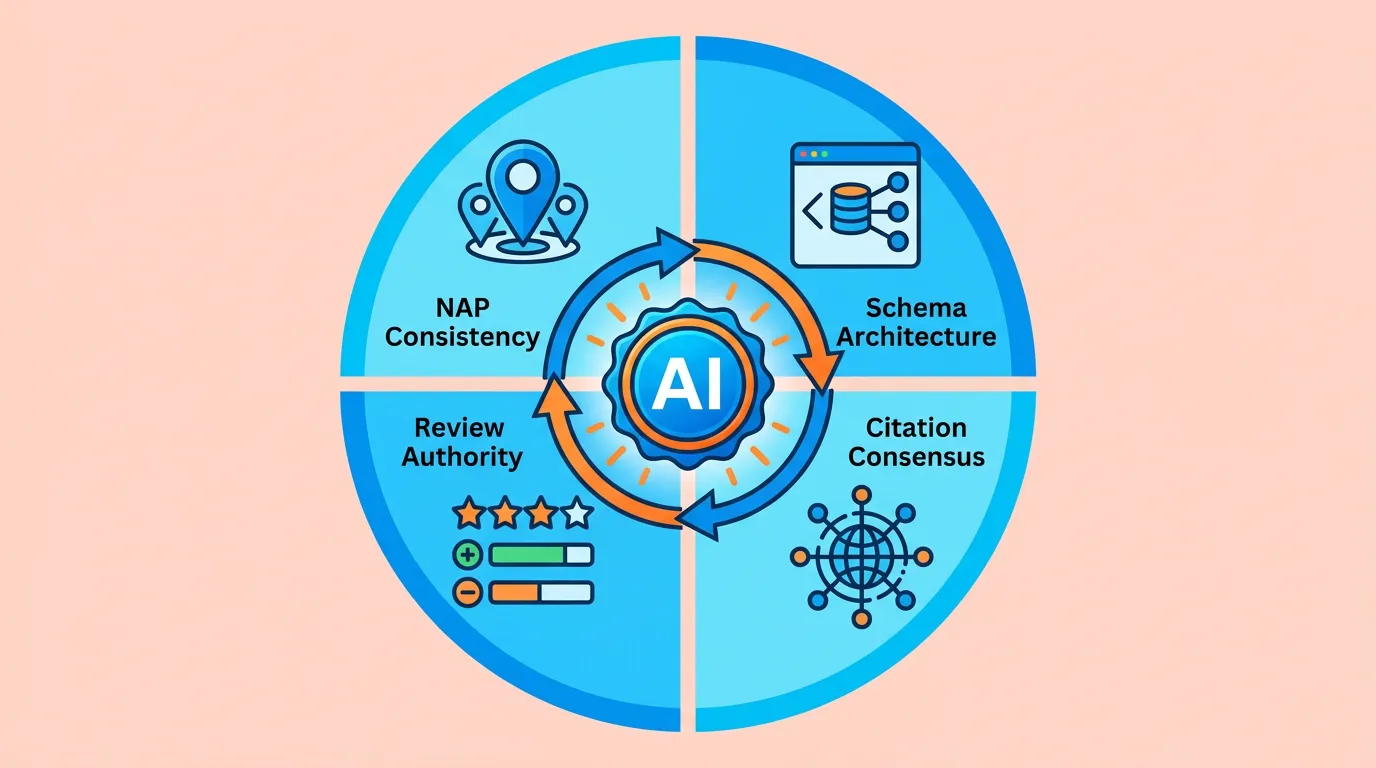
I tell docs this all the time — you can't just fix your Google reviews and call it done. Entity authority has four parts, and all four have to work together. One or three out of four and AI still hedges.
Get all four aligned and you create the consensus signal that makes AI comfortable recommending you.
Component 1: NAP Infrastructure
Name. Address. Phone. Three pieces of data. Hundreds of platforms. Zero tolerance for variation.
When your Google Business Profile says "Back in Motion Chiropractic, 1234 Main St., Suite 100" and your Yelp listing says "Back in Motion Chiropractic Clinic, 1234 Main Street, #100" — those aren't equivalent to AI.
That's two different records for what might be two different entities.
AI resolves entity identity by cross-referencing sources. When sources don't agree, confidence drops. When confidence drops, AI hedges. When AI hedges, it recommends the clinic with clean data instead.
BrightEdge data confirms AI pulls citations from a much wider source pool than traditional search ever did — including every directory, map platform, and healthcare listing your clinic appears on.
NAP infrastructure means auditing every source, correcting every inconsistency, and locking in one canonical record that every platform reflects.
Component 2: Medical Schema Architecture
Schema markup is the language AI speaks natively. Most chiropractic websites aren't speaking it.
JSON-LD schema embedded in your site explicitly declares: this is a MedicalBusiness entity, these are the specialties offered, this is the practitioner's credentials, this is the service area, these are the hours.
Without schema, AI infers. With schema, AI knows.
| Schema Type | Purpose | AI Benefit |
|---|---|---|
| MedicalBusiness | Declares entity type and category | Healthcare provider classification, not generic local business |
| LocalBusiness | Anchors geographic entity data | Confirms service area for location-based queries |
| FAQPage | Structured Q&A pairs | Citable content blocks AI can extract directly |
| MedicalCondition | Defines conditions treated | Matches clinic to condition-specific patient queries |
| Person (Practitioner) | Identifies the doctor as a verified entity | Practitioner-level citations and recommendation credibility |
Yext's analysis of 6.8 million AI citations confirmed 86% of AI citations come from brand-managed sources — with Gemini favoring first-party websites 52.1% of the time. Schema is what makes your site machine-readable enough to be the source Gemini actually trusts.
Component 3: Citation Depth
A citation is any independent third-party mention of your clinic that AI can verify. Not all of them carry equal weight.
- Tier 1 — Healthgrades, WebMD, Vitals, Zocdoc. Healthcare-specific directories AI treats as authoritative data sources for provider recommendations.
- Tier 2 — Google Business Profile, Apple Maps, Bing Places, Yelp. The mapping and general directory platforms AI uses to corroborate local entity data.
- Tier 3 — Facebook, Instagram. Lower individual weight, still used to confirm entity consistency.
Depth matters. The number of Tier 1 and Tier 2 sources that confirm your entity with consistent data feeds directly into AI recommendation confidence.
Practices that understand the future of chiropractic search aren't waiting to be discovered. They're building the citation footprint that makes discovery inevitable.
Component 4: Review Sentiment
Most docs think about reviews as a ranking signal. AI treats them differently.
In traditional local SEO, more stars meant a higher listing position. In AI-driven recommendations, reviews are a binary filter — either you pass the confidence threshold or you're excluded entirely.
SOCi's data is clear: ChatGPT-recommended locations averaged 4.3 stars. Middling ratings meant no recommendation, regardless of other signals.
But it's not just the stars. AI parses review text.
A practice with 200 reviews saying "great location, friendly staff" is less AI-visible than one with 80 reviews saying "fixed my six-month back pain problem." The second set gives AI the specific outcome language it uses to match your clinic to a patient's exact query.
Volume matters. Content matters more.
What Each AI Platform Actually Needs
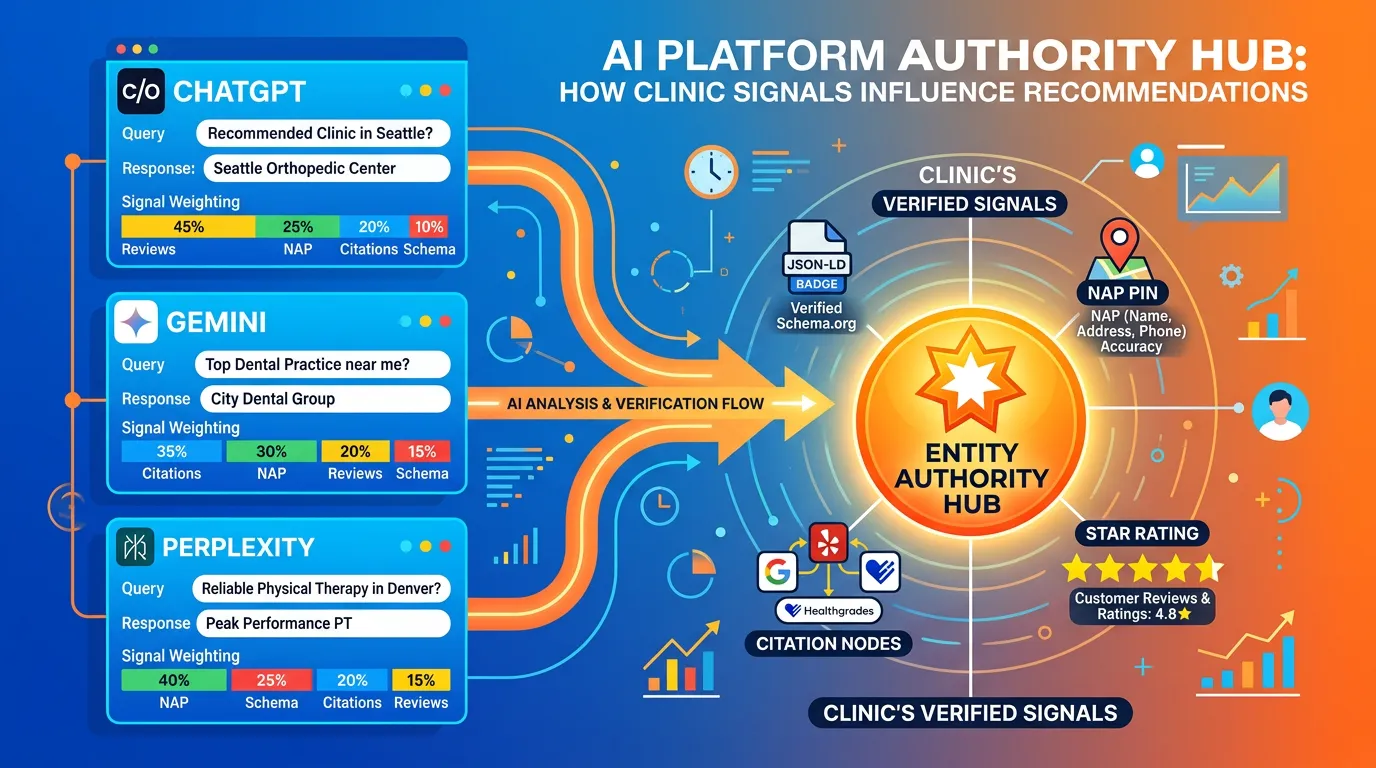
ChatGPT, Gemini, and Perplexity don't use the same playbook. I've seen docs pour everything into Google and still wonder why ChatGPT doesn't recommend them. Different systems. Different signals. You need to understand the gap.
How Gemini Works
Gemini has an advantage the other platforms don't — it's grounded in Google Maps data.
SOCi found Gemini's business profile accuracy at 100%. ChatGPT and Perplexity? Around 68%. That grounding means your Google Business Profile isn't just a local ranking factor anymore. It's a primary input into Gemini's entity verification.
Gemini favors first-party websites for 52.1% of citations. A schema-marked clinic site is essentially a Gemini citation engine waiting to be turned on. Most clinics just haven't built the schema layer that activates it.
How ChatGPT Works
ChatGPT is more conservative — which explains the 1.2%.
No direct Google Maps access. So it cross-references multiple sources independently: Healthgrades, Yelp, clinic sites, healthcare directories, third-party review aggregators.
That's why citation depth is so critical for ChatGPT specifically. A clinic on twelve platforms with consistent data is far more recommendable than one on three, even if those three are excellent.
For the AI recommendation criteria ChatGPT uses, consensus is everything. Multiple independent sources describing the same clinic the same way. That's what breaks through the 1.2% filter.
The Zero-Click Equation
Here's why none of this is optional anymore.
SparkToro's research shows roughly 60% of Google searches end without a click. On mobile — 77%.
The patient asking "what chiropractor near me treats disc herniation" gets an answer inside the AI interface. Makes a decision. Never visits your website.
That's not a future concern. That's happening right now.
In 2026, the citation is the click. Being recommended by AI is the conversion event, not a traffic source.
| Platform | Recommendation Rate | Primary Trust Signal | Accuracy Rate |
|---|---|---|---|
| ChatGPT | 1.2% of locations | Multi-source citation consensus | ~68% |
| Gemini | 11% of locations | Google Maps + first-party website | 100% |
| Perplexity | 7.4% of locations | Real-time web crawl + directories | ~68% |
| Google Local 3-Pack | 35.9% of locations | Traditional local SEO signals | High |
Traditional local SEO gets you into the 3-pack. Entity authority gets you into the AI recommendation set — which is increasingly where high-intent patients are making their decisions before they ever visit a website.
Entity Authority Is a Practice Asset, Not a Marketing Expense
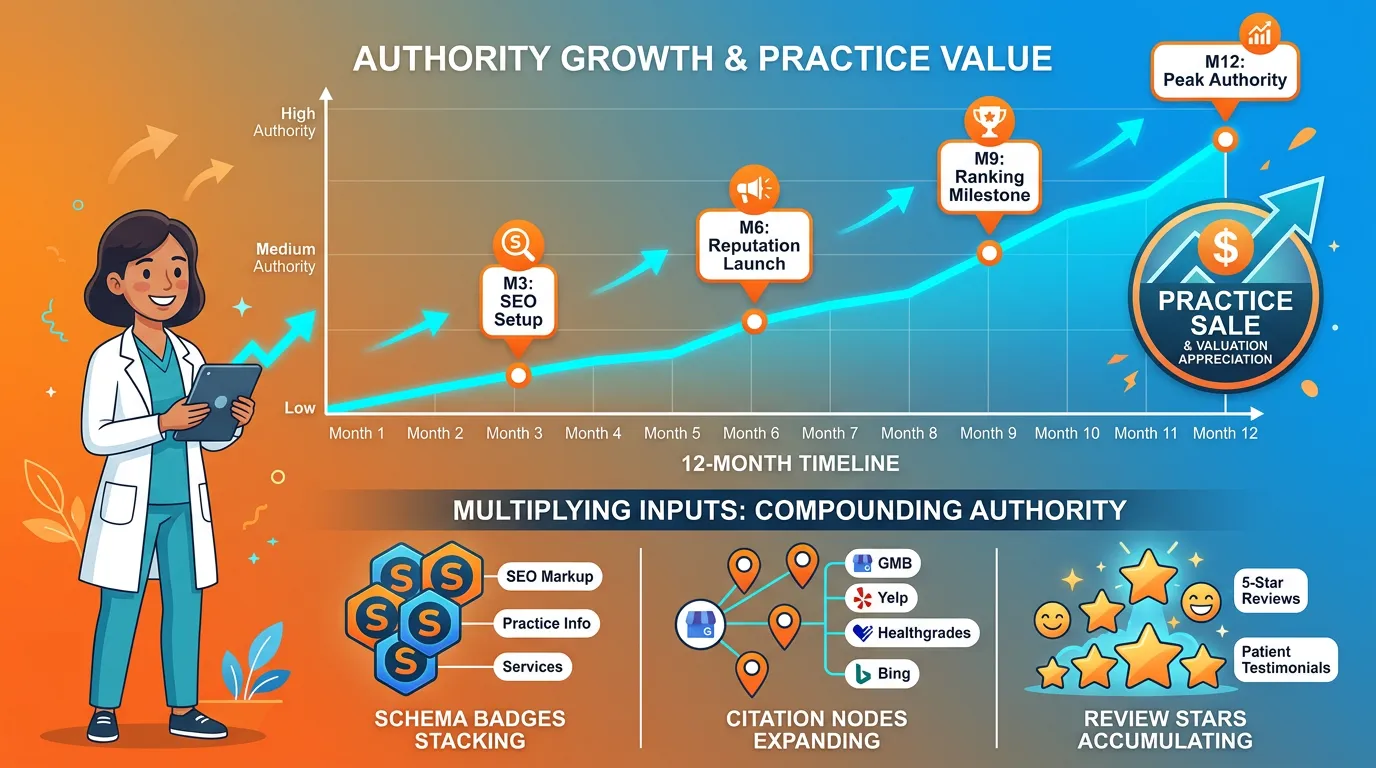
Most marketing spend is an expense. Pay for ads, ads run, ads stop. The moment you stop paying, the value disappears.
Entity authority compounds.
The Compounding Advantage
Every citation you earn, every schema element you implement, every consistent NAP record you lock in — those become permanent fixtures in the AI knowledge graph.
They don't reset when you pause a campaign. They don't vanish when an algorithm updates.
A clinic at month one of entity infrastructure has minimal AI recommendation presence.
A clinic at month twelve has a deep citation footprint across dozens of platforms, verified entity records AI trusts, a growing content archive AI pulls from regularly, and reviews that tell AI exactly what conditions get fixed there.
The gap between those two clinics grows every month — not because one is spending more, but because one is building something that compounds and the other is buying something that evaporates.
This is why the AI Authority System treats entity authority as a capital investment — not a marketing line item. And why the authority infrastructure that makes it possible is built for permanence, not quarterly reporting cycles.
What "Digitally Native" Means in 2026
Being digitally native in 2026 has nothing to do with how old your domain is or how many blog posts you've published.
Digitally native in 2026 means a practice AI can independently verify, classify, and confidently recommend — without uncertainty about what the business is, where it operates, or why it should be trusted.
That status has to be built. It doesn't happen automatically.
The practices that build it now create a structural advantage that's genuinely difficult to displace. Once you have deep citation consensus, complete schema, and strong review sentiment locked in across every platform — you become the default recommendation for your market.
Displacing that requires a competitor to start the same infrastructure work from scratch.
Most won't.
There's also a practice valuation angle almost nobody talks about. When a clinic goes to market, AI authority infrastructure is a quantifiable asset. A practice AI actively recommends is worth more than one AI ignores — because that patient flow keeps coming whether or not the owner is personally out there hustling for it.
The value of a well-built Chiropractic Entity Authority Guide isn't just this quarter's new patients. It's the compounding worth of a practice AI trusts.
Frequently Asked Questions
Is a Chiropractic Entity Authority Guide just a new name for SEO?
No — and the distinction matters.
Traditional SEO fights for a spot in ten blue links. Entity authority earns the one AI recommendation. SEO chases clicks. Entity authority builds citations. Different game, different infrastructure, different outcome.
Does traditional SEO still have value? Yes, in its domain. But if your current strategy doesn't reach patients inside the AI interface where they're making their provider decision — SEO alone won't close that gap.
Why does ChatGPT recommend some chiropractors but not others?
Because AI is brutally selective in a way most docs don't realize until they go looking.
SOCi's 2026 data found ChatGPT recommended just 1.2% of nearly 350,000 analyzed locations. AI recommends practices with verified, consistent data across every source it checks. If your data is fragmented or absent from the platforms ChatGPT cross-references — you don't get recommended.
Worth noting: the practices AI recommends aren't necessarily the best chiropractors in their market. They're the ones with the best-built entity infrastructure. That's fixable.
Does my clinic need MedicalBusiness schema to get AI citations?
Yes. Here's why the specifics matter.
Generic LocalBusiness schema tells AI you're a business in a location. MedicalBusiness schema tells AI you're a specific type of healthcare provider offering specific medical services — the distinction that determines whether you show up as a healthcare recommendation at all.
Yext's analysis confirmed Gemini favors first-party websites for 52.1% of citations. Schema is what makes your site citable — without it, AI has to guess, and AI doesn't recommend what it has to guess about.
How long does it take to see results?
Most practices see measurable shifts in authority visibility and AI citations within 60–90 days of correct implementation.
Entity signals take time to propagate. Google re-crawls schema. Directories sync. Every platform has to update and agree.
But the more important point: entity authority compounds in a way ad spend never does. Work done in month one is still working in month twelve. That's a return profile that's genuinely rare in marketing.
Why does zero-click search make my website less effective?
Because your website needs a click to reach — and the click is disappearing.
SparkToro data shows roughly 60% of Google searches end without a click. On mobile, 77%. When patients get their answer inside the AI interface, your website is bypassed entirely.
The only way to influence that patient's decision is through AI citations. No citations means you don't exist to that patient. That's not a website problem — it's an entity authority problem.
What's the difference between entity authority and domain authority?
Domain authority is a backlink-based metric built for traditional search ranking. It measures how many external sites link to your domain.
Entity authority measures how verifiably and consistently your business is recognized across the AI knowledge graph — citation depth, schema completeness, NAP consistency, review sentiment.
Zero correlation between the two. A clinic with a domain authority of 40 but complete entity infrastructure will outperform a clinic with a domain authority of 60 but fragmented entity signals — every time, in AI recommendation environments.
Can I build entity authority without an agency?
You can. The components aren't secret.
The precision required is significant, though, and the failure modes are invisible. NAP inconsistencies across 50+ platforms silently block AI recommendations — you'd never know without auditing every source. Schema errors look fine on the surface but prevent AI from reading them. Citation gaps only become visible if you know which platforms AI actually queries.
Most docs who try this themselves end up with a partially optimized presence that still doesn't trigger consensus trust. Partial optimization isn't entity verification.
Does entity authority matter if I already rank well on Google?
Absolutely — and this assumption is what leaves well-ranked practices most exposed.
BrightEdge research found only 17% of AI Overview citations also rank in the organic top 10. Ranking first on Google doesn't get you cited in the AI answer. The two systems run on completely different logic.
A page-one practice without entity infrastructure is invisible to ChatGPT, Gemini, and Perplexity — the platforms handling first-contact patient discovery for patients who never make it to Google at all.
The Only Question That Matters Right Now
The data isn't ambiguous.
Traditional search volume is dropping as AI absorbs the queries that used to generate page-one clicks. BrightEdge confirmed healthcare treatment queries now trigger AI Overviews at 100% saturation. AI platforms recommend a fraction of the clinics that show up in traditional local search.
Practices playing by the old rules are losing patients they never knew they were competing for.
Patients didn't stop looking for chiropractors. They started looking somewhere different — inside an AI interface that gives them one trusted answer instead of ten options to sort through.
If you're not the recommended answer, you don't exist to that patient. They made their decision before they ever got to your website.
A Chiropractic Entity Authority Guide is the playbook built for where patient discovery actually lives in 2026. Not because it's a clever new marketing tactic — because the infrastructure required to be found has fundamentally changed.
The practices that build this now compound that advantage for years.
Entity authority isn't about being everywhere. It's about being verifiably, consistently, undeniably present in the exact places AI looks when your next patient asks who they should trust.
Build it before your competitor does.
There are probably gaps in your AI visibility you don't know about.
Most docs who talk to us are confident their online presence is solid. Good reviews. A professional website. Decent rankings. And then we run the actual analysis.
The gaps aren't where you'd expect.
Schema markup that looks fine but contains parsing errors AI silently skips. NAP inconsistencies cascading across healthcare directories. Missing citation footprints on the exact platforms ChatGPT cross-references when deciding who to recommend.
That's exactly what the AI Visibility Check is built to surface.
Not a website audit. A diagnostic of how AI engines currently classify, verify, and recommend (or don't recommend) your practice. Takes about fifteen minutes. You'll know exactly where your entity infrastructure has gaps and why your clinic isn't showing up in AI recommendations the way your competitors are.
The gap between where your entity authority stands today and where it needs to be isn't a mystery. It's a measurement.
Run your AI Visibility Check and find out exactly where you stand.
621 Enterprises, Inc. | Copyright 2026 | All rights reserved