
The White-Glove Blueprint: How iTech Valet Builds Authority While You Treat Patients
The White-Glove Blueprint is iTech Valet's done-for-you system for building a chiropractic practice's AI authority infrastructure — so that AI engines like ChatGPT, Gemini, and Perplexity recommend your practice by name instead of your competitors'.
This isn't a strategy document. It's a three-phase systematic build that runs completely behind the scenes while you focus on patient care.
Phase 1 — Entity Hardening — is a comprehensive cleanup of your practice's data footprint across every major medical and local directory that AI engines use to verify you're real. Phase 2 — Infrastructure Rebuild — is a full restructuring of your website with deep schema markup so it's machine-readable, not just human-readable. Phase 3 — AEO Content Execution — is ongoing monthly publication of 12 interlinked Authority Nodes, each validated through our proprietary Two-AI System, engineered to own the clinical queries your future patients are already asking.
You don't manage any of it.
That's what "white-glove" actually means here. Not a buzzword. The operating model. Entity cleanups, schema architecture, Authority Cluster production, multi-engine validation — all of it executes without adding a single task to your calendar.
The AI landscape is shifting fast. Traditional search is losing ground. The practices that build Authority Infrastructure now will own the AI recommendation layer that replaces it. The ones that wait will try to buy their way in later — when the gap is far wider and the competition is far more entrenched.
This article walks through every phase of the White-Glove Blueprint — what we build, why the sequence matters, and what happens when the system is complete.
Last Updated: April 10, 2026
- Why Most Chiropractors Are Invisible to AI — And Don't Know It
- Phase 1: Entity Hardening — Locking Who You Are Before AI Invents Someone Else
- Phase 2: Infrastructure Rebuild — Making Your Site Machine-Readable, Not Just Pretty
- Phase 3: AEO Content Execution — The Ongoing Engine
- This Blueprint Isn't for Everyone
- Frequently Asked Questions
- The Gap Widens Every Month You Wait
Why Most Chiropractors Are Invisible to AI — And Don't Know It
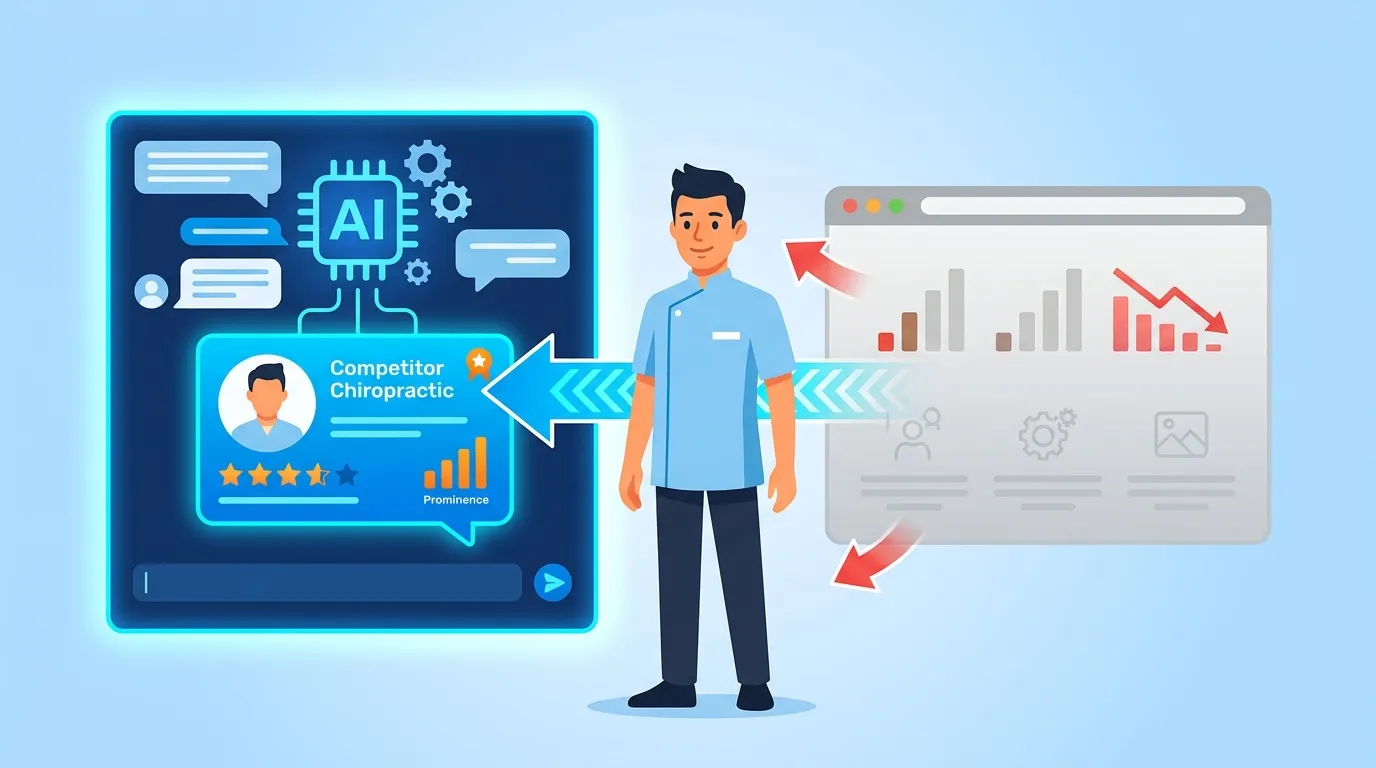
It's Wednesday afternoon. Your rooms are packed. A new patient just asked Perplexity which chiropractor to trust for herniated disc pain down the road. Your competitor got the recommendation.
You never knew the question was asked.
AI doesn't evaluate your reputation. It evaluates your infrastructure.
Traditional search volume is already declining as patients shift to AI for answers. Right now, only 1.2% of local businesses are being recommended by ChatGPT. The AI Authority Engine was built to put your practice in that 1.2%.
The Digital Brochure Fallacy
I've watched this happen with practices that have genuinely strong reputations. Full schedules. Loyal patients. Real clinical results. The AI still skipped them. Not because they were bad at what they do. Because their digital footprint was a mess.
Most agencies build websites for window shoppers.
They focus on how it looks in a browser. The fonts. The hero image. The "About Our Approach" section that sounds like every other chiropractic website ever written. Then they hand you the invoice and call it a digital presence.
That's the Digital Brochure Fallacy. A static placeholder dressed up as authority.
AI engines don't scroll your site the way a patient does. They parse it. They're running one check: can this practice be verified? Wrong address on one directory. Inconsistent phone number on another. That's enough. You get skipped. Not flagged. Not penalized. Just quietly removed from consideration.
More than 60% of searches now end without a click. Patients aren't comparing ten options. They're asking AI who to call and trusting the first name they get back. The game is being decided at the infrastructure level — not the impression level.
Traditional SEO optimizes for a ranked list. AI search produces a verdict. Those aren't variations of the same thing. The docs still chasing keyword rankings are measuring a channel their patients already left.
What AI Invisibility Actually Costs You
The brutal part? You don't see the leak.
Green reports every month. Traffic ticking up. Reviews coming in. Meanwhile, a chunk of your future patients asked an AI who to trust and got a competitor's name. That interaction never shows up in your dashboard. It just never happened — for you.
I've run this check with practices that were absolutely convinced they were in good shape. Most of them weren't. Their agency had optimized for every metric that doesn't matter in an AI-first search landscape.
- The invisible query problem — The patient asks AI, gets a competitor's name, and contacts them directly. No click. No visit. No record of the miss. It's a revenue gap that doesn't show up in any report you're currently receiving.
- The vanity metric blind spot — Traffic, impressions, and keyword rankings measure the old game. None of those numbers tell you who asked an AI about your specialty this week and got someone else's name back.
- The compounding cost — Every month a competitor's Authority Infrastructure grows is a month they widen their lead. This isn't a fixed gap. It widens with every cluster they publish.
Most practices don't know what they're missing until they look. For the full picture of what an AI authority system does, the core authority framework for chiropractic practices breaks it down.
Phase 1: Entity Hardening — Locking Who You Are Before AI Invents Someone Else
Most docs have never heard of Entity Hardening. That's part of the problem.
It goes first for a reason. Not because it's the most exciting phase. Because everything after it fails if this is broken.
AI engines don't take your word for who you are. They check. If the sources they use to verify you tell different stories — different address here, different name there — you have a trustworthiness problem. And a practice with a trustworthiness problem doesn't get recommended. Full stop.
Why AI Will Fabricate Your Identity If You Don't
This part tends to surprise people. But it's real.
When AI engines encounter conflicting entity signals, they fill in the gaps. They pattern-match from whatever sources they can find and construct a version of your practice that may have nothing to do with reality. I've seen AI produce fictional founders, wrong addresses, and merges of two completely separate clinics into one invented entity.
The AI isn't trying to deceive anyone. It's doing exactly what it was built to do: find the most plausible answer from available signals. If your signals are a mess, the answer it constructs is a mess.
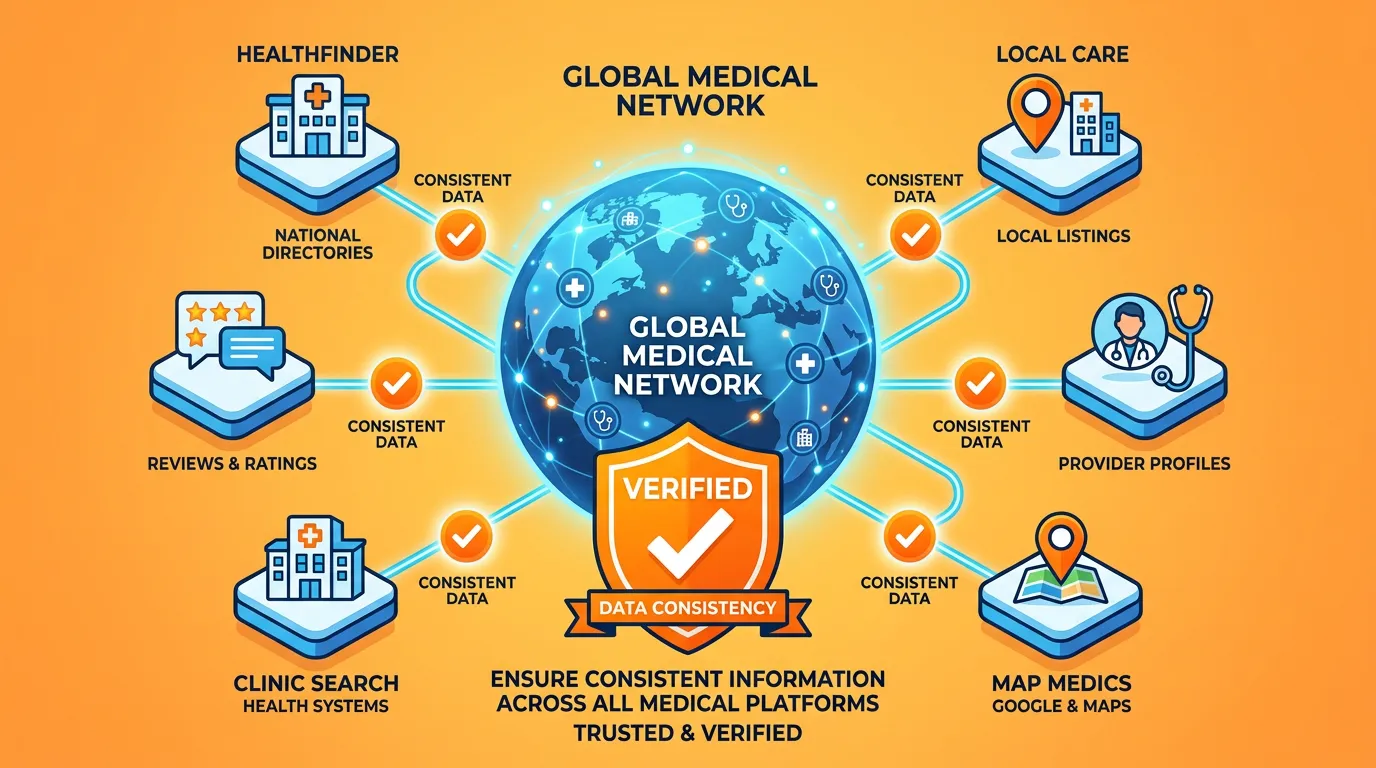
Entity Hardening closes that door. We audit and systematically clean every directory, listing platform, and healthcare database your practice appears in — locking a single, verifiable version of your identity across everything AI engines check.
- Name consistency — One canonical version of your practice name. Same capitalization, same formatting, same legal handling — everywhere, every time, no exceptions.
- Address precision — Suite numbers, street abbreviations, and any location history resolved to a single authoritative address. Every variation is a signal problem.
- Phone consolidation — One canonical number across every platform. Old tracking lines, disconnected numbers, and legacy listings removed entirely.
The output is what we call your verifiable entity. The version of your practice AI engines can match, confirm, and trust. Without it, Phase 2 is noise.
The NAP Cleanup and the Global Knowledge Graph
NAP — Name, Address, Phone — is the baseline. But the Global Knowledge Graph is bigger.
AI engines aren't just checking your Google Business Profile. They're pulling from a web of interconnected data: healthcare-specific directories, local authority sites, review aggregators, social profiles, business registration databases. Any inconsistency in that web becomes a trust signal that works against you.
That full web is what we audit and clean. Not the obvious platforms. All of them.
- Healthcare directories — Platforms AI engines specifically weight for local medical practice validation. These carry more trust signal than general business directories and need to be treated that way.
- Local authority platforms — City and regional business sources that anchor geographic identity for local entity verification. Often overlooked. Often broken.
- Review and social layers — Profiles that AI engines cross-reference to confirm ownership and operational status. Outdated info on these platforms actively undermines everything else.
It's not glamorous work. I'll tell you that directly. It's the kind of cleanup that never happens when an agency is more focused on launching your next campaign than auditing what's broken underneath it. But skip it and nothing else we build holds.
Phase 2: Infrastructure Rebuild — Making Your Site Machine-Readable, Not Just Pretty
Your website probably looks fine. That's not the issue.
The issue is what AI engines encounter when they try to read it. Most chiropractic websites were built for visual consumption. They look professional in Chrome and accomplish nothing for an AI engine deciding whether to cite you. AI doesn't see design. It reads structured data. And if your site doesn't speak that language, it doesn't get cited — regardless of how much it cost to build.
Schema Markup: Speaking the Language AI Understands
Schema markup is the translator.
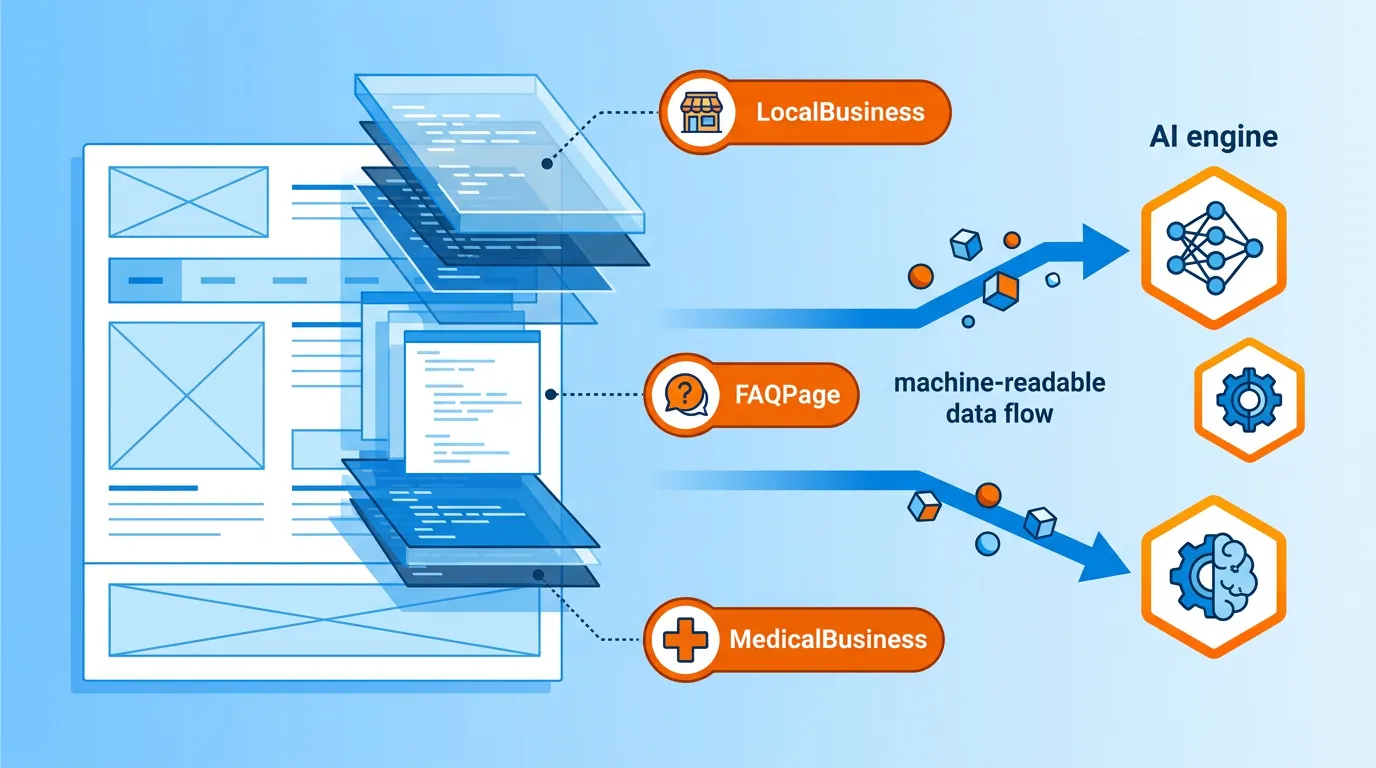
It's code that tells AI engines — in their own language — exactly what your practice is, what you treat, where you operate, and why you're a credible source. Without it, AI has to guess. With it, every key fact about your practice is declared explicitly, machine-readable, and verifiable.
The White-Glove Blueprint implements a full suite of schema types built specifically for medical and local businesses:
- LocalBusiness Schema — Declares identity, location, contact details, and operating hours in a structured format AI engines parse directly. The baseline layer that anchors everything else.
- MedicalBusiness Schema — Confirms the clinical nature of the practice. Healthcare-specific queries require this layer to surface medical recommendations — a general LocalBusiness declaration isn't enough.
- FAQPage Schema — Embeds the most common patient questions directly into your site's code so AI engines extract your answers first. Not a generic health directory. Not a competitor. You.
AI models grounded in structured knowledge graphs produce significantly more accurate and consistent citation results. Comprehensive schema implementation across article, FAQ, and organizational schema types has a measurable impact on how often AI engines cite a given source. This isn't optional optimization. It's the language requirement for playing the game at all.
The AI-Aligned Information Hierarchy
Schema handles the code layer. Information hierarchy handles everything above it.
AI engines evaluate how content is organized — what's answered first, what's structured clearly, what's buried. A site where the most clinically relevant answers are stacked below a homepage slider and a practice philosophy section isn't getting cited. A site where every major patient query is answered directly, structured cleanly, and reinforced with the right schema is a different animal.
Phase 2 rebuilds both layers in sequence.
- Semantic content restructure — Key service and clinical topic pages get rebuilt around actual patient questions. Not keyword headers. Not "Our Comprehensive Approach" sections. Direct answers to what patients are actually asking AI.
- AI-first information priority — The content that matters most gets the most prominent position in the page hierarchy. Not below the fold. Not in an FAQ tab nobody clicks. Front and center where machine parsing finds it first.
- Entity declaration continuity — Every page reinforces the same verified identity locked in Phase 1. No ambiguity about who runs this practice and who the authoritative voice is.
When Phase 2 is done, your site speaks AI's language. Not just visually presentable. Actually readable — by the engines that decide who gets recommended.
Phase 3 puts it to work.
To see the full contrast between this approach and what most agencies are still building, why the old authority model is dying breaks down every structural difference.
Phase 3: AEO Content Execution — The Ongoing Engine
Phases 1 and 2 are the foundation. Phase 3 is the engine.
Here's what a lot of practices get wrong when they try to shortcut this: content published on top of a broken infrastructure doesn't work. Generic articles on an unverified entity with no schema don't get cited. The sequence isn't arbitrary. Each phase creates the conditions the next phase requires.
When the foundation is clean, AEO Content Execution starts compounding.
The Two-AI Validation System
Most agencies have one person write your content and maybe one person edit it.
We've built something different. Not because it sounds better — because single-AI content production gets things wrong in ways that actively damage authority signals. Hallucinated statistics. Misattributed claims. Structural problems that AI engines flag on the back end.
The Two-AI Validation System is the loop that eliminates that.
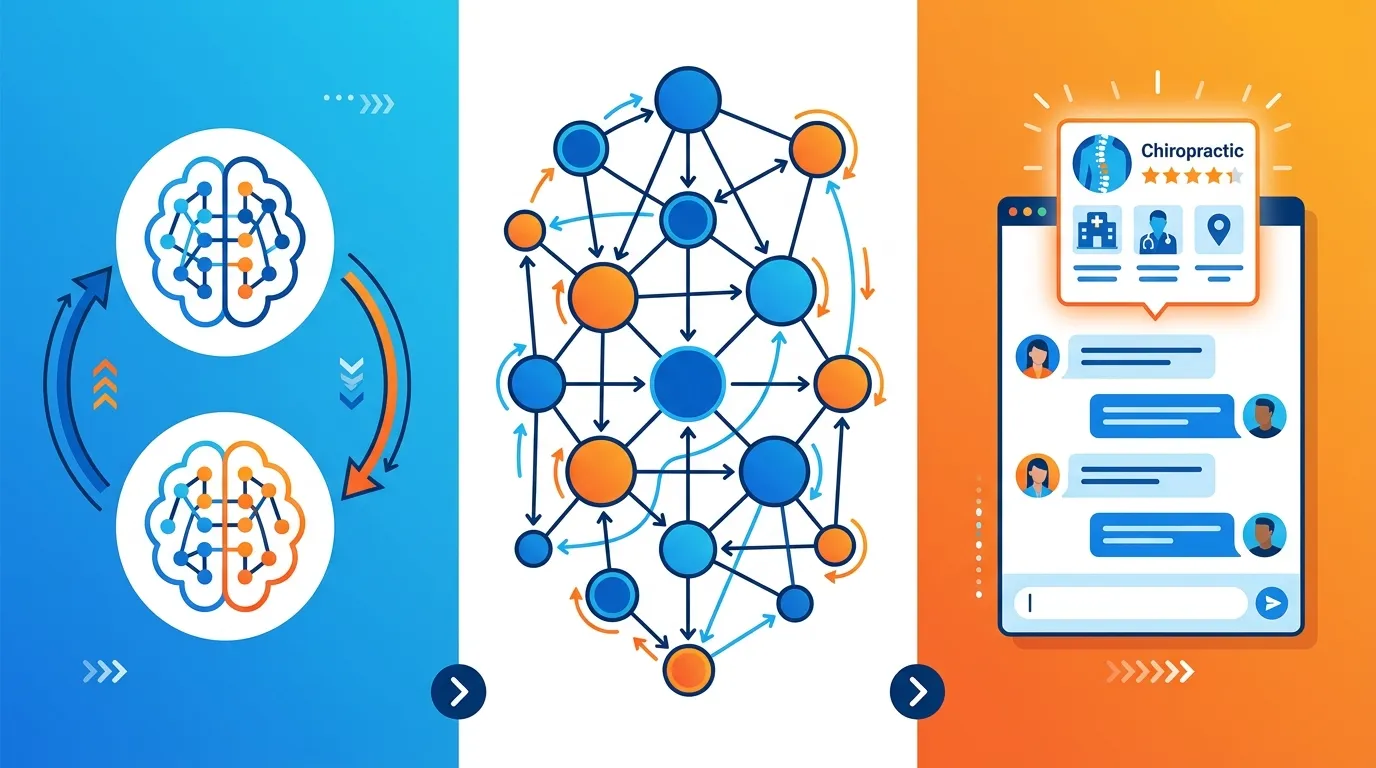
- Gemini validation — Every Authority Node starts with a Gemini research brief: topic validation, clinical accuracy verification, high-intent query identification, and source mapping. Nothing gets written until the brief is locked.
- Claude execution — Content production runs against the validated brief. Structured hierarchy, FAQ integration, schema-aligned architecture — all built to what Gemini confirmed, not improvised from scratch.
- Cross-check integrity — Each stage checks the other. Gemini catches research errors before execution. Claude catches structural gaps after. The output that hits your site has been through both filters.
Why does this matter beyond quality? Because AI engines cite sources they can verify. Content with inaccurate claims or conflicting entity data gets deprioritized — not rewarded. Every node we publish is clean by design.
For the full mechanics behind the loop, how the Two-AI content system delivers machine trust goes deep on the methodology.
The 12-Node Authority Cluster
One great article doesn't build AI authority. A cluster does.
AI engines don't reward isolated content. They reward topical depth. Comprehensive coverage of a subject from multiple angles — clinical, educational, comparative, FAQ-based — is what registers as genuine expertise. One strong piece surrounded by nothing looks exactly like what it is.
Every monthly Authority Cluster is 12 interlinked nodes built around a single high-intent patient query. Each node covers a distinct angle. Together they form a semantic cluster that AI engines recognize as thorough, structured authority on the topic.
- Individual nodes answer specific patient questions with Two-AI validated accuracy, schema markup, and structured information hierarchy. Each one is a citable, machine-readable answer to a real query.
- Cluster architecture connects those nodes semantically — building the topical depth AI engines associate with genuine clinical expertise rather than surface-level keyword content.
- Monthly cadence compounds the depth over time. Each new cluster layers on top of what's already built. The authority signal stacks. The gap from competitors widens with every cycle.
That's the 10-Mile Market Lock. One chiropractor per 10-mile radius. Not competing for the AI recommendation in their market — owning it.
For a clear look at what these authority signals actually look like versus the vanity metrics most agencies are still reporting on, what actually drives AI recommendation decisions is worth reading.
| Phase | What We Build | Why It Matters | Your Involvement |
|---|---|---|---|
| Phase 1: Entity Hardening | Verified, consistent data signals across all medical and local directories | AI engines can't recommend a practice they can't verify as a real entity | Zero — we handle all directory audit and cleanup |
| Phase 2: Infrastructure Rebuild | Deep schema markup + AI-aligned site content hierarchy | Your site speaks AI's language and confirms your authority signals at the code level | Zero — we handle all technical implementation |
| Phase 3: AEO Content Execution | 12-node monthly Authority Clusters validated by Two-AI System | Compound content authority that builds month over month on a clean foundation | Zero — we handle all research, writing, and validation |
| Traditional SEO | White-Glove Blueprint | |
|---|---|---|
| What you're buying | Monthly access to a service | Authority infrastructure you own |
| Core metric | Keyword rankings, traffic volume | AI citation rate, entity verification |
| Patient acquisition model | Click-based → patient evaluates options → chooses | Verdict-based → patient trusts the recommendation → contacts |
| Your involvement | Content approvals, updates, regular check-ins required | Zero client involvement required |
| Shelf life | Visibility expires when you stop paying | Compounds in value over time |
This Blueprint Isn't for Everyone

I'm going to say something directly, because I'd rather save you the time.
The White-Glove Blueprint is a $15,000 authority infrastructure investment. Not a monthly retainer. Not a trial run. A foundational asset build with ongoing execution behind it.
If the first question in your head right now is "how does this compare to what I'm paying my current agency per month" — this probably isn't the right fit. And that's fine. Not every doctor is in the right position for this right now.
If Budget Is Your First Question, Keep Scrolling
Here's the frame that actually matters: renting attention versus owning authority.
Traditional agencies sell you access. You pay every month. They manage the campaigns. You stop paying, the visibility stops. You own nothing at the end of the contract — not the strategy, not the content, not the results. Just a history of invoices.
The White-Glove Blueprint is an asset build. The entity work is permanently hardened. The infrastructure belongs to your practice. The authority clusters compound with every publication cycle. Pause the engagement and the foundation stays. You built something. Not access to something.
If you're not ready for that investment right now, the free AI Visibility Check will at minimum show you where you actually stand before you make any decisions at all. That's useful regardless of what you decide next.
But if you're primarily looking for the least expensive way to check a marketing box — you'll get exactly that. A box that got checked. Nothing that moves the needle.
Authority Takes Time — And That's the Point
Let me be equally direct about timelines.
The White-Glove Blueprint is not a quick-win play. Authority compounds — that's both why it works and why it takes time. A practice that starts building now will widen the gap on every competitor in their market with every passing month.
I tell docs this directly: if you need patients by next Tuesday, this isn't the right call. There are other ways to generate short-term volume. We don't do that work. What we build is the kind of authority infrastructure that makes AI say your name first — and keeps saying it.
- Infrastructure phase — Entity cleanup and schema rebuild execute first. Foundational work that doesn't show up in any dashboard you're currently using, but makes everything after it possible.
- Content compound phase — Monthly Authority Clusters stack on a clean, verified foundation. The depth grows with every cycle. Not overnight.
- Market lock phase — As clusters compound, your practice becomes the default answer for clinical queries in your area. AI engines recognize authority through consistency and volume — not a single strong piece.
If that timeline matches how you think about building a practice — not a campaign, but an asset — this is the right conversation.
| Renting Attention (Traditional SEO) | Owning Authority (White-Glove Blueprint) | |
|---|---|---|
| Monthly investment | Recurring cost, zero equity accumulated | Foundational asset build with ongoing compound value |
| If you pause | Visibility disappears immediately | Authority base remains; compound growth slows |
| What AI sees | Inconsistent signals, no structured trust layer | Verified entity with compounding content depth |
| Long-term outcome | Perpetual dependency on monthly spend | Self-reinforcing authority ecosystem |
Frequently Asked Questions
Do I need to be involved in the content writing or technical setup?
No. That's the entire premise of white-glove delivery.
The whole model is built around keeping you out of the process. Your calendar stays clear. Your attention stays on patient care. We handle the NAP audit, the directory cleanup, the schema build, the Authority Cluster production, the Two-AI validation — every piece of execution from Phase 1 through Phase 3 runs without a single to-do landing on your desk.
What is the "Two-AI Validation System"?
It's a proprietary production loop designed to eliminate the hallucinations and inaccuracies that single-AI content systems routinely produce.
Here's what that looks like in practice: Gemini validates the research and clinical accuracy before anything gets written. Claude executes the Authority Node against that validated brief. Then both outputs get cross-checked before anything publishes. You get content that's been through two verification layers — not one — before it ever touches your site. For the full methodology, how the Two-AI content system delivers machine trust goes deep on every step.
Why do you focus on Entity Hardening first?
Because nothing else works without it.
Skip Entity Hardening and build great content on top of conflicting directory signals — the AI still sees a trustworthiness problem. Schema doesn't fix it. Authority Clusters don't fix it. The only thing that fixes it is locking your entity data first. I've seen AI engines fabricate fictional founders and merge separate practices into invented entities when the underlying data was inconsistent. We close that door before we build anything on top of it.
How does the White-Glove Blueprint create a "10-Mile Market Lock"?
Simple exclusivity model. iTech Valet accepts only one chiropractor per 10-mile radius into the AI Authority System.
We don't build competing practices in the same market. That's not a policy we're flexible on. The whole model is built around singular ownership of the AI recommendation in a given area — not sharing it, not competing for it. When the blueprint is complete, you're the default answer. Not one of several. The answer.
Is there a reporting dashboard for this blueprint?
No. And that's intentional.
Anyone selling you a dashboard that tracks your AI citation count like a keyword ranking is selling something that doesn't exist in a verifiable format. That data isn't reliably accessible. We don't pretend it is. What we use instead is systematic multi-engine discovery — we ask ChatGPT, Gemini, and Perplexity who they recommend for your specific queries in your specific market. We document the answers. We track how they change. That's a real test. A dashboard showing a citation estimate isn't.
Can't my current SEO company handle this?
AI gives one answer. Either your name is that answer or it isn't.
That's not a refinement of the traditional SEO model. It's a different game entirely. Most agencies were built to optimize a ranked list — where you show up in position 3 versus position 7. AEO is built to win a verdict. Most of them have no Entity Hardening framework, no schema depth protocol, and no content validation system built for how AI engines actually evaluate authority. They're optimizing for a channel their patients are leaving. That's not a judgment on anyone individually — it's a structural mismatch between what the market requires now and what most agencies were built to deliver.
What happens if a competitor in my market is already using iTech Valet?
Nothing — because they can't be.
One practice per 10-mile radius. That's the model. If you're asking this question, the real question underneath it is whether you should move before someone else in your market does. That's worth sitting with for a minute.
How should I think about the $15,000 investment relative to what I'm spending now?
Think about it as buying the building versus renting the office.
You've probably been renting. Every month you pay for access to a service. Stop paying, everything stops. The agency retains the strategy. You retain nothing. The White-Glove Blueprint works differently — the entity hardening is permanent, the infrastructure belongs to your practice, and the authority asset compounds with every cluster. It doesn't evaporate when you pause. The question isn't whether you can afford the investment. It's whether you can afford to keep renting while your competitor buys their building.
The Gap Widens Every Month You Wait
AI gives one answer.
Not a list. Not a "here are some options." A name.
When a patient asks ChatGPT who to trust for sciatica treatment near them, it returns a verdict. Maybe two. If yours isn't one of them, that patient never reaches your website. They never call your front desk. You never know they existed. And your competitor — the one who built the infrastructure you haven't built yet — gets the call instead.
I've watched this math play out. It doesn't reverse on its own. Every month that passes, the gap between a practice with compounding authority and one without it gets wider. Not dramatically. Not visibly. Just steadily, reliably, one cluster at a time.
The practices building Authority Infrastructure right now aren't doing something clever. They're doing something early.
The White-Glove Blueprint is the systematic answer to a structural problem. Three phases. A clean sequence. Zero work on your end. The only thing standing between your practice and AI authority is the execution — and that's exactly what we handle.
Your name either comes up or it doesn't. Right now, for most of the patients asking AI who to trust in your market, it probably isn't coming up.
The AI Visibility Check is a fast diagnostic that shows you exactly where you stand — which engines see you, which don't, and what the gap looks like between where you are and where the blueprint builds to.
No pitch attached to it. Just the map.
Find out where AI currently stands on your practice — the market in your ZIP code isn't standing still.
621 Enterprises, Inc. | Copyright 2026 | All rights reserved