Why AI Authority Decays (And How to Stop It)
Here's what happens: AI engines like ChatGPT, Gemini, and Grok constantly re-evaluate entity trust. They're not looking at a snapshot of your practice from six months ago. They're analyzing real-time signals: content freshness, citation velocity, semantic density, and whether your entity data remains consistent and authoritative. If you stop producing new AEO content, those signals weaken. Not because what you built was wrong, but because authority is comparative. If your competitors are still executing and you're not, the gap closes. Fast.
The maintenance protocol isn't about preventing catastrophic failure. It's about protecting the lead you built and ensuring the $15,000 you invested in the Local AI Authority Engine continues to compound in year two, year three, and beyond. This article breaks down exactly why authority decays, what the maintenance protocol looks like in practice, and how to think about ongoing execution as asset management — not an endless retainer.
Last Updated: April 24, 2026
Authority Decay: The Invisible Enemy
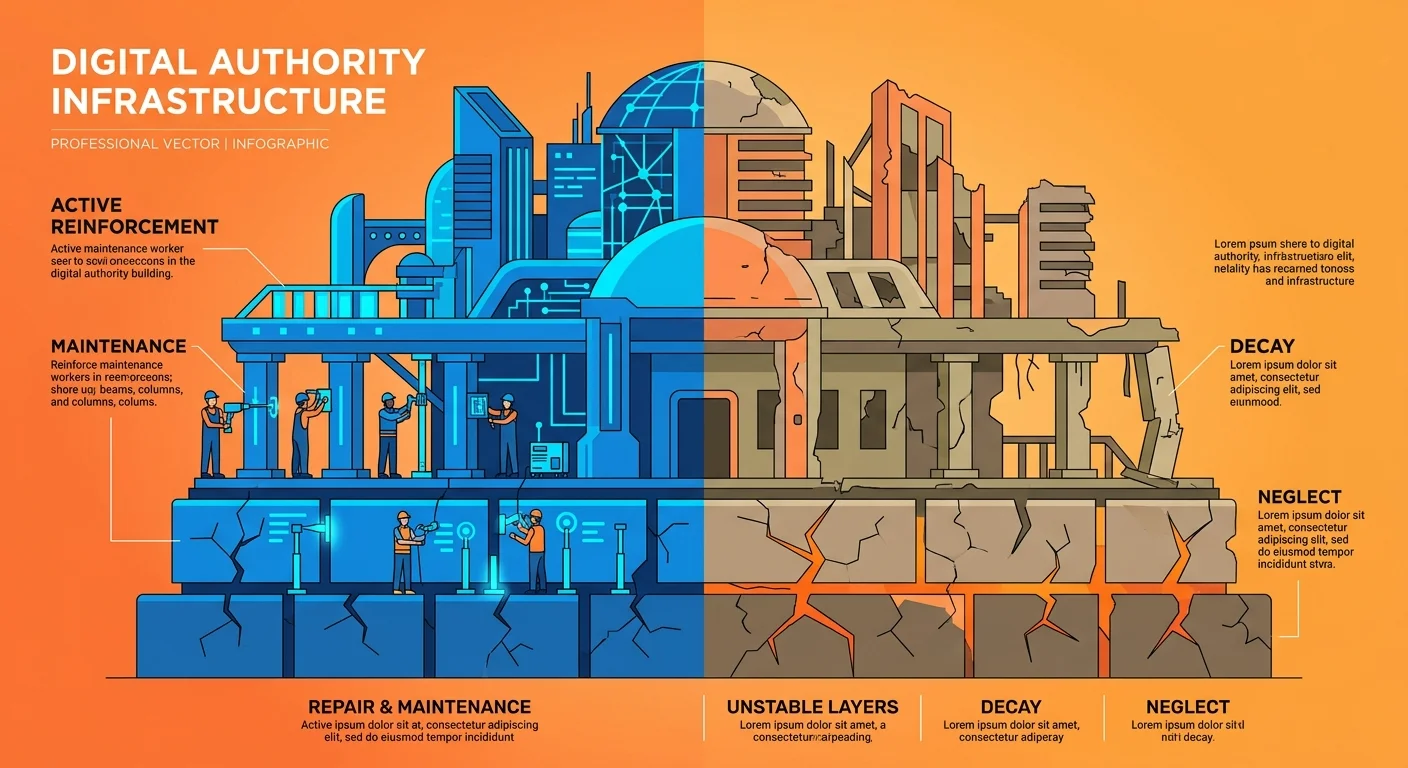
Authority doesn't vanish overnight. It gets watered down.
AI engines see your competitors publishing fresh content and start trusting them more. That's authority decay — the slow, quiet process of becoming irrelevant because you stood still.
The infrastructure we built for you isn't the problem. The problem is what happens when you stop feeding it new signals. AI engines look at your entity data today and compare it to what they saw six months ago. Nothing changed. Meanwhile, your competitors kept publishing. Kept building citation velocity. Kept reinforcing entity trust.
The digital marketing industry sold you a lie: build it once, and you're done.
That works for a brochure. It doesn't work for authority.
Because authority is comparative. AI doesn't evaluate you in isolation. It evaluates you against everyone else answering the same queries. If they're moving forward while you're standing still, you're not staying neutral. You're falling behind.
What Authority Decay Actually Means
It's the gradual weakening of the trust signals AI engines use to determine whose name they say when someone asks a question.
Your content doesn't disappear. But your competitors' content becomes more relevant, more current, and more trusted — while yours becomes stale.
Think about how AI answer engines work. They don't just look at what exists. They evaluate recency, consistency, and context. A practice that published 12 AEO articles last year but nothing since isn't maintaining authority. They're watching it erode.
The content is still there. The infrastructure is still intact. But the signals that tell AI "this entity is active, trusted, and current" are weakening.
Here's what decays first:
- Content freshness — AI prioritizes entities with recent, relevant content updates
- Citation velocity — The rate at which your entity appears in new authoritative contexts
- Semantic relevance — How well your content matches evolving patient language and query patterns
- Entity consistency — Whether your NAP data, credentials, and service descriptions remain aligned across platforms
| Factor | Authority Decay | Traditional Site Degradation |
|---|---|---|
| Cause | Competitors strengthen while you stand still | Technical errors or broken functionality |
| Visibility | Gradual and comparative — you lose ground relative to others | Immediate and absolute — site breaks or rankings tank |
| Fix | Resume consistent AEO execution and entity signal reinforcement | Repair technical issues or rebuild infrastructure |
| Timeline | Slow erosion over 6-12 months | Can happen overnight |
The Signals That Weaken First
Not all trust signals decay at the same rate. Some erode fast. Others hold longer.
Understanding which signals weaken first tells you where the gaps open — and where competitors exploit them.
Content freshness is the first casualty.
AI engines use publication dates and update timestamps to evaluate relevance. A practice that hasn't published new content in six months sends a signal: this entity isn't actively engaged in the topic space.
Doesn't matter if the content from last year is still accurate. Google's freshness algorithm prioritizes newer, relevant results because it assumes they reflect current understanding and active expertise.
Citation velocity follows.
This is the rate at which your entity appears in new, authoritative contexts — directories, industry platforms, semantic clusters. If you stop producing AEO content, you stop creating citation opportunities.
Competitors executing monthly content build those opportunities every 30 days. The gap compounds.
Semantic relevance drifts slowly but inevitably.
Patient language evolves. The way people ask questions changes. AI query patterns shift. Content written 12 months ago matched the semantic expectations of that moment.
Today's expectations are different. Not radically. Just enough that a competitor publishing fresh content optimized for current language patterns starts appearing more relevant.
Entity data consistency holds the longest — but only if you maintain it.
If your NAP data, schema, or directory profiles drift out of sync, AI engines lose confidence in the entity itself. This isn't decay. It's erosion from neglect.
Why Most Practices Don't See It Coming
Authority decay is invisible until it's obvious.
And by the time it's obvious, the damage is done.
Here's why: visibility doesn't vanish overnight. Traffic stays relatively steady in the first 90 days. AI engines still cite your existing infrastructure. Your Google Business Profile still ranks. Patients still find you — just like they did last month.
Everything looks fine.
Month four. Month five. You start noticing competitors appearing in AI recommendations alongside you. Not instead of you. Just... next to you.
That's the first signal. The gap is narrowing. You're no longer the only answer. You're one of several options.
Month seven. Month eight. AI engines begin favoring competitors with fresher content. You drop from "the answer" to "a decent option." New patient acquisition from AI recommendations slows.
Not enough to panic. Just enough to notice.
By month twelve, competitors who stayed consistent now own the recommendations you built the Local AI Authority Engine to capture. Your authority hasn't disappeared. It's just been displaced.
And reversing that displacement requires rebuilding momentum — not picking up where you left off.
Most practices don't see it coming because the decline is gradual. Linear at first. Then exponential.
The compound effect of authority works both ways. Consistent execution compounds your lead. Inaction compounds your competitor's gains.
Why "Set It and Forget It" Fails
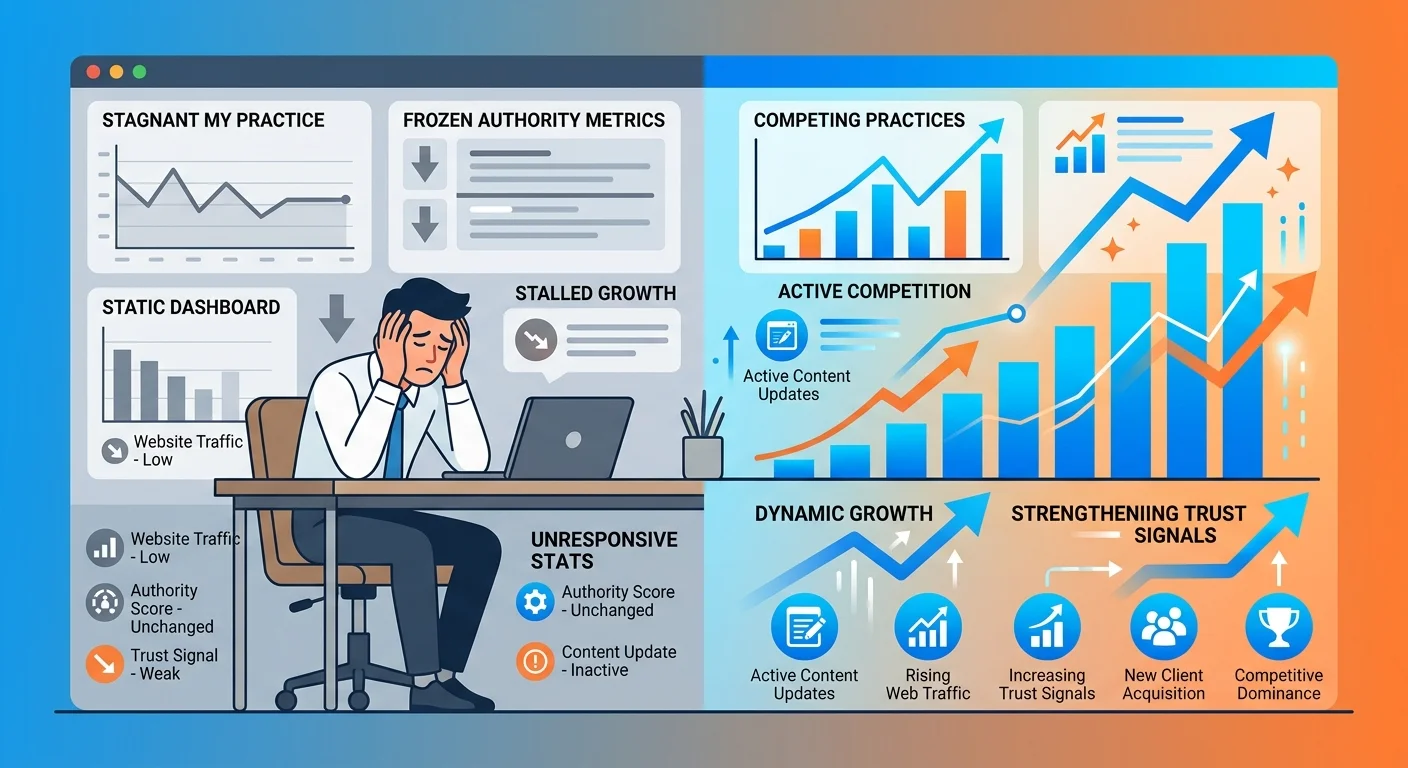
The "set it and forget it" mindset works for physical assets that don't compete.
You buy a building. You maintain the roof. You don't rebuild the foundation every year.
Digital authority doesn't work that way.
Your authority isn't a static possession. It's a position. And positions are comparative.
The moment you stop reinforcing your authority, competitors who are still executing start closing the gap. Not because you did anything wrong. Because they're doing the work you stopped doing.
The digital marketing industry conditioned you to think of websites as one-time projects. Build it. Launch it. Move on.
That model worked when websites were digital brochures. It doesn't work when AI engines evaluate real-time trust signals to determine whose name they say when someone asks a question.
The infrastructure you built is the foundation. The ongoing execution is what keeps AI engines convinced that foundation is still the most authoritative answer.
The Digital Asset Fallacy
You wouldn't buy an investment property and then refuse to maintain it.
You'd fix the roof when it leaks. You'd repaint when the exterior fades. You'd update the HVAC before it fails.
Not because the property is broken, but because maintenance protects the asset's value.
Digital authority works the same way. The infrastructure we built — your schema, entity architecture, internal linking structure, and initial content library — is the property.
The ongoing AEO content execution is the maintenance.
Without it, the asset doesn't break. It just becomes less valuable compared to competitors who are actively maintaining theirs.
UNESCO's research on digital preservation confirms this: digital assets, without active preservation and maintenance, are subject to decay, data loss, and eventual obsolescence.
Not because they fail. Because the ecosystem around them evolves — and assets that don't evolve with it become irrelevant.
The fallacy is assuming that because your website still functions, your authority is intact.
Functionality isn't authority. Authority is trust. And trust is comparative.
If AI engines see your entity data from six months ago and nothing has changed, they don't trust you less because you're broken. They trust you less because competitors are demonstrating current, active engagement in the topic space.
Authority Is Comparative, Not Absolute
Your authority doesn't exist in a vacuum.
AI engines evaluate you against every other practice answering the same queries. Every time ChatGPT, Gemini, or Grok processes a question like "best chiropractor near me," they're running a comparative analysis.
Who has the freshest content? Who has the strongest entity trust signals? Who demonstrates the most semantic relevance to the patient's actual intent?
If you built the infrastructure six months ago and stopped, your signals are frozen. Competitors executing monthly AEO content are strengthening their signals every 30 days.
The gap closes.
Not because you lost authority in an absolute sense, but because your comparative position weakened.
This is the compound effect of authority in reverse. Consistent execution doesn't just maintain your position. It widens the gap.
Inaction doesn't just stall your progress. It hands momentum to competitors.
The practices dominating AI recommendations 12 months from now aren't the ones with the best infrastructure. They're the ones that kept executing after the infrastructure was built.
The Hopium Trap
Here's the truth: the marketing industry sells one-time projects because they're easier to close.
"Build your website and you're done" sounds appealing. It sounds like a finish line.
But it's a lie.
Agencies sell hopium because ongoing execution requires ongoing commitment — from the client and the agency. It's harder to sell. It's harder to deliver. It requires white-glove service, consistent quality, and long-term strategic thinking.
Most agencies can't or won't do that work. So they sell the fantasy that authority is a project, not a process.
The "set it and forget it" buyer wants to believe that lie. They want authority to be a checkbox. Build it once. Move on. Focus on other priorities.
And six months later, they wonder why competitors are showing up in AI recommendations that used to belong to them.
Authority isn't a project. It's an asset. And like any asset, it requires stewardship.
The practices that treat it that way compound their lead. The ones that don't watch their competitors close the gap — and eventually take the position they built.
If you're looking for a way to check a box and walk away, this protocol isn't for you.
If you're serious about long-term visibility, keep reading.
The Maintenance Protocol: What It Actually Looks Like
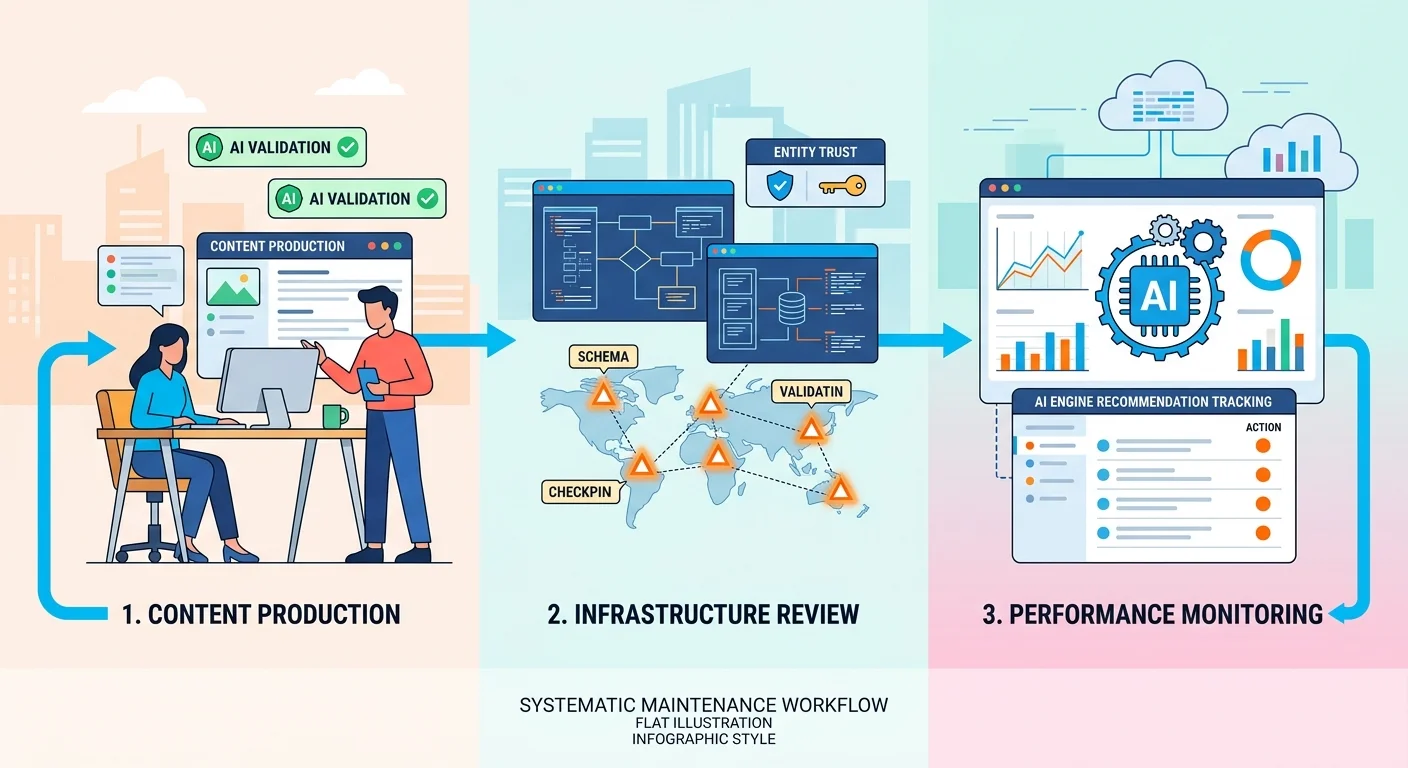
The maintenance protocol isn't a retainer for activity reports. It's not a subscription for monthly check-ins.
It's a systematic process for reinforcing the entity trust signals AI engines use to determine whose name they say when someone asks a question.
Here's what it actually involves: ongoing AEO content execution, quarterly infrastructure reviews, and real-time authority monitoring.
Each component serves a specific function. None of them are optional if you're serious about protecting the investment you made in the Authority Engine.
This isn't busywork. It's asset management.
The $1,200 per month after your initial 12-month engagement isn't paying for our time. It's paying for the compound effect of consistent execution — the only mechanism that ensures your authority continues to grow instead of decay.
Monthly AEO Content Execution
Twelve AEO articles per month. Every month. No gaps. No pauses. No "let's take a break and see what happens."
Each article goes through our Two-AI content system: Gemini researches and validates. Claude writes. Gemini validates again. Claude refines.
Every claim sourced. Every statistic verified.
We don't publish vibes. We publish receipts.
The content isn't random. It's clustered around the semantic anchors that reinforce your entity trust. Month one might focus on treatment modalities. Month two on patient outcomes. Month three on clinical expertise.
Every article builds on the infrastructure we established in year one. Every article strengthens the signals AI engines use to confirm you're the authority in your market.
This is where the compounding happens.
One article strengthens one signal. Twelve articles strengthen twelve signals. A hundred and forty-four articles over twelve months create a semantic density that competitors starting from zero can't replicate without the same level of consistent execution.
| Activity | Frequency | Purpose | Impact on Authority |
|---|---|---|---|
| AEO Content Production | 12 articles/month | Strengthen semantic density and citation velocity | Compounds entity trust signals monthly |
| Two-AI Validation | Every article | Ensure factual accuracy and eliminate AI hallucinations | Protects trust and prevents citation erosion |
| Semantic Clustering | Ongoing | Align content with entity signals and patient query patterns | Deepens relevance and topical authority |
| Internal Linking Updates | As needed | Maintain architecture flow and distribute authority | Reinforces entity relationships across content library |
Quarterly Infrastructure Review
The infrastructure doesn't need monthly attention. It needs strategic attention.
Every 90 days, we audit the foundation:
- Schema validation — Confirm all structured data remains accurate and machine-readable
- Entity data consistency — Verify NAP alignment across directories, profiles, and citations
- Internal linking architecture — Ensure authority flow remains intact as content library grows
- Technical performance scan — Check site speed, mobile responsiveness, and crawlability
These aren't maintenance tasks in the traditional sense. They're strategic checkpoints.
If schema drifts out of sync, AI engines lose confidence in your entity. If citation data conflicts across platforms, trust signals weaken. If internal linking degrades as new content is added, authority distribution breaks down.
The quarterly review catches those gaps before they compound into visibility problems.
It's not about fixing what's broken. It's about ensuring the foundation remains structurally sound as the content library expands.
Ongoing Entity Trust Reinforcement
Building Entity Trust isn't a one-time event. It's an ongoing process of confirming to AI engines that your entity data is accurate, consistent, and authoritative.
Every month, we:
- Update directory profiles — Ensure platforms like Healthgrades, Zocdoc, and Vitals reflect current entity data
- Verify citation consistency — Confirm your NAP appears identically across all platforms AI engines trust
- Maintain structured data — Keep schema markup aligned with content updates and service offerings
- Track authority signals — Monitor how AI engines cite your practice compared to competitors
This isn't SEO. This is identity management for AI.
Every inconsistency weakens trust. Every aligned signal strengthens it.
The maintenance protocol ensures the entity AI engines cite today matches the entity they'll cite six months from now.
| Action Type | Frequency | Authority Signal Reinforced |
|---|---|---|
| Directory Profile Updates | Monthly | Citation consistency and entity verification |
| Schema Maintenance | Quarterly | Machine-readable entity structure |
| Citation Audits | Quarterly | Cross-platform entity trust alignment |
| AI Visibility Checks | Quarterly | Real-time recommendation tracking and competitive positioning |
| Content Library Expansion | Monthly (12 articles) | Semantic density, citation velocity, topical authority |
How AI Engines Re-Evaluate Trust Over Time
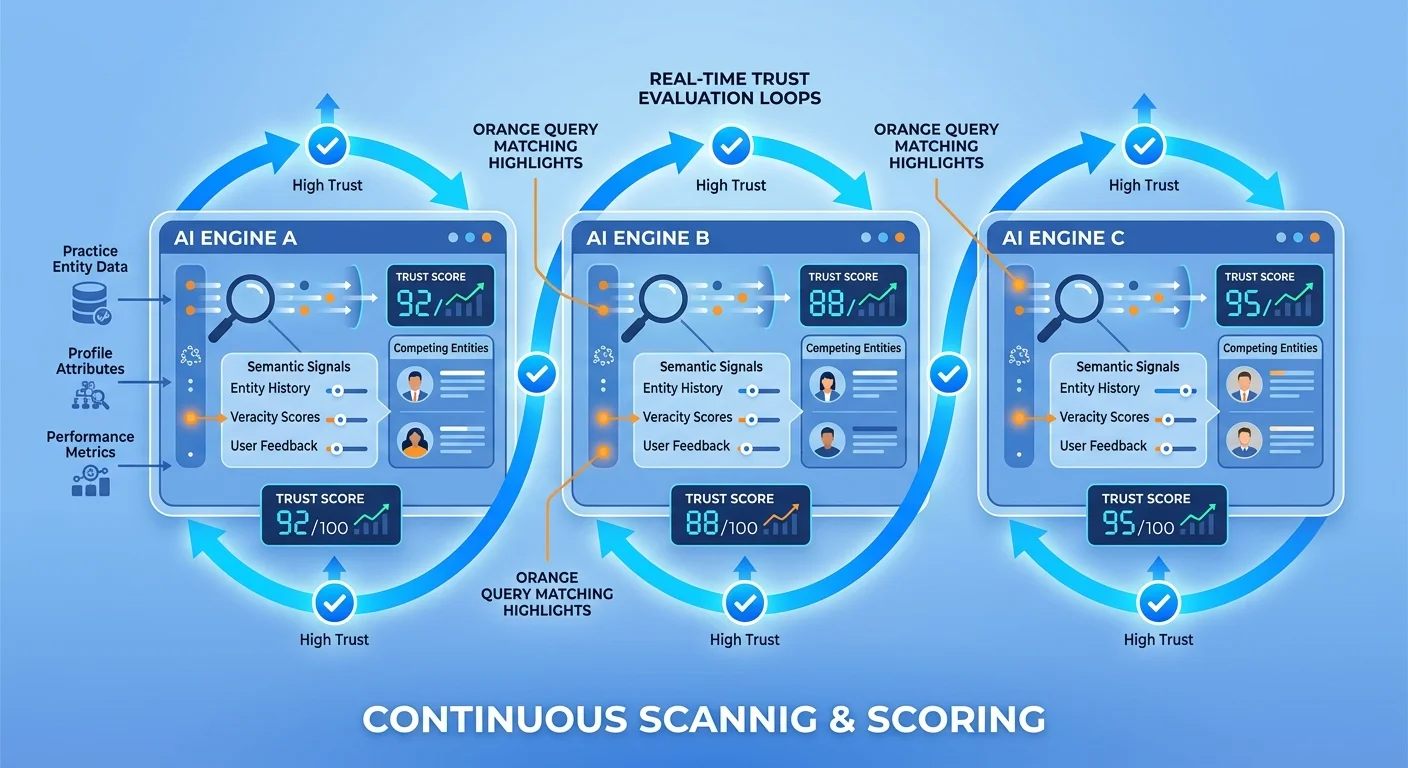
AI doesn't work from snapshots. It works from live evaluations.
Every query triggers a fresh analysis. Who has the most relevant content? Who demonstrates the strongest entity trust? Who matches the semantic intent of what the patient is actually asking?
This is why authority maintenance matters.
AI engines don't remember that you were the best answer six months ago. They evaluate whether you're the best answer right now.
And if competitors have been executing while you've been standing still, "right now" looks different than it did when you first built the infrastructure.
Research from Deloitte on trust in AI systems confirms this: building and maintaining trust in AI requires ongoing validation and performance monitoring — not a one-time setup.
The same principle applies to how AI engines evaluate your practice. Trust isn't granted once. It's re-earned with every query.
Real-Time vs. Cached Authority
AI engines use a combination of real-time signals and cached data to determine whose name they say.
The balance between the two shifts depending on the platform, the query type, and how frequently your entity data changes.
Real-time signals include:
- Recent content publication dates — When was the last time this entity published relevant content?
- Citation velocity — How often is this entity appearing in new authoritative contexts?
- Entity data freshness — When was this entity's structured data last updated?
Cached data includes:
- Historical trust weight — How long has this entity been recognized as authoritative?
- Accumulated semantic density — How much topical content exists in the entity's library?
- Established citation network — How many authoritative platforms cite this entity?
If your authority is strong in cached data but weak in real-time signals, AI engines start to question whether the cached trust is still valid.
Fresh content updates tell AI: "This entity is still active. Still relevant. Still the authority."
Without those updates, cached authority begins to erode — not immediately, but steadily.
The Citation Velocity Factor
Citation velocity isn't about how many citations you have. It's about how often you're getting new citations.
AI engines measure the rate at which your entity appears in fresh, relevant contexts. If that rate slows, it signals declining relevance — even if your total citation count remains high.
Think of it like this: a practice with 500 citations from 2023 and zero new citations in 2024 looks stagnant. A practice with 300 citations from 2023 and 144 new citations in 2024 (12 AEO articles per month) looks active, engaged, and growing.
AI engines favor the second practice.
Not because the total count is higher, but because the velocity demonstrates ongoing authority.
Monthly AEO content execution is the mechanism that maintains citation velocity. Every article creates new citation opportunities. Every semantic cluster reinforces entity trust. Every validation loop confirms factual accuracy.
Competitors who stop executing lose velocity. Competitors who keep going compound it.
Semantic Drift and Query Evolution
Patient language evolves. The way people ask questions changes. AI query patterns shift.
Content written 12 months ago matched the semantic expectations of that moment. Today's expectations aren't the same.
Not radically different. Just enough that a competitor publishing fresh content optimized for current language patterns starts appearing more semantically relevant.
AI engines prioritize content that matches how patients are asking questions today — not how they asked them last year.
This is semantic drift.
It's not about your content becoming wrong. It's about your content becoming less aligned with current query patterns.
The only way to counter it is ongoing content execution that tracks evolving patient language and adjusts semantic anchors accordingly.
The maintenance protocol doesn't just protect what you built. It ensures what you built stays aligned with how AI engines evaluate relevance today — not six months ago.
The Compounding Effect of Consistent Execution
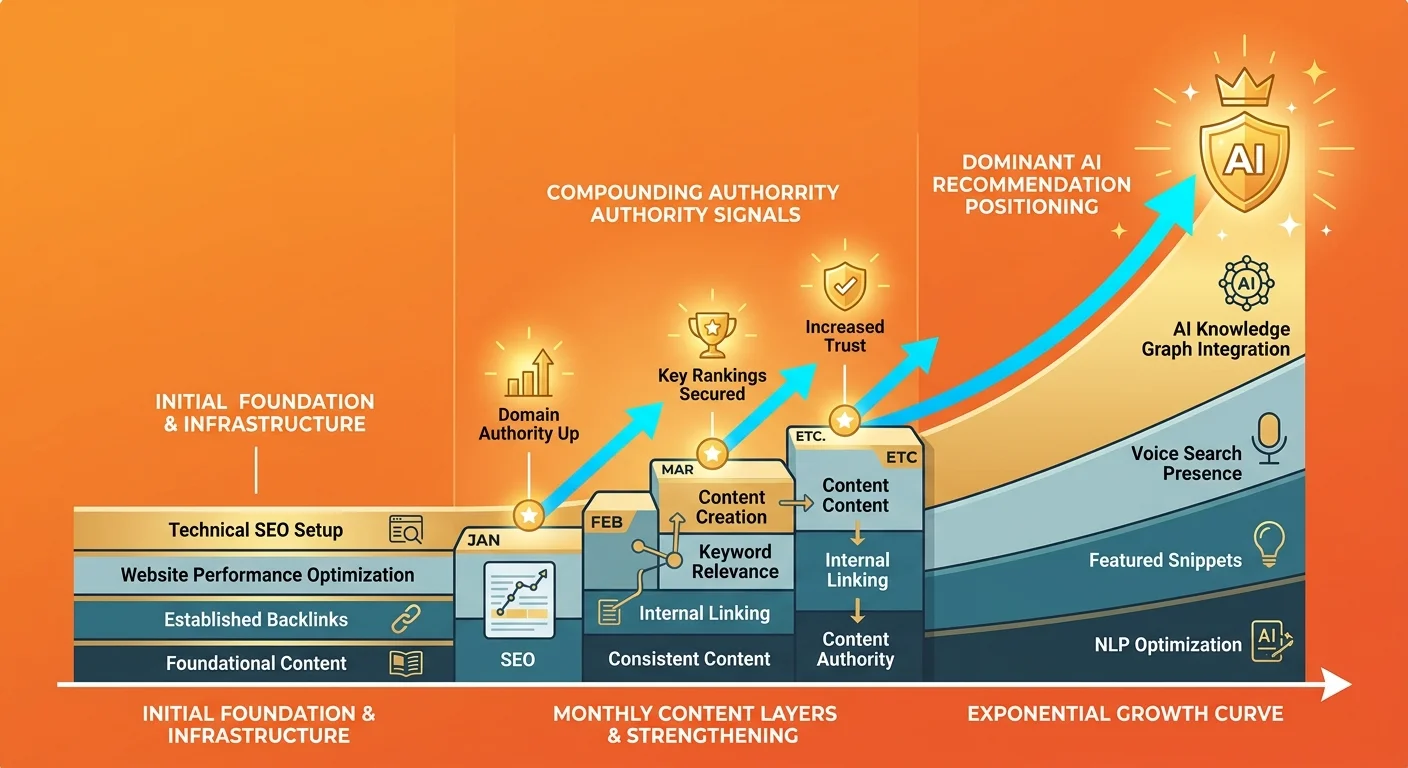
Authority doesn't grow linearly. It compounds.
Every month of consistent execution builds on the last. The infrastructure you established in year one is the foundation. The content you publish in year two strengthens the signals AI engines use to confirm that foundation is still the most authoritative answer.
This is where most practices get it wrong.
They think year one is the hard work and year two is maintenance. Year one builds the foundation. Year two is where the compounding accelerates.
The practices that quit after 12 months give up right before the exponential growth kicks in.
HubSpot's research on the compounding returns of content marketing confirms this: the value of content isn't linear.
Consistent publishing and maintenance leads to compounding visibility and authority over time. The first six months show modest gains. Months 7-12 show measurable growth.
Months 13-24 show exponential returns — if you keep executing.
Month 1-12: Building the Foundation
The first 12 months establish the infrastructure.
We build the authority engine: machine-readable schema, entity architecture optimized for AI trust, internal linking structure, and 144 AEO articles layering semantic density across your topical landscape.
By month six, you start appearing in AI recommendations. Not consistently. Not exclusively. But you're in the conversation.
AI engines recognize your entity. Your content matches patient queries. Your trust signals are strong enough to compete.
By month twelve, you're the answer.
Not one of several options. The answer. When someone asks ChatGPT, Gemini, or Grok who the best chiropractor in your area is, your name is the one they say.
That's not luck. That's the compound effect of 12 months of consistent execution building entity trust AI engines can't ignore.
But here's the thing: month twelve isn't the finish line. It's the inflection point.
The foundation is built. The trust is established. Now the compounding accelerates.
Month 13-24: The Compound Acceleration
Year two is where authority becomes a competitive moat.
Every new article you publish builds on the 144 articles from year one. Every trust signal you reinforce compounds on the signals you've already established.
Competitors who started later are still building their foundation. You're widening the gap.
The content library you built in year one gains trust weight. AI engines see: this entity has been producing authoritative content consistently for over a year.
That historical trust carries forward.
New content benefits from the accumulated authority of existing content. The semantic clusters deepen. The citation velocity strengthens. The entity trust becomes harder for competitors to displace.
This is where measuring AI citation value becomes critical. You're not just tracking whether AI engines cite you. You're tracking how often, in what contexts, and how your positioning compares to competitors.
The gap between "the answer" and "one of several options" is the difference between owning the market and fighting for scraps.
| Timeframe | Infrastructure State | Content Library Depth | Typical AI Visibility |
|---|---|---|---|
| Months 1-6 | Foundation being built | 72 AEO articles | Sporadic recommendations — entity recognized but not dominant |
| Months 7-12 | Infrastructure complete | 144 AEO articles | Consistent recommendations — competitive positioning established |
| Months 13-18 | Authority compounding | 216 AEO articles | Dominant recommendations — clear market leader in AI citations |
| Months 19-24 | Competitive moat established | 288 AEO articles | Exclusive recommendations — competitors struggling to compete |
The Widening Gap
Every month of consistent execution makes it harder for competitors to displace you.
Not because the system is rigged. Because you own more verified entity signals than they do.
A competitor starting today has to build the infrastructure you already own. They have to publish the content you've already published. They have to earn the trust you've already earned.
And while they're doing that, you're adding 12 new articles every month.
The gap doesn't stay static. It widens.
This is the compound effect in action. Authority isn't addition. It's multiplication.
One month of execution doesn't add one unit of authority. It multiplies the authority you've already built.
The longer you execute consistently, the harder it becomes for competitors to catch up — even if they're doing everything right.
The practices that dominate AI recommendations two years from now aren't the ones with the best infrastructure. They're the ones that kept executing.
Month after month. Building on what they already owned. Compounding the lead they established.
The AI authority case studies we track over 18-24 months all confirm the same pattern: consistent execution wins, not one-time builds.
What Happens When You Stop
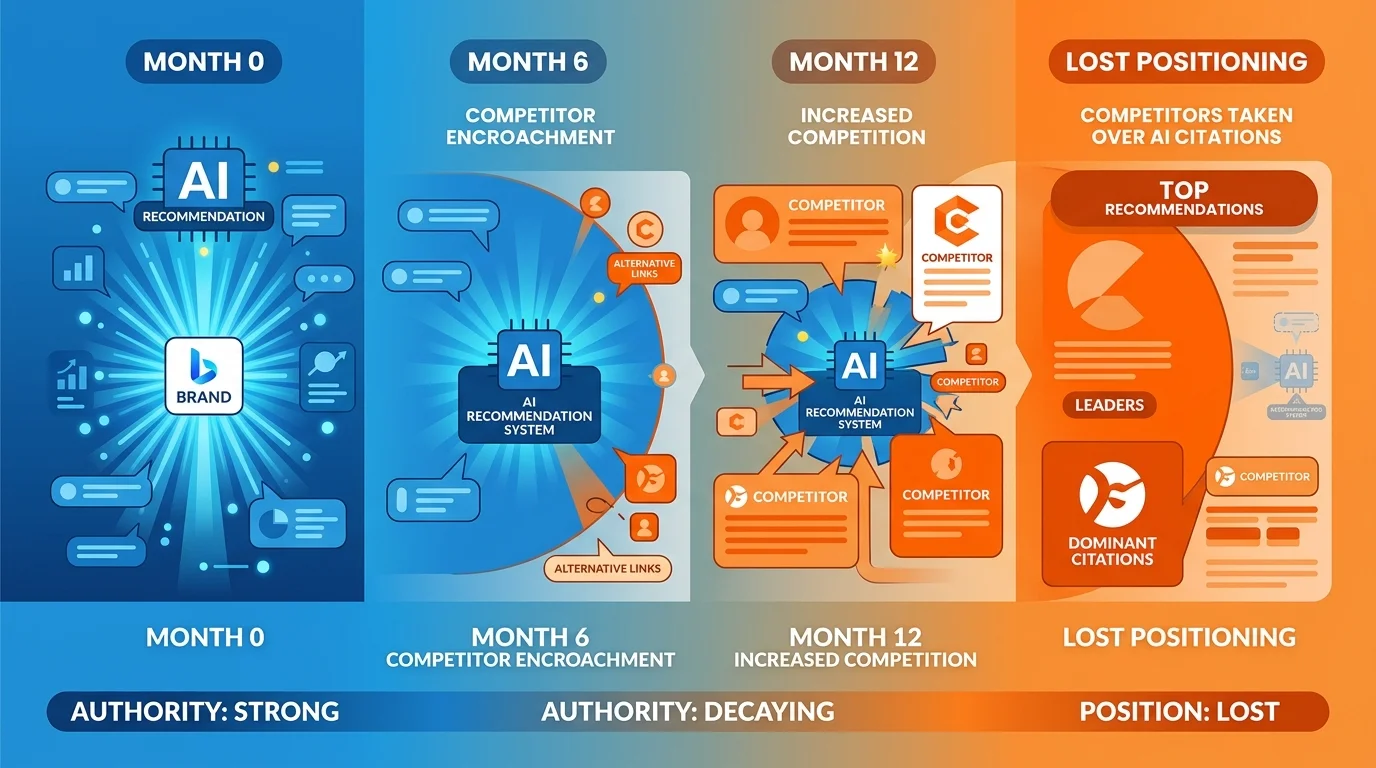
You built the foundation. You invested $15,000. You executed for 12 months.
AI engines recommend you. Patients find you. Everything is working.
So you stop.
You pause the monthly content execution. You focus on other priorities. You assume the infrastructure you built will carry forward.
Here's what happens next.
The decay doesn't start immediately. The first 90 days feel fine. Traffic stays stable. AI engines still cite your existing content. Your Google Business Profile still ranks. Patients still book appointments.
Everything looks exactly like it did when you were executing.
That's the trap.
The First 90 Days: False Security
Month one after you stop: nothing changes.
Your authority is still strong. The infrastructure is intact. The content library is still fresh enough that AI engines trust it.
Competitors are executing, but their signals aren't strong enough yet to displace you.
Month two: still stable.
You might notice a slight drop in new patient inquiries from AI recommendations, but it's within normal variance. Nothing alarming. Nothing that makes you think stopping was a mistake.
Month three: competitors start appearing alongside you in AI recommendations.
Not instead of you. Just... next to you.
You're no longer the exclusive answer. You're one of several options. That's the first signal. The gap is narrowing.
But traffic hasn't dropped enough to panic. So you rationalize: "We built the infrastructure. It's holding."
False security. The decay has already started. You just can't see it yet.
Month 4-6: The Quiet Shift
By month four, the shift becomes measurable.
Competitors who kept executing now have four additional months of content strengthening their entity trust. Their citation velocity is rising. Yours is frozen.
AI engines notice.
You're still being recommended. But the frequency drops. The context shifts.
Instead of "the best chiropractor in [city]," you're now "a good option for [specific treatment]." The semantic positioning weakens.
Not dramatically. Just enough that competitors who stayed consistent start winning queries you used to own.
Month five. Month six. Your lead continues to shrink. Competitors close the gap.
The content you published six months ago is still there, but AI engines prioritize fresher signals. Your entity data hasn't changed. Theirs has.
The comparative analysis shifts in their favor.
Traffic drops. Not catastrophically. Just... noticeably.
New patient bookings from AI recommendations slow. You're still getting results. Just not the results you were getting when you were executing.
And here's the kicker: you don't realize the cause.
You assume it's seasonal variance. Market shifts. Anything except the obvious truth that stopping execution handed momentum to competitors.
Month 7-12: The Visibility Reversal
By month seven, AI engines begin favoring competitors with fresher content.
You drop from "the answer" to "a decent option."
The infrastructure you built is still intact. The content you published is still accurate. But the trust signals AI engines use to determine whose name they say have weakened enough that competitors who kept executing now look like the more current, active authority.
Month eight. Month nine. The reversal accelerates.
Competitors who were nowhere six months ago now dominate the recommendations that used to belong to you. They didn't build better infrastructure. They didn't publish better content.
They just kept going while you stopped.
By month twelve, your visibility has reverted to pre-Authority Engine levels.
Not because the infrastructure failed. Because you stopped feeding it.
The foundation is still there. The content library exists. But without ongoing execution, AI engines treat you like a historical reference — not a current authority.
Year Two: The Compound Loss
This is where it gets brutal.
Competitors who stayed consistent for 24 months now own 288 AEO articles. You own 144.
They have 12 months of compounding citation velocity. You have 12 months of decay.
The gap you spent $15,000 and a year of execution to build has reversed.
And closing it doesn't mean picking up where you left off. It means starting over.
You can't resume at month 13 and expect the compounding to continue. The momentum is gone. The trust signals weakened.
AI engines don't remember that you were the authority 12 months ago. They evaluate whether you're the authority today.
And today, you're not.
Reversing the gap requires rebuilding. Not from zero — the infrastructure still exists — but from a weakened competitive position.
Competitors own the semantic territory you used to dominate. They've compounded their lead while you stood still.
Catching them requires not just matching their execution, but exceeding it. For months. Maybe years.
The practices that understand this don't stop. Ever.
Because they know the cost of pausing isn't neutral. It's compounding loss handed directly to competitors who kept going.
Maintenance vs. Traditional SEO Retainers
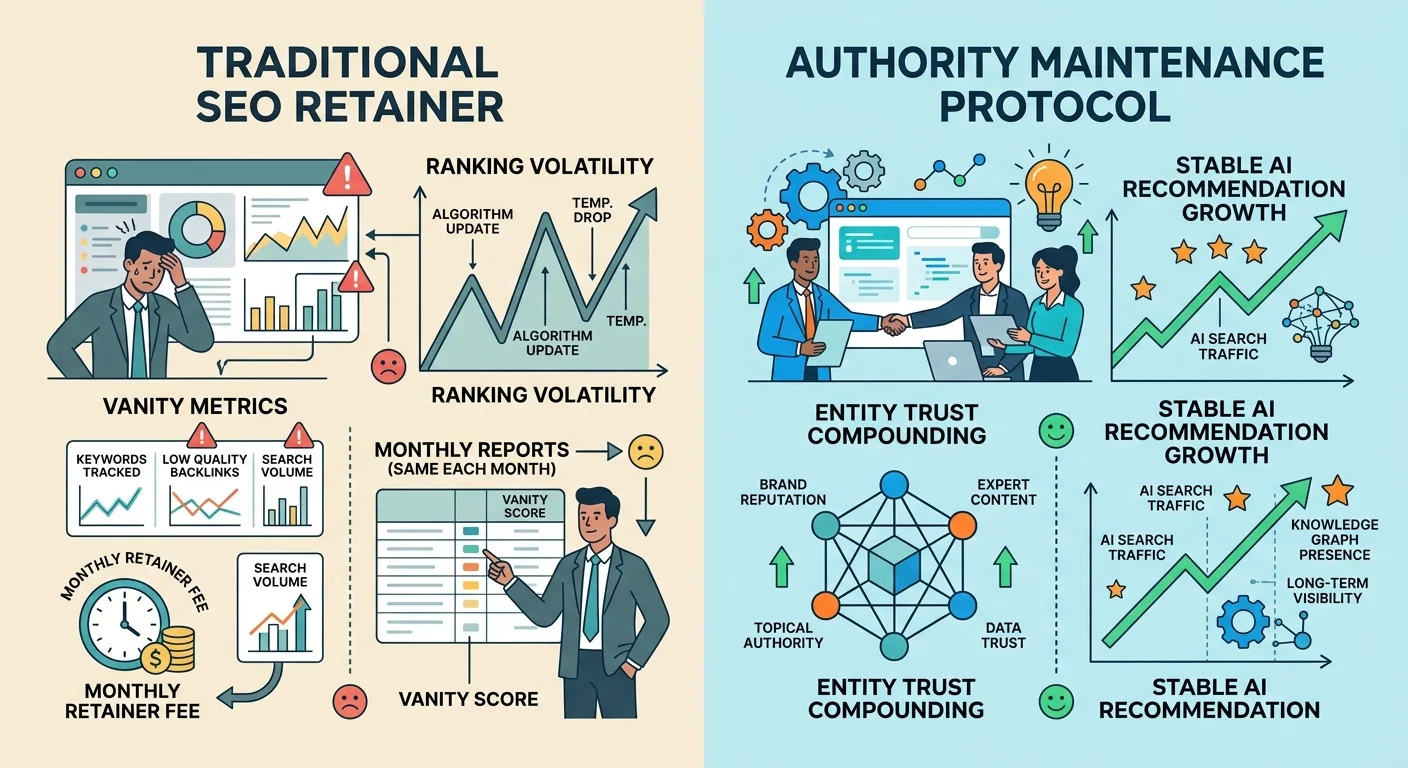
Here's the objection I hear most often: "This sounds like every other SEO retainer. You're just trying to lock me into a never-ending monthly fee."
I get it.
You've been burned. You paid an agency $500 a month for two years and got nothing but activity reports and vanity metrics. Rankings that didn't matter. Traffic that didn't convert. Promises that never materialized.
Now I'm telling you to commit to ongoing execution, and it sounds like the same trap.
It's not. And here's why.
Traditional SEO retainers optimize for an algorithm that's being replaced. Authority maintenance builds an asset you own that compounds regardless of which platform dominates.
SEO retainers rent traffic. Authority maintenance builds equity.
When you stop paying for SEO, the traffic disappears. When you pause authority execution, the infrastructure remains — even if the visibility decays.
This isn't a retainer for busywork. It's asset management for the authority you built.
What SEO Retainers Actually Deliver
Let's be clear about what you're buying with a traditional SEO retainer:
- Monthly reports showing keyword rankings (which don't control whether AI recommends you)
- Backlink building (which AI engines don't prioritize the way Google's old algorithm did)
- Technical fixes (which matter, but don't compound authority)
- Content creation (usually commodity blog posts that don't pass AI validation)
- Algorithm chasing (reacting to Google updates instead of building owned assets)
None of that is inherently bad. Some of it is necessary.
But here's what it doesn't do: it doesn't build entity trust. It doesn't strengthen semantic density. It doesn't create the citation velocity that determines whether ChatGPT, Gemini, or Grok say your name when someone asks who to trust.
AEO vs. traditional SEO isn't a debate about which is better. It's a recognition that the game changed.
SEO optimizes for ranked lists. AEO optimizes for being the answer.
Those aren't variations of the same thing. They're fundamentally different objectives requiring fundamentally different execution.
What Authority Maintenance Delivers
The maintenance protocol focuses on one thing: ensuring the authority infrastructure you built continues to compound.
That means:
- Ongoing entity trust reinforcement — Monthly AEO content execution strengthens the signals AI engines use to verify your entity is active, authoritative, and current
- Semantic density expansion — New content clusters deepen topical coverage and ensure your entity matches evolving patient query patterns
- Infrastructure alignment — Quarterly reviews ensure schema, citations, and entity data remain consistent as the ecosystem evolves
- Competitive positioning — Quarterly AI Visibility Checks track how your authority compares to competitors and identify semantic gaps before they widen
This isn't a subscription for activity. It's systematic reinforcement of the assets you own.
The content we publish doesn't disappear when you stop paying. It compounds into your content library.
The entity trust we build doesn't evaporate. It strengthens your competitive position.
The infrastructure we maintain doesn't vanish. It remains the foundation everything else builds on.
| Factor | Traditional SEO Retainer | Authority Maintenance Protocol | Why It Matters |
|---|---|---|---|
| Objective | Improve rankings on Google search results | Become the answer AI engines recommend | AI doesn't rank — it recommends |
| Asset Ownership | You rent traffic — stop paying, traffic disappears | You own infrastructure and content library | Equity compounds even if execution pauses |
| Measurement | Keyword rankings, backlinks, organic traffic | AI recommendation frequency, entity trust signals, citation velocity | Rankings don't control AI citations |
| Execution Focus | Algorithm updates, technical fixes, backlink building | AEO content production, entity trust reinforcement, semantic clustering | AI prioritizes entity trust over backlinks |
| Longevity | Results tied to ongoing payments | Infrastructure remains, visibility decays slowly if execution stops | Authority is an asset, not a subscription |
The Asset Ownership Difference
This is the critical distinction: SEO retainers rent traffic. Authority maintenance builds equity.
When you stop paying for SEO, the rankings drop. The backlinks lose value. The traffic disappears.
You're left with nothing.
When you pause authority execution, the infrastructure you built remains. The content library you own stays live. The schema, entity architecture, and citation network don't vanish.
The visibility decays over time — but the foundation is still there.
If you decide to resume execution six months later, you're not starting from zero. You're starting from a weakened position that still holds structural value.
Competitors closed the gap while you paused, but you didn't lose everything. You lost momentum.
And momentum can be rebuilt faster than infrastructure.
That's the difference. SEO retainers are subscriptions. Authority maintenance is stewardship.
One disappears when payments stop. The other compounds when execution continues — and holds value even when it doesn't.
The Quarterly AI Visibility Check
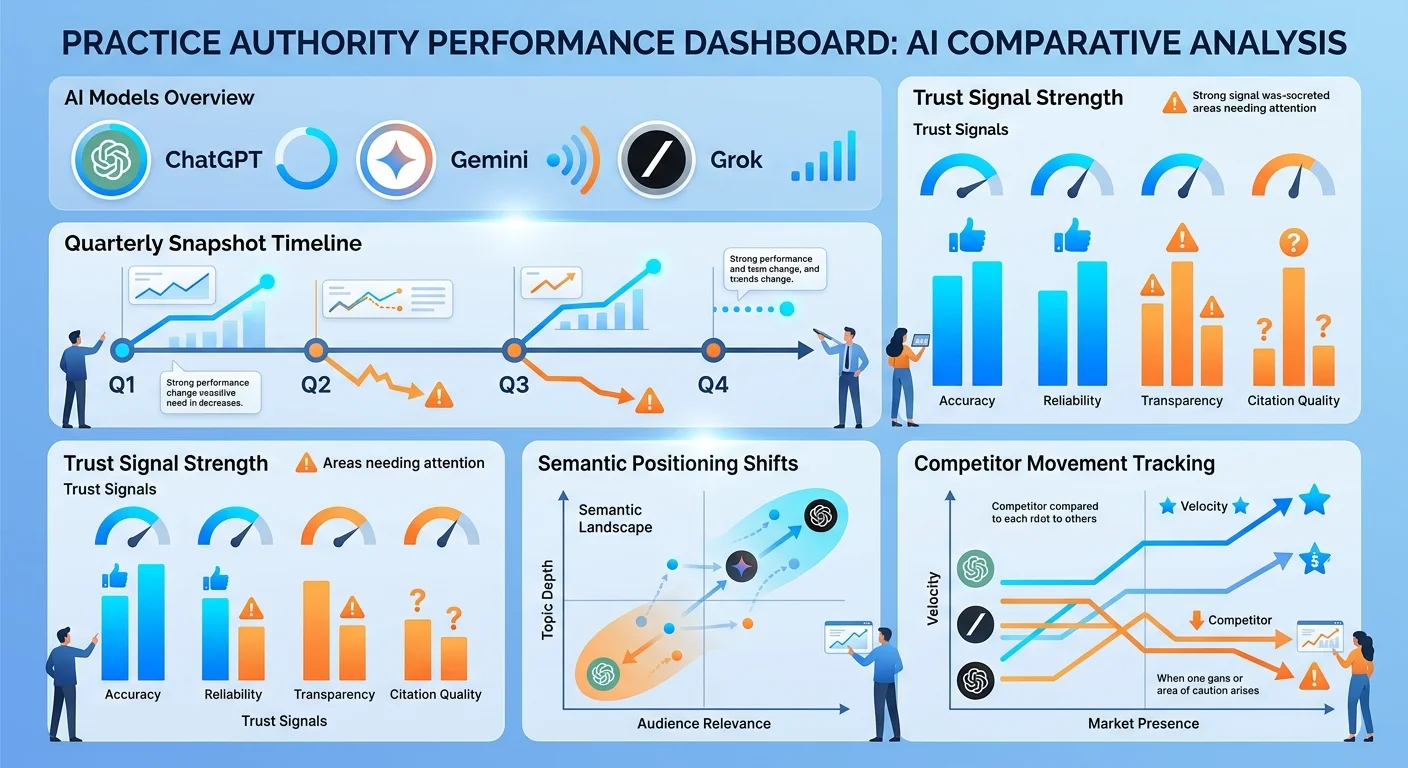
The maintenance protocol isn't a guess-and-hope system. It's a data-driven process.
And the data comes from quarterly AI Visibility Checks — the same diagnostic we ran before you invested in the Authority Engine, now deployed as an ongoing monitoring tool.
Every 90 days, we run an AI Visibility Check to see exactly how ChatGPT, Gemini, and Grok are citing your practice compared to competitors.
This isn't vanity metrics. It's competitive intelligence.
We're tracking:
- Recommendation frequency — How often does each engine name your practice when asked who to trust?
- Entity trust signal strength — How confident are AI engines in your entity data?
- Semantic positioning — What contexts trigger your citation vs. competitors'?
- Competitive movement — Who's gaining ground? Who's losing it?
The check takes 15 minutes. The insights shape the next 90 days of execution.
What the Check Measures
The AI Visibility Check isn't a ranking report. It's a trust signal diagnostic.
We're not measuring where you appear in a list. We're measuring whether AI engines recommend you at all — and if they do, how confidently.
Here's what we track:
- Direct recommendations — When asked "who's the best chiropractor in [city]," does AI name you?
- Conditional recommendations — When asked about specific treatments or patient types, does AI cite you as the specialist?
- Competitor displacement — Are you being recommended instead of competitors, or alongside them?
- Citation consistency — Do all three engines (ChatGPT, Gemini, Grok) agree, or are there gaps?
If all three engines recommend you consistently, your entity trust is strong.
If one engine cites you but others don't, there's a semantic or citation gap we need to close.
If competitors appear alongside you, the next 90 days of content execution focuses on widening the gap.
How We Adjust Strategy Based on Results
The quarterly check isn't just measurement. It's strategic input for the next phase of execution.
If the check reveals semantic gaps — patient queries where competitors are being cited instead of you — we adjust content focus. The next 12 articles cluster around those semantic anchors.
We strengthen entity signals in the specific contexts AI engines are using to evaluate recommendations.
If entity trust signals are weak on one platform (e.g., Gemini cites you, ChatGPT doesn't), we audit the structured data and citation network those platforms prioritize.
Schema alignment. Directory consistency. Citation velocity. Whatever the gap is, we close it.
If competitive movement shows a specific practice gaining ground, we analyze their execution. What semantic territory are they claiming? What entity signals are they strengthening?
Then we counter. Not by copying. By deepening our own authority in overlapping contexts.
The maintenance protocol isn't static. It adapts based on what the data tells us.
Every 90 days. Every check. Every strategic pivot.
Why Quarterly, Not Monthly
Authority changes compound slowly.
Monthly checks create noise without actionable data. You can't measure meaningful trust signal shifts in 30 days.
Quarterly intervals show trends. Patterns. Strategic movement that justifies execution adjustments.
Monthly content execution happens every 30 days. Infrastructure reviews happen every 90 days. AI Visibility Checks happen every 90 days.
The rhythm is intentional. Content builds. Infrastructure stabilizes. Checks validate. Adjust. Repeat.
If we checked monthly, we'd be reacting to variance instead of trends.
Quarterly checks give us the signal clarity we need to make confident strategic decisions — and ensure the next 90 days of execution compounds on the right priorities.
Post-Engagement: What Year Two Looks Like
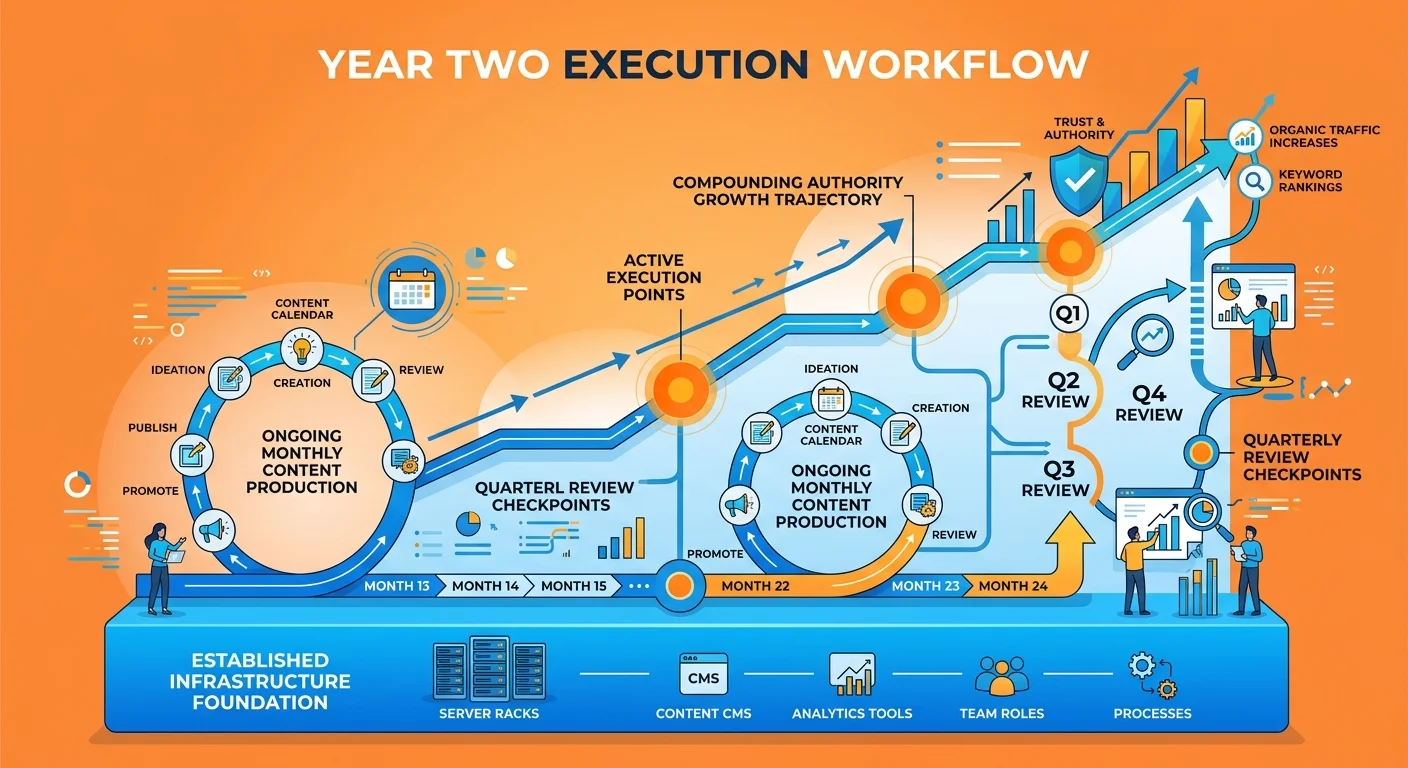
You've completed the initial 12-month engagement.
The infrastructure is built. The content library is established. AI engines recommend you.
The question now: what happens next?
Year two isn't a restart. It's a continuation.
The Local AI Authority Engine you invested in is the foundation. The maintenance protocol is what ensures that foundation continues to compound instead of decay.
Here's exactly what ongoing execution looks like — and what it costs.
The Monthly Execution Plan
Twelve AEO articles per month. Same as year one. Same quality. Same validation system.
The only difference: instead of building semantic density from scratch, we're deepening the clusters you already own.
Our Two-AI content system doesn't change. Gemini researches and validates. Claude writes. Gemini validates again. Claude refines.
Every claim sourced. Every statistic verified.
The execution that built your authority in year one is the same execution that protects it in year two.
Content focus shifts based on quarterly AI Visibility Check results. If the check reveals semantic gaps, we prioritize those anchors. If competitive movement shows a practice gaining ground, we counter with content that strengthens your entity signals in overlapping contexts.
The articles aren't random. They're strategic.
Every month compounds the authority you've already built.
Pricing and Commitment
$1,200 per month. No long-term contract required. Month-to-month execution.
You're not locked in. You can pause anytime.
But here's what I'll tell you: the practices that pause watch their competitors close the gap. The practices that stay consistent compound their lead.
Every month you execute strengthens the position you built. Every month you pause hands momentum to someone else.
The pricing isn't arbitrary. It reflects the cost of white-glove execution: research, writing, validation, publishing, and quarterly monitoring.
You're not paying for our time. You're paying for the compound effect of consistent execution — the only mechanism that ensures authority continues to grow instead of decay.
What You Own vs. What We Execute
You own the infrastructure. The website. The schema. The entity architecture. The content library.
All of it.
If you decide to walk away after year one, you keep everything we built. It's yours.
What we execute: ongoing content production, quarterly visibility checks, infrastructure reviews, and entity trust reinforcement.
The execution compounds on the infrastructure you own.
If you pause, the foundation remains. The visibility decays, but the assets don't vanish.
This isn't a subscription where you lose access when payments stop. It's stewardship of an asset you own.
The more consistently we execute, the more valuable that asset becomes. The less consistently we execute, the more competitors erode the position you built.
If You Choose to Pause
You can.
The foundation remains intact. The content library stays live. The schema, entity data, and citation network don't disappear.
But visibility begins slow decay.
Competitors who stayed consistent start appearing in AI recommendations that used to belong to you. The gap you spent 12 months building starts to close.
Not immediately. Not dramatically. But steadily.
Resuming execution later requires rebuilding momentum. You're not starting from zero — the infrastructure exists — but you're not picking up where you left off either.
Competitors compounded their lead while you paused. Catching them requires exceeding their execution.
For months. Maybe years.
The practices that understand this don't pause. They know the cost of stopping isn't neutral.
It's compounding loss handed directly to competitors who kept going.
FAQ
Why can't I just build the authority infrastructure and leave it alone?
Because authority decays.
AI engines constantly re-evaluate trust signals. If you stop producing new, relevant AEO content, your competitors who are still executing will begin to look like the more current, active authority.
The infrastructure you built is the foundation. The ongoing execution is what keeps AI engines convinced that foundation is still the most authoritative answer.
Without it, your signals weaken. Not because what you built was wrong, but because authority is comparative. If they're moving forward and you're standing still, the gap closes.
Is AI authority maintenance the same as a traditional SEO retainer?
No.
SEO retainers focus on chasing algorithm changes and improving rankings. Authority maintenance focuses on deepening entity trust and semantic relevance — assets you own, which are less volatile than algorithm-dependent rankings.
SEO retainers rent traffic. Stop paying, the traffic disappears.
Authority maintenance builds equity. Pause execution, and the infrastructure remains — even if visibility decays.
The content we publish compounds into your library. The trust we build strengthens your competitive position. The infrastructure we maintain stays intact.
That's the difference.
How often does my authority infrastructure need to be reviewed?
The underlying infrastructure is stable, but AEO content execution is monthly.
We conduct quarterly AI Visibility Checks to monitor how AI perception is evolving and adjust content strategy accordingly.
Monthly content execution builds semantic density and citation velocity. Quarterly infrastructure reviews ensure schema, entity data, and technical performance remain aligned. Quarterly visibility checks validate that the execution is working and identify strategic adjustments.
The rhythm is intentional: content builds monthly, infrastructure stabilizes quarterly, checks validate quarterly.
What happens if I stop the maintenance protocol?
Your visibility won't vanish overnight, but slow decay will begin.
Competitors will start to win new AI recommendations, and the authority gap you built will start to shrink.
The first 90 days look fine. Traffic stays stable. AI engines still cite your existing content. But by month six, competitors executing monthly content start appearing alongside you.
By month twelve, they've closed the gap.
The infrastructure you built remains intact, but the trust signals AI engines use to determine whose name they say have weakened.
Resuming execution later requires rebuilding momentum — not starting from zero, but not picking up where you left off either.
Can I handle the maintenance myself after the first year?
While you own the infrastructure, the maintenance protocol involves our proprietary Two-AI Validation System and a deep understanding of AEO.
It's not a simple checklist. It's white-glove, done-for-you execution.
Gemini researches and validates. Claude writes. Gemini validates again. Claude refines. Every claim sourced. Every statistic verified.
We don't publish vibes. We publish receipts.
Could you replicate that process? Maybe.
But the question isn't whether you can. It's whether you should.
Your time is worth more than managing content validation loops. Let us handle the execution. You focus on running your practice.
How do I know the maintenance is actually working?
Quarterly AI Visibility Checks show exactly how AI engines are citing your practice compared to competitors.
We track recommendation frequency, entity trust signals, and semantic positioning shifts over time.
If all three engines (ChatGPT, Gemini, Grok) recommend you consistently, your entity trust is strong. If one cites you but others don't, we identify the gap and adjust execution.
If competitors appear alongside you, we deepen the semantic clusters they're competing in.
The checks aren't vanity metrics. They're competitive intelligence that shapes the next 90 days of execution.
What if my competitors start doing the same thing?
If they start today, they're building from zero while you're compounding on 12+ months of established authority.
The gap widens with consistent execution, not from one-time builds.
A competitor starting fresh has to build the infrastructure you already own. They have to publish the content you've already published. They have to earn the trust you've already earned.
And while they're doing that, you're adding 12 new articles every month.
The compound effect doesn't favor latecomers. It favors the practices that started first and stayed consistent.
Is this just a way to lock me into a never-ending monthly fee?
You're not locked into anything.
Month-to-month execution after year one is recommended because authority compounds, but you can pause anytime. You own the infrastructure we built regardless of whether you continue execution.
The website. The schema. The entity architecture. The content library. All of it.
What we execute is ongoing content production and quarterly monitoring.
If you pause, the foundation remains. The visibility decays, but the assets don't vanish.
The pricing isn't a lock-in. It's the cost of white-glove execution that ensures your authority continues to grow instead of decay.
Conclusion
Authority isn't a project. It's an asset.
And like any asset, it requires stewardship.
The practices that dominate AI recommendations in year two aren't the ones that built the best infrastructure in year one. They're the ones that kept executing.
Month after month. Building on what they already owned. Compounding the lead they established.
If you stop, the decay is slow enough that you won't notice it immediately. But your competitors will.
And by the time the gap becomes obvious, reversing it requires starting over — not picking up where you left off.
The maintenance protocol isn't a retainer for activity reports. It's the system that protects what you built and ensures the $15,000 you invested continues to compound instead of depreciate.
If you're serious about long-term visibility, this is the work. Not later. Now.
Every month you execute strengthens the position you built. Every month you pause hands momentum to someone else.
The choice is simple: compound or decay. There's no neutral middle ground.
Want to see where your authority stands right now — and whether it's compounding or decaying?
Run the AI Visibility Check. It takes 15 minutes and shows you exactly what ChatGPT, Gemini, and Grok say when someone asks who to trust in your market.
If the results show you're not the answer, you'll know exactly what needs to be addressed. If they show you are the answer, you'll know the protocol is working.
Either way, you'll have the data you need to make the next decision.
621 Enterprises, Inc. | Copyright 2026 | All rights reserved