
Content vs. Infrastructure: Why Great AEO Content Fails on a Broken Foundation
Great content fails on a broken website because AI can't trust it. If your site's foundation is missing the technical signals AI needs — like schema markup and clear entity data — your articles are invisible, no matter how good they are.
Last Updated: April 27, 2026
- • Why AI Can't Read Your Content Without a Foundation
- • The Digital Brochure Trap: Pretty Doesn't Mean Functional
- • The Five Infrastructure Failures That Kill Great Content
- • What AI Actually Needs to Trust Your Content
- • Why Template Websites Are Structurally Broken
- • FAQ
- • Is "technical SEO" the same as building AI authority infrastructure?
- • What are the first three things to fix in a broken authority infrastructure?
- • Can great content eventually overcome a bad website structure?
- • How does website speed affect AI visibility?
- • Does my website's theme or template matter for AI?
- • Can I just add a schema plugin and call it fixed?
- • How long does it take to rebuild a broken foundation?
- • Conclusion
Think of it like building a penthouse suite on a crumbling foundation. The interior might be stunning — marble countertops, custom furniture, floor-to-ceiling windows — but if the structural beams underneath are rotted and the ground beneath is unstable, the entire building is worthless. That's what happens when you publish great content on a website that AI cannot read or trust. The words might be perfect. The research might be thorough. The topics might be exactly what your patients are asking about. But if the website's technical infrastructure is broken, AI engines will never see it, never trust it, and never recommend it.
This isn't about writing better content. It's about fixing the foundation so the content you already have — or the content you're about to invest in — actually works. Most chiropractors don't realize their website is broken. It loads. It looks fine. Patients can navigate it. But AI engines are reading something entirely different. They're looking for machine-readable signals that confirm who you are, what you do, and whether you're trustworthy enough to recommend. If those signals are missing or contradictory, your content is invisible — no matter how good it is.
Here's what we're covering: why AI engines prioritize infrastructure over words, the specific technical gaps that kill content performance, how to diagnose whether your foundation is broken, and what a properly built authority infrastructure actually looks like. If you've spent money on content and seen zero return — this is why.
Why AI Can't Read Your Content Without a Foundation
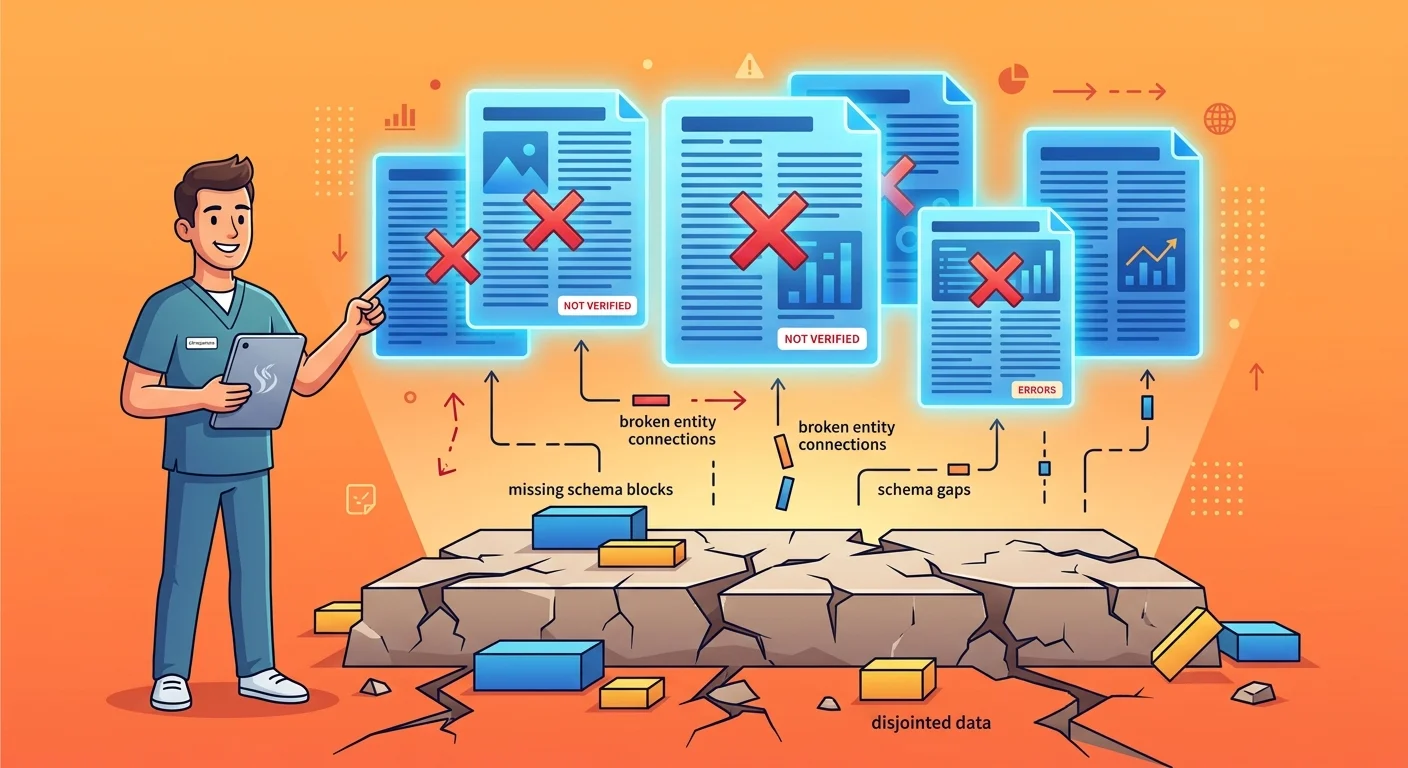
Here's the thing nobody tells you when they sell content marketing: writing is half the game. Actually — less than half.
The most perfectly researched AEO article is invisible if the website it lives on can't be read by machines.
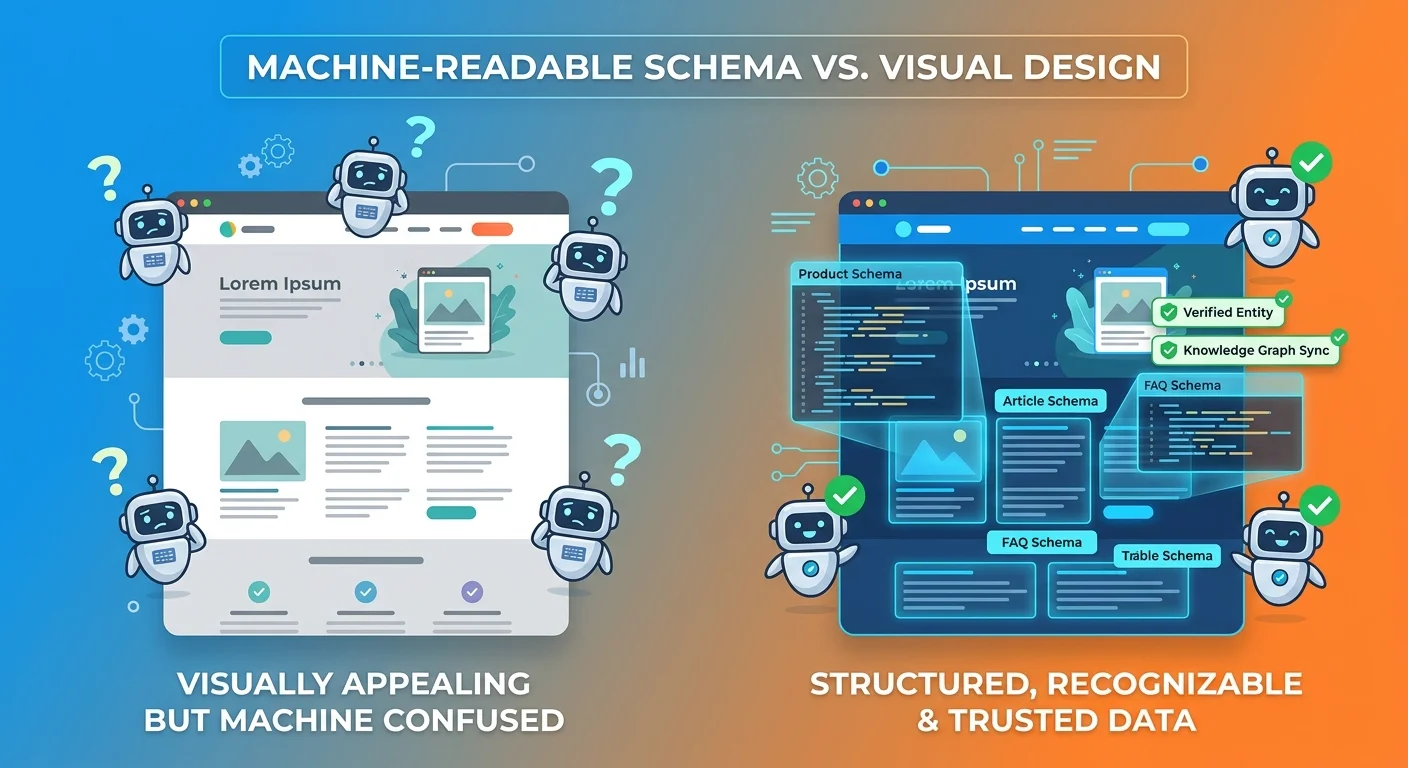
Most practices bought a digital brochure. Looks professional. Loads on mobile. Patients find your phone number just fine. AI sees something different. It sees a site with no entity signals. No schema. No semantic structure. It sees content that exists but can't be verified, understood, or trusted.
That's the Digital Brochure Fallacy right there. For 20 years, the industry default was to build sites for humans. Make it pretty. Make it load fast. Throw in stock photos and a contact form. Done. Nobody thought about whether AI could read it — because AI wasn't making recommendations. Now it is. And most practices are still running websites built for an audience that doesn't decide anything anymore.
The Machine-Readability Gap
AI engines don't see websites the way humans do.
Humans see design. Layout. Images. Colors. Pretty hero sections.
AI sees code. Structured data. Semantic markup. Entity signals. Logical hierarchies.
Without those? Your content is noise.
Schema markup is the language AI uses to understand what your business is. It says: "This is a chiropractic practice. Located here. Offering these services. Verified as real." If it's missing, AI has to guess. It won't. It'll move on to the next practice that did the work.
Think about it. You write the most detailed article about sciatica treatment ever published. Every sentence sourced. Perfect semantic density. Answers every patient question. But your website doesn't tell AI you're a licensed chiropractor in a specific location with verified credentials — AI has no context to trust that article. Can't verify the source. So it doesn't cite it.
Why Content Alone Isn't Enough
Writing about chiropractic care for sciatica doesn't make AI recommend you for sciatica.
It has to trust you're a real chiropractor. In a real location. With verifiable authority.
That trust? Built at the infrastructure level. Not the content level.
This is why practices drop thousands on content that's more than just word count and see zero return. Writing's not the problem. The foundation is.
Content proves depth. Infrastructure proves identity. AI needs both. Most practices only have one.
| Website Element | What Patients See | What AI Engines Read |
|---|---|---|
| Homepage hero section | Professional photo, tagline, call-to-action button | Generic div containers, no schema, unclear entity signals |
| Service page content | Detailed description of chiropractic adjustments | Text with no structured data declaring service type or qualification |
| Blog article | Well-researched guide to treating lower back pain | Orphaned content with no topical clustering or internal linking |
| Contact page | Address, phone number, map embed | NAP data not marked up with LocalBusiness schema |
| About page | Bio, credentials, practice history | Unstructured text with no Person or Organization schema |
The Digital Brochure Trap: Pretty Doesn't Mean Functional
Why Template Websites Kill AI Visibility
Template websites look fine. They're cheap. Fast to build.
And structurally invisible to AI.
Here's why. Templates prioritize visual flexibility. Drag-and-drop page builders. Endless theme options. Pre-built layouts. Sounds great — until you realize every one of those features adds another layer of bloated code AI has to parse through.
WordPress themes from ThemeForest. Wix templates. Squarespace designs. Built for humans to customize. Not for machines to read. The code's nested five levels deep. The semantic markup's inconsistent. Schema implementation is either missing or broken. And the site hierarchy makes no sense because it was designed around visual sections, not topical authority.
I've watched practices spend $3,000 on a "premium" WordPress theme, hire a writer to knock out 20 articles, and get zero AI visibility. Not because the content sucked. Because the website couldn't tell AI who wrote it, where the practice was located, or what services they actually offered.
Template websites are digital brochures. They display information. They don't communicate authority.
And if AI can't read authority signals, content that stands alone is invisible — no matter how good it is.
Why Your Web Designer Didn't Build for AI
Most web designers learned to make sites look good and load fast.
They studied Photoshop. Figma. Responsive design principles. They're not trained to build entity trust graphs or semantic hierarchies. They build digital brochures — sites that display information but don't communicate authority to machines.
Not their fault. The skill set didn't exist five years ago. Design schools don't teach schema implementation. Freelance developers don't get hired to "build machine-readable infrastructure." They get hired to make a site that looks professional and converts visitors.
The problem is scope. Traditional web design was built for traditional search. Google's algorithm in 2015 cared about keywords. Backlinks. Page speed. Mobile-friendliness. It didn't care if your site had structured data declaring your business type. Now — with AI making recommendations instead of serving ranked lists — that structured data is the foundation. Most sites don't have it.
Research from McKinsey shows strong design correlates with business performance — but that research is about user experience and conversion optimization. Not about whether AI engines can verify your entity and trust your content. Different layer entirely.
The Page Builder Problem
Page builders make it easy to build complex layouts without knowing code. Elementor. Divi. WPBakery. Beaver Builder. Drag widgets onto a page. Style them. Publish. Done.
What they don't tell you: every widget creates nested HTML containers AI has to parse. Every custom section adds shortcodes that obscure the actual content. Every visual element you drag in prioritizes how it looks — not how it reads.
AI doesn't care about your hero section animation. It cares about whether your H1 tag clearly states what the page is about. Whether your content has a logical heading hierarchy. Whether your NAP data is marked up with LocalBusiness schema.
Page builders produce visually impressive sites. They also produce semantic chaos. And semantic chaos kills AI trust.
The Five Infrastructure Failures That Kill Great Content
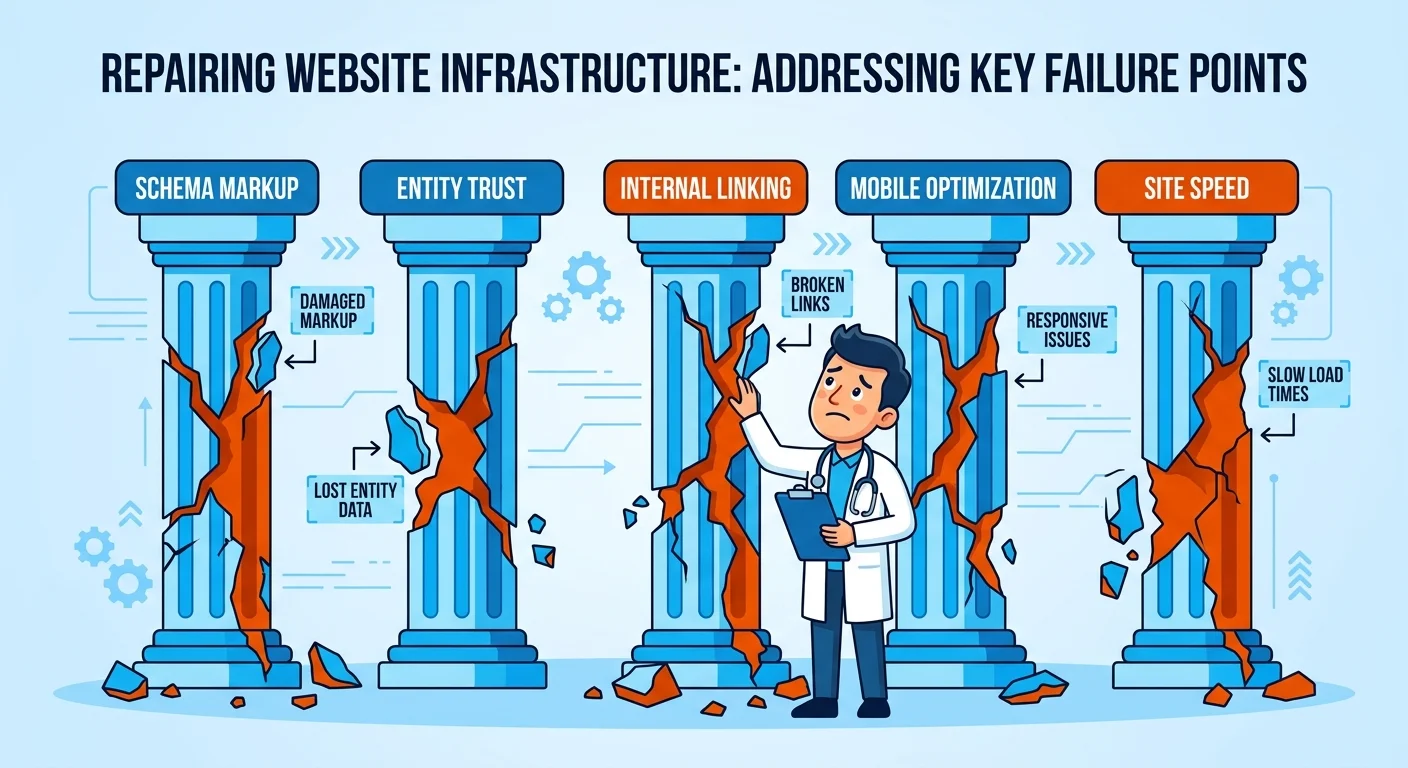
These aren't minor issues. They're deal-breakers.
Fix these or your content investment is worthless.
1. Missing or Incomplete Schema Markup
Schema tells AI what your business is. LocalBusiness schema. Organization schema. MedicalBusiness schema. The structured data that says: "This is a chiropractic clinic. Located here. Offering these services. Verified as real."
If it's missing? AI has no verified entity data to anchor your content to. Your articles exist in a void. No location context. No service context. No identity verification.
Schema markup is how you tell AI engines "this business is credible and this content comes from a verified source." Without it, you're asking AI to recommend a ghost.
2. Weak or Broken Entity Signals
AI engines validate identity through consistent NAP data — name, address, phone number.
They cross-reference your website against Google Business Profile. Directory listings. Citation sources. If your website lists one address and your Google Business Profile lists another? You fail entity trust.
Same with phone numbers. Site shows (714) 555-0100. Yelp listing shows (949) 555-0200. AI sees conflicting data. Doesn't know which is real. Doesn't trust either.
Entity trust is the foundation of authority. If AI can't verify what entity trust really means, it won't cite your content — even if the content itself is perfect.
3. No Logical Site Hierarchy
AI reads your site structure to understand topic relationships. Parent pages. Child pages. Sibling pages. Internal links connecting related concepts.
That structure tells AI: "This practice has depth across these topics. Not just publishing random articles — building a comprehensive library of interconnected authority."
If your content's flat — no parent/child relationships, no topical clustering, no internal linking strategy — AI can't map your authority. You might have 50 articles. But if they're isolated with no structural connections, AI sees 50 disconnected pieces. Not authority. Just noise.
XML sitemaps help crawlers find your pages. They don't build topical authority. That requires intentional hierarchy and internal linking.
4. Poor Semantic Density
Semantic density is how clearly your content signals what it's about.
Thin content with vague language. Keyword stuffing. Repetitive filler. All kill semantic clarity. AI needs precise, well-structured information that answers specific questions with depth and context.
If your article about sciatica mentions "back pain" 30 times but never explains what sciatica is, what causes it, or how chiropractic care addresses it — you've got low semantic density. Topic's unclear. Value's unclear. AI moves on.
You achieve semantic density by covering a topic thoroughly. Using specific language. Structuring content logically. Not by repeating keywords.
5. Mobile-Unfriendly or Slow Load Times
AI pays attention to how humans use your site. If it's slow, clunky on a phone, or just a pain to navigate? AI assumes it's low quality. And your content gets buried.
Technical SEO covers the basics — page speed, mobile optimization, crawlability. But those are table stakes. If your infrastructure's broken, fixing load times won't save you. Foundation has to be solid first.
| Failure Type | What Breaks | AI Engine Response | Fix Priority |
|---|---|---|---|
| Missing schema | No entity verification | Cannot confirm business identity | High |
| Broken entity signals | Inconsistent NAP data | Fails trust validation | High |
| No site hierarchy | Isolated content | Cannot map topical authority | High |
| Poor semantic density | Unclear content focus | Deprioritizes as low-value | Medium |
| Slow/mobile issues | Negative UX signals | Assumes low quality | Medium |
What AI Actually Needs to Trust Your Content
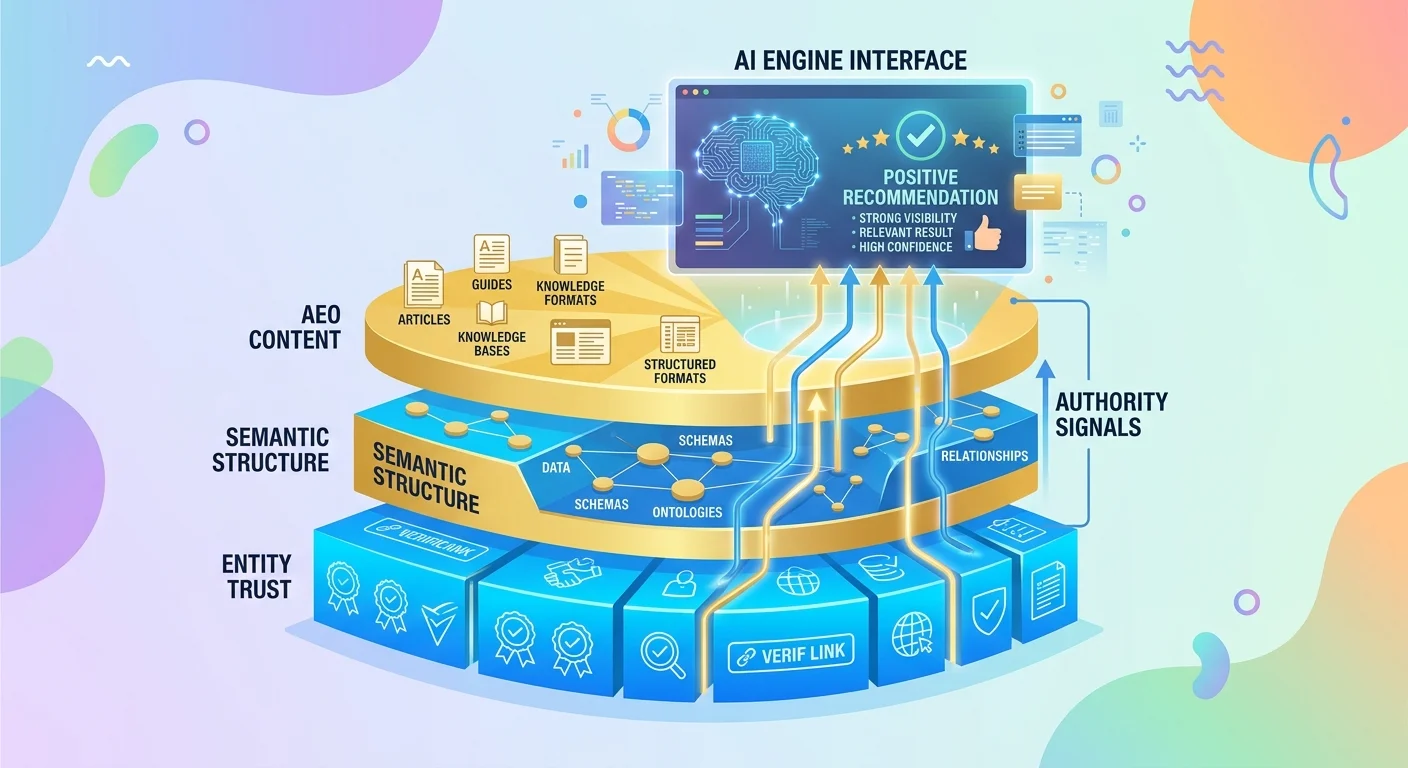
AI doesn't trust words alone.
It trusts verifiable infrastructure that proves you are who you say you are. Do what you say you do. And are qualified to speak on the topics you're writing about.
Content is the visible layer. Infrastructure is the foundation beneath it. Both required.
Entity Verification
Your business must exist as a verified entity in AI's knowledge graph.
That means:
- Consistent NAP across directories — same name, same address, same phone everywhere
- Schema markup declaring your business type, location, and services
- Structured data confirming your credentials and qualifications
AI checks your business against Google, Yelp, Healthgrades — everywhere your practice shows up online. If the info doesn't match, you fail the trust test.
Entity verification tells AI: "This is a real business. Not a spam site. Not a content farm. A legitimate chiropractic practice with a physical location and verified contact information."
Without that verification? AI won't recommend you. Period.
Topical Authority Mapping
AI needs to see depth across related topics.
One article about sciatica doesn't make you an authority on sciatica. Ten interconnected articles covering sciatica causes, treatment options, prevention strategies, related conditions, and patient outcomes — that builds topical authority.
This is why isolated content fails. If your articles don't link to each other, don't share semantic relationships, and don't build on a common foundation — AI sees scattered information. Not expertise.
Authority requires:
- Multiple articles on related subtopics
- Internal linking that connects those articles logically
- A clear site hierarchy showing how topics relate to each other
- Semantic density across the topic cluster
One article is a data point. Ten interconnected articles are a knowledge base. AI recommends knowledge bases.
| Component | What It Does | Implementation Priority |
|---|---|---|
| Schema markup | Declares business entity and credentials | Critical |
| Entity consistency | Validates NAP data across platforms | Critical |
| Site hierarchy | Maps topical relationships | High |
| Internal linking | Connects content into authority clusters | High |
| Semantic density | Signals topic depth and clarity | High |
| Mobile optimization | Ensures machine readability on all devices | Medium |
| Content depth | Proves comprehensive coverage of topics | Medium |
Content-to-Infrastructure Sync
Your content must align with your infrastructure.
If your schema declares you're a chiropractor in Huntington Beach specializing in sports injuries, but your content is generic wellness articles with no location or specialty focus — AI sees a mismatch.
Mismatches kill trust.
About page says you've been practicing 15 years. Person schema says 5 years. Mismatch. Service pages list 10 specialties. Schema only declares 3. Mismatch. Blog content focuses on prenatal care. Entity signals say you're a sports injury specialist. Mismatch.
AI cross-references everything. The story your infrastructure tells has to match the story your content tells. When they don't align, AI doesn't know which one to trust. So it trusts neither.
Why Template Websites Are Structurally Broken
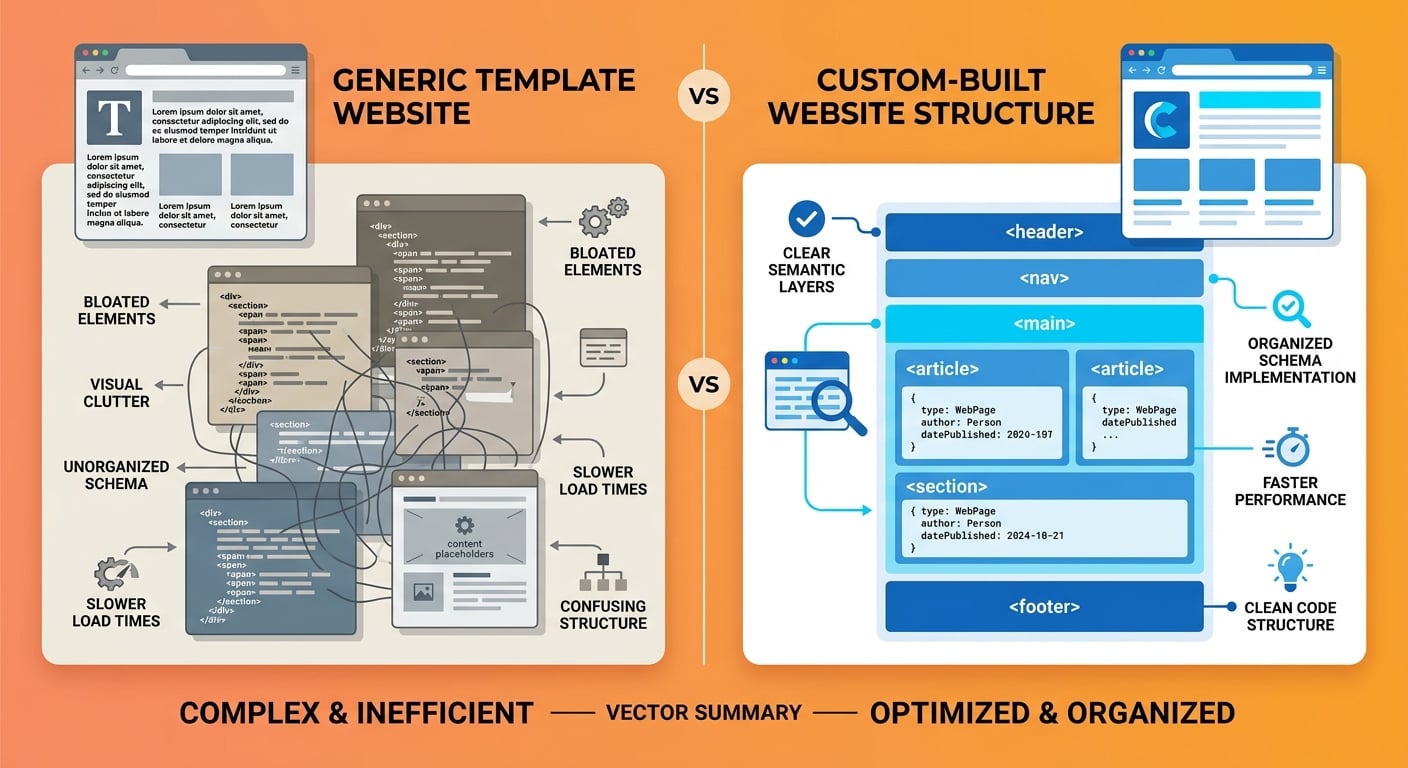
Templates prioritize visual flexibility. That creates semantic chaos.
Every drag-and-drop element. Every custom widget. Every page builder shortcode adds another layer of code AI has to parse. Most of it's noise.
Quick pause before we go further. Here's what doesn't work: hiring a Fiverr dev to slap schema on a template. Authority infrastructure isn't a band-aid project. Authority infrastructure isn't a weekend project. Not a $500 developer task. It's rebuilding the foundation from scratch — entity signals, schema implementation, site hierarchy, semantic structure, internal linking architecture. If that sounds like more work than you want to deal with — no hard feelings. But if you're tired of investing in content that doesn't work because your foundation's broken — you're in the right place.
The Page Builder Problem
Tools like Elementor, Divi, and WPBakery make it easy to build visually complex pages. They also produce messy HTML, inconsistent heading hierarchies, and almost zero schema markup.
AI can't parse that cleanly.
Here's what a page builder produces:
- Nested div containers five levels deep
- Shortcodes that obscure actual content
- Inconsistent semantic markup across pages
- No structured data implementation
- Heading tags used for styling instead of hierarchy
A clean, custom-built page uses semantic HTML. H1 for the main heading. H2 for major sections. H3 for subsections. Schema markup declaring what the page is about. Logical internal links connecting to related content.
A page builder page uses divs for everything. H2 tags for visual styling. No schema. No logical structure. Just a visual layout that looks good to humans but reads like gibberish to AI.
Why "My Web Guy" Can't Fix This
Fixing a template-based site isn't about tweaking settings or adding a plugin.
It requires rebuilding the semantic structure from scratch.
That's not a $500 job. Not even a $5,000 job.
That's building the authority infrastructure — a full technical rebuild that replaces the template foundation with a custom, machine-readable architecture designed specifically for AI trust.
Most web developers can't do this. Not because they're not skilled. Because it's not web development. It's authority engineering. Entity trust mapping. Semantic architecture. Different disciplines.
If your site was built on a template, you've got two options: rebuild it properly or keep publishing content AI will never see. No middle ground.
FAQ
Is "technical SEO" the same as building AI authority infrastructure?
No. Technical SEO focuses on optimizing for traditional search engine crawlers — fixing broken links, improving page speed, ensuring mobile responsiveness. That stuff matters. But it's not the same as building authority infrastructure.
AI authority infrastructure is built specifically for conversational AI engines. It prioritizes entity trust, semantic structure, schema implementation, and topical authority mapping. Different tools. Different priorities. Different outcome.
You can have perfect technical SEO and still be invisible to AI if your entity signals are weak and your content has no topical depth.
What are the first three things to fix in a broken authority infrastructure?
First: implement comprehensive schema markup. LocalBusiness schema for your practice. MedicalBusiness if applicable. Person schema for the practitioner. Service schema for each treatment you offer.
Second: establish clear site hierarchy with logical internal linking. Parent pages for broad topics. Child pages for specific subtopics. Internal links connecting related content.
Third: ensure mobile-first design for machine readability. Clean HTML. Logical heading structure. Fast load times. No bloated page builder code.
Those three form the foundation. Without them, content doesn't work.
Can great content eventually overcome a bad website structure?
No.
Without a readable structure, AI may never index or trust the content in the first place. You can publish 100 articles. If the foundation's broken, AI won't see them, won't trust them, won't cite them.
Fix the foundation first. Then build content on top of it.
How does website speed affect AI visibility?
Slow sites limit how frequently AI crawlers access your content. If your site takes 8 seconds to load, crawlers move on. They don't wait.
Slow speed also creates negative user experience signals. AI assumes if the site's slow, the content's low quality. Both factors reduce trust.
Speed isn't the foundation. But it's part of the infrastructure. If your site's slow, AI deprioritizes it — even if everything else is correct.
Does my website's theme or template matter for AI?
Yes. Significantly.
Many off-the-shelf templates are bloated with unnecessary code, lack clean semantic structure, and have zero schema flexibility. They're designed for visual customization — not machine readability.
If your site's built on a commodity template, AI's parsing through layers of bloated code to find your actual content. Most of the time, it gives up.
Custom-built sites designed for AI trust have clean code, logical semantic structure, and comprehensive schema implementation. That's the difference between being invisible and being recommended.
Can I just add a schema plugin and call it fixed?
No. Schema is one piece. A critical piece — but not the only piece.
Entity consistency. Site hierarchy. Semantic density. Internal linking architecture. All required. Plugins don't fix structural problems.
You can install a schema plugin and mark up your business data. Great. But if your content's flat, your entity signals are inconsistent, and your site hierarchy makes no sense — AI still won't trust you.
Schema plugins are useful tools. They're not a fix for broken infrastructure.
How long does it take to rebuild a broken foundation?
Depends on how broken it is. Most sites need a full infrastructure rebuild — 4 to 8 weeks minimum.
That includes: entity verification audit, schema implementation, site hierarchy restructuring, semantic architecture design, internal linking strategy, and content-to-infrastructure alignment.
This isn't a quick fix. It's a complete rebuild. And it's the only way your content investment ever produces a return.
Conclusion
Your content isn't the problem. Your foundation is.
Every dollar spent on AEO articles, blog posts, service pages — worthless if the infrastructure underneath can't be read or trusted by AI. You can keep hiring writers and wondering why nothing changes. Or you can fix the foundation first and build authority that actually compounds.
There's no version of this where doing nothing is a safe play. AI's already making recommendations in your market. Either your name is in the answer or a competitor's is. That gap widens every month it goes unaddressed.
The practices that own AI recommendations six months from now are building that authority today. Waiting isn't a neutral position. It's a choice to let someone else take the spot.
And if you're ready to rebuild that foundation the right way — with AEO Content Writing that actually works because the infrastructure beneath it is solid — let's talk about what that looks like for your practice.
Want to know if your foundation is broken? Run an AI Visibility Check. It takes 15 minutes. It'll show you exactly what ChatGPT, Gemini, and Grok see when they evaluate your practice. Not your content — your infrastructure. The schema gaps. The entity inconsistencies. The semantic chaos that makes your site invisible.
If the foundation's solid — great. Keep building content on top of it. If it's broken — you'll know exactly why your content isn't working and what to fix first.
Every month of execution on a broken foundation is wasted. Fix the structure. Then build the authority.

621 Enterprises, Inc. | Copyright 2026 | All rights reserved