Why Traditional Agency Retainers Stop Working

Here’s the flaw. Traditional agency retainers are built on rented attention – and the platform they’re renting it from is shrinking.
Gartner predicts search engine volume will drop 25% by 2026 – driven by consumers switching to conversational AI. That’s not a future problem. That’s the platform your retainer is optimizing for right now.
The agency model was designed to put you on a list. AI doesn’t produce a list. It produces a verdict. And the infrastructure your agency built to get you ranked doesn’t speak the language AI engines use to decide who gets named.
The Treadmill Problem: What You’re Actually Paying For
Picture a treadmill. You pay every month, the belt keeps moving, and the machine runs. Stop the payments – the belt stops. Nothing you built carries forward. You don’t own the authority. You don’t own the citations. You own a monthly report and a starting-over problem.
That’s the retainer model in full. Not a flaw in execution – a flaw in architecture. It’s designed to hold a position on platforms that are losing relevance. Not to build a permanent authority signal that compounds. why most AI authority agencies fail
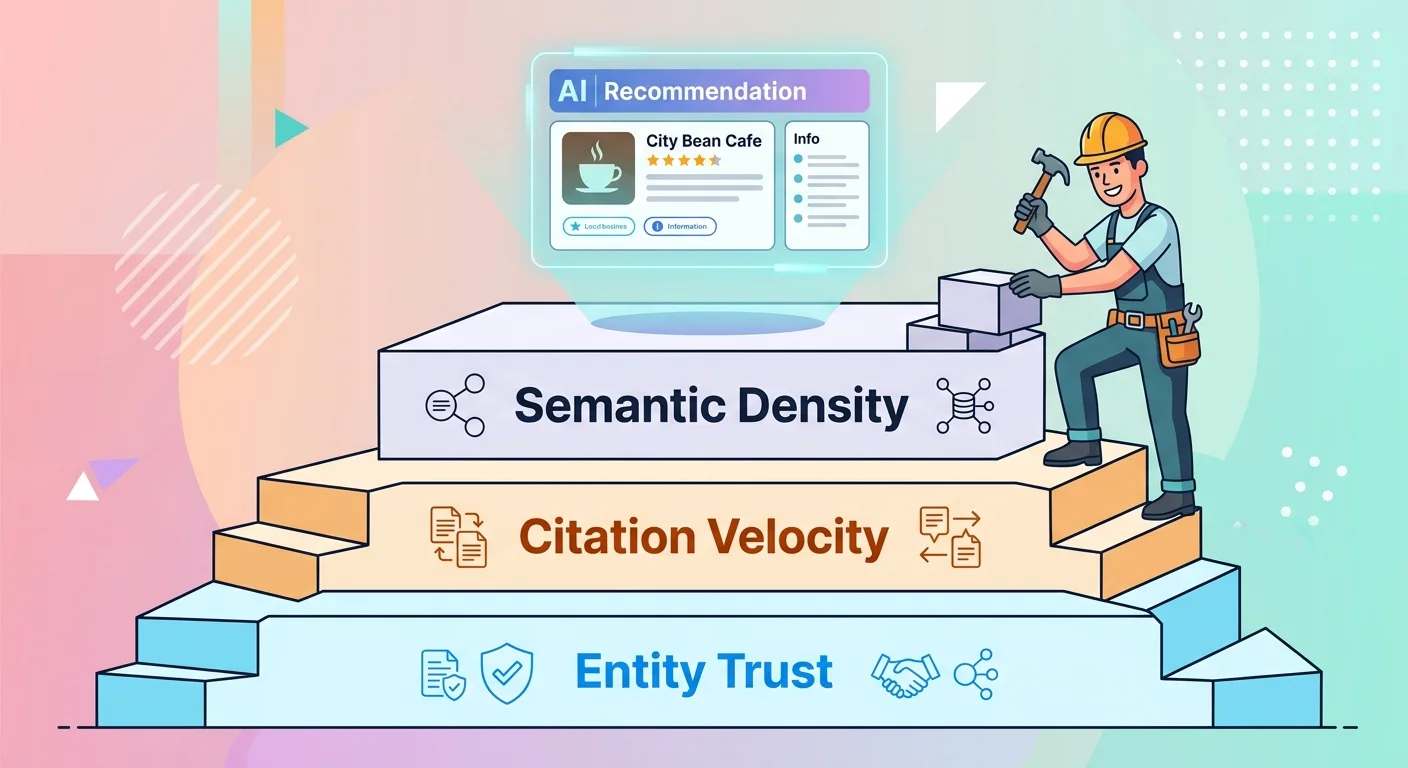
The Local AI Authority Engine is the staircase version. Every month of execution builds a permanent step – schema reinforced, entity signals deepened, AEO content compounding on top of itself. Stop paying, and the steps don’t disappear. The authority you built stays built. That’s not a retainer. That’s an asset.
Why Vanity Metrics Don’t Fill Schedules
Agencies report what’s easy to measure. Clicks. Impressions. Keyword position movement. The numbers can look genuinely impressive – even when zero new patients walked through the door.
More than half of surveyed consumers now rely on AI recommendations over classic search results – according to Salesforce customer trust index. So the metric your agency is optimizing – click-through rate from a search list – is increasingly irrelevant to how your next patient is actually choosing. They’re not clicking through a list. They’re asking an AI. And the AI isn’t checking your keyword position.
Vanity metrics don’t fill schedules because they’re measuring the wrong game. The practices winning AI recommendations right now aren’t winning on better-looking reports. They’re winning because they built Entity Trust, Citation Velocity, and Semantic Density – the signals that actually determine whose name gets said.
| Retainer Deliverable | What It Measures | What It Actually Produces | What Stops When You Stop Paying |
|---|---|---|---|
| Keyword optimization | Search ranking position | Placement on a list that AI engines do not consult when producing recommendations | Rankings drift or disappear entirely – no permanent authority signal remains |
| Monthly content production | Page views and session counts | Human-readable articles with no machine-readable entity signals or schema structure | Content sits idle – no compounding citation layer was ever built beneath it |
| Backlink outreach | Domain authority score | A metric that reflects search engine algorithm preferences, not AI engine trust criteria | Score becomes an orphaned number – AI engines do not use it to determine who to recommend |
| Social media management | Follower count and engagement rate | Platform-owned attention that disappears the moment posting stops or algorithms shift | Audience access resets to zero – no owned authority asset transfers forward |
| Paid advertising campaigns | Impressions, clicks, and cost-per-click | Rented visibility on platforms that capture attention without building entity credibility | Ad traffic stops the moment the budget is cut – zero residual visibility carries over |
| Monthly performance reporting | Click-through rates and impression share | A snapshot of a contracting search ecosystem, not a measure of AI recommendation presence | Reports stop – and there is no compounding infrastructure left behind to show for the spend |
Why the Retainer Model Was Never Built for AI Search
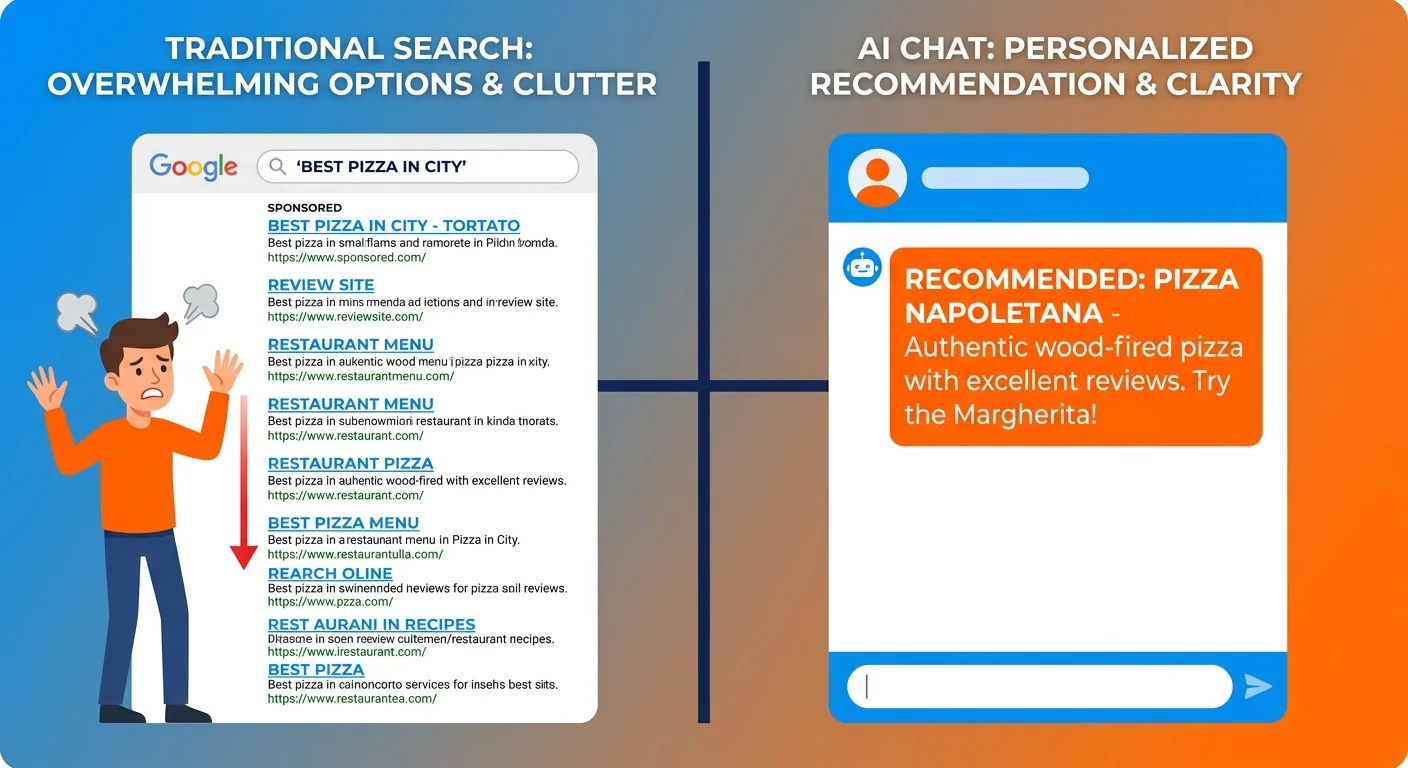
The retainer model didn’t fail because agencies got lazy. It failed because it was built for a world that no longer exists – one where search engines served up lists and your only job was to show up near the top.
That world is being dismantled. Generative AI is forcing a direct pivot from click-through organic traffic to zero-click citation engines. The platform your retainer was built to dominate is being replaced – and the retainer model has no answer for what comes next.
This isn’t a performance problem. It’s a structural one. The agency built the right machine for the wrong future. And most practices are still paying monthly to maintain it.
How AI Engines Decide Whose Name to Say
Here’s what most practices don’t realize: AI engines don’t rank. They decide. When a patient asks ChatGPT who the best chiropractor near them is, one business gets named – not ten. And that recommendation runs on signals that have nothing to do with anything a traditional retainer touches.
Those signals are Entity Trust, Citation Velocity, and Semantic Density. Entity Trust tells the AI your business is a verified, coherent entity – not just a website with keywords on it. Citation Velocity is the rate at which credible sources reference your entity over time. Semantic Density is the depth and consistency of topical authority across your entire content ecosystem. None of these are byproducts of a traditional retainer.
The difference between getting named and staying invisible comes down to this: entity-level trust versus keyword-level noise. The AI isn’t reading your content. It’s reading your infrastructure. That distinction is everything – and it starts with understanding how AI authority content builds trust.
Why Keyword Content and Backlinks Don’t Signal Entity Trust
Here’s the core mismatch. Keyword content is written for humans scrolling through a search list. AI engines don’t scroll lists. They extract structured entity signals from machine-readable infrastructure. Keyword content – no matter how polished – doesn’t transmit those signals.
Backlinks have the same problem. Link building was designed to signal authority inside Google’s PageRank system – a model built on hyperlink graphs between web pages. Large Language Models don’t evaluate hyperlink graphs the same way. They look at entity coherence, structured data, and cross-platform citation patterns. A backlink profile that took years to build contributes almost nothing to that evaluation.
That work isn’t wasted because it was done poorly. It’s wasted because it was aimed at the wrong target. Gartner predicts search engine volume will drop 25% by 2026 – and the content architecture most practices are sitting on was never designed to speak to what’s replacing it.
The Infrastructure Gap Most Agencies Never Address
Most agencies skip the infrastructure layer entirely – not because they’re cutting corners, but because they’re not built to deliver it. Schema markup, entity validation, structured data architecture, machine-readable content hierarchies – these aren’t on the retainer menu. They’re not even in the conversation.
That’s the gap. Not the content. Not the creativity. The gap is the layer beneath the content – the foundation that tells AI engines who you are, what you do, and whether you’re credible enough to name. Without that foundation, every piece of content your agency produces is a staircase built on sand. The steps look solid. But there’s nothing permanent underneath them.
| Signal Type | What Traditional Agencies Optimize | What AI Engines Actually Read | Gap |
|---|---|---|---|
| Keyword Relevance | Keyword density, placement, and search volume targeting | Topical authority depth and Semantic Density across a content ecosystem | Keyword optimization signals relevance to a list algorithm – not to a language model evaluating entity coherence |
| Business Identity | Website copy, title tags, and meta descriptions | Structured schema markup, entity validation, and machine-readable business data | A well-written website is invisible to AI engines if the underlying entity signals are absent or inconsistent |
| Authority Signals | Backlink profiles and domain authority scores | Cross-platform citation patterns and Citation Velocity over time | Hyperlink graphs shaped traditional search rankings – Large Language Models evaluate entity consistency across the web, not link counts |
| Trust Verification | Review volume and star ratings on consumer directories | Entity coherence confirmed across structured data, citations, and authoritative third-party references | Reviews influence consumer perception – they do not transmit the Entity Trust signals AI engines use to decide who to name |
| Content Output | Human-readable articles designed for click-through engagement | Machine-readable AEO content structured for AI extraction and entity reinforcement | Content written for human readers navigating a search list does not transmit the structured signals AI engines parse when producing a verdict |
| Performance Measurement | Clicks, impressions, and keyword position movement | AI citation frequency and authority signal depth across ChatGPT, Gemini, and Grok | The metrics traditional agencies report measure performance on a platform that is actively losing relevance to conversational AI |
What an AI Authority Engine Actually Does
An AI Authority Engine isn’t a better retainer. It’s a different architecture – one built to change what AI engines are able to say about you when a patient asks a question you should own.
Here’s what’s happening underneath all of this. Search engines are becoming answer engines – and the optimization game has moved from chasing click-through positions to earning zero-click citations inside conversational AI responses. Gartner predicts search engine volume will drop 25% by 2026 as users migrate to AI platforms. Most businesses don’t know that yet. The ones that do are already pulling ahead.
More than half of consumers rely on AI recommendations over classic search results. Pew Research tracking data confirms ChatGPT usage among US adults jumped from 18% to 23% in under a year. 80% of business buyers expect real-time responses. They’re not scrolling a list. They’re asking a question and taking the first name they get. The businesses earning that citation aren’t outspending anyone. They’re out-structuring them.
Entity Trust: The Foundation AI Engines Require
Entity Trust is the foundation everything else is built on. Before ChatGPT or Gemini will name your business as a recommendation, the engine has to be able to verify who you are. Your name. Your category. Your location signals. Your schema markup. Your citation consistency across the web. All of it has to match, cohere, and confirm.
The Salesforce customer trust index found that 73% of customers expect companies to understand their unique needs. AI engines are the mechanism that’s now mediating that expectation. They surface the brands with coherent, machine-readable entity signals. The brands without those signals don’t make the cut – they’re invisible before the conversation even starts.
A traditional retainer doesn’t build Entity Trust. It builds traffic reports. Those aren’t the same thing – and confusing them is exactly how practices end up invisible. That gap is the whole reason what a healthy agency relationship actually looks like looks nothing like what most agencies are selling.
Citation Velocity and Semantic Density: The Compounding Layer
Entity Trust is the floor. But the floor alone doesn’t win the recommendation. What wins it is what gets built on top.
Citation Velocity is the rate at which authoritative sources – directories, publications, structured data – consistently reference your entity with accurate, matching information. Semantic Density is the depth and specificity of the topical content surrounding those entity signals. These aren’t buzzwords. They’re the two variables AI engines use to decide which business is credible enough to name. Together, they don’t just tell the engine you exist. They tell it you’re the most trustworthy answer in the room.
Every month of AEO content execution adds another layer of semantic depth. Every citation added raises your velocity. And none of it disappears the moment you stop writing a check – because the infrastructure is yours. You built it. You own it. That’s not how a retainer works. A retainer stops the moment the payment stops. This compounds the moment you start.
How Machine-Readable Infrastructure Differs From a Website Rebuild
Here’s what machine-readable infrastructure is not. It’s not a new website theme. It’s not a faster load time or a prettier homepage. It’s the structured data, schema architecture, and content hierarchy that tells AI engines exactly what category you belong to, what problems you solve, and why you’re the most credible entity to name. A design refresh doesn’t build any of that.
Conversational engines don’t crawl your homepage and hope for the best. They query an internal model of your entity’s trustworthiness. If that model is thin, incomplete, or contradictory – you don’t get cited. Full stop.
| Authority Component | What It Is | Why AI Engines Require It | What Happens Without It |
|---|---|---|---|
| Entity Trust | A verified, coherent identity signal that AI engines can cross-reference across your entire digital footprint – schema, directories, structured data, and cross-platform citations | AI engines don’t recommend websites – they recommend entities. Without a verified entity signal, the engine has no coherent identity to surface, regardless of how much content exists on the site | The engine defaults to a competitor whose infrastructure is cleaner. Your business is invisible not because it’s unqualified – but because it’s unverifiable |
| Citation Velocity | The rate at which credible, topically relevant sources reference your entity over time – driven by sustained AEO content execution and structured cross-platform presence | AI engines evaluate consistency and frequency of entity references, not just existence. A business referenced once is a data point. A business referenced continuously is a trusted source | Entity signals decay. A practice that builds initial trust but stops publishing gives competing entities the opportunity to accumulate velocity and displace it in AI recommendations |
| Semantic Density | The depth and interconnection of topical authority across the entire content ecosystem – content that references verified entities, interlocks by topic, and signals genuine expertise at the infrastructure level | AI engines categorize businesses by topical authority, not keyword frequency. Dense, interconnected content signals that a business is a genuine expert in a field – not just a site that mentions relevant terms | The engine classifies the business as a generic website rather than a topical authority. Surface-level content without semantic depth produces no AI citation – regardless of how well it reads to a human visitor |
| Schema Architecture | Machine-readable structured data embedded in the site’s technical layer that tells AI engines exactly who the business is, what it does, where it operates, and how it relates to verified entities across the web | Schema is the primary language AI engines use to parse and validate entity identity. Without it, the engine has to guess – and when it guesses wrong, it either misclassifies the business or ignores it entirely | The entity remains ambiguous. No amount of well-written content compensates for a missing structured data layer – AI engines simply can’t verify what they can’t read |
| AEO Content Execution | A sustained monthly cadence of machine-readable, topically authoritative content that deepens entity signals over time – each article adds a permanent layer to the authority infrastructure | Citation Velocity and Semantic Density are compounding assets. They require ongoing execution to build momentum. A single content push produces a single signal – sustained execution produces a pattern AI engines recognize as authority | The compounding stops. Unlike a traditional retainer where pausing resets results, the infrastructure built to date remains – but the velocity stalls and competing entities accumulate the signals that would have been yours |
How the Shift Actually Works: From Retainer to Authority Engine
Here’s what the actual sequence looks like. Not the sales pitch. The work.
This isn’t a vendor swap. You’re not canceling one retainer and signing another.
You’re replacing the architecture underneath your entire digital presence. A system optimized to appear on a list gets rebuilt into one that earns a named verdict inside a conversational AI response. Those are different engineering problems. They require completely different work.
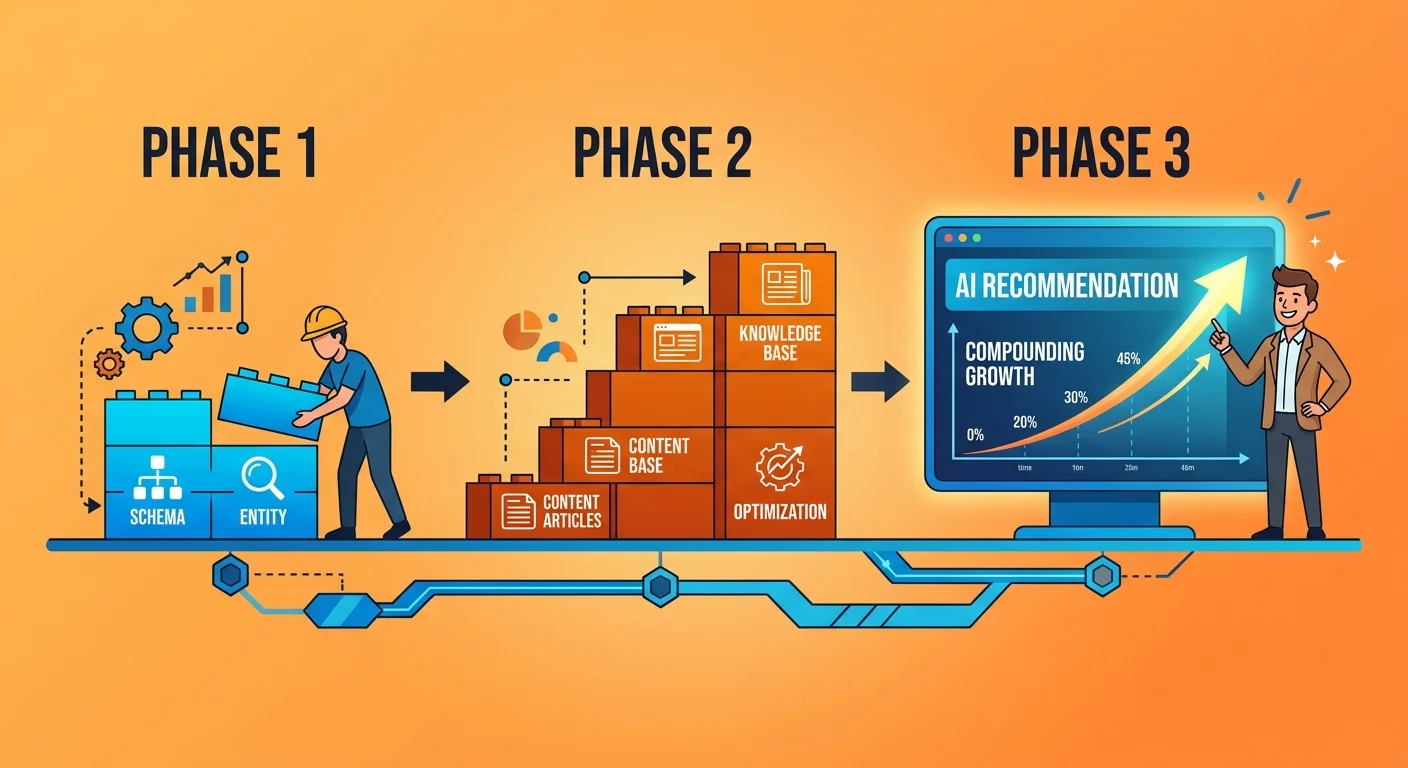
The shift runs in three sequential phases. Each one builds on the last.
None of them exist in a traditional retainer model – which is exactly why practices on that treadmill keep paying without progressing. Pew Research tracking data puts 23% of US adults on ChatGPT as of March 2024, up from 18% in July 2023. The audience already moved. The infrastructure most practices are running hasn’t.
Phase One: Infrastructure Audit and Rebuild
Phase one starts with an audit. And most practices don’t like what it shows.
Before a single AI Authority article gets written, the existing digital infrastructure gets pulled apart. Schema markup. Entity signals. Structured data. Cross-platform consistency.
What most practices find: the signals AI engines use to verify and categorize a business are absent, incomplete, or actively contradicting each other. That’s not a content problem. That’s a foundation problem. And stacking content on top of a broken foundation doesn’t produce authority – it produces noise with extra steps.
The rebuild closes those gaps. Schema architecture gets implemented correctly. Entity data gets verified and synchronized across every platform where the business appears. Machine-readable content hierarchies get built so ChatGPT, Gemini, and Grok can parse, categorize, and trust the entity.
For practice owners burned by agencies that never touched this layer, the instinct is to do nothing – protect against another misdirected investment. That reaction makes sense. But inaction isn’t neutral. Every month on a broken foundation is a month a competitor is building a permanent one. the recovery path
Phase Two: AEO Content Execution at Scale
Foundation locked. Phase two starts.
AEO content execution isn’t keyword blogging with a rebrand. It’s a disciplined monthly production of machine-readable, topically authoritative AI Authority articles – each one built to add citation signals to the entity’s profile, deepen Semantic Density, and increase Citation Velocity over time.
The content gets written to be extracted by AI engines and cited as a direct answer. Not to be read by visitors who clicked a search list. That distinction changes everything about how it gets built – and why most agencies can’t build it.
Here’s the context that makes this urgent. 73% of marketing and advertising professionals in the US now use generative AI. The volume of AI-produced content is exploding.
What separates content that earns AI citations from content that gets ignored isn’t output volume. It’s structural validity – correct schema, accurate entity references, and semantic coherence at the infrastructure level. Scale without structure is just more noise. And right now, the internet is drowning in it.
Phase Three: Authority Compounding Over Time
This is where the staircase starts to pay off permanently.
Every month of AEO content execution adds a permanent step to the entity’s authority profile. Citation Velocity increases. Semantic Density deepens. Entity Trust strengthens.
None of it resets when the calendar turns. None of it disappears if you pause. The compounding effect is structural – built into the architecture itself, not sustained by a monthly payment.
That’s the treadmill-or-staircase difference made real. The treadmill keeps you moving. The staircase keeps you climbing – and every step you’ve already built stays exactly where you left it.
| Month | What Gets Built | Authority Signal Created | Compounding Effect |
|---|---|---|---|
| Month 1-2 | Infrastructure audit and schema architecture rebuild – entity data verified and synchronized across every platform where the business appears | Entity Trust signal established – AI engines can now identify, categorize, and verify the business as a coherent, credible entity | Foundation is permanent – every subsequent content signal builds on verified infrastructure rather than an unstable base |
| Month 3-4 | First wave of AI Authority articles published – machine-readable, topically authoritative, structured for AI extraction | Citation Velocity begins – each article adds a new citation signal to the entity’s profile across conversational AI platforms | Early signals compound with the infrastructure layer; the entity starts appearing in AI engine knowledge graphs as a topical authority |
| Month 5-6 | Sustained AEO content execution deepens topical coverage – interconnected articles reinforce each other’s entity references | Semantic Density increases – AI engines categorize the business as a verified authoritative source on its core subject matter, not just a site that mentions it | Citation Velocity and Semantic Density amplify each other; the authority profile becomes harder for competitors to displace |
| Month 7-9 | Content ecosystem matures – AI Authority articles cross-reference verified entities, structured data signals are consistent and reinforced | Named recommendation frequency increases – conversational AI engines begin surfacing the business as the direct answer to relevant queries | Each new article strengthens existing articles; the compounding effect accelerates as the content network grows denser and more interconnected |
| Month 10-12 | Full authority infrastructure operating – schema, entity signals, and content execution all functioning as a unified, machine-readable system | Durable AI visibility established – the entity is recognized, trusted, and recommended by ChatGPT, Gemini, and Grok with consistency | The staircase is built – every step remains in place regardless of month-to-month fluctuations; the authority asset compounds indefinitely without resetting |
Who This Shift Is For (And Who It Is Not)
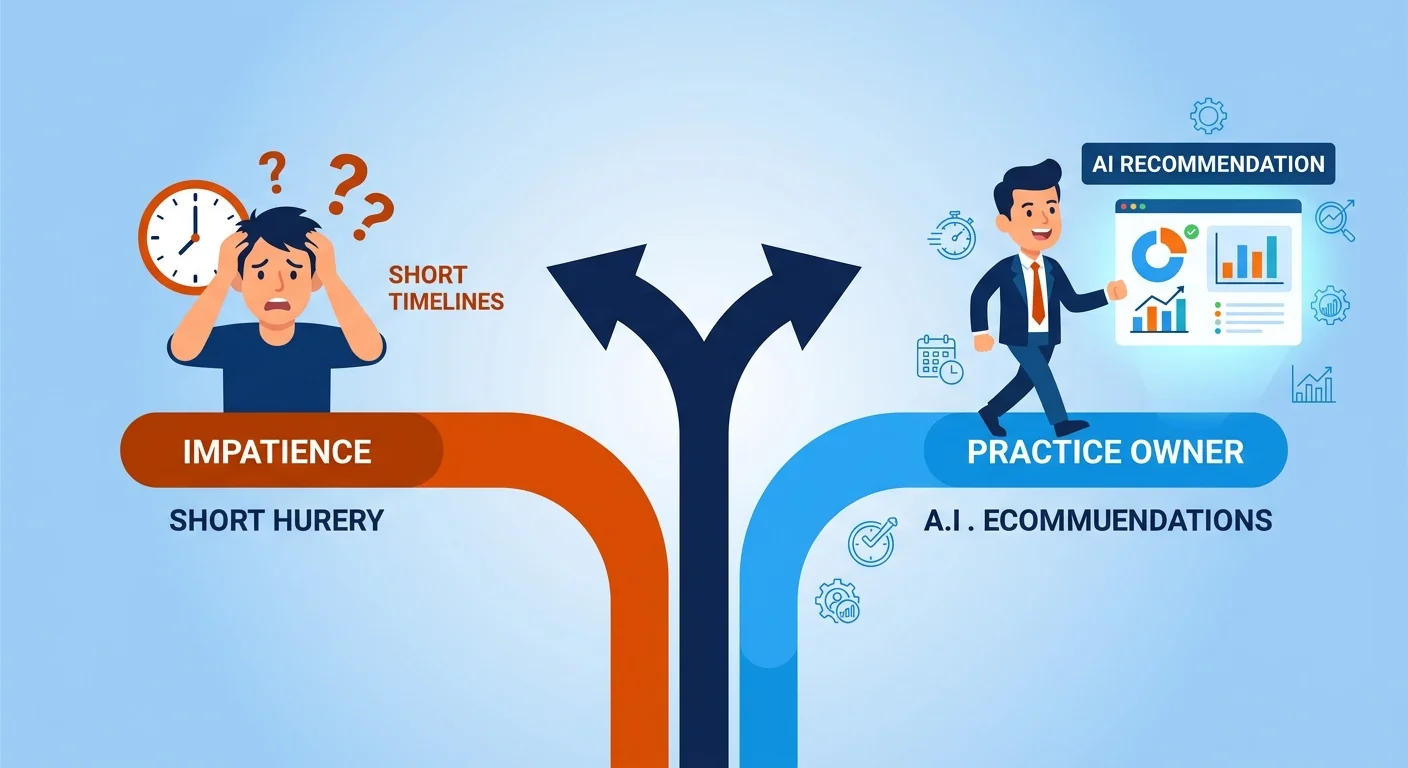
Not every practice belongs here. That’s not a caveat – it’s the most useful thing I can say before you read another word.
The AI Authority Engine was built for a specific kind of operator. Someone running long enough to know the difference between motion and momentum. Someone who’s watched retainer invoices clear month after month while the waiting room held steady. Someone who looked at 23% of US adults already using ChatGPT – up from 18% just eight months earlier – and didn’t think ‘interesting trend.’ They thought: the migration already happened. I’m behind.
Then there’s everyone else. The 90-day guarantee seekers. The price-shoppers. The ones convinced the treadmill just needs a faster setting. This section is the filter. Read it honestly and you’ll know exactly which side of the line you’re standing on.
The Practice This Was Built For
This was built for the established local practice – chiropractic, medical, professional services – generating real revenue but hitting a ceiling on what traditional marketing can move.
You’ve hired an agency before. Maybe more than one. You got reports that looked professional – impressions, clicks, rankings – and couldn’t trace a single line item to a patient walking through the door. You’re not anti-technology. You’re anti-waste. And here’s the number that should sting: 80% of business buyers now expect real-time, direct answers from AI engines – not a list of links to scroll through. Your patients are in that 80%. The infrastructure you’re paying for right now wasn’t built for them.
The practices this was built for are done watching authority reset to zero every time a payment stops. They want something permanent – a compounding digital asset that earns AI citations, strengthens month over month, and puts their name in the answer instead of a competitor’s. That’s the staircase. If that’s what you’re after, keep reading.
Who Should Not Make This Shift
Here’s where I’ll be direct. If this lands wrong, that’s useful information too.
If you need measurable ROI in 90 days or less, this isn’t your answer. Authority compounds – it doesn’t microwave. Statista marketing adoption metrics show 73% of marketing professionals are already using generative AI to produce content at scale. The market is drowning in fast content. What AI engines reward isn’t speed – it’s structural credibility built over time. If your decision framework requires a short-cycle guarantee, the treadmill will feel more comfortable. It’s designed to.
Same goes if you want to manage the process yourself, shop on price, or test a stripped-down version before committing. The AI Authority Engine is a full-infrastructure rebuild plus sustained monthly content execution. White-glove. Done-for-you. No DIY tier. No discount entry point. And no version of this works if the operator isn’t committed to the long game. If that’s not where you are right now – no hard feelings. But don’t talk yourself into a half-measure and blame the model when it doesn’t compound.
| Buyer Profile | Ready for an AI Authority Engine? | Why or Why Not |
|---|---|---|
| Established local practice with consistent revenue that has plateaued | Yes | Has the operational foundation to sustain a long-term authority build and the revenue base to make it a strategic investment rather than a financial risk. |
| Practice owner burned by one or more agency retainers that delivered metrics but no patient growth | Yes | Understands the difference between vanity reporting and real-world outcomes – and is ready for infrastructure that builds permanent authority instead of renting temporary visibility. |
| Operator who wants a done-for-you build with no learning curve or platform management | Yes | The AI Authority Engine is white-glove by design. The client does nothing. The rebuild, the content execution, and the entity validation are handled end to end. |
| Buyer who needs measurable ROI in 90 days or less | No | Authority is a compounding asset, not a short-cycle campaign. Practices looking for a quick-return guarantee will find the treadmill more comfortable – it’s built for that expectation. |
| Operator who wants to manage the process, compare pricing tiers, or test a stripped-down version first | No | There is no DIY entry point and no discount tier. The system works because it is executed completely and consistently – a half-measure doesn’t compound, it stalls. |
| Practice that believes the current retainer just needs a different agency or a faster setting | No | The problem isn’t the vendor – it’s the architecture. Swapping one retainer for another optimizes the treadmill. It does not replace it with a staircase. |
Frequently Asked Questions
Here’s where most people pause. Not because the strategy doesn’t make sense. Because a few specific questions are blocking the door – and they deserve a straight answer.
These aren’t edge cases. They’re the exact questions that come up right before someone decides to stay put – or make the move.
Why are traditional agency marketing retainers failing to produce new patients or clients?
They’re optimizing for the wrong engine. Traditional retainers were engineered to rank you on a list – ten blue links, a scroll, a click. That chain is breaking down fast.
Traditional search engine volume is projected to drop 25% by 2026 as patients migrate directly to conversational AI platforms. They’re not Googling anymore. They’re asking. And when someone asks ChatGPT or Gemini who to trust, keyword positions and monthly content output don’t produce an answer.
Entity Trust does. Most retainers don’t build it. That’s the whole problem.
What is the difference between a traditional SEO retainer and an AI Authority Engine?
A retainer gets you on a list. An AI Authority Engine gets you named as the answer. Those aren’t variations of the same outcome – they’re completely different engineering problems.
Retainers target click-through traffic on search result pages that are rapidly losing relevance to conversational AI. The Local AI Authority Engine rebuilds the foundational infrastructure that AI engines use to determine who they trust – schema, Entity Trust, Citation Velocity, Semantic Density.
It’s not about ranking higher. It’s about being the entity an AI cites by name when someone in your market asks who to trust.
How does an AI Authority Engine rebuild my digital infrastructure to be read by ChatGPT and Gemini?
It starts at the foundation. Schema markup, entity signals, machine-readable content architecture – these are the signals AI engines use to verify who you are and whether you’re worth citing. Right now, most practice websites are digital brochures. They look fine to a human. A large language model can’t do anything with them.
The rebuild makes the site legible to AI: structured data, clean entity relationships, and content that confirms your identity across every surface an engine consults. Then the content execution layer starts – monthly AI Authority articles that compound over time, building the citation depth and semantic authority that conversational engines pull from when generating recommendations.
And here’s the thing – according to Salesforce research, 80% of business buyers now expect real-time, direct responses. Not a list. A verdict. The infrastructure rebuild is what puts your name in that verdict.
Will shifting away from my marketing agency disrupt my current local search visibility?
Not in any meaningful way. And here’s the reframe that actually matters: if your current visibility is driven by traditional keyword rankings, that visibility is already declining – whether you do anything or not. Gartner predicts search engine volume will drop 25% by 2026. The risk isn’t in making the shift.
The risk is in waiting.
Stronger entity signals support local AI recommendations – they don’t undermine them. You’re not abandoning a working system. You’re replacing a system that’s already being dismantled without your input.
How long does it take to establish verified Entity Trust with major AI engines?
There’s no honest microwave answer here. What I can tell you is that 23% of US adults had already used ChatGPT as of March 2024 – up from 18% just eight months earlier – and that curve isn’t slowing down.
Every month of infrastructure and content execution compounds. The practices that started building Entity Trust earlier are already further ahead than the ones starting today. That’s not a scare tactic. That’s just how compounding works.
The question isn’t how long it takes. The question is how much ground you’re willing to give up while you wait.
Can I run an AI Authority Engine alongside my existing agency retainer?
Technically, yes. Practically, it creates a conflict. Traditional retainers are optimized for click-through traffic on search result pages – the exact channel being cannibalized by conversational AI. Running both means paying for a system losing relevance while building the one replacing it.
That’s not a strategy problem. That’s a budget problem.
So run the honest test: is the retainer producing real patient bookings with a clear paper trail? Keep it – and add the Authority Engine on top. But if it’s producing reports full of impressions and ‘rankings’ with no line to a patient walking through the door, you already have your answer. You’re paying for the treadmill. The question is whether you’re ready to start building the staircase.
The Bottom Line on Retainers vs. Authority
Here’s the truth: you’re already on one of these two paths.
The treadmill or the staircase. No hybrid. No version that compounds without a compounding commitment.
Every month a retainer resets to zero is a month the staircase doesn’t get a new step. Somewhere in your market, a practice that made a different call is already standing higher than they were twelve months ago.
This isn’t about tearing down what agencies built. It’s about being honest that what they built was optimized for a world that’s being replaced right now.
ChatGPT, Gemini, and Grok don’t return lists. They return verdicts. The businesses earning those verdicts spent months building Entity Trust, deepening Semantic Density, and stacking Citation Velocity – the signals that actually determine whose name gets said.
The ones still paying retainers for keyword positions? They’re getting listed. Somewhere below the fold. On a platform fewer people open every quarter.
iTech Valet builds the staircase. That’s not a positioning line – it’s a structural description of what the Local AI Authority Engine actually does.
Permanent. Compounding. Machine-readable authority that doesn’t disappear when you stop writing a check.
If you want to know exactly where you stand right now – what ChatGPT, Gemini, and Grok say when someone in your market asks who to trust – run the AI Visibility Check. Fifteen minutes. Real data. No guesswork. If the results don’t make the problem self-evident, walk away. But if they do – you’ll know exactly which path you’ve been on. And exactly what it costs to stay there.
You know which one you’re standing on. The only thing you don’t know yet is what ChatGPT, Gemini, and Grok are saying about your practice right now – when someone in your market asks who to trust.