
Why Keyword Optimization No Longer Works
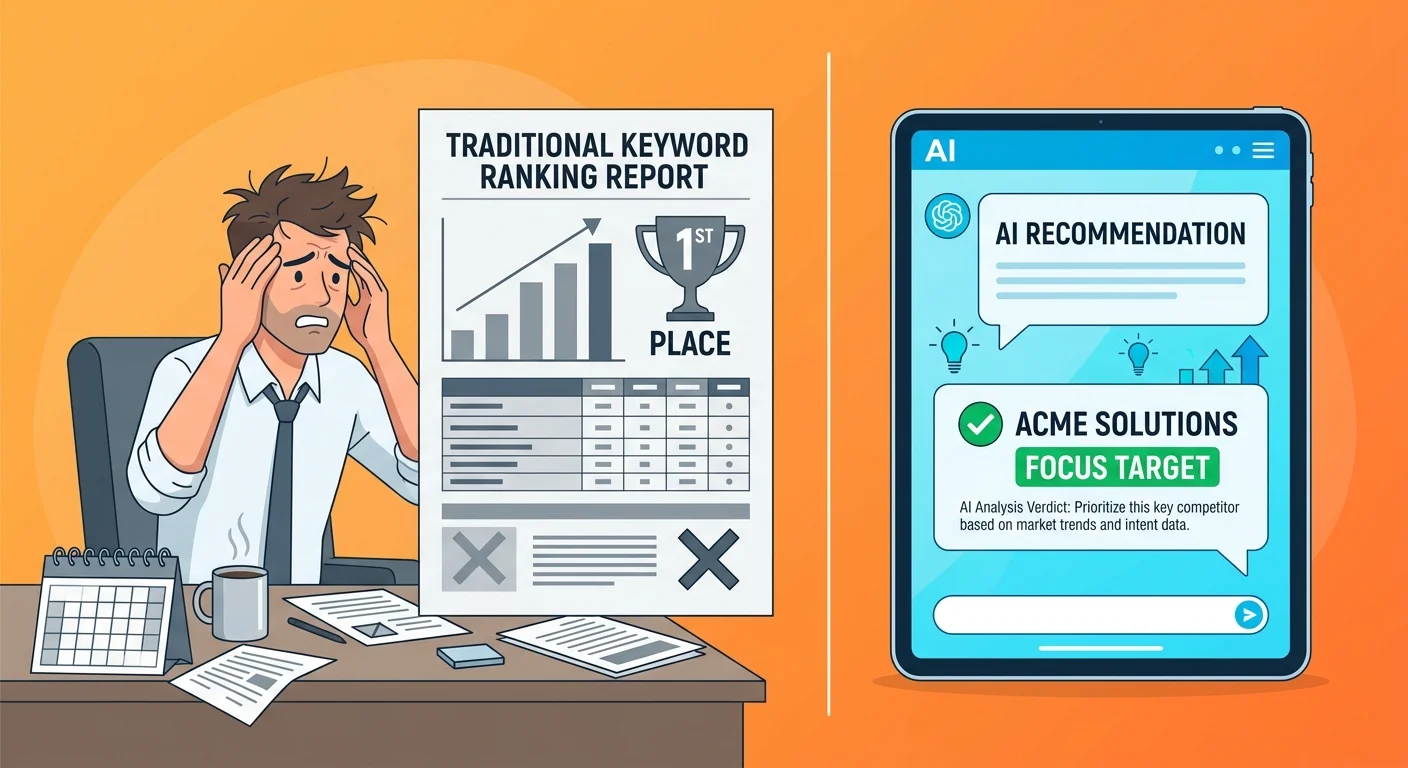
The game changed.
Patients stopped Googling. Not slowly. Not gradually. ChatGPT hit 100 million users in two months – faster than any technology in history. And what those users do is fundamentally different from what they used to do on Google.
They ask questions. Full sentences. Natural language. “Who’s the best chiropractor near me for lower back pain?”
And they expect one answer. Not ten blue links to compare. A verdict.
That shift broke the entire keyword model. Because keyword optimization was built for list-based search. You optimized a page for “best chiropractor near me” so you’d show up on Page 1. Patients would scan the list, click a few results, compare options, decide. The keyword got you on the list. That was the whole game.
AI doesn’t work that way.
When someone asks Gemini or ChatGPT who the best chiropractor in their area is, it doesn’t return a list. It names one or two practices. It explains why. It cites the sources it trusts. That’s the answer. If your entity isn’t trusted enough to be cited – you’re invisible. And the factors AI uses to determine trust have nothing to do with whether you rank #3 for a specific keyword.
This is where the AI Authority Engine becomes the only solution that addresses the actual problem. Keyword rankings are obsolete because the mechanism that made them matter – list-based search – is being replaced by answer-based AI.
Here’s what actually happened.
The industry kept selling keyword optimization because it’s easy to report. Agencies could send you a spreadsheet every month showing you ranked #3 for this phrase and #7 for that one. The report looked like progress. The client felt like things were moving. But those rankings weren’t generating new patients – because patients weren’t clicking through lists anymore.
That’s not an agency failure. That’s a system failure.
The entire keyword model was built on the assumption that search would always be a list. That assumption is dead.
The Yellow Pages Analogy
Paying for keyword optimization in 2026 is like buying Yellow Pages ads in 2015.
The vendor isn’t scamming you. The Yellow Pages company still prints the books. They’ll still deliver them. They’ll still charge you to be listed under “Chiropractors.”
But the channel your patients used to discover businesses died. Nobody opens the Yellow Pages anymore. They Google it. Or now – they ask an AI.
You didn’t get ripped off. The vendor delivered the book. The problem is, you bought an ad for a channel nobody uses anymore.
That’s where most chiropractic practices are right now with keyword strategies. They’re still buying ads in the Yellow Pages. Except instead of a physical book, it’s a list of blue links on Google that patients stopped clicking. And instead of a Yellow Pages rep, it’s a marketing agency sending monthly ranking reports that mean nothing.
The mechanism of discovery changed. Your strategy didn’t.
What Google’s AI Overviews Actually Mean
Even Google – the company that created the keyword-ranking system – moved on.
According to Google’s own blog post announcing AI-powered search features, the company is aggressively rolling out AI Overviews and Search Generative Experience (SGE) features. Those features don’t return a ranked list of ten websites. They synthesize an answer from multiple trusted sources and present it directly in the search results.
The user gets the information without clicking anything.
That’s called zero-click search. And it’s not a fringe feature. Google is making it the default experience because they know conversational AI is where user behavior went. They’re racing to keep up with ChatGPT and Gemini. They can’t afford to lose search dominance to answer engines – so they’re becoming one.
What does that mean for your keyword-optimized pages?
They’re invisible.
Because Google’s AI Overviews aren’t pulling answers from the pages that rank #1 for a keyword. They’re pulling answers from the entities they trust. Entities with comprehensive, interconnected content architectures. Entities with schema markup. Entities with verified credentials and consistent signals across multiple pages.
In other words – answer clusters. Not keyword-targeted articles.
If Google itself is abandoning the list-based model, why are practices still paying agencies to chase rankings on that list?
The Vanity Metric Trap
Here’s why agencies kept selling keyword rankings long after they stopped mattering: they’re easy to report and hard to challenge.
“You rank #3 for ‘chiropractor lower back pain near me.’”
That sounds like progress. The client doesn’t know that nobody types that exact phrase anymore. They don’t know that even if someone did, the AI Overview would answer the question without the user ever clicking the #3 result. All they see is a number that went up. That feels like success.
But it’s not. It’s hopium.
A metric that looks impressive on a spreadsheet but delivers zero business impact.
Let’s keep it real: keyword rankings are vanity metrics. They measure position on a list that patients stopped clicking. They exist to keep clients paying, not to generate patients. And the reason they worked as vanity metrics for so long is that most business owners don’t understand the difference between ranking on a list and being cited by an AI.
They sound similar. They’re not even close.
Ranking on a list means you showed up in the search results. Being cited by AI means the engine trusted your entity enough to recommend you as the answer.
The first is visibility. The second is authority.
And authority is what AI engines use to make their recommendations.
If your agency’s monthly report shows keyword rankings but no data on whether ChatGPT or Gemini cites your practice – you’re being sold a strategy that died two years ago.
| Metric | Keyword-Based Model | Answer Cluster Model | Why It Matters |
|---|---|---|---|
| Primary Goal | Rank on Page 1 for target keywords | Be cited as the answer by AI engines | AI doesn’t rank – it recommends. Lists are obsolete. |
| Content Focus | One article per keyword | Interconnected articles covering entire topic | AI measures topic authority, not keyword density. |
| Success Indicator | Keyword position (#1, #3, #7) | Citation frequency in AI responses | Rankings are vanity metrics. Citations generate patients. |
| User Behavior Assumption | Users type keywords, click blue links | Users ask questions, trust AI verdicts | Patients stopped clicking. They started asking. |
What Is an Answer Cluster?
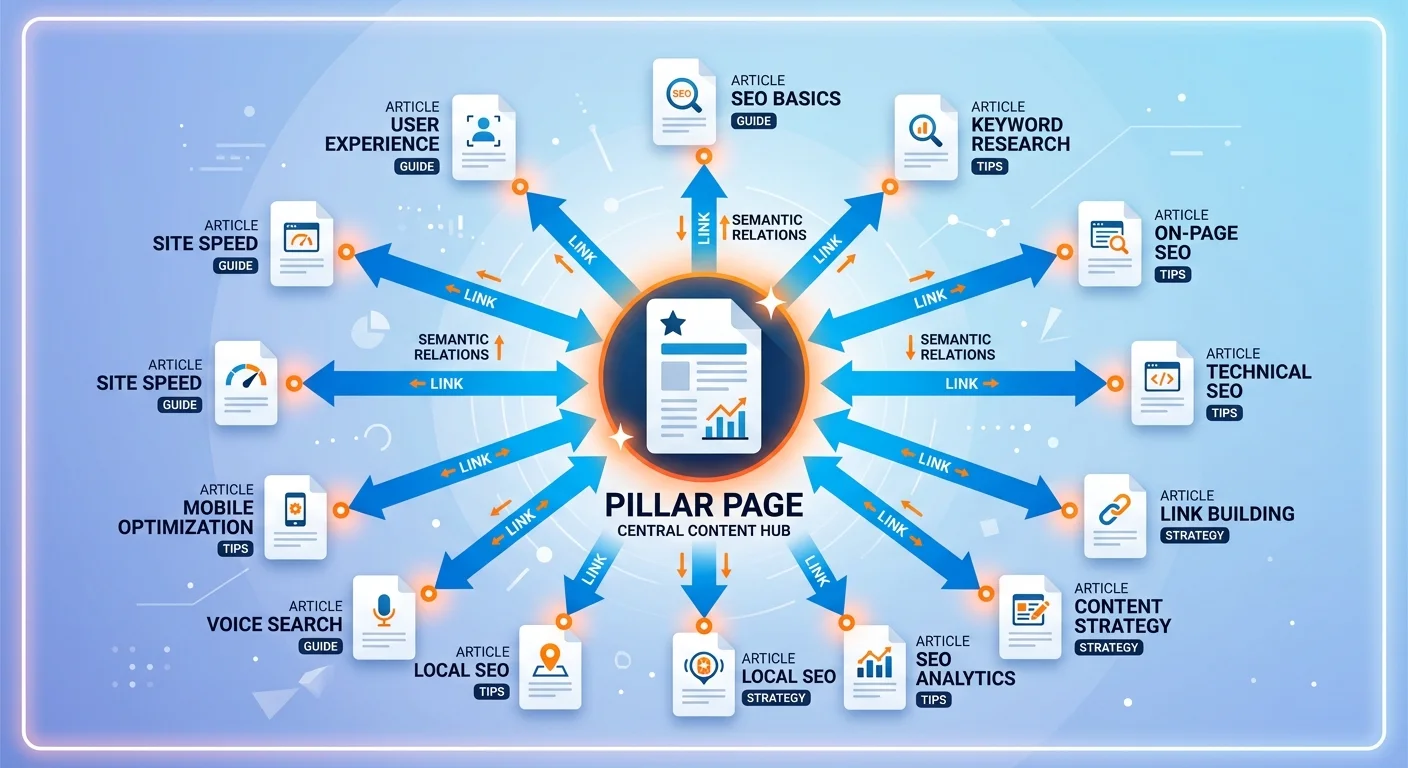
An answer cluster is a structured content architecture designed to establish topic-level authority.
It’s not a collection of random blog posts. It’s not ten articles loosely related to the same subject.
It’s a deliberate, interconnected system where every piece of content serves a specific structural purpose – and AI engines can read that structure because it’s encoded in schema markup and reinforced through strategic internal linking.
The model is hub-and-spoke.
At the center sits the pillar page – a comprehensive resource covering the broad topic. Radiating out from that pillar are cluster articles, each diving deep into a specific subtopic, question, or angle within the larger subject.
The pillar links to every cluster. Every cluster links back to the pillar. Related clusters link to each other where contextually relevant.
That linking pattern creates a semantic web.
And when AI engines crawl your site, they don’t just see individual articles. They see proof that your entity has invested in comprehensive coverage of the entire topic. That’s what builds trust. That’s what earns citations.
HubSpot’s guide on topic clusters explains the pillar-and-cluster model as the replacement for the old keyword-siloed approach. The difference isn’t cosmetic. It’s architectural.
A keyword-optimized article exists in isolation. An answer cluster article exists as part of a cohesive system that AI can read, validate, and cite.
The businesses winning AI recommendations aren’t the ones with the most backlinks or the highest domain authority. They’re the ones that rebuilt their content as answer clusters.
Pillar Page vs Cluster Articles
The pillar page is the entry point.
It’s the comprehensive resource that covers the broad topic in enough depth to stand alone as the definitive guide. If someone lands on your pillar page and reads nothing else – they should walk away with a complete understanding of the subject.
But it’s not just a long-form article. It’s also the navigational hub.
Every cluster article links back to it. The pillar links out to all the clusters. That bidirectional linking reinforces the relationship between the broad topic and its supporting subtopics. AI engines read those links as semantic proof that your entity owns the entire topic – not just fragments of it.
Cluster articles are deep-dive pieces.
Each one addresses a specific question, objection, or angle within the larger topic. They’re not summaries. They’re not fluff. They’re comprehensive answers to individual subtopics – often 2,000 to 3,000 words each – because the goal is to be the most complete source AI can find on that specific subtopic.
Here’s the critical distinction: a pillar page without clusters is just a long article. Clusters without a pillar are just disconnected blog posts.
The power comes from the relationship.
The pillar establishes the broad authority. The clusters prove depth. The internal links tell AI “this entity has mastered every angle of this topic.”
How Many Articles Are in a Cluster?
There’s no magic number.
The size of the cluster depends on the complexity of the topic and the competitive landscape in your market.
A robust cluster typically includes one pillar page and somewhere between 5 and 20 supporting articles. But that’s a guideline – not a rule. The goal isn’t to hit an arbitrary article count. The goal is comprehensive coverage.
If the topic requires 30 articles to address every meaningful subtopic and user question – you build 30 articles. If it only needs 8 – you build 8.
What matters is whether the cluster fully addresses the topic from every angle a patient might approach it.
If someone could ask a question about your pillar topic and you don’t have a dedicated cluster article answering it – the cluster is incomplete. And incomplete clusters don’t generate citations. They generate gaps that competitors fill.
| Content Type | Topic | Purpose |
|---|---|---|
| Pillar Page | Comprehensive Chiropractic Care | Broad overview covering the entire topic – serves as navigational hub and authority anchor |
| Cluster Article | What to Expect at Your First Chiropractic Visit | Deep-dive answering specific patient question – links back to pillar |
| Cluster Article | How Chiropractic Adjustments Work | Mechanism explanation – addresses educational subtopic within pillar |
| Cluster Article | Chiropractic Care vs Physical Therapy: What’s the Difference? | Comparison content addressing common patient confusion – competitive angle within topic |
| Cluster Article | Is Chiropractic Care Safe? Risks and Considerations | Objection handling – addresses counter-intent within the pillar topic |
How Answer Clusters Differ from Traditional Blog Posts
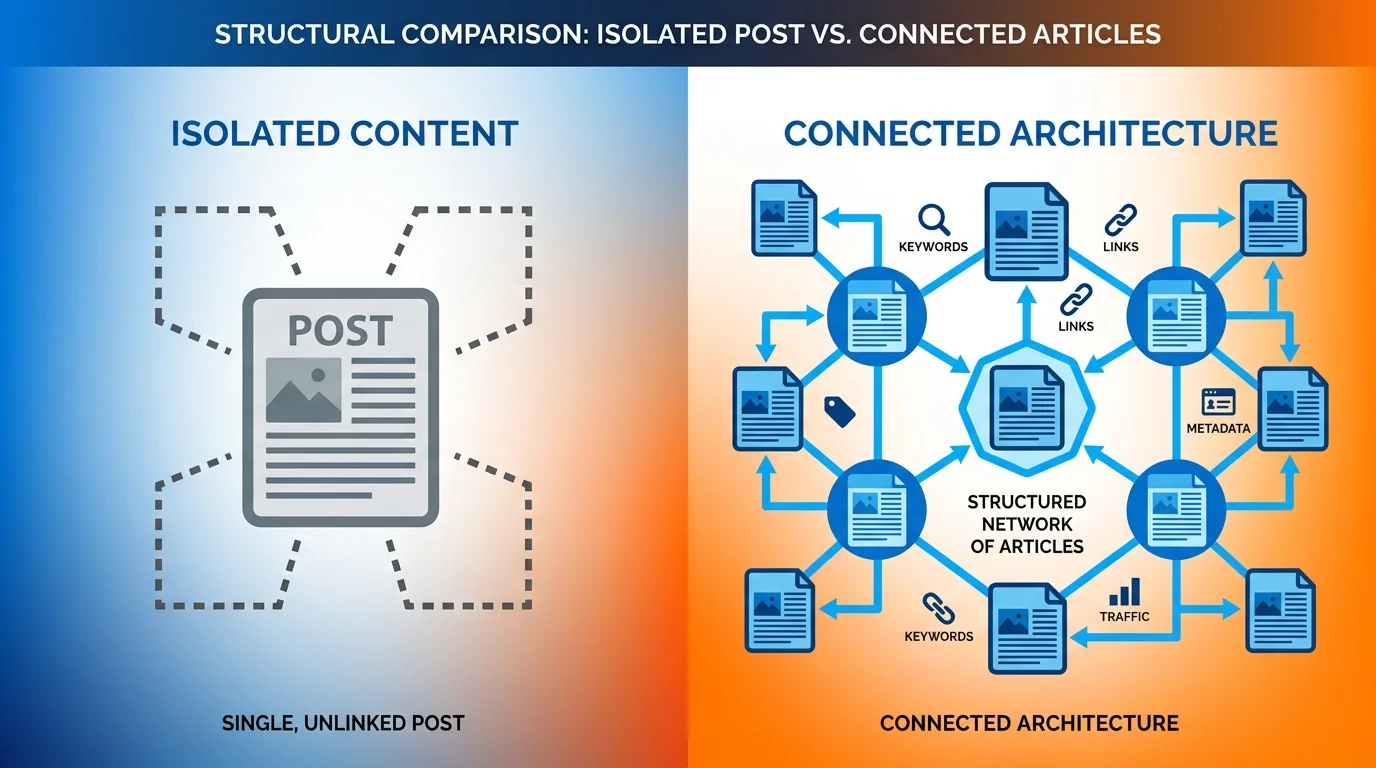
Traditional blog posts were written as standalone articles.
Each post targeted one keyword. Each post existed in isolation. There was no strategic connection to other content. No linking strategy. No schema markup tying them together.
Just a chronological feed of loosely related posts optimized for individual search queries.
That model worked when search was list-based. It doesn’t work now.
Answer clusters are architecturally designed systems.
Every article serves a structural purpose within the larger topic. Every piece of content is semantically connected through internal links and schema markup. The cluster isn’t just a collection of articles – it’s a content infrastructure that AI engines can read, validate, and cite as proof of topic-level authority.
The difference isn’t subtle. It’s foundational.
Blog posts target individual keywords. Answer clusters build topic-level authority.
Those are not variations of the same strategy.
The Depth Problem
Most traditional blog posts are 800 to 1,200 words of surface-level advice optimized for a single keyword.
They answer the literal question – Direct Intent – and stop. No exploration of related concerns. No objection handling. No next-step guidance. Just enough content to rank on a list.
Answer clusters prioritize completeness over length.
Each cluster article covers its subtopic exhaustively. That often means 2,000 to 3,000 words – sometimes more – because the goal isn’t to hit a word count target. The goal is to be the most comprehensive, accurate, and useful answer AI can find on that specific subtopic.
Depth signals authority.
AI engines don’t cite thin content. They cite sources that demonstrate mastery of the subject. And mastery isn’t proven by writing 800 words about 50 different keywords. It’s proven by writing 3,000 words about one subtopic and covering it so thoroughly that no follow-up question remains unanswered.
That’s why word count is the wrong metric. Length without depth is just padding. Depth without strategic structure is just isolated expertise.
You need both – and you need them organized into a cluster.
The Intent Coverage Gap
Keyword-focused blog posts address Direct Intent only.
Someone types “what is a chiropractic adjustment” – the post answers that literal question and moves on. But that’s not how patients actually think.
They have follow-up concerns.
“Does it hurt?” “How long does it take?” “What happens if it doesn’t work?” “Is this better than physical therapy?”
Those are Indirect Intent, Counter-Intent, and Post-Intent questions. And if your content doesn’t address them – AI engines cite the content that does.
Answer clusters are built around all five intent layers:
- Direct Intent – The literal question
- Indirect Intent – The real goal behind the question
- Latent Intent – Related considerations the user hasn’t thought to ask yet
- Counter-Intent – Objections, concerns, reasons they might not choose something
- Post-Intent – What happens after the answer – next steps, realistic expectations, first interaction details
Every H2 section in a cluster article must address at least 3 to 4 of those intent layers.
A section that only answers the literal question and moves on will always lose to one that also explains why, what next, and why not. That’s the coverage gap between blog posts and answer clusters.
The Linking Structure
Blog posts link randomly or not at all.
Some practices use “related posts” widgets that auto-populate based on tags or categories. Some just don’t link internally at all. Either way – there’s no strategy. No semantic architecture. No signal to AI that these articles are part of a larger system.
Answer clusters use strategic internal linking to create a semantic web.
Every cluster article links back to the pillar using semantic anchor text that reinforces the relationship. The pillar links out to every cluster article. Related clusters link to each other where contextually relevant.
That linking pattern isn’t arbitrary. It tells AI engines “this collection of content is interconnected around a central topic.” And when the engine sees that pattern reinforced across multiple pages with consistent schema markup and entity signals – it reads it as proof of topic ownership.
Blogs are content. Clusters are architecture.
| Element | Traditional Blog | Answer Cluster | AI Impact | Business Outcome |
|---|---|---|---|---|
| Content Depth | 800-1,200 words | 2,000-3,000+ words per article | Depth signals authority – AI cites comprehensive sources | Patients trust practices that demonstrate mastery, not surface knowledge |
| Intent Coverage | Direct Intent only | All 5 intent layers | AI prefers sources that address follow-up questions proactively | Fewer objections, faster conversions, more booked appointments |
| Linking Strategy | Random or none | Strategic semantic web | Links signal topic relationships – AI reads structure as proof of authority | Higher citation velocity – AI recommends your practice more often |
| Schema Markup | Usually absent | Implemented across all articles | Schema tells AI how content is organized – without it, AI can’t parse the cluster | Invisible without schema. Trusted with it. |
| Topic Ownership | Isolated expertise | Comprehensive coverage | AI rewards breadth – one article = data point, cluster = proof | Competitors with clusters dominate recommendations even with worse websites |
The Architecture of a Functional Answer Cluster
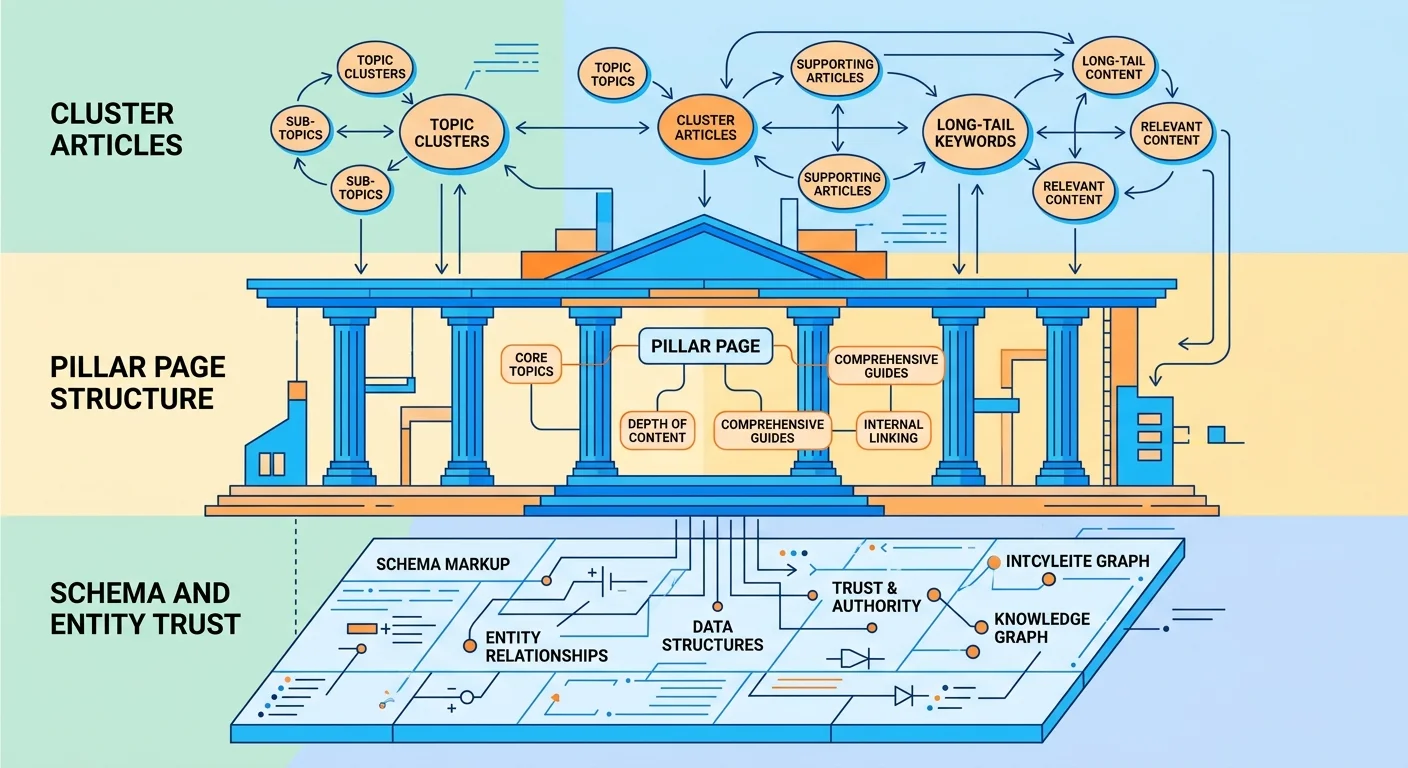
Building an answer cluster isn’t a writing task. It’s an architectural project.
You’re not just adding words to pages. You’re encoding semantic relationships. You’re telling AI engines “this entity has comprehensive authority on this topic” through schema markup, strategic linking, verified entity signals, and content depth.
All five components must be present. Miss one – the cluster fails.
This is where most businesses fail. They think they can read one article, understand the concept, and execute it themselves.
They can’t.
Because they underestimate the technical complexity. AEO Content Writing Services exist specifically because the DIY approach consistently produces broken clusters that AI engines ignore.
Here’s what a functional cluster requires.
Component 1: Schema Markup
Schema is the machine-readable layer that tells AI engines what each page is about and how it relates to other pages in the cluster.
Without schema, AI can’t read the cluster structure. It sees isolated articles with no semantic connection.
With schema, it sees a cohesive authority system where the pillar establishes the broad topic and the clusters prove depth across every subtopic.
Schema types used in answer clusters:
- Article schema – Identifies the content type
- BreadcrumbList schema – Maps site hierarchy and navigation
- Organization schema – Verifies entity identity and credentials
- FAQPage schema – Structures question-and-answer content for AI extraction
Schema isn’t optional. It’s the structural foundation.
And it has to be implemented correctly – which means understanding how to encode semantic relationships between the pillar and clusters. Most DIY attempts fail here because they copy generic schema templates without understanding what the markup is actually communicating to AI.
Component 2: Pillar Page Foundation
The pillar page must be comprehensive enough to stand alone as the definitive resource on the topic.
It’s not just an introduction. It’s not just a gateway. It’s a complete guide that would satisfy a user even if they never clicked through to the cluster articles.
That depth is critical because AI engines evaluate authority by measuring how thoroughly a source covers a topic. A thin pillar page signals surface-level expertise. A comprehensive pillar signals mastery.
And the clusters linked to that pillar reinforce the breadth of that mastery.
The pillar serves three functions:
- Entry point – Often the first piece of content a user encounters
- Navigational hub – Links out to every cluster article
- Authority anchor – The central page all clusters link back to
If the pillar is weak – the entire cluster collapses. Because the pillar is what tells AI “this entity owns the topic.”
Component 3: Cluster Article Depth
Each cluster article must fully answer its subtopic.
No surface-level fluff. No keyword stuffing to hit a length target. Deep, comprehensive coverage of the specific question or angle it addresses.
This is where most DIY attempts fail. Business owners underestimate the depth required. They think “I’ll write 1,000 words about this” and move on.
That’s not enough.
A functional cluster article covers every angle of its subtopic – Direct Intent, Indirect Intent, Latent Intent, Counter-Intent, Post-Intent. It anticipates follow-up questions. It addresses objections. It provides next-step guidance.
Depth isn’t measured in word count. It’s measured in completeness.
If someone could read the article and still have unanswered questions about the subtopic – it’s not deep enough. And incomplete cluster articles break the authority signal the cluster is supposed to project.
AI engines don’t cite thin content. They cite the most complete answer they can find.
If your cluster articles are shallow – a competitor’s deeper content will win the citation. Even if their website is worse than yours.
Quick pause before we go further.
If you’re looking for a way to build an answer cluster in a weekend and see results by Monday – this isn’t it. Authority is built in layers. Foundation first, content compounding on top, AI visibility deepening every month.
If that timeline doesn’t fit your decision framework – no hard feelings.
But if you’re tired of short-term tactics that disappear the moment you stop paying for them, you’re in the right place.
Building a functional answer cluster is not something you absorb from one article and execute effectively. It requires entity mapping, schema implementation, strategic linking architecture, and content depth that most business owners don’t have the time or technical background to deliver.
That’s not an insult. It’s reality.
The DIY Underestimator believes it’s just “writing a few blog posts.” It’s not. It’s infrastructure. And infrastructure requires expertise.
Component 4: Internal Linking Strategy
Every cluster article links back to the pillar using semantic anchor text. The pillar links out to all cluster articles. Related cluster articles link to each other where contextually relevant.
That linking pattern creates the semantic web AI engines use to measure authority.
When they crawl your site and see the same entity name, consistent schema markup, and a strategic linking architecture connecting multiple comprehensive articles – they read it as proof that your entity has invested in the topic.
Not just written about it. Invested in it.
Search Engine Journal’s guide to topic clusters breaks down the mechanics of internal linking in a cluster model. The key insight: links aren’t just navigation. They’re semantic signals.
They tell AI which content is related, how it’s related, and which page is the authoritative hub.
Random linking breaks the signal. Strategic linking reinforces it.
Component 5: Entity Trust Signals
AI engines evaluate entity trust before they cite you as an answer.
Entity trust is built through consistent signals across all pages in the cluster:
- Business name – Identical across every page, no variations
- Location – Consistently formatted address
- Credentials – Verified, sourced, schema-encoded
- Citations – External sources backing up claims
- Author identity – Named authority figure with verifiable bio
Moz’s guide to entity-based optimization explains how AI engines build confidence in entities by understanding the relationships between concepts – not just matching keywords. That shift from keyword-based to entity-based evaluation is why answer clusters work and isolated blog posts don’t.
Entity trust is fragile.
One inconsistency – wrong business name, unverified credential, fabricated statistic – breaks the signal. AI engines deprioritize entities they can’t verify.
And once trust is broken, it’s almost impossible to rebuild.
Why AI Engines Trust Answer Clusters Over Individual Articles
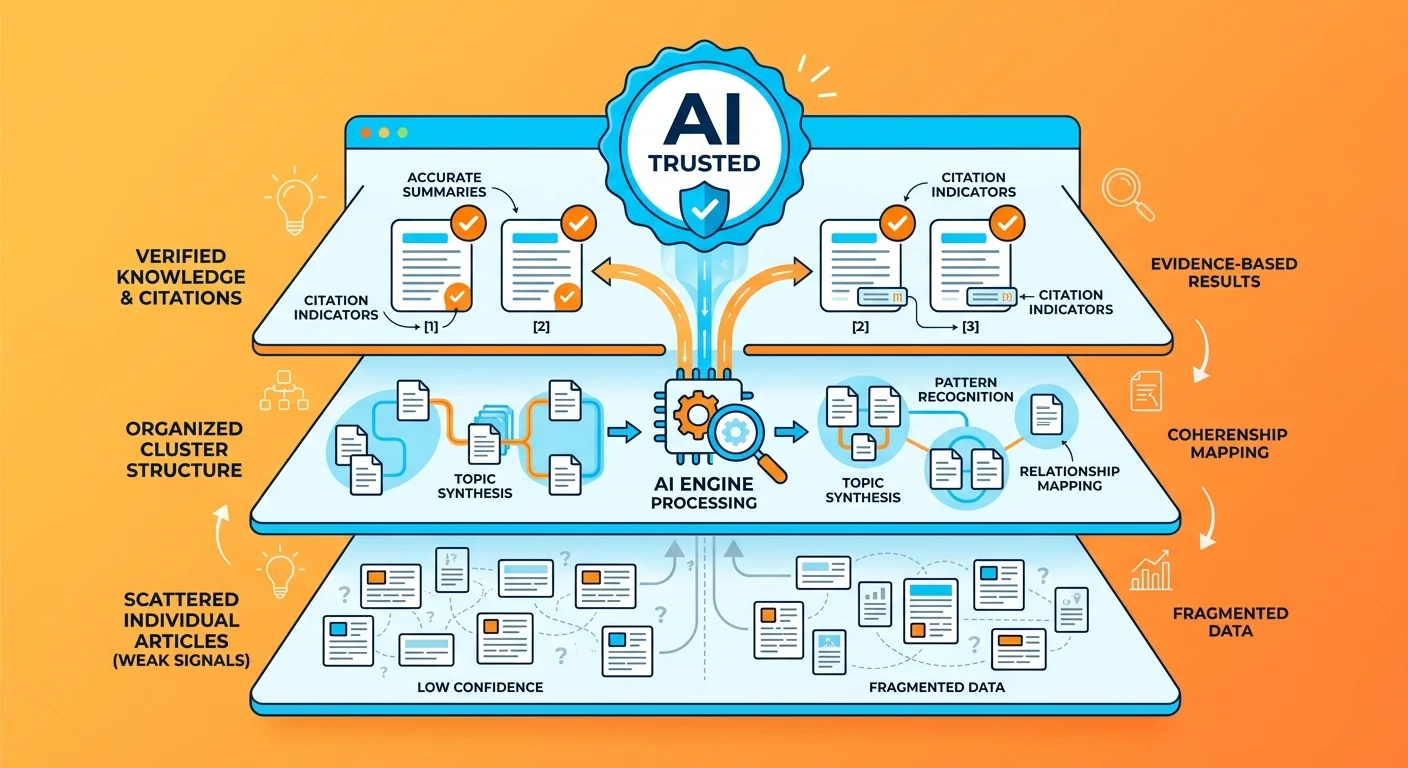
AI engines are tasked with recommending the most reliable, comprehensive source for any user query.
One article on a subtopic is a data point. Twenty interconnected articles covering every aspect of the same topic is proof of expertise.
AI rewards the latter. Always.
The mechanism: when an AI engine evaluates which entity to cite, it doesn’t just look at whether the content answers the Direct Intent. It evaluates whether the entity has demonstrated sustained investment in the topic. Whether the content is interconnected. Whether the entity signals are consistent. Whether external sources validate the claims. Whether the schema markup is present and correct.
Individual articles can’t pass those tests. Answer clusters can.
Breadth of Coverage
One article on “chiropractic adjustments” tells AI you understand one subtopic.
Twenty articles covering adjustments, patient intake, treatment timelines, aftercare, risks, comparisons to physical therapy, insurance considerations, and common misconceptions tells AI you’ve mastered the entire subject.
Breadth signals authority.
AI engines don’t cite narrow expertise when comprehensive expertise is available. And the only way to demonstrate comprehensive expertise is through a cluster – not a single long-form article.
This is why practices with worse websites sometimes dominate AI recommendations. They built clusters. You didn’t.
The website quality doesn’t matter if the content architecture is invisible.
Consistent Entity Signals
Answer clusters reinforce the same entity across multiple pages.
Business name, location, credentials, services – all appear consistently throughout the cluster. That repetition builds entity recognition.
AI engines evaluate entities, not pages.
When they see your entity name appear 15 times across 15 interconnected articles, all citing the same credentials, all formatted with the same schema markup, all linked back to the same pillar – they read it as proof that your entity is legitimate, established, and authoritative.
One article doesn’t build entity recognition. A cluster does.
Citation Velocity
Citation velocity measures how frequently AI engines cite your entity as the answer across different queries.
Higher citation velocity means AI trusts your entity enough to recommend it more often.
Answer clusters generate higher citation velocity because they cover more questions within the topic. Every cluster article is an opportunity to be cited. The more comprehensive the cluster – the more questions you answer – the more citations you earn.
Measuring answer dominance explains how to track citation velocity and use it as the primary success metric for AEO.
The short version: keyword rankings measure list visibility. Citation velocity measures AI trust.
Only one of those metrics generates patients.
| Trust Signal | How Clusters Provide It | Individual Article Limitation |
|---|---|---|
| Breadth of Coverage | Cluster covers 10-20 interconnected subtopics within the main subject | Single article addresses one question – AI reads it as narrow expertise |
| Consistent Entity Signals | Business name, credentials, location repeated across all cluster articles with identical schema | One article provides one data point – not enough repetition to build entity recognition |
| Citation Velocity | Every cluster article = one more opportunity to be cited by AI | One article = one opportunity. Competitors with clusters get cited 10-20x more often |
| Semantic Relationships | Internal linking and schema markup encode relationships between subtopics | Isolated article has no semantic connections – AI can’t measure topic authority |
| Sustained Investment | Building a cluster takes months – signals long-term commitment to the subject | One article can be written in a day – AI reads it as transactional content, not authority |
Common Mistakes When Building Answer Clusters
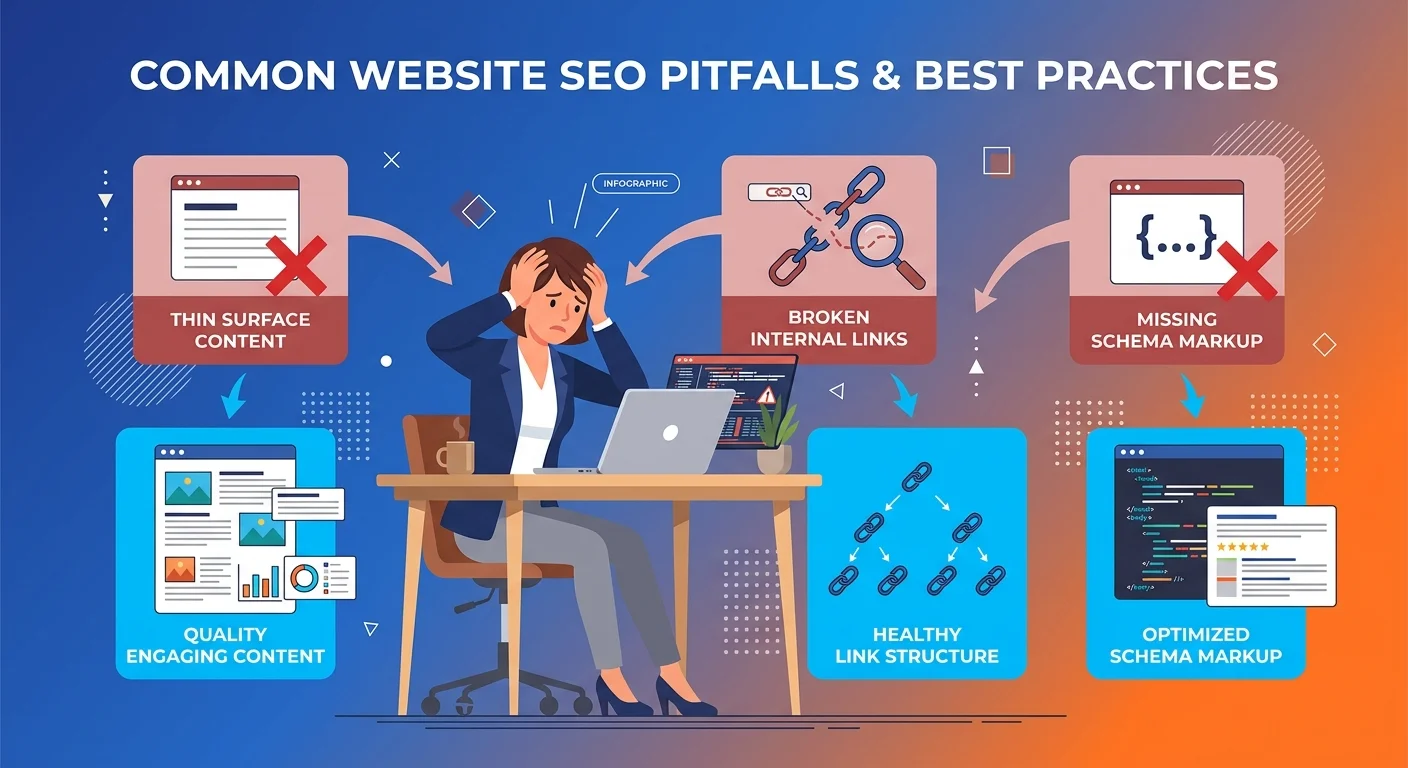
Most businesses fail at answer cluster execution because they treat it like traditional blog writing.
They write ten articles, link them loosely, skip the schema, and call it a cluster. Then they wonder why AI engines ignore them.
The result: a collection of disconnected posts that look like a cluster but function like isolated blog content. AI can’t read the structure. The entity signals are inconsistent. The depth is insufficient.
And the business wasted months of effort building something that doesn’t work.
Here are the five most common failure points.
Mistake 1: Treating Clusters Like Blog Posts
Writing ten articles and calling it a cluster doesn’t work.
Each article must be architecturally connected through linking, schema, and semantic anchors.
The failure pattern: business writes ten loosely related articles, adds a few internal links, and assumes that’s enough. It’s not. The articles exist as separate pieces of content. There’s no pillar page serving as the hub. There’s no strategic linking pattern reinforcing the semantic relationships. There’s no schema encoding the structure for AI to read.
Random articles on loosely related topics are not a cluster. They’re a blog archive with better organization.
Mistake 2: Skipping Schema Markup
Schema is not optional. It’s the machine-readable layer that tells AI engines how your content is structured.
Without it, AI can’t parse the cluster relationships. It sees pages with text. It doesn’t see a semantic web proving topic authority.
And when AI can’t read the structure – you’re invisible. Even if the content itself is excellent.
Most businesses skip schema because they don’t understand what it does. They think it’s a technical optimization layer – something that helps rankings.
It’s not. It’s an AI communication layer.
Without it, you’re publishing content in a language AI engines can’t read.
Mistake 3: Underestimating Content Depth
Surface-level 800-word articles don’t cut it in a cluster.
Every cluster article must fully address its subtopic. That often means 2,000 to 3,000 words of comprehensive, sourced content.
Depth signals authority. AI engines evaluate whether a source has fully answered a question or just provided a summary. Summaries don’t get cited. Complete answers do.
The failure pattern: business writes shorter articles to “move faster.” They hit word count targets instead of topic coverage targets.
The result: thin content that doesn’t establish authority. And thin content in a cluster breaks the authority signal the cluster is supposed to project.
Mistake 4: Ignoring the Pillar Page
Some businesses skip the pillar page entirely and just write cluster articles.
That’s a structural failure.
The pillar is the hub. It’s the central authority point AI engines anchor to. Without it, there’s no semantic center. The cluster articles are just disconnected blog posts with better internal linking.
The pillar page isn’t optional. It’s the foundation the entire cluster is built on.
Skip it – the cluster collapses.
Mistake 5: No Internal Linking Strategy
Links must be strategic.
Every cluster article links to the pillar using semantic anchor text. Related clusters link to each other. The linking pattern creates a semantic web AI engines can read.
The failure pattern: business adds internal links randomly. “Here’s a related post” widgets. Generic “read more” anchor text. No consistency. No semantic strategy.
Just links for the sake of having links.
Random linking doesn’t signal authority. It signals disorganization. And when AI engines crawl a site with no clear linking architecture – they can’t determine which page is the authoritative source.
So they don’t cite any of them.
FAQ
What is an “answer cluster” in AEO?
An answer cluster is a collection of semantically related articles built around a central pillar topic.
It’s designed to comprehensively answer every user question about that topic, establishing deep authority that AI engines trust.
The structure: one pillar page covering the broad topic, 5-20 supporting cluster articles diving deep into specific subtopics, strategic internal linking connecting all articles, and schema markup encoding the relationships so AI can read the structure.
The goal isn’t just to write content. It’s to build a content infrastructure that proves to AI engines you’ve mastered the entire topic – not just fragments of it.
How many articles are typically in one answer cluster?
There’s no magic number.
A robust cluster often includes one main pillar page and anywhere from 5 to 20 supporting cluster articles that dive deep into specific sub-topics.
The size depends on the complexity of the topic. “Chiropractic care” as a broad subject might require 20+ articles to cover comprehensively. “Spinal decompression therapy” as a narrower topic might only need 8-10 articles.
What matters is completeness.
If a patient could ask a question about your pillar topic and you don’t have a dedicated cluster article answering it – the cluster is incomplete. And incomplete clusters don’t generate citations.
Do keywords still have any role in AEO?
Yes. But the role changed.
Keywords are now used to identify the subtopics and specific questions within an answer cluster. They’re discovery tools – they help you map out what patients are asking so you know which cluster articles to write.
But they’re not the primary focus anymore.
Let’s keep it real: keyword rankings are vanity metrics. They measure visibility on a list that patients stopped clicking. The goal isn’t to rank for keywords. The goal is to build topic-level authority that makes AI engines cite your entity as the answer.
Keywords help you plan the cluster. They don’t determine whether AI trusts you.
How do you measure the success of an answer cluster vs a single keyword?
Success is measured by answer dominance – whether AI engines consistently cite your entity as the authority for the entire topic.
That’s tracked by running the same set of patient questions through ChatGPT, Gemini, and Grok every month and recording how often your practice gets named in the response.
That frequency is your citation velocity. Higher citation velocity means AI trusts your entity more. Lower citation velocity means competitors are winning recommendations.
Measuring answer dominance walks through the mechanics of tracking citation velocity and using it as the primary success metric for AEO execution.
Keyword rankings measure list visibility. Citation velocity measures patient generation.
Only one of those metrics matters.
Can I just turn my old blog posts into an answer cluster?
Rarely. It’s almost never that simple.
Most old blog posts were written as isolated, keyword-focused articles. They lack the depth, structure, and internal linking required to function as a cohesive, AI-readable answer cluster.
You can sometimes salvage the research and rewrite the content into cluster format. But that’s a rebuild – not a conversion. The old posts were optimized for a different system. They won’t work in the new one without structural changes.
The smarter play: start fresh. Build the pillar. Map the subtopics. Write the cluster articles with AEO intent from the start.
Trying to retrofit old blog content usually wastes more time than just building correctly the first time.
What’s the first step to building my first answer cluster?
The first step is identifying a core service or patient problem you want to own.
This becomes the pillar topic that the entire cluster will be built around.
Don’t pick something too broad. “Healthcare” is too broad. “Chiropractic care” is too broad. “Lower back pain treatment” is narrow enough to build a functional cluster around.
Once you’ve identified the pillar topic, map the subtopics. What specific questions do patients ask about this subject? What objections do they have? What concerns keep them from booking?
Those questions become the cluster articles.
That mapping process – identifying the pillar and the subtopics – is the foundation. Skip it, and you’ll end up with a collection of disconnected articles instead of a cohesive cluster.
But doesn’t Google still use keywords for ranking?
Even Google moved on.
According to BrightEdge research on the future of search optimization, the industry is shifting from a keyword-based model to a topic-based model that focuses on user intent and semantic context.
Google’s own AI Overviews don’t rank pages by keyword density. They synthesize answers from entities they trust.
The game changed. Patients stopped typing keywords and started asking questions. Google responded by becoming an answer engine – because they couldn’t afford to lose search dominance to ChatGPT and Gemini.
Continuing to chase keyword rankings is chasing a system being replaced.
You’re not wrong that keywords used to matter. You’re wrong if you think they still do.
The mechanism shifted. Your strategy needs to shift with it.
How long does it take to build a functional answer cluster?
It depends on the topic complexity and the depth of content required.
A typical robust cluster with one pillar and 10-15 cluster articles takes 3 to 6 months to build and publish.
That timeline assumes professional execution – researched content, schema implementation, strategic linking, entity verification. DIY attempts usually take longer because business owners underestimate the technical complexity and end up rebuilding sections that didn’t work the first time.
And here’s the critical part: authority compounds over time. It doesn’t happen instantly.
The practices that commit to consistent monthly execution see results build gradually – more citations, higher visibility, more patient inquiries. The ones that quit after three months because they didn’t see instant results hand that compounding advantage to competitors who kept going.
Conclusion
Keyword optimization isn’t just outdated. It’s a resource drain.
Every dollar spent chasing keyword rankings is a dollar not spent building the answer clusters that AI engines actually use to determine who to recommend.
That’s not hyperbole. That’s the mechanism.
When someone asks ChatGPT or Gemini who the best chiropractor in their area is – those engines don’t check Google rankings. They evaluate entity trust, topic authority, and content depth.
All three are built through answer clusters. None are built through keyword strategies.
The businesses that own AI recommendations 12 months from now are building clusters today. The ones waiting for more proof – waiting to see if this “trend” sticks – will find themselves invisible.
Wondering why competitors with worse websites are getting all the new patients. Paying agencies for ranking reports that show progress on metrics that don’t generate bookings.
There’s no middle path. You’re either building topic-level authority through answer clusters or you’re paying for vanity metrics that don’t move the business forward.
If you’re still running keyword-focused strategies – stop. Not because it’s unethical. Because it’s obsolete.
The Yellow Pages strategy doesn’t work when patients stopped opening the Yellow Pages. And keyword rankings don’t work when patients stopped clicking through lists.
What Answer Engine Optimization is explains the system that replaced keyword strategies. Our proprietary Two-AI Validation System explains how we ensure every claim in every cluster article is verified before it publishes – because AI engines don’t cite content they can’t trust.
The shift already happened. The only question left is whether you’re going to adapt or become irrelevant.
Want to see if AI engines recognize your practice as an authority – or if they’re recommending competitors instead?
The AI Visibility Check runs your business through ChatGPT, Gemini, and Grok to show you exactly what patients see when they ask for a recommendation.
It takes 15 minutes. And if the results don’t make it self-evident why answer clusters matter – walk away. No pressure.