
Why Local Intent Drives AI Healthcare Recommendations
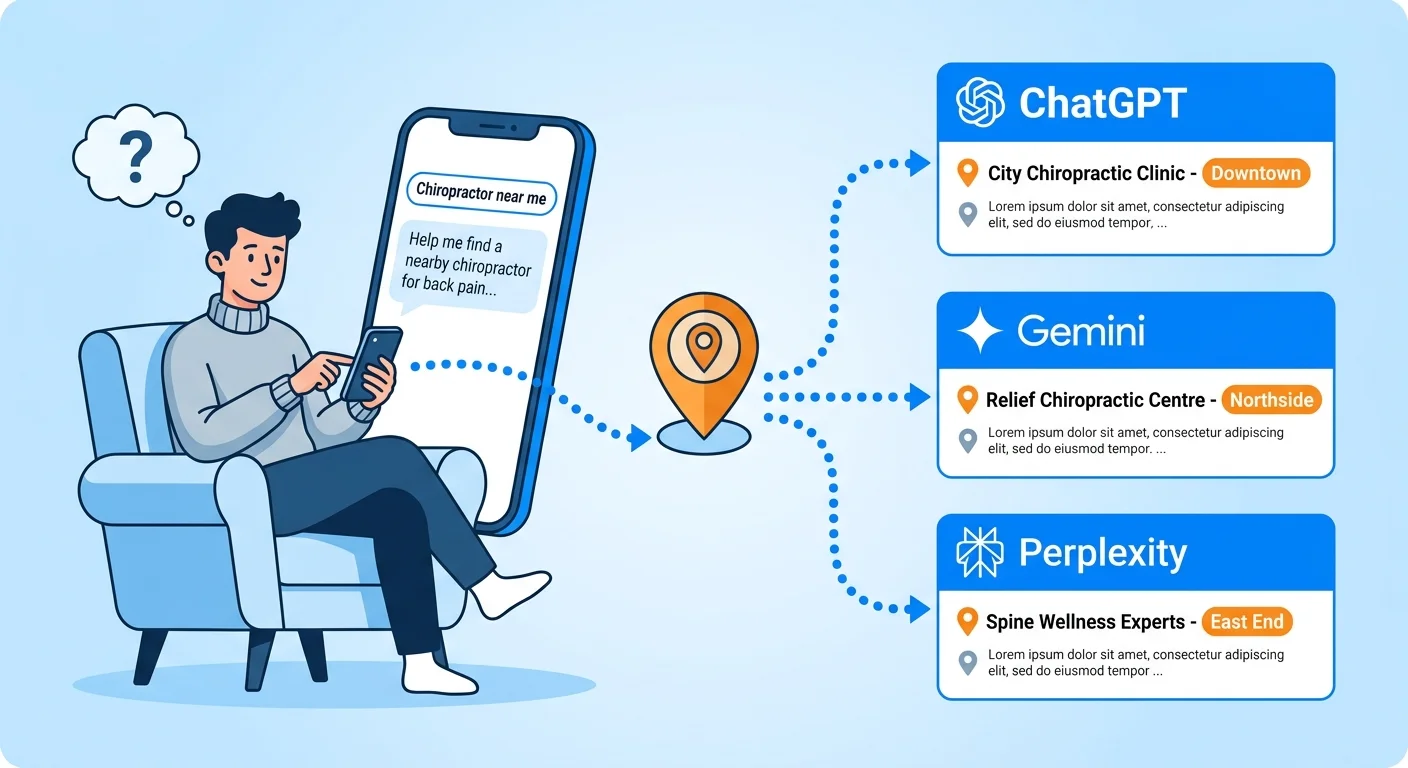
AI already knows the query is local-even when patients don’t say “near me.” That’s not an algorithm quirk. That’s the entire design.
Patients don’t ask “Who is a good chiropractor?” They ask “Who’s the best chiropractor near me?” And even when they don’t say it out loud, AI infers it. According to research from the National Library of Medicine, patients increasingly turn to online sources for provider selection-and trust and accessibility are the factors that actually matter. AI engines know this. They default to local every time.
So when someone types “best chiropractor” into ChatGPT or asks Gemini for a recommendation, the AI doesn’t pull up a list of every practice in America. It cross-references the user’s location data, checks verified signals from local directories and business listings, and returns one answer: the practice with the strongest local entity trust.
That answer isn’t based on how many blog posts you published last month.
It’s based on whether AI can prove you exist as a legitimate, authoritative chiropractor in a specific place.
AI Is Built to Replicate a Referral
AI answer engines are designed to mimic the trust mechanism of asking a knowledgeable friend.
Your friend would never say “Here are 10 chiropractors in 5 different states.” They’d say “Go see Dr. Smith on Main Street.”
AI does the same thing.
It processes the query, identifies the intent as local, and delivers the single most authoritative answer it can validate for that location. Not a ranked list. Not a “see more results” prompt. One recommendation.
This is AI Authority-the ability to be the answer AI trusts enough to say out loud.
If your practice isn’t that answer, you don’t exist in the conversation.
The patient never sees your name. They never visit your website. They book with whoever AI recommended. And here’s the kicker: most of them never even realize there were other options.
The Zero-Click Reality
Most AI-powered searches end without a click.
BrightEdge research confirms this: a majority of searches end with the answer provided directly in the conversational interface. The patient sees the recommendation, accepts it as truth, and moves forward.
No comparison shopping. No scrolling through options.
The answer AI gives is the only answer they see.
If you’re not that answer, you don’t exist. Not on page two. Not in the “also consider” section. Nowhere.
Local Is Not a Limitation-It’s a Feature
The industry taught you that more traffic equals more patients.
That was true for Google in 2015. It’s not true for AI in 2025.
AI doesn’t rank you. It validates you. And validation is hyper-local.
You’re not competing with every chiropractor in the country. You’re competing with the 3-5 practices in your immediate area that AI can verify as legitimate, specialized authorities. If you’ve got stronger local trust signals than they do, you win. If you don’t, you lose.
That’s not a bug. It’s the entire point.
The Entity Graph: How AI Validates Your Practice Location
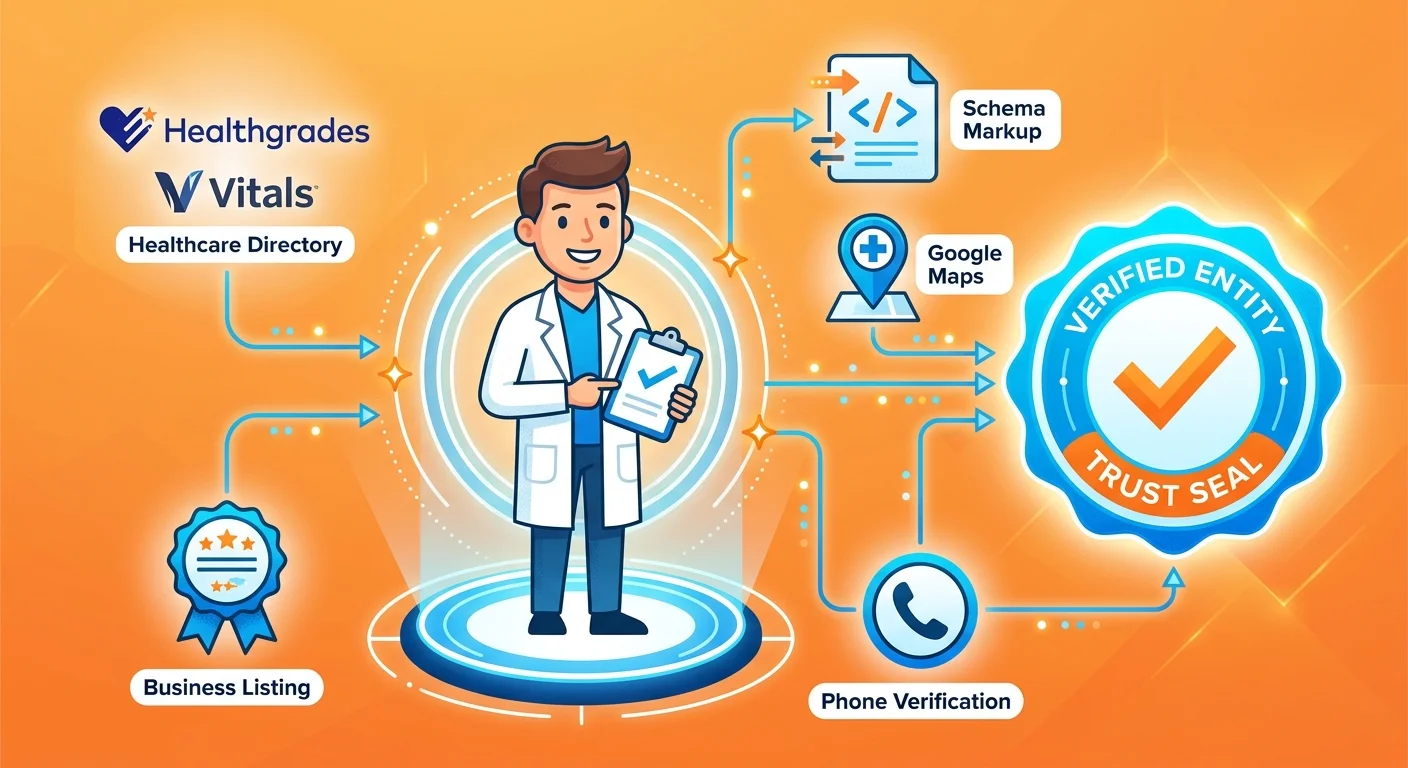
AI doesn’t take your word for it.
When you claim to be a chiropractor in Huntington Beach specializing in sciatica treatment, AI cross-references that claim across dozens of verified sources to build an entity graph-a digital profile of your practice’s trustworthiness and locality.
Search Engine Land explains that search engines-and by extension, AI-understand real-world things like people, places, and businesses through entity recognition. Your practice isn’t a collection of keywords. It’s an entity. And AI validates that entity by checking whether the signals about you are consistent, authoritative, and locally grounded.
Your website says you’re at 123 Main Street.
Does your Google Business Profile say the same thing? Does Zocdoc? Healthgrades? Vitals?
If those data points don’t match exactly, AI treats you as multiple unverified entities instead of one authoritative practice.
You fail the validation test before the conversation even starts.
The NAP Consistency Test
Name, Address, Phone Number.
If these three data points don’t match exactly across your website, Google Business Profile, Zocdoc, Healthgrades, and Vitals-AI treats you as multiple unverified entities instead of one authoritative practice.
- Name: Is it “Smith Chiropractic” on your website and “Dr. John Smith Chiropractic Clinic” on Healthgrades? That’s two entities.
- Address: Is it “123 Main St” on your site and “123 Main Street, Suite 5” on Google? That’s two entities.
- Phone: Is it (714) 555-1234 on Zocdoc and 714-555-1234 on your contact page? That’s two entities.
AI doesn’t assume these are the same practice. It flags them as inconsistent and moves on to a competitor with clean data.
NAP consistency isn’t a nice-to-have. It’s the baseline validation test. If you fail it, nothing else matters.
Directory Trust Compounds
Zocdoc and Healthgrades aren’t just patient-facing directories.
They’re structured data validators AI uses to confirm you’re a real, licensed chiropractor in a real location.
When AI builds your entity graph, it checks: Does Zocdoc list you? Is your address verified? Are patient reviews recent? Does Healthgrades confirm your credentials and location?
These directories carry institutional trust. They’ve done the vetting work AI relies on. If you’re listed accurately and consistently across them, AI treats you as a verified entity. If you’re missing, inconsistent, or outdated-AI can’t trust you.
And here’s the thing: Consensus Trust Engineering shows that AI doesn’t just check one source. It cross-references all of them. The more sources that validate the same data about you, the stronger your entity trust.
One verified directory is a start. Five verified directories with identical NAP data is a compound trust signal AI can’t ignore.
| Signal Type | What AI Checks | What Happens If Missing |
|---|---|---|
| NAP Consistency | Name, Address, Phone match across all sources | AI treats you as multiple unverified entities |
| Directory Listings | Presence on Zocdoc, Healthgrades, Vitals | AI cannot validate your practice exists |
| Schema Markup | LocalBusiness schema on website | AI cannot read your location data |
| Service Area Definition | Explicit geographic boundaries in schema | AI cannot determine if you serve the query location |
| Specialization Signals | Consistent treatment focus across sources | AI cannot determine what you’re an authority for |
Schema Markup and Local Authority Signals
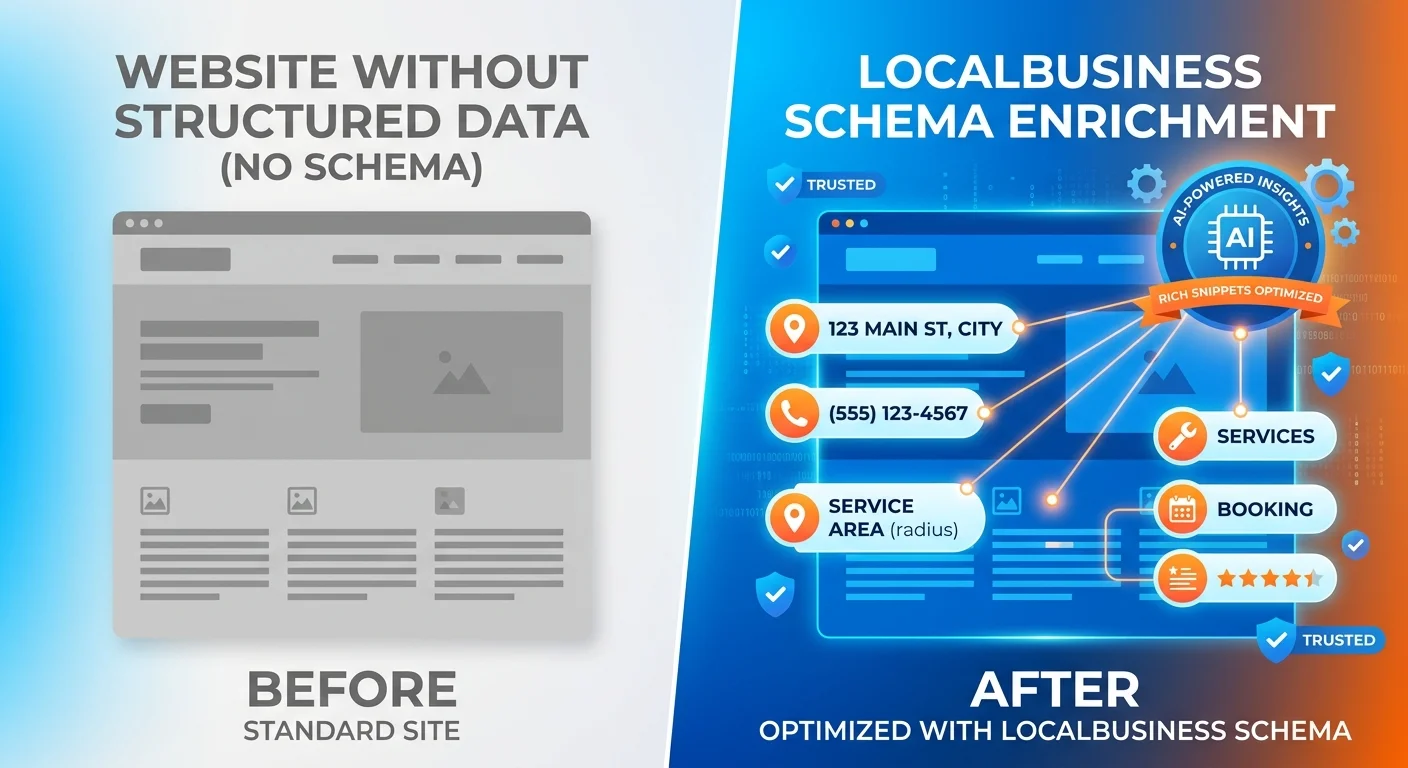
LocalBusiness schema is the machine-readable language that explicitly tells AI your name, address, phone number, service area, and what you specialize in.
Without it, your contact page is just decorative text.
You can have your address in the footer, your phone number in the header, and a beautifully designed contact page. AI doesn’t care. It can’t read any of that as structured data.
It’s looking for schema-the explicit markup that says “This is a LocalBusiness. Here is the name. Here is the address. Here is the service area. Here is what they specialize in.”
If that markup isn’t present, AI moves on.
Why a “Digital Brochure” Website Fails
Most agencies build you a pretty website with your address in the footer.
That’s a digital brochure. AI can’t read it.
AI needs structured data-LocalBusiness schema, MedicalBusiness schema, service area definitions-or you don’t exist in its validation process. Your $15,000 custom website with the sleek design and the smooth animations is structurally invisible to AI if it lacks machine-readable authority signals.
This is the Missing Schema Hides Your Clinical Expertise problem in action. Your clinical expertise is hidden behind a wall of human-readable text that AI engines cannot parse, validate, or trust.
The agencies that sold you that website either didn’t know this-or didn’t care.
Either way, you paid for a placeholder.
Service Area vs. Serving Area
Listing 10 cities you “serve” on a service page is not the same as defining a service area in schema.
AI needs explicit geographic boundaries, not marketing copy.
When you write “We serve Huntington Beach, Fountain Valley, Costa Mesa, Newport Beach, and Westminster” on your homepage, AI reads that as generic text. It has no idea whether you have a physical location in those cities, whether you actually treat patients there, or whether that’s just aspirational marketing speak.
But when you define a service area in schema-using geoCoordinates, areaServed properties, and explicit radius or polygon boundaries-AI knows exactly where you operate and can validate whether you’re a legitimate answer for queries in that area.
Marketing copy is ignored. Schema is trusted.
| Schema Field | What It Tells AI | Why It Matters |
|---|---|---|
name |
Your practice’s official name | Validates entity identity across sources |
address |
Your exact physical location | Confirms you exist in the claimed area |
telephone |
Your verified contact number | Cross-references with directory listings |
areaServed |
Geographic boundaries you serve | Determines if you’re relevant for local queries |
@type: MedicalBusiness |
You are a healthcare provider | Triggers healthcare-specific validation rules |
medicalSpecialty |
What conditions you treat | Connects you to topic-specific queries |
The “Everything to Everyone” Trap
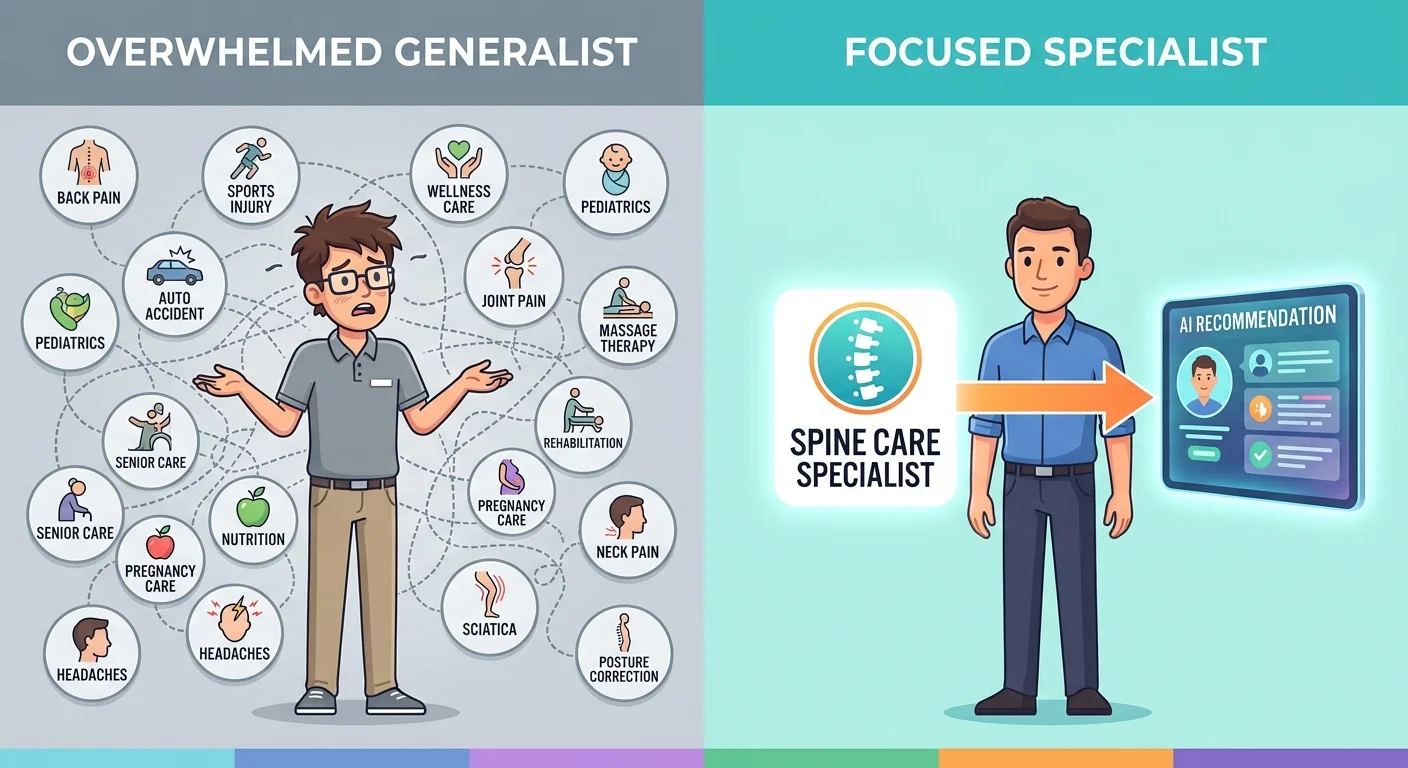
If you list 20 services and claim to serve an entire county, you’ve told AI you’re the trusted answer for nothing.
AI rewards depth, not breadth.
When a patient asks “Who’s the best chiropractor for sciatica near me?” AI looks for the practice with the deepest, most consistent authority signals for sciatica treatment in that specific location. Not the practice that also treats sports injuries, auto accidents, wellness care, pediatric chiropractic, prenatal care, headaches, and 15 other conditions across a 50-mile radius.
The generalist loses. Every time.
This is the “Everything to Everyone” anti-persona playing out in real time. AI doesn’t see you as versatile. It sees you as unfocused. And unfocused means untrustworthy.
Specialization Is How AI Validates Authority
A chiropractor who owns the entity for “sciatica treatment in Huntington Beach” will always be recommended over a practice that vaguely claims to serve all of Orange County with a list of 20 conditions.
Why?
Because AI validates authority through signal consistency.
If your website, your Zocdoc profile, your Healthgrades listing, and your schema markup all say “sciatica treatment, Huntington Beach”-AI sees a focused, specialized entity. The signals reinforce each other. The entity trust compounds.
But if your website lists 20 services, your Zocdoc profile emphasizes auto accident care, and your schema markup defines a service area covering 10 cities-AI sees noise. The signals conflict. The entity trust dilutes.
McKinsey research on local marketing confirms this: hyper-local relevance is now the baseline expectation for consumers, and digital signals of proximity and specialization drive decisions. AI engines are built to replicate that expectation.
The tighter your focus, the stronger your entity trust.
The broader your claims, the weaker your validation.
The Service Area Death Spiral
Expanding your service area to capture more traffic dilutes your entity trust.
AI sees you as a generalist, not a specialist. The practice with a tighter geographic focus and deeper authority signals wins.
When you claim to serve Huntington Beach, Fountain Valley, Costa Mesa, Newport Beach, Westminster, Garden Grove, Santa Ana, and Irvine-you’re not telling AI you’re available to more patients. You’re telling AI you don’t have a strong enough local presence in any one of those areas to be the definitive answer.
The competitor who claims only Huntington Beach-and backs it up with verified NAP data, directory listings, schema markup, and patient reviews all tied to that one location-is the practice AI recommends.
Your broader service area didn’t make you more visible. It made you invisible.
| Practice Type | Service Area Claimed | AI Entity Trust Level | Recommendation Likelihood |
|---|---|---|---|
| Specialist | Huntington Beach only | High – focused, validated signals | Very High |
| Moderate Generalist | Huntington Beach + 2-3 adjacent cities | Medium – some dilution, still manageable | Moderate |
| Broad Generalist | 8+ cities across Orange County | Low – diffuse signals, no clear authority | Very Low |
| “Everything to Everyone” | Entire county, 20+ services | None – AI cannot validate specialization | Zero |
Why Your Competitor Gets Recommended Instead of You
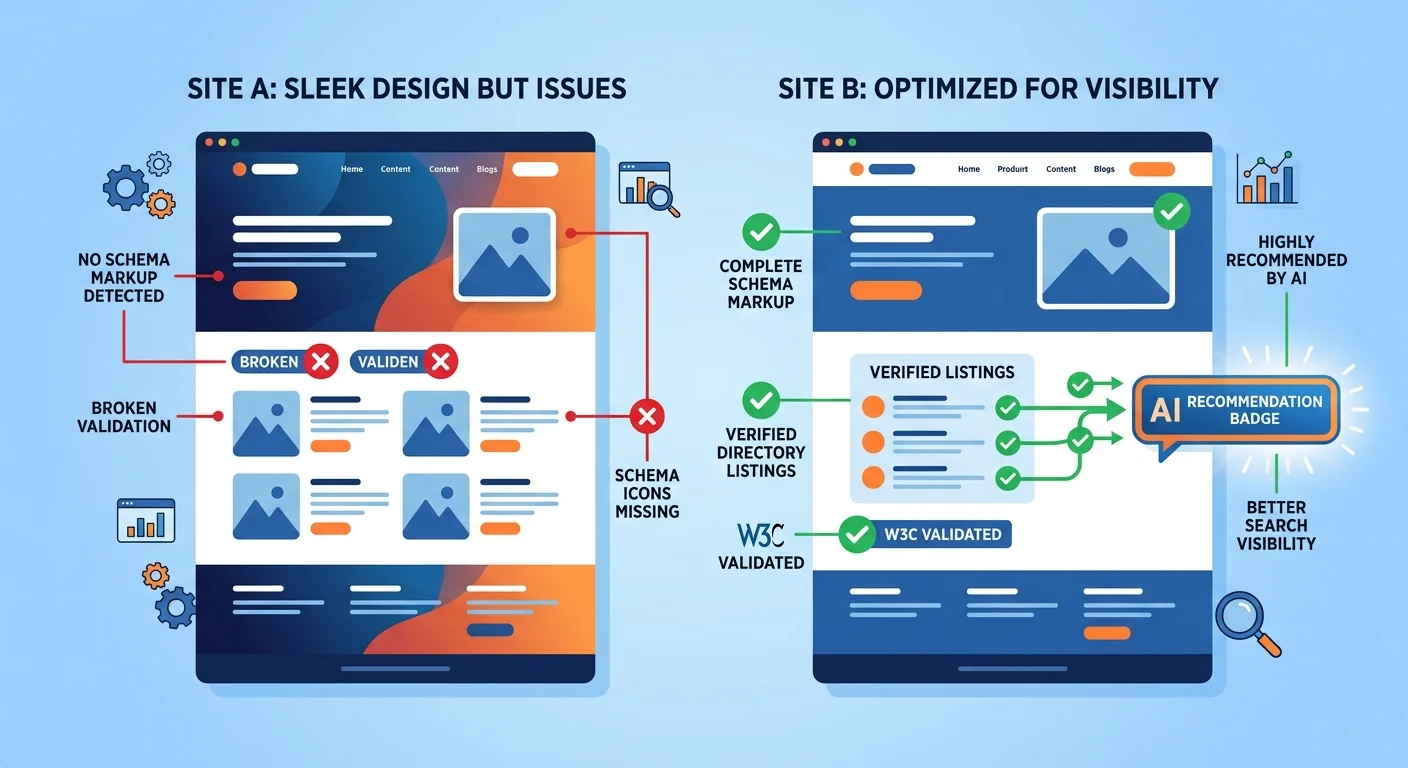
Your competitor’s website might look worse than yours.
But if they have better authority infrastructure-complete schema, validated directory listings, consistent NAP data-they’re the answer AI trusts.
You paid $15,000 for a custom website with a sleek design, smooth animations, and professional photography. Your competitor has a template site that looks like it was built in 2018.
But when a patient asks AI who the best chiropractor is, your competitor gets recommended. Not you.
Why?
Because AI doesn’t judge visual design.
AI Doesn’t Judge Visual Design
But doesn’t a professional-looking website signal credibility?
To humans, yes. To AI, no.
AI reads the underlying data structure. Your $15,000 custom website is invisible if it lacks machine-readable authority signals.
A beautiful website that AI cannot read is just an expensive business card. It might convert the patients who find you through other channels, but it does nothing to help AI discover you, validate you, or recommend you in the first place.
Your competitor’s “ugly” site has LocalBusiness schema. Yours doesn’t.
Their NAP data is consistent across Zocdoc, Healthgrades, and their Google Business Profile. Yours isn’t.
Their service area is explicitly defined in machine-readable format. Yours is buried in a paragraph on the About page.
AI validates them. AI ignores you.
That’s not a ranking issue. That’s a Website is a Liability issue. Your site isn’t helping you. It’s hiding you.
The Authority Infrastructure Gap
AI cross-references your practice against your competitors in real time.
If they have verified Zocdoc profiles, complete schema, and consistent entity signals-and you don’t-you lose by default.
It doesn’t matter if your services are better. It doesn’t matter if your patient outcomes are superior. AI can’t validate any of that. It can only validate what’s machine-readable.
The gap between you and your competitor isn’t clinical. It’s infrastructural.
And here’s the thing: you don’t even know the gap exists until you run a diagnostic. You think your website is fine because it looks professional. You think your Google Business Profile is enough because patients leave reviews. You think your directory listings are accurate because you set them up years ago.
But AI is checking all of that-and more-in real time. And if the data doesn’t match, if the schema is missing, if the entity signals are weak-you’re not in the conversation.
The difference between SEO and AEO is this: SEO optimized for a ranked list. AEO optimizes for being the single recommended answer.
Your competitor figured that out. You haven’t yet.
The Compounding Effect of Invisibility
Every month you’re invisible, your competitor compounds their authority.
AI engines update their entity graphs continuously. The gap widens.
When your competitor gets recommended by ChatGPT, that recommendation gets logged. When they get cited by Perplexity, that citation strengthens their entity trust. When they show up in Gemini’s answer, AI learns that this is the practice to trust for this location and specialty.
Your invisibility isn’t static. It’s a compounding disadvantage.
The longer you wait to fix it, the further behind you fall. And the practices that moved early-building schema, validating directory data, tightening their service areas, specializing their messaging-are already locking in the authority signals AI uses to determine who to recommend.
Six months from now, the gap won’t just be wider. It’ll be structural. And closing it won’t be a matter of “catching up.” It’ll be a matter of rebuilding from scratch.
Want to know where you stand right now? Run your AI Visibility Check. It takes 15 minutes and shows you exactly what AI sees when someone asks who to trust in your market.
FAQ
Does my Google Business Profile guarantee I’ll get local AI recommendations?
No. While a Google Business Profile is a critical signal, AI engines cross-reference dozens of sources to validate authority. A strong GBP is necessary but not sufficient on its own.
If your website lacks schema, your directory listings are inconsistent, or your entity signals are weak-AI will not recommend you, even if your GBP is fully optimized. The GBP is one data point in a much larger validation process.
AI treats your GBP as a starting point, not the finish line. It checks whether the data on your GBP matches the data on your website, Zocdoc, Healthgrades, and Vitals. If those signals conflict, AI flags you as unverified and moves on to a competitor with cleaner data.
How does schema markup affect local AI results?
LocalBusiness schema explicitly tells AI your name, address, phone number, and service area in a machine-readable format. Missing or incorrect schema is the primary reason AI engines can’t trust and recommend a local practice.
Without schema, your contact page is just human-readable text. AI can’t extract structured data from a paragraph. It needs explicit markup that says “This is the business name. This is the address. This is the phone number. This is the service area. This is the medical specialty.”
If that markup isn’t present, AI cannot validate your entity. It moves on to a competitor whose website speaks its language.
Schema is the difference between being a verified local entity and being invisible.
Can I be the AI-recommended chiropractor for multiple cities?
It’s possible if you have verified physical locations in each city. But AI prioritizes hyper-local authority. Trying to be the answer for a broad region without specific location proof dilutes your entity trust.
If you have one office in Huntington Beach and claim to serve Costa Mesa, Newport Beach, and Irvine-AI treats you as a Huntington Beach practice offering extended service, not as a local authority in those other cities.
If you have physical offices in each of those cities, with verified NAP data and directory listings for each location, AI can validate you as a local authority in multiple markets. But each location needs its own entity infrastructure.
The broader your claims without physical proof, the weaker your trust signals. The tighter your focus, the stronger your validation.
Why would an AI recommend my competitor who has a worse website?
AI does not judge a website’s visual design. It reads the underlying data structure. Your competitor’s “worse” website may have superior authority infrastructure, making it more trustworthy to AI.
A sleek, modern website with missing schema and inconsistent directory data is invisible to AI. A basic template site with complete LocalBusiness schema, verified NAP consistency, and strong directory signals is the practice AI recommends.
Visual design matters to humans. Data structure matters to AI. If your infrastructure is weak, your design is irrelevant.
What’s the first step to improving my local AI visibility?
Run a diagnostic to see what AI engines currently say about your practice versus your competitors. This establishes a baseline and reveals the specific gaps in your authority infrastructure.
You can’t fix what you can’t measure. If you don’t know whether ChatGPT recommends you, whether Gemini cites your practice, or whether Perplexity validates your entity-you’re guessing. The diagnostic removes the guesswork.
It shows you exactly where your schema is missing, where your NAP data is inconsistent, where your directory listings are incomplete, and where your entity trust is weak compared to competitors.
Once you see the gaps, the path forward is obvious.
The practices that are winning aren’t hoping their website is good enough. They know what AI sees-and they’ve built the infrastructure to be the answer. Want to see what patients are asking AI about your practice right now?
Conclusion
AI gives one answer.
If you’re not the answer, you don’t exist.
For local healthcare queries, that answer is brutally selective. AI doesn’t rank you on a list. It validates your entity, cross-references your authority signals, and decides whether you’re the trusted answer for a specific location and specialty.
Your address being on your website doesn’t prove locality to AI. Your 20-service list doesn’t prove specialization. Your beautiful homepage doesn’t prove authority.
What proves it: LocalBusiness schema. Consistent NAP data across verified directories. Validated entity signals that AI can cross-reference in real time. A tightly defined service area and clear specialization that tells AI exactly what question you answer and where you answer it.
The practices that own AI recommendations in their markets aren’t guessing. They know what AI sees when it evaluates their practice-and they’ve built the infrastructure to be the answer.
Want to know if AI is recommending your practice-or your competitor’s? The AI Visibility Check takes 15 minutes and shows you exactly what ChatGPT, Gemini, and Perplexity say when someone asks who to trust in your market. No guesswork. Just data.