
WebMD says to ask your doctor whether you are a good candidate for nonsurgical spinal decompression, and it says it is best not to try it if you are pregnant. Blue Cross and Blue Shield of Texas says that, according to labeled indications from the U.S. Food and Drug Administration (FDA), vertebral axial decompression may be used as a treatment for patients with incapacitating low back pain and for decompression of the intervertebral discs and facet joints. A Journal of Clinical Medicine trial excluded patients with migrated or excluded hernias, a history of spine surgery or vertebral fracture, or contraindications to NSAIDs, corticosteroids, or epidural injection. It excluded pregnant women too. WebMD says more research is needed to establish the safety and effectiveness of nonsurgical spinal decompression.
What the Page Should Say Decompression Is
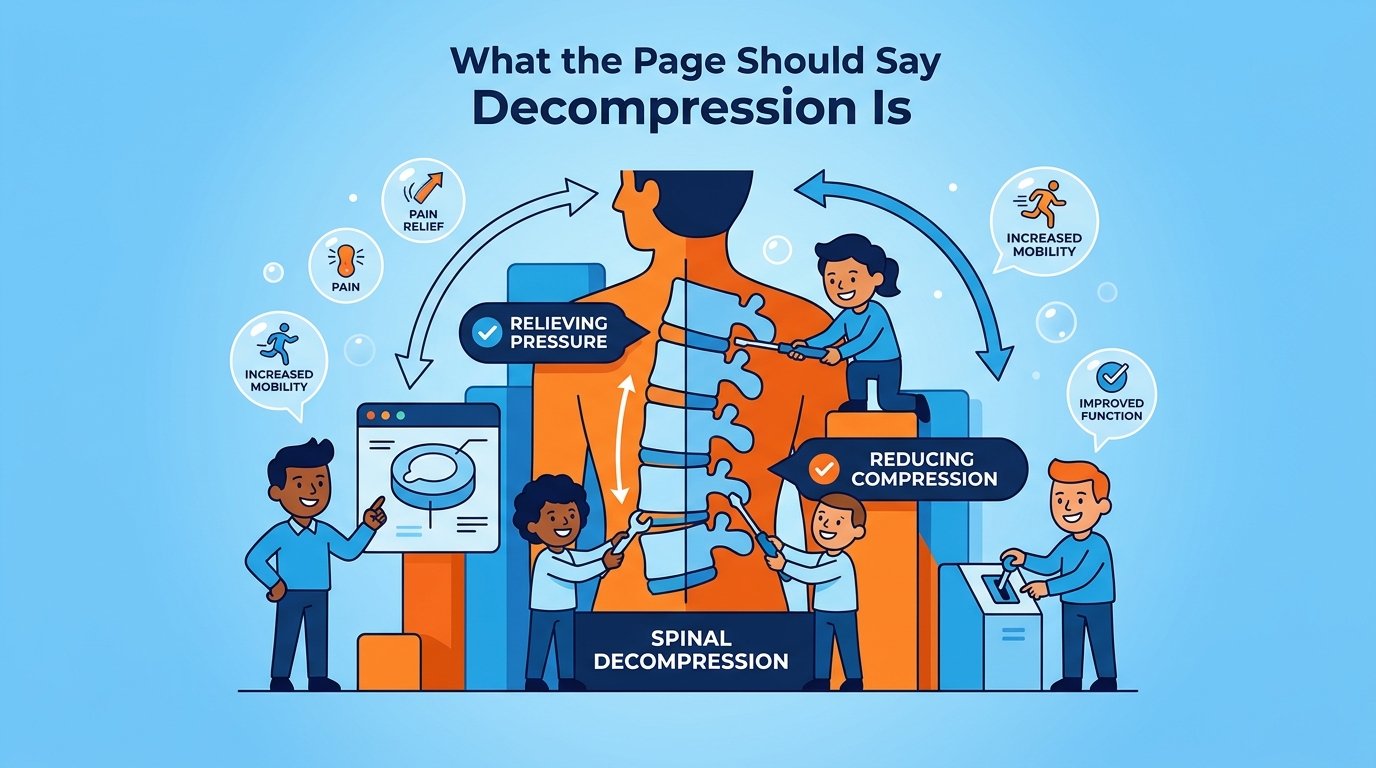
Start with what it is. WebMD says nonsurgical spinal decompression is a type of motorized traction, which is a machine that pulls on the spine, and that it may help relieve back pain. The source is Spinal Decompression Therapy: Is It Right for You?
Cigna supplies the regulatory label. The U.S. Food and Drug Administration (FDA) classifies the tables used for axial or spinal decompression therapy as powered traction equipment.
You’ll find the line between decompression and general care drawn in Spinal Decompression vs General Chiropractic Care in Content. The writing itself is iTech Valet’s AEO Content Writing work, and how that work is done is set out on iTech Valet Service Plans & Pricing.
Symptoms and Diagnoses the Cleared Indications Name
The conditions on your page should come from two documents. One is the Vertebral Axial Decompression policy THE803.021 from Blue Cross and Blue Shield of Texas. The other is the DRX9000-SL 510(k) clearance, July 2025 from the U.S. Food & Drug Administration.
Low Back Pain and Sciatica
Blue Cross and Blue Shield of Texas says that, according to the labeled indications (the listed uses) from the U.S. Food and Drug Administration, vertebral axial decompression may be used as a treatment for patients with incapacitating low back pain. It may also be used to decompress the discs between the spine bones and the facet joints.
The July 2025 clearance letter from the U.S. Food and Drug Administration says the DRX9000-SL True Non-Surgical Spinal Decompression System provides a primary treatment modality, meaning a main treatment method, for managing pain and disability in patients suffering with incapacitating low back pain and sciatica.
The cleared uses say the DRX9000-SL has been found to relieve pain and symptoms linked to:
- herniated discs
- bulging or protruding discs between the spine bones
- degenerative disc disease
- posterior facet syndrome
- sciatica
Radicular Pain From Disc Herniation
The Journal of Clinical Medicine trial report says disc herniation makes up 85 out of 100 (85%) of the causes of lumbar radicular pain. That’s nerve pain from the lower back.
Cigna’s criteria for conventional lumbar mechanical traction (traction, not decompression) include a patient with sciatica or signs of nerve root compression, plus either peripheralization with extension movements or a positive crossed straight leg raise test.
Cigna also cites a preliminary prediction rule for cervical radiculopathy, which is nerve pain from the neck. With at least three of five predictors present, the chance that cervical (neck) traction would work rose from 44 out of 100 (44%) to about 79 out of 100 (79.2%). The study gave that a positive likelihood ratio of 4.81, a number showing how much a positive finding raises the odds of success. The 95% confidence interval, the range the true value likely falls in, was 2.17 to 11.4.
Who the Page Should Tell Not to Try It

WebMD says to ask your doctor whether you are a good candidate. It also says it is best not to try nonsurgical spinal decompression if you are pregnant.
The Journal of Clinical Medicine trial left out patients with migrated or excluded hernias. It also left out patients with a history of spine surgery or a broken vertebra, and patients who should not get non-steroidal anti-inflammatory drugs (NSAIDs), corticosteroids, or epidural injections. Pregnant women were left out too.
The same trial left out people with cauda equina syndrome. It describes this as nerve problems in the perineum (the area between the legs) and lower limbs, without spinal cord involvement but with pressure on the cauda equina nerves. It also left out people with motor deficit of the lower limbs, meaning leg strength of 3 out of 5 or less on the Medical Research Council (MRC) scale. The trial says this is a surgical emergency.
The Cureus study left out patients with:
- acute low back pain (less than 6 weeks)
- a history of lumbar surgery
- spondylolisthesis or spinal stenosis
- inflammatory rheumatic disease
- a sequestered hernia
If I were you, I’d publish one plain, factual exclusion list in a sensible order before I’d publish a stack of posts on the subject. I write for how easily an engine can grasp the facts, never for volume. How far a hub like this should reach is set out in What Belongs in a Spinal Condition Hub, and What Does Not.
What the Evidence Shows for Different Patient Groups
Start with the big picture. WebMD says more research is needed to show how safe and how effective nonsurgical spinal decompression is. A review in Brain & Spine says high heterogeneity (large differences between the studies) and inconsistent study methods limit how firmly it can make recommendations for specific subgroups of patients.
The Cureus authors say there is little evidence that spinal decompression devices differ from simple traction. Why? It’s unclear whether muscle tension plays a significant role in changing how the spine bones shift during traction.
I’d rather be the source an AI names and draws on than one more name in a list. So I put the trials that found nothing right next to the ones that found benefit, and I say where the evidence is thin.
Cigna sets out its coverage position in its Axial/Spinal Decompression Therapy/Mechanical Traction coverage policy. The table below draws on the Blue Cross and Blue Shield of Texas policy, Lumbar Tractions in Radicular Pain Caused by Herniated Disc: RCT on 424 Participants, and Traditional Motorized Traction vs Non-surgical Spinal Decompression for Chronic Low Back Pain.
| Patient group | Finding |
|---|---|
| Chronic lumbar disc degeneration or bulge, no radicular pain (sham-controlled trial) | Did not show a benefit over the control group |
| Lumbar disc herniation, mechanical traction vs conventional physical therapy (2022 meta-analysis) | Mechanical traction significantly better on pain scores and disability scores |
| Lumbar radiculopathy, supine vs prone traction (2021 review) | Supine traction added to physical therapy had significant effects on pain and disability; prone did not |
| Radicular pain caused by herniated disc, tractions group vs medical group (Journal of Clinical Medicine RCT) | 62% (120/194) vs 51% (98/194) met the primary outcome (p = 0.024) |
| Subacute and chronic lumbar discopathies (2024 retrospective study) | Motorized traction and spinal decompression added to conventional treatment more effective than conventional treatment alone |
Where Trials and Guidelines Found No Benefit
Blue Cross and Blue Shield of Texas says the only sham-controlled randomized trial published so far did not show that vertebral axial decompression helped more than the control group. Sham-controlled means the comparison group got a fake treatment, and people were randomly assigned to each group.
That trial randomized sixty subjects with chronic symptomatic lumbar disc degeneration or bulging disc, no radicular pain, and no prior surgical treatment (dynamic stabilization, fusion, or disc replacement).
Blue Cross and Blue Shield of Texas also cites the North American Spine Society’s 2020 guideline. For patients with subacute or chronic low back pain, it says traction is not recommended to give clinically significant improvements in pain or function.
Where Traction Added to Care Helped
Blue Cross and Blue Shield of Texas reports two reviews. Here’s what each found.
A 2022 meta-analysis (a study that combines the results of many studies) of lumbar disc herniation found that mechanical traction was significantly better than conventional physical therapy at improving pain scores and disability scores.
A 2021 systematic review of lumbar radiculopathy (nerve pain from the lower back) found that mechanical traction lying face up (supine), added to physical therapy, had significant effects on pain and disability. Traction lying face down (prone), added to physical therapy, did not.
Now the Journal of Clinical Medicine trial. The main result the study measured, called the primary outcome, was met by 120 of 194 people (about 6 in 10, 62%) in the traction group. In the medical group, 98 of 194 (about half, 51%) met it. The study found a statistical difference, with a p-value of 0.024. That’s a number used to judge whether a gap is likely due to chance.
When the trial looked at smaller groups within it, lumbar (lower back) traction seemed to be more effective in acute lumbar radicular pain (pain along a nerve) and in S1 radicular pain (pain along the S1 nerve), with a significant difference.
A 2025 meta-analysis of lumbar disc herniation in Brain & Spine found that traction therapy had the highest effect size, 2.52 on the study’s own scale. The 95% confidence interval, the range the true value likely falls in, was 1.57 to 3.37. Exercise therapy came next at 1.97 (95% confidence interval, 0.46 to 3.48), then manipulation therapy at 1.91 (95% confidence interval, 0.24 to 4.04).
A 2024 retrospective study in Cureus looked back at past patient records. It found that in patients with subacute and chronic lumbar discopathies (lower back disc problems), motorized traction and spinal decompression added to conventional treatment worked better than conventional treatment alone.
In SLR-positive patients, change rates in VAS scores were higher in the traction group and the spinal decompression group than in the conventional treatment group (p = 0.004 and p = 0.006 respectively).
When the Page Should Point Past Decompression
WebMD says that if other measures don’t work, your doctor may suggest surgical spinal decompression for bulging or ruptured disks, bony growths, or other spinal problems.
Surgery carries its own risks. A study cited in Exercise, manipulation and traction physiotherapy in lumbar disc herniation: systematic review and meta-analysis found that 29.66% of patients having surgery for a herniated lower back disc, about 3 in 10, had complications after surgery. The most common were chronic pain and needing surgery again.
The World Federation of Neurosurgical Societies (WFNS) spine committee recommends that when there are no red flag symptoms (serious warning signs), a mix of changing activity, medication, and physical therapy gives good results for most patients with lumbar disc herniation.
Frequently Asked Questions
Does insurance cover spinal decompression?
Not so fast. Cigna’s coverage policy considers nonsurgical axial or spinal decompression therapy experimental, investigational, and/or unproven for treating neck, low back, and related disorders. Cigna says the research on it is lacking and of low quality. It also says health plan members carry significant burdens: high out-of-pocket costs, time spent getting the treatment, and unproven or misleading marketing about its supposedly proven effectiveness and safety.
How long is a typical course of decompression?
WebMD says a treatment session may last 30 to 45 minutes, and you may need 20 to 28 treatments over five to seven weeks. Cigna says typical treatment plans for axial (spinal) decompression are 20 sessions, and each session lasts 30 to 40 minutes.
What side effects should the page mention?
Tell your patients the side effect data is limited, and give them the trial’s numbers. Cigna says information on the range of side effects, and how often they happen, during vertebral axial decompression (VAX-D) therapy is limited. In the Journal of Clinical Medicine trial, nine people reported adverse effects (side effects). That was 7 of 211 people (about 3 in 100, 3%) in the traction group and 2 of 213 (about 1 in 100, 1%) in the medical group. There was no statistical difference between the groups.
Can the page’s markup state who should not have decompression?
Yes. Schema.org lists a contraindication property, which takes a MedicalContraindication or Text and is described as “A contraindication for this therapy.” Put your exclusions there, in the same plain words you use on your page.
Candidacy Takes a Clinician
Candidacy rests on named symptoms, stated exclusions and a clinician’s confirmation, set against evidence that is still developing. WebMD says more research is needed to establish the safety and effectiveness of nonsurgical spinal decompression. The WFNS spine committee recommends that, in the absence of red flag symptoms, a combination of activity modification, medication, and physical therapy yields positive outcomes for most patients with lumbar disc herniation.
iTech Valet does AI search visibility and answer engine optimization work for local service businesses, chiropractic practices first. Want to see whether ChatGPT, Gemini and Google’s AI answers recommend your practice by name? Run My AI Visibility Check