The Broken Assumption Your Marketing Has Always Run On
I’ve had this same conversation too many times.
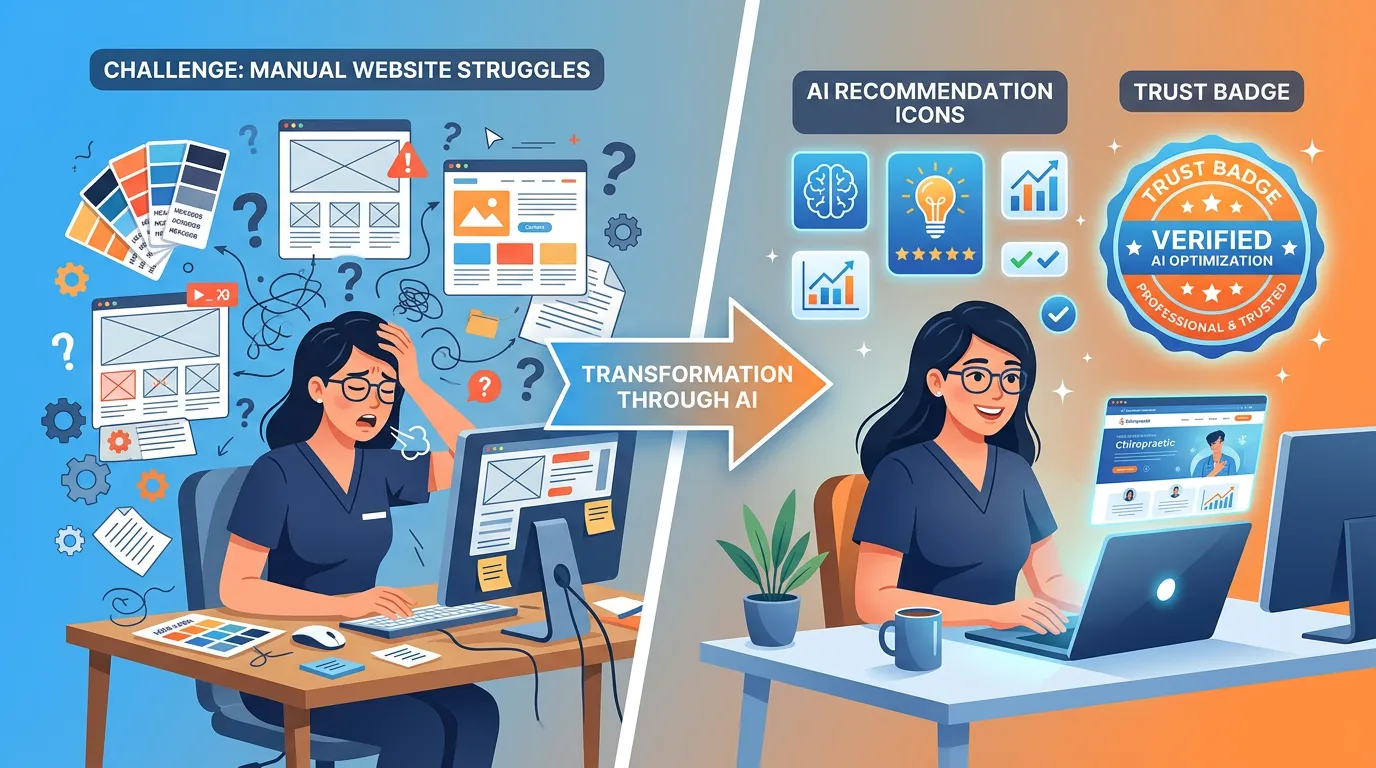
Doc spends $12,000 on a new website. Clean design, fast pages, mobile-ready. Agency called it ‘state of the art.’ Six months later, the doc types their specialty and city into ChatGPT. Their competitor’s name comes back. Not theirs.
That’s when it hits them.
They thought the website was the asset. It’s not. It’s a digital brochure with a hosting bill. Built for the humans who find it – except the systems generating patient recommendations now don’t work that way.
As an AI authority agency, that’s the gap we work in every day. The design investment is real. The AI visibility? Almost never.
Why Aesthetic-First Design Is a Dead End
I’m not saying design is irrelevant. Once someone lands on your site, it matters.
But here’s the part agencies skip: if AI doesn’t surface you first, nobody’s landing anywhere.
Every decision in aesthetic-first design – colors, layouts, imagery, copy – gets made for the human eye. I get why. That’s how websites have always been built. But AI search visits are surging with double-digit month-over-month growth. The channel patients use to find you changed. The way your site is built didn’t.
Here’s what AI actually does when it encounters your site. It doesn’t look at colors. It doesn’t notice your hero image. It reads the data structure – schema markup, entity signals, content hierarchy. If that layer isn’t there, you’re noise.
A site without structured data, schema, or entity verification doesn’t register as a verified practice. It registers as unconfirmed content somewhere on the internet.
- What AI actually reads – Schema markup, entity citations, content depth, and claim consistency across every platform it can check. Your design mockup doesn’t include a single one of these.
- What design optimizes for – Human visual engagement, brand feel, emotional response. Means nothing to the system deciding whose name to say.
- The result – I’ve seen practices with mediocre design and solid infrastructure get recommended consistently. I’ve seen beautiful sites disappear completely.
I’ve watched this hurt practices with genuinely great doctors. Reviews, results, real patient outcomes. To the AI they didn’t exist in any reliable sense – because the infrastructure that proves you’re real wasn’t there.
What the Search Data Actually Shows
Here’s what I tell docs when they say ‘but we’re already ranking on Google.’
Gartner projects traditional search engine volume will drop 25% by 2026 as people shift to AI chatbots. That’s not a future problem. It’s happening now. And over 60% of desktop searches already end without a click – the AI answers the question directly, the patient gets what they needed, no website visited. On mobile, that number is 77.2%.
That’s not a trend. That’s the baseline.
Generative AI is acting as a substitute answer engine – patients ask, AI answers, the search is over. If your practice isn’t in that answer, that patient is already gone.
Ranking on Google is fine. But the patients who found your competitor through AI? They came from a conversation you weren’t part of.
What Authority Infrastructure Actually Is
Everyone says they build ‘authority.’ Barely anyone means the same thing.
So here’s what I mean.
Authority Infrastructure isn’t a fancier website. It’s not a content calendar. It’s not another SEO package with a better name.
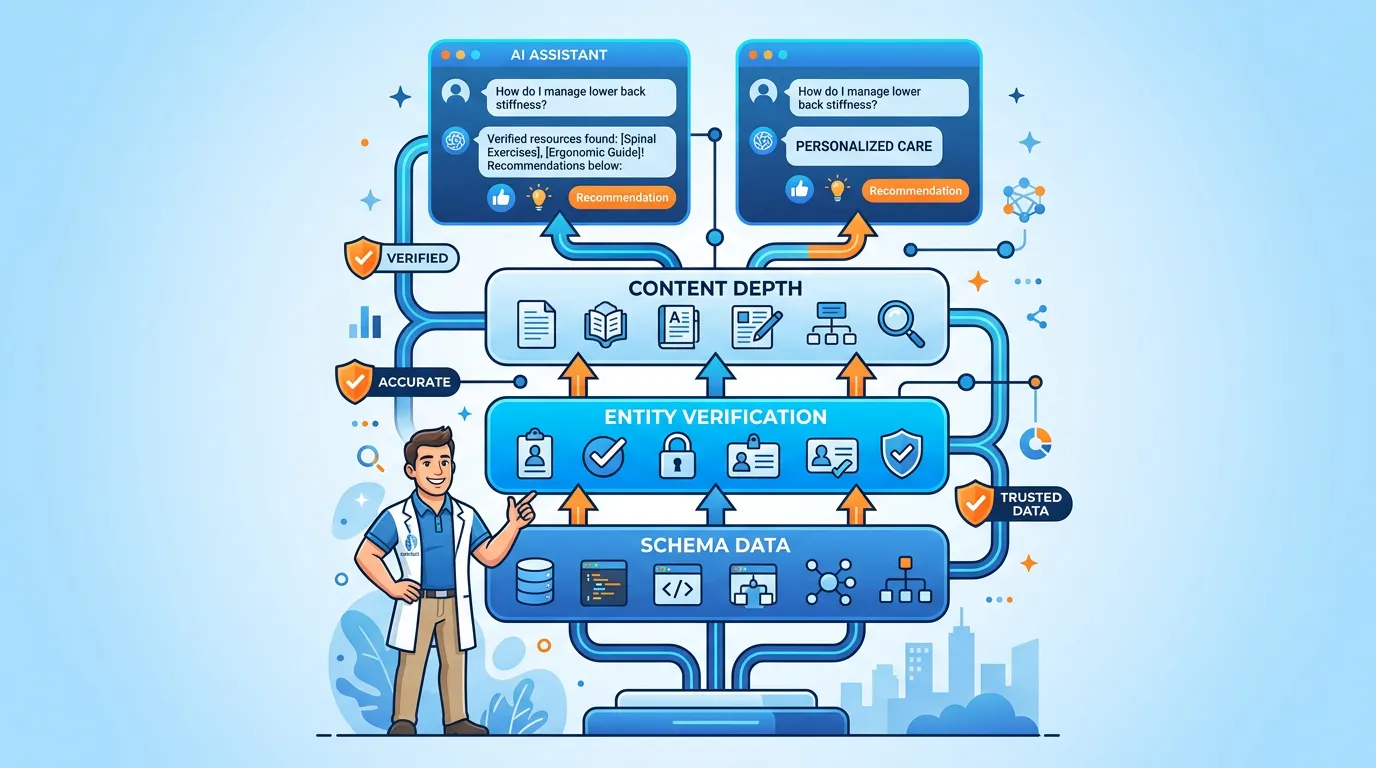
It’s the machine-readable verification layer AI checks before it says your name. The stack that answers the question AI is quietly running on every practice it considers: Can I trust this enough to recommend them?
The Three Layers of Machine Readability
Three things. That’s what AI actually checks. Not your design. Not your star rating. These:
- Structured Data (Schema Markup) – The technical code that tells AI exactly what your practice is, where you’re located, and what you treat. Without it, AI is guessing. With it, AI knows. Most chiropractic websites have none. Zero.
- Entity Verification – Your name, address, and practice description need to match consistently across every platform AI can pull from – Google Business Profile, healthcare directories, citation sources. One inconsistency reads as ‘unverified.’ Verified practices get recommended. Unverified ones get skipped.
- Content Depth (AEO Articles) – AI looks for topical authority. Not keywords – authority. Content that covers every angle of what patients actually ask, built so AI can parse it and a human can still read it. A service page that says ‘we treat back pain’ doesn’t do this. Intent-layered content does.
Read more about what an AI Authority Engine actually does and how these layers fit together.
Why Infrastructure Is an Asset, Not an Expense
I talk to docs about this all the time. The moment it clicks is usually when I put it this way.
Your hosting bill is an expense. Stop paying it, the site goes dark. That’s what an expense does – it delivers access, not equity.
Authority Infrastructure is an asset. The entity trust AI has built around your practice doesn’t disappear when a contract ends. The schema you implemented keeps working. The content authority that’s been stacking up for months doesn’t reset when you stop a retainer.
I tell docs to think about it like owning your building versus renting space. Renting buys access. Owning builds equity. Every month you maintain the infrastructure, AI’s confidence in your practice increases. That’s equity.
Traditional SEO is renting attention. You stop paying, the visibility stops too. Authority Infrastructure? You own the position.
| Digital Brochure (Standard Website) | Authority Infrastructure | |
|---|---|---|
| What It Optimizes For | Human visual engagement | Machine reasoning and trust verification |
| AI Readability | Low – often structurally invisible | High – built for AI-first discovery |
| Lifespan | Static until redesigned | Compounds monthly as AI trust builds |
| Patient Discovery Path | Traditional search rankings | AI recommendations and zero-click answers |
| Economic Model | Expense – recurring hosting and redesigns | Asset – compounds in value over time |
The Visibility Gap Is Already Costing You
Here’s the part that catches docs off guard.
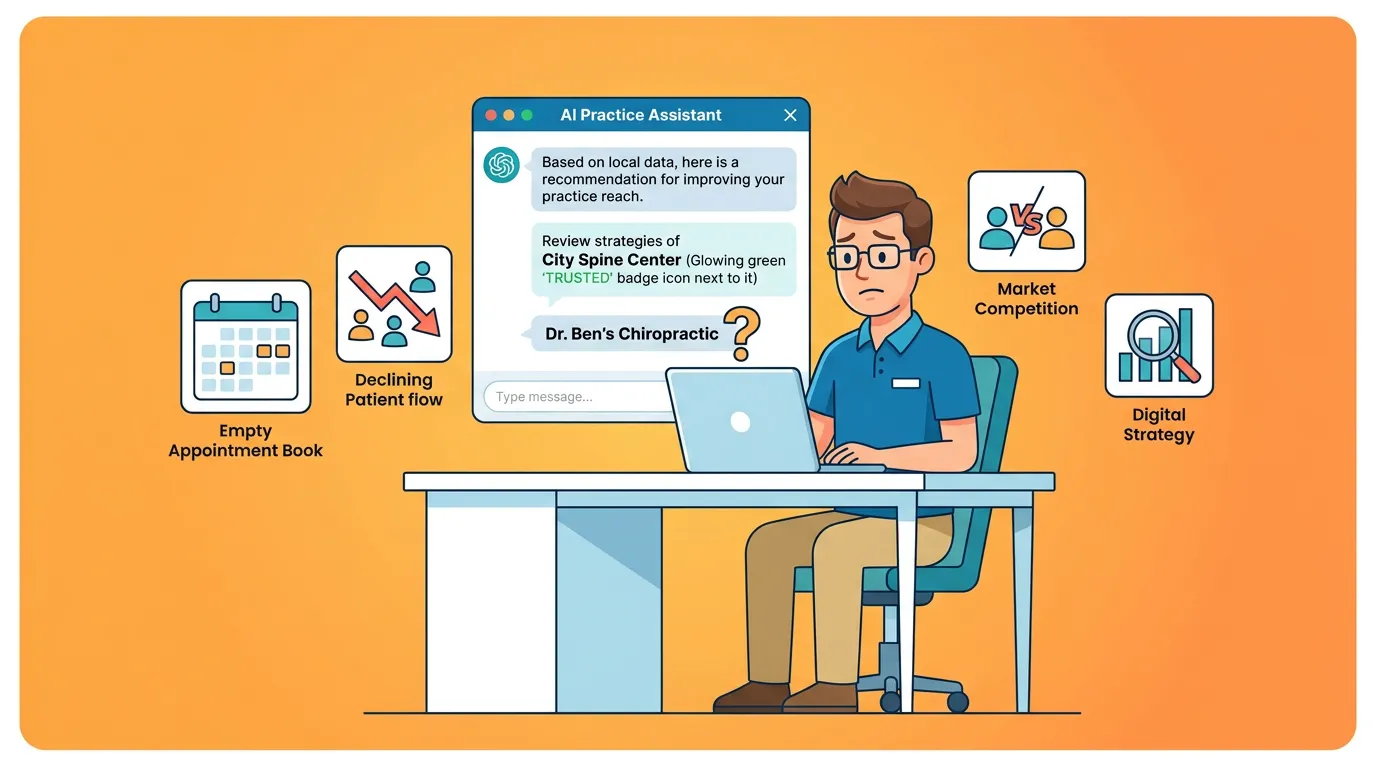
It’s not that AI doesn’t know you. It’s that AI trusts your competitor more.
That’s how the gap works. Recommendation confidence builds from consistent, verified signals over time. Your competitor’s been stacking entity data, content depth, and schema while you’ve been running a website that AI can barely parse.
Understanding the five layers of patient intent makes this concrete – patients ask AI questions at every stage before they pick up the phone. Miss any one of those stages and you’ve lost them before they ever called.
This Isn’t for Everyone – And That’s Fine
I’m going to save us both some time.
If your first move is comparing this to what your current agency charges per month – we’re not the right fit. If ‘budget-friendly’ is a requirement – not the right fit. If you need to see results in 90 days to keep moving – definitely not.
This is for the doc who thinks like a business owner. The one who looks at a $15,000 infrastructure investment and runs the math on what it compounds to over three years – not what it costs this month.
The Budget-First Buyer reads about why Authority Infrastructure costs what it does and thinks ‘that’s too much.’ The right client reads the same page and thinks ‘that actually makes sense.’ Same content. Two completely different people. We work with the second one.
- Not a fit – You want results in 90 days or less
- Not a fit – Price is the first filter, not the fit
- Not a fit – You think a DIY template can replicate this
- The right fit – You’re playing a 3-5 year game and you understand compound authority
The Compound Effect Works Against You When You Wait
Most docs hear ‘start sooner’ and think it’s a sales line.
It’s not.
AI trust doesn’t reset. A competitor with 12 months of consistent entity signals, verified citations, and content depth – while you have zero – that’s not a 12-month head start. That’s 12 months of AI confidence pointing at them that gets harder to displace with every additional signal they add.
You’re not just behind. The gap is actively compounding against you.
AI-first platforms like Perplexity already prioritize summarized answers and citations over a ranked link list. The infrastructure your competitor built is exactly what generates those citations. Every month they build and you don’t, their position gets stronger. Yours stays where it is.
Traffic vs. Trust – The Metric That Doesn’t Matter Anymore
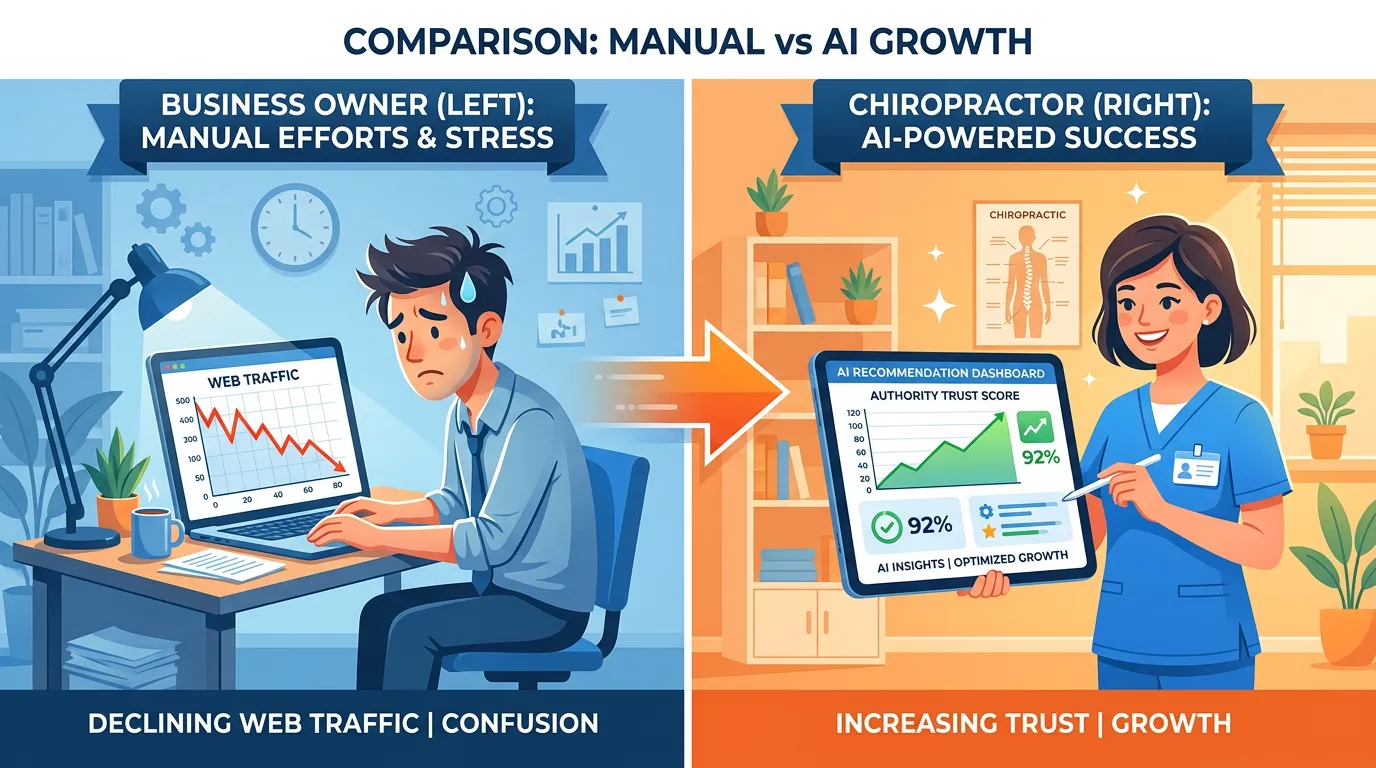
This is the part that makes most marketing agencies uncomfortable.
Traffic stopped being the point.
For 20 years, ‘more clicks’ meant ‘more patients.’ That math worked when discovery happened through ranked lists – show up high enough, people clicked, some called. That model is breaking. Fast.
Zero-Click Is Not a Trend. It’s the Standard.
Over 60% of desktop searches and 77.2% of mobile searches end without a click. AI gives the answer. Patient gets what they needed. No website was visited.
Your agency reporting on click volume is handing you a metric that no longer predicts whether a patient calls.
Let me say that more plainly. You can have 10,000 monthly impressions and zero new patients from them. If the AI engine isn’t naming your practice in responses, those impressions are invisible activity. None of it moves the needle.
Traditional SEO optimizes for a list. AI search produces one answer. Those aren’t the same sport.
Authority trust matters more than click volume now. A practice with solid infrastructure and modest impressions has a better shot than a practice with massive traffic and no verifiable AI signal. That’s not a hot take – it’s what the search behavior data keeps showing.
- Impressions – Counted every time your site appears in a result, whether anyone clicked or not. Easy to report. Easy to look good on paper. Won’t tell you if a single patient called.
- Zero-click searches – Queries resolved entirely inside the AI interface. No site visit. If you’re not the cited source, you got nothing from that search.
- AI recommendations – When ChatGPT, Gemini, or Perplexity names your practice in a response. This is the acquisition signal that matters now. It doesn’t show up in Google Analytics.
Can I Build Infrastructure Without Rebuilding My Website?
Most of the time, yes.
People hear ‘infrastructure build’ and picture a full redesign. That’s usually not what happens. The existing site stays. What we’re doing is working underneath it – implementing schema, cleaning up entity consistency across every platform AI checks, building out the content layer that actually gets read.
Think of it like putting an engine in a car that looks fine but won’t start. The exterior doesn’t move. The thing that makes it run is what gets fixed.
The only exception is sites on platforms that make schema implementation structurally impossible – that’s a small category. Everything else can be retrofitted without touching the design.
We walk through exactly how the build works – start to finish, without it touching your schedule.
| Discovery Signal | Traditional SEO – Traffic Model | Authority Infrastructure – Trust Model |
|---|---|---|
| How Patients Find You | Ranked list – they choose to click | AI recommendation – named directly |
| What Gets Measured | Impressions, clicks, keyword rankings | Entity trust, AI citations, content depth |
| When It Stops Working | Algorithm update or budget cut | Continues compounding when maintained |
| Patient Decision Stage | Passive browsing – still comparing options | Active recommendation – trust already established |
| What AI Reads | Keyword density – weak signal | Schema, entity data, content authority – strong signal |
Frequently Asked Questions
Why doesn’t a high-end website design guarantee AI recommendations?
AI doesn’t “see” design. It parses data.
I’ve seen docs drop $15,000 on a redesign and watch their AI visibility stay at zero. The site looked incredible. The AI didn’t care. If the structured data layer isn’t there, the recommendation engine isn’t reading you – no matter what the design looks like.
What’s the actual difference between a “Digital Brochure” and “Authority Infrastructure”?
A digital brochure is a website built for human window-shoppers. It tells your story, looks good, and describes your services.
Then it waits for a human who found you some other way. Authority Infrastructure is what runs underneath the content – structured data, entity signals, content depth. The stuff AI reads before it decides whether to say your name. One exists for the patient who already knows you’re there. The other earns the introduction.
Is Authority Infrastructure just another name for advanced SEO?
No. And the distinction matters.
Traditional SEO builds for a ranked list. Ten results, humans pick one. Authority Infrastructure builds for a verdict – one name, one recommendation. Patients don’t compare ranked results when they ask AI. They get an answer. Those are two completely different disciplines. The agency still selling keyword rankings in 2026 is selling a playbook for a game that’s winding down.
Can I add Authority Infrastructure to my current website without a rebuild?
In most cases, yes. The infrastructure work happens behind what visitors see.
Schema goes in at the code level. Entity data gets verified and corrected across every platform AI checks. AEO content builds into whatever architecture you already have. The design doesn’t move. The only time we run into issues is when a site is built on a platform that makes schema implementation structurally impossible – that’s a small category. A free AI Visibility Check tells you exactly what your setup needs before we touch anything.
How does Authority Infrastructure compound as an asset?
Every month AI engines see consistent, verified signals about your practice, their recommendation confidence increases.
It works like a trust account. First deposit – schema and entity verification – tells AI you’re a real, confirmed practice. Content depth tells AI you know what you’re talking about. Ongoing citations and new AEO articles tell AI you’re still active and relevant. Each layer compounds on the last.
Pull out of an ad campaign and the visibility drops the same week. Let the infrastructure keep running and it keeps building. That’s what makes it an asset instead of a line item. A competitor trying to displace you has to build the same stack from scratch – while you already have the lead.
How long does it take to build Authority Infrastructure?
I won’t attach a guaranteed timeline – because anyone who does that is selling something that doesn’t exist.
Technical foundation goes in first – schema, entity cleanup, the structural layer. Then content builds on top, month by month. AI confidence increases as signals stack up. Anyone giving you a 60-day window with a straight face is making something up. If the ‘how fast’ question is what’s driving the conversation, we’re probably not the right fit. I’d rather say that now.
What signals does AI actually check when recommending a chiropractor?
AI engines look for verification, not aesthetics.
The consistent pattern across ChatGPT, Gemini, and Perplexity is this: How consistently is this practice described the same way across multiple sources? Is there structured data confirming what the practice does and where it’s located? Does the content go deep enough to demonstrate real authority – or does it just list services? The practices that get named aren’t always the ones with the most reviews or the nicest sites. They’re the ones with the most consistent, verifiable, AI-readable signal stack. That’s not an accident. That’s infrastructure.
| What AI Checks | Why It Matters | What Most Sites Have |
|---|---|---|
| Schema Markup | Tells AI exactly what your practice is and does | None or minimal |
| Entity Consistency | Name, address, and description match across all platforms | Often inconsistent |
| Content Depth | Topical authority across patient-relevant questions | Surface-level service pages |
| Citation Sources | Verified mentions in directories and authoritative sources | Inconsistent or missing |
The Verdict
Here’s where I land every time I have this conversation.
AI gives one answer. If you’re not the answer, you don’t exist.
Not ‘you rank lower.’ Not ‘you’re harder to find.’ You don’t exist in that conversation. The patient got a name. It wasn’t yours. They’re already calling.
I’ve walked through this with practices that were convinced they were in decent shape. Most weren’t. The practice with the compound authority advantage was usually someone two miles away, building quietly while everyone else was refreshing their designs and chasing Google rankings.
Your website might be the best-looking thing in your market. Doesn’t matter if the machine can’t verify you. The patients using AI to find a chiropractor – and that number grows every single month – need to find a practice that AI trusts enough to name.
That’s the only position worth building for now.
You built a great website. The question is whether AI knows your practice well enough to recommend it.
Find out exactly what AI knows – and doesn’t – about your practice. See your AI visibility score before your competitor adds another month of trust signals ahead of you.
What you learn will change what you build next.