Why Your Current Metrics Are Measuring the Wrong Game
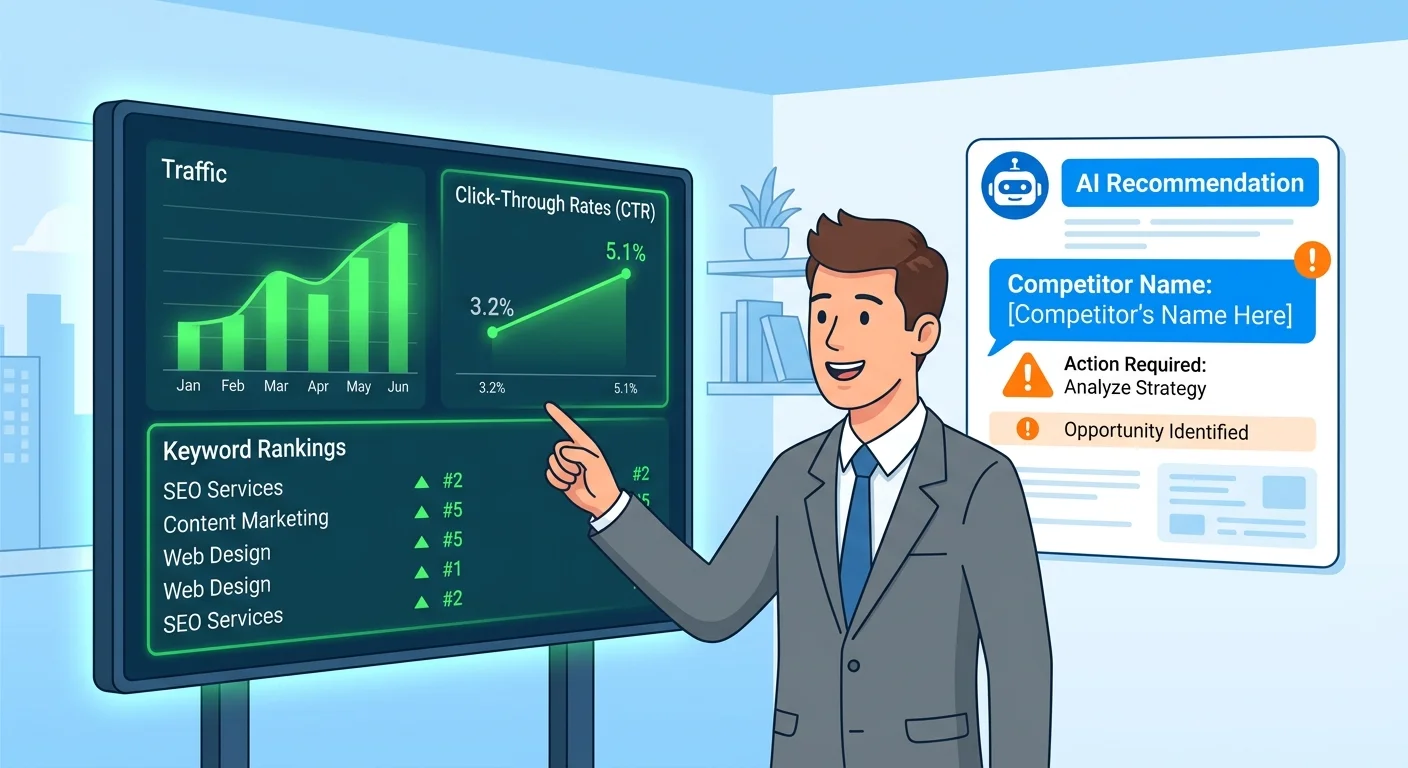
The dashboard still shows green. Sessions up. Rankings holding. Impressions climbing.
But the game those numbers were built to track? It’s already gone.
That old game had a simple chain: patient Googles a question, gets ten blue links, clicks through, books an appointment. Every metric you’ve ever tracked was built around that chain.
AI-powered search broke the chain. There’s no list anymore. There’s a verdict. One name. One recommendation. One answer. Every metric you built around the browsing list is now tracking a competition that already ended.
Gartner projects a 25% drop in traditional search engine volume by 2026 as conversational AI absorbs that behavior. That’s not a trend to monitor.
That’s a stadium change. Practices still training for click-through rates are preparing for a match that moved to a different arena – without posting the new address.
Why Traditional SEO Metrics Break in an AI-Answer World
Traditional search optimization ran on one chain: rank higher, get clicked more, win more patients. Organic sessions, bounce rate, average position – every metric served that chain.
Now a patient asks ChatGPT or Gemini who to trust for chiropractic care. The engine doesn’t consult your rankings. It consults its own judgment about which entities it can verify. Your dashboard numbers aren’t in that conversation.
So the dashboard isn’t lying. It’s just answering a question nobody’s asking anymore.
That’s what published analysis of AI-driven search keeps surfacing: this isn’t a new level of the same game. It’s a different sport entirely. The field changed. The scoring changed. Most practices haven’t looked up from the old scoreboard yet – and every month they don’t, the gap widens.
Here’s what separates the practices already winning AI citations from everyone else: it’s not content volume. It’s not domain authority. It’s whether the content architecture makes it structurally easy for an AI engine to verify, trust, and cite you.
That’s why practices pivoting to AI authority content aren’t making a tactical upgrade – they’re switching to an entirely different scoring system. One most agencies don’t know exists.
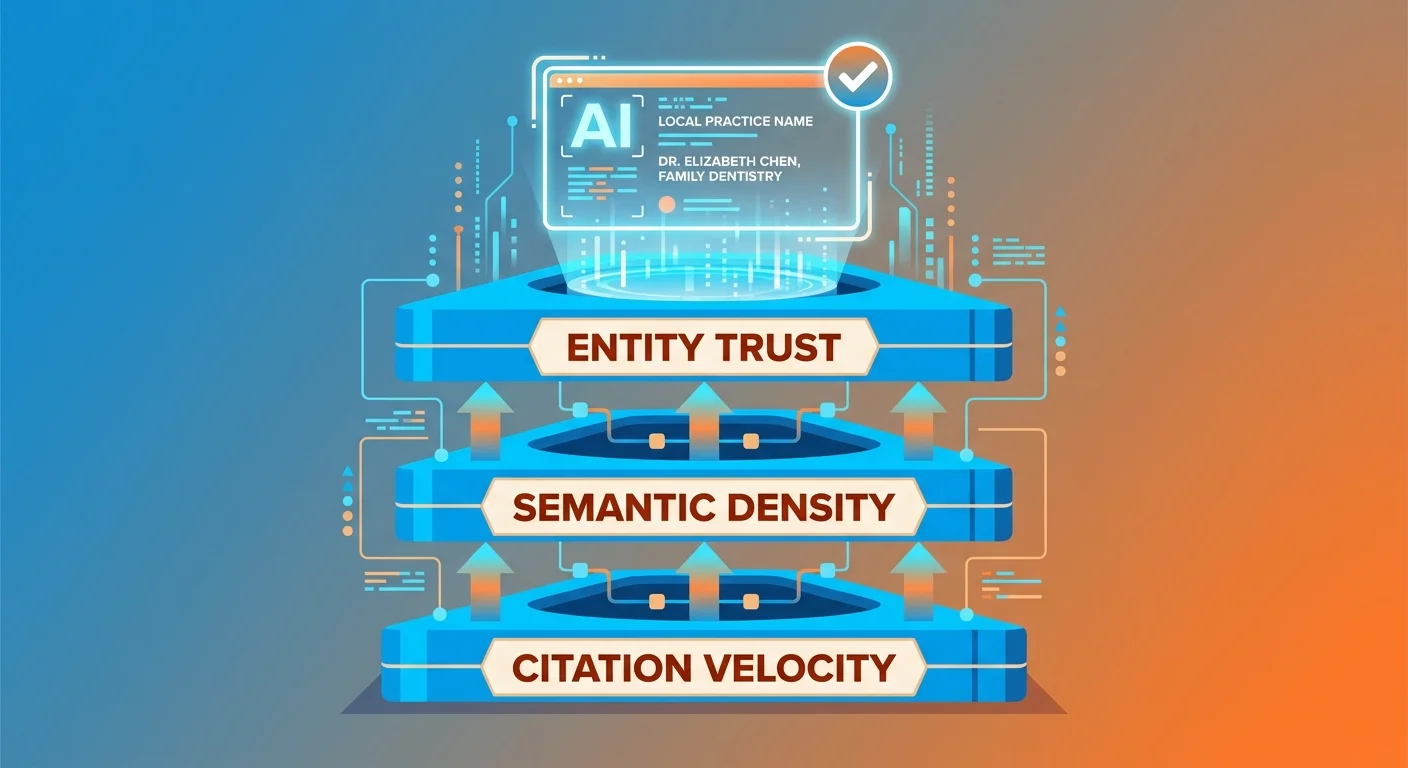
And that new scoring system doesn’t care about bounce rate. It tracks Entity Trust, Semantic Density, and Citation Velocity – three signals that don’t appear in any standard analytics report.
The Local AI Authority Engine is built around these signals specifically. Because when the engine delivering the verdict is an AI and not an algorithm ranking a list, these are the only signals that move anything.
| Metric | What It Measured (SEO Era) | What It Measures Now (AI Era) | Verdict |
|---|---|---|---|
| Organic Sessions | How many people clicked through from a search results page | A count of behavior that AI-driven verdict delivery increasingly bypasses entirely | Measuring clicks in a zero-click search environment |
| Page-One Rankings | Where a page appeared in a ranked list of ten blue links | A position on a scoreboard AI engines don’t consult when generating a cited answer | Ranking for a list that the verdict model replaced |
| Click-Through Rate (CTR) | The percentage of searchers who clicked a result after seeing it | Irrelevant when a single AI-generated answer satisfies the query without any link clicked | Optimizing for a step in the journey that AI skips |
| Bounce Rate | Whether a visitor left after viewing one page – a proxy for content relevance | Nothing – AI engines never land on your page, so no bounce is ever recorded | A behavioral signal with no surface in the AI citation pathway |
| Domain Authority Score | A third-party proxy for how many sites linked to yours – used to predict rank | A backlink-weighted number AI engines don’t use to determine citation trustworthiness | Measuring link volume when AI is scoring Entity Trust and Semantic Density |
| Impressions | How often a page appeared in search results, whether clicked or not | A visibility signal tied to a ranked-list model that conversational AI doesn’t produce | Counting appearances on a stage the audience has already left |
| Citation Velocity | Not tracked – didn’t exist as a concept in traditional search optimization | The rate at which AI engines pull from your content across queries and time periods – a compounding authority signal | The metric that actually matters now – and it’s not in your dashboard |
The Three Signals AI Engines Actually Use to Assign Authority
So what does the new scoreboard actually track?
Not sessions. Not bounce rate. Not average position on a list fewer people are scrolling through. The signals that matter inside an AI engine are machine-readable, structural, and completely invisible to every conventional reporting tool you’re probably still running.
Here’s the thing: AI engines aren’t guessing when they pick a name to recommend. They’re running a verification process – cross-referencing entity data, evaluating topical depth, measuring how consistently a source gets pulled across different queries over time.
That process surfaces three distinct signals: Entity Trust, Semantic Density, and Citation Velocity.
These aren’t abstract concepts. They’re measurable. They’re buildable.
But they need a completely different infrastructure than the one traditional search optimization runs on. That’s exactly why the practices still chasing page-one rankings are training for the wrong sport.
Entity Trust: The Foundation Signal
Entity Trust is the foundation signal. And it’s the one most practices don’t even know is broken.
It measures whether an AI engine can independently verify that your business is real – consistently described, accurately structured, and recognizable across every platform where your information appears.
Think about what that verification process actually checks. Your name, address, phone number, and service descriptions have to match – not approximately, not close enough – across your primary content hub, your directory listings, your social profiles, and every third-party citation.
One inconsistency doesn’t nudge your numbers down. It creates ambiguity. And AI engines resolve ambiguity by naming someone else.
Here’s the part that stings. Private AI investment reached $95.99 billion in 2023 – and that capital is going into systems that are getting more precise about who they trust, not less.
The bar isn’t creeping up. It’s already high. A practice with mismatched entity data scattered across a dozen platforms is structurally invisible to an engine making that call.
Semantic Density: The Depth Signal
Semantic Density is the depth signal. And it has nothing to do with how many articles you’ve published.
It’s about whether your content proves specific, genuine expertise – or reads like surface coverage written to check a keyword box.
And here’s where most content strategies fall apart: volume isn’t depth. An AI engine processing your content isn’t counting words. It’s evaluating whether topical coverage is tight, interconnected, and authoritative – or thin and scattered.
That’s why Semantic Cohesion Triplets matter so much. AI engines reward coherent content architectures. They don’t reward isolated articles.
The practices with high Semantic Density don’t just cover a topic. They own the territory.
Every article reinforces the entity. Every subtopic points back to a central expertise claim. Any question in the subject area leads an AI engine back to the same verified source.
That’s not an accident. That’s an architecture.
Citation Velocity: The Momentum Signal
Citation Velocity is the momentum signal – and it’s the one that compounds.
It measures how frequently and consistently an AI engine pulls from your content across different queries, different time periods, and different contexts. Low velocity means occasional citations. High velocity means your entity has become a default reference point.
That difference isn’t trivial. It’s the gap between being named and being invisible.
Now here’s where the old scoreboard completely breaks down. The investment data on AI infrastructure makes the reason clear: these engines aren’t static tools. They’re continuously updated systems trained on evolving data.
A practice that built authority signals six months ago and stopped isn’t holding steady. It’s losing ground to every competitor who kept executing.
Citation Velocity doesn’t spike. It builds.
Approximately 70% of U.S. adults have already heard of ChatGPT. The adoption curve is mainstream – which means the compounding effect of high Citation Velocity is already underway in most markets right now.
The practices earning citations today are widening the gap on every practice still watching sessions reports and waiting to see if anything changes.
| Authority Signal | What AI Engines Look For | What Breaks It | How to Strengthen It |
|---|---|---|---|
| Entity Trust | Consistent, verifiable entity data across all platforms – name, address, phone, service descriptions, and business category must match exactly everywhere the practice appears | Mismatched or inconsistent entity data across directories, social profiles, and content hubs creates ambiguity – AI engines resolve ambiguity by naming a competitor whose data is cleaner | Audit every platform where the practice appears and enforce exact consistency; structure primary content around a single, authoritative entity description that all other platforms reflect |
| Semantic Density | Topically tight, interconnected content that demonstrates genuine depth on a subject – AI engines evaluate whether coverage is authoritative and structured, not whether it is voluminous | Thin, scattered content that covers many topics at surface level signals a generalist, not an authority; isolated articles with no topical interconnection fail to reinforce a single expertise claim | Build structured content architectures where every article reinforces the entity’s core expertise and links back to a central topical hub – depth and interconnection over volume |
| Citation Velocity | The frequency and consistency with which an AI engine pulls from a practice’s content across different queries, time periods, and contexts – a compounding signal that builds with sustained execution | Stopping content execution after an initial build allows Citation Velocity to decay; competitors who continue executing widen the gap as AI engines update their reference models continuously | Maintain consistent, structured content execution month over month so that citation frequency compounds rather than stalls – velocity is built through sustained infrastructure, not one-time publication |
How to Audit Your Current Authority Signals
Knowing the three signals is one thing. Knowing where you actually stand on them is a different problem entirely.
Most practices have no idea. Not because the data doesn’t exist – because none of their current reporting tools are built to surface it.
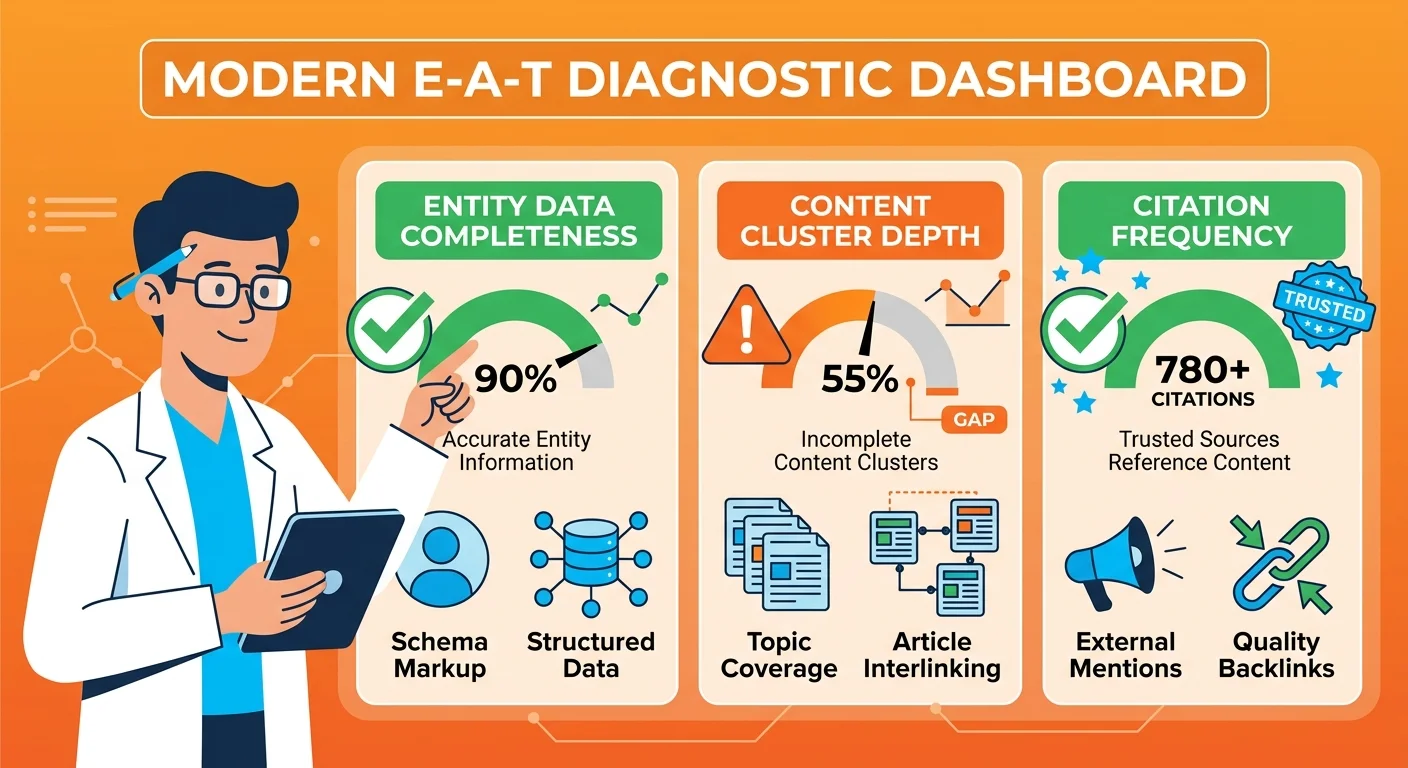
So here’s where you start. An authority audit isn’t a technical exercise reserved for agencies. It’s a diagnostic with three distinct layers – each one examining a signal your AI citation potential actually depends on.
First: can AI engines verify who you are? Second: does your content demonstrate genuine topical depth, or just surface-level coverage? Third: is your entity being pulled consistently across different queries over time?
Each layer has specific, observable indicators. None of them show up in a standard analytics report.
And this matters now. Not eventually. FTC guidance makes clear that unsupported claims about AI performance require scientific proof – which means the platforms your patients are already using are under increasing pressure to return verified, trustworthy entities.
That pressure flows directly to your authority signals. Approximately 70% of U.S. adults have already heard of ChatGPT. These engines aren’t a future consideration. They’re already the room where your next patient is deciding who to call.
What a Strong Authority Audit Reveals
Here’s what a strong authority audit surfaces: gaps you didn’t know existed. And most of them are structural – not content problems.
Entity Trust failures show up first. Inconsistent business name formatting across directories. Mismatched service descriptions between your primary content hub and third-party citations. Contact information that differs by platform.
These aren’t minor housekeeping issues. To an AI engine running a verification pass, they’re ambiguity signals. And ambiguity means someone else gets named.
The Semantic Density layer reveals something different: whether your content tells a coherent story or just covers topics in isolation.
The practices that convert AI authority into consistent patient appointments aren’t just publishing more. They’re publishing in a structured topical hierarchy – every piece reinforcing the entity, every subtopic connecting back to a central expertise claim.
If your content reads like a collection of independent articles, that’s exactly what the audit will show.
Citation Velocity is the hardest gap to confront. It’s the one that requires the most honest reckoning – and the one you can’t manufacture retroactively.
The AI Visibility Check diagnoses exactly this: what ChatGPT, Gemini, and Grok say when someone in your market asks who to trust. That output is your velocity benchmark.
If your name isn’t in those responses, the audit isn’t delivering bad news. It’s delivering a starting line. The practices that act on it now are the ones building the gap that compounds.
| Audit Area | What to Check | Strong Signal Looks Like | Weak Signal Looks Like |
|---|---|---|---|
| Entity Trust – Business Identity Consistency | Whether your business name, address, phone number, and service descriptions match exactly across your primary content hub, directory listings, social profiles, and third-party citations | Every platform returns the same entity data – no variation in name formatting, address structure, or service terminology; AI engines can verify your identity without resolving conflicting signals | Inconsistent name formatting across platforms, mismatched service descriptions between your content hub and directories, or contact details that differ by source – each discrepancy introduces ambiguity that causes AI engines to name a competitor instead |
| Entity Trust – Structured Data Markup | Whether your primary content hub carries machine-readable schema that explicitly communicates your business type, service area, practitioner credentials, and operating details to AI engines | Schema markup is present, complete, and accurately reflects your current entity data; AI engines can extract structured facts without inferring them from unstructured prose | Schema is absent, incomplete, or contains outdated information; AI engines must guess at entity details from context clues, reducing verification confidence and citation likelihood |
| Semantic Density – Topical Coverage Depth | Whether your published content covers your core subject area at multiple levels of specificity – foundational concepts, applied subtopics, and practice-specific expertise – or addresses topics in isolated, disconnected pieces | Content architecture forms a coherent topical hierarchy where every piece reinforces the central entity and every subtopic connects back to a primary expertise claim; AI engines recognize the practice as a dominant source on the subject | Content covers topics independently without structural interconnection; articles feel like a collection rather than a unified authority architecture; AI engines see surface-level coverage rather than genuine topical ownership |
| Semantic Density – Content Interconnection | Whether internal linking patterns create deliberate topical pathways that guide AI engines from subtopics back to core authority claims, or whether articles exist as standalone pages with no reinforcing structure | Internal links flow systematically between related content pieces, reinforcing the same entity at each node; the topical network is tight, intentional, and readable as a structured authority architecture | Internal links are sparse, random, or missing entirely; no clear topical pathway exists for an AI engine to follow; each article competes with the others rather than compounding toward a central authority signal |
| Citation Velocity – AI Engine Response Presence | Whether your entity name appears in the responses that ChatGPT, Gemini, and Grok generate when someone in your market asks who to trust or who to see for your core service area | Your entity is named consistently across multiple AI engine responses on different query variations; citation frequency is stable or increasing over time; your name appears without prompting from branded queries | Your entity is absent from AI engine responses even on queries directly relevant to your specialty and market; competitors are named in your place; your citation velocity is effectively zero |
| Citation Velocity – Cross-Query Consistency | Whether AI engines pull from your content across varied query phrasings, different intent types, and different contexts – or only surface your entity on a narrow set of exact-match questions | Your entity appears across a broad range of query types – informational, comparison, and recommendation – indicating deep integration into the AI engine’s verified knowledge base for your subject area | Your entity surfaces only on highly specific queries or not at all; citation pattern is narrow and inconsistent; authority signals haven’t compounded into reliable, repeatable citations across the question types your prospective patients actually ask |
The Metrics That Actually Track AI Visibility Progress
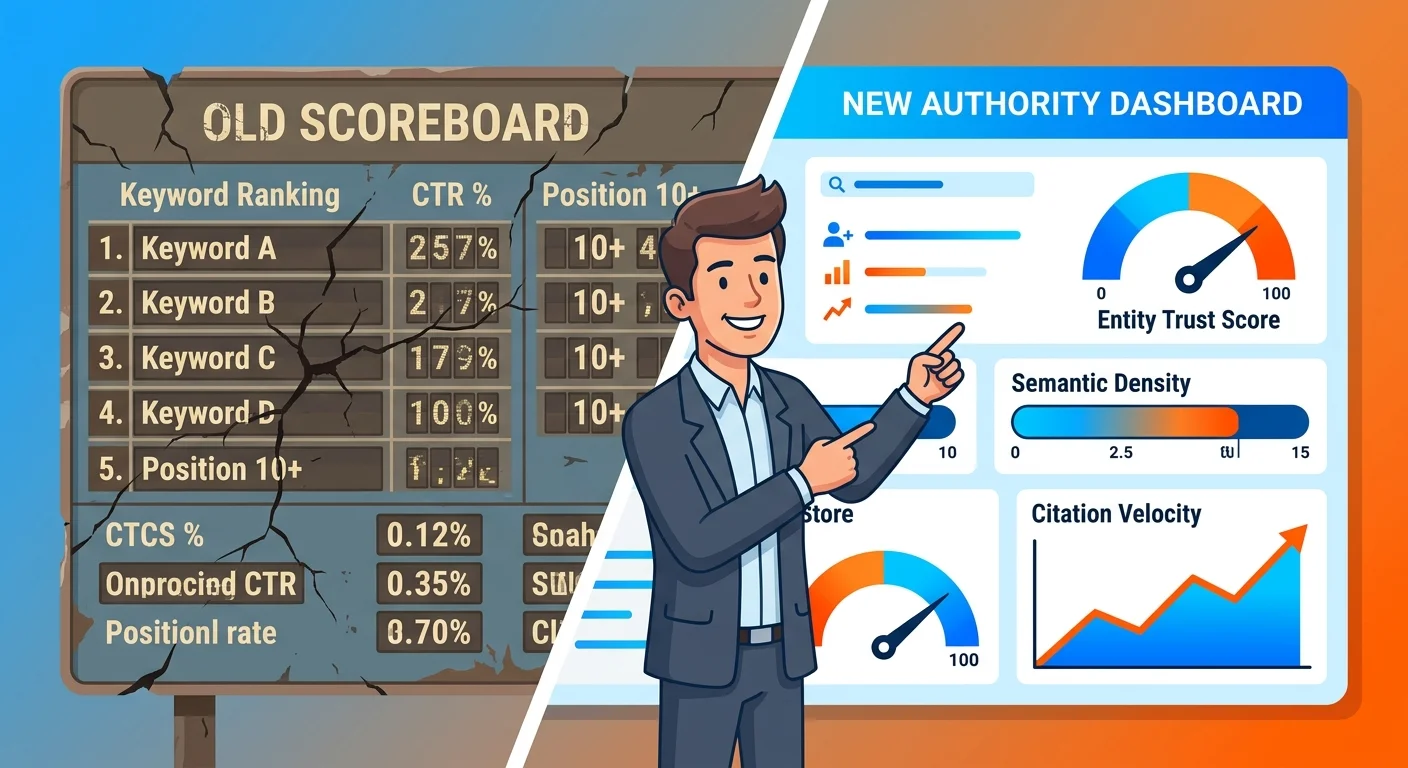
The scoreboard is still running.
Sessions, impressions, average position – all of it still populating dashboards across thousands of practices right now. Not one of those numbers tells you whether ChatGPT is naming you or your competitor when a patient asks who to call.
Gartner projects a 25% drop in traditional search engine volume by 2026. That’s not erosion. That’s a structural replacement.
The game changed. The scoreboard didn’t. And the practices still optimizing for the old game are doing it with increasing precision on a field that keeps shrinking.
So what does a replacement scoreboard look like?
It tracks authority indicators – signals that reflect how AI engines evaluate, verify, and ultimately cite a source. Not clicks. Not session duration. The signals that matter when the engine delivering the verdict is generating a single answer, not a ranked list of ten.
Replacing Vanity Metrics With Authority Indicators
Vanity metrics flatter. Authority indicators inform.
That’s not a measurement problem. It’s a visibility problem. And right now, those two things are pointing in opposite directions for most practices.
The first authority indicator to track is entity consistency rate – how precisely your business information matches across every platform where it appears. Not approximately. Exactly.
AI engines running verification passes don’t award partial credit for close enough. Inconsistent name formatting, mismatched service descriptions, contact information that varies by directory – each one registers as an ambiguity signal.
And ambiguity gets resolved by recommending someone else.
But entity consistency is only the floor.
The second indicator is topical coverage depth – whether your content infrastructure demonstrates genuine expertise or surface-level familiarity. Practices that understand how clinical voice translates into machine-readable authority are the ones building depth AI engines can actually evaluate. Not just indexed text filling a topic gap.
Depth means interconnected, reinforcing content. Not a collection of isolated articles that happen to share a subject. This is where learning to measure content authority beyond session counts stops being optional.
The third indicator is citation frequency – how often your entity appears as a sourced answer across different queries and contexts. This is Citation Velocity made measurable.
McKinsey estimates generative AI will add $2.6 trillion to $4.4 trillion in annual economic value across sales, marketing, and customer operations. That’s the scale of investment flowing into the engines making citation decisions every day.
Practices with rising citation frequency are compounding authority. Practices watching a sessions dashboard are compounding nothing.
The replacement scoreboard doesn’t just tell you where you rank. It tells you whether you’re being named at all – and why.
| Vanity Metric (Old Scoreboard) | Why It Misleads in AI Search | Authority Indicator (New Scoreboard) | How to Track It |
|---|---|---|---|
| Organic traffic volume | Counts clicks from a ranked list – a delivery mechanism AI engines bypass entirely when generating a single verified answer | Citation frequency | Run AI engine queries in your market and record how often your entity appears as a named source across different question types |
| Keyword ranking position | Reflects placement in a traditional index – AI engines don’t return ranked lists, they return one verdict built on entity trust signals | Entity consistency rate | Audit business name, service descriptions, and contact information across every directory and citation source for exact-match alignment |
| Click-through rate (CTR) | Measures behavior on a results page users are increasingly skipping – zero-click verdicts make CTR structurally irrelevant to AI visibility | Topical coverage depth | Map your content architecture to confirm every subtopic connects back to a central expertise claim rather than existing as an isolated article |
| Average session duration | Tracks on-page engagement after a click – tells you nothing about whether an AI engine verified your entity before the click ever happened | Entity Trust signal strength | Assess schema markup completeness, structured data accuracy, and consistency of entity signals across your primary content hub and third-party platforms |
| Impressions and page views | Counts how many times a page appeared in a traditional index – a metric that doesn’t exist in AI-generated answer environments | Semantic Density index | Evaluate whether your content infrastructure demonstrates interconnected, reinforcing expertise or surface-level topic coverage with no internal hierarchy |
| Domain authority score | A third-party estimate of backlink strength – AI engines evaluate machine-readable entity verification, not link graphs, when constructing a citation verdict | Citation Velocity trend | Track whether AI engine citations of your entity are increasing, flat, or absent across repeated queries over time – compounding citations signal a default reference point |
Frequently Asked Questions
Here’s what comes up every time. Same questions. Different practices, different markets, different revenue numbers – same sticking points once someone actually understands what changed.
These aren’t beginner questions. They come from people who already know the scoreboard flipped – and need to know exactly what to do next.
What is content authority in the age of AI search?
It’s how verifiable your entity is to an AI engine when someone asks a relevant question. Not a platform score. Not a dashboard number you can screenshot and send to a client.
It’s a composite – built from Entity Trust, Semantic Density, and Citation Velocity. Those three signals determine whether your name gets said or someone else’s does. That’s the whole game.
And the stakes are real. Pew Research puts awareness of ChatGPT at roughly 70% of U.S. adults. These aren’t niche tools anymore. Content authority is what decides whether you’re in their output – or completely invisible to it.
How do you measure content authority without keyword rankings?
Stop looking at the old scoreboard. Start tracking three signals instead.
Entity Trust is measured by entity consistency rate – how precisely your business information matches across every directory, citation, and third-party platform. Semantic Density is measured by topical coverage depth – whether your content architecture shows interconnected expertise or just a list of isolated topics. Citation Velocity is measured by citation frequency – how often your entity actually gets named as an answer.
None of those show up in a standard analytics report. That’s not a gap in your tools. That’s exactly the point.
What are the core metrics for AEO visibility?
Three: entity consistency rate, topical coverage depth, and citation frequency. Each one maps directly to a signal AI engines use when deciding who to cite.
Entity consistency rate tracks whether your business information is identical across every platform. Topical coverage depth tracks whether your content tells a coherent, reinforcing story – or just fills a topic list with no structural logic connecting it. Citation frequency tracks how often you’re actually named as the answer.
These aren’t vanity metrics. They’re the only indicators that move the needle in the game AI engines are running.
Why does traditional organic traffic tracking fail on AI search engines?
Because AI search doesn’t return a list. It returns a verdict – one name, one answer, end of interaction. Organic traffic tracking was built to count clicks on a ranked list. When the list disappears, the metric measures nothing.
Gartner projects a 25% drop in traditional search engine volume by 2026 as conversational AI absorbs that behavior. The sessions dashboard is already measuring a shrinking game.
Tracking organic traffic to evaluate AI visibility is measuring the score of a sport that’s no longer being played.
How does an AI Visibility Check determine my authority score?
The AI Visibility Check queries ChatGPT, Gemini, and Grok with the same questions your prospective patients are already asking – and records exactly what comes back.
The output shows whether your entity appears in those responses, how it’s framed, and whether the information returned matches what you’ve published. That’s your actual baseline.
Not where you assume you stand based on a sessions report. Where you actually stand – on Entity Trust, Semantic Density, and Citation Velocity – in the engines already making the call right now.
How long does it take to build measurable AI citation authority?
Authority compounds. It doesn’t flip overnight. But the diagnostic baseline is available right now – and structural gaps in Entity Trust can often be addressed quickly once they’re identified.
Semantic Density and Citation Velocity build as the content architecture deepens and citations accumulate. The practices compounding authority today started before the shift was obvious to everyone else.
That’s not a reason to wait. That’s the argument against it. Every month of execution builds on the last. Every month of inaction hands that compounding to whoever moved first.
The Scoreboard Has Changed – Are You Tracking It?
The old scoreboard is still lit up. Sessions, impressions, average position – all of it still populating dashboards, still flashing numbers that look fine.
But Gartner projects a 25% drop in traditional search engine volume by 2026. Approximately 70% of U.S. adults have already heard of ChatGPT. The engines making citation decisions aren’t coming.
They’re already here. They’re already deciding whose name gets said in your market. And the scoreboard hasn’t changed – the game has.
Here’s the thing: Entity Trust, Semantic Density, and Citation Velocity don’t care what your sessions report says. They’re the signals that determine whether an AI engine can verify who you are, whether your content architecture demonstrates genuine expertise, and whether your entity has become a default reference point across different queries and contexts.
And they compound. Every piece of content reinforces the entity. Every citation makes the next citation more likely.
That’s the architecture the new game rewards. Not clicks. Not bounce rate. Not a page-one position on a list fewer people are scrolling through every month.
So the decision is binary. Keep watching the old numbers on the old scoreboard – or start building the infrastructure that earns a citation when someone asks an AI engine who to trust.
The practices moving now aren’t just staying current. They’re compounding authority while every practice waiting for clarity is handing that ground to someone else.
The scoreboard hasn’t changed – the game has. The only question is whether you’re playing the one that’s actually running.
Here’s what you need to know right now: Entity Trust, Semantic Density, and Citation Velocity are the only metrics that matter to ChatGPT, Gemini, and Grok. You can’t fix what you haven’t measured. Run the AI Visibility Check and find out exactly where you stand – before someone else in your market does.
What Are Semantic Cohesion Triplets and Why Do AI Engines Favor Them?
Semantic cohesion triplets are structured content units built in Subject-Predicate-Object format – the same relational logic AI knowledge graphs use to parse, verify, and recommend entities. When authority content is structured as semantic triplets, AI engines can extract clear relational statements about who a business is, what it does, and why it is credible. That extraction determines whether a business gets named as the recommended answer.
AI search returns a verdict, not a list. When a user asks ChatGPT or Gemini who the best chiropractor in their area is, one name comes back. The businesses receiving that recommendation are the ones whose content is structured in ways AI can parse and trust. Unstructured prose, keyword-dense paragraphs, and generic marketing copy do not pass that test.
The mechanism traces to how neural networks process language. Structuring relational information as semantic triplets increases natural language processing parsing efficiency compared to unstructured prose blocks. According to research published by the National Institutes of Health, triplets correspond directly to database node links – the building blocks of the knowledge graphs AI engines consult when forming a recommendation. A business writing in triplet-structured statements is producing content in the same format the machine is reading.
Consumer behavior has already shifted to match. According to Pew Research Center, approximately 90% of US adults are now aware of everyday AI use cases integrated into commercial products. Traditional search is contracting in parallel – Gartner projects that conversational AI and search-based chatbots will trigger a 25% drop in traditional search engine volume by 2026. The window to build AI-readable authority before that shift completes is open now.
Semantic cohesion triplets are not a content trend or a formatting preference. They are the foundational unit of machine-readable authority – the structural difference between being cited by AI and being invisible to it.
Last Updated: July 10, 2026
By Gerek Allen, Founder
Table of Contents −
- • What Semantic Cohesion Triplets Actually Are
- • Why Unstructured Prose Fails AI Engines
- • How Triplets Build Entity Trust in Knowledge Graphs
- • Turning Triplet Theory Into Practice: What Implementation Actually Looks Like
- • Frequently Asked Questions
- • The Only Structure AI Trusts
What Semantic Cohesion Triplets Actually Are
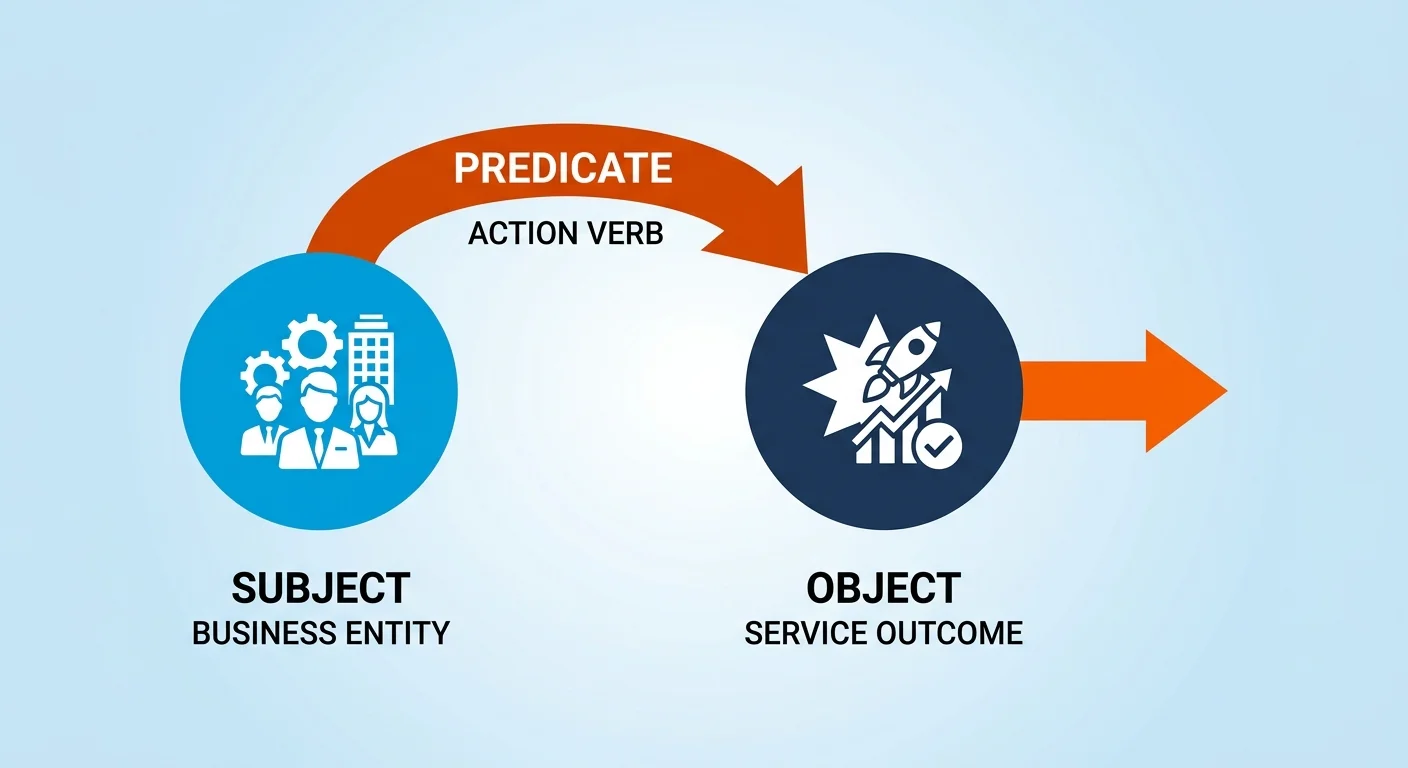
A semantic cohesion triplet is a structured content unit built in Subject-Predicate-Object format. One relational statement. No ambiguity. Machine-readable from word one.
Here’s the thing: most businesses bury their authority in narrative paragraphs. Brand voice. Flowing copy that reads beautifully to a human and says almost nothing to a machine.
AI engines don’t read stories. They extract relationships. When your content speaks in clear Subject-Predicate-Object statements, you stop hoping an algorithm finds you. You give it exactly what it needs to name you.
That’s the transition happening right now. From document-centric writing to machine-readable semantic architecture.
The businesses that make that move first give AI engines enough relational data to recommend them. The ones that don’t stay invisible – no matter how much content they produce.
The Subject-Predicate-Object Architecture
The Subject is the entity being defined. Your practice, your service, your specialty.
The Predicate is the verified relationship – what that entity does, holds, or gets recognized for.
The Object anchors the claim: the specific outcome, credential, or condition tied to that entity.
Put all three together and you get a statement an AI knowledge graph can store as a node. That’s not a metaphor. That’s the actual data structure.
That node isn’t optional. It’s the whole point. NIH research from the National Institutes of Health confirms that structuring relational inputs as semantic triplets increases natural language processing parsing efficiency in neural networks compared to unstructured prose blocks.
Triplets map directly to database node links. That’s the exact architecture AI knowledge graphs use to verify and recommend entities. This isn’t a content preference – it’s an infrastructure match.
Here’s what that gap looks like in practice.
"Dr. Martinez is a highly experienced chiropractor who has been serving the community for years and is known for his great bedside manner." An AI engine extracts almost nothing from that sentence. No node. No relationship. No claim it can file anywhere.
"Dr. Martinez specializes in spinal decompression therapy for lumbar disc herniation" is a triplet. Parseable. Storable. Citeable. That’s the difference between content that builds authority and content that fills space.
Why the Structure Matters More Than the Words
The words are secondary. What the machine evaluates is relational clarity.
That’s why conventional marketing copy is now structurally obsolete. Generic, filler-heavy prose produces zero parseable nodes – no matter how polished it reads to a human.
A published analysis on how organizations must restructure their content workflows for answer-engine discovery confirms what the architecture already makes obvious: the shift isn’t about writing better. It’s about writing differently.
Triplet-structured AEO Content Strategy gives AI engines the relational signals they need to render a verdict in your favor. Not shuffle your name somewhere on a list.
| Content Type | Structure | What AI Engines Extract | Entity Trust Signal |
|---|---|---|---|
| Semantic Cohesion Triplet | Subject → Predicate → Object (structured relational statement) | A clear, parseable entity node with defined relationships | High – machine can store, verify, and cite the claim directly |
| Conventional Marketing Paragraph | Narrative prose with embedded claims, adjectives, and filler | Fragmented signals with no reliable relational structure | Low – engine must guess at relationships; most signals discarded |
| Keyword-Dense Content Block | High-frequency terms arranged around a target phrase | Keyword presence only – no entity relationships extracted | None – no node is formed; authority cannot compound |
| Credential or Specialization Statement (triplet-structured) | Entity → holds credential → in named discipline or condition | Verifiable authority claim linked to a specific service or outcome | High – directly feeds knowledge graph node for recommendation |
| Generic Practice Description | Conversational overview of services with no relational anchors | No extractable entity, predicate, or object relationship | None – indistinguishable from every other practice in the same category |
| Service-Condition Mapping (triplet-structured) | Service → addresses → specific patient condition or diagnosis | Parseable relationship between offering and outcome | High – positions the entity as the answer to a specific query type |
Why Unstructured Prose Fails AI Engines
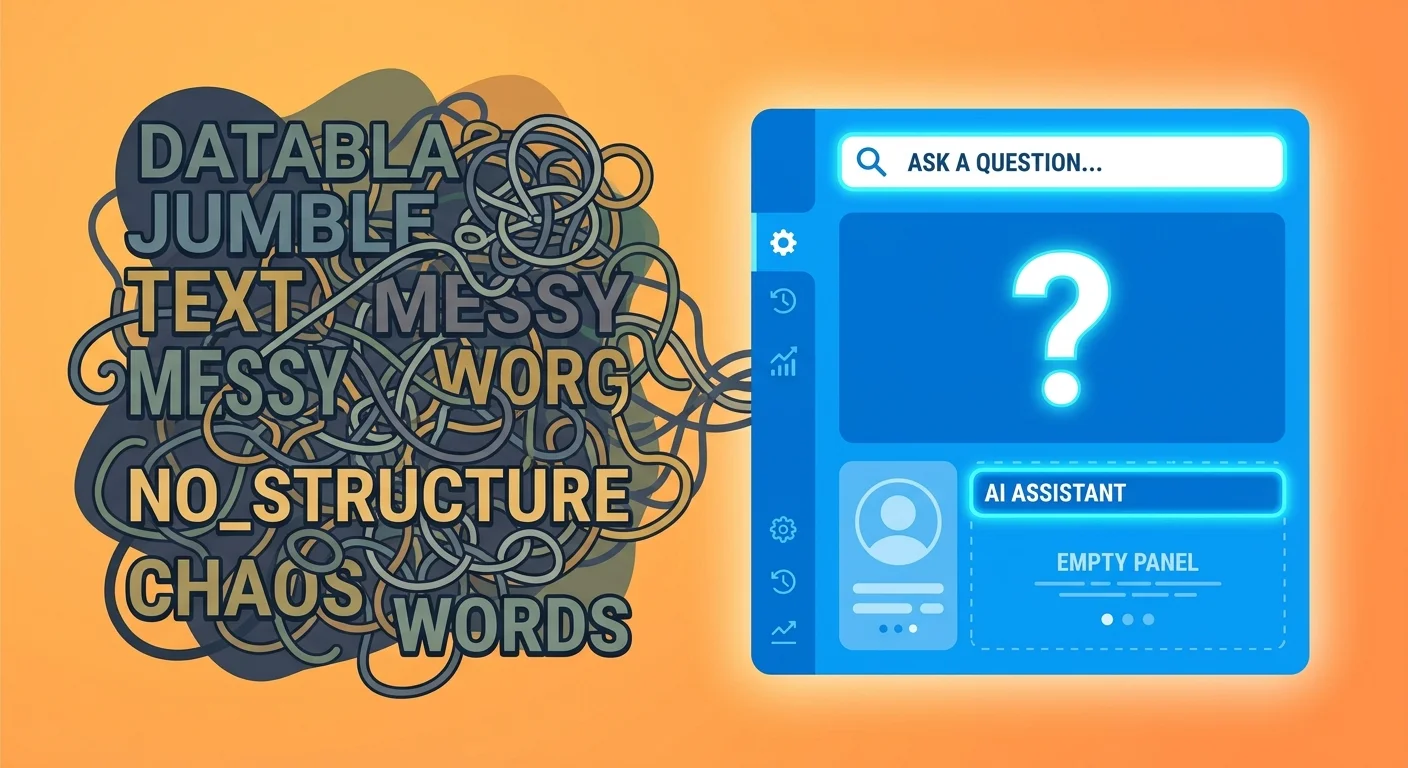
Unstructured prose doesn’t just underperform with AI engines. It produces zero parseable data. No relational anchor. Nothing to extract, nothing to file, nothing to cite.
Here’s the thing: AI engines aren’t reading for meaning. They’re scanning for structure. A paragraph that winds through a story before landing on a claim gives the machine nothing to work with. Buried signals don’t earn recommendations.
And this isn’t a problem that belongs to some future-forward tech niche. Every industry is getting hit. The businesses that restructure their content first are the ones AI engines have enough relational data to name. The ones that don’t restructure? Invisible – not by accident, but by architecture.
The Problem With Writing for Humans Instead of Machines
The problem isn’t bad writing. Most unstructured content reads just fine – to a human. But AI engines don’t read. They parse relationships. Narrative prose buries those relationships inside context, qualification, and filler that machines are built to discard.
So when a practice publishes a paragraph about their philosophy of care, their years of experience, and their commitment to patient outcomes – a human finds that reassuring. An AI engine finds almost nothing. No Subject. No Predicate. No Object. No node.
That gap becomes undeniable the moment you try to measure content authority against what AI engines actually extract. Human-readable copy and machine-readable authority are not the same output. Treating them as interchangeable is what keeps most practices off the recommendation entirely.
Why Traditional Content Strategies Leave AI With Nothing to Trust
Conventional content strategies were built to rank on a list. AEO structures authority to earn a verdict. Those aren’t two versions of the same goal. They’re opposite architectures. A strategy optimized for keyword density and document length produces content AI engines cannot cite, trust, or recommend.
And the math is already moving against traditional approaches. Conversational AI and search-based chatbots are projected to trigger a 25% drop in traditional search engine volume by 2026. That isn’t a future problem. Every month of unstructured content is a month of compounding invisibility inside the answer engines that are replacing the old list.
Think of it like a courtroom. The attorney who files the most paperwork doesn’t win. The one who builds the clearest, most verifiable case does. AI engines work the same way. Volume without relational structure is noise. Triplet-structured AI authority content is evidence – and evidence is what earns the recommendation.
| Content Pattern | What It Tells a Human | What It Tells an AI Engine | Outcome for Entity Trust |
|---|---|---|---|
| Philosophy-of-care narrative | Establishes warmth, values, and patient focus | No Subject, Predicate, or Object – zero parseable relationships | No entity nodes created; practice remains unverifiable to AI |
| Years-of-experience paragraph | Builds credibility and reassurance for human readers | Unanchored time reference with no relational structure | No credential node; AI cannot store or cite the claim |
| Keyword-stuffed service description | Signals topical relevance to a human skimming the page | Repeated terms with no Subject-Predicate-Object structure | High keyword density, zero relational data – unranked and unrecognized |
| Generic ‘we treat everyone’ statement | Communicates inclusivity and broad patient welcome | No defined entity, no specific service, no outcome anchor | Diffuse signal; AI cannot assign the practice to any specialty node |
| Patient testimonial in flowing prose | Provides social proof and emotional resonance | Narrative context buries any relational claim inside opinion language | AI discards the surrounding filler; no trust signal extracted |
| Triplet-structured authority statement | May feel clinical or direct to a human reader | Clear Subject-Predicate-Object relationship instantly parseable | Stores as a knowledge graph node; entity trust compounds with every statement |
How Triplets Build Entity Trust in Knowledge Graphs
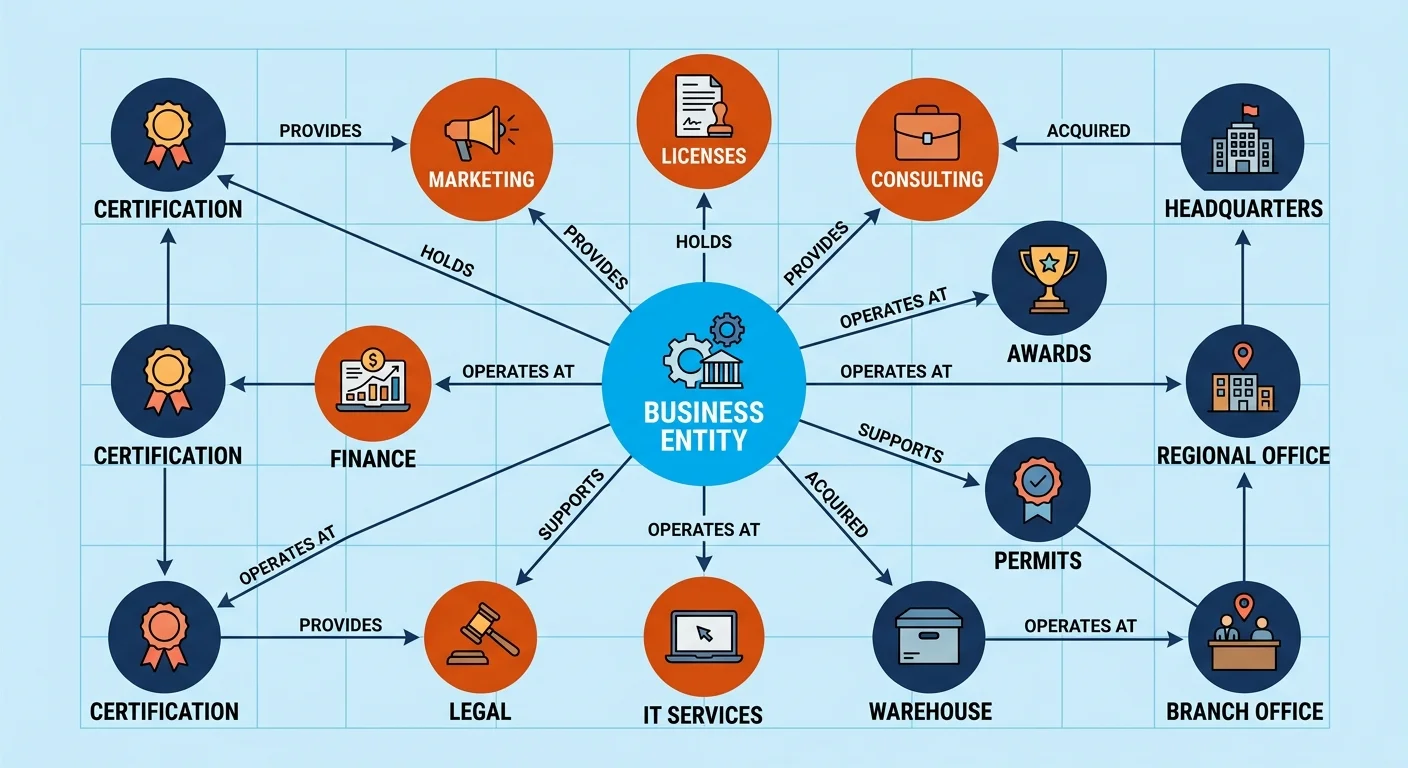
A triplet doesn’t just describe a business. It registers one.
Every Subject-Predicate-Object statement in your authority content becomes a verifiable node inside the knowledge graph an AI engine consults before it names anyone. That’s the architecture – not a metaphor, not a best practice.
AI engines don’t read your content. They map it.
Semantic graph research confirms that knowledge representation through semantic graphs enables machine agents to verify relational trust networks between business entities and their services. The engine is looking for connective tissue – who you are, what you do, what you’re credentialed to claim. Triplets are that connective tissue. Without them, there’s nothing to map.
That efficiency gap is the whole game.
The business with triplet-structured content gets parsed, verified, and named. The business with unstructured prose blocks gets skipped. Not penalized – just invisible. And invisible doesn’t show up in the recommendation.
From Isolated Facts to a Networked Entity Profile
One triplet gives an AI engine one node.
A body of authority content built entirely from triplets gives it a networked entity profile – something it can verify, cross-reference, and recommend with confidence.
Here’s where the verdict analogy lands hardest.
A judge doesn’t rule on a single exhibit. They rule on the weight of evidence – how every claim connects to the next, how the relationships hold together under scrutiny. AI engines operate identically. When structured AI authority content creates dozens of interlinked triplet nodes – each verifying your identity, services, and credibility – the knowledge graph builds a trust network it can stake a recommendation on.
That’s not ranking. That’s a verdict.
And because semantic graphs validate relational trust networks between business entities and their services, that network compounds.
Each new triplet-structured authority article adds more nodes. More nodes mean stronger relational pathways. Stronger pathways mean higher confidence in the recommendation.
This is what authority as a compounding asset actually means. Not more content. More connective structure.
Who This Is NOT For
Hard stop.
Not every business belongs in this conversation. And being clear about that upfront is more useful than letting the wrong buyer get three months deep before figuring it out.
If you’re looking for a 90-day fix, triplet-structured authority isn’t it. Knowledge graphs build through consistent, layered execution – not a single content push.
If you want guaranteed ranking outcomes written into a contract, that doesn’t exist with integrity. Businesses making claims about AI system performance are subject to strict regulatory oversight requiring factual substantiation – and any agency promising specific AI recommendation outcomes is operating outside that standard. That should concern you.
So if the guarantee is the requirement, this isn’t the right fit.
And if you’re treating AI authority content as an expense to minimize rather than infrastructure to build, the compounding math will never work in your favor.
The businesses earning AI recommendations right now started building entity trust before the shift became undeniable. They didn’t wait for proof. They became the proof.
If you need results before you’re willing to commit to the process – this isn’t your fit. That’s not a judgment. It’s a qualification.
| Entity Signal Type | How Triplets Express It | Knowledge Graph Impact | AI Recommendation Outcome |
|---|---|---|---|
| Identity Signal | Triplets declare who the entity is with explicit Subject-Predicate-Object statements – name, specialty, credential, and location expressed as discrete relational nodes | The knowledge graph files the entity as a distinct, verifiable node – not a generic business category or an ambiguous name match | AI engines can confidently name the entity when a user query matches its declared identity – no ambiguity, no substitution |
| Service Signal | Triplets articulate what the entity does through precise predicate-object pairings – each service expressed as a standalone, extractable claim | The graph maps relational pathways between the entity node and its service nodes – creating a verifiable network of what the business offers | AI engines surface the entity in response to service-specific queries because the relational pathway between entity and service is confirmed |
| Credibility Signal | Triplets anchor authority claims to verifiable predicates – credentials, associations, and specializations stated as structured relational facts rather than narrative assertions | The graph treats credibility nodes as trust validators – each confirmed credential strengthens the entity’s overall recommendation confidence score | AI engines prioritize entities whose credibility signals are structurally verified over those whose authority is implied through general prose |
| Relationship Signal | Triplets connect the entity to conditions, populations, and outcomes it serves – each connection expressed as a Subject-Predicate-Object pair that the graph can traverse | The graph builds a semantic cluster around the entity – linking it to related concepts, conditions, and queries through structured relational edges | AI engines draw on the cluster to match the entity to adjacent queries the business may not have explicitly targeted – expanding recommendation reach |
| Consistency Signal | Triplets repeat and reinforce the same core entity claims across multiple authority documents – each repetition adding a new node that confirms the prior | The graph interprets consistent relational repetition as corroboration – multiple nodes making the same verified claim compound into higher trust confidence | AI engines favor entities whose identity, services, and credibility are confirmed across multiple corroborating sources rather than asserted in a single document |
Turning Triplet Theory Into Practice: What Implementation Actually Looks Like
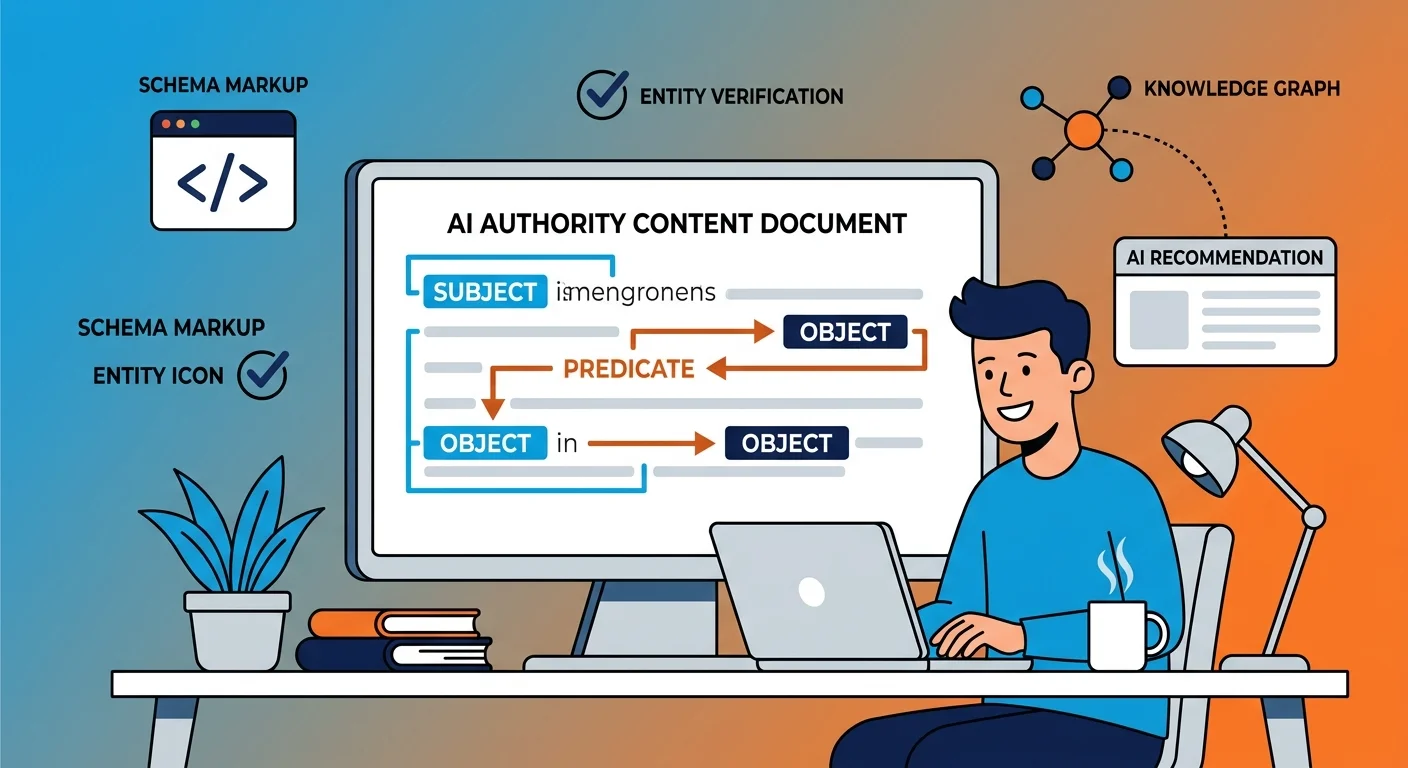
Understanding triplets is the easy part. Writing them is where most businesses fall apart.
That gap – theory versus execution – is where AI authority either compounds or dies quietly. Most businesses land on the wrong side and never know why.
The shift from document-centric writing to machine-readable semantic architecture is already happening. Most content produced during that transition still reads like a brochure – narrative warmth, zero relational structure.
Back to the courtroom analogy. A compelling opening statement isn’t a verdict. Evidence is. Triplets are the evidence. Without them, you’re presenting atmosphere to a machine that only weighs facts.
So the question stops being "what is a triplet" and becomes "how do I write one."
The answer is more mechanical than creative. That’s the point. Triplet-structured writing is a discipline – every sentence either earns a node or it doesn’t.
Writing Sentences That Function as Semantic Nodes
A sentence functions as a semantic node when it contains a clear Subject, a specific Predicate, and a concrete Object. That’s the entire test.
Strip the qualifiers. Strip the hedges. Strip the narrative wind-up. What’s left should be a claim an AI engine can parse, store, and verify.
Here’s the thing: the difference between a node and filler isn’t length. It’s relational density.
"Dr. Chen has extensive training" is a sentence. "Dr. Chen performs dry needling therapy for chronic myofascial pain" is a node. One gives an AI engine a subject. The other gives it a Subject, a Predicate, and an Object it can cross-reference against a knowledge graph. That distinction is the entire game.
Research published through the National Institutes of Health confirms it: structuring relational inputs as semantic triplets increases natural language processing parsing efficiency in neural networks compared to unstructured prose blocks. That efficiency gap is exactly why AI authority articles outperform conventional blog content at every stage of the recommendation process – not because they’re longer, but because they’re structurally legible to machines.
The sentence is the unit of authority. Build each one like the node it needs to be – or accept that you’re producing content an AI engine can’t cite, store, or trust.
Where Triplets Belong in Your AI Authority Content
Triplets belong everywhere a machine might scan for entity data. Front-loaded in every section. Inside every service claim. Inside every credentialing statement your authority content makes.
Not buried in paragraph three. Not softened with qualifiers. AI engines scan from the top and stop when they find what they need. Give it to them first.
The National Institutes of Health confirms that knowledge graphs verify relational trust networks between entities and their services. But that verification only works if the relational claim exists in the content to begin with.
If a practice’s core service isn’t stated as a Subject-Predicate-Object node – clearly, prominently, up front – the knowledge graph has nothing to verify. The recommendation never happens. Placement isn’t a formatting preference. It’s a prerequisite.
The goal isn’t to turn every sentence into a database entry. Narrative can carry the connective tissue between nodes. That’s fine.
But the core identity claims, service statements, and credentialing facts have to be triplet-structured. Every time. Without exception. Every piece of AI authority content is either building a verifiable entity profile or producing noise. There is no third option.
| Content Zone | Triplet Type to Deploy | Example Subject | Example Predicate | Example Object |
|---|---|---|---|---|
| Service Introduction | Identity Anchor | Practice name or practitioner | provides / offers / delivers | Specific service or treatment modality |
| Credential Statement | Authority Validator | Practitioner name or title | is certified in / holds licensure for / is trained in | Named credential, specialization, or governing body |
| Condition-to-Service Bridge | Intent Mapper | Named patient condition or symptom | is treated with / is addressed through / responds to | Specific clinical method or protocol |
| Geographic Claim | Location Node | Practice name | serves / operates in / is located in | Defined city, metro area, or service region |
| Outcome Statement | Result Anchor | Service or treatment type | produces / supports / enables | Specific patient outcome or functional improvement |
| Entity Relationship | Trust Connector | Practitioner or practice | is affiliated with / partners with / is credentialed by | Professional association, institution, or accrediting body |
Frequently Asked Questions
Here are the questions that come up every time this conversation moves from theory to execution. Each one has a direct answer.
No hedging. No ‘it depends.’ The only variable is whether your entity profile is built to receive the verdict AI engines are already rendering.
What are semantic cohesion triplets?
Semantic cohesion triplets are structured content units built on the Subject-Predicate-Object model – the same relational logic knowledge graphs use to store and verify entity data. Each triplet makes one clean, parseable claim: who a business is, what it does, or what it’s credentialed to deliver.
That structure is what separates a sentence an AI engine can cite from one it skips entirely. Roughly 90% of US adults now interact with AI recommendations in their daily lives, according to Pew Research Center. The entities those engines surface aren’t the ones with the best prose. They’re the ones whose content was built as verifiable nodes.
Why do AI answer engines prioritize triplets over paragraphs?
Paragraphs are written for humans. Triplets are written for machines – and AI answer engines are machines running knowledge graph lookups, not reading comprehension passes.
Structuring relational inputs as semantic triplets increases natural language processing parsing efficiency in neural networks compared to unstructured prose blocks. That efficiency gap is decisive. An AI engine parsing a paragraph has to infer the Subject, guess the Predicate, and extract the Object from surrounding context. A triplet hands it all three.
The engine doesn’t reward effort. It rewards parseable structure. Triplets are parseable. Paragraphs, on their own, are not.
How do triplets build entity trust in knowledge graphs?
Each triplet-structured claim adds one verified connection to a knowledge graph: this entity performs this service in this domain. That’s how entity trust gets built – one relational node at a time.
Stack enough of those connections and the graph has something it can stake a recommendation on. A single triplet is a data point. A body of triplet-structured authority content is a case.
AI engines rule on the weight of the case. Not the volume of the content.
What happens if my content has weak entity signals?
Weak entity signals mean the knowledge graph has nothing to verify. And an AI engine that can’t verify won’t recommend.
This isn’t a future risk. Gartner projects a 25% drop in traditional search engine volume by 2026 as conversational AI displaces the old list. That shift isn’t slowing. Every month a business produces unstructured prose instead of triplet-structured authority content, a competitor with cleaner entity signals compounds their lead.
Weak signals don’t get penalized. They get ignored. And being ignored by an AI engine is functionally the same as being invisible.
Can traditional content strategies produce semantic cohesion triplets?
Not by default – and that’s exactly the problem. Traditional content strategies are built around document-centric writing: narrative flow, keyword placement, readability scores. None of that output is triplet-structured unless someone is deliberately building Subject-Predicate-Object nodes into every core claim.
Most content workflows don’t enforce that discipline. So yes, technically any strategy could produce triplets. But without a framework that enforces relational structure at the sentence level, it won’t happen consistently enough to matter.
Intention isn’t architecture. The sentence either functions as a node or it doesn’t.
The Only Structure AI Trusts
Here’s the verdict.
AI engines don’t rank businesses. They rule on them. They pull the knowledge graph, weigh the relational evidence, and name one answer.
The businesses that get named built their entity identity into verifiable Subject-Predicate-Object nodes. The ones that didn’t are generating content no AI engine can cite, trust, or recommend – no matter how much of it exists.
That’s the only structure AI trusts. Not narrative warmth. Not keyword density. Not document volume.
Semantic cohesion triplets. Clean, relational, machine-parseable claims that build a networked entity profile an AI engine can stake a recommendation on.
Every authority article not built this way produces noise. Every one that is built this way adds a node to a compounding trust network – one that gets harder for a competitor to displace with every passing month.
The courtroom doesn’t wait for you to catch up. It renders a verdict on the evidence already in the room.
Right now, AI engines in your market are recommending someone. Either your entity profile gives them enough relational structure to name you – or a competitor’s does. That gap widens every month it goes unaddressed.
AI delivers a verdict, not a list. The only question is whether your name is in it.
AI isn’t building a shortlist. It’s naming one business – and right now, in your market, that verdict is already being rendered.
You either know what it says or you don’t. The AI Visibility Check takes fifteen minutes. It shows you exactly what ChatGPT, Gemini, and Grok say when someone asks who to trust in your space.
If that name isn’t yours – now you know where to start.