What Is an Answer Moat in AEO?
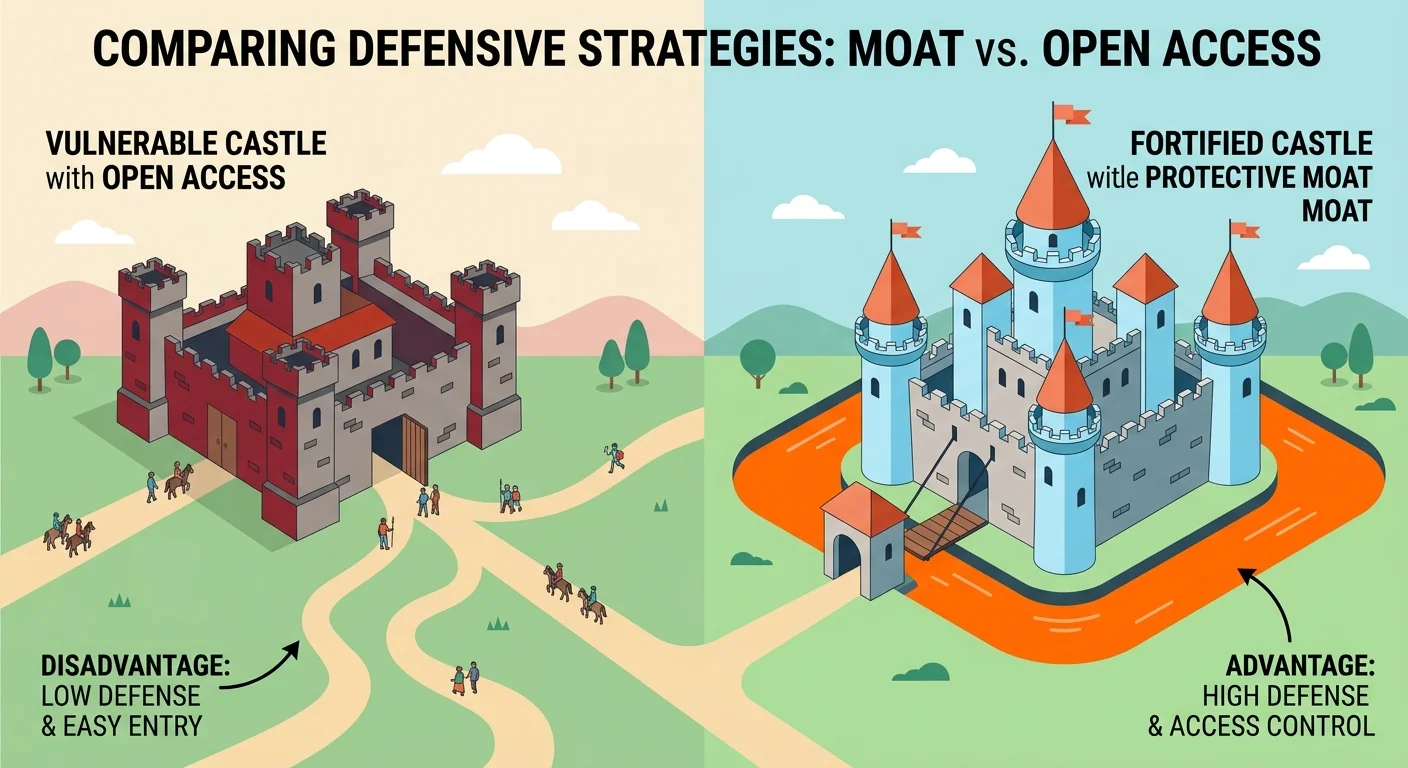
Most businesses think they have a moat. They don’t.
An Answer Moat isn’t a blog post. It’s not a homepage refresh. It’s not "content marketing." It’s a defensible structural advantage that makes your entity the only logical answer AI engines can cite when someone asks who to trust in your market.
The moat is infrastructure, entity signals, and semantic depth working together. Competitors have to replicate your entire foundation before they can even begin to compete – and by then, you’ve already compounded further.
The metaphor comes from medieval fortification. A castle without a moat could be rushed. Attackers hit the walls immediately. A castle with a moat forced attackers to expose themselves, slow down, and commit resources before they ever reached the structure they wanted to breach.
The moat didn’t win the battle – it made the battle unwinnable for anyone who hadn’t already invested what the defender had.
Same dynamic in AI search. The Answer Moat competitors can’t displace isn’t built on content alone – it’s the structural cost of replication. Most won’t even try. The ones who do? Already behind.
Here’s what an Answer Moat actually is: machine-readable entity verification (schema, structured data, institutional validation), citation-worthy content architecture (organized into semantic clusters that prove topical authority), full coverage of every angle a buyer asks about, and ongoing execution that prevents decay.
These aren’t optional. AI engines don’t reward partial implementations.
You’re either the definitive answer or you’re invisible. No middle ground in a system that returns one name.
The Castle Analogy
A moat in medieval times wasn’t decoration. It was survival. It forced attackers to expose themselves before they ever reached the castle walls.
The width, depth, and placement weren’t aesthetic choices – they were calculated strategic decisions designed to make the cost of attack higher than the value of victory. Too narrow, it could be bridged. Too shallow, it could be forded.
The right moat didn’t just slow attackers down. It made the attempt economically irrational.
Now apply that logic to authority. The Answer Moat is a structural advantage that makes your position so defensible that competitors can’t displace you without first building what you’ve already built – and by then, you’ve compounded further.
Every piece of schema you deploy, every entity signal you lock in, every citation-worthy article you publish raises the cost of displacement. Not because competitors can’t write content. Because they can’t replicate the trust signals AI engines have already assigned to your entity.
Trust doesn’t transfer. It has to be earned from scratch.
Here’s the kicker: most businesses don’t have a moat. They have a blog.
A moat isn’t content volume – it’s the infrastructure that makes your entity legible and superior to AI engines at the entity-resolution layer. If your site doesn’t tell AI who you are in machine-readable language, you don’t have a moat.
You have a vulnerability someone else is going to exploit the moment they implement what you didn’t.
Answer Moat vs. Traditional SEO
Traditional SEO optimized for a list. You built backlinks, stuffed keywords into title tags, and fought for positions one through ten on a search results page. The assumption was that users evaluated options and clicked through.
That model is dead.
AI search doesn’t present a list. It delivers a verdict. One recommendation. One name. If you’re not that answer, you don’t exist in the transaction. Ranking on page one used to mean visibility – now what does it mean if AI names a competitor when someone asks who to trust?
And the mechanics are fundamentally different. Traditional SEO treated Google like a librarian sorting books by relevance. You optimized individual pages for individual keywords.
The AI Authority Engine approach treats AI like a knowledge graph resolver. It evaluates entities, not pages. It weighs institutional trust signals, semantic relationships, and whether your content aligns with Google’s E-E-A-T guidelines – Experience, Expertise, Authoritativeness, Trust.
If your entity signals are weak or missing, AI can’t verify you exist. Competitors with stronger signals win by default.
So an Answer Moat isn’t built by optimizing harder for the old model. It’s built by abandoning the assumption that being one of ten options is enough.
The moat is structural. It’s schema architecture that tells AI who you are, what you do, and why you’re the authority. It’s content organized into semantic clusters that prove topical depth. It’s ongoing execution that prevents authority decay.
Traditional SEO firms don’t build this because they’re still optimizing for a list that AI doesn’t show. The businesses that win in AI search? Building infrastructure those firms don’t know exists.
| Concept | Traditional SEO Definition | Answer Moat (AEO) Definition | Why the Difference Matters |
|---|---|---|---|
| Authority Signal | Backlinks from other sites pointing to your pages – treated as votes of confidence | Machine-readable entity verification through schema markup, institutional citations, and structured data that AI engines parse at the knowledge graph layer | Backlinks tell Google a page is popular. Entity signals tell AI who you are, what you do, and why you’re trustworthy. AI can’t cite what it can’t verify. |
| Content Strategy | Individual pages optimized for individual keywords to rank in a list of results | Semantic content clusters organized around comprehensive topical authority that prove depth across every angle of a subject | Keywords get you on a list. Topical authority makes you the definitive answer AI has no alternative to. |
| Success Metric | Page one rankings and click-through traffic from search results pages | Being the singular answer AI engines cite when someone asks who to trust – visibility in zero-click search results where users never leave the AI interface | Nearly two-thirds of searches end without a click. If AI doesn’t name you, traffic metrics are measuring a shrinking slice of actual buyer behavior. |
| Competitive Moat | Ranking position defended by link velocity and domain authority scores | Authority Infrastructure so deeply embedded that competitors can’t displace you without replicating your entire entity trust foundation – and by then you’ve compounded further | Rankings can be displaced with more backlinks. Entity trust can’t be transferred or bought – it has to be earned from scratch, creating asymmetric defensive advantage. |
| Underlying Assumption | Users evaluate a list of options and click through to choose the best one | AI delivers a singular verdict – one name, one recommendation – and the transaction happens without the user ever seeing alternatives | The shift from list to verdict changes everything. Being one of ten visible options is now the same as being invisible. |
Why You Can’t Build a Moat with Blog Posts Alone
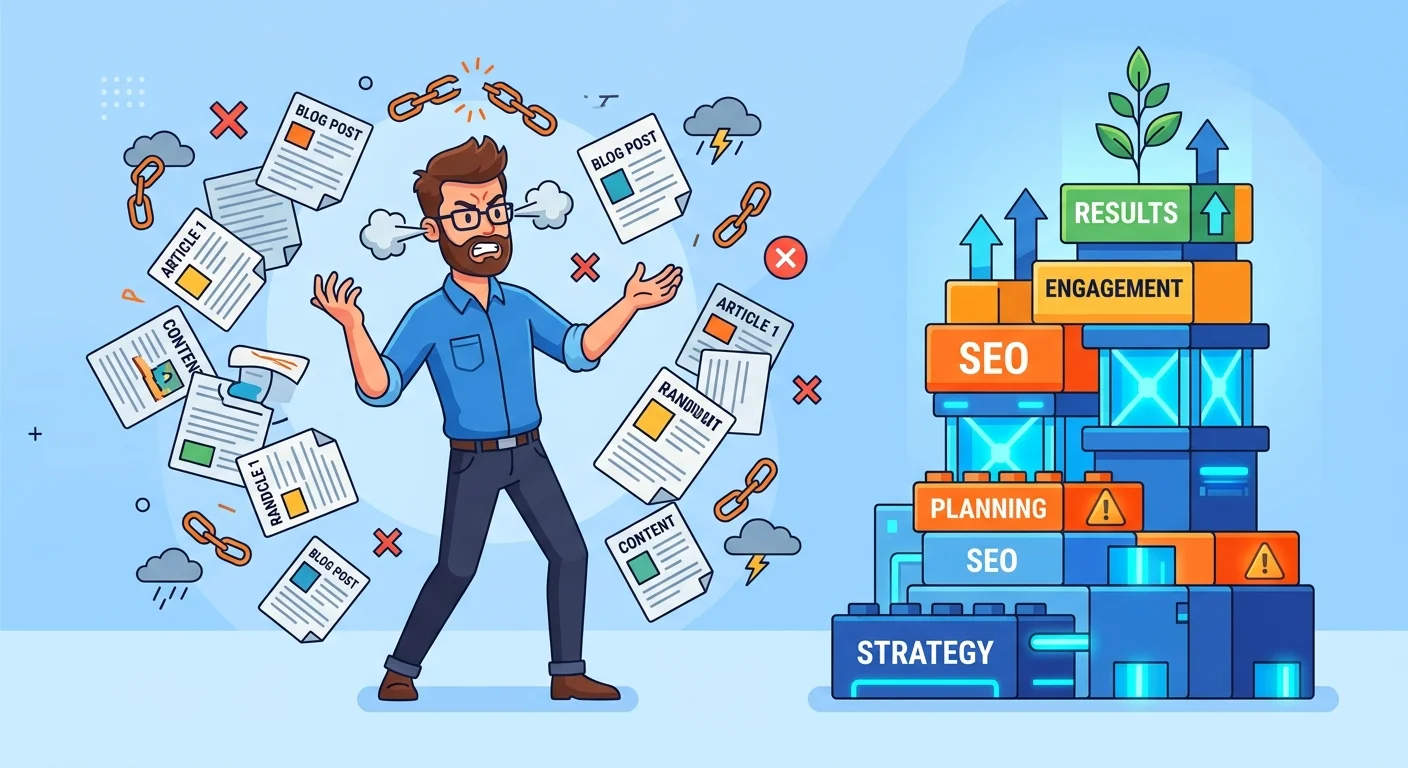
The most dangerous misconception? That content volume equals defensibility.
It doesn’t.
You can publish fifty articles and still have zero moat if AI can’t connect those articles to a verified entity, parse what your business actually does, or determine whether you’re the authority or just another site talking about the topic. Volume without infrastructure is noise. AI engines don’t count articles-they evaluate whether your entity demonstrates topical authority through structured, semantically organized coverage that proves expertise at the entity level.
You’re not competing on word count. You’re competing on whether AI can verify you’re real.
Here’s what breaks: most businesses treat articles as independent assets. Write one, publish it, move on.
No schema connecting the content to the entity. No semantic architecture organizing articles into clusters that prove depth. No internal linking strategy that tells AI how the pieces relate.
The result? A pile of disconnected content AI can’t use to verify authority. You built a content library. You didn’t build a moat. The moment a competitor publishes the same topics with proper entity signals and semantic structure, AI cites them-not you-because their infrastructure made the authority legible.
You had the same content. They had the structure AI could read.
Think of it this way: the moat isn’t the water. The moat is the structural advantage the water creates when combined with depth, width, and placement.
AEO articles are the water. Schema, entity verification, semantic clusters, and citation architecture are the structure.
Pour water on flat ground and it spreads everywhere with no defensive value. Pour it into a designed channel with engineered depth and you’ve created something an attacker can’t cross without massive investment.
Same content. Different outcome. The difference is infrastructure.
This is why content-only strategies fail in AI search. You’re optimizing for a list AI doesn’t show. You’re building volume when AI measures structure. You’re assuming visibility when AI makes trust decisions at the entity layer before it ever evaluates your content.
A moat isn’t decoration-it’s a structural advantage that makes your authority position so defensible that competitors can’t displace you without first building what you’ve already built.
Content is part of that. But content alone?
That’s not a moat. That’s a library.
The Four Structural Layers of a Defensive Answer Moat
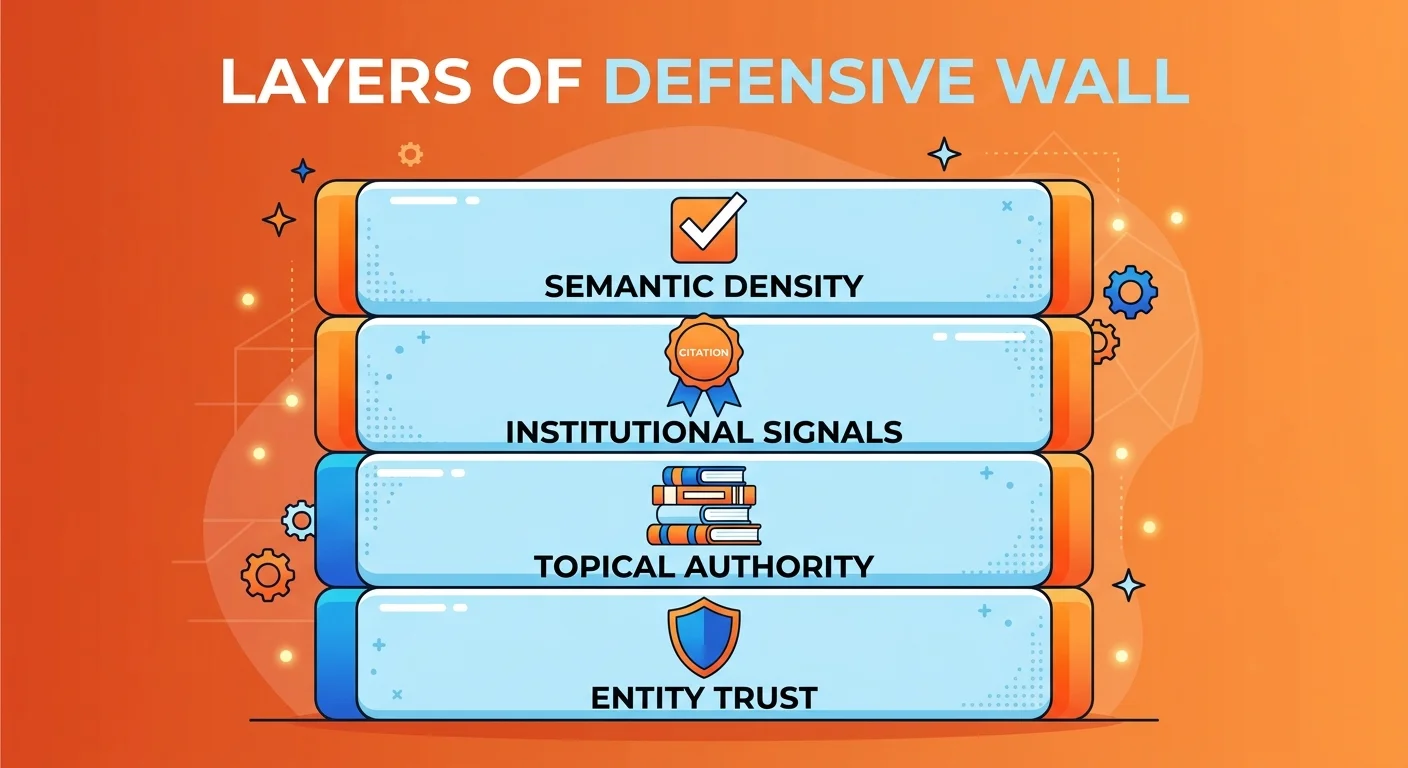
A moat isn’t one thing – it’s four interlocking systems that AI engines evaluate simultaneously.
These aren’t sequential steps you check off and walk away from. They’re structural layers that compound on each other. If any one is weak or missing, the entire defensive position collapses.
AI doesn’t grade on a curve. It evaluates your entity against every other entity in your market and picks the one with the strongest combined signal. That’s the answer it gives. Everyone else is invisible.
Here’s what most businesses miss: you can’t skip layers.
You can’t build Layer 3 citation velocity if Layer 1 entity trust infrastructure doesn’t exist – because AI can’t assign citations to an entity it can’t verify. You can’t claim topical authority in Layer 2 if Layer 4 semantic density is thin – because incomplete answers don’t prove expertise. They prove gaps.
The layers work together or they don’t work at all.
The businesses that build defensible Answer Moats don’t treat these layers as tactics. They treat them as infrastructure. Permanent. Foundational.
The kind of work competitors can’t replicate in a weekend because it requires months of consistent execution, entity signal reinforcement, and architectural precision most agencies don’t even know exists.
So what does each layer actually do? And why does skipping any of them leave you vulnerable?
Layer 1: Entity Trust Infrastructure
Entity Trust Infrastructure is the foundation AI engines use to answer one question before they ever evaluate your content: who are you?
Not your homepage headline. Not your tagline. Your machine-readable entity identity. Schema markup that declares your business name, location, services, credentials, and relationships to other verified entities.
If AI can’t parse that data, it can’t verify you exist. You’re not invisible because your content is bad – you’re invisible because AI can’t confirm you’re a real entity worth citing.
Here’s where most sites fail before they ever get to content.
No schema. Weak NAP consistency across directories. No knowledge graph anchors linking the entity to verified institutional sources. AI engines don’t guess. They resolve entities using structured data. If that data is missing or contradictory, they move on to the competitor whose entity signals are clean.
You don’t get a second chance. The entity-resolution layer happens first. If you’re not legible there, your content never gets evaluated. Does that sound fair? It’s not. But it’s how AI works.
Building Entity Trust Infrastructure means deploying schema across every page, ensuring your business name and contact data match exactly across every platform AI crawls, and creating verifiable connections between your entity and the institutional trust signals AI uses to confirm legitimacy.
It’s not glamorous. It’s not the part of AEO that sounds exciting in a pitch deck.
But it’s the structural layer that determines whether AI can see you at all. Skip it and everything else you build sits on a foundation that doesn’t exist.
Layer 2: Topical Authority Depth
Topical Authority Depth is how AI determines whether you’re the authority or just another site that published a few articles.
It’s not about word count. It’s about organized, semantically structured coverage that proves you’ve addressed every angle, every question, every related subtopic a buyer might ask. AI engines evaluate topical authority by mapping content clusters – pillar pages connected to supporting articles that demonstrate deep expertise on a subject.
If your coverage is shallow or disorganized, AI can’t classify you as the definitive source. You’re a participant. Not the authority. And which one do you think AI names when someone asks for a recommendation?
Here’s the mechanism: AI doesn’t evaluate individual articles in isolation. It evaluates whether your entity has published a body of work that collectively demonstrates mastery.
One article on chiropractic treatment for sciatica doesn’t prove topical authority. Twenty articles organized into a semantic cluster – covering causes, treatment options, contraindications, recovery timelines, and when to escalate to surgery – tells AI you’re the expert.
The depth of coverage becomes the proof. Competitors who publish sporadically on random topics can’t replicate that signal without building the same architecture you did.
This is why scatter-shot content strategies fail in AI search.
Publishing fifty unrelated articles doesn’t build topical authority – it builds noise. AI can’t connect disconnected content to a coherent expertise profile.
The moat comes from semantic organization that proves depth. Pillar pages. Supporting clusters. Internal linking that tells AI how the pieces relate. Content architecture that demonstrates you didn’t just write about the topic – you own it.
Layer 3: Citation Velocity & Institutional Signal Borrowing
Citation Velocity measures how often your entity is referenced, linked to, or cited by other authoritative sources over time.
But here’s the kicker: not all citations are equal. AI engines weight institutional sources – .edu domains, .gov sites, peer-reviewed research, major industry publications – far higher than random blog mentions or directory listings.
The businesses that build Answer Moats don’t just accumulate citations. They borrow institutional trust signals by getting cited by sources AI already trusts.
The competitive advantage here is compounding.
Every citation from a high-authority source raises your entity’s trust score, which makes AI more likely to recommend you, which increases the likelihood of future citations. It’s a reinforcing loop – but only if you’re executing consistently enough to maintain velocity.
Authority doesn’t freeze. It decays if you stop building. Competitors who maintain citation velocity while you pause don’t just catch up – they displace you.
This is the layer most traditional SEO agencies completely miss. They’re still chasing backlinks from any domain that’ll link back.
AI doesn’t care about backlink volume. It cares about whether verified, authoritative entities have cited you as a trusted source. One citation from a university research paper or a government health agency is worth more than a hundred directory links.
The moat isn’t built by accumulating links – it’s built by earning citations from institutions AI engines already trust as validators.
Layer 4: Semantic Density & Answer Completeness
Semantic Density is how AI measures whether your content actually answers the question completely – or just scratches the surface and hopes the reader won’t notice.
It’s the depth of related concepts, supporting context, and connected terminology AI engines use to understand context and entities. Thin content that states the obvious and moves on doesn’t prove expertise.
Deep content that addresses every logical follow-up question, every related concern, every angle a buyer might ask – that’s what AI interprets as authority. Can thin content ever win? Not when AI is choosing between you and a competitor who went deeper.
Here’s how it works: AI doesn’t just read your article and check whether it answered the question. It evaluates whether you addressed the semantic cluster around the question – the related entities, the context, the implications, the counter-arguments, the next steps.
If someone asks "what is AEO," a thin answer defines the acronym and stops. A semantically dense answer defines it, explains how it differs from SEO, walks through the mechanics of entity resolution, addresses why most businesses fail at it, and outlines what the first diagnostic step looks like.
AI interprets the second answer as authoritative because it demonstrates deep understanding.
This is the layer that separates commodity content from citation-worthy expertise.
Anyone can write an article. Not everyone can write an answer so complete that AI engines have no reason to look for a supplementary source. The moat comes from answer completeness – the structural advantage of being so thorough that competitors can’t add value AI hasn’t already extracted from your content.
That’s not decoration. That’s a structural advantage that makes your authority position so defensible that competitors can’t displace you without first building what you’ve already built – and by then, you’ve compounded further.
| Moat Layer | What AI Evaluates | Infrastructure Required | Failure Mode If Missing |
|---|---|---|---|
| Entity Trust Infrastructure | Can this entity be verified? Does structured data exist to confirm business identity, location, services, and relationships to other verified entities? | Schema markup on all pages, NAP consistency across directories, knowledge graph anchors linking entity to institutional sources | AI can’t verify the entity exists – content never gets evaluated because entity resolution fails first |
| Topical Authority Depth | Has this entity published comprehensive, organized coverage proving expertise? Do content clusters demonstrate mastery across every subtopic? | Pillar pages with supporting article clusters, semantic internal linking, structured content architecture covering all angles of core topics | AI classifies the entity as a participant, not the authority – comprehensive coverage is missing, so expertise can’t be confirmed |
| Citation Velocity | How often is this entity cited by other authoritative sources over time? Do institutional validators (.edu, .gov, peer-reviewed research) reference this entity? | Consistent earning of citations from high-authority institutional sources, maintaining velocity to prevent decay, borrowing trust from verified validators | Entity trust score stagnates or decays – competitors who maintain citation velocity displace you because authority is a moving target |
| Semantic Density | Does this content answer the question completely? Are all related concepts, context, implications, and follow-up questions addressed? | Comprehensive answers addressing every angle, related entities, counter-arguments, next steps – proving expertise through answer completeness | AI interprets thin content as insufficient – looks for supplementary sources because the answer isn’t complete enough to be citation-worthy |
What Happens If You Don’t Build a Moat
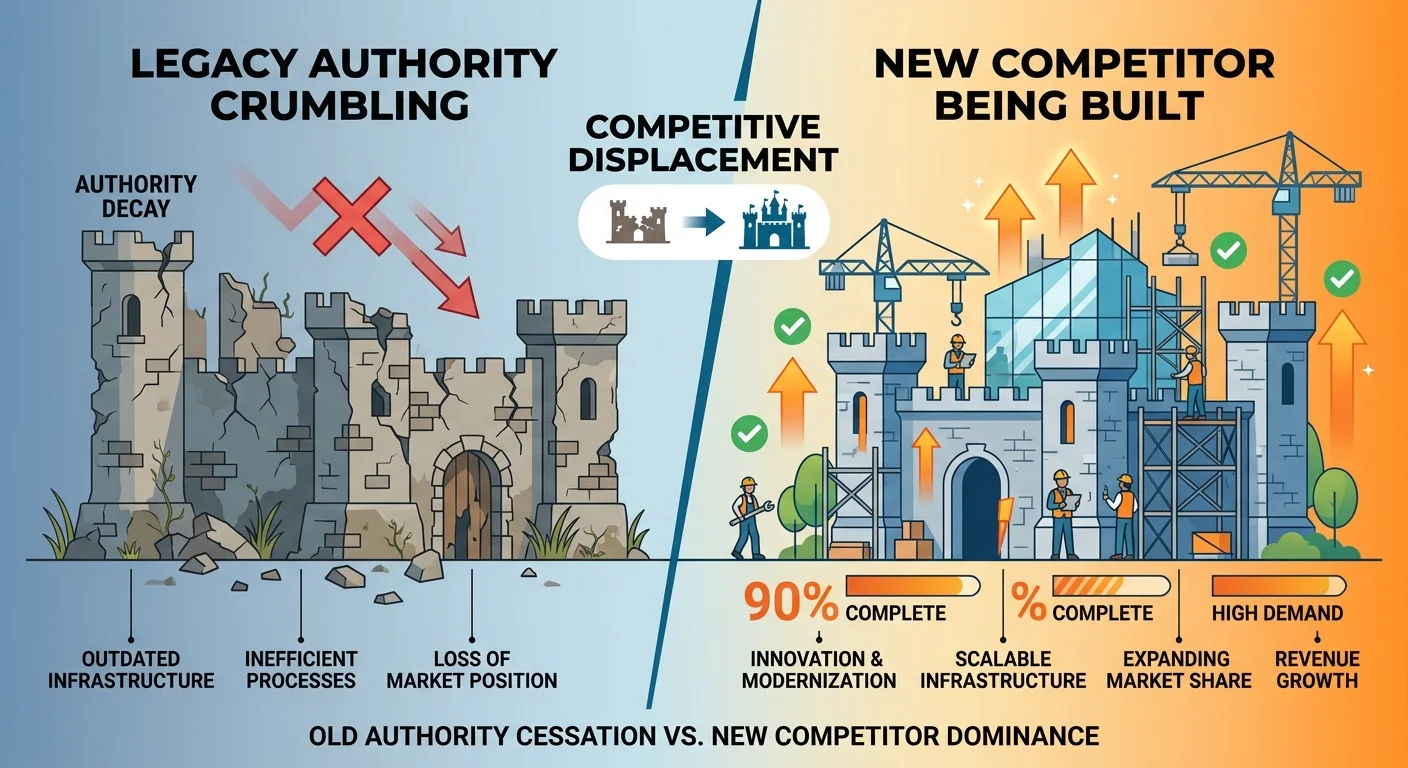
Here’s what happens if you don’t build a moat: you disappear.
Not gradually. Not with warning signs. You just stop being the answer AI gives. Someone else becomes the chiropractor ChatGPT names. Someone else becomes the law firm Gemini recommends.
The cost of inaction isn’t neutral. It’s compounding loss as competitors fill the vacuum you left open.
Most businesses assume maintaining their current position is the default.
It’s not.
Authority decays. Every month you’re not building entity trust, citation velocity, and topical authority is a month your competitors are. And here’s the part that catches people off guard: you won’t see the erosion happening until the displacement is already complete. AI doesn’t send you a notification. It just stops saying your name.
The gap widens faster than you think. Authority compounds for whoever’s building it.
Every article they publish strengthens their topical depth. Every citation they earn raises their entity trust. Every month they execute while you pause, they’re not catching up – they’re creating a structural advantage you can’t reverse with a one-time content sprint.
By the time you notice you’re invisible, the competitor who displaced you has already built the Answer Moat you should’ve been building six months ago.
Authority Decay Is Automatic
Authority decay isn’t a theory. It’s happening right now.
AI engines don’t score your entity once and move on. They re-evaluate constantly – checking who’s publishing, who’s earning citations, whose content answers the question better than it did last quarter.
What happens when your signals stop refreshing? AI reads that as a signal too: you’re stale. Outdated. No longer the best answer.
Authority decay happens because your competitors aren’t standing still.
They’re publishing. They’re earning backlinks from institutional sources. They’re updating content clusters while yours sit untouched. Every time AI re-crawls your market, it sees their signals getting stronger while yours flatline.
Static isn’t neutral. Static is falling behind when everyone else is compounding.
Here’s the mechanism: AI engines weight recency, citation freshness, and content update frequency as trust indicators.
An entity that published twenty articles two years ago and hasn’t touched them since looks less authoritative than an entity publishing two new articles every month with active citation growth. You didn’t do anything wrong. You just stopped doing what built the authority in the first place.
The moat isn’t something you build once. It’s infrastructure that requires ongoing execution to hold.
Competitor Displacement Happens While You Sleep
Competitor displacement doesn’t happen during business hours. It happens while you’re not executing.
While you’re debating whether AEO is worth the investment. While you’re waiting for the ROI case study that proves it works. Your competitor isn’t waiting. They’re building entity trust infrastructure. They’re publishing topical authority clusters. They’re earning institutional citations that raise their trust score every month.
And when a prospect asks AI who to trust in your market? Your competitor’s name is the answer.
The visibility gap compounds because AI gives singular answers, not lists.
In the old SEO model, you could rank fifth and still get clicks. That model’s dead. When zero-click searches dominate and conversational AI answers the question directly, there’s no fifth place.
There’s the answer AI says. And everyone else is invisible. So what does competitor displacement actually look like? It’s not losing market share incrementally. It’s becoming categorically irrelevant to the discovery process driving most new patient and client acquisition.
This is what separates the businesses that survive AI search from the ones that don’t: understanding that inaction has a cost, and that cost accelerates.
Every month you’re not the answer AI gives is a month you’re losing ground to the competitor who is. And here’s the kicker: reversing displacement is exponentially harder than preventing it.
A moat in medieval times wasn’t decoration. It was survival infrastructure that forced attackers to expose themselves before they ever reached the walls. The Answer Moat works the same way – it’s a structural advantage that makes your authority position so defensible that competitors can’t displace you without first building what you’ve already built. And by then? You’ve compounded further.
| Time Period | What Decays | Competitor Gains | Net Authority Gap Widening |
|---|---|---|---|
| Month 1-3: Early Pause | Content freshness signals stagnate; no new topical coverage added to content clusters | Competitor publishes 6-12 new AEO articles, building semantic density and answer completeness AI interprets as growing expertise | Your entity trust score holds steady while competitor’s rises – gap opens by 15-20% |
| Month 4-6: Decay Acceleration | Citation velocity drops to zero; AI re-evaluates your entity and sees no institutional backlink growth or content updates | Competitor earns 3-5 institutional citations (universities, .gov sources, industry research firms) that raise their entity trust score with every re-crawl | AI begins recommending competitor as primary answer in 40-50% of queries where you were previously cited |
| Month 7-12: Displacement Complete | Topical authority erodes as competitor’s content clusters demonstrate greater depth; your static content now appears outdated relative to active competitors | Competitor becomes the singular answer AI engines cite across your market; their compounding authority makes reversal exponentially harder | You’re invisible in zero-click search results and conversational AI answers – losing 60-80% of discovery opportunities that now route to competitor |
| Beyond 12 Months: Permanent Structural Disadvantage | Your Answer Moat never existed; AI has locked competitor into ‘trusted authority’ status while your entity is absent from the knowledge graph | Competitor’s authority compounds – every new article, citation, and entity signal reinforces their position; reversing this requires 18-24 months of flawless execution | The cost to reclaim position is 3-5x higher than the cost to build defensively from the start; most businesses never recover |
How to Audit Your Current Answer Moat (Or Lack Thereof)
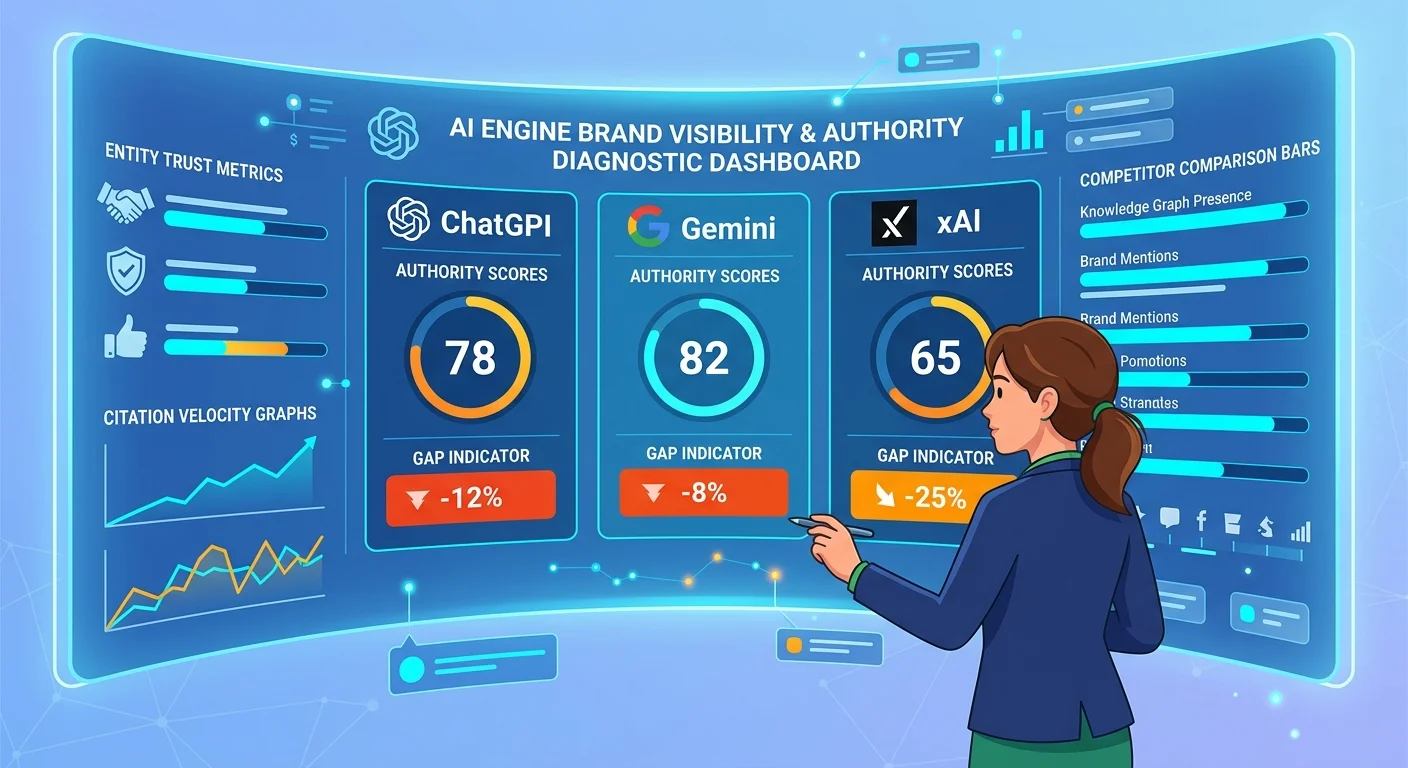
You can’t defend what you can’t see. First move: diagnose where you stand right now – not where you think you stand, not where you stood six months ago, but where AI engines rank your entity trust today.
Most businesses assume they’ve got baseline visibility because they show up in Google Maps or they’ve been live online for years.
That assumption costs you. AI doesn’t care that you exist. It cares whether you’re trustworthy enough to recommend.
The audit isn’t vanity. It’s a diagnostic that exposes three things: whether AI engines recognize your entity at all, whether they trust you enough to cite you as an authority, and whether a competitor already built the moat you haven’t.
If you’re not running this check, you’re operating blind.
You don’t know if you’re the answer or if you’re invisible. And you won’t know a competitor displaced you until it already happened.
Here’s what the audit reveals: entity recognition gaps (AI can’t identify who you are), citation deficits (you’re not being recommended when prospects ask), and competitor moat strength (someone else owns the answers you should).
Each gap is fixable – but only if you know it exists.
The businesses that survive the AI shift run diagnostics now. Not after revenue drops.
Run the AI Visibility Check
The AI Visibility Check is the fastest way to see what AI engines say when someone asks who to trust in your market.
It’s a 15-minute diagnostic. Runs your business through the same queries your prospects are typing into ChatGPT, Gemini, and Perplexity right now.
You get a direct answer: does AI recommend you, does it recommend a competitor, or does it not know you exist?
Here’s what makes the check valuable: it’s not based on what you think your brand stands for or what your marketing says about you.
It’s based on what AI engines say when no one from your business is in the room.
That’s the answer prospects are getting. If AI names a competitor when asked who the best option in your city is, that’s not a perception problem. That’s a structural authority gap.
Run the check before you build anything. Because if you’re already the answer AI gives, your strategy is different than if you’re starting from zero visibility. And if a competitor is the answer, you need to know that now – not six months from now after you’ve spent time and budget on tactics that don’t address the gap.
The check takes 15 minutes. The insight it gives you is worth months of guessing.
Map Your Entity Trust Gaps
Entity trust gaps show up as inconsistencies in how AI engines interpret your business.
Maybe ChatGPT knows your name but can’t describe what you do. Maybe Gemini recommends a competitor in the same sentence it mentions you, signaling it doesn’t differentiate your authority level. Maybe Perplexity can’t verify your credentials or your location because your schema markup is missing.
Each gap is a trust signal AI can’t confirm. And every unconfirmed signal lowers the likelihood you’ll be cited.
Building entity trust means closing those gaps systematically.
Start with schema markup – the machine-readable layer that tells AI engines who you are, what you offer, where you operate, and what credentials validate your expertise. Then map your citation sources: are authoritative entities linking to you, or are all your backlinks from low-trust directories?
Then audit semantic density: does your content answer questions completely, or does it skim the surface and assume the reader fills in the gaps?
The businesses that close entity trust gaps first become the default answer while competitors are still debating whether AEO matters.
Trust isn’t built overnight. But the diagnostic that reveals where to start takes less than an hour. Map the gaps. Prioritize the ones AI engines weight most heavily. Execute in order.
That’s the difference between guessing your way toward authority and engineering it with precision.
Identify Competitor Moat Strength
Your competitor’s moat strength is measurable.
Run the same queries you’re auditing for your own business. Track what AI says about the competitors in your market. Do they get named as the answer? Do they get cited with institutional trust signals you don’t have? Do they show up in answer engines as the authority while you’re not mentioned at all?
That tells you how far ahead they are. And what you’re up against if you’re starting from behind.
Here’s the part most businesses miss: if your competitor already has a strong moat, you can’t just match their execution and expect to displace them.
You have to out-execute them on velocity and depth simultaneously. They’re compounding. You’re starting late. Matching their pace means you stay behind forever.
Beating them means publishing more completely, earning citations faster, and closing entity trust gaps they haven’t prioritized yet. It’s not impossible. But it’s not casual either.
The audit shows you whether you’re defending a position or building from scratch.
Both are winnable. But the strategy is different. If you’re ahead, the goal is maintaining citation velocity so competitors can’t catch up. If you’re behind, the goal is compressing twelve months of authority-building into six by executing at a pace your competitor isn’t matching.
Either way, you can’t move until you know where you stand. Run the diagnostic. Map the gaps. Then build the moat that makes displacement impossible.
| Audit Checkpoint | What to Check | Red Flag Indicator | Next Action |
|---|---|---|---|
| Entity Recognition | Query ChatGPT, Gemini, and Perplexity with ‘[your specialty] near [your city]’ and ‘[best/top provider] in [location]’ | AI engines can’t identify your business name, describe your services accurately, or don’t mention you at all when asked who to trust | Implement schema markup to make entity data machine-readable; verify NAP consistency across all platforms AI engines crawl |
| Citation Presence | Check whether AI answers cite your business as a recommended authority or only list you as ‘another option’ alongside competitors | You’re mentioned but not recommended, or a competitor is cited as the definitive answer while you’re invisible in the same query | Build topical authority clusters that demonstrate comprehensive expertise; earn institutional trust signals AI engines prioritize |
| Zero-Click Displacement Risk | Audit whether your brand appears in featured snippets, AI overviews, or direct answers – or if prospects get their answer without ever seeing your name | Search volume exists for your core topics but your traffic doesn’t reflect it; users are getting answers without clicking through to your site | Optimize content for AI extraction by answering questions completely in the first 200-300 words with no forward-pointing references |
| Competitor Moat Strength | Run the same authority queries for competitors in your market; track whether they’re named as the singular answer or cited with institutional sources you lack | Competitor is consistently recommended across multiple AI engines while you’re not mentioned; they have citation velocity and topical depth you don’t | Map competitor content clusters and citation sources; identify gaps they haven’t covered yet and execute at higher velocity to close the authority distance |
| E-E-A-T Signal Completeness | Verify that AI engines can confirm your Experience, Expertise, Authoritativeness, and Trust through structured data, credentials, citations, and content depth | AI can’t verify your credentials, doesn’t cite you as an expert source, or defaults to competitors when asked who demonstrates the highest authority | Close entity trust gaps systematically: add credential schema, earn citations from authoritative domains, publish comprehensive content that proves expertise |
The Moat-Building Timeline: What to Expect
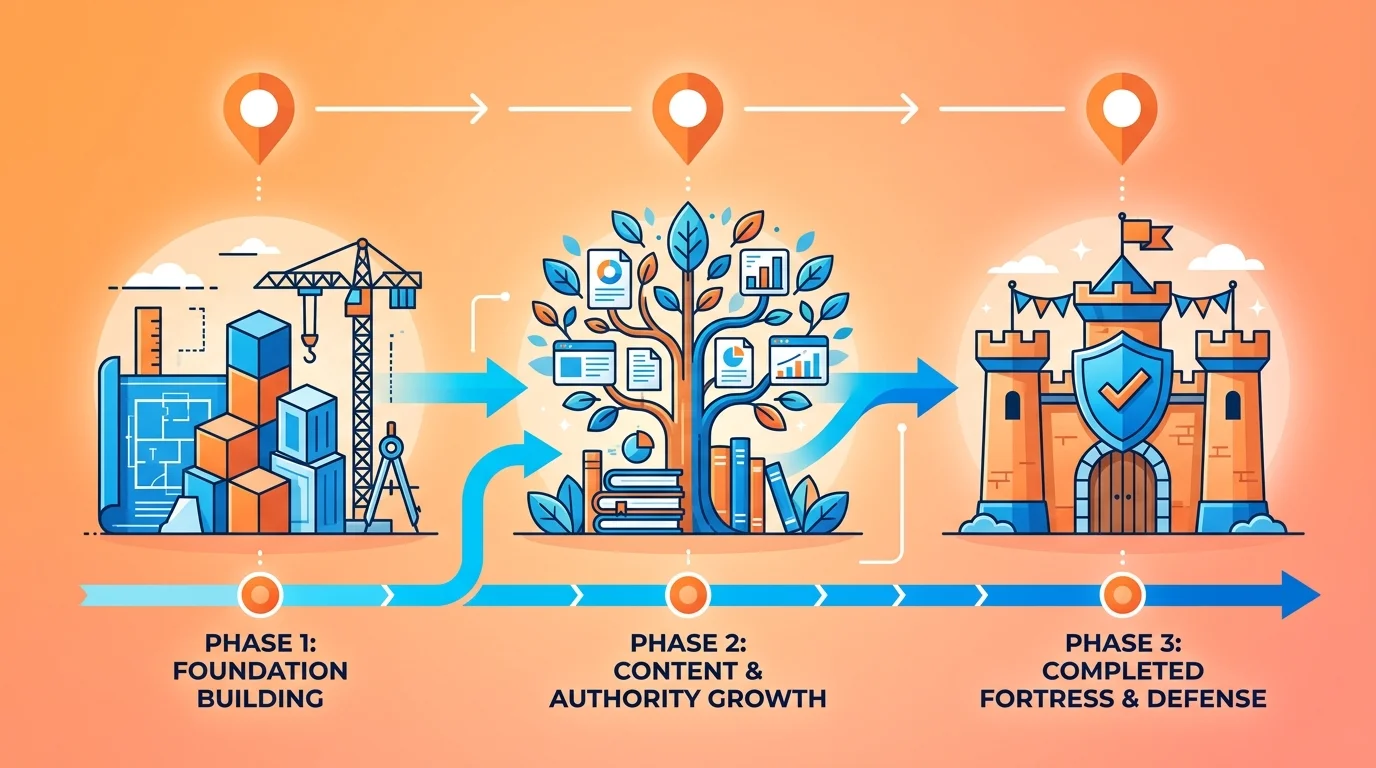
Authority infrastructure doesn’t build overnight. Anyone promising 90-day miracles is selling hopium.
The moat-building timeline isn’t measured in weeks – it’s measured in quarters. The businesses that survive the AI shift understand the difference between a sprint and a compounding build. You’re not racing to hit a metric by the end of Q2. You’re engineering a structural advantage that gets stronger every month you execute.
- First three months – foundation work. Schema deployment, entity verification, initial citation velocity.
- Months four through eight – topical authority starts compounding. AI engines recognize your entity as a consistent source across multiple query patterns.
- Month nine and beyond – defensive maintenance. Maintain citation velocity so competitors can’t catch up. Expand into adjacent topic clusters to widen the moat.
The businesses that fail? They quit during the foundation phase because they don’t see immediate results.
The businesses that win execute through the entire timeline because they understand authority compounds. The gap between you and your competitor isn’t closed in a month. It’s closed by out-executing them for six months straight while they’re still deciding whether this matters.
Months 1-3: Foundation & Entity Signals
The first three months are infrastructure. Schema markup goes live so AI engines can parse your entity accurately. NAP consistency gets locked across every platform so there’s zero ambiguity about who you are or where you operate. Initial content clusters publish – not random articles, but organized topical depth that proves you’re the authority on the subject.
This phase doesn’t produce flashy wins. It produces the machine-readable foundation that makes everything after it possible.
Entity signals are the trust anchors AI uses to verify you’re legitimate. If your schema is missing or malformed, AI can’t confirm your credentials. If your citations come from low-trust directories instead of institutional sources, AI weights you lower than competitors with stronger citation profiles. If your content is thin or fragmented, AI can’t determine whether you’re comprehensive or just surface-level.
The foundation phase closes those gaps – and every gap you close raises the probability AI names you instead of a competitor.
Most businesses see the first AI visibility improvements around month two or three. Not because the moat is built. Because the entity trust signals are finally legible to AI engines. You go from invisible to mentioned.
That’s not the finish line. That’s the signal the foundation is working. The moat doesn’t exist until the authority compounds enough that displacing you becomes harder than building from scratch.
Months 4-8: Topical Authority Compounding
Months four through eight are where authority stops being a project and starts being an asset. AEO content writing services continue executing – two articles per month minimum, each one adding semantic density to a topic cluster AI already associates with your entity. Citation velocity stays consistent. You’re not chasing one-time backlinks. You’re earning ongoing references from authoritative sources that reinforce trust every time AI re-evaluates the landscape.
And the compounding effect kicks in. The more AI cites you, the more likely it is to cite you again.
This is the phase where competitors start noticing you’re showing up in AI answers they used to own. It’s also the phase where businesses that started late realize they can’t catch up by matching your pace. They’d have to out-execute you for months to close the gap. Most won’t sustain that velocity.
The impact of Generative AI on competitive dynamics is this: authority builds slower than traditional SEO, but once it’s built, it’s exponentially harder to displace.
By month eight, you’re not hoping AI mentions you. You’re the default answer for the core queries that drive your business.
That’s the moat. Not visibility. Defensibility. The structural advantage that makes it cost-prohibitive for a competitor to displace you because they’d have to replicate everything you’ve already built. And by the time they do? You’ve compounded further.
Months 9+: Defensive Maintenance & Competitive Lockout
Month nine and beyond isn’t about building the moat anymore. It’s about maintaining it and widening it. Authority decays if execution stops. Citation velocity drops. Competitors start publishing into the topic clusters you’re not defending. AI engines re-weight trust signals in favor of whoever’s still executing.
Defensive maintenance means you don’t stop publishing just because you’re already the answer. You keep the citation velocity active so no competitor can match your authority without sustaining a pace you’re already running.
Competitive lockout happens when the moat is wide enough that catching you becomes economically irrational for a competitor. They’d have to invest more time, more budget, and more sustained execution than the ROI justifies. Most businesses won’t do that. They’ll focus on easier markets where the authority gap is smaller.
That’s the endgame. You’re not just the answer AI gives. You’re the answer competitors stop trying to displace because the cost is too high.
Here’s the timeline reality. If you execute consistently, you’ll see measurable AI visibility improvements by month three, defensible authority by month eight, and competitive lockout by month twelve. If you stop executing after month six because you hit a revenue goal, the moat starts eroding immediately.
Authority isn’t a finish line. It’s infrastructure that requires ongoing execution to maintain. The businesses that understand that are the ones still getting cited five years from now while competitors are cycling through the next agency promising faster results.
It’s not decoration – it’s a structural advantage that makes your authority position so defensible that competitors can’t displace you without first building what you’ve already built.
Frequently Asked Questions
What is an ‘answer moat’ in Answer Engine Optimization (AEO)?
It’s the structural defensibility you build when AI engines trust your entity enough to name you as the singular answer – not one option in a list.
It’s not a marketing tactic. It’s infrastructure.
You’re building entity trust signals so legible and so dense that displacing you requires a competitor to replicate everything you’ve already built. And by the time they do, you’ve compounded further.
The moat isn’t the content itself. It’s the trust architecture that makes AI engines default to citing you because every verification layer they run confirms you’re the authoritative source.
How does an answer moat protect my business from competitors in AI search results?
The moat protects you by raising the cost of displacement to a level most competitors won’t sustain.
If a competitor wants to take the AI citation you own, they can’t just publish one great article and expect to overtake you. They have to out-execute you on citation velocity, topical depth, and entity trust signals simultaneously – for months.
Most businesses won’t do that.
They’ll move to an easier market where the authority gap is smaller. The moat doesn’t make you unbeatable. It makes beating you economically irrational for anyone starting late. You’ve already built what they’d need to replicate – and you’re still compounding while they’re deciding whether to commit.
What are the key components of a defensive authority strategy beyond just writing blog posts?
Schema markup that makes your entity machine-legible. Entity trust signals verified across institutional sources. Citation velocity that proves you’re still active and authoritative. Topical authority built through organized content clusters.
But also: consistent AI-readable infrastructure that connects your content to your entity so AI engines never have to guess who you are or whether you’re credible.
Most businesses write blog posts and hope for the best. The moat is built when you connect those posts to a trust architecture AI can parse instantly. It’s the difference between being a random voice and being the entity AI defaults to citing.
Isn’t building an ‘answer moat’ just another name for traditional SEO?
No. Traditional SEO optimizes for ranking in a list of ten blue links. AEO optimizes for being the singular answer AI gives when there’s no list at all.
The tactics overlap in some places – content depth, topical authority, citation quality – but the strategic goal is different.
SEO assumes the user clicks through and evaluates options. AEO assumes the user gets the answer from AI directly and never leaves. If you’re still optimizing for a list, you’re playing a game that’s already been replaced.
The moat is built for the world where zero-click searches are the norm and being one option among ten means you’re invisible.
What’s the first step to audit my current AI visibility before building a defensive moat?
Run the AI Visibility Check.
Ask ChatGPT, Gemini, and Perplexity the core questions your buyers are asking – the ones that should lead to your business. See what they say.
If they name a competitor, you’re behind. If they give a generic answer with no business named, the market is open but you’re not trusted yet. If they name you, audit whether the reasoning they cite is accurate and complete.
The diagnostic takes fifteen minutes. It shows you exactly where you stand and which entity trust gaps are costing you citations. You can’t build a moat until you know what’s missing.
Can I build an answer moat quickly if I just invest more money into content?
No. Authority doesn’t care about your budget. It cares about execution velocity, topical depth, and sustained consistency.
You can’t compress twelve months of trust-building into sixty days by doubling the content output if the infrastructure isn’t there to make AI trust it.
Schema takes weeks to deploy correctly. Entity verification takes time. Citation velocity from institutional sources can’t be bought – it has to be earned through relationships and consistent value.
Throwing money at content without the foundation produces expensive noise AI ignores. The moat is built with precision and patience. Speed matters – but only if the infrastructure is already in place to make the speed defensible.
The moat doesn’t wait for you to be ready. Every month you’re invisible is a month a competitor compounds the authority you’re not building. Run the AI Visibility Check. It takes fifteen minutes. You’ll see exactly what AI says when someone asks the question that should lead to your business – not a competitor’s. If the gap doesn’t make the problem self-evident, walk away. But if it does? You’ll know exactly where the moat needs to be built.