
Why E-E-A-T Became a Machine-Readable Authority Signal
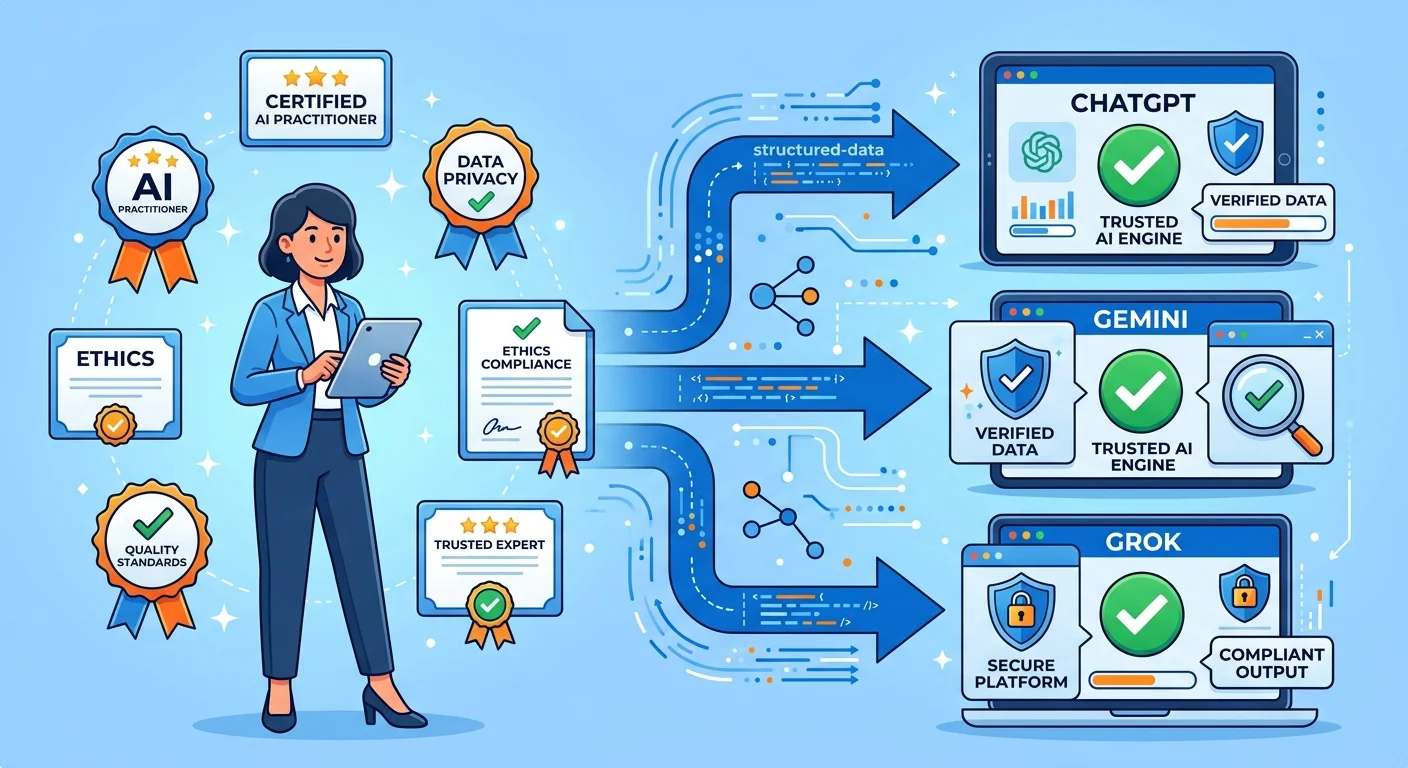
E-E-A-T started as a quality framework for human evaluators. Google’s raters used it to judge whether content was trustworthy. Then AI engines started reading content the same way. They needed to verify who wrote it. They needed credentials. They needed proof those credentials were real.
The shift wasn’t subtle.
What used to be a guideline for humans became a parsing rule for machines. If your credentials aren’t structured as data, AI can’t verify them. If AI can’t verify them, you don’t get cited.
Here’s what changed: Google added Experience to E-A-T, creating E-E-A-T to push content created with demonstrating first-hand experience. That became a machine-readable signal. Trust is the most important member of the E-E-A-T family. It’s the accuracy, honesty, safety, and reliability of the page. AI assesses it using signals like author information, sources, and contact details.
AI engines parse those signals as structured data.
They’re not reading your bio for tone. They’re extracting entities, affiliations, and verification markers. The degree you earned. The institution that granted it. The years you’ve practiced. The licenses you hold. If those aren’t marked up, they don’t exist.
Credentials aren’t decoration anymore. They’re data.
A beautifully written About the Doctor page means nothing if it’s not marked up so AI can parse the degree, the institution, the years of practice, and the specialization. The visual presentation is for humans. The structured data is for machines.
Most practices build for humans and wonder why AI never says their name.
What AI Engines Actually Look For
AI doesn’t read your credentials the way a patient does.
It parses structured signals. It extracts data. It verifies you’re qualified to answer the question.
When ChatGPT or Gemini evaluates whether to recommend your practice, they’re extracting specific data points. Your degree. Your institution. Your years in practice. Your specialization. Your affiliations.
If those signals aren’t machine-readable, they don’t exist.
You can have a wall full of diplomas. If Schema markup isn’t telling AI what those diplomas are, you’re not verifiable. And if you’re not verifiable, you don’t get recommended.
The Four Components
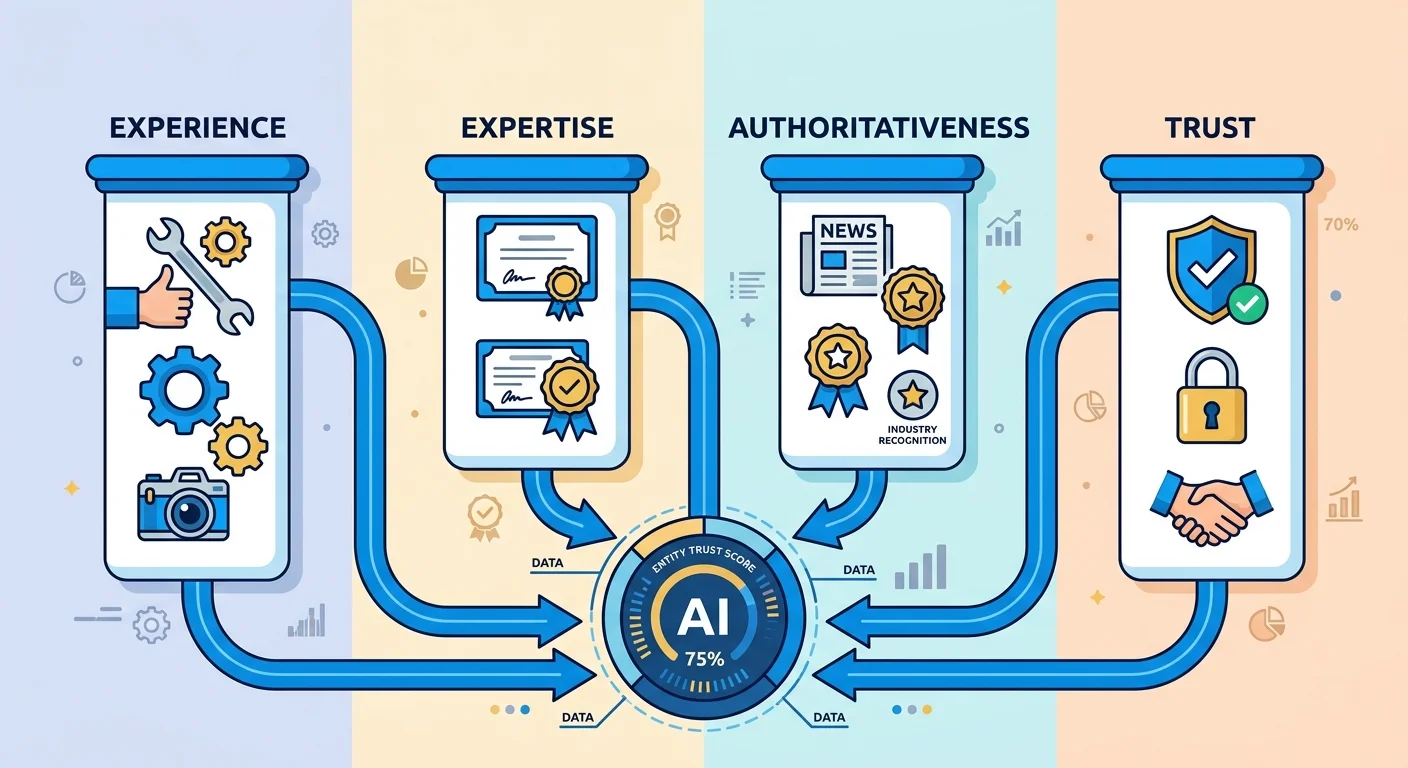
E-E-A-T breaks down into four components: Experience, Expertise, Authoritativeness, and Trust.
Experience proves you’ve done the work firsthand. Expertise proves you’re formally trained. Authoritativeness proves others recognize your authority. Trust proves the information you publish is accurate and honest.
Each one serves a different verification function.
Trust is the most important member of the E-E-A-T family. Without it, the other three don’t matter.
AI engines assess the concept of trustworthiness based on signals like author information, sources, and contact details. If your author page doesn’t link to verifiable credentials, you fail the trust check before the engine even evaluates your expertise.
Expertise
Expertise is the formal qualification layer. Your degree. Your license. Your certification.
AI engines look for structured data that names the institution, the credential type, and the field of study. A sentence that says ‘Dr. Smith graduated from Stanford’ isn’t enough. Schema markup that explicitly states alumniOf: Stanford University and hasCredential: Doctor of Chiropractic is what the engine reads.
For YMYL topics-medical, financial, legal advice-E-E-A-T standards are higher. YMYL pages demand a very high level of trust. Expertise isn’t optional for YMYL content.
If you’re a chiropractor publishing content about treatment protocols, AI won’t recommend you unless your credentials are verifiable at the entity level. The stakes are too high to guess.
Authoritativeness
Authoritativeness is what others say about you. It’s the external validation layer.
AI engines scan for mentions in reputable sources. News articles. Directory profiles. Guest posts on established sites. Citations in research.
If your name appears nowhere outside your own domain, you’re not authoritative. You’re self-declared.
Here’s where most practices fail. They build a beautiful website. They write a compelling bio. They never get cited anywhere else.
AI has no third-party proof you’re worth recommending.
Authoritativeness requires external signals. Schema markup helps AI connect your entity to those signals. But the signals themselves have to exist first.
Trust
Trust is the foundation. It refers to the accuracy, honesty, safety, and reliability of the page.
AI engines assess it by checking whether your author page links to real credentials. Whether your contact information is consistent across platforms. Whether the content you publish aligns with verifiable facts.
If any of those checks fail, you’re flagged as untrustworthy.
Here’s the callback: credentials aren’t decoration. They’re data.
A photo and a paragraph about your philosophy won’t build entity trust. Schema markup that declares your degree, your institution, your years in practice, and your specialization will.
The visual presentation is for humans. The structured data is for AI. Most practices build for one and wonder why the other never says their name.
| E-E-A-T Component | What It Measures | Primary Signal Type |
|---|---|---|
| Experience | Demonstrates first-hand or life experience with the topic – proof the author has done the work, not just studied it | Case examples, practice years, patient outcomes, direct involvement in the field |
| Expertise | Formal training, credentials, and qualifications – the institutional proof that the author is educated in the subject | Degrees, certifications, licenses, professional affiliations marked up in Schema |
| Authoritativeness | Recognition from external, independent sources – what others say about the author or practice outside your own domain | Citations in reputable publications, directory profiles, guest posts, mentions in news articles |
| Trust | Accuracy, honesty, safety, and reliability of the page – the foundation AI uses to decide if the content is dependable | Consistent NAP data, verifiable author information, cited sources, transparent contact details |
How to Structure Author Pages for Entity Trust
Most author pages fail because they’re built for human readers. Not machine parsers.
They tell a story. They establish tone. They don’t declare structured data.
AI engines don’t read narrative bios the way patients do. They extract entities. They extract affiliations. They extract credentials and verification markers.
If those signals aren’t marked up as data, the bio doesn’t exist.
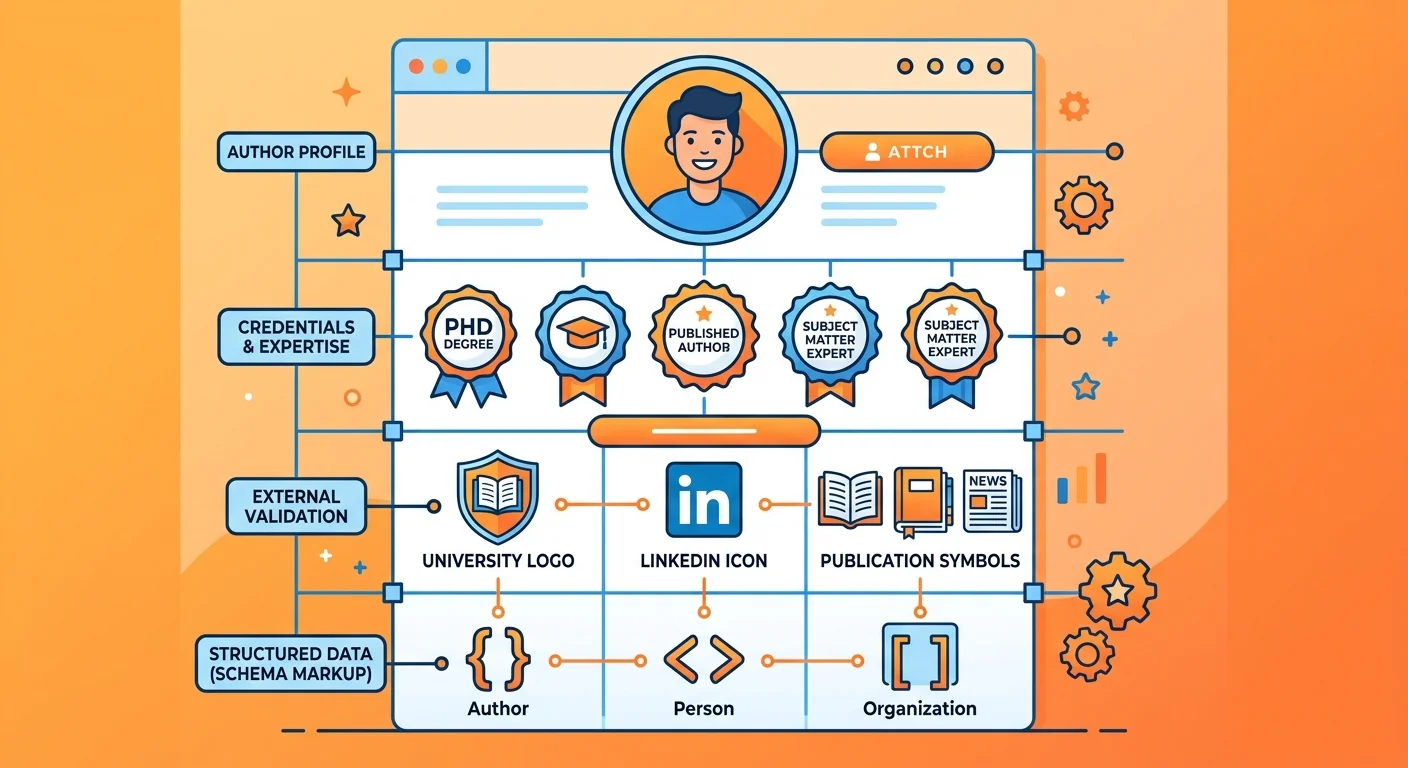
Author pages or bios are a key method for demonstrating the Expertise and Experience of the content creator. A detailed author bio should link to credentials, social media profiles, and other publications.
But the link isn’t enough.
The credential has to be declared as structured data with Schema.org so AI can parse the relationship between the person, the institution, and the qualification.
Author Bio Placement
Your author bio belongs in two places. On a dedicated author page. And inline with every piece of content that person writes.
The dedicated page is where you build the full credential stack. The inline byline is where you link to it.
Both need Schema markup. Without it, AI can’t connect the content to the author.
Here’s the callback: credentials aren’t decoration.
A beautifully written bio that says ‘Dr. Smith has 15 years of experience’ tells a human reader something. It tells AI nothing.
Schema markup that declares alumniOf, hasCredential, and knowsAbout tells AI everything. The visual presentation is for humans. The structured data is for machines.
Most practices build for one and skip the other.
Credential Links and External Validation
A detailed author bio should link to credentials, social media profiles, and other publications. Those links serve two purposes.
They give human readers a way to verify your background. They give AI engines third-party validation signals.
If your LinkedIn, your directory profiles, and your guest posts all exist but aren’t linked from your author page, AI can’t connect them.
External validation is what separates claimed expertise from verified Authoritativeness.
AI engines scan for mentions of your name outside your own domain. A credential declared on your site is a claim. A credential verified by an external directory, a news mention, or a published study is proof.
Link to those signals from your author page. Make it easy for AI to trace the path.
This is where core authority infrastructure matters.
You’re not just linking to your LinkedIn profile because it looks professional. You’re linking to it because AI engines use those external entities to verify that the person on your site is the same person mentioned elsewhere.
If the name, the credential, and the affiliations match across platforms, you’re verifiable. If they don’t, you’re fragmented.
Schema Markup for Person Entities
Using structured data, like Schema.org markup for a ‘Person’, helps search engines understand the relationships between entities, authors, and their credentials. Schema properties like alumniOf, hasCredential, and knowsAbout can explicitly state qualifications.
Without Schema markup, your bio is just text. With it, your bio is a machine-readable entity profile that AI can verify and cite.
alumniOf declares the institution where you were trained. hasCredential declares the degree or license you hold. knowsAbout declares the topics you’re qualified to address.
Each property is a verification signal.
AI engines read those signals and decide whether you’re qualified to answer the question. If the properties are missing, AI has no data to evaluate.
Here’s the callback: credentials aren’t decoration. They’re data.
A paragraph that says ‘Dr. Smith is a board-certified chiropractor’ is human-readable. Schema markup that declares hasCredential: Board Certified Chiropractor and alumniOf: Palmer College of Chiropractic is machine-readable.
AI engines don’t parse narrative prose for qualifications. They extract structured properties. If those properties aren’t declared, you’re not verifiable.
| Schema Property | What It Encodes | Example Value |
|---|---|---|
| alumniOf | Declares the educational institution where the practitioner received formal training | Palmer College of Chiropractic |
| hasCredential | Explicitly states the degree, license, or certification the practitioner holds | Doctor of Chiropractic (DC) |
| knowsAbout | Lists the specific topics, conditions, or techniques the practitioner is qualified to address | Sports injury rehabilitation, spinal adjustment |
| memberOf | Declares professional organizations or associations the practitioner belongs to | American Chiropractic Association |
| sameAs | Links to external profiles on other platforms to verify entity consistency across the web | LinkedIn profile URL, directory profile URL |
| workLocation | Specifies the geographic area or facility where the practitioner provides services | San Diego, CA or specific clinic address |
Integrating Credentials Into Article-Level Bylines
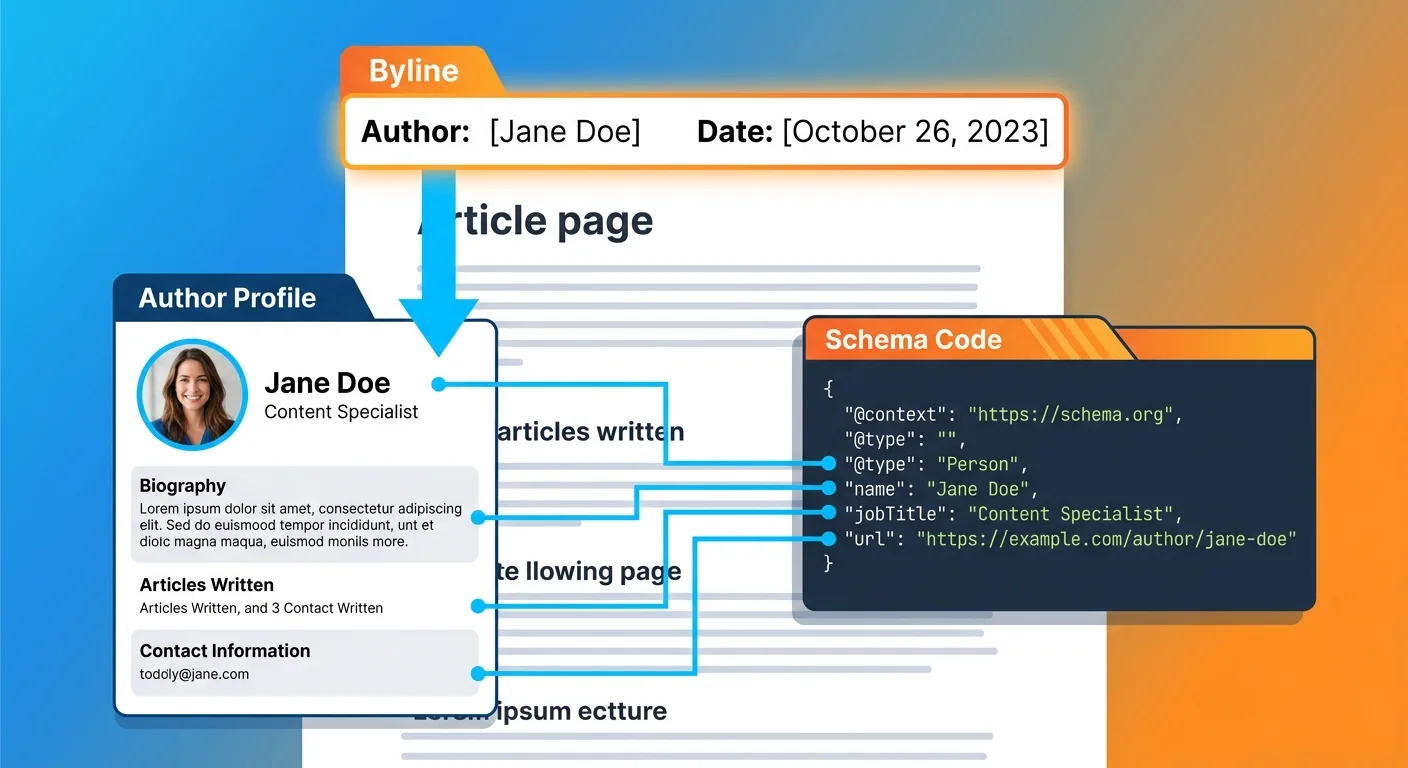
Author pages establish the entity. Bylines attach that entity to every piece of content you publish.
If you’re publishing AEO articles, case studies, or treatment guides, every piece needs a byline that links back to the author page. That’s how AI engines connect the content to the credentials.
No byline? No connection. No connection means AI can’t verify the author.
Most practices skip the byline entirely. They publish content under the practice name.
AI can’t verify a practice. It verifies people.
If your content doesn’t name a person with verifiable credentials, AI won’t cite it. The byline isn’t a design flourish. It’s the entity link that makes your content trustworthy to machines.
Byline Format
The byline format is simple. Name, credential, title.
‘By Dr. Sarah Kim, Board Certified Chiropractor.’
That’s it. The credential proves Expertise. The title proves role authority. The link to the author page proves the entity is verifiable.
You don’t need a paragraph-long intro. You don’t need a photo inline with every article. You need the name, the credential, and the link. AI engines extract that data.
If the byline says ‘By iTech Valet Team,’ AI has nothing to verify. If it says ‘By the founder of iTech Valet, Gerek Allen,’ AI can trace that name to an author page, a LinkedIn profile, and external mentions.
One byline is verifiable. The other isn’t.
Linking the Byline to the Author Page
The byline has to link to the author page. Non-negotiable.
The byline is the bridge between the content and that bio. If the byline doesn’t link, AI can’t connect the two entities.
You’re declaring an author. You’re not giving AI a way to verify them.
Here’s the callback: credentials aren’t decoration.
A byline that says ‘Written by our team’ tells AI nothing. A byline that says ‘By Dr. Sarah Kim’ and links to a Schema-marked author page with hasCredential, alumniOf, and knowsAbout properties tells AI everything.
The visual byline is for humans. The linked, structured author page is for machines. Most practices build one and skip the other.
Per-Article Schema
Every article needs its own Schema markup that declares the author entity.
Structured data with Schema.org lets you mark up a Person. BlogPosting Schema has an author property. That property should reference the Person entity you declared on the author page.
The byline is the human-readable link. The Schema is the machine-readable connection.
If your author page declares Gerek Allen as an entity with alumniOf: UC Riverside and hasCredential: BS in Business Administration, your article Schema should reference that same entity.
AI reads both. It verifies the person is the same across pages.
If the credentials on the author page don’t match the author declared in the article Schema, you’re fragmented. AI won’t trust either signal.
What YMYL Topics Demand
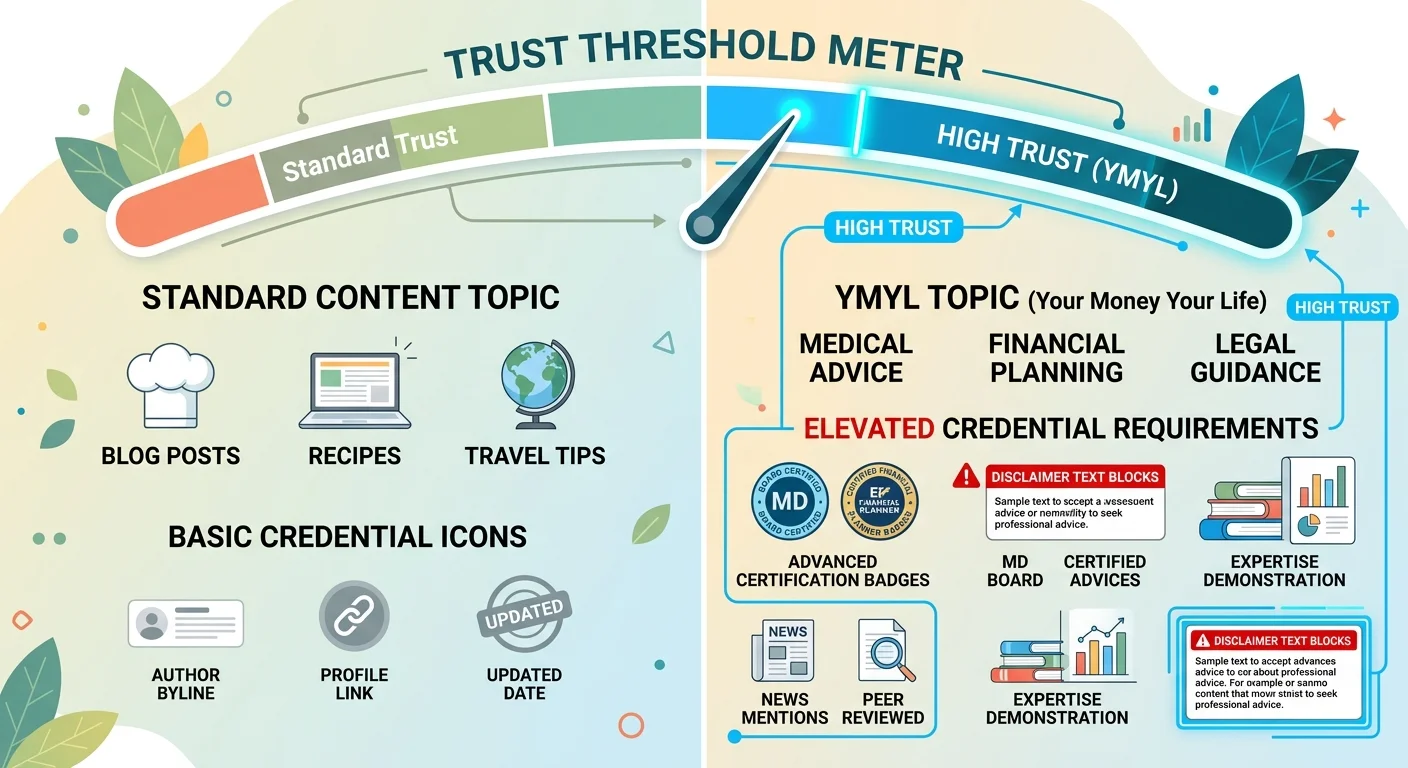
If your practice operates in a Your Money or Your Life (YMYL) topics vertical, the E-E-A-T bar isn’t the same. It’s higher.
Medical advice. Financial planning. Legal counsel. These aren’t low-stakes topics. AI engines apply stricter evaluation criteria. The cost of getting it wrong is too high for them to guess.
YMYL pages demand a very high level of Trust. Expertise is crucial for YMYL content. A generic author page won’t clear that bar.
AI engines want proof the person writing your content has the qualifications, the training, and the external validation to be trusted with advice that affects someone’s health or financial security. If you can’t prove it, you’re invisible.
The engine moves on.
Higher Credential Thresholds
Credentials that are optional in other industries are mandatory in YMYL verticals.
A blog about productivity tools can get away with a thin author page. A chiropractic practice can’t. AI engines expect declared degrees, licenses, certifications, and institutional affiliations. All marked up with Schema so the engine can verify them.
If it’s not structured, it doesn’t exist.
Your bio has to answer a simple question: why should AI trust this person’s medical advice?
If the answer isn’t immediately verifiable through structured data-alumniOf, hasCredential, knowsAbout-AI moves to the next result. The credential threshold for YMYL topics isn’t a suggestion.
It’s a gate.
External Reputation Signals
Mentions in reputable news articles, Wikipedia pages, or reviews from known experts contribute to perceived authority. YMYL verticals require that external validation.
A credential you declare on your own site is a claim. A credential verified by a third-party directory, a peer-reviewed publication, or a media mention is proof.
AI knows the difference.
AI engines scan for your name outside your domain. They’re looking for signals that other entities-directories, institutions, publications-recognize you as an authority.
If those signals don’t exist, your on-site credentials don’t carry weight. Reputation signals from external, independent sources are vital for establishing Authoritativeness and Trust.
Without them, you’re self-declared.
Here’s the callback: credentials aren’t decoration.
A paragraph about your training tells human patients you’re qualified. A network of external mentions-directory profiles, guest articles, speaking engagements-tells AI you’re verifiable.
Most YMYL practices build the internal credential page and never create the external signal layer. AI needs both.
Medical and Financial Disclaimers
YMYL verticals also require disclaimers that signal transparency and honesty.
Medical and financial disclaimers aren’t just legal protection. They’re Trust signals. They tell AI that you’re not making guarantees you can’t keep.
The disclaimer has to be visible and consistent.
‘This content is for informational purposes only and does not constitute medical advice’ isn’t filler text. It’s a machine-readable signal that you’re operating within ethical boundaries. AI engines read disclaimers.
If they’re missing, the engine flags your content as potentially misleading-even if your credentials are strong. The disclaimer is part of the Trust stack.
Common E-E-A-T Implementation Mistakes
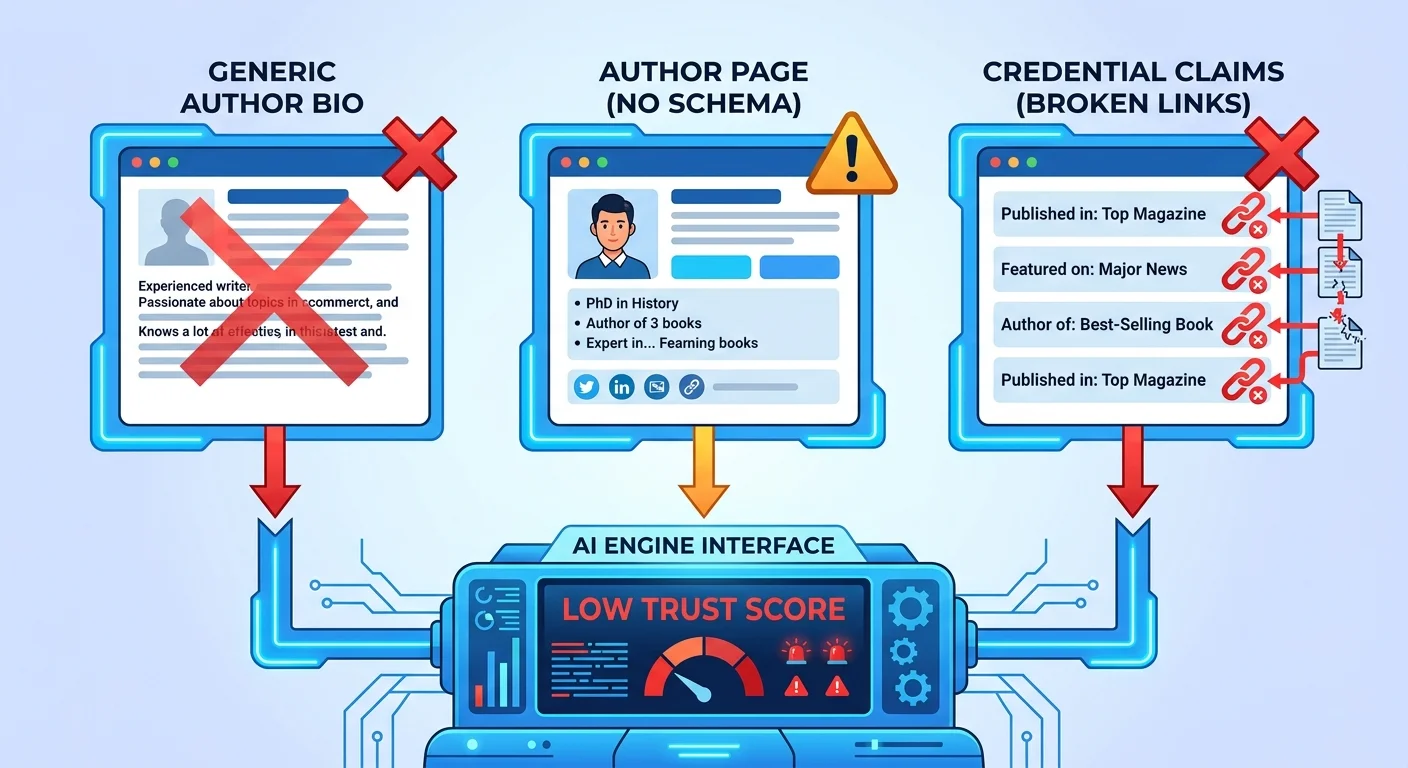
Most practices think they’ve built E-E-A-T signals. They haven’t.
The author page exists. The credentials are listed somewhere. The byline’s there.
But none of it’s machine-readable. AI engines extract structured data, not narrative prose. If the credentials aren’t declared in Schema, AI can’t verify them. You built the page. You didn’t build the signal.
You’re not failing because you didn’t try. You’re failing because you built for human readers instead of machine parsers.
The same mistakes repeat across every industry. Generic bios. Missing Schema. No external validation. Each one tells AI your entity isn’t verifiable.
Here’s what to fix first.
Generic Author Bios
A paragraph that says ‘Dr. Kim has over 15 years of experience helping patients achieve better health’ tells AI nothing.
AI engines don’t extract qualifications from prose. They extract them from structured properties.
If your bio doesn’t declare alumniOf, hasCredential, or knowsAbout, AI has no data to verify. The story’s there. The data isn’t.
A detailed author bio should link to credentials, social media profiles, and other publications. Most bios skip all three.
They describe the practitioner’s philosophy. They talk about their mission statement. That’s not verifiable.
AI needs institutional affiliations, declared degrees, and external entity links. Without those signals, the bio is decoration-not data.
Missing Schema Markup
The single biggest E-E-A-T failure is building a beautiful author page with zero Schema markup.
Schema.org markup for a ‘Person’ tells AI the relationships between entities, authors, and their credentials. Properties like alumniOf, hasCredential, and knowsAbout explicitly state qualifications.
If the markup isn’t present, AI reads your author page as unstructured text. Impossible to parse. Impossible to verify.
You can’t see Schema when you load the page. That’s why most practices skip it.
They build what they can see-headings, paragraphs, photos. But AI doesn’t see the page the way you do. It reads the code. If the code doesn’t declare your credentials as structured properties, you’re invisible.
How we measure success in AI visibility starts with verifying Schema is present and correctly populated-not guessing based on what the bio looks like to humans.
No External Validation
Your bio declares you’re board certified. Your LinkedIn says the same thing. But AI can’t connect the two entities because you didn’t link them.
Reputation signals from external, independent sources are critical for establishing Authoritativeness and Trust. Mentions in reputable news articles, Wikipedia pages, or reviews from known experts contribute to perceived authority.
If those external mentions don’t exist-or if they exist but aren’t linked from your author page-AI treats your credentials as unverified claims.
Here’s the callback: credentials aren’t decoration.
A credential you declare on your own site is a claim. A credential verified by a third-party directory, a media mention, or a peer-reviewed publication is proof.
Most practices build the internal signal layer-author page, byline, Schema-and stop there. They never create the external validation network. AI needs both.
Whether an Authority Engine is a better investment comes down to this: are you building signals AI can verify, or are you building a website that looks good to humans and remains invisible to machines?
| Mistake | Why AI Engines Miss It | What to Do Instead |
|---|---|---|
| Bio written in narrative prose only | AI extracts structured properties, not paragraphs-prose credentials can’t be parsed or verified | Declare credentials using Schema.org Person markup with alumniOf, hasCredential, and knowsAbout properties |
| Author page exists but isn’t linked from article bylines | AI can’t connect the article to the author entity-the credential signal is fragmented across disconnected pages | Link every byline to the author page, then reference that Person entity in BlogPosting Schema’s author property |
| Credentials listed on-site but no external validation signals | Claims you make about yourself aren’t proof-AI needs third-party mentions to verify authoritativeness | Build directory profiles, guest articles, and media mentions that link back to your author page and establish external reputation signals |
| Generic byline like ‘Written by our team’ | AI can’t identify or verify an anonymous entity-no name means no credential lookup, no trust signal | Use a named author with a linked Schema-marked author page declaring verifiable qualifications |
| Author page Schema exists but article Schema doesn’t reference it | AI reads both pages separately-if the author entity isn’t declared in article markup, the credential connection is invisible | Add BlogPosting Schema to every article with an author property that references the same Person entity declared on the author page |
| YMYL content with no external credential verification | YMYL topics demand higher trust thresholds-on-site claims alone won’t pass the verification bar AI engines apply | Build external mentions in peer-reviewed publications, institutional directories, and reputable news sources that validate your expertise |
Frequently Asked Questions
Let’s hit the questions practices actually ask when they start building E-E-A-T infrastructure.
These aren’t theoretical. They’re the friction points that surface when you realize credentials are data, not decoration.
Most practices have the credentials. They just don’t know how to make them machine-readable.
Here’s what to fix first.
What is E-E-A-T and how does it specifically relate to entity trust?
E-E-A-T stands for Experience, Expertise, Authoritativeness, and Trust. Google added ‘Experience’ to the original E-A-T framework because first-hand experience matters-not just credentials on a wall. Trust is the most important member of the E-E-A-T family. It’s the accuracy, honesty, safety, and reliability of the page.
Entity trust is how AI verifies you’re who you claim to be. E-E-A-T signals-structured credentials, external validation, institutional affiliations-are how you prove it.
Without those signals, AI can’t verify your entity. You’re invisible.
How can I display practitioner credentials on my website so AI engines can understand them?
Schema.org markup for a ‘Person’ tells AI who you are and what you’re qualified to talk about. Properties like alumniOf, hasCredential, and knowsAbout explicitly declare your degrees, licenses, and affiliations.
Without Schema, your credentials are unstructured text. AI can’t parse them.
Build an author page. Add Schema markup declaring your degrees, licenses, and institutional affiliations. Link to external directory profiles. That’s how AI reads credentials-not from prose, from structured properties.
Does adding author bios with credentials to articles actually improve AI visibility?
Yes. Trust is assessed based on signals like author information, sources, and contact details. If your author bio includes structured credentials with Schema markup, AI can verify the entity behind the content.
Every article that references that author page inherits the Trust signal. Without the bio, AI reads your content as anonymous. Anonymous content doesn’t get recommended.
The bio isn’t optional. It’s infrastructure.
What’s the difference between building entity trust and traditional link building?
Link building was about passing PageRank. Entity trust is about passing verifiability.
Traditional link building optimized for algorithmic signals Google could measure. Entity trust optimizes for the structured data AI engines parse to verify relationships. Trust is the most important member of the E-E-A-T family.
You’re not building links. You’re building verifiable entity connections that tell AI your credentials are real.
How do AI answer engines like ChatGPT and Gemini evaluate practitioner credentials differently than old search engines?
Old search engines ranked pages. AI answer engines recommend entities.
ChatGPT and Gemini don’t care if you’re on page one. They care if you’re verifiable. Trust is assessed based on signals like author information, sources, and contact details. AI engines scan for Schema properties that declare credentials. They cross-reference external directories. They look for institutional affiliations.
If those signals don’t exist, AI doesn’t recommend you-even if your content is excellent. The shift isn’t subtle. It’s foundational.
Is Schema markup for a person’s credentials a critical part of building entity trust?
Yes. Schema.org markup for a ‘Person’ tells search engines the relationships between entities, authors, and their credentials. Properties like alumniOf, hasCredential, and knowsAbout explicitly state qualifications.
Without Schema, AI reads your credentials as narrative text. It can’t verify them. Schema turns your bio into machine-readable data.
That’s the difference between a credential claim and a credential AI can parse. If the Schema isn’t present, you’re invisible.
Why This Infrastructure Compounds
Here’s what most practices miss: every signal you build doesn’t improve one article. It compounds across every piece of content your entity publishes.
The author page you structured with Schema? It doesn’t validate one byline. It validates every byline that references it.
The external directory profiles you linked? They don’t prove one credential. They prove every credential claim across your domain.
Authority infrastructure isn’t built one article at a time. You build it once. Then every new piece of content amplifies it.
Most practices treat credentials as a design checkbox. They write a bio, add a photo, call it done.
That’s static.
Authority signals compound when they’re structured. When your Person Schema declares alumniOf, hasCredential, and knowsAbout properties-and when your BlogPosting Schema references that same entity in every article-AI doesn’t evaluate each article in isolation. It evaluates your entity as a whole.
Every article you publish strengthens the entity graph. Every credential signal you build reinforces the next one. That’s how visibility turns into authority.
The practices that win aren’t the ones with the most content. They’re the ones whose content is tied to verifiable entities AI can trust.
Credentials aren’t decoration – they’re data.
If AI can parse your credentials, verify your institutional affiliations, and connect your entity to external validation signals – you’re not one option in a list of five. You’re the answer.
That’s the shift. That’s what an AI Authority Engine delivers. You build the infrastructure once. Every credential signal, every Schema declaration, every external validation point compounds across everything you publish. That’s how visibility turns into authority.
You’ve got the credentials. The question is whether AI can see them.
Most practices assume their author pages and bios are enough. They’re not. AI reads structured data – not narrative prose. If your Schema markup isn’t declaring alumniOf, hasCredential, and knowsAbout properties, you’re invisible. If your external directory profiles aren’t linked from your author page, AI can’t verify you. If your content doesn’t reference a structured Person entity, every article you publish is anonymous.
Credentials aren’t decoration. They’re data.
We built the AI Visibility Check to show you exactly what ChatGPT, Gemini, and Perplexity see when someone asks who to trust in your market. It takes 15 minutes. You’ll see whether your entity is verifiable – or whether your credentials sit on a page AI can’t parse.