
What Are Entity Trust Signals and Why Do AI Engines Care?
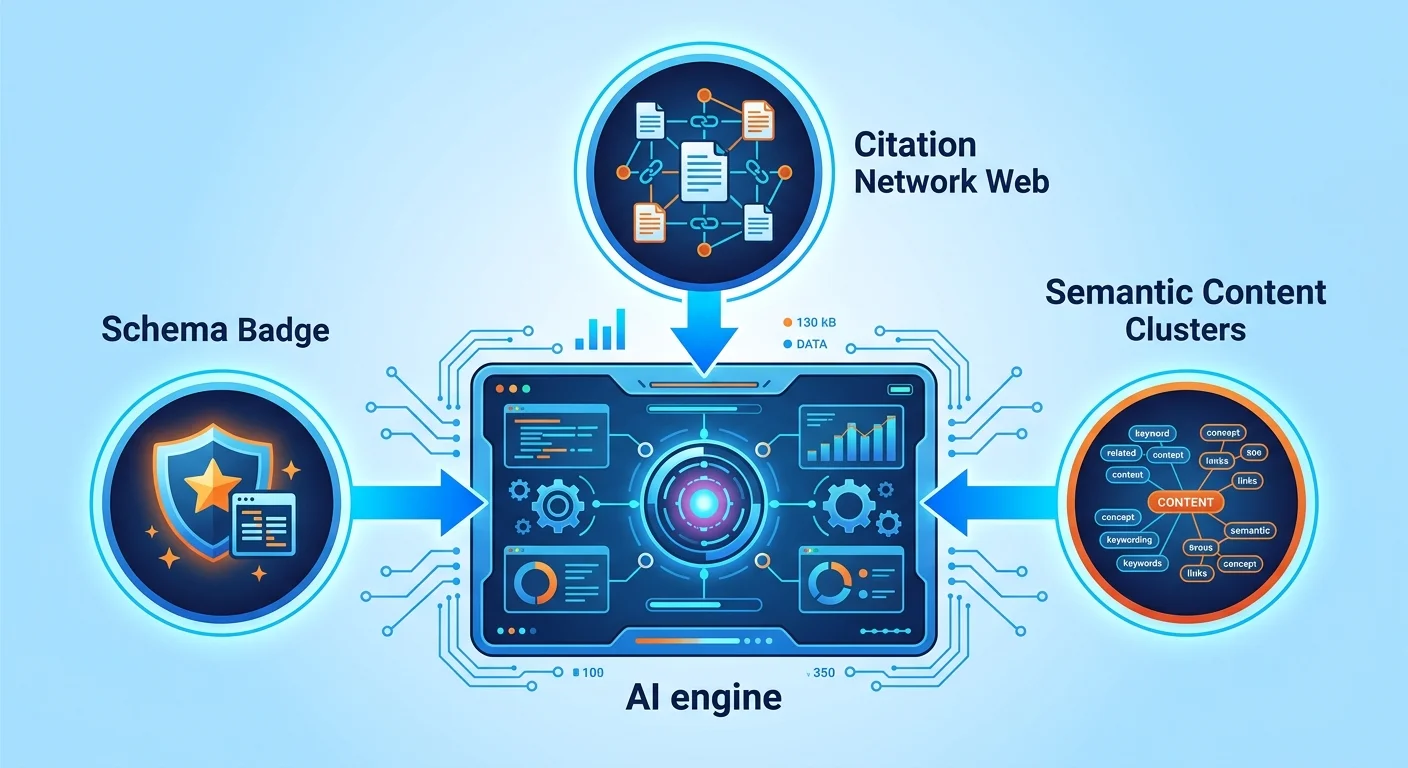
Entity trust signals are not your star rating. They are not your website’s age.
They are the machine-readable proof that ChatGPT, Gemini, and Grok use to confirm a practice is real, credible, and worth naming out loud. Schema and Structured Data. Citation Velocity. Semantic Density. These are the structural signals that allow an AI engine to verify a clinical identity across hundreds of data points – and then produce a single recommendation.
AI engines aren’t reading your website. They’re auditing it.
They cross-reference your business name, address, phone number, and specialty across every platform that mentions you. They check for structured schema that tells them what your entity actually is. They measure how often authoritative sources cite you as a credible answer to a health question. One inconsistent NAP listing. One missing schema block. One citation gap. That’s all it takes to fall out of consideration.
Over eighty percent of patients consult digital resources before booking a chiropractic appointment. The structured profiles those patients find? Same profiles AI engines use to decide who gets named. So a practice with a fragmented digital footprint is invisible at both layers – to the patient searching manually, and to the AI answering on the patient’s behalf.
That’s why this isn’t a retainer conversation. It’s an infrastructure conversation.
The Local AI Authority Engine is built on one premise: systematic digital entity validation is the gate, not a nice-to-have. High-intent patients are already searching. AI engines are already answering. Every day a practice operates without those signals in place, a competitor with stronger entity trust fills the recommendation slot instead.
The chair doesn’t stay empty. Someone else sits in it. That’s the real cost of waiting. authority asset investment
| Trust Signal | What AI Engines Look For | What Weak Signals Look Like | Patient Booking Impact |
|---|---|---|---|
| Schema and Structured Data | Explicitly defined business name, address, phone, specialty, and service area encoded in machine-readable markup – consistent across every indexed platform | Missing or incomplete schema markup; business information exists only in visual page text that AI engines cannot parse or cross-reference | Practice is excluded from AI recommendations because its clinical identity cannot be verified – the engine names a competitor whose entity is fully defined |
| Citation Velocity | The frequency and consistency with which authoritative external sources – directories, medical platforms, local publications – reference the practice as a credible answer to a patient’s health question | Sparse citations concentrated in one or two low-authority directories; business name or address inconsistencies across platforms signal unreliable entity data | AI engines cannot confirm clinical credibility through independent corroboration – the practice scores low on trust validation and drops out of the recommendation consideration set |
| Semantic Density | Depth and breadth of topically relevant, structured content that teaches AI engines exactly what conditions the practice treats, who it serves, and what outcomes patients can expect | Generic or thin website content; pages that name services but provide no context for patient conditions, treatment approaches, or clinical specificity | AI engines cannot confidently match the practice to high-intent patient queries – the practice appears too ambiguous to recommend for specific conditions, losing bookings to specialists with denser authority content |
| Entity Consistency | Identical business name, address, phone number, and specialty data across every digital touchpoint – website, directories, health platforms, and third-party citations | Conflicting versions of the practice name, outdated addresses, or disconnected phone numbers spread across platforms that AI engines crawl and compare | Contradictory entity data triggers low-confidence scoring in AI models – fragmented profiles are categorized as low-authority and are systematically excluded from single-answer recommendations |
Why Traditional SEO Fails to Build Entity Trust
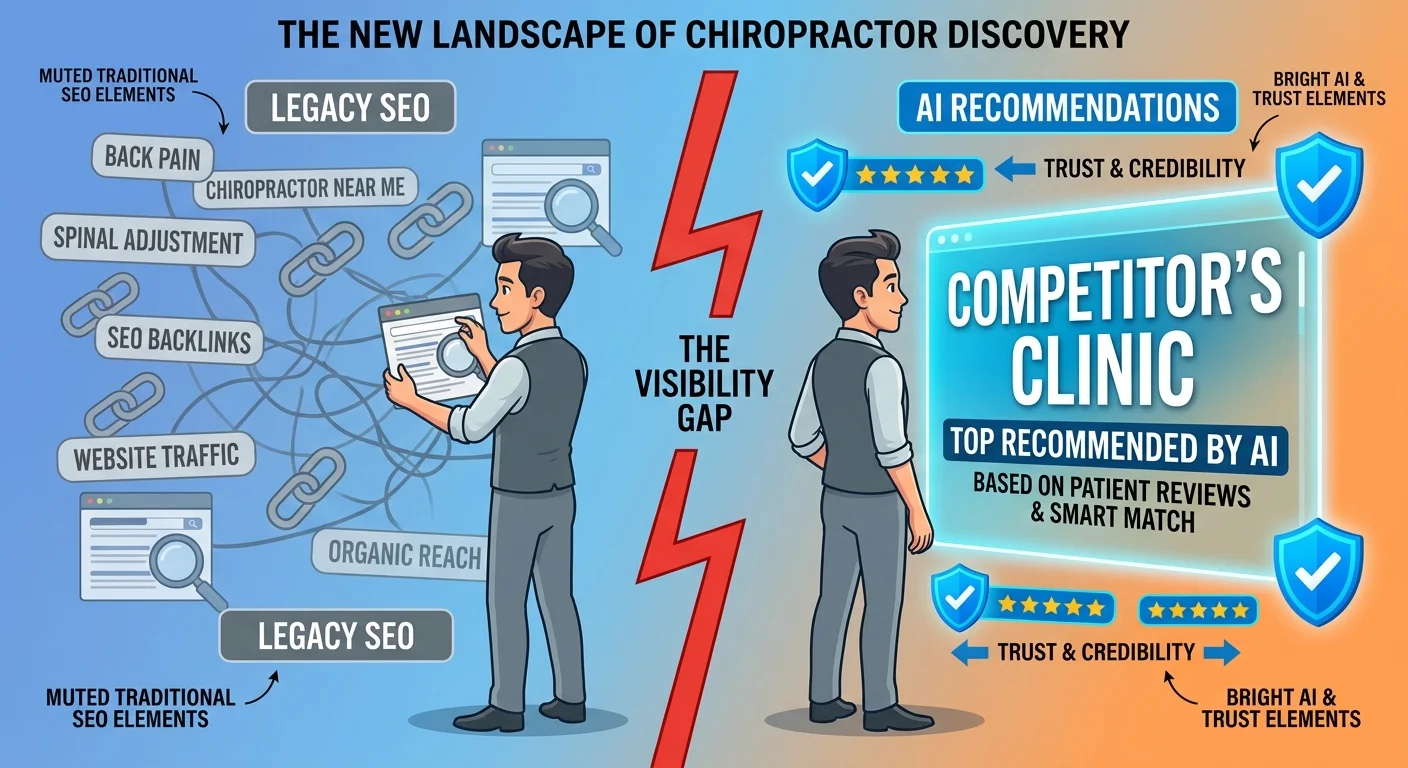
Traditional SEO was built to win a list. AI search produces a verdict. Those aren’t variations of the same game. They have completely different rules – and most practices are still training for the wrong one.
The entire logic of traditional optimization assumes a patient opens a browser, types a query, gets ten links, and clicks one. That chain is breaking. Conversational AI doesn’t return ten options. It names one. And the signals it uses to choose that name have nothing to do with keyword density, page authority scores, or backlink counts.
So when a practice starts asking hard questions about where its budget is actually going – here’s the honest answer. Every dollar spent optimizing for a system AI engines don’t use is a dollar that didn’t go toward the entity signals those engines actually read. This isn’t a ranking problem. It’s an infrastructure mismatch. And you can calculate exactly what it’s costing you when you look at the cost of this gap.
Why Keyword Rankings Don’t Signal Entity Trust
Keyword rankings tell a search algorithm that a page is relevant to a query. They tell an AI engine nothing about whether the practice behind that page is a verified, credible clinical entity worth recommending to a real patient.
Here’s the thing: AI engines don’t rank pages. They validate entities. ChatGPT and Gemini cross-reference a practice’s name, address, specialty, and credentials across every platform that mentions them – directories, review sites, health databases, structured schema on the practice’s own site. Fragmented, non-validated data gets categorized as low-authority. A practice with inconsistent digital profiles doesn’t rank poorly. It fails validation entirely.
Over eighty percent of patients consult digital resources before booking a chiropractic or physical therapy appointment. The structured profiles, health platform listings, and cited authority signals those patients find – those are the exact same assets AI engines read when generating a recommendation. Weak profiles don’t just lose patients who search manually. They lose patients who never search at all, because AI answered first and said someone else’s name.
That’s the empty chair. Not a ranking drop. A complete absence from the conversation – every time a patient asks an AI engine who to trust in your market.
The Directory Listing Trap
Most practices think being listed on Healthgrades, Zocdoc, or Yelp covers them. It doesn’t. Directory listings are inputs. Entity trust is the output. That output only forms when those listings are structured, consistent, complete, and connected to a schema-verified digital identity – one AI engines can cross-reference without hitting a single conflict.
A directory listing without structured data is noise. AI engines cross-reference every data point, across every platform, to confirm a practice is real and worth recommending. A phone number that differs between a Google Business Profile and a health directory doesn’t create a minor inconsistency. It creates a validation failure. And validation failures mean the practice doesn’t get named – full stop.
Federal consumer protection enforcement has made this even harder to ignore. Strict federal guidelines now mandate compliant, secure entity identity profiles for healthcare businesses. Mismanaged patient data transfers directly degrade the trust metrics that recommendation engines rely on. Practices leaning on low-trust tracking platforms aren’t just exposed to regulatory risk. They’re actively burning the AEO Content Writing Services infrastructure they need to get recommended in the first place.
That’s the trap. It feels like visibility – patients can technically find a listing. But fragmented digital profiles directly correlate with lower booking rates. Being findable and being recommended are not the same outcome. AI doesn’t surface directories. It surfaces entities it trusts. And trust is built on Schema and Structured Data, Citation Velocity, and Semantic Density – not on how many platforms a practice signed up for.
| Tactic | Traditional SEO Outcome | AI Engine Response | Entity Trust Contribution |
|---|---|---|---|
| Keyword Optimization | Pages rank for query-relevant terms in a list of results | Ignored – AI engines do not rank pages; they validate entities | Zero – keyword density is not an entity trust signal |
| Backlink Building | Domain authority score increases over time | Irrelevant – AI cross-references structured identity data, not link graphs | Minimal – links do not confirm clinical identity or specialty credentials |
| Directory Listings (Unstructured) | Practice appears on multiple platforms | Creates noise – inconsistent NAP data across platforms triggers validation failure | Negative – fragmented profiles are categorized as low-authority by recommendation engines |
| Page Speed and Technical SEO | Improves crawl efficiency and user experience scores | Neutral – AI engines do not use page performance as a recommendation signal | Zero – technical hygiene does not contribute to Schema and Structured Data, Citation Velocity, or Semantic Density |
| Meta Descriptions and Title Tags | Signals query relevance to search algorithm crawlers | Ignored – AI engines read structured schema and cross-referenced entity data, not meta tags | Zero – meta copy is not a component of entity trust architecture |
| Monthly Content Publishing (No AEO Framework) | Increases indexed page count and session volume | Dismissed – content without semantic density and entity anchoring adds no citation authority | Low – volume without AEO structure does not build Citation Velocity or Semantic Density |
How AI Engines Score a Healthcare Practice’s Authority Daily
AI engines don’t care how long a practice has been open. They don’t factor in effort, longevity, or patient satisfaction scores.
They score authority. And that scoring runs continuously – every single day – against structural signals most practices have never been told exist.
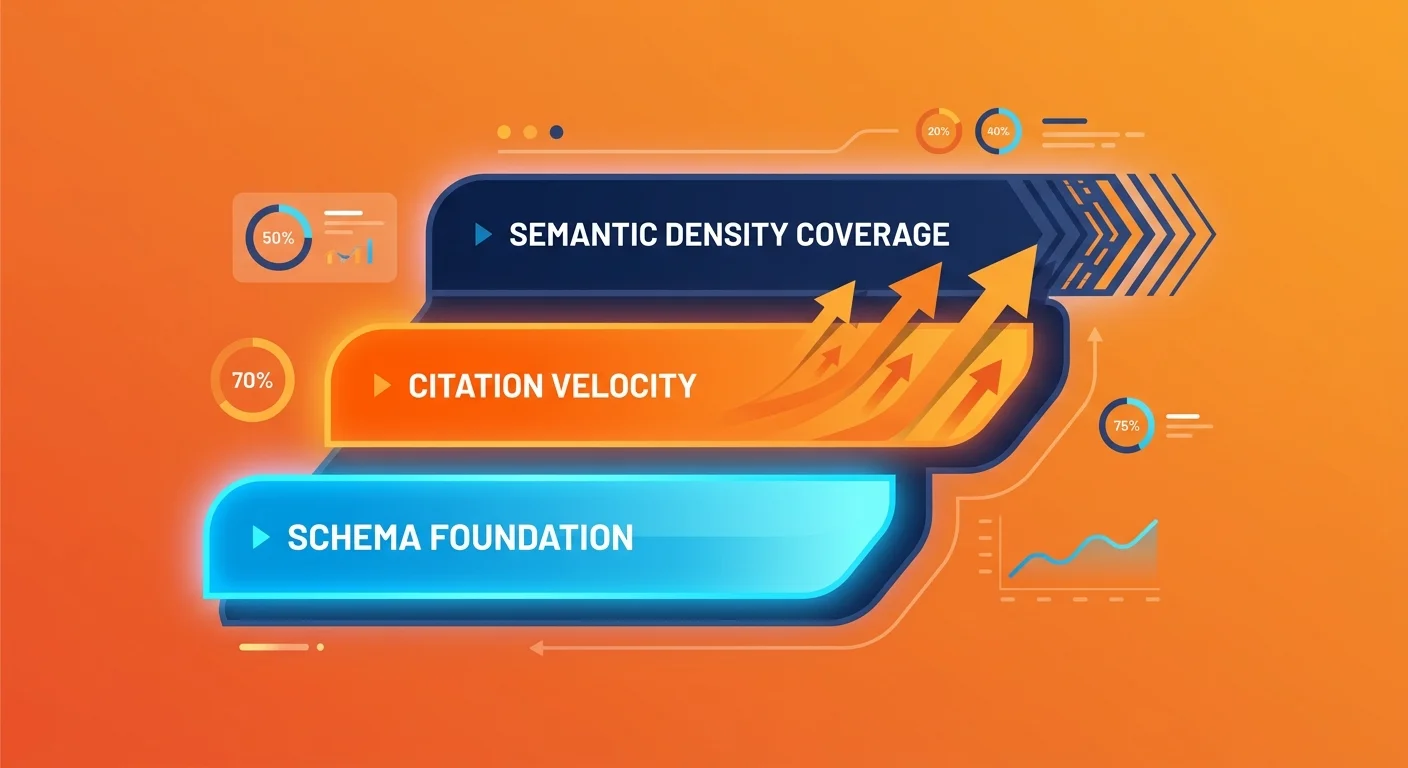
Three framework layers drive that score: Schema and Structured Data, Citation Velocity, and Semantic Density. Each one answers a different question the AI engine is asking.
Schema and Structured Data answers: "Is this a verified, consistently identified clinical entity?" Citation Velocity answers: "Are authoritative sources confirming this entity’s relevance over time?" Semantic Density answers: "Does this entity demonstrate the depth of topical expertise required to serve a patient’s specific need?"
Three questions. All three have to pass. Answering two out of three doesn’t get a practice recommended.
Here’s why that matters financially: 70% of consumers say digital trust is non-negotiable before they commit to a booking. But AI engines aren’t waiting for the patient to evaluate trust. They’re doing it first – filtering out every practice that hasn’t built the structural signals required to pass.
High-trust entities compound. The authority a practice builds this month stacks on last month. And that compounding starts the day the signals go in – not the day a practice decides it’s finally ready to deal with this.
Citation Velocity: The Compounding Signal
Citation Velocity is the rate at which authoritative sources mention a practice as a credible answer to a health-related query.
Not backlinks. Not social shares. Authoritative citation – from structured health directories, clinical databases, credentialed review platforms, and consistent references across the web’s institutional layer.
That distinction trips up a lot of practices. They see a handful of directory listings and assume the box is checked. It isn’t.
Here’s the thing: this signal compounds. A practice that earns consistent citations this month builds on them next month. The AI engine’s model of that practice’s credibility deepens with every new, consistent reference.
The practice that waits – sitting on legacy directory listings and calling it visibility – doesn’t just fall behind. It falls further behind every single day.
Because the competitor earning citations now is building an authority lead that gets harder to close with every passing week.
Fragmented citation data – mismatched names, inconsistent addresses, conflicting specialties across platforms – gets categorized as low-authority by recommendation engines. The AI engine reads inconsistency as unreliability. And unreliable entities don’t get recommended.
Systematic entity validation isn’t optional infrastructure. It’s the baseline required to even enter the conversation high-intent patients are having with AI right now.
The empty chair isn’t a metaphor. It’s the direct output of a Citation Velocity score that never got built.
Semantic Density and Topical Coverage
Semantic Density is where most practices are completely unprepared – and where the gap between them and their competitors grows fastest.
AI engines don’t just confirm a practice exists. They assess whether its digital presence reflects genuine clinical depth on the exact topics patients are asking about right now.
That’s a very different bar than having a website. Most practices haven’t cleared it.
So what does Semantic Density actually require? AEO content that answers the specific questions patients bring to conversational AI. Not generic wellness articles. Not keyword-stuffed pages written for a 2019 algorithm.
Structured, authoritative content that signals topical command – proof that this practice is the credible, expert answer to the question a patient is asking right now.
The authority metrics that predict practice growth back this up. Semantic Density is measurable. And right now, most practices are scoring near zero.
And Semantic Density doesn’t work in isolation. It works in concert with Schema and Structured Data and Citation Velocity – three signals that reinforce each other.
A practice with strong structured data but thin topical content fails at the semantic layer. A practice with deep content but inconsistent citations fails at the velocity layer. Partial credit doesn’t exist here. All three have to be built, maintained, and compounded together.
That’s not a monthly retainer task. That’s an infrastructure rebuild.
| Authority Signal | How AI Engines Measure It | Compounding Effect Over Time | Competitive Consequence of Absence |
|---|---|---|---|
| Schema and Structured Data | Cross-references a practice’s name, address, specialty, and credentials across every platform that mentions it – looking for consistency, completeness, and machine-readable markup on the practice’s own site | Each consistent, schema-verified data point reinforces the practice’s entity identity – the model’s confidence in recommending the practice deepens with every passing validation cycle | A practice with fragmented or absent structured data fails entity validation entirely – it is not ranked lower, it is excluded from the recommendation pool |
| Citation Velocity | Measures the rate and consistency at which authoritative sources – structured health directories, clinical databases, credentialed review platforms – confirm the practice as a credible answer to patient queries | Citations earned today build on citations earned last month – the AI engine’s authority model for that practice grows stronger with every new, consistent reference from a credible source | A practice that isn’t earning consistent citations cedes ground to competitors who are – and the authority gap widens every week, making recovery progressively more difficult and more costly |
| Semantic Density | Assesses whether the practice’s digital presence reflects genuine clinical depth on the topics patients are actively asking about in conversational AI – structured, authoritative content signals topical command | Deep topical content compounds into a persistent subject-matter authority signal – the more consistently a practice answers the right questions, the more reliably AI engines name it as the trusted answer | A practice with thin or generic content is invisible at the semantic layer regardless of how strong its other signals are – patients asking specific clinical questions get directed to a competitor whose content answers them |
| Cross-Signal Coherence | Evaluates whether Schema and Structured Data, Citation Velocity, and Semantic Density reinforce each other – AI engines look for alignment across all three layers, not isolated strength in one | Coherence between all three signals creates a self-reinforcing authority loop – each layer’s strength amplifies the credibility of the other two, producing compounding visibility that is extremely difficult for competitors to displace | Strength in one or two layers without the third creates a structural ceiling – the practice earns partial credit but never clears the threshold required for a consistent, recurring AI recommendation |
The Daily Patient Math: What Invisibility Actually Costs

Nobody frames this as a daily cost. They should.
The empty chairs in a practice’s schedule aren’t random. They’re the direct output of AI naming someone else. Traditional search engine volume is already projected to drop twenty-five percent by 2026 – driven by AI chatbots replacing the old query-and-click chain. That shift doesn’t ease in gradually. It hits one unanswered patient query at a time, every single day a practice’s entity signals stay weak.
Seventy percent of consumers say digital trust is non-negotiable before they commit to a booking. But most practices picture that trust moment as the patient reading their reviews. It isn’t.
The AI already ran the evaluation. The patient asked a question. The engine produced a name. That name wasn’t theirs.
The practice never got a chance to make a first impression – because the decision happened upstream, invisibly, before a single click. That is not a ranking problem. That is a daily transfer of patient bookings from one schedule to another. And it compounds in ways most practices never stop to calculate – starting with the 3-year cost of that transfer.
Here’s what makes this worse: the math gets harder to reverse every week.
High-trust entities compound. Every day a competitor stacks authority signals, the gap between their practice and a waiting practice widens – not by a little, by a lot. The practice that waits isn’t standing still. It is actively depositing into a competitor’s authority account with every week it delays.
The chair sits empty. Not as a metaphor. As a ledger entry. And it only starts filling back up the day the infrastructure that earns AI recommendations actually gets built.
| Months of Delayed Action | Estimated Daily AI Searches Missed | Competitor Authority Compound Gain | Cumulative Patient Booking Gap |
|---|---|---|---|
| 1 Month | Meaningful daily AI query volume missed as competitor builds early entity signals | Minimal but compounding – competitor begins establishing Citation Velocity lead | Small but real – each unfilled slot is a booking transferred to a competitor |
| 3 Months | Daily missed queries grow as AI search displaces traditional search volume | Competitor authority signals reinforce across Schema and Structured Data, Citation Velocity, and Semantic Density layers | Gap widens – competitor’s compounding authority lead becomes measurably harder to close |
| 6 Months | AI chatbot adoption accelerates missed daily query exposure as shift away from traditional search deepens | Competitor has established a multi-layer authority lead across all three signal layers – gap is now structural, not cosmetic | Cumulative booking gap reaches a level where recovery requires full infrastructure rebuild, not incremental fixes |
| 12 Months | Seventy percent of consumers treating digital trust as a booking prerequisite have already been routed to competitors | Competitor authority is entrenched – AI engines are citing them as the recurring, trusted answer in your market | The daily transfer of patient bookings to a competitor has become the new baseline – reversal requires sustained, compounding execution |
The Qualification Gate: Who This Problem Actually Belongs To

Not every practice has this problem to the same degree.
And not every practice that has it is ready to do something about it.
That’s not a hedge. It’s a filter. The rest of this section is for the practice that belongs in the room.
Here’s who this problem belongs to: the established local chiropractor already generating revenue, already seeing patients, already sensing that something is quietly broken in how new patients find them.
Ninety percent of U.S. adults are aware of AI applications in daily life. Only thirty percent trust automated digital healthcare assessments without clinical verification. That gap is exactly where the right practice operates. Their patients are using AI to find care. Their patients are skeptical of unverified recommendations. And right now, their practice isn’t the verified entity those patients see named.
Seventy percent of consumers say digital trust is essential before committing to a booking. The practices winning those bookings built the trust infrastructure AI uses to make that call. The ones that haven’t built it aren’t losing to bad reviews or a competitor’s better website. They’re losing to a stronger entity signal.
But this is not for the practice shopping for a shortcut. Not for the one that needs a 90-day guarantee on new patient volume. Not for the practice convinced that a refreshed homepage and a few more Yelp reviews will close the gap.
If that’s the conversation you want to have – wrong room.
The AI Visibility Check exists for the practice that wants actual data. What AI says about them today. Where the gaps are. What it would take to become the name that gets said instead of a competitor’s. That’s the starting point. Everything after it is infrastructure.
Building the Authority Infrastructure That AI Engines Trust
Knowing the cost is step one. Building the answer is step two.
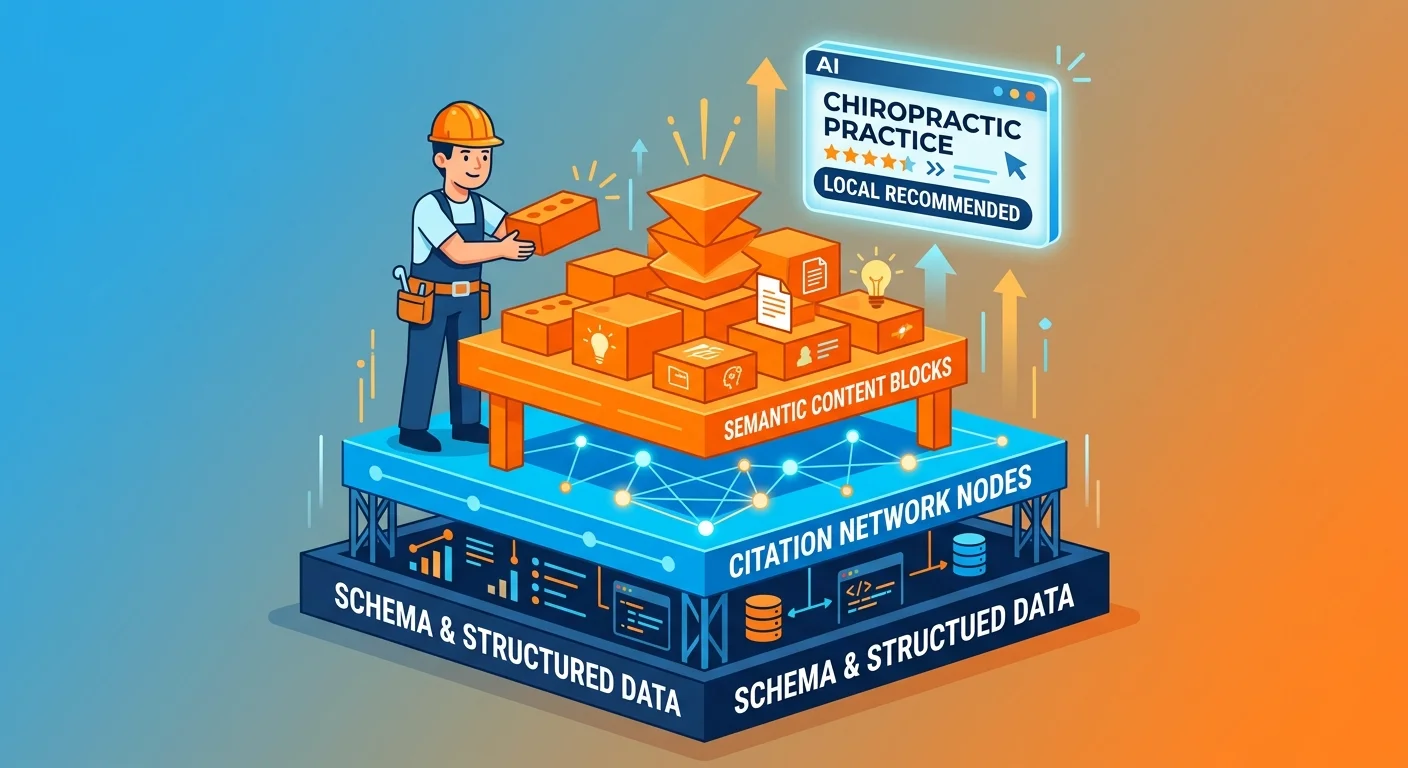
And the answer has a specific architecture. Not a checklist. Not a platform sign-up. A construction sequence with load-bearing components – in a very specific order.
Schema and Structured Data, Citation Velocity, and Semantic Density are not three separate tactics a practice can pick from.
They are load-bearing components of the same structure. Pull one out and the whole system underperforms. Build all three together and they compound – deepening the AI engine’s confidence in a practice’s entity with every passing month.
That compounding is the point. It’s what separates an authority asset from a monthly expense.
So this section is a sequence, not a theory.
Foundation first. Then ongoing execution. Then the compounding that keeps the signal growing long after the infrastructure is in place.
Schema and Structured Data as the Foundation
Schema and Structured Data is the foundation because it answers the most fundamental question an AI engine asks: does this entity actually exist, and can I verify it?
Without a clean, machine-readable identity layer, nothing built on top of it holds. Citations lose coherence. Content loses attribution. The AI engine can’t confirm which signals belong to which practice – so it doesn’t name one.
Every other authority signal is weaker until this layer is resolved.
Here’s something most practices miss entirely: strict FTC guidelines mandate compliant, secure entity identity profiles for healthcare businesses.
That means schema isn’t optional from a regulatory standpoint either. Mismanaged patient data transfers degrade the trust metrics recommendation engines rely on – and AI engines are increasingly aligned with the same institutional credibility standards federal regulators enforce.
A practice with a fragmented entity identity isn’t just invisible to AI. It’s structurally suspect. That’s a harder hole to climb out of.
Fragmented, non-validated data gets categorized as low-authority by recommendation engines. That categorization happens at the schema layer first.
A practice’s name, address, phone number, specialty classifications, and service descriptions have to match – exactly and consistently – across every platform where the entity appears.
Not approximately. Exactly. This isn’t a content problem. It’s an infrastructure problem. And it’s the one that makes every other authority signal less effective until it’s fixed.
AEO Content Execution as Ongoing Signal Compounding
Schema establishes who the practice is.
But it doesn’t fill the chair by itself.
AEO content execution is what builds the AI engine’s ongoing confidence that this practice deserves to be named as the answer to a specific patient’s specific question. Schema opens the door. Content proves the practice belongs in the room.
Over eighty percent of patients consult digital resources before booking a chiropractic or physical therapy appointment. The AI engine sits at the top of that research chain – it’s the first resource those patients reach.
Every piece of structured, authoritative AEO content deepens the AI engine’s confidence in a practice’s topical expertise. Without it, even clean schema isn’t enough.
Fragmented digital profiles directly correlate with lower patient booking rates. Thin content is a form of fragmentation. A practice with solid schema but shallow content still fails the depth test – and depth is exactly what AI engines use to decide which entity is the most credible answer.
The chair stays empty not because the practice has no availability.
It stays empty because the AI engine’s model of that practice never accumulated enough signal depth to surface its name when a patient needed it.
AEO content execution is what closes that gap – month over month, signal over signal, until the practice isn’t just findable but trusted. That’s not a destination. That’s a compounding asset. And it only starts compounding the day the work begins.
| Infrastructure Component | Signal Layer | AI Engine Benefit | Timeline to Signal Impact |
|---|---|---|---|
| Schema and Structured Data | Signal Layer 1 – Schema and Structured Data | Establishes a verified, machine-readable entity identity that AI engines can confirm before surfacing any recommendation | Foundation – must be in place before other signal layers can function |
| AEO Content Execution | Signal Layer 3 – Semantic Density | Deepens topical authority so AI engines recognize the practice as the trusted answer to a specific patient’s specific question | Compounds month over month as content volume and topical coverage grow |
| Citation and Platform Consistency | Signal Layer 2 – Citation Velocity | Reinforces entity credibility across third-party platforms, giving AI engines corroborating signals that confirm the practice’s authority | Builds progressively – each new consistent citation strengthens the existing signal stack |
| Full Infrastructure Integration | All three signal layers operating together | Creates a compounding authority asset that grows harder for competitors to displace – AI engine confidence deepens with every month of consistent execution | Ongoing – the system does not peak; it compounds as long as execution continues |
Frequently Asked Questions
But frameworks don’t pay the bills. Specifics do.
Every practice that gets this far hits the same wall – they want to know how it actually works, what the timeline looks like, and whether the problem is really as bad as it sounds.
It is.
So here are the straight answers.
No qualifications. No reassurance designed to make the problem feel smaller than it is.
What is an entity trust signal in AEO and why does my healthcare practice need it?
An entity trust signal is any structured, verifiable data point that tells an AI engine your practice is real, credible, and relevant. Business name. Address. Phone number. Specialty classifications. Schema markup. Review profiles. Directory citations. All of it.
Together, those signals build the engine’s internal confidence model for your practice. Without them, there’s no reliable basis for the engine to recommend you over a competitor whose entity is fully validated.
Fragmented, non-validated data gets classified as low-authority. That classification doesn’t mean you rank lower.
It means you get cut from the recommendation entirely. Not lower. Gone.
How does waiting to optimize for AI search engine recommendations cost my clinic money daily?
Every day without strong entity signals is a day your patients find someone else. Over eighty percent of patients consult digital resources before booking a chiropractic or physical therapy appointment – and the AI engine sits at the top of that research chain.
When a patient asks who to trust, the engine names the practice whose entity it trusts. If that’s not you, the patient books elsewhere.
That happens once in the morning. Once at noon. Once in the afternoon. Multiply it across a week, a month, a quarter.
The cost isn’t a projection. It’s the daily output of every AI recommendation that named a competitor instead of you.
Why are standard healthcare directory listings no longer enough for models like Gemini or ChatGPT?
Standard directory listings were built for old-model search – where a patient scrolled a ranked list and clicked a link. That chain is breaking down.
Traditional search engine volume will drop twenty-five percent by 2026 as conversational AI replaces the query-and-click model. Gemini and ChatGPT don’t rank directories. They synthesize signals from across a practice’s entire digital footprint – schema, citation consistency, content depth, structured topical authority – and return a single recommendation.
A Healthgrades profile with no supporting schema, no AEO content, and no Citation Velocity behind it is a low-signal data point. It gets weighed and outcompeted by the practice that built the full stack.
Directories are one input. They were never the infrastructure.
What are the specific authority metrics used by AI search engines to recommend local chiropractors?
Three load-bearing layers. Schema and Structured Data. Citation Velocity. Semantic Density.
Schema and Structured Data establishes the entity – who you are, where you operate, what you treat, verified and machine-readable. Citation Velocity measures how consistently that identity is confirmed across third-party platforms over time. Semantic Density is the depth of structured, authoritative AEO content that tells the engine you have topical expertise worth trusting.
All three run simultaneously. Not sequentially. Not selectively.
Strong schema with thin content underperforms. Heavy directory presence with no structured data underperforms. The engine needs the full stack before it makes a confident recommendation. Partial credit doesn’t exist here.
How long does it take for a clinic to transition to machine-trusted digital infrastructure?
Any agency that gives you a specific guarantee on timeline is selling you a number, not a result.
Here’s what’s actually true: seventy percent of consumers view digital trust as essential before committing to a booking – and high-trust entities compound faster once the foundation is in place. The foundation has to be right before anything else compounds. AEO content execution builds on top of it month over month.
The practices that move first on the full infrastructure stack create a compounding gap. Late movers don’t just start from zero. They start from behind a competitor who has been building authority the entire time they were waiting.
So the correct question isn’t how long it takes. It’s how much ground the practice is willing to give up while it decides.
The Empty Chair Has a Price Tag
The chair sits empty. Not because the practice has no availability. Because AI ran its evaluation, found weak entity signals, and said someone else’s name instead.
That decision happened before the patient ever saw a result. Before they had a chance to choose. Gartner projects traditional search engine volume will drop twenty-five percent by 2026 as conversational AI replaces the old query-and-click chain.
That’s not a trend on the horizon. That’s a transfer already in motion – and every day a practice delays building its authority infrastructure is another day it funds a competitor’s growth.
Here’s what makes this worse: compounding works in both directions.
Seventy percent of consumers say digital trust is non-negotiable before they commit to a booking. High-trust entities grow faster. They earn more citations, deepen their semantic authority, and extend their lead with every month that passes. The practice that moved first isn’t just filling its own chairs – it’s making yours harder to fill.
Citation Velocity and Semantic Density aren’t items on a future to-do list. They’re load-bearing components of an authority asset that either gets built or doesn’t. There’s no partial credit. There’s no neutral position. Waiting isn’t a pause. It’s a daily deposit – made invisibly, directly into a competitor’s authority account.
The cost of waiting isn’t theoretical. It isn’t recoverable on a convenient timeline. Every empty chair has a price tag – and that price gets paid daily, invisibly, in patient bookings that went to the practice AI trusted instead of yours.
The empty chair isn’t a metaphor. It’s a ledger entry. And it only starts filling the day the infrastructure that earns AI recommendations actually gets built.
iTech Valet builds that infrastructure. The question isn’t whether your practice has this problem. The question is how many more chairs you’re willing to leave empty before you find out.
Here’s the thing: AI is already answering your patients’ questions right now. The only question is whose name it’s saying. Run the AI Visibility Check and find out exactly where you stand.